Billboards near Homewood, IL
No Minimum Spend. No Long-Term Contracts. Just Results.
Trusted by Leading Brands


Billboard advertising
near Homewood has never been easier



How much is a billboard near Homewood?
Why Choose Blip for Billboard Advertising near Homewood
Blip lets you launch Homewood billboards in minutes, hitting I-57 and Halsted commuters without traditional buying hurdles.
Set a flexible budget for Homewood and focus spend on peak drives to Calumet City, Thornton, and Country Club Hills.
No contracts mean you can test Homewood against school-season, Friday sports, or holiday shopping traffic and pivot fast.
Use real-time analytics to see what works on Homewood-area corridors like I-294 and 183rd St, then shift budget to winners.
Blip's creative tools help tailor Homewood ads for families, shoppers, and South Suburban commuters with clear, local messaging.
Frequently Asked Questions About Billboard Advertising near Homewood
How much does a billboard cost near Homewood, Illinois with Blip?
With Blip, you control exactly how much you spend on Homewood billboards by setting a daily budget that can be adjusted any time, so you only pay for the 7.5 to 10-second “blips” your ad actually receives. Costs for billboards near Homewood, Illinois depend on when and where your ads run and on advertiser demand, but Blip’s pay-per-blip model keeps everything flexible and transparent. You can start with any budget, test different times of day in the Homewood area, and let the platform automatically pace your spend.
Where can I advertise with Blip near Homewood, Illinois?
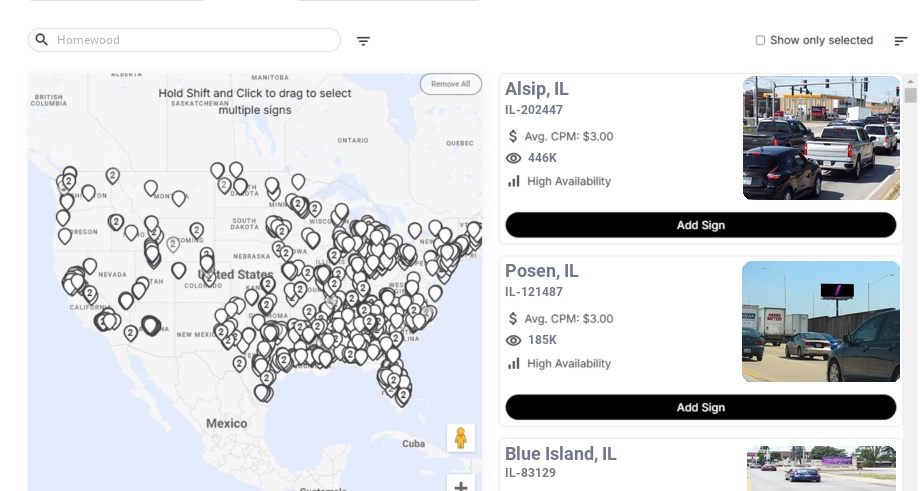
Blip’s 18 digital billboards serving the Homewood area are placed in nearby communities that capture local and regional traffic. These include Thornton, Country Club Hills, Calumet City, Blue Island, and Alsip. Together, they function as a focused local network that repeatedly reaches commuters, shoppers, and workers in the south suburbs.
What makes Homewood, Illinois a good market for billboard advertising?
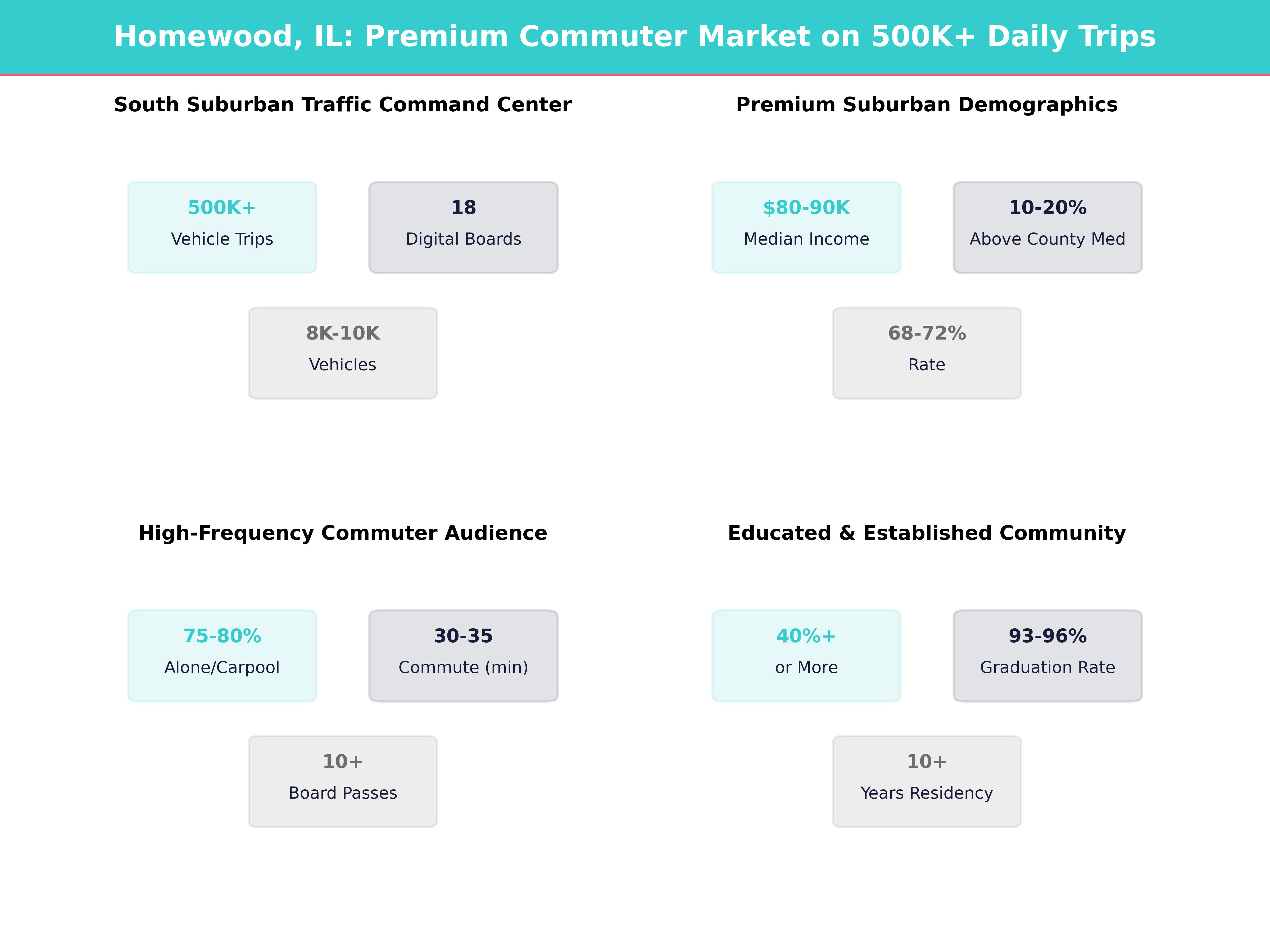
Homewood is a mature, stable south suburban community with strong household incomes, busy arterial roads, and a tight-knit community that pays attention to local businesses. The area has roughly 19,000–20,000 residents, median household income around $80,000–$90,000, and about 68–72% owner-occupied housing. These numbers point to a market with solid purchasing power and a high share of families and long-term residents.
When should I run billboards in Homewood, Illinois with Blip?
Homewood is a classic commuter suburb, so morning and evening commute windows are especially valuable. The page recommends concentrating up to 80–90% of your budget in morning and evening commute times, while using 10–20% for off-peak or daytime slots. Late-night blips can also be more affordable, while midday can work well for errands, retail, and appointments.
How can I target the right audience with Homewood, Illinois billboards?
The Homewood area draws families with children, mid-career professionals, a diverse population, and many homeowners. The page recommends family-centered visuals, inclusive imagery, education and stability themes, and very specific calls-to-action like “Exit at 183rd St” or “2 miles south on Halsted.” These localized cues can improve relevance and recall for repeat commuters.
Do I need a contract to advertise with Blip near Homewood?
No, Blip has no long-term contracts or minimum commitments. You can start, pause, or stop your campaign at any time.
How fast can I launch a billboard campaign with Blip near Homewood?
You can have your campaign live in minutes. Create a free account, select your locations, set your budget, upload your design, and start running once approved.
Where can I advertise with Blip near Homewood?
Blip has digital billboards near Homewood. You can browse available locations on a map, choose the ones that fit your audience, and start advertising right away.
Still have questions? Launch a campaign in minutes — no contracts, no commitments.
Start Your CampaignHomewood Billboard Advertising Guide
Homewood, Illinois sits at the heart of Chicago’s south suburban commuter belt, with strong household incomes, busy arterial roads, and a tight-knit community that pays attention to local businesses. With 18 digital billboards serving the Homewood area from nearby cities like Thornton, Country Club Hills, Calumet City, Blue Island, and Alsip, we can build highly targeted campaigns that keep your message in front of residents as they commute, shop, and head to regional destinations. For brands specifically looking for billboards near Homewood, this surrounding ring of inventory functions like a focused local network that repeatedly reaches the same high-value audiences.
Understanding the Homewood Area Market
Homewood is a mature, stable south suburban community in Cook County. According to recent estimates from the Village of Homewood
- Population: roughly 19,000–20,000 residents (the village’s latest figures typically fall around 19,300)
- Households: approximately 7,500–8,000 households
- Median household income: around $80,000–$90,000, consistently 10–20% higher than the overall Cook County median
- Owner-occupied housing: roughly 68–72% of housing units
- Median age: about 40–42 years, a bit older than the countywide median, reflecting many established households
Educational attainment in the Homewood–Flossmoor area is also strong, with well over 40% of adults holding an associate’s degree or higher, and a sizable share working in education, healthcare, and professional services.
These numbers point to a market with solid purchasing power, a high share of families and long-term residents, and a community that responds well to local, relationship-based messaging. That makes Homewood billboards and other nearby out-of-home placements especially effective for advertisers who depend on repeat local exposure.
Key local resources that help define the character of the market include:
- The Village of Homewood
- Homewood-Flossmoor High School District 233, where graduation rates typically exceed 93–96% and college-going rates are well above state averages
- Regional tourism through Visit Chicago Southland
- Local news via the Homewood-Flossmoor Chronicle and the Southtown section of the Chicago Tribune
- County-level services and business resources through Cook County Government
For advertisers, this means campaigns near Homewood can speak directly to educated, family-oriented consumers who care about schools, property values, dining, services, and recreation in their immediate community. When billboard advertising near Homewood taps into these priorities, it can feel like a natural part of residents’ everyday environment rather than intrusive marketing.
Where Our Billboards Serve the Homewood Area
Blip’s 18 digital billboards serving the Homewood area are placed in nearby communities that capture local and regional traffic and function as de facto billboards near Homewood for daily commuters:
- Thornton (2.4 miles from Homewood) – Traffic from I‑294, IL‑394, and routes leading to casinos, industrial zones, and riverfront logistics. The I‑294 segment near nearby Thornton 130,000–150,000 vehicles per day, while IL‑394 draws heavy truck and commuter volumes to and from Indiana.
- Country Club Hills (3.2 miles) – High visibility along I‑57 and major retail corridors drawing shoppers from Homewood, Hazel Crest, Matteson, and beyond. The I‑57 corridor around Country Club Hills typically sees 110,000–125,000 vehicles per day, feeding into regional power centers and big-box retail.
- Calumet City (6.9 miles) – Regional draw from River Oaks Center, Torrence Ave retail, and the I‑94/Bishop Ford and I‑80/94 corridors. Near Calumet City, the I‑80/94 segment routinely exceeds 160,000–180,000 vehicles per day, with Torrence Avenue handling 25,000–30,000 vehicles daily near the mall.
- Blue Island (7.0 miles) – Heavily traveled Western Ave, local rail, and routes linking to Beverly, Morgan Park, and Midlothian. Blue Island sits at a key crossroads where Western Avenue and 127th Street can each see 18,000–25,000 vehicles per day.
- Alsip (8.5 miles) – Access to I‑294, Cicero Ave, and the industrial and service hubs that employ many south suburban residents. The I‑294 and Cicero Avenue corridors in and near Alsip often report 140,000+ and 30,000–35,000 vehicles per day respectively, driven by warehouses, manufacturing, and service centers.
(Volume estimates are based on recent Illinois Department of Transportation traffic counts and regional planning summaries.)
These locations collectively reach:
- Commuters traveling to/from Chicago via I‑57, I‑294, I‑80/94, and the Bishop Ford, where combined corridors move well over 500,000 vehicle trips per day across the south suburbs.
- Local shoppers heading to big-box retail in Country Club Hills, Calumet City, and surrounding suburbs, where centers like River Oaks Center and major strip centers can draw 50,000–80,000 shoppers per week in peak seasons.
- Workers in logistics, healthcare, education, and manufacturing based in Alsip, Thornton, and the wider south suburbs, where many industrial parks employ hundreds to thousands of workers each on multiple shifts.
Because digital slots are sold per “blip,” we can selectively concentrate impressions on the boards and time windows that best intersect Homewood-area traffic patterns, often achieving tens of thousands of weekly impressions on a modest budget when scheduled efficiently. This flexibility effectively turns our Homewood billboards network into an on-demand billboard rental near Homewood that can scale up or down with your goals.
Commuting Patterns and When to Show Your Ads
Homewood is a classic commuter suburb. Many residents work in Chicago or other Cook County job centers, while others are employed at regional hospitals, distribution centers, schools, and industrial facilities.
Regional transportation data and reports from agencies like Metra Cook County show:
- A majority of workers in the broader Homewood–Flossmoor area commute by car, with 75–80% driving alone or carpooling, and average one-way commute times around 30–35 minutes.
- The I‑57, I‑294, and I‑80/94 corridors each carry well over 100,000 vehicles per day, with combined peak-hour flows exceeding 8,000–10,000 vehicles per hour in some segments.
- Local arterial roads such as Halsted St, Ridge Rd, 183rd St, and Governors Highway often handle 15,000–25,000 vehicles per day, staying busy throughout school and shopping hours.
- Metra’s Electric Line serves the Homewood area, with the Homewood Station 2,000–2,500 average weekday boardings pre‑pandemic and rebounding into the 1,500–2,000 range in recent years, but vehicle commuting remains dominant.
For scheduling your blips:
Morning commute (5:30–9:00 a.m.)
- Target boards near Thornton, Country Club Hills, Alsip, and Blue Island to catch drivers heading toward Chicago and regional job centers, when traffic volumes can be 30–40% higher than mid-day on key expressways.
- Best for: coffee and breakfast, transit parking, quick-service restaurants, gyms, healthcare, and service businesses (HVAC, plumbing, home services) promoting same-day or next-day bookings. Response rates for “need-it-now” categories often spike in these hours, with many advertisers reporting 20–30% more calls during morning-focused flights.
Midday (10:00 a.m.–3:00 p.m.)
- Reach stay-at-home parents, retirees, remote workers making errands, and shift workers. In many suburban corridors, midday still accounts for 30–35% of daily traffic.
- Best for: grocery, retail promotions, medical/dental offices, auto service, and local attractions or daytime events. Appointment-based businesses often see stronger web traffic during this window as commuters research services on their phones.
Evening commute (3:30–7:00 p.m.)
- High volume of family trips, after-school activities, and return commutes; in some Homewood-area corridors, PM peak volumes rival or slightly exceed morning peaks.
- Best for: restaurants, family entertainment, youth activities, tutoring, sports programs, and time-sensitive “tonight only” offers. Dinner and entertainment advertisers frequently see noticeable same-day spikes when evening campaigns are in rotation.
Late night (after 9:00 p.m.)
- More affordable blips and a captive audience of service workers, logistics employees, and nightlife traffic. While overall volume is lower (often 20–30% of daytime levels), share of attention can be higher due to less visual clutter.
- Best for: staffing ads, convenience stores, 24-hour services, streaming/entertainment, and brand awareness at a lower cost per impression.
With Blip’s scheduling tools, we can:
- Concentrate up to 80–90% of your budget in morning/evening commute windows.
- Reserve 10–20% for off-peak/daytime slots to stretch your reach and frequency at lower prices.
This balance works particularly well near Homewood, where commuter flows shape daily life and where many residents pass the same boards 10+ times per week on their regular routes. For advertisers focused on billboard advertising near Homewood specifically, aligning your schedule to these patterns is one of the best ways to maximize return.
Homewood Area Demographics and How to Tailor Your Message
The Homewood area draws together several key audience segments:
- Families with children – Homewood-Flossmoor High School is a major point of pride; the district routinely reports graduation rates above 93–96%, with strong participation in extracurriculars, arts, and athletics. District enrollment typically lands in the 2,800–3,000 student range, meaning a large base of school-engaged households.
- Mid-career professionals – Many residents work in education, healthcare, public sector roles, logistics, and professional services. In nearby communities, 25–30% of workers are employed in education, health, and social services, and another 10–15% in professional, scientific, and management fields.
- Racial and ethnic diversity – The Homewood area and broader south suburbs have substantial African American and multicultural populations; in many nearby ZIP codes, Black residents account for 45–65% of the population, with growing Latino and multiracial communities. Inclusive messaging and imagery are particularly important.
- Homeowners – With around 70% homeownership, big-ticket household decisions (remodeling, landscaping, financial planning, insurance) become powerful billboard categories, and homeowners often spend more per year on home-related services than renters.
Creative implications:
- Family-centered visuals – Feature families, school-related imagery, youth sports, and community scenes recognizable in the south suburbs. Ads referencing local institutions (without infringing trademarks) can feel especially relevant.
- Representation matters – Use racially diverse models and inclusive language; this aligns with the lived experience of Homewood area residents and can increase perceived relevance and trust.
- Education and stability themes – Messaging about long-term value, security, and community improvement resonates strongly in a market where many households have lived in the area for 10+ years.
- Offer clarity – Include very specific calls-to-action: “Exit at 183rd St,” “2 miles south on Halsted,” “Call today for same-day service,” etc. Clear directionals can lift response rates, especially when your locations are within 3–5 minutes of the advertised boards.
Local Events and Seasonality to Leverage
The Homewood area has a full calendar of local events and seasonal patterns that you can build campaigns around:
- School calendar – Back-to-school (August–September), homecoming, and graduation season see spikes in shopping, services, and family spending. District enrollment in the Homewood–Flossmoor area means thousands of students and parents moving along the same corridors during these months.
- High school sports – Friday evening traffic increases near key routes as families travel to games and school events. Football, basketball, and other major sports can draw 1,000–3,000 spectators per event to Homewood-Flossmoor High School and neighboring schools.
- Winter weather – Snow and cold drive demand for auto repair, heating services, indoor entertainment, and home improvement. In a typical winter, the Chicago Southland sees 30–40 inches of snow and numerous freeze-thaw cycles, raising demand for HVAC, roofing, and auto services.
- Summer festivals and outdoor activities – Community events, parks, golf courses, and outdoor dining attract regional visitors. Busy festival weekends can bring thousands of attendees into downtown Homewood and nearby hubs.
We can use Blip’s flexibility to:
- Run short, intense flights (7–14 days) around specific events like school registration, holiday shopping, or local festivals, when foot traffic and spending can spike 20–40% compared to typical weeks.
- Adjust creative by season: winter safety and comfort, spring home projects, summer fun, fall prep and back-to-school.
- Rotate multiple seasonal creatives simultaneously across our 18 boards serving the Homewood area to see which performs best, then shift more budget to the top-performing designs.
To align with local calendars, follow updates from:
- Village of Homewood Events
- Homewood-Flossmoor Park District tens of thousands of visits annually
- Visit Chicago Southland events calendar
Crafting High-Impact Creative for the South Suburbs
Because drivers near Homewood may have only 6–8 seconds to absorb your message, your design must be simple, bold, and locally relevant. Eye-tracking and outdoor advertising studies consistently show that recall drops sharply when drivers are forced to process more than 2–3 key elements at highway speeds.
Design guidelines for this area:
- Headline: 7 words or fewer
Example: “Homewood’s Fastest Emergency Plumbing Service” - One main visual that reads clearly from 500–700 feet away.
- High-contrast colors – avoid dark-on-dark combinations. White or bright text on dark backgrounds or vice versa works best, and improves legibility by 20–30% at a distance.
- Large logo and URL/phone – aim to fill at least 15–20% of the vertical space so your brand is recognizable even with a quick glance.
- Hyper-local cues – mention “near Homewood,” “minutes from Halsted & 183rd,” or “serving the Homewood–Flossmoor area.” Localized references can improve relevance and recall, especially among repeat commuters looking for services they can reach within a few minutes of where they see your Homewood billboards.
Because our boards serving the Homewood area are distributed across several nearby suburbs, consider location-specific variants:
- One version geared to shoppers heading toward Country Club Hills retail, referencing I‑57 exits and major shopping centers.
- Another version focused on entertainment and dining for traffic near Blue Island and Alsip, where many residents and workers look for “after-shift” and weekend options.
- A third that speaks to commuters on their way to and from Chicago through Calumet City and Thornton, emphasizing convenient hours and quick access from major expressways.
Blip lets us upload multiple creatives and control where and when each one shows, enabling effective A/B testing across the south suburban corridor. Over 4–8 weeks, advertisers can use impression and response data to refine which visuals, headlines, and offers perform best.
Using Blip’s Tools to Target the Homewood Area Efficiently
With 18 digital billboards serving the Homewood area, the key is to allocate your budget intelligently and treat this inventory as a flexible billboard rental near Homewood rather than a single fixed placement:
1. Geographic focus
- Prioritize boards in Thornton and Country Club Hills for maximum exposure to Homewood-area commuters and shoppers, since they are just 2–4 miles away. Many residents will pass these locations twice daily on work and school runs.
- Use boards in Calumet City and Alsip to extend your reach to regional visitors and workers who may travel into the Homewood area for services, dining, or recreation. These corridors tap into large employment bases numbering in the tens of thousands across logistics, healthcare, and industrial employers.
- Include Blue Island boards to catch cross-town traffic from Chicago neighborhoods heading to south suburban destinations, especially along Western Avenue and 127th Street.
2. Daypart and weekday strategy
- Front-load 60–70% of your daily spend into morning and evening commute windows Monday–Friday, when traffic densities are highest and commuters are most routinized.
- Use 20–30% for midday and weekend coverage when families run errands, attend youth sports, and dine out. Retail and dining locations often see their highest in-store traffic on Saturday and Sunday, making weekend impressions particularly valuable.
- Reserve 5–10% for low-cost late-night impressions, particularly for always-on branding campaigns or recruiting, when there is less competing advertising and viewers have more time to process your message.
3. Budget pacing
- For product launches or grand openings, you might run a high-intensity 2–3 week burst near Homewood with higher daily budgets, aiming to reach core audiences multiple times per day during the launch window.
- For ongoing presence, set a steady, always-on schedule with lower daily caps and prioritize boards closest to Homewood. Consistent exposure over 3–6 months can build brand familiarity, especially in a community where many residents drive the same routes every day.
Industry-Specific Ideas for the Homewood Area
Different sectors can tap into distinct Homewood-area behaviors and needs, using billboards near Homewood and in neighboring suburbs to reach highly qualified prospects.
Local Retail and Restaurants
- Focus on boards in Country Club Hills and Calumet City to reach shoppers already in a retail mindset near major centers and malls that attract thousands of daily visits.
- Use “Tonight only” or “This weekend” promos and directional cues (“Next exit,” “3 minutes off I‑57”). Time-limited offers can boost urgency and are especially effective ahead of peak shopping windows (Thursday–Sunday evenings).
- Rotate creatives with seasonal specials, catering, or kids-eat-free offers. Many families in the Homewood–Flossmoor area dine out or order in multiple times per week, providing frequent opportunities to influence decisions.
Home Services and Contractors
- Emphasize trust, speed, and local presence: “Serving the Homewood–Flossmoor area since 2005.” In homeowner-dense areas, even a 1–2% response rate from a well-timed campaign can mean a strong return on investment.
- Winter: furnace checks, insulation, snow removal, emergency plumbing.
- Spring: roofing, gutters, landscaping, remodeling, exterior painting.
- Use phone numbers prominently for quick action during commute times; many service calls are made within 1–2 hours of the initial media exposure when the need is urgent.
Healthcare and Professional Services
- Highlight proximity and convenience: “Same-day appointments, minutes from Homewood.” Patients typically choose providers within a 15–20 minute drive, which aligns well with the reach of boards in Thornton, Alsip, and Country Club Hills.
- Promote urgent care, dental, vision, and physical therapy with clear benefits: “Open late,” “Walk-ins welcome,” “Most insurance accepted.”
- Use boards in Alsip and Thornton to reach workers in industrial zones who may seek care close to home or work, especially for occupational medicine, urgent care, and chiropractic services.
Education, Training, and Youth Programs
- Advertise preschools, tutoring centers, after-school programs, and skills training that complement strong local school culture. Parents in high-achieving districts often invest in supplemental education, test prep, and enrichment.
- Time campaigns around report card season, school breaks, and summer camp sign-up windows, when enrollment inquiries can spike 20–30%.
- Highlight measurable outcomes (e.g., “Increase reading scores,” “Career-ready certification in 6 months”) and location convenience for busy families.
Recruiting and Employment
- Target late-night, early-morning, and weekend traffic in Alsip, Thornton, and Calumet City, where logistics and industrial employers operate 24/7.
- Show wage ranges, shift types, and application URLs in very large type. Clear pay information can dramatically increase response, especially for hourly roles.
- Consider dedicated recruiting flights when local unemployment ticks up or when seasonal hiring ramps for warehouses, retail, and hospitality.
Measuring Success and Optimizing Over Time
To ensure your Homewood-area campaign is working, we recommend defining concrete metrics before launch:
- Website visits from ZIP codes around Homewood (60430, 60422, nearby areas) during the campaign window, tracked through analytics platforms.
- Call volume or form fills tracked via unique phone numbers or URLs used only on your billboards. Many advertisers see 10–30% increases in these metrics during well-structured outdoor campaigns.
- In-store mentions of billboard-only promo codes (“Mention ‘HOMEWOOD’ for 10% off”), allowing you to tie walk-in traffic directly to out-of-home exposure.
Then, use Blip’s reporting and your internal analytics to:
- Compare performance by board location (Thornton vs. Country Club Hills vs. Calumet City, etc.) and shift impressions toward the top 3–5 performing boards.
- Test two or three creative variants and retire the lowest-performing one after 2–3 weeks, reallocating budget to the winners.
- Shift 20–30% of your budget toward the best‑performing times of day and locations once you see patterns emerge over a 4–6 week period.
Over 8–12 weeks, this cyclical improvement can significantly reduce your cost per inquiry or sale while deepening your brand’s presence across the Homewood area. Advertisers that continuously optimize often see higher recall and lower cost per lead compared to one-time, fixed campaigns, especially when they treat billboard rental near Homewood as an ongoing, test-and-learn channel rather than a single static buy.
Bringing It All Together for the Homewood Area
The Homewood area combines strong household incomes, a commuter-heavy lifestyle, and a regional retail and employment network stretching through Thornton, Country Club Hills, Calumet City, Blue Island, and Alsip. By using Blip’s 18 digital billboards serving the Homewood area, advertisers can:
- Reach residents multiple times per week on their regular routes across corridors that collectively move hundreds of thousands of vehicles daily.
- Tailor creative to family-oriented, education-focused, and community-minded audiences with above-average graduation rates, homeownership, and household incomes.
- Align campaigns with local events, school calendars, and seasonal trends that reliably shift spending patterns throughout the year.
- Continuously optimize placement, timing, and messaging based on real performance, reallocating impressions to the best-performing boards and dayparts.
With thoughtful scheduling, localized creative, and clear goals, digital billboards near Homewood become a powerful, flexible channel to grow awareness, drive traffic, and build long-term loyalty in one of Chicago’s most engaged south suburban communities.