Billboards near Riverdale, IL
No Minimum Spend. No Long-Term Contracts. Just Results.
Trusted by Leading Brands


Billboard advertising
near Riverdale has never been easier



How much is a billboard near Riverdale?
Why Choose Blip for Billboard Advertising near Riverdale
Blip lets you launch Riverdale ads fast on I-94, I-57, and Sibley Blvd—perfect for reaching daily commuters without the usual buying hassle.
Set a flexible Riverdale budget and start small, then scale for school dismissal, weekend shopping, or Chicago Southland event traffic.
No contracts means Riverdale brands can test commuter corridors near Halsted and Western, then shift spend to what drives results.
Track Riverdale campaign performance in real time and optimize for peak 6-9 a.m. and 3-7 p.m. traffic on south side routes.
Use Blip's creative tools to build Riverdale ads that speak to a younger, family-focused Southland audience with clear, local offers.
Frequently Asked Questions About Billboard Advertising near Riverdale
How much does a billboard cost near Riverdale, Illinois with Blip?
With Blip, you can advertise on digital Riverdale billboards on any budget, because you choose your own daily spend and Blip automatically keeps your campaign within that limit. Each “blip” is a brief 7.5–10 second display on billboards near Riverdale, Illinois, and you only pay for the blips you receive. Pricing per blip varies based on when and where your ad runs, as well as advertiser demand, giving you flexibility to match your goals.
Where can I advertise with Blip near Riverdale, Illinois?
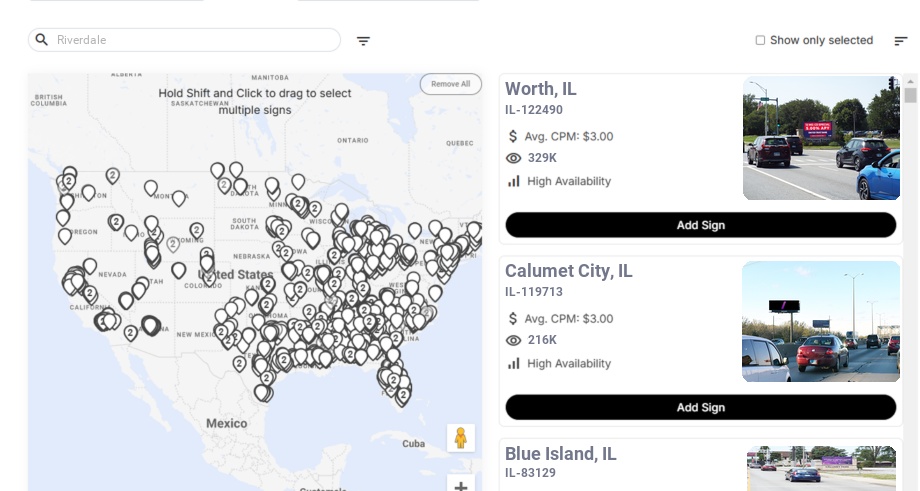
We serve the Riverdale area with 25 digital billboards strategically placed in nearby communities, forming a flexible, regional network for billboard advertising near Riverdale. These locations include Blue Island, Calumet City, Thornton, Alsip, Country Club Hills, Worth, and Chicago Ridge. Collectively, these suburbs account for well over 100,000 local residents and tens of thousands of workers, expanding your reach far beyond Riverdale’s village limits while still staying within a short driving distance that feels local.
What kind of audience do Riverdale, Illinois billboards reach?
The Riverdale area is strongly commuter-based and highly tied to the broader Chicago economy. In many Southland communities, 75–85% of employed residents drive or carpool to work, with average commute times regularly exceeding 30 minutes. The Riverdale area’s population is overwhelmingly African American, with many nearby communities also featuring Black majorities or pluralities.
When should I run Riverdale, Illinois billboard ads for the best results?
For the Riverdale area, peak viewing opportunities align with commuter traffic, school schedules, retail shopping, and faith-based activities. Morning commute windows are typically 6:00–9:00 a.m., and evening traffic peaks from 3:00–7:00 p.m. Midday hours, school dismissal times, and weekends can also be effective depending on your audience and offer.
Why use Blip billboards near Riverdale, Illinois instead of just one local board?
By placing your digital messages on our boards in adjacent cities, you can repeatedly reach Riverdale-area commuters, shoppers, and through-traffic on their normal routes. With 25 digital billboards within about 10 miles, you can consistently reach Riverdale-area residents where they live, work, shop, and travel. This approach creates a powerful, locally focused coverage pattern for brands comparing billboard advertising near Riverdale.
Do I need a contract to advertise with Blip near Riverdale?
No, Blip has no long-term contracts or minimum commitments. You can start, pause, or stop your campaign at any time.
How fast can I launch a billboard campaign with Blip near Riverdale?
You can have your campaign live in minutes. Create a free account, select your locations, set your budget, upload your design, and start running once approved.
Where can I advertise with Blip near Riverdale?
Blip has digital billboards near Riverdale. You can browse available locations on a map, choose the ones that fit your audience, and start advertising right away.
Still have questions? Launch a campaign in minutes — no contracts, no commitments.
Start Your CampaignRiverdale Billboard Advertising Guide
Riverdale, Illinois sits at a pivotal crossroads on Chicago's south side, where neighborhood traffic, suburban commuters, and regional freight all converge. With 25 nearby digital billboards serving the Riverdale area, we can help you tap into dense commuter flows between Chicago and south suburban communities like Blue Island, Calumet City, Thornton, Alsip, Country Club Hills, Worth, and Chicago Ridge—all within about 10 miles of Riverdale. For brands looking for billboards near Riverdale, this tight cluster of locations creates a powerful, locally focused coverage pattern.
Understanding the Riverdale Area Market
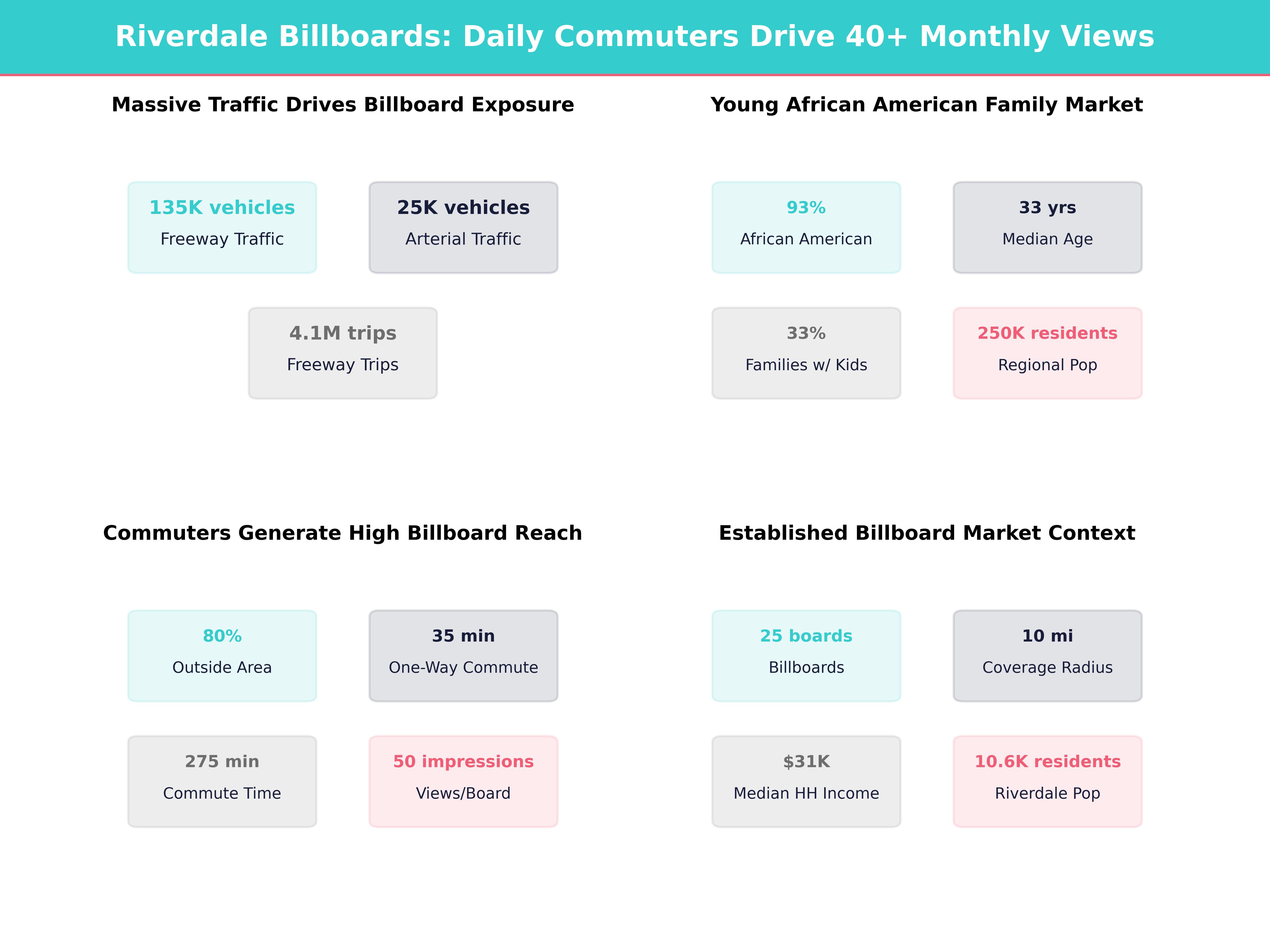
The Riverdale area is compact but highly connected. The Village of Riverdale reports a population of roughly 10,000–11,000 residents; recent estimates place it around 10,500–10,700 people, with a median age close to 32–33 years. The community is majority African American—commonly reported at 90–95% of residents identifying as Black or African American—and households tend to be younger and more family-oriented than the national average, with about 30–35% of households including children under 18.
Median household income in the village is in the low $30,000s (roughly $30,000–$33,000), compared with a national median above $70,000, and it is not unusual for 25–35% of residents to live below the poverty line. A sizable share of residents work outside the immediate area—often estimated at 75–85% of employed residents commuting to jobs in other communities—traveling toward Chicago or other job centers along I‑94 and I‑57. Typical one‑way commute times for Riverdale-area workers often fall in the 30–40 minute range, meaning many residents spend 250–300 minutes per week on the road or on transit, giving advertisers multiple weekly impressions through strategically placed Riverdale billboards.
Within about a 10‑mile radius of Riverdale—including nearby municipalities such as Blue Island, Calumet City, Harvey Alsip, and Country Club Hills—the combined population exceeds 250,000 residents. That broader “Riverdale trade area” skews similar demographically: younger than the U.S. average, majority-minority, and heavily commuter-based, making billboard advertising near Riverdale an efficient way to reach a large, concentrated Southland audience.
Key takeaways for advertisers:
- You’re speaking to a predominantly Black, working-class community with strong ties to Chicago’s broader Southland. With more than 9 out of 10 residents identifying as Black, culturally relevant and respectful messaging is essential.
- Budgets are tighter than in many northern and western suburbs: with household incomes around 50–55% of the national median, value, savings, and clear benefits should be front and center.
- Many residents commute daily—often 5 days per week—giving you repeated exposure opportunities on major corridors and at key choke points. Reaching a commuter twice per weekday can translate to 40+ impressions per month per person when campaigns are scheduled around peak periods, especially when using an always-on mix of Riverdale billboards and nearby freeway locations.
For local context and community priorities, it’s useful to review information from the Village of Riverdale and broader regional resources like Cook County and the Chicago Southland Convention & Visitors Bureau Thornton Township and the Riverdale Park District
Where Our Billboards Reach the Riverdale Area
We serve the Riverdale area with 25 digital billboards strategically placed in nearby communities, forming a flexible, regional network for billboard advertising near Riverdale:
- Blue Island (about 1.9 miles from Riverdale)
- Calumet City (about 3.0 miles)
- Thornton
- Alsip (about 5.3 miles)
- Country Club Hills (about 7.1 miles)
- Worth (about 8.3 miles)
- Chicago Ridge (about 8.8 miles)
Collectively, these suburbs account for well over 100,000 local residents and tens of thousands of workers, expanding your reach far beyond Riverdale’s village limits while still staying within a short driving distance that feels “local” to Riverdale-area consumers. For advertisers comparing different options for billboard rental near Riverdale, this pattern lets you blanket the immediate trade area without paying for distant impressions that don’t serve your core market.
These locations sit along and near major routes that Riverdale-area drivers use daily:
- I‑94 (Bishop Ford Freeway) and I‑57, primary commuting routes to Chicago
- IL‑83/Sibley Boulevard, which slices through the Riverdale area
- Halsted Street, Western Avenue, and other major north–south arterials
According to recent Illinois Department of Transportation counts (summarized on IDOT’s website), nearby freeway segments such as I‑94 and I‑57 commonly carry:
- Around 120,000–150,000 vehicles per day in the south suburbs, or roughly 3.6–4.5 million vehicle trips per month on a single segment
- Key arterial roads like Sibley Boulevard and Halsted Street often see 20,000–30,000 vehicles per day, or about 600,000–900,000 vehicles per month
IDOT District 1, which includes Cook County, reports that some high‑volume south suburban interchanges can see more than 200,000 vehicles per day when both directions are combined—ideal for high‑frequency brand exposure.
By placing your digital messages on our boards in these adjacent cities, you can repeatedly reach Riverdale-area commuters, shoppers, and through‑traffic on their normal routes. With average digital billboard loops showing each advertiser’s message every 60–90 seconds, a single driver caught in a 10‑minute rush‑hour backup can realistically see your ad 6–10 times in one trip, maximizing the impact of every billboard near Riverdale you include in your media plan.
Who You’re Reaching: Audience & Demographics
The Riverdale area is strongly commuter-based and highly tied to the broader Chicago economy. Several characteristics shape how we suggest you build your campaigns:
1. Commuter-heavy workforce
- In many Southland communities, 75–85% of employed residents drive or carpool to work, with only a minority using transit. Average commute times regularly exceed 30 minutes; some residents traveling into central Chicago spend 45–60 minutes each way.
- Metra’s Electric District line stops at Riverdale, providing rail access to downtown Chicago; see schedules via Metra
- Bus routes operated by Pace Suburban Bus and connections to the CTA
Implication for advertisers:
Commuters see your messages in bursts during the same windows each weekday. Consistent dayparting—e.g., every weekday between 6–9 a.m. and 3–7 p.m.—builds familiarity quickly. If a daily commuter passes a billboard 5 times per week and sees your message 2–3 times per pass, that can translate into 40–60 impressions per person per month from one location alone. Combining downtown‑facing freeway boards with local Riverdale billboards near Sibley or Halsted makes it easier to follow the same audience throughout their daily trip.
2. Predominantly Black community
The Riverdale area’s population is overwhelmingly African American, with many nearby communities—such as Harvey, Dolton, and Calumet City—also featuring Black majorities or pluralities. In some census tracts in and around Riverdale, Black residents account for 90–98% of the population. The area has deep cultural and historical ties to Chicago’s South Side and south suburban Black communities, with strong traditions around local churches, high school sports, and neighborhood-based organizations.
Implication for advertisers:
- Use imagery that reflects the community—Black families, local landmarks, Southland lifestyle.
- Support local causes, schools, and events; featuring partnerships or shout‑outs builds trust. For example, highlighting sponsorships with Dolton-Riverdale School District 148, Thornton Township High Schools District 205, or local youth sports leagues can resonate strongly.
- Messaging around entrepreneurship, education, and advancement resonates strongly, especially given that Southland communities often show high interest in job training, credential programs, and small business support.
3. Younger and family-oriented
- Median age is in the early 30s (roughly 31–33), compared with a national median around 38–39, indicating a younger adult base.
- It is common for 30–35% of households in the area to include children under 18, compared with about 28–30% nationally.
- Riverdale-area families are served by districts such as Dolton-Riverdale School District 148 and Thornton Township High Schools District 205, along with neighboring systems in Harvey School District 152 and Calumet Public School District 132
Implication for advertisers:
- Child‑ and teen‑focused services (youth sports, after‑school programs, tutoring, fast‑casual dining, entertainment) can perform very well, especially when timed around school dismissal and weekends.
- Emphasize convenience and time savings for busy parents—“On your way home,” “Right off I‑94,” “Just 5 minutes from Riverdale.” If your location is within 3–5 miles (a 5–10 minute drive), spell that out; research on consumer behavior consistently shows that perceived travel time is a major decision factor for families. When paired with clear travel cues on Riverdale billboards, this kind of proximity message can directly influence last‑minute decisions.
Traffic Patterns and When to Run Your Blips
For the Riverdale area, peak viewing opportunities align with commuter traffic, school schedules, retail shopping, and faith-based activities.
Weekday commuter peaks
Based on typical Chicago-area traffic patterns reported by outlets like ABC7 Chicago and IDOT counts:
- Morning: 6:00–9:00 a.m., with many expressway segments hitting peak volumes between 7:00–8:30 a.m.; speeds can drop below 25 mph on congested stretches, giving drivers longer reading times.
- Evening: 3:00–7:00 p.m., with a secondary spike around 4:30–6:00 p.m. for southbound I‑94 and I‑57 as workers return from Chicago and inner‑ring suburbs.
Use these windows if you:
- Offer commuter-friendly products (coffee shops, gas stations, car washes, quick-service restaurants).
- Want to reach workers heading to and from Chicago and nearby industrial and logistics corridors. The Chicago region’s industrial market exceeds 1.5 billion square feet, with large concentrations of warehouses and logistics hubs in south suburban Cook County and adjacent Will County—meaning a steady flow of truck and employee traffic past key boards.
Midday and school-related traffic
- 11:00 a.m.–2:00 p.m.: Lunch breaks and mid‑shift workers. In many metro areas, up to 20–25% of daily traffic volume passes during these midday hours.
- 2:00–4:30 p.m.: School dismissal and after-school pickups, particularly around key routes connecting Riverdale to adjacent suburbs, such as Sibley Boulevard, 144th Street, and Halsted.
Consider focusing some budget here if you:
- Target parents, teachers, and students (childcare, tutoring, pediatric care, sports leagues).
- Run retail promotions aimed at daytime shoppers or older residents, who often prefer off‑peak hours.
Evenings and weekends
Weeknights after 7:00 p.m. and weekends see more family outings, entertainment, faith-based gatherings, and shopping. The Chicago Southland region, promoted by Visit Chicago Southland Chicago Ridge Mall and centers in Country Club Hills, Alsip, and Calumet City draw large weekend crowds, often boosting local traffic volumes 10–20% above weekday baselines on key corridors.
Use these periods to promote:
- Restaurants, bars, entertainment venues, local events
- Churches and faith-based events, which draw strong attendance in the Riverdale area—Southland congregations frequently report hundreds to thousands of weekly attendees.
- Big weekend retail sales and seasonal promotions; major retail seasons (back‑to‑school, Black Friday, holiday) can see sales spikes of 20–40% over an average month.
With digital billboards, we can adjust your schedule continuously—ramping up frequency before a weekend event, concentrating morning messages around limited‑time breakfast deals, or launching late‑evening messaging for 24‑hour services. This flexibility is a key advantage of digital billboard rental near Riverdale compared with static placements that can’t be dayparted or updated as quickly.
Tailoring Creative for the Riverdale Area
To stand out on digital billboards near Riverdale, we recommend a few creative best practices tailored to the local audience:
1. Hyper-local references
- Reference well‑known corridors: “Just off Sibley,” “Near Halsted,” or “Minutes from the Riverdale Metra station.” The Village of Riverdale and nearby municipalities like Harvey Calumet City often highlight these same streets in their own communications, reinforcing their familiarity.
- Use phrases like “Serving Riverdale families since…,” “Proud to serve the Riverdale area,” or “Your Riverdale-area [business type].” Local pride is strong: high school sports in districts like District 205 can draw thousands of fans across a season.
2. Culturally relevant imagery and tone
- Use photography and design that reflect the predominantly Black community—families, professionals, and youth that look like your target audience.
- Avoid generic stock images that feel disconnected from the Southland experience. Highlight recognizably local backdrops where possible (Metra platforms, Bishop Ford overpasses, Sibley Boulevard, neighborhood parks).
3. Emphasize value and clear offers
Given the area’s median income levels, residents are value-conscious:
- Highlight concrete savings: “Save $50 today,” “2‑for‑1,” “$0 enrollment fee.” In lower‑income communities, clear discounts and no‑fee messaging often drive higher response rates than vague brand slogans.
- Use large fonts and limited text—ideally 7–10 words total. Industry testing frequently shows that messages with 7 words or fewer can improve recall by 20–30% compared with more crowded designs.
- Include a very simple call to action: “Exit at Sibley,” “Call now,” or a short URL/QR code.
4. Connect billboards to mobile and local search
Many Riverdale-area residents use smartphones to find deals and directions; smartphone ownership across the Chicago region commonly exceeds 80–85% of adults.
- Use short URLs, easy-to-remember promo codes (“RIVERDALE10”), or QR codes for pedestrians at lower‑speed locations.
- Align your billboard message with what people see on your Google Business Profile or social media. For example, if you advertise “$29 oil change” on the board, ensure the same offer headlines your website and social feeds.
5. Creative rotation
Digital billboards allow you to run multiple creatives in rotation:
- One creative focused on a flagship offer
- One highlighting community involvement (e.g., sponsoring a local school or youth team)
- One featuring time‑sensitive events (job fairs, open houses, limited-time sales)
We can adjust which creatives show at which times of day—for example, a hiring message during commuting hours and a retail promo on weekend afternoons. Campaigns that use at least 2–3 creatives per flight often see stronger engagement than single‑image campaigns, because varied messaging catches the eye of repeat commuters who are exposed to your Riverdale billboards day after day.
Seasonal Opportunities in the Riverdale Area
The Chicago Southland’s seasonality creates natural windows for targeted campaigns. The region experiences four distinct seasons, with average highs ranging from the mid‑20s °F in January to the low 80s °F in July, and snow events that can significantly slow traffic and increase billboard dwell times.
Winter (November–February)
- Weather conditions and early darkness increase drive-time visibility. Sunset can be as early as 4:20 p.m. in December, meaning your illuminated digital boards stand out during the busy evening commute.
- Focus on auto services, heating/utility support, financial services, and holiday retail. Cold snaps and snow events often boost demand for towing, auto repair, and HVAC services by 20–30% over mild periods.
- Highlight safety and convenience: “Stay warm,” “Avoid the snow,” “Same-day service.” Shoppers also concentrate spending in November–December; many retailers see 25–30% of annual sales during the holiday season.
Spring (March–May)
- Tax season: great for tax prep firms, accountants, and financial services. The majority of tax refunds are issued between late February and early May, often leading to short-term spikes in auto sales, furniture purchases, and bill payments.
- Education and youth activities: spring sports, tutoring, and after-school programs.
- Home improvement and landscaping as residents prepare for summer; hardware and garden centers regularly report double‑digit sales increases from March to May compared with winter months.
Summer (June–August)
- School is out; youth programs, camps, and family entertainment are prime. Many households plan day trips to parks and attractions promoted by Visit Chicago Southland
- Events and festivals around the Southland region draw larger crowds; local municipal calendars in Blue Island, Calumet City, and Country Club Hills often list concerts, parades, and community days that spike weekend traffic.
- Construction and seasonal hiring campaigns perform well. Road construction season (typically April–October) can slow traffic on I‑94, I‑57, and key arterials, increasing driver exposure time to your ads.
Fall (September–October)
- Back‑to‑school and sports seasons: focus on clothing, supplies, tutoring, and athletics. School spending often peaks in August–September.
- Healthcare, flu shots, and insurance enrollment campaigns gain traction. Flu vaccination campaigns usually ramp up in September–October, followed by open enrollment for health insurance in late fall.
- Retail ramp‑up toward holiday shopping. Many national and regional chains now start holiday promotions in October, and early messaging can capture planners and bargain hunters.
Aligning your creative and budgets with these seasonal moments ensures your message feels timely and useful to Riverdale-area residents, and it helps you get more value out of every billboard rental near Riverdale by matching your heaviest spend to the moments of highest demand.
Strategy Ideas by Business Type
Here are concrete ways different advertisers can leverage digital billboards serving the Riverdale area:
Local retailers and restaurants
- Run lunch and dinner promos near boards in Blue Island, Alsip, and Chicago Ridge where shopping and dining traffic is strong. Centers like Chicago Ridge Mall and retail corridors in Alsip and Country Club Hills attract thousands of vehicles per day.
- Use simple offers: “Lunch under $8 – 10 minutes from Riverdale,” with arrows or exit instructions. Value‑oriented price points (under $10) resonate especially well in communities with median incomes in the low $30,000s.
- Increase frequency Thursdays–Sundays to catch weekend shoppers; for many retailers, 50–60% of weekly sales occur between Friday and Sunday.
Auto dealers and service centers
- Target commuters on I‑94 and I‑57 with reliability and affordability messaging. With 120,000–150,000 vehicles per day on key freeway segments, even a conservative 1–2% impression‑to‑action rate can translate into hundreds of incremental service visits over a campaign.
- Promote “$29 oil changes,” “Same‑day brakes,” or “$0 down for Riverdale-area drivers.”
- Focus on morning and evening drive times; run weather‑specific copy during snow and extreme cold. When temperatures drop below freezing, service‑related search and call volumes routinely jump, making timely billboard copy especially effective.
Healthcare providers
- Use trust-building headlines: “Trusted care for Riverdale families,” “Walk‑in clinic open late.”
- Highlight proximity: “5 minutes from Riverdale Metra” or “Off Sibley & Halsted.” Many patients are willing to travel 5–7 miles for primary care and 10–15 miles for specialty care if access and hours are convenient.
- Increase impressions during back‑to‑school and flu season. Pediatric visits typically spike in August–September, and flu shot demand accelerates in fall.
Education and training programs
- Community colleges, trade schools, CDL training, and certification programs can emphasize career advancement: “New career in 6 months.” Short‑term credential programs (6–12 months) are particularly attractive in working‑class communities where residents balance jobs and family.
- Focus on 18–34 age window commuters; schedule heavily around morning and evening drives when potential students are traveling to and from work.
- Use a strong, simple CTA: “Text JOBS to [number].” Text-based responses can be especially effective for commuters who see your message for just a few seconds.
Financial services and credit unions
- Emphasize real-world benefits: “Get paid 2 days early,” “No overdraft fees,” “Fast tax refunds.” In markets with significant working‑class and hourly employment, early pay and fee-free accounts can be major differentiators.
- Concentrate budgets around tax season and paydays (1st and 15th of the month, Fridays). Many households receive paychecks on these dates, and financial decision‑making peaks accordingly.
- Connect billboards to a specific landing page for the Riverdale area. Campaigns that use localized landing pages alongside billboards often report higher conversion rates than generic homepages.
Using Data to Refine and Optimize
Because our billboards are digital, we can continually refine your campaign serving the Riverdale area based on performance and local conditions.
Consider tracking:
- Website traffic and calls by time of day: Align your highest‑spending billboard windows with your busiest conversion times. If analytics show 40% of calls arrive between 4–7 p.m., consider concentrating a matching share of your impressions in that window.
- Offer-specific response: Use unique promo codes or phone numbers on different creatives to see what resonates. For example, compare “RIVERDALE10” vs. “SIBLEY10” to test whether geographic references increase response.
- Local news and events: Monitor outlets like the Chicago Tribune’s Daily Southtown, Chicago Sun-Times, and local stations such as WGN-TV FOX 32 Chicago for Riverdale-area stories, then adjust messaging to stay relevant (e.g., back‑to‑school drives, community initiatives, local sports milestones).
We can then:
- Shift impressions toward the corridors and dayparts that drive the best response—e.g., moving 20–30% of your budget from underperforming midday slots to higher‑converting evening commutes.
- Swap underperforming creatives quickly. If one offer is generating 2–3 times more calls than another, we can increase its share of rotations in near real time.
- Increase presence during weeks when your audience is most likely to act (tax refund weeks, start of school, major sales, or big local events promoted by Visit Chicago Southland
This kind of continuous optimization is especially valuable if you’re testing billboard advertising near Riverdale for the first time and want to quickly learn which messages, corridors, and schedules deliver the strongest return.
Bringing It All Together
The Riverdale area sits at a powerful intersection of neighborhood life and regional commuting. With 25 digital billboards within about 10 miles—in Blue Island, Calumet City, Thornton, Alsip, Country Club Hills, Worth, and Chicago Ridge—we can help you consistently reach Riverdale-area residents where they live, work, shop, and travel.
By grounding your campaign in local demographics (a community of roughly 10,500+ residents, more than 90% Black, with median household incomes in the low $30,000s), commuter patterns (120,000–150,000 freeway vehicles per day plus 20,000–30,000 on key arterials), seasonal behavior, and culturally relevant creative, you can turn digital billboards near Riverdale into a cost‑effective, flexible engine for awareness and action—one that delivers repeated impressions to the same high‑value audiences week after week. Thoughtful billboard rental near Riverdale lets you stay visible in the moments that matter most, from daily commutes to big seasonal shopping periods, while keeping your message rooted in the community you serve.