Billboards near Lake Forest, IL
No Minimum Spend. No Long-Term Contracts. Just Results.
Trusted by Leading Brands


Billboard advertising
near Lake Forest has never been easier



How much is a billboard near Lake Forest?
Why Choose Blip for Billboard Advertising near Lake Forest
Blip lets you launch fast in Lake Forest, targeting I-94 and U.S. 41 commuter traffic without a rep or long setup.
In Lake Forest, Blip auto-optimizes your spend around Route 60, Route 176, and Waukegan Rd traffic to fit your goal.
No contracts in Lake Forest mean you can test ads for Lake Forest College, AbbVie, and hospital commuters, then pause anytime.
Use Blip dayparting in Lake Forest to hit 6-9am and 4-7pm rushes when North Shore drivers are most active.
Track Lake Forest results in real time and shift creative for summer Ravinia, Lake County Fair, or holiday Market Square traffic.
Blip's creative tools help you build clean, high-contrast ads that stand out on Lake Forest-area digital billboards.
Frequently Asked Questions About Billboard Advertising near Lake Forest
How much does a billboard cost in Lake Forest with Blip?
Blip makes billboard advertising in the Lake Forest area flexible and budget-friendly. Pricing is pay-per-play, starting at just $0.01 per display, so you can get exposure without a large upfront spend. The cost per blip changes based on time of day, location, and advertiser demand, while Blip’s algorithm works to stretch your budget and maximize reach.
Where can I advertise with Blip in the Lake Forest area?
Our 2 digital billboards in Lake Bluff, just 4.5 miles from Lake Forest and within 10 miles of the market, let us reach residents, commuters, students, shoppers, and visitors who move through this corridor every day. Our inventory serving the Lake Forest area is in Lake Bluff, and that is an advantage rather than a limitation. Lake Bluff sits directly in the same daily movement pattern as Lake Forest, which means our boards can intercept local and regional traffic.
What kind of audience can Blip reach near Lake Forest?
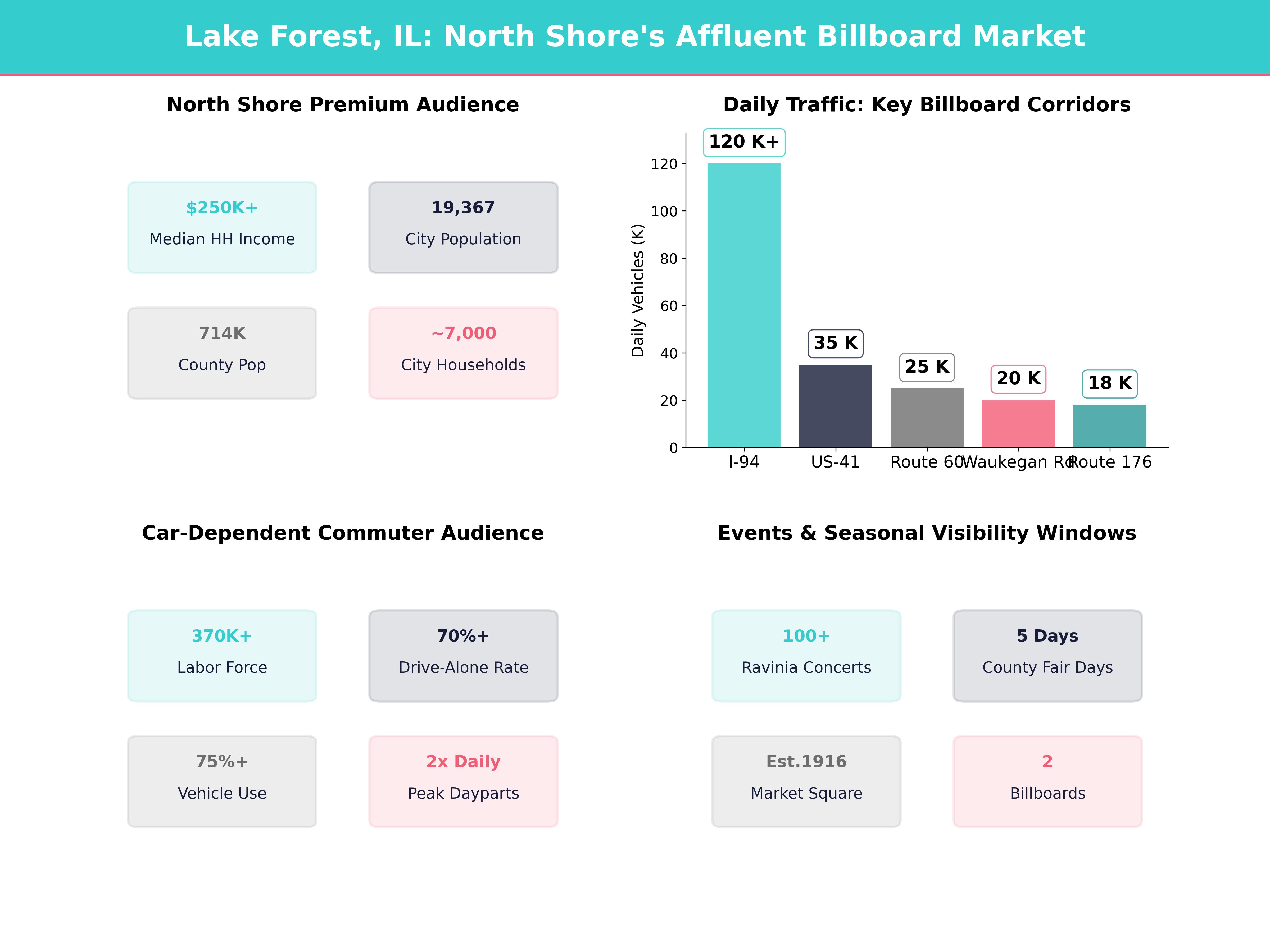
The Lake Forest area gives us one of the strongest premium suburban billboard audiences on Chicago’s North Shore, centered on a city of 19,367 residents within Lake County’s 714,342-person market. We see the Lake Forest area as a small-by-population market with outsized spending power, education levels, and regional influence. Median household income in Lake Forest is above $250,000.
When is the best time to run Blip ads in Lake Forest?
Strong Lake Forest-area campaigns usually follow the calendar. We recommend building timing around school cycles, event seasons, weather, and the region’s distinct commuter habits. Spring, summer, fall, and winter all offer different opportunities, from March or April launches to Memorial Day through Labor Day traffic and holiday shopping in November and December.
Which roads in Lake Forest should I target with Blip billboard ads?
The most important regional artery is Interstate 94, also known locally as the Tri-State Tollway. According to IDOT traffic counts, I-94 segments serving the Lake Forest area commonly exceed 120,000 vehicles per day. U.S. 41, Route 60, Route 176, and Waukegan Road also capture local trips, school traffic, hospital traffic, retail trips, dining traffic, and commuters.
Do I need a contract to advertise with Blip near Lake Forest?
No, Blip has no long-term contracts or minimum commitments. You can start, pause, or stop your campaign at any time.
How fast can I launch a billboard campaign with Blip near Lake Forest?
You can have your campaign live in minutes. Create a free account, select your locations, set your budget, upload your design, and start running once approved.
Where can I advertise with Blip near Lake Forest?
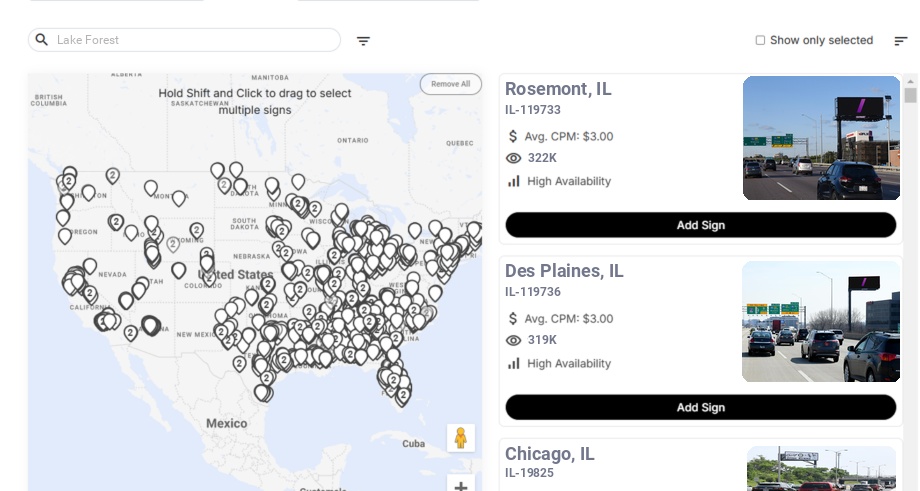
Blip has digital billboards near Lake Forest. You can browse available locations on a map, choose the ones that fit your audience, and start advertising right away.
Still have questions? Launch a campaign in minutes — no contracts, no commitments.
Start Your CampaignLake Forest Billboard Advertising Guide
The Lake Forest area gives us one of the strongest premium suburban billboard audiences on Chicago’s North Shore, centered on a city of 19,367 residents within Lake County’s 714,342-person market. Our 2 digital billboards in Lake Bluff, just 4.5 miles from Lake Forest and within 10 miles of the market, let us reach residents, commuters, students, shoppers, and visitors who move through this corridor every day.
Lake Forest area market overview
We see the Lake Forest area as a small-by-population market — just 19,367 residents in the city — with outsized spending power, education levels, and regional influence. That matters because billboard performance is not just about raw population. It is also about concentration of affluent households, consistent road use, and the quality of destinations that pull people through the market.
Core demographics and household profile near Lake Forest
Regional data from the Chicago Metropolitan Agency for Planning and the City of Lake Forest highlights several reasons this market stands out:
- The City of Lake Forest has a population of 19,367.
- The city has roughly 7,000 households.
- Lake County 714,342.
- Lake Forest sits about 30 miles north of Chicago.
- The city includes about 7 miles of Lake Michigan shoreline.
- Median household income in Lake Forest is above $250,000.
Those numbers tell us the Lake Forest area behaves more like a premium trade area than a typical suburban ZIP code. We are not only reaching local residents. We are also reaching people who travel through the area for work, shopping, schools, healthcare, dining, and recreation.
Economic strength and commuting behavior around Lake Forest
The business base around Lake Forest adds another layer of value. The market connects to employers and institutions such as Northwestern Medicine Lake Forest Hospital, Lake Forest College, AbbVie North Chicago, Packaging Corporation of America, and Reynolds Consumer Products. We also benefit from the broader Lake County labor pool.
- The Illinois Department of Employment Security 370,000 people.
- In Lake County, more than 70% of workers drive alone to work.
- When carpooling is added, well over 3 out of 4 commuters in the county rely on private vehicles.
Even though the Lake Forest area is served by Metra
Key traffic corridors serving the Lake Forest area
For a market like Lake Forest, route selection is everything. We want to show up where local affluence and regional movement overlap. The good news is that the area has a clear set of commuter and connector corridors that consistently serve local travel patterns.
I-94 and the Tri-State Tollway near Lake Forest
The most important regional artery is Interstate 94, also known locally as the Tri-State Tollway. This corridor connects the North Shore to Chicago, the western suburbs, Milwaukee
According to IDOT traffic counts, I-94 segments serving the Lake Forest area commonly exceed 120,000 vehicles per day. That makes the tollway the best corridor for broad-reach awareness campaigns, especially for:
- Healthcare providers.
- Regional retailers.
- Universities and schools.
- Home services.
- Legal, financial, and real estate brands.
- Restaurants and event venues.
The main access points that matter for the Lake Forest area are the interchanges tied to Route 60, Route 176, and nearby north-south connectors. If we want to reach people entering or leaving the market by car, I-94 is one of the most reliable places to start.
U.S. 41, Route 60, Route 176, and Waukegan Road
If I-94 gives us regional volume, U.S. 41 and surrounding arterials give us local relevance. These roads capture the practical trips that shape everyday demand near Lake Forest.
- U.S. 41 segments serving Lake Bluff and the Lake Forest area generally carry about 30,000 to 40,000 vehicles per day.
- Route 60, also known as Town Line Road, often runs in the 20,000 to 30,000 daily vehicle range.
- Route 176, also known as Rockland Road, often runs in the 15,000 to 20,000 daily vehicle range.
- Waukegan Road, also known as Illinois 43, commonly reaches 15,000 to 25,000 vehicles per day on relevant segments.
These are the roads we watch when advertisers want to reach school traffic, hospital traffic, retail trips, dining traffic, and commuters who are not necessarily on the tollway for long distances.
Why Lake Bluff billboards work for the Lake Forest market
Our inventory serving the Lake Forest area is in Lake Bluff, and that is an advantage rather than a limitation. Lake Bluff sits directly in the same daily movement pattern as Lake Forest, which means our boards can intercept:
- Residents traveling between Lake Forest and Lake Bluff.
- Drivers using U.S. 41 and nearby arterials.
- People heading toward Libertyville, Vernon Hills North Chicago, and other nearby activity centers.
- Families moving between schools, sports, shopping, and appointments.
For advertisers, that means we can capture the Lake Forest area audience without needing a billboard physically inside the city.
Audience segments we can reach near Lake Forest
The Lake Forest area is valuable because it is not one-dimensional. We can reach affluent professionals, established families, school communities, and leisure-oriented visitors in the same geography.
Commuters, executives, and professional households
The first core segment is the affluent commuter and executive household. Lake Forest’s median household income above $250,000 puts the market among the strongest consumer spending environments in Illinois. We often see this audience respond well to messaging from:
- Wealth management firms.
- Healthcare specialists.
- High-end home improvement brands.
- Real estate teams.
- Luxury auto dealers.
- Private clubs, hospitality brands, and destination dining.
This segment also overlaps with corporate traffic tied to employers such as AbbVie Packaging Corporation of America, and Reynolds Consumer Products. Because Lake County’s labor force exceeds 370,000, we are reaching not just local residents, but the broader professional ecosystem that serves them.
Students, parents, and school communities near Lake Forest
Education is another major audience driver. The Lake Forest area has multiple institutions that generate daily and seasonal movement:
- Lake Forest College enrolls about 1,850 students.
- Lake Forest Academy enrolls about 435 students.
- Lake Forest Community High School District 115 serves roughly 1,500 students.
When we add younger students, parents, faculty, staff, alumni, visiting families, and event attendees, the education segment becomes much larger than the enrollment counts alone. This makes the market especially attractive for tutoring, orthodontics, camps, family entertainment, dining, apparel, and local services.
Families, shoppers, and leisure visitors serving the Lake Forest area
The Lake Forest area also draws a strong destination audience. That audience includes weekend diners, recreation users, North Shore shoppers, wedding guests, and visitors exploring the region.
- Market Square 1916, and it remains one of the area’s signature shopping districts.
- The Lake County Forest Preserves 31,000 acres across 60 preserves with nearly 200 miles of trails.
- The Chicago Botanic Garden spans 385 acres and attracts visitors from across the North Shore.
- Ravinia Festival presents 100+ concerts and events each summer.
- The Lake County Fair runs for 5 days each July.
That mix creates excellent opportunities for restaurants, hospitality, entertainment, museums, events, home-and-garden brands, and seasonal retail. It also reinforces why billboard advertising near Lake Forest should not be planned only as a commuter buy. It is a lifestyle and destination buy too.
Seasonal and timing opportunities in the Lake Forest area
Strong Lake Forest-area campaigns usually follow the calendar. We recommend building timing around school cycles, event seasons, weather, and the region’s distinct commuter habits.
Spring campaigns near Lake Forest
Spring is one of the best planning windows for the Lake Forest area. Families begin thinking about camps, summer programs, graduation, landscaping, home improvement, and event bookings.
We often recommend launching spring campaigns in March or April for:
- Outdoor living and remodeling services.
- Real estate listings and staging.
- Healthcare appointments.
- School admissions and enrichment.
- Graduation gifting and dining.
This is also the right time to build awareness before late-spring school events tied to Lake Forest College, Lake Forest Academy, and District 115.
Summer visibility serving the Lake Forest area
Summer expands the audience mix. We still reach commuters, but we also gain more leisure traffic, recreational movement, and regional visitation.
From Memorial Day through Labor Day, the Lake Forest area benefits from beach traffic, golf traffic, outdoor dining, camps, and weekend exploration. Ravinia Festival runs its summer schedule from June through September, and the Lake County Fair adds a concentrated 5-day traffic spike in July. This is an excellent window for restaurants, entertainment, retail, healthcare, and family-oriented services.
Fall routines and back-to-school timing near Lake Forest
Late August, September, and October are ideal for routine-based advertising. Families settle into school schedules, college students return, sports calendars fill up, and commuters move back into predictable patterns after summer vacations.
We like fall for:
- Education and enrichment brands.
- Healthcare and elective procedures.
- Home maintenance and roofing.
- Financial planning.
- Retail promotions tied to school, sports, and holiday prep.
Because the Lake Forest area includes both family households and college traffic, fall campaigns can deliver strong repetition without requiring huge creative changes.
Winter and holiday opportunities in the Lake Forest area
Winter changes both timing and design. In the Chicago region, sunset arrives before 4:30 p.m. in December, which makes the evening commute feel visually “prime time” earlier in the day. By late June, sunset is after 8:20 p.m., so winter and summer creative do not perform in the same way.
We recommend winter strategies that lean into:
- Holiday retail and gifting.
- Fine dining and hospitality.
- Healthcare, wellness, and elective services.
- Indoor family activities.
- New-year planning for education, fitness, and home organization.
Holiday shopping tied to Market Square Hawthorn Mellody Farm November and December especially productive.
Billboard design tips for the Lake Forest area
Creative that works near Lake Forest usually feels polished, local, and efficient. We want to respect the market’s visual expectations while still making the message impossible to miss.
Use a North Shore look and feel
The Lake Forest area responds well to refined creative. We usually recommend clean typography, strong contrast, and a restrained palette built around navy, deep green, lake blue, white, charcoal, or warm neutral tones. Those colors fit the local architecture, shoreline setting, and upscale retail environment better than cluttered bargain-style layouts.
That does not mean every ad must look luxurious. It means even value-driven ads should look intentional and credible. A home services ad, for example, can still promote price or urgency, but it will usually perform better if the design feels trustworthy rather than chaotic.
Make the geography immediately relevant
Drivers serving the Lake Forest area know the names that matter locally. We can improve response by referencing recognizable places and route logic, such as Market Square Northwestern Medicine Lake Forest Hospital, Lake Forest College, Lake Bluff, Libertyville, or major connectors like U.S. 41 and Route 60.
Messages that emphasize convenience often work well here. If a business is truly close to a known route, it can be smart to say so in plain language. A strong local billboard does not need to say everything. It only needs to answer why the next step is worth taking.
Keep the message simple enough for a fast read
Because each digital display lasts about 7.5 to 10 seconds, we recommend one idea per ad. We want one headline, one brand cue, and one clear action. We also recommend large type, high-contrast backgrounds, and minimal copy.
For the Lake Forest area specifically, imagery of tree-lined streets, lakefront scenes, classic homes, healthcare confidence, or campus life can feel much more native than generic stock graphics. If we are targeting affluent families, polished lifestyle imagery often beats hard-sell coupon language.
Regional strategies near Lake Forest
Even with just 2 boards serving the market, we can still build smart regional strategy. The key is to think in travel patterns rather than city limits.
Use Lake Bluff as the gateway to the Lake Forest area
Because our boards are in Lake Bluff, just 4.5 miles from Lake Forest, we can use them as near-home frequency builders. This is especially effective for businesses that depend on repeat exposure, such as:
- Dentists and specialists.
- Home remodeling companies.
- Real estate agents.
- Private schools and enrichment programs.
- Restaurants and hospitality.
- Fitness, wellness, and personal services.
This strategy works because residents do not live only within municipal borders. They shop, commute, dine, and run errands across the Lake Forest and Lake Bluff corridor constantly.
Target commuter windows on the routes that matter most
For reach and repetition, we recommend scheduling around the moments when the Lake Forest area is most predictably mobile. In many cases, that means concentrating spend during:
- 6:00 to 9:00 a.m. for morning commuting.
- 4:00 to 7:00 p.m. for evening return traffic.
- Friday afternoons for dining, entertainment, and weekend planning.
- Saturday late morning through early evening for retail and family movement.
That timing is especially useful for campaigns tied to I-94, U.S. 41, Route 60, and Route 176. We do not need to buy every hour of every day if the audience is most valuable during specific windows.
Match the message to nearby trade areas
The Lake Forest market overlaps with several neighboring demand centers, including Libertyville, Vernon Hills Highland Park, and North Chicago. That gives us room to tailor strategy by category.
For example:
- Retail and restaurant brands can align with shopping trips toward Hawthorn Mellody Farm
- Healthcare brands can lean into travel tied to Northwestern Medicine Lake Forest Hospital and surrounding medical offices.
- Education brands can focus on the school-year rhythms created by Lake Forest College, Lake Forest Academy, and local K-12 families.
- Hospitality and event brands can align with weddings, summer concerts, and North Shore leisure travel.
Blip tools and capabilities for campaigns serving the Lake Forest area
The Lake Forest area rewards precision, and that is where our platform helps. We can be very hands-on when the route and timing matter, or we can let automation handle optimization when the goal is broader awareness.
We can choose local control or automated optimization
If we want tight control, we can run a manual campaign and select the specific Lake Bluff billboards serving the Lake Forest area ourselves. That is useful when we know the exact audience window we want, such as weekday commuting, Friday dining traffic, or a short event push.
If we want broader efficiency, we can use a Blip-optimized campaign and let the platform allocate budget toward the best opportunities. That approach is often ideal for awareness campaigns, local launches, and advertisers who want results without micromanaging every setting.
We can use timing and pricing flexibility to fit the market
Blip’s pay-per-play model starts at $0.01 per display, which makes it practical to test the Lake Forest area without committing to a traditional large buy. Because pricing changes with demand, time of day, and location, we can put more budget behind the windows that matter most and stay lean when they do not.
That matters in a market like Lake Forest, where a well-timed message can outperform a constant but inefficient schedule.
We can test, learn, and improve quickly
We also like Blip for Lake Forest-area campaigns because we can rotate creative, compare dayparts, and monitor performance in real time. If one message works better for healthcare, another for retail, and another for school traffic, we do not need to guess for a full month before making changes.
Getting started with billboard rental near Lake Forest
Getting started near Lake Forest is simpler when we begin with the audience and route, not the billboard format. Once we know who we are trying to reach and when they move, the right strategy becomes much clearer.
Define what success looks like for the Lake Forest area
We recommend starting with one primary objective. That objective might be more store visits, more appointment bookings, more event attendance, more website traffic, or stronger awareness among affluent households. The clearer the goal, the easier it is to decide whether we should emphasize commuter traffic, family traffic, weekend traffic, or seasonal visitors.
Evaluate billboard fit by travel behavior
When we help advertisers choose boards serving the Lake Forest area, we usually ask a few practical questions:
- Does the location reach weekday commuters, weekend shoppers, or both?
- Is the board close to a key decision route such as I-94, U.S. 41, Route 60, or Route 176?
- Does the audience need repeated exposure over time, or a short burst around an event?
- Is the message local enough to feel relevant to the Lake Forest area?
- Does the creative match the speed and context of the roadway?
Because our current inventory is concentrated in Lake Bluff, these questions help us decide how to use those boards most effectively for Lake Forest-area goals.
Start small, then scale what works
Traditional billboard companies often push fixed terms, rep-managed negotiations, and broad market packages. For advertisers serving the Lake Forest area, that can mean paying for more inventory, more time, or more geography than the campaign actually needs.
We recommend a simpler path:
- We start with the 2 Lake Bluff digital billboards serving the Lake Forest area.
- We launch a focused test for 2 to 4 weeks.
- We use dayparting if the audience is strongest during commuting or weekend windows.
- We review results and adjust creative, timing, or budget based on what the market tells us.
That process is usually faster, more flexible, and less risky than traditional billboard rental. It also gives us a practical way to learn the Lake Forest area before scaling up. When the goal is to reach a premium suburban audience efficiently, that kind of control can make a real difference.