Billboards in Dolton, IL
No Minimum Spend. No Long-Term Contracts. Just Results.
Trusted by Leading Brands


Billboard advertising
in Dolton has never been easier
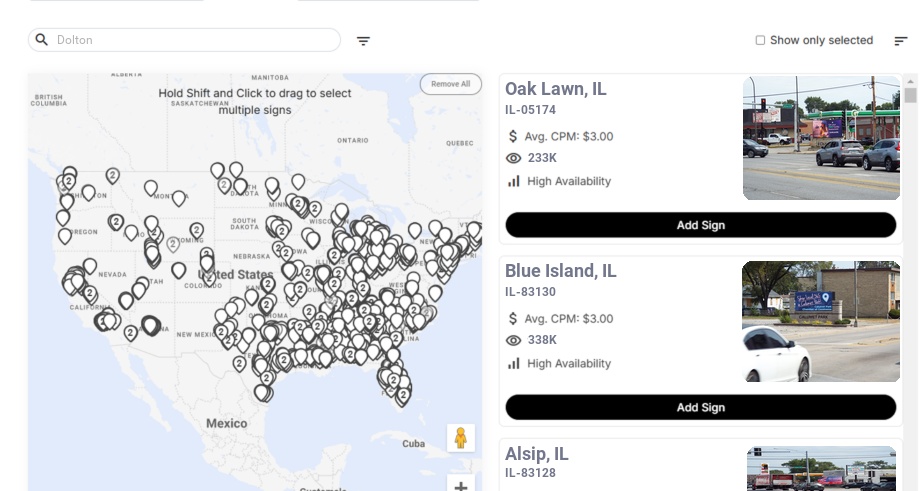



How much is a billboard in Dolton?
Why Choose Blip for Billboard Advertising in Dolton
Blip lets you launch on Dolton corridors like I-94 and Sibley Boulevard in minutes—self-serve access for commuters heading into Chicago.
Set a budget that fits Dolton, then let Blip pace spend automatically across local retail traffic on Torrence and River Oaks Drive.
Daypart your Dolton ads for school drop-off, rush hour, or weekend church traffic to match when South Suburban drivers are on the road.
No contracts means you can test Dolton billboards around I-57 and I-294, then shift fast if Calumet City shoppers respond best.
Track Dolton campaign results in real time and adjust on the fly as traffic spikes near River Oaks, the Metra line, or holiday shopping.
Use Blip’s creative tools to build bold, readable Dolton ads for families, commuters, and job seekers in the South Suburbs.
Frequently Asked Questions About Billboard Advertising in Dolton
How much does a billboard cost near Dolton, Illinois with Blip?
With Blip, you control exactly what you spend on Dolton billboards by setting your own daily budget, and Blip automatically keeps your campaign within that amount. Each ad is a short “blip,” a 7.5–10 second display on rotating digital billboards near Dolton, Illinois, and you only pay for the blips you receive. The price of each blip changes based on when and where you choose to advertise and current advertiser demand, so you can start small and scale up anytime.
Where can I advertise with Blip near Dolton, Illinois?
With 19 nearby digital billboards serving the Dolton area from Calumet City, Thornton, Blue Island, Alsip, and Country Club Hills, we can help you tap into a daily audience that lives, shops, and commutes all around Dolton. These billboards are positioned along corridors that carry commuters between the Dolton area, neighboring suburbs, and Chicago. Key routes include I‑94, I‑57, I‑294, Sibley Boulevard, Torrence Avenue, River Oaks Drive, 147th Street, and Cicero Avenue.
Who sees Blip billboards near Dolton, Illinois?
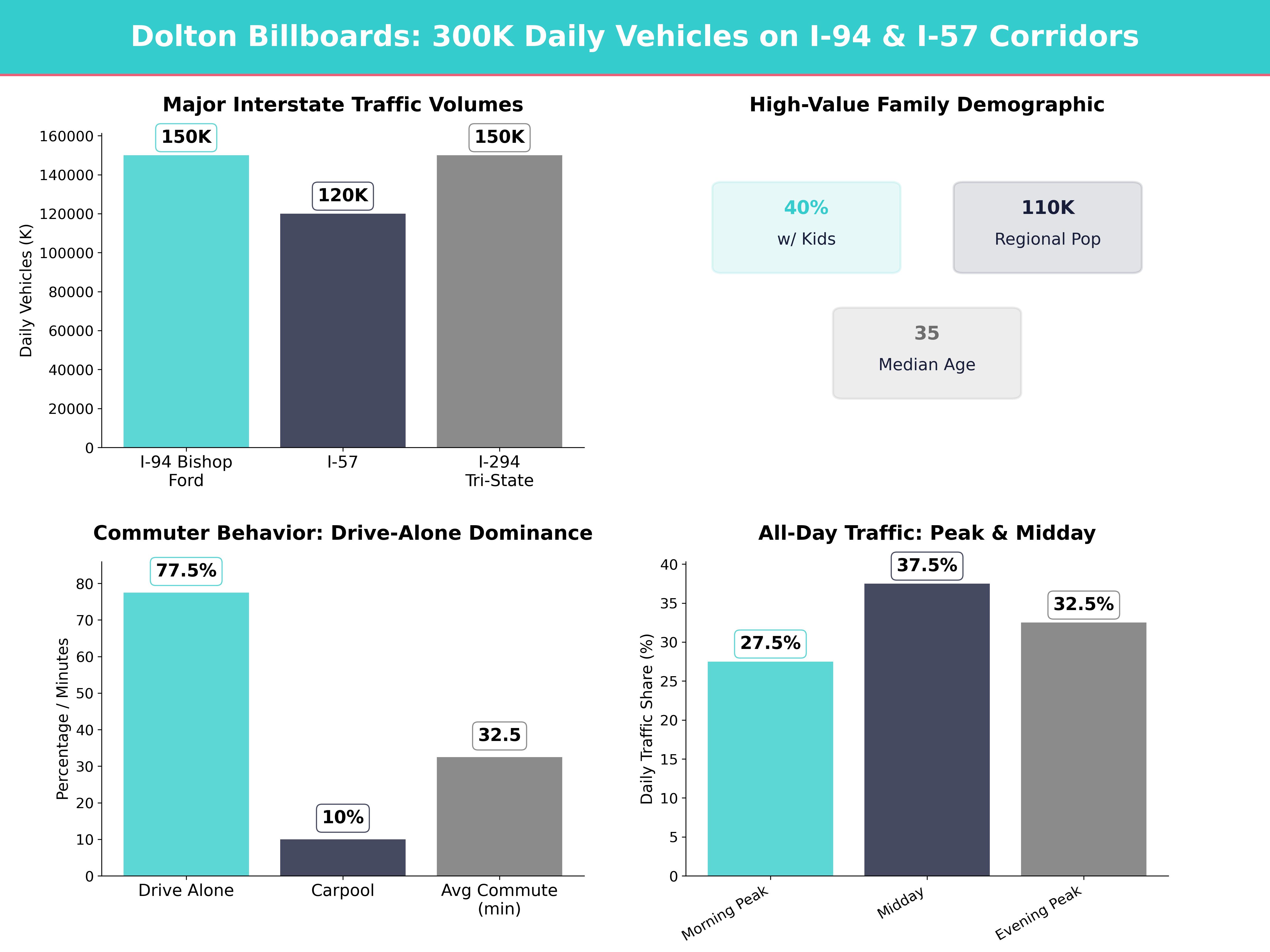
Dolton’s population is roughly 21,000–22,000 residents, with more than 7,000 households concentrated in only about 4.7 square miles. Taken together, Dolton and nearby communities represent a regional population of more than 110,000 people that regularly uses the corridors where our billboards sit. In many South Suburban communities, 75–80% of workers typically commute by driving alone, with another 8–12% carpooling.
What are the best times to advertise on Dolton, Illinois billboards with Blip?
The Dolton area audience is heavily driven by commuting and weekday routines, but weekend shopping and church traffic are also very strong. In many south suburban corridors, 25–30% of weekday daily traffic occurs during the morning peak, while evening peaks can capture another 30–35% of daily traffic. Weekend volumes on retail corridors commonly approach 90–100% of weekday traffic, and around major shopping nodes Saturday counts can even surpass weekday averages.
What kinds of messages work best on billboards near Dolton, Illinois?
The Dolton area responds best to billboard creative that is bold, direct, and community-aware. Use one primary message and one strong call to action, and keep the design simple with large fonts and high contrast. Feature Black families, professionals, and youth where appropriate, and use clear, respectful, and authentic language rather than generic “suburban” stock imagery.
Do I need a contract to advertise with Blip in Dolton?
No, Blip has no long-term contracts or minimum commitments. You can start, pause, or stop your campaign at any time.
How fast can I launch a billboard campaign with Blip in Dolton?
You can have your campaign live in minutes. Create a free account, select your locations, set your budget, upload your design, and start running once approved.
Where can I advertise with Blip in Dolton?
Blip has digital billboards in Dolton. You can browse available locations on a map, choose the ones that fit your audience, and start advertising right away.
Still have questions? Launch a campaign in minutes — no contracts, no commitments.
Start Your CampaignDolton Billboard Advertising Guide
We view the Dolton area as a powerful crossroads of South Suburban Chicago life, where dense residential neighborhoods, major commuting corridors into Chicago, and busy local retail strips all converge. When we plan billboards near Dolton that tap into both local and regional traffic, this mix of audiences makes the area especially attractive for out-of-home campaigns. With 19 nearby digital billboards serving the Dolton area from Calumet City, Thornton, Blue Island, Alsip, and Country Club Hills, we can help you tap into a daily audience that lives, shops, and commutes all around Dolton.
Understanding the Dolton Area Audience
The starting point for an effective campaign is a clear picture of who we’re reaching near Dolton and who will regularly see Dolton billboards.
-
Population & households
- Dolton’s population is roughly 21,000–22,000 residents, with more than 7,000 households concentrated in only about 4.7 square miles, which works out to 4,400–4,700 residents per square mile—denser than many nearby south suburbs.
-
Surrounding communities significantly expand your reach within a 10–15 minute drive:
- Calumet City (~35,000 residents) across about 7.3 square miles.
- Blue Island (~22,000 residents) across about 4.5 square miles.
- Alsip (~19,000 residents) across about 6.5 square miles.
- Country Club Hills (~16,000 residents) across about 4.9 square miles.
- Taken together, Dolton and these adjacent communities represent a regional population of more than 110,000 people that regularly uses the corridors where our billboards sit.
-
Age & family structure
- The median age near Dolton is in the mid‑30s, with over half of residents typically falling between ages 25 and 64, the prime working and spending years.
- Family households account for roughly two‑thirds of all households in many nearby communities, and Dolton has a notably high share of households with children under 18, often in the 35–45% range.
- School districts and park districts in the area, such as Dolton School District 148, Dolton School District 149 Thornton Township High Schools District 205, and the Dolton Park District, support year‑round youth activities, sports, and events that keep family traffic on the roads before and after school.
- This makes family-oriented messaging—schools, childcare, youth programs, family dining, and healthcare—especially relevant.
-
Income & spending power
- Median household income in the Dolton area is generally in the low‑to‑mid $40,000s, with surrounding suburbs ranging from roughly $40,000 to $70,000+, creating a broad working‑ and middle‑income consumer base.
-
Across the broader South Suburban region, consumer expenditure data consistently shows that households devote over:
- 30–35% of spending to housing and utilities,
- 12–15% to food at home and dining out,
- 15–20% to transportation (auto payments, fuel, maintenance, insurance),
- 8–12% to healthcare and personal care.
-
That mix supports strong demand for:
- Value-forward retail and services (discount retailers, auto services, QSR/fast casual dining).
- Essential services (healthcare clinics, dental, financial services, insurance, trades/contractors).
- Education and training (community college programs, trade schools, certifications), especially given the region’s large base of residents with some college or technical training.
-
Commuting patterns & car usage
- In many South Suburban communities, 75–80% of workers typically commute by driving alone, with another 8–12% carpooling. This means well over 8 in 10 workers are in vehicles regularly passing local billboards.
- Average one‑way commute times in the south suburbs are often 30–35 minutes, longer for those heading into downtown Chicago or major job centers near the interstates.
- These long, car‑based commutes are ideal for repetition-based billboard campaigns that build brand familiarity over days and weeks, and they are a key reason why billboard advertising near Dolton can deliver consistent impressions.
-
Racial and cultural makeup
- Dolton and several neighboring suburbs have a predominantly African American population, often in the 80%+ range. Nearby communities like Blue Island and Alsip introduce additional diversity, with Latino, White, and multi‑ethnic communities creating a broader cultural mix across the region.
-
Campaigns that perform well here typically:
- Use inclusive imagery that reflects Black families and professionals.
- Speak to community pride and local uplift: jobs, scholarships, youth programs, and small business growth.
- Feature clear, respectful, and authentic language rather than generic “suburban” stock imagery.
- Local institutions such as churches, youth leagues, and community centers remain highly influential, and aligning your tone with their emphasis on family, faith, and opportunity tends to strengthen response.
To understand local priorities and community initiatives, advertisers should review resources like the Village of Dolton Calumet City, Blue Island, Alsip, and Country Club Hills municipal sites, which frequently highlight festivals, safety campaigns, and local economic development efforts you can align with in your messaging. Regional perspectives from entities such as Cook County, the Chicago Metropolitan Agency for Planning, and tourism partners like Visit Chicago Southland
Where the Traffic Flows Near Dolton
Our 19 digital billboards are positioned along corridors that carry commuters between the Dolton area, neighboring suburbs, and Chicago. Understanding these patterns helps you pick the right locations and dayparts for billboard advertising near Dolton.
Key routes that influence billboard exposure include:
-
Interstates & major highways
- I‑94 (Bishop Ford Freeway) just east of Dolton typically sees ~140,000–160,000 vehicles per day on segments north and south of the Dolton area, according to the Illinois Department of Transportation (IDOT). Over the course of a month, that translates to 4–5 million vehicle trips past Bishop Ford segments that serve Dolton‑area commuters.
- I‑57 west of Dolton, especially near Country Club Hills and Alsip, carries ~110,000–130,000 vehicles per day, making it a major commuter and trucking route toward Chicago and the south suburbs. Over a year, that can mean 40+ million vehicle impressions available to well‑placed billboards along key stretches.
- I‑294 (Tri‑State Tollway) further west adds heavy regional traffic—commuters, logistics, and travelers connecting between I‑80, I‑57, and I‑90/94. Segments in the south suburbs routinely handle 150,000+ vehicles per day, combining local and through‑traffic that extends your reach beyond Dolton.
-
Key local arterials near Dolton
- Sibley Boulevard (IL‑83): One of the main east–west arteries through the Dolton area into Calumet City and Harvey. Certain stretches see upwards of 20,000–30,000 vehicles per day, connecting residential neighborhoods with big-box retail and industrial zones. Over a typical week, a single driver might pass the same point 10–20 times, which is ideal for message reinforcement.
- Torrence Avenue, a major north–south corridor intersecting Sibley and linking to River Oaks and I‑94, regularly carries 15,000–25,000 vehicles per day in the Dolton/Calumet City vicinity.
- River Oaks Drive (Calumet City): Serving the River Oaks shopping district and River Oaks Center 20,000 vehicles per day, especially during holiday and back‑to‑school seasons when retail traffic spikes 15–30%.
- 147th Street (Blue Island / Midlothian Turnpike) and Cicero Avenue: Major corridors between Blue Island, Alsip, and Country Club Hills with strong daily volumes and lots of retail and service businesses. Segments along Cicero in the south suburbs commonly reach 25,000–35,000 vehicles per day, supporting high‑frequency local campaigns.
-
Transit
- The Metra Electric District line, operated by Metra Blue Island, Harvey, Riverdale), carrying thousands of commuters into downtown Chicago each weekday. Annual Metra Electric ridership in recent recovery years has totaled in the tens of millions of trips, with peaks during traditional office commute hours.
- Pace Bus routes, managed by Pace Suburban Bus, cross Sibley, 147th, Torrence, and other key roads, adding riders who also drive or are passengers in vehicles exposed to billboards. Across the Pace system, weekday ridership counts in the hundreds of thousands, and many riders live or work within a few miles of Dolton.
- While our billboards are roadside, timing your message with inbound/outbound commuting peaks can complement rail and bus campaigns and improve cross‑channel frequency.
With Blip, we can direct your spending toward the billboards closest to the corridors that match your customers’ actual travel paths—whether that’s shoppers around River Oaks, commuters on I‑57/I‑94, or local traffic along IL‑83 that you want to reach with billboards near Dolton.
Peak Times to Reach the Dolton Area
The Dolton area audience is heavily driven by commuting and weekday routines, but weekend shopping and church traffic are also very strong. When you schedule your Blip campaign, consider these patterns to get the most from your Dolton billboards:
-
Morning commute (6–9 a.m.)
- In many south suburban corridors, 25–30% of weekday daily traffic occurs during the morning peak. Workers headed toward Chicago via I‑94, I‑57, and local connectors like Sibley Blvd create sustained flow.
- School start times add concentrated surges; Dolton‑area schools and nearby high schools generate pronounced traffic around 7–8 a.m. and again in the mid‑afternoon.
-
Ideal for:
- Quick-service breakfast, coffee, convenience stores, gas stations.
- Workplace-related services: staffing agencies, training programs, trade schools.
- Reminder-style ads (“Stop by on your way home…”).
-
Midday (10 a.m.–3 p.m.)
- Midday periods often account for 35–40% of daily traffic on local arterials, dominated by errands, shopping, and service appointments.
-
Good for:
- Retail promotions, grocery, pharmacies.
- Medical clinics, dental, auto repair, and personal services.
- Seniors and stay-at-home caregivers, a segment that often has more flexible daytime schedules and drives local economic activity in healthcare and retail.
-
Evening commute (3–7 p.m.)
- Evening peaks can capture another 30–35% of daily traffic, sometimes higher on Fridays as residents head to shopping centers and social activities.
- Return traffic from Chicago and industrial corridors back into the Dolton area fills I‑94, I‑57, and key arterials.
-
Strong slot for:
- Restaurants, delivery apps, entertainment, gyms.
- Same-day or next-day service offers.
- Event reminders for that evening or upcoming weekends.
-
Weekends
- Weekend volumes on retail corridors commonly approach 90–100% of weekday traffic, and around major shopping nodes like River Oaks and Country Club Hills, Saturday counts can even surpass weekday averages.
- Saturday tends to be heavy for shopping and social activities; Sunday for church, family gatherings, and errands. In many South Suburban communities, more than half of households report regular religious service attendance, driving reliable Sunday morning and midday flows.
- Advertising around large retail clusters (e.g., near Calumet City and Alsip) during weekends maximizes exposure to families and group outings.
Using Blip’s scheduling controls, we can concentrate your impressions into the time windows that matter most to you—for instance, only weekday rush hours for a commuter-focused product, or weekend daytime for local retailers.
Creative Strategies That Resonate Near Dolton
The Dolton area responds best to billboard creative that is bold, direct, and community-aware. Because drivers typically have 6–8 seconds to absorb your message and research shows that over 70% of drivers glance at roadside ads during a typical trip, simplicity and cultural relevance matter for any billboard advertising near Dolton.
1. Lead with value and clarity
-
Use one primary message and one strong call to action:
- “$49 Brake Special – Exit at Sibley”
- “Enroll Now – Job Training That Pays”
-
Highlight value clearly:
- Specific price points (“$5 Meal Deal”) or savings (“Save 30% This Weekend”).
- Simple benefits (“Same-Day Braces Consults” or “Instant Approval Auto Loans”).
- Studies of out-of-home (OOH) campaigns have shown that clear, offer‑driven creative can lift store visits by 10–20% during promotional windows compared with baseline weeks.
2. Reflect the community visually
- Feature Black families, professionals, and youth where appropriate, consistent with Dolton’s demographics and those of nearby communities like Harvey and Riverdale.
- Show real local environments that resemble the area—brick bungalows, churches, youth sports, industrial work, and small storefronts—rather than generic, upscale downtown imagery.
- If you serve multiple communities (Dolton, Calumet City, Blue Island), reinforcing that “We’re here for South Suburban Chicago” can feel inclusive without overpromising a specific neighborhood presence.
- OOH research frequently finds that relevant, locally tailored creative produces 15–30% higher ad recall than generic designs.
3. Make directions hyper-local
-
Since our billboards sit in Calumet City, Thornton, Blue Island, Alsip, and Country Club Hills, anchor your creative to recognizable landmarks and exits:
- “5 Minutes from River Oaks Mall”
- “Off I‑57 at 167th Street – Next to Walmart”
- “On Sibley, East of Cottage Grove”
- Call out transit-friendly locations (“Near Metra / Pace Route ___”) if relevant, especially if you’re near lines publicized by Metra Pace Suburban Bus.
- Simple distance cues (“2 lights ahead”) and exit numbers improve response because drivers make decisions quickly—often in under 3 seconds once they notice a sign.
4. Design for legibility
- Use large fonts (at least ~18–24 inches at physical scale), high contrast (light text on dark or vice versa), and 3–7 words of main copy. Industry testing shows that ads with fewer than 7 key words tend to achieve the highest readability scores.
- Avoid clutter: one image, one logo, one short line of copy, one URL/QR or phone (not all three).
- If you want to target mobile engagement, a short URL or clear search phrase (“Search: Dolton Job Training”) often works better than a long web address. National OOH studies indicate that 40–50% of adults who notice a digital billboard have taken some mobile action (searching, visiting a site, mapping directions) afterward.
Seasonal and Event-Based Opportunities Near Dolton
Aligning your campaign with the local calendar can significantly improve performance. South Suburban communities frequently promote events through their municipal sites, event calendars, and local news outlets such as the Daily Southtown, ABC7 Chicago, and WGN-TV millions, and billboards timed with their coverage can extend your visibility.
Here are key windows to consider:
-
Back-to-school (August–September)
- Schools in and near the Dolton area drive an uptick in shopping for clothes, supplies, and services; retailers typically see mid‑ to high‑single‑digit percentage sales bumps during August and early September compared with summer averages.
-
Strong time for:
- Youth programs, tutoring, after-school care.
- Healthcare (physicals, eye exams, dental checkups).
- Retail promotions for clothing, shoes, and electronics.
- Promoting limited‑time offers with clear dates (“This Week Only”) helps capture parents making budget‑conscious decisions.
-
Holiday shopping (November–December)
- River Oaks and nearby shopping centers see increased traffic; regional retail reports often cite 20–30% higher foot traffic in peak December weeks versus fall averages.
- Emphasize gift cards, limited-time offers, layaway/financing, and “shop local” messaging.
- Consider dayparting to evenings and weekends as traffic patterns shift around holiday schedules and extended store hours.
-
Tax season (February–April)
- With median incomes and a large working-class base, tax refunds are a major driver of spending. Nationally, tens of millions of households receive refunds, and many allocate a substantial share to debt payoff, auto repairs, and major purchases.
-
Ideal for:
- Tax preparation services.
- Big-ticket purchases (autos, furniture, appliances).
- Financial products (checking accounts, credit unions, personal loans), especially from local institutions and community banks spotlighted by outlets like Block Club Chicago
-
Spring & summer community events
-
Festivals, park events, and local celebrations in the Dolton area and surrounding suburbs can be promoted via municipal calendars:
- Village of Dolton events
- Calumet City community events.
- Blue Island events.
- Country Club Hills events.
- Regional attractions and festivals highlighted by Visit Chicago Southland Choose Chicago also bring visitors through the South Suburbs, adding tourist and day‑trip traffic to local volumes.
-
Use billboards to:
- Boost event attendance in the final 1–3 weeks before the date.
- Promote regional attractions to drivers already in the area for shopping or recreation.
-
Festivals, park events, and local celebrations in the Dolton area and surrounding suburbs can be promoted via municipal calendars:
-
Hiring surges
- Logistics, warehousing, healthcare, and manufacturing often ramp up recruiting in spring/summer and pre-holiday. Labor market data in the Southland consistently shows hundreds to thousands of open jobs in these sectors at any given time.
- Simple hiring creatives (“Now Hiring in the Dolton Area – $X/hr + Benefits”) work very well on high-traffic routes.
- OOH recruitment campaigns can generate noticeable spikes in application volume within 7–14 days of launch, especially when aligned with pay periods and tax refund season.
With Blip, we can easily ramp up impressions for a few key weeks around these events without committing to a long-term static contract, giving you a flexible way to handle short-term billboard rental near Dolton.
Matching Billboard Locations to Dolton-Area Goals
Because our 19 digital billboards serving the Dolton area are distributed across several neighboring cities, you can craft location-specific tactics when planning billboard advertising near Dolton:
-
Calumet City (1.2 miles from Dolton)
- Calumet City is home to the River Oaks retail district and heavy traffic on Sibley, Torrence, and I‑94 access points.
- Best for: Reaching Dolton residents heading to River Oaks shopping, casino patrons (if applicable nearby), and east–west traffic along Sibley and Torrence.
- Great for: Retail, entertainment, restaurants, and neighborhood-focused brands, particularly those that rely on high weekend and evening foot traffic.
-
Thornton (3.6 miles from Dolton)
- Thornton-area boards reach traffic along I‑294/I‑80-area feeders and local commuters; the area has a concentration of industrial and logistics operations.
- Great for: Industrial recruitment, logistics, construction, and B2B services looking to tap into a workforce that already commutes along these corridors.
- Because commercial vehicle traffic is strong here, billboards can reach truck drivers and tradespeople who influence purchasing decisions for fleets, equipment, and business services.
-
Blue Island (4.1 miles from Dolton)
- Captures both local neighborhood traffic and regional flows along 127th/131st/147th and the Metra-access corridors, including riders from the Blue Island–Vermont Street station and nearby lines.
- Great for: Education (colleges, trade schools), healthcare, and multi-community service providers that draw from a broad base of residents.
- Blue Island’s historic downtown and arts scene also support campaigns for events, dining, and nightlife, reinforced by coverage in outlets like the Daily Southtown.
-
Alsip (7.5 miles from Dolton)
- Traffic includes I‑294, Cicero, and 127th/115th-area commuters, plus shoppers visiting major big‑box and auto‑oriented retail.
- Great for: Regional retailers, auto dealers, and brands looking to reach a wider South Suburban audience beyond Dolton’s immediate neighborhood.
- Positioning messaging here helps you tap both north–south (Cicero) and east–west (115th/127th) flows that connect multiple communities.
-
Country Club Hills (7.8 miles from Dolton)
- I‑57 and 167th/183rd corridors serve a heavy mix of commuters and shoppers, including those accessing nearby entertainment and retail centers.
- Great for: Big-ticket items (autos, furniture), entertainment venues, and employers drawing from Dolton and nearby suburbs.
- The area’s proximity to venues and shopping centers makes it ideal for event and concert promotions and regional brand awareness.
We can help you decide whether to:
- Concentrate on 1–2 key corridors for frequency.
- Spread across all 19 boards for maximum reach in the Dolton area.
- Run A/B creative tests on different sets of boards to see which messages resonate best.
Example Campaign Approaches for the Dolton Area
To translate these insights into action, here are practical campaign frameworks that show how to use billboards near Dolton effectively:
1. Local Retailer Driving In-Store Visits
- Goal: Increase weekend foot traffic.
- Audience insight: In retail corridors like River Oaks, Saturday traffic can climb 20–30% above weekday averages in key seasons.
-
Tactics:
- Run Friday–Sunday, 10 a.m.–7 p.m.
- Focus boards near Calumet City and Blue Island shopping corridors.
- Creative: “This Weekend Only – 30% Off Shoes – 5 Minutes from River Oaks.”
- Pair with a short URL or “Search: [Store Name Dolton]” for easy recall.
- Add urgency by including specific dates and limited‑time language, which has been shown to improve response and store visits during campaigns.
2. Healthcare Clinic Expanding Patient Base
- Goal: Reach families and working adults in the Dolton area.
- Audience insight: With a large share of households including children and a strong working‑age population, preventive care and urgent‑care services are high‑demand categories.
-
Tactics:
- Weekday schedule, morning and evening commutes.
- Use boards in Calumet City and Country Club Hills to reach cross‑traffic from multiple suburbs.
- Creative: “Same-Day Appointments – Family Clinic Serving the Dolton Area – Call XXX‑XXXX.”
- Swap in seasonal versions (sports physicals, flu shots, back-to-school visits) during months when local schools and park districts, such as the Dolton Park District, promote youth sports and activities.
- Highlight convenience (“Walk‑ins Welcome”) and insurance acceptance, which are key decision drivers for working families.
3. Employer Hiring Local Workers
- Goal: Fill entry- to mid-level roles quickly.
- Audience insight: With high car‑commute rates and strong representation in logistics, healthcare, and manufacturing, roadside hiring messages can reach a large pool of potential applicants multiple times per week.
-
Tactics:
- High-frequency bursts, 2–4 weeks at a time, focusing on I‑94 and I‑57 routes.
- Creative: “Now Hiring Near Dolton – $19/hr + Benefits – Apply at [Short URL].”
- Test one board with hourly wage highlighted and another with benefits/shift flexibility, then favor the best-performing message.
- Align bursts with known hiring cycles (spring build‑up, pre‑holiday) and payday periods; campaigns that coincide with these windows often see higher application and clickthrough rates.
Using Blip’s Flexibility to Optimize for the Dolton Area
Blip’s platform lets us tailor your Dolton-area presence with precision, making it simple to manage billboard rental near Dolton without long-term commitments:
- Budget control: Start with a modest daily budget and increase once you see which times and locations respond best. Digital OOH allows you to adjust spend in real time rather than locking into fixed 4‑week cycles.
- Geo-targeting: Choose the specific boards in Calumet City, Thornton, Blue Island, Alsip, and Country Club Hills that align with where your customers live, work, and shop. Within a 5–8 mile radius of Dolton, you can reach more than 100,000 local residents plus regional travelers.
- Dayparting: Concentrate spend into the most valuable hours—commute times, weekends, school drop-off windows, or late evening for entertainment. Many advertisers see higher cost‑efficiency when they focus on just the 30–50% of hours that matter most for their category.
-
Creative rotation: Upload multiple creatives to:
- Speak to different segments (families, commuters, job seekers).
- Highlight rotating promotions or limited-time offers.
- Test images, headlines, and calls to action. Digital campaigns that regularly test and update creative often enjoy double‑digit gains in recall and response versus static messaging.
By combining strong local understanding of the Dolton area with data-driven scheduling and creative testing, we can turn nearby digital billboards into a consistent, high-impact presence for your brand—keeping you top of mind for residents as they move through their daily lives and making billboard advertising near Dolton a measurable part of your marketing mix.