Billboards near Wheeling, IL
No Minimum Spend. No Long-Term Contracts. Just Results.
Trusted by Leading Brands


Billboard advertising
near Wheeling has never been easier



How much is a billboard near Wheeling?
Why Choose Blip for Billboard Advertising near Wheeling
Blip lets Wheeling advertisers launch fast on Milwaukee Ave, Dundee Road, I-294, or I-90—right where commuters and airport traffic already pass.
Set a daily budget for Wheeling and Blip keeps spend on track, so local shops can test billboard ads without long-term commitments.
Use dayparting in Wheeling to hit 7-9 a.m. and 4-6 p.m. commuters, plus weekend diners and Rivers Casino traffic in Des Plaines.
Track real-time results in Wheeling, then shift impressions toward the Rolling Meadows and Des Plaines boards that drive the most response.
Blip's creative tools make it easy to build bold, bilingual Wheeling ads for the area's diverse families, workers, and airport travelers.
Frequently Asked Questions About Billboard Advertising near Wheeling
How much does a billboard cost near Wheeling, Illinois with Blip?
With Blip, you can run eye-catching ads on digital Wheeling billboards on any budget, making it easy for businesses of all sizes to get noticed in the Wheeling area. You simply set a daily budget during campaign creation, and Blip automatically keeps your billboard advertising within that limit, so you stay in control. The price of billboards near Wheeling, Illinois varies based on the times you choose to run your ads, the locations serving the Wheeling area, and advertiser demand.
Where can I advertise with Blip near Wheeling, Illinois?
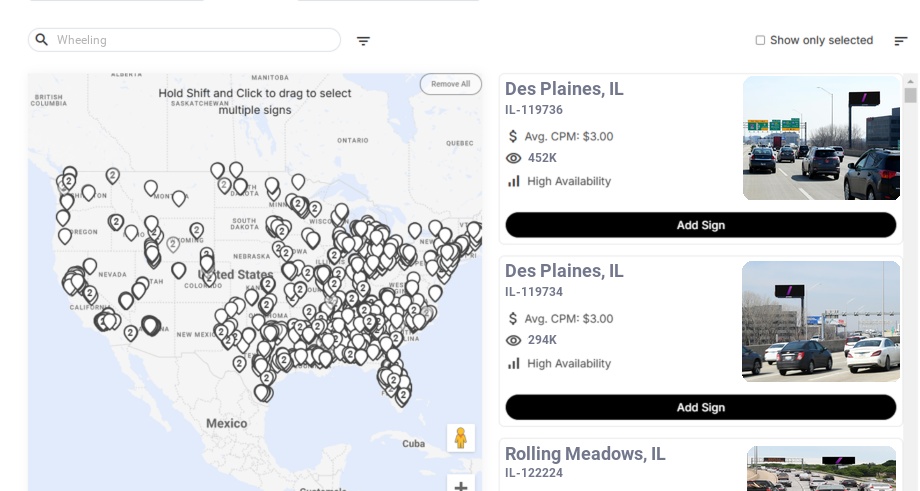
Blip has six digital billboards serving the Wheeling area, all within about 10 miles, primarily in Rolling Meadows and Des Plaines. These suburbs sit along high-traffic arteries that carry thousands of Wheeling-area drivers every day, so choosing billboards near Wheeling in these corridors is an efficient way to reach locals as well as regional traffic.
What kind of audience do Wheeling, Illinois billboards reach?
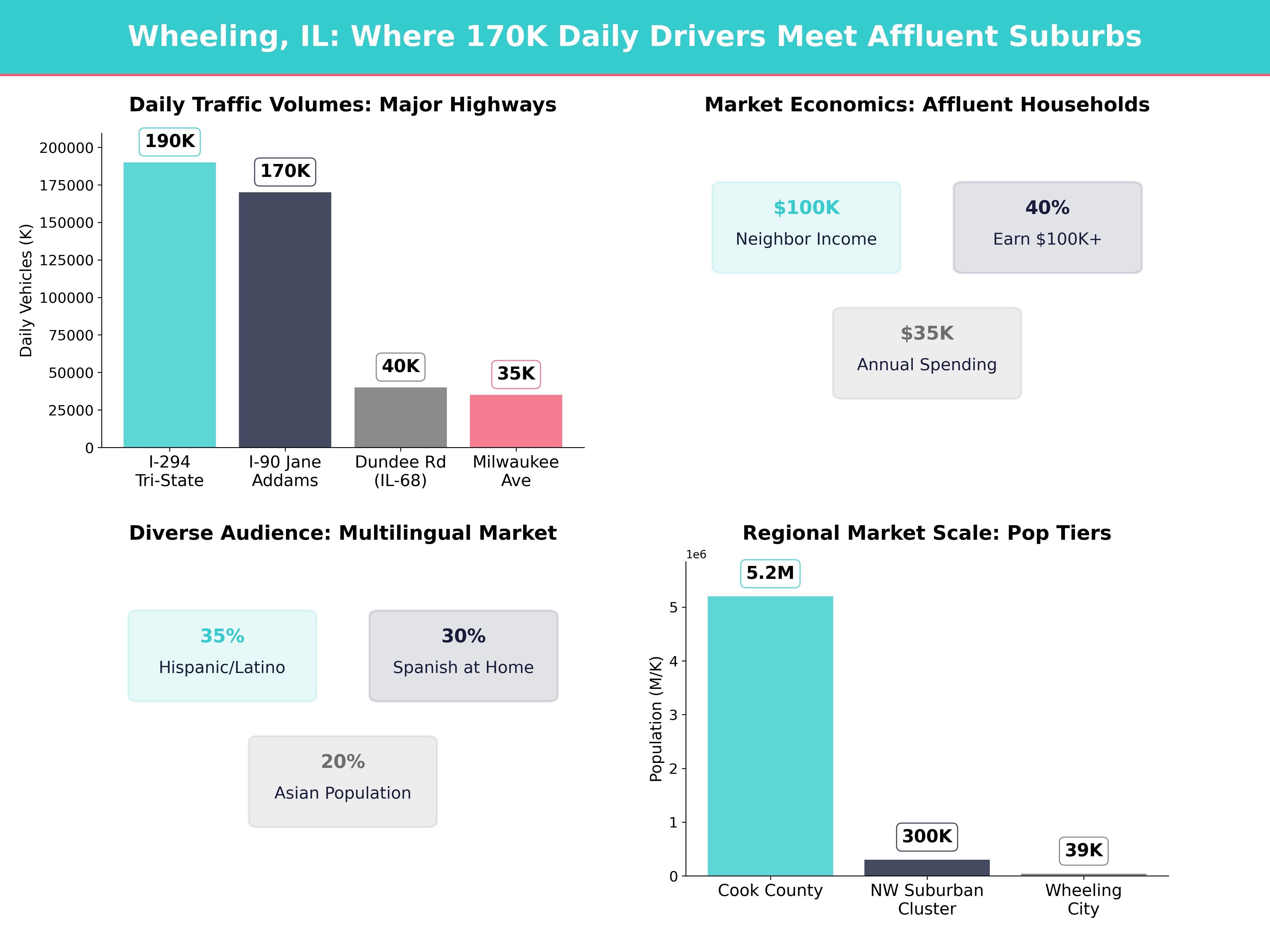
Wheeling’s position in northwest Cook County gives advertisers access to a dense, diverse, and relatively affluent audience, making Wheeling billboards an attractive option for local and regional brands. Wheeling’s population is just over 39,000 people, and it sits within the larger northwest suburban cluster of more than 300,000 residents when you include nearby communities like Des Plaines, Mount Prospect, Arlington Heights, and Rolling Meadows.
When is the best time to run Blip billboards in Wheeling, Illinois?
In the Wheeling area, we can generally expect weekday AM traffic from 6:30–9:00 a.m. and weekday PM traffic from 3:30–6:30 p.m. Weekend peaks are usually late morning to early afternoon, plus evening dining hours on Fridays and Saturdays. Seasonal variations matter, with traffic volumes often rising 5–10% in late spring and summer on weekends.
What major roads and traffic corridors matter for advertising near Wheeling, Illinois?
Average daily traffic on major nearby routes typically includes Milwaukee Avenue near Wheeling at 25,000–35,000 vehicles per day and Dundee Road at 30,000–40,000 vehicles per day. I-294 near Des Plaines is commonly 150,000–190,000 vehicles per day, and I-90 near Rolling Meadows is roughly 140,000–170,000 vehicles per day. These corridors help boards near Wheeling reach both local commuters and regional traffic.
Do I need a contract to advertise with Blip near Wheeling?
No, Blip has no long-term contracts or minimum commitments. You can start, pause, or stop your campaign at any time.
How fast can I launch a billboard campaign with Blip near Wheeling?
You can have your campaign live in minutes. Create a free account, select your locations, set your budget, upload your design, and start running once approved.
Where can I advertise with Blip near Wheeling?
Blip has digital billboards near Wheeling. You can browse available locations on a map, choose the ones that fit your audience, and start advertising right away.
Still have questions? Launch a campaign in minutes — no contracts, no commitments.
Start Your CampaignWheeling Billboard Advertising Guide
Wheeling, Illinois sits in the heart of Chicago’s northern suburbs, with busy commuter corridors, a diverse residential base, and strong industrial and service employment. With six Blip digital billboards serving the Wheeling area from nearby Rolling Meadows and Des Plaines
Understanding the Wheeling Area Market
Wheeling’s position in northwest Cook County gives advertisers access to a dense, diverse, and relatively affluent audience, making Wheeling billboards an attractive option for local and regional brands.
-
Population & households
- Wheeling’s population is just over 39,000 people, and it sits within the larger northwest suburban cluster of more than 300,000 residents when you include nearby communities like Des Plaines Mount Prospect Arlington Heights, and Rolling Meadows. The broader Cook County population is about 5.2 million, keeping Wheeling firmly embedded in one of the largest metro areas in the U.S.
Local reference: Cook County, Illinois - The Village of Wheeling reports a blend of single-family and multifamily housing, with several large apartment and condo developments along key roads like Milwaukee Avenue and Dundee Road. Roughly 55–60% of occupied units in the area are owner‑occupied and 40–45% are renter‑occupied, which supports year‑round, repeat exposure from local residents traveling the same corridors daily.
- Household sizes in the Wheeling area average around 2.6–2.8 persons per household, meaning that every impression you win may represent multiple potential customers within a single family.
- Wheeling’s population is just over 39,000 people, and it sits within the larger northwest suburban cluster of more than 300,000 residents when you include nearby communities like Des Plaines Mount Prospect Arlington Heights, and Rolling Meadows. The broader Cook County population is about 5.2 million, keeping Wheeling firmly embedded in one of the largest metro areas in the U.S.
-
Income & spending power
- Wheeling’s median household income is in the $75,000–$80,000 range, with many neighboring communities (like Arlington Heights and Mount Prospect $85,000–$100,000+ range. A substantial share of households earn six figures; in many northwest suburbs, 30–40% of households report incomes of $100,000 or more.
- At these income levels, typical annual household spending on retail, food away from home, and entertainment often exceeds $30,000–$35,000 per household. This supports discretionary spending on dining, home improvement, healthcare, automotive services, and education—prime sectors for local billboard campaigns.
- Unemployment in the northwest Cook County area generally tracks near or below national averages, often in the 3–4% range in stable economic periods, which further supports consistent consumer demand.
-
Diversity
- Wheeling is notably diverse, with substantial Hispanic/Latino and Asian populations alongside non‑Hispanic White and other groups. In the Wheeling area, it is common for 30–35% of residents to identify as Hispanic/Latino and 15–20% to identify with Asian communities, with dozens of languages spoken at home.
-
For many advertisers, this means:
- Bilingual or Spanish‑forward messaging can be effective, especially for family services, retail, and QSR. In nearby northwest suburbs, Spanish is spoken at home in roughly 20–30% of households.
- Visuals representing a broad range of ages and backgrounds resonate well, particularly in sectors like healthcare, education, and financial services.
- Cultural events and holidays (e.g., Hispanic Heritage Month, Lunar New Year, Diwali) can be leveraged for timely creative. Community event calendars from the Village of Wheeling and Wheeling Park District
-
Employment & daytime population
- Wheeling contains large industrial parks, logistics warehouses, and business parks near Chicago Executive Airport and along major arterials. The Chicago Executive Airport area alone supports over 1,300–1,500 on‑airport jobs across aviation, maintenance, and related services, with hundreds more in surrounding businesses.
Source: Chicago Executive Airport - The Wheeling/Prospect Heights industrial corridor includes hundreds of firms in manufacturing, distribution, and technology, contributing to a daytime population that often exceeds the residential population by 15–25% as workers commute in from surrounding communities.
Local business reference: Wheeling/Prospect Heights Chamber of Commerce - Nearby O’Hare International Airport, less than 15 miles from Wheeling, supports more than 30,000 on‑airport jobs, feeding regional demand for travel, hospitality, and logistics services that your campaigns can tap into.
Source: O’Hare International Airport
- Wheeling contains large industrial parks, logistics warehouses, and business parks near Chicago Executive Airport and along major arterials. The Chicago Executive Airport area alone supports over 1,300–1,500 on‑airport jobs across aviation, maintenance, and related services, with hundreds more in surrounding businesses.
When we design campaigns for the Wheeling area, we’re speaking to:
- Commuters working in local industrial and office corridors,
- Families living in apartment clusters and subdivisions,
- Service and hospitality workers,
- Frequent flyers and aviation-related businesses around Chicago Executive Airport,
- Visitors and tourists moving between O’Hare, the northwest suburbs, and downtown Chicago.
Where Our Billboards Are and How They Serve Wheeling
Blip has six digital billboards serving the Wheeling area, all within about 10 miles, primarily in:
- Rolling Meadows (~5.8 miles from Wheeling)
- Des Plaines (~9.5 miles from Wheeling)
These suburbs sit along high‑traffic arteries that carry thousands of Wheeling‑area drivers every day, so choosing billboards near Wheeling in these corridors is an efficient way to reach locals as well as regional traffic.
-
Average daily traffic (ADT) on major nearby routes typically includes:
- Milwaukee Avenue (IL‑21) near Wheeling: often 25,000–35,000 vehicles per day.
- Dundee Road (IL‑68): frequently in the 30,000–40,000 vehicles per day range.
- I‑294 (Tri‑State Tollway) near Des Plaines: commonly 150,000–190,000 vehicles per day.
- I‑90 (Jane Addams Memorial Tollway) near Rolling Meadows: roughly 140,000–170,000 vehicles per day.
Source: Illinois Department of Transportation and Illinois Tollway
Key implications for advertisers:
-
Regional travel patterns
- Many Wheeling residents commute toward I‑90, IL‑53, and I‑294, passing through or near Rolling Meadows and Des Plaines. In many northwest suburbs, 65–75% of workers commute to jobs outside their home municipality, which means a high share of residents are regularly exposed to out‑of‑town boards.
- Des Plaines is also a major node for traffic heading to and from O’Hare International Airport and employment centers to the south and east. O’Hare processes more than 73 million passengers annually in typical years, adding a constant flow of workers, travelers, and service vehicles through the Des Plaines corridor.
Source: O’Hare International Airport -
By focusing impressions on these boards, you reach:
- Wheeling residents leaving for work in the morning,
- Workers returning in the evening,
- Shoppers and diners traveling across the northwest suburbs on weekends,
- Visitors heading to regional attractions promoted by Meet Chicago Northwest.
-
Extended reach beyond Wheeling
- Rolling Meadows boards pick up traffic from Arlington Heights, Palatine, and Schaumburg 200,000 and substantial retail and office clusters, including major destinations like Woodfield Mall.
- Des Plaines boards capture drivers from Mount Prospect Park Ridge, and O’Hare corridors, adding another 150,000+ residents in easy driving distance.
- If your business draws from multiple nearby towns (gyms, medical practices, dealerships, regional attractions), our boards near Wheeling let you speak to this broader catchment area with a single campaign, instead of managing separate static placements in each community.
When you set up your Blip campaign, we recommend:
- Selecting all six boards serving the Wheeling area first to maximize local frequency. In suburban markets, achieving 8–12 average weekly impressions per unique driver can significantly improve recall for local brands and make your billboard advertising near Wheeling more cost‑effective.
- Layering in time‑of‑day controls that align with known traffic flows (more on that below).
- Testing different board combinations if you’re focused strictly on east‑west traffic (e.g., Dundee Road) vs. north‑south (e.g., Milwaukee Avenue, I‑294).
Traffic Patterns and Commuter Behavior Near Wheeling
Understanding how and when people move is central to an effective digital billboard campaign and to getting the most value from billboard rental near Wheeling.
-
Commuting modes & times
- In Wheeling and nearby suburbs, around 70–75% of workers commute by driving alone, with another 8–10% carpooling. Transit ( Metra Pace Suburban Bus, and CTA connections) accounts for roughly 8–12% of work trips, with the remainder via walking, biking, or remote work.
- Average one‑way commute times hover around 27–30 minutes, meaning a large share of residents are on the road during classic rush hours.
- Nearby Metra lines (including the North Central Service, with a stop at the Wheeling station) carry thousands of passengers on a typical weekday, adding to traffic around park‑and‑ride lots and arterial roads.
-
Peak travel windows While precise counts vary by roadway, in the Wheeling area we can generally expect:
- Weekday AM: 6:30–9:00 a.m.
- Weekday PM: 3:30–6:30 p.m.
- Weekend peaks: late morning to early afternoon (10:00 a.m.–2:00 p.m.), plus evening dining hours on Fridays and Saturdays.
- Seasonal variations matter: traffic volumes can rise 5–10% in late spring and summer on weekends as residents travel to festivals, parks, and airports, and can dip slightly during severe winter weather.
-
Where our boards intersect those flows
- Rolling Meadows sits along major commuter routes connecting to I‑90 and IL‑53, which link the northwest suburbs to Schaumburg’s office parks and the broader Chicago region.
- Des Plaines captures flows to and from O’Hare and the Tri‑State Tollway (I‑294), plus shoppers and casino visitors. Rivers Casino in Des Plaines draws over 3 million visitors annually, contributing to steady evening and weekend traffic.
Local info: City of Des Plaines
With Blip’s flexible scheduling, we can align your impressions with the moments when your audience is most likely to see them:
- B2B, industrial, and logistics campaigns: emphasize weekday morning and late afternoon slots to capture shift changes and commuting workers around industrial parks and airport‑adjacent businesses.
- Restaurants and entertainment: prioritize evening and weekend windows, especially 5–9 p.m. Fridays and Saturdays when dining traffic and casino or event‑related travel is heaviest.
- Healthcare, education, and household services: run a mix of daytime and early evening impressions to reach caregivers, remote workers, and parents on school runs. Many schools and childcare centers in the area operate on schedules that create 7:30–9:00 a.m. and 2:30–4:00 p.m. mini‑peaks around pickup and drop‑off.
Tailoring Creative to the Wheeling Area Audience
Digital billboard creative in the Wheeling area should be optimized for fast‑moving traffic, diverse demographics, and a mix of local residents and through‑commuters. Well‑designed creative helps ensure that your investment in billboard advertising near Wheeling translates into real attention and action.
We suggest focusing on:
-
Clear, location‑oriented calls to action
-
Include simple, directional language:
- “5 minutes east in Wheeling”
- “On Milwaukee Ave near Dundee”
- “Next to Chicago Executive Airport in the Wheeling area”
-
If you serve multiple towns, list them succinctly:
- “Serving Wheeling, Des Plaines & Arlington Heights”
- Mention proximity to high‑recognition landmarks like Chicago Executive Airport, major intersections (e.g., “Milwaukee & Dundee”), or popular community facilities such as the Wheeling Park District
-
Include simple, directional language:
-
Big, legible text and short messages
- Aim for 6–8 words total and keep font sizes large—letters should be at least 18–24 inches tall on‑screen to ensure readability at highway speeds.
- Prioritize one main message: “New Patients Welcome,” “Now Hiring,” “Kitchen Remodel Sale,” etc.
- Use high‑contrast color combinations (e.g., white or yellow on dark blue/black backgrounds) that testing in many markets shows can increase legibility by 20–30% compared with low‑contrast designs.
-
Cultural and language sensitivity
-
Given Wheeling’s sizable Hispanic and Asian populations:
- Consider bilingual English/Spanish text for broad consumer campaigns, especially for family services, clinics, retail, and food.
- Use imagery that reflects the area’s diversity—families, working professionals, and multigenerational households.
- Highlight cultural events and holiday promos to stand out (e.g., specials around Hispanic Heritage Month events promoted by local schools or Diwali celebrations promoted by area cultural organizations).
-
Given Wheeling’s sizable Hispanic and Asian populations:
-
Visuals that stand out in Chicago‑area weather
-
Bright, high‑contrast colors perform well through:
- Overcast skies (~160+ overcast days per year in the Chicago region),
- Early sunsets in winter (sunset before 5:00 p.m. from late November through January),
- Snow and rain (Chicago averages around 35–40 inches of snow annually).
- Avoid small details or subtle gradients that can wash out in glare or snow. Simple icons and bold imagery often yield higher recognition at 45–60 mph driving speeds.
-
Bright, high‑contrast colors perform well through:
-
Commuter‑friendly offers
-
Many drivers passing our Rolling Meadows and Des Plaines boards are on repeat routes:
- Promote time‑sensitive offers (“Tonight Only,” “This Week”) but rotate often so commuters see fresh content—frequent commuters may pass a board 10–20 times per month.
- Highlight convenience: “Open Late,” “Walk‑ins Welcome,” “Easy Parking,” “Online Check‑In.”
- In a region where car ownership commonly exceeds 1.5 vehicles per household, car‑oriented offers (drive‑thru, curbside pickup, quick‑service maintenance) resonate strongly.
-
Many drivers passing our Rolling Meadows and Des Plaines boards are on repeat routes:
Because Blip accepts multiple creative files per campaign, we recommend:
-
Running 2–4 rotating designs:
- Version A: brand awareness,
- Version B: promotion or discount,
- Version C: hiring or recruitment,
- Version D: event‑specific.
- Swapping in new creatives at least monthly to reduce ad fatigue among daily commuters. For long‑running campaigns, a full creative refresh every 8–12 weeks can help maintain recall and response.
Seasonality and Local Events Near Wheeling
The Wheeling area follows a classic Midwest seasonal rhythm, with certain times of year especially strong for out‑of‑home advertising. Planning your billboard rental near Wheeling around these rhythms can increase impact without necessarily increasing budget.
-
Winter (Dec–Feb)
- Early darkness and snowy conditions increase evening billboard visibility, since illuminated boards can be easier to notice in low light. Sunset occurs as early as 4:20–4:30 p.m. in December.
-
Promote:
- Auto repair, tire shops, and car washes (winter driving and salt exposure increase demand),
- Healthcare (flu season, urgent care, dental),
- Indoor entertainment and restaurants.
- Tie into local holiday activities and community lights displays.
Info and event calendars are often posted by the Village of Wheeling and Wheeling Park District
-
Spring (Mar–May)
- As weather improves, road travel picks up; many Chicago‑area corridors see 5–10% higher traffic volumes compared to deep winter. Home sales, moves, and renovation projects also increase.
-
Strong sectors:
- Home improvement & landscaping,
- Real estate and apartment leasing,
- Tax prep and financial services (especially February–April).
- Use countdown‑style messaging around deadlines (e.g., “File by April 15”) to create urgency.
-
Summer (Jun–Aug)
- Festivals, outdoor dining, and travel to and from O’Hare and regional attractions push traffic volumes higher, particularly on weekends and Fridays. Tourism organizations like Meet Chicago Northwest note strong seasonal visitation during this period.
-
Use boards serving the Wheeling area to:
- Promote local festivals and community events, including park district concerts, fireworks, and cultural celebrations,
- Drive tourism‑related activities around Chicago Executive Airport and nearby suburbs,
- Highlight summer promotions, camps, and recreational programs.
Regional tourism details: Meet Chicago Northwest.
-
Fall (Sep–Nov)
- Back‑to‑school, fall sports, and early holiday shopping shape travel routines. Many families return to structured schedules, leading to consistent weekday traffic peaks.
-
Focus on:
- Education and tutoring,
- Healthcare and wellness (sports physicals, flu shots),
- Retail promotions leading into Black Friday and local holiday markets.
- October and November are also prime months for promoting enrollment deadlines, open houses, and year‑end sales events.
We can adjust your Blip schedule so that your spend naturally rises in key months for your business and tapers in slower seasons, without committing to static long‑term contracts.
Using Blip’s Tools Strategically in the Wheeling Area
Blip’s flexibility is especially valuable in a suburban market like Wheeling, where traffic patterns and audience needs shift throughout the week. It also makes digital billboard rental near Wheeling accessible for smaller businesses that need to closely control spend.
Key tactics to consider:
-
Dayparting (time‑of‑day scheduling)
-
Concentrate impressions during:
- 7–9 a.m. and 4–6 p.m. for commuting workers,
- 10 a.m.–2 p.m. for retail and errands,
- 5–9 p.m. for restaurants and entertainment.
-
For restaurants near Wheeling:
- Run lunch messages late morning/early afternoon (10:30 a.m.–1:30 p.m.),
- Switch to dinner promos and happy hour offers after 3–4 p.m.
- For family‑oriented services, experiment with school‑adjacent windows (7–8:30 a.m. and 2:30–4 p.m.) to catch parents around drop‑off and pickup.
-
Concentrate impressions during:
-
Board‑level optimization
- Start by selecting all six boards serving the Wheeling area.
-
After 2–4 weeks, analyze which boards:
- Deliver the most impressions within your budget,
- Align with surges in website traffic or store visits,
- Correspond with customers’ self‑reported “I saw you on the billboard near ____” comments.
- Shift more budget to the highest‑performing boards (for example, those closer to shopping corridors or primary commuter routes). Over time, concentrating spend on the top 2–3 boards that perform best can yield a higher return without increasing total budget.
-
Budget control
-
Because Blip operates on a pay‑per‑blip model, you can:
- Start with modest daily budgets (e.g., $10–$20/day) and still achieve meaningful local reach.
- Increase spend for peak sales periods (e.g., end‑of‑month, holidays, special events, or during local festivals downtown and at park district venues).
- Pause or scale down quickly if you hit capacity (e.g., fully booked schedules, full classrooms).
- Many local businesses find success starting with $300–$600 per month, then scaling as results become clear.
-
Because Blip operates on a pay‑per‑blip model, you can:
-
Creative testing (A/B)
-
Run at least two creatives simultaneously:
- One with a strong price or promotion,
- One focused on brand benefits or convenience.
-
Monitor which version coincides with:
- Higher call volume or inbound leads,
- Coupon redemptions,
- Foot traffic spikes.
- Even a 10–20% performance difference between creatives can guide where to focus your long‑term message.
- Over time, we can refine your creative approach to what resonates best in the Wheeling area, including testing bilingual vs. English‑only messaging, or image‑heavy vs. text‑heavy layouts.
-
Run at least two creatives simultaneously:
Sector‑Specific Ideas for Wheeling Area Advertisers
Below are tailored strategies for some of the most active local industries using Wheeling billboards and nearby placements.
Restaurants, Cafés, and Bars
- Audience: Local residents from Wheeling, plus workers and commuters traveling through Rolling Meadows and Des Plaines. In many northwest suburbs, 40–50% of households report eating out at least once per week, with higher frequencies among younger and higher‑income segments.
-
Strategies:
- Target weekday lunch and evening slots; push weekend brunch or specials on Fridays and Saturdays.
-
Feature:
- “Lunch Specials from $X,”
- “Kids Eat Free Tues,”
- “Happy Hour 4–6 p.m.”
- Use simple visuals: appetizing food shots, your logo, and a short call‑to‑action.
- Emphasize proximity: “5 minutes from this exit near Wheeling.”
- For venues near Chicago Executive Airport or O’Hare hotel clusters, include “Airport‑Friendly Hours” or “Near Airport Hotels” to capture visitors and airline staff.
Auto Dealers, Repair, and Car Washes
- This region has high car ownership—often 90–95% of households have at least one vehicle, and more than 50% have two or more—and a large commuting population.
-
Strategies:
-
Promote:
- Seasonal tire swaps,
- Oil change specials,
- “Free Inspection with Service,”
- “Unlimited Wash Club from $X/month.”
-
Run heavier flights:
- Before/after serious weather events,
- At the start of winter and spring when potholes, salt, and temperature shifts drive service needs.
-
Direct drivers:
- “On Milwaukee Ave in the Wheeling area,”
- “Just off I‑294 near Des Plaines.”
- Consider distinct messages for weekday commuters (maintenance and express services) vs. weekend traffic (larger repairs or sales events).
-
Promote:
Healthcare, Dental, and Vision
- With many families and older residents, preventive and routine care is in steady demand. In suburban markets like Wheeling, over 80% of adults typically visit a doctor or dentist at least once per year.
-
Strategies:
-
Highlight:
- “New Patients Welcome,”
- “Same‑Day Appointments,”
- “Evening & Weekend Hours,”
- “Walk‑Ins Welcome for Urgent Care.”
-
Time slots:
- Run daytime and early evening impressions when caregivers are most likely on the road.
-
Use trust‑building elements:
- Years in practice,
- “Locally owned in the Wheeling area,”
- “Most insurance accepted,”
- “Serving X,000+ patients in the northwest suburbs.”
- For multi‑location practices, list a simple URL or phone number and mention key nearby towns (e.g., “Serving Wheeling, Des Plaines & Buffalo Grove”).
-
Highlight:
Education, Training, and Childcare
- The Wheeling area includes numerous schools, early‑childhood centers, and training programs, along with adult education and workforce training entities throughout northwest Cook County.
-
Strategies:
-
Promote:
- Enrollment periods (spring and late summer),
- Tutoring and test prep in fall and early spring,
- Career training in periods of workforce transition (often Jan–Mar and Aug–Oct).
-
Calls‑to‑action:
- “Now Enrolling,”
- “Limited Spots Available,”
- “Schedule a Tour.”
-
Use calendar‑based flights:
- Increase impressions 6–8 weeks before key registration dates or semester starts.
- For childcare, emphasize convenience-driven points like “Open 6:30 a.m.–6 p.m.” or “Near Wheeling Park District
-
Promote:
Hiring and Workforce Recruitment
With large industrial parks and logistics operations nearby, many employers compete for the same labor pool. In manufacturing and warehousing, regional job openings often number in the thousands at any given time across northwest Cook County.
-
Strategies:
-
Use boards serving the Wheeling area for:
- Manufacturing, warehouse, logistics, hospitality, healthcare, and retail hiring.
-
Messaging:
- “Now Hiring – $X/hr + Benefits,”
- “Bonuses for Evening Shifts,”
- “Apply Today in Wheeling Area,”
- “No Experience Needed – Paid Training.”
-
Run heavier during:
- Post‑holiday periods (Jan–Feb),
- Back‑to‑school (Aug–Sep),
- Periods of expansion or new contracts.
-
Add clear application paths:
- Short URLs,
- QR codes (for slower roads or boards near stoplights),
- “Text APPLY to ###‑###.”
-
Use boards serving the Wheeling area for:
Measuring Success and Refining Your Campaign
To make the most of digital billboards near Wheeling, we recommend a structured approach to measurement so you can see exactly how your out‑of‑home investment is performing.
-
Define clear goals up front
- Brand awareness: increases in direct website traffic, branded search volume, social mentions, and location‑based searches (e.g., “dentist Wheeling,” “car wash Des Plaines”).
- Response: calls, form fills, coupon redemptions, or event registrations.
- Store visits: foot traffic, “How did you hear about us?” questions at checkout, and POS‑tracked promo codes.
-
Connect your offline and online data
- Use short URLs, memorable promo codes, or unique phone numbers on your billboard creative to attribute responses.
-
Watch for:
- Website traffic spikes that line up with your scheduled impression windows,
- Increased search activity around your brand name in the Wheeling area,
- Higher in‑store check‑ins or loyalty sign‑ups during heavy campaign periods.
- Even a 5–10% lift in key metrics during flighted periods can be meaningful for local businesses.
-
Adjust based on results
- If you see more response when boards in Des Plaines get heavier delivery, prioritize those for airport‑oriented and southbound commuters.
- If weekend impressions generate strong results for restaurants or entertainment, allocate more weekend budget and tailor creative accordingly.
- Test changes in one variable at a time (creative, board mix, or daypart) so you can clearly see what’s driving performance.
- Refresh creative every 4–8 weeks to keep messages feeling new, especially for daily commuters who may pass a given board dozens of times per month.
-
Stay plugged into local trends
-
Monitor local news outlets like the Daily Herald and Journal & Topics for coverage of:
- New developments,
- Major road projects,
- Community events that influence traffic and consumer behavior.
Sources: Daily Herald – Northwest Suburbs, Journal & Topics
-
Follow updates from the Village of Wheeling, City of Des Plaines
- Road closures or construction that may shift traffic,
- New parks, facilities, or event venues,
- Special events (parades, festivals, marathons) that alter traffic patterns.
- Use this information to quickly spin up or adjust Blip campaigns to react to real‑world conditions in the Wheeling area.
-
Monitor local news outlets like the Daily Herald and Journal & Topics for coverage of:
By combining hyper‑local knowledge of the Wheeling area with Blip’s flexible, pay‑per‑blip digital billboards in nearby Rolling Meadows and Des Plaines, advertisers can build campaigns that are timely, data‑driven, and cost‑effective. Thoughtful use of Wheeling billboards and nearby inventory gives you a consistent presence on the routes your customers travel every day. With smart targeting, strong creative, and a willingness to test and refine, digital billboards can become a powerful, always‑on channel for reaching the thousands of people who live, work, and travel near Wheeling every day.