Billboards near Park Forest, IL
No Minimum Spend. No Long-Term Contracts. Just Results.
Trusted by Leading Brands


Billboard advertising
near Park Forest has never been easier
How much is a billboard near Park Forest?
Why Choose Blip for Billboard Advertising near Park Forest
Blip lets you launch fast on Park Forest corridors like I-57 and 159th Street—perfect for commuter and shopper traffic without the usual barriers.
In Park Forest, set a daily budget that fits your goals and only pay for the blips you get—ideal for value-focused local businesses.
Use dayparting in Park Forest to hit rush-hour commuters, midday families, or weekend shoppers near Country Club Hills and Thornton.
No contracts with Blip means Park Forest advertisers can test seasonal pushes for festivals, back-to-school, or winter auto service, then pivot anytime.
Track Park Forest campaign results in real time and shift spend toward the routes working best on I-57, US-6, and Cicero Avenue.
Blip's creative tools make it easy to tailor bold, local Park Forest ads for fast highway views and a diverse south suburban audience.
Frequently Asked Questions About Billboard Advertising near Park Forest
How much does a billboard cost near Park Forest, Illinois with Blip?
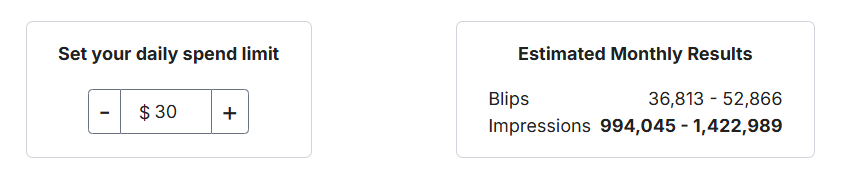
With Blip, you control exactly how much you spend on Park Forest billboards by setting a daily budget that can be as small or as large as you like, and Blip automatically keeps your campaign within that amount. Each “blip” is a 7.5–10 second ad on digital billboards near Park Forest, Illinois, and you only pay for the blips you get, so your total cost over time is simply the sum of those brief ad plays. Prices per blip vary based on when and where your ad runs and overall advertiser demand, but you can adjust your budget anytime to match your goals.
Where do Blip billboards reach near Park Forest, Illinois?
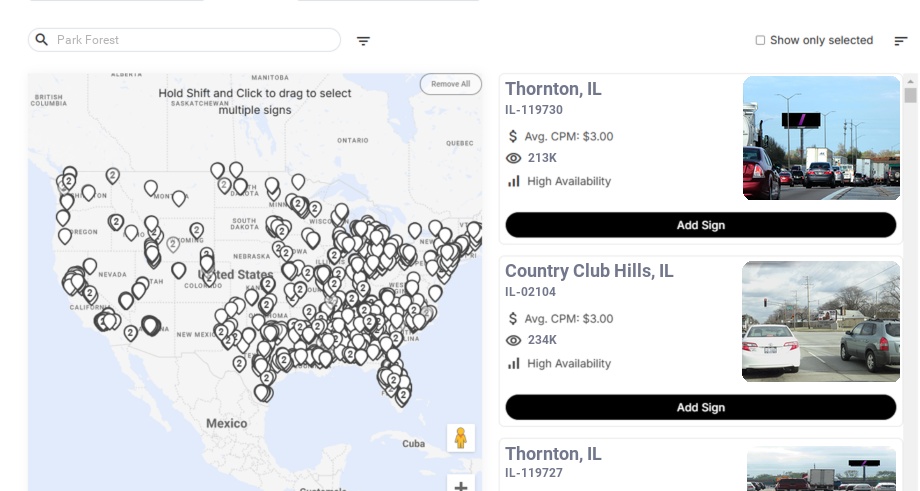
Our four digital billboards serving the Park Forest area are positioned in nearby communities within 10 miles, capturing both local and regional flows and providing consistent billboard advertising near Park Forest without needing boards directly inside the village limits. Country Club Hills is about 6 miles from Park Forest and sits along I‑57, US‑6 (159th Street), and Cicero Avenue, while Thornton is about 7.5 miles away near I‑294, I‑80, and IL‑83. These locations are ideal for reaching Park Forest residents heading to and from Chicago, as well as shoppers, commuters, and regional travelers.
What kind of people live in Park Forest, Illinois for billboard advertising?
Park Forest is a mature, middle-income community with stable neighborhoods and strong local identity. The area has a population of roughly 21,000–22,000 residents, a median household income in the low–mid $50,000s, and a diverse population that is more than 60–65% Black or African American. It also has a median age in the mid-to-late 30s, with a balanced mix of families and seniors.
When is the best time to run Blip ads near Park Forest, Illinois?
Blip’s ability to schedule by time of day is especially powerful near Park Forest, where traffic patterns are consistent but vary by corridor and purpose. Weekday rush hours are ideal for commuters, midday captures seniors and at-home parents, and evenings and weekends are strong for shopping, dining, entertainment, and events. The page also notes that Blip can allocate higher budgets to the most valuable dayparts and reduce or pause spending during lower-impact times.
What kinds of businesses should advertise on Park Forest, Illinois billboards?
Digital billboards serving the Park Forest area work especially well for local retail and services, healthcare and wellness, education and training, and events, arts, and nonprofits. The page specifically highlights grocery, hardware, and discount stores, auto service centers, local banks and credit unions, colleges and trade schools, and community events. These campaigns benefit from the high daily traffic counts and the dense network of local institutions around Park Forest.
Do I need a contract to advertise with Blip near Park Forest?
No, Blip has no long-term contracts or minimum commitments. You can start, pause, or stop your campaign at any time.
How fast can I launch a billboard campaign with Blip near Park Forest?
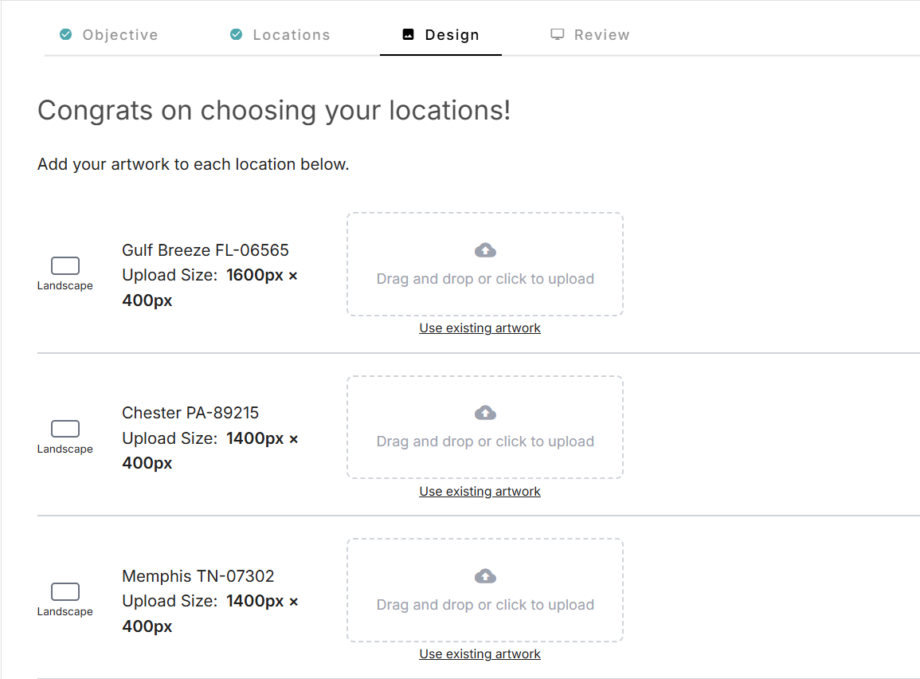
You can have your campaign live in minutes. Create a free account, select your locations, set your budget, upload your design, and start running once approved.
Where can I advertise with Blip near Park Forest?
Blip has digital billboards near Park Forest. You can browse available locations on a map, choose the ones that fit your audience, and start advertising right away.
Still have questions? Launch a campaign in minutes — no contracts, no commitments.
Start Your CampaignPark Forest Billboard Advertising Guide
The Park Forest area sits at the heart of Chicago’s south suburbs, with residents, commuters, and shoppers constantly moving along the key corridors that connect Park Forest to nearby hubs like Country Club Hills and Thornton
Understanding the Park Forest Area Market
Park Forest is a mature, middle-income community with stable neighborhoods and strong local identity. According to village and regional planning data from sources such as the Village of Park Forest and the Chicago Metropolitan Agency for Planning, the Park Forest area has:
- A population of roughly 21,000–22,000 residents, with about 8,500–9,000 households, making it one of the larger south suburban communities and a consistent draw for retail and services.
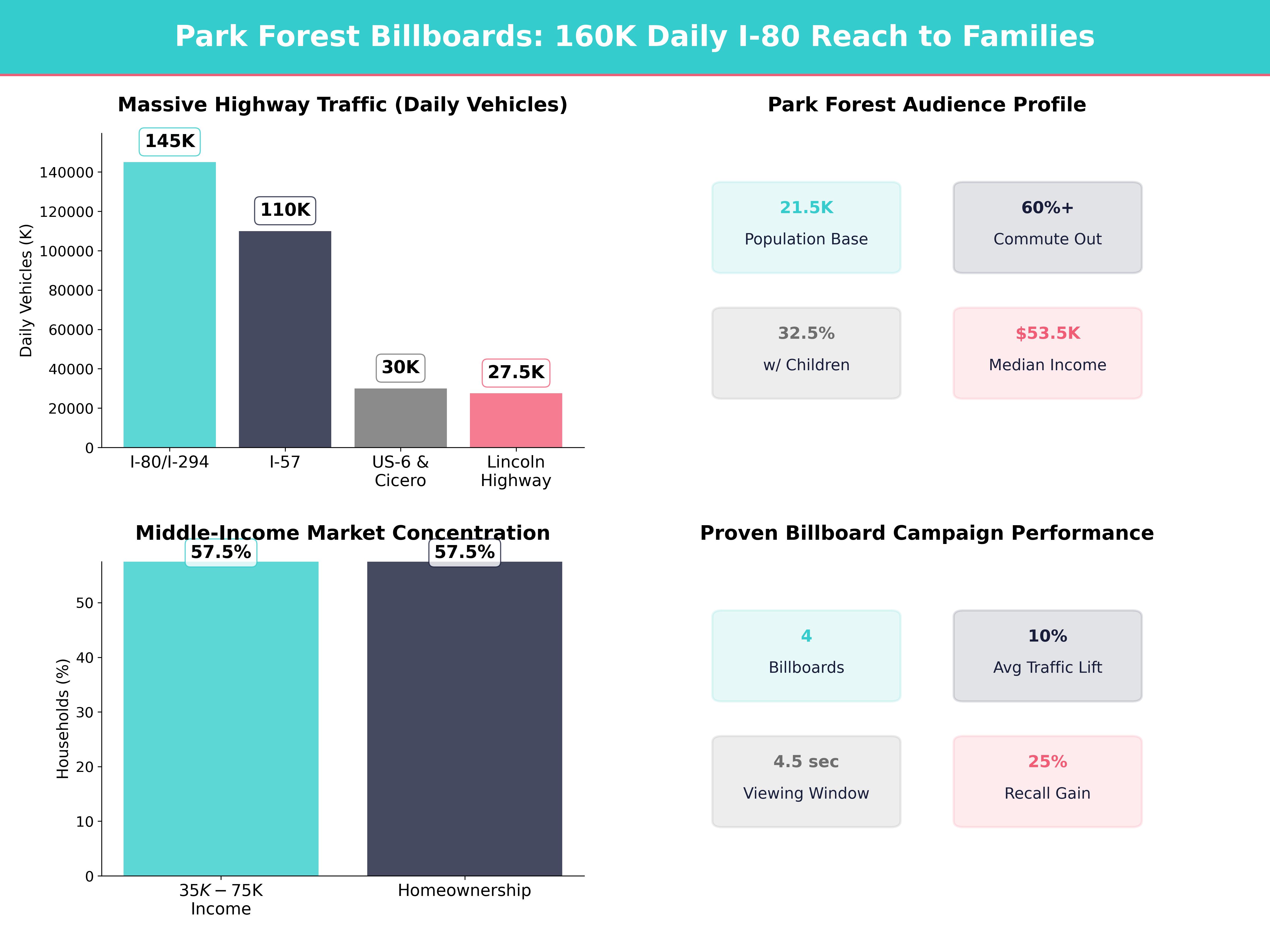
- A median household income in the low–mid $50,000s (around $52,000–$55,000), with roughly 55–60% of households between $35,000 and $75,000, ideal for value-focused retail, health, financial, and home services messaging.
- A diverse population: more than 60–65% Black or African American, around 20–25% White, and an expanding Latino and multiracial population that has grown by several percentage points over the past decade, which supports inclusive, community-oriented creative.
- A median age in the mid-to-late 30s, with roughly 25–30% of residents under 18 and 15–18% age 65+, creating a balanced mix of families with school-age children and a meaningful senior population.
- A homeownership rate in the 55–60% range, indicating a stable base of long-term residents who respond well to trust- and relationship-based branding.
Local government and planning information from the Village of Park Forest emphasizes a focus on neighborhood stability, arts and culture, and small-business development, all of which support hyper-local, community-based billboard messaging. The village’s economic development efforts and cultural assets—such as the Downtown Park Forest area, annual festivals, and arts programming—attract thousands of visitors each year, giving advertisers recurring seasonal touchpoints and making billboard advertising near Park Forest especially effective for staying visible during these peaks.
Nearby economic and traffic hubs like Country Club Hills and Thornton expand the effective reach of campaigns serving the Park Forest area, as residents regularly travel to these communities for work, shopping, entertainment, and regional travel connections. For instance, retail corridors in Country Club Hills and industrial/transportation centers near Thornton
Where Our Billboards Reach Near Park Forest
Our four digital billboards serving the Park Forest area are positioned in nearby communities within 10 miles, capturing both local and regional flows documented in Illinois Department of Transportation (IDOT) traffic counts and providing consistent billboard advertising near Park Forest without needing boards directly inside the village limits.
-
Country Club Hills (about 6 miles from Park Forest):
- A major retail and traffic node along I‑57, US‑6 (159th Street), and Cicero Avenue, with big-box shopping, dining, and entertainment that draw visitors from Park Forest, Matteson, and Tinley Park.
- IDOT traffic counts on I‑57 between 159th Street and 167th Street typically show 100,000–120,000 vehicles per day (AADT), while segments of US‑6 (159th Street) and Cicero Avenue in Country Club Hills and neighboring Matteson and Markham often carry 25,000–35,000 vehicles per day.
- This is ideal for reaching Park Forest residents heading to and from Chicago, as well as shoppers visiting big-box retail and dining along 159th Street and Cicero Avenue.
-
Thornton (about 7.5 miles from Park Forest):
- Strategically located near I‑294 (Tri-State Tollway), I‑80, and IL‑83 (Torrence Avenue), with high regional through-traffic connecting Chicago’s south suburbs to northwest Indiana.
- Many Park Forest area residents heading toward northwest Indiana, the south suburbs, or O’Hare/Midway corridors pass through or near this area.
- IDOT volumes on nearby stretches of I‑80/I‑294 commonly fall in the 130,000–160,000 vehicles per day range, with key interchanges near Halsted Street and Torrence Avenue acting as major funnel points for commuters, trucks, and regional shoppers.
Because Blip lets us buy digital “blips” of time on these boards by budget rather than by fixed contracts, advertisers can scale exposure to Park Forest area drivers and shoppers without needing to commit to long-term, static billboard leases. This makes billboard rental near Park Forest straightforward and budget-friendly, so you can buy into high-traffic locations that routinely capture hundreds of thousands of weekly impressions at spend levels that match your goals.
Key Audience Segments in the Park Forest Area
A strong campaign starts with a clear audience. In the Park Forest area, several high-value segments stand out, supported by commuting and demographic trends in data from CMAP and south suburban planning agencies. Understanding these segments helps tailor Park Forest billboards to the people most likely to respond.
Commuters and Workers
- A substantial share of Park Forest residents—often 60% or more of employed adults—commute out of the village for work, with common destinations including Chicago, Matteson, Tinley Park, Chicago Heights, and nearby industrial and logistics hubs.
- Nearby highways such as I‑57, I‑80, and I‑294, plus arterials like Lincoln Highway (US‑30) and Cicero Avenue, are daily routes for thousands of Park Forest area commuters. Segments of Lincoln Highway near Chicago Heights typically record 25,000–30,000 vehicles per day.
- Metra’s Electric District line, accessible from nearby stations in Matteson and University Park, carries tens of thousands of riders weekly, while Pace Suburban Bus routes connect Park Forest to surrounding job centers.
Billboards serving the Park Forest area in Country Club Hills and Thornton can repeatedly hit this commuter base during morning and evening rush hours, perfect for:
- Professional services (healthcare, dental, legal, financial)
- Education and workforce programs
- Transit-accessible retail and dining promotions
- Automotive services, given that south suburban drivers average 20–30+ minutes per commute, much of it on these corridors.
Families and Households
The Park Forest area has a high share of family households, supported by:
- School District 163 (Park Forest–Chicago Heights), highlighted by Park Forest–Chicago Heights School District 163 as serving around 1,500–2,000 students across multiple elementary and middle schools.
- Nearby Rich Township High School District 227, described on the District 227 website as serving roughly 4,000 high school students from several south suburban communities.
- Family-oriented amenities promoted by the Village of Park Forest, including more than 400 acres of parks and open space, multi-use trails, and a full calendar of youth and family events.
As a result, roughly 30–35% of Park Forest households are families with children under 18, creating consistent demand for child- and household-focused services.
Family-oriented campaigns can focus on:
- After-school programs and youth sports
- Kids’ healthcare and dental services
- Groceries, quick-service restaurants, and family dining
- Home improvement, furniture, and local contractors
- Financial products such as savings accounts and college-planning tools targeted at parents
Seniors and Long-Term Residents
Park Forest has a meaningful population over 55, including retirees and long-term homeowners:
- Seniors (age 65+) comprise roughly 15–18% of the local population, with an even larger share when including pre-retirement residents aged 55–64.
- Many have lived in the area for 10–20+ years, giving them strong loyalty to local providers and institutions such as nearby hospitals and clinics in Chicago Heights and Olympia Fields Franciscan Health Olympia Fields.
This group often responds to:
- Healthcare providers and specialists
- Senior living and in-home care
- Financial planning, insurance, and estate services
- Local cultural and community events
Clear, easy-to-read creative placed during weekday mid-days and early evenings can capture this audience as they move between medical appointments, shopping centers, and community events, when traffic volumes on local arterials remain strong but slightly below rush-hour peaks. For advertisers, this makes Park Forest billboards a useful complement to print and direct mail efforts targeting older residents.
Students and Lifelong Learners
The Park Forest area sits within reach of several educational institutions, including:
- Prairie State College in Chicago Heights – highlighted by Prairie State College as serving tens of thousands of credit and non-credit students annually from across the south suburbs.
- Governors State University in University Park – promoted by Governors State University as enrolling more than 5,000 students in undergraduate and graduate programs, many of whom are adult learners and commuters.
Campaigns for higher education, certification programs, and trade schools can focus on:
- Evening and weekend commuters along the Country Club Hills and Thornton boards, which see continuing high traffic into the early evening hours.
- Enrollment periods (late spring, late summer, early winter), when institutions report their largest spikes in inquiries and applications.
- Messaging around affordability, flexible schedules, and local access—key factors for south suburban students, many of whom balance school with work and family responsibilities.
Traffic Patterns and Dayparting Strategy
Blip’s ability to schedule by time of day (dayparting) is especially powerful near Park Forest, where traffic patterns are consistent but vary by corridor and purpose. IDOT and regional planning data show that peak congestion on I‑57 and I‑80 in the south suburbs typically aligns with standard commuter windows, while retail corridors see more diffuse midday and weekend peaks. Matching your billboard advertising near Park Forest to these patterns helps ensure that impressions align with customer intent.
Weekday Rush Hours (6–9 a.m., 3:30–7 p.m.)
- Ideal for commuters traveling to and from jobs in Chicago, Matteson, Tinley Park, and industrial or logistics zones along I‑57 and I‑80. Morning peaks on I‑57 and I‑80 segments near Country Club Hills and Hazel Crest often reach 70–80% of daily capacity.
-
Use rush-hour dayparts for:
- Service businesses that want top-of-mind awareness (auto repair, medical, insurance)
- Transit-accessible destinations (downtown Chicago, Metra-linked locations)
- Quick-service restaurants promoting breakfast or dinner options
- Employers recruiting for shift-based or office roles, especially when hiring surges or job fairs are scheduled
Midday (10 a.m.–3 p.m.)
- Captures seniors, at-home parents, service workers on variable schedules, and professionals on lunch or errand breaks.
- Traffic levels on major arterials like Lincoln Highway and Cicero Avenue remain strong, often at 50–60% of peak volume.
-
Strong for:
- Healthcare appointments and elective services
- Retail (groceries, discount stores, clothing, home goods)
- Local government or nonprofit messaging
- Financial institutions, as many branches report steady midday walk-in activity
Evenings and Weekends
- Park Forest area residents often travel for shopping, dining, and entertainment at hubs promoted by the Chicago Southland Convention & Visitors Bureau hundreds to several thousand attendees per weekend.
- Weekend highway volumes on I‑57 and I‑80 remain high, frequently reaching 80–90% of weekday levels, with retail corridors experiencing some of their heaviest activity on Saturday afternoons.
-
Weekend and evening dayparts are ideal for:
- Restaurants, bars, bowling, and entertainment venues
- Events, concerts, and seasonal attractions
- Faith-based services or community gatherings
- Automotive and home services targeting weekend project and errand trips
With Blip, we can allocate higher budgets to the most valuable dayparts and reduce or pause spending during lower-impact times, allowing hyper-efficient campaigns that mirror real traffic and shopping patterns on Park Forest billboards and nearby routes.
Creative Strategies That Resonate Near Park Forest
Effective billboard creative in the Park Forest area should reflect both the community’s character and the fast-moving nature of nearby highways. Strong creative ensures that your investment in billboard rental near Park Forest translates into real attention and recall.
Emphasize Clear, Local Relevance
-
Use place names Park Forest residents recognize:
- “Near Lincoln Highway and Cicero”
- “Minutes from Matteson & Park Forest area”
- “Serving the Park Forest area since 1995”
-
Highlight proximity with drive-time phrases backed by actual travel times: most drivers can reach key retail corridors in 5–12 minutes from Park Forest. For example:
- “5 minutes from this exit”
- “Just off I‑57 at 159th”
These cues help drivers immediately connect your message to their mental map and make it easier to act on impulse offers, especially when they repeatedly see the same message on billboards near Park Forest during regular commutes.
Design for Fast Highways
On high-speed corridors near Country Club Hills and Thornton:
- Limit to 7 words or fewer of main copy where possible, in line with outdoor-industry best practices that show dramatic drops in comprehension as word counts increase.
- Use large, high-contrast fonts; white or yellow text on dark backgrounds is highly legible, especially in winter or rain.
-
Prioritize a single focal point:
- Logo + one offer (“$29 Oil Change”)
- Event + date (“Jazz Fest, Aug 10–11”)
- Call to action + short URL or phone number.
This approach matches the 3–6 second viewing window typical for vehicles traveling 55–70 mph past a digital billboard.
Culturally Aware, Community-Forward Messaging
Local news outlets like the Daily Southtown and Patch’s Park Forest section
- Community festivals and art events
- Youth programs and school achievements
- Civic engagement and neighborhood initiatives
Brands that reference community values—support for local schools, sponsorship of events, or neighborhood improvement—tend to build stronger affinity. Consider:
- “Proud supporter of Park Forest youth”
- “Serving south suburban families for 20+ years”
- Featuring local imagery (village green, parks, or recognizable landmarks) in your visuals.
With more than 60% of residents identifying as Black or African American and a significant share of multigenerational households, messaging that reflects cultural diversity, family connections, and local pride resonates strongly.
Rotating Creative by Season
The Park Forest area experiences all four seasons distinctly, which creates natural campaign windows and predictable shifts in demand:
-
Winter (Dec–Feb):
- Promote heating, auto service (batteries, tires, brakes), insurance, and post-holiday retail. Local crash and breakdown statistics typically rise in severe weather, making preventative auto and safety messaging timely.
- Feature strong contrast and simple design for low-visibility conditions, when sunset can fall as early as 4:20 p.m. in December.
-
Spring (Mar–May):
- Focus on home improvement, yard services, tax prep, and spring events. Many contractors and landscapers report their first major booking spikes in late March and April.
- Align with local events listed on the Village of Park Forest calendar, such as community clean-ups, art walks, and park activities.
-
Summer (Jun–Aug):
- Highlight festivals, summer camps, outdoor dining, and attractions promoted by Chicago Southland tourism thousands of attendees across multiple weekends.
- Use bright colors and bold imagery that stand out in long daylight hours, with sunsets after 8 p.m. in June offering extended visibility for evening campaigns.
-
Fall (Sep–Nov):
- Back-to-school, healthcare (flu shots, screenings), and holiday pre-planning. Schools in District 163 and District 227 typically start classes in August, making late July and August prime windows for education-related messaging.
- Tailor messaging to school schedules and fall sports calendars across local districts, as Friday nights and weekend days see heavy family travel to games, practices, and events.
Blip’s flexible platform allows you to swap creatives quickly, so campaigns can mirror these seasonal shifts without reprinting or long lead times, and you can test which seasonal themes deliver the best response on Park Forest billboards and nearby routes.
Using Geography to Your Advantage
Because our billboards serving the Park Forest area sit in surrounding markets, the geography of how residents move becomes central to strategy. Commuting and shopping patterns documented by regional planners show that a large share of Park Forest residents make daily or weekly trips to nearby suburbs for work, school, healthcare, and retail. Well-placed billboards near Park Forest can intercept these trips multiple times per week.
Target Likely Travel Paths
Consider the most common trips Park Forest area residents make:
- Park Forest ↔ Country Club Hills (via Lincoln Highway, Cicero, I‑57)
- Park Forest ↔ Chicago (via I‑57, Metra Electric stops in nearby communities like University Park and Matteson)
- Park Forest ↔ Northwest Indiana (via I‑80, I‑294)
- Park Forest ↔ University Park, Chicago Heights, Tinley Park for school, retail, and services
Align your campaign with these patterns:
- Place heavier emphasis on boards that intercept commuter flows relevant to your location. For example, a retailer in Tinley Park may weight spend toward the Country Club Hills board that catches I‑57 and 159th Street traffic.
- Use directional cues (“Next 2 Exits,” “Next Right on Cicero”) when your location is an easy on/off from nearby highways or major arterials, especially where travel-time savings of 5–10 minutes over competing routes can be highlighted.
- Promote offers that match trip purposes—commute, shopping, weekend leisure, or school—so your creative feels timely to why drivers are on the road.
Regional vs. Hyper-Local Tactics
- Hyper-local campaigns (e.g., a dentist or auto shop serving the Park Forest area) should focus on proximity, trust, and convenience, using geographically specific headlines (“5 minutes from Downtown Park Forest,” “On Lincoln Highway near Chicago Heights”). These businesses typically draw customers from a 3–7 mile radius, which aligns well with the board locations and makes billboard advertising near Park Forest a natural extension of local word-of-mouth.
- Regional campaigns (e.g., hospitals, universities, or destination retailers) can lean more on brand recognition and benefits, using the Park Forest area boards as part of a multi-market south suburban strategy that may span 20–30+ miles of draw radius.
Blip lets us adjust budgets per board, so you can weight spend heavily toward the boards that align with your customer draw radius and scale back on areas that bring diminishing returns.
Local Business and Event Use Cases
Digital billboards serving the Park Forest area work especially well for these kinds of advertisers, drawing on both the high daily traffic counts and the dense network of local institutions, as highlighted by the Village of Park Forest and Chicago Southland Convention & Visitors Bureau
Local Retail and Services
- Grocery, hardware, and discount stores emphasizing weekly deals or grand openings. Many chains report that digital billboard support can lift store traffic 5–15% during key promotional periods.
- Auto service centers leveraging repeated impressions along commuter routes; with over 100,000 vehicles per day on nearby interstates, even a small share of converted drivers can produce substantial volume.
- Local banks and credit unions highlighting branch openings, checking bonuses, or mortgage offers, especially around spring homebuying season and year-end financial planning.
Rotating creative allows you to:
- Feature different product categories by season (back-to-school, holiday, tax season).
- Test multiple offers to see which drives more website visits or in-store traffic.
- Align short-term campaigns (48–72 hours) with flash sales or limited-time promotions.
Healthcare and Wellness
With residents frequently traveling through Country Club Hills and Thornton for work and errands, healthcare providers can:
- Promote primary care, urgent care, and dental services with straightforward calls to action.
- Highlight after-hours or weekend hours for commuters—particularly valuable given that many south suburban workers have 30–60 minute round-trip commutes.
- Push seasonal campaigns (e.g., flu shots, physicals, screenings) tied to public health messaging promoted by local providers and municipalities such as Cook County and nearby villages.
Because healthcare decisions are often high-consideration, the repeated exposure offered by digital billboards—frequently dozens of impressions per driver per month on regular routes—supports brand familiarity and trust.
Education and Training
Colleges, trade schools, and certification programs can:
- Run heavy bursts just before key enrollment deadlines, when institutions like Prairie State College and Governors State University typically see double- or triple-digit percentage increases in website visits and inquiries.
- Alternate messaging by program (nursing, IT, trades, business) to different dayparts or days. For example, healthcare programs may focus on daytime commuters linked to hospitals and clinics, while IT or business programs target evening traffic.
- Use short URLs or QR-friendly domains for easy on-the-go follow-up, capitalizing on the high smartphone adoption rate in the region (often 90%+ of adults).
Events, Arts, and Nonprofits
The Park Forest area has a strong arts and community-events culture promoted through:
- The Village of Park Forest events calendar
- Regional listings on Chicago Southland Convention & Visitors Bureau
- Coverage in local news outlets like Daily Southtown
Many local festivals, concerts, and community gatherings attract hundreds to several thousand attendees each, depending on the event and season.
Digital billboards can:
- Build awareness 2–4 weeks before an event, when awareness and intent to attend are most responsive to advertising.
- Countdown to event dates (“This Weekend,” “Tonight 7 p.m.”), creating urgency that drives last-minute attendance.
- Thank sponsors or promote recurring series (farmer’s markets, summer concerts), supporting fundraising, grant applications, and long-term community visibility.
Measuring and Optimizing Your Campaign
To get the most from your investment in digital billboards serving the Park Forest area, pair our flexible tools with clear performance indicators. This applies whether you’re testing a small trial of billboard advertising near Park Forest or running a sustained, multi-board presence.
Define Clear KPIs
Align your campaign with measurable outcomes such as:
- Increases in website traffic from south suburban ZIP codes (e.g., 60466, 60478, 60471, 60411, and surrounding).
- Promo code redemptions or landing page visits tied to billboard-only offers, aiming for a measurable lift (even 1–3% conversion from exposed audiences can be meaningful in high-traffic corridors).
- Store traffic or sales spikes aligned with your flight dates and dayparts, tracked via POS data or footfall analytics.
- Call volume or appointment requests tracked to billboard messaging using unique phone numbers or call-tracking services.
Use Time-Based and Geographic Testing
Because you can adjust spend in near real time with Blip:
- Test different creatives by week and compare web or store metrics. For example, run Offer A for one week, Offer B the next, and measure differences in redemptions or traffic.
- Shift budget toward the times and boards that show the best results (e.g., higher weekend store traffic after weekend-heavy flights, or better midweek performance tied to specific promotions).
- Run A/B tests with different offers or headlines to see which resonates most in the Park Forest area—such as comparing discount-focused messaging versus convenience or quality-focused messaging.
Integrate with Other Local Media
Digital billboards become more powerful when integrated with:
- Social media campaigns targeting Park Forest area interests and ZIP codes, using geo-targeting around Park Forest, Country Club Hills, Thornton, and nearby communities.
- Local news advertising through outlets like Patch Park Forest Daily Southtown, which reach tens of thousands of south suburban readers online and in print.
- Direct mail or email campaigns reinforcing the same tagline or offer, especially for hyper-local service providers and retailers.
A consistent phrase or visual across billboards, digital ads, and local media increases recall substantially—industry studies often cite 20–30% gains in ad recall when multiple channels are coordinated—and improves the odds that Park Forest area residents will act when they see your message.
By understanding how Park Forest area residents move through nearby corridors, what they value, and how seasons and dayparts shape their routines, we can design digital billboard campaigns that feel both smart and local. With four flexible digital billboards in nearby Country Club Hills and Thornton, and Blip’s ability to adjust creative, budget, and timing on demand, advertisers can efficiently reach the Park Forest area with messages that truly fit the market and leverage the hundreds of thousands of weekly impressions available on the region’s busiest routes, all while keeping billboard rental near Park Forest aligned with your goals and budget.