Billboards in Oak Lawn, IL
No Minimum Spend. No Long-Term Contracts. Just Results.
Trusted by Leading Brands


Billboard advertising
in Oak Lawn has never been easier



How much is a billboard in Oak Lawn?
Why Choose Blip for Billboard Advertising in Oak Lawn
Blip lets you launch Oak Lawn ads in minutes, perfect for commuters on 95th, Cicero, I-55, and I-294.
Set a flexible budget for Oak Lawn and pay only for the blips you use—great for testing retail, healthcare, or hiring messages.
Daypart Oak Lawn campaigns for rush hours, Chicago Ridge Mall weekends, or midday hospital traffic to match real audience flow.
No contracts mean Oak Lawn businesses can start small, pause, or scale up fast around school, mall, or holiday spikes.
Track Oak Lawn performance in real time and shift spend toward the boards and corridors that drive the most calls and visits.
Use Blip's creative tools to make clear, local Oak Lawn billboards with simple, high-contrast copy for drivers moving fast.
Frequently Asked Questions About Billboard Advertising in Oak Lawn
How much does a billboard cost near Oak Lawn, Illinois with Blip?
With Blip, you choose exactly how much you want to spend each day on Oak Lawn billboards, and Blip automatically keeps your campaign within that daily budget. Because you only pay per “blip”—a 7.5 to 10-second ad on rotating digital billboards near Oak Lawn, Illinois—your total cost is simply the sum of all the blips you receive. You can start small, adjust your budget anytime, and scale up when you see results in the Oak Lawn area.
Where can I advertise with Blip near Oak Lawn, Illinois?
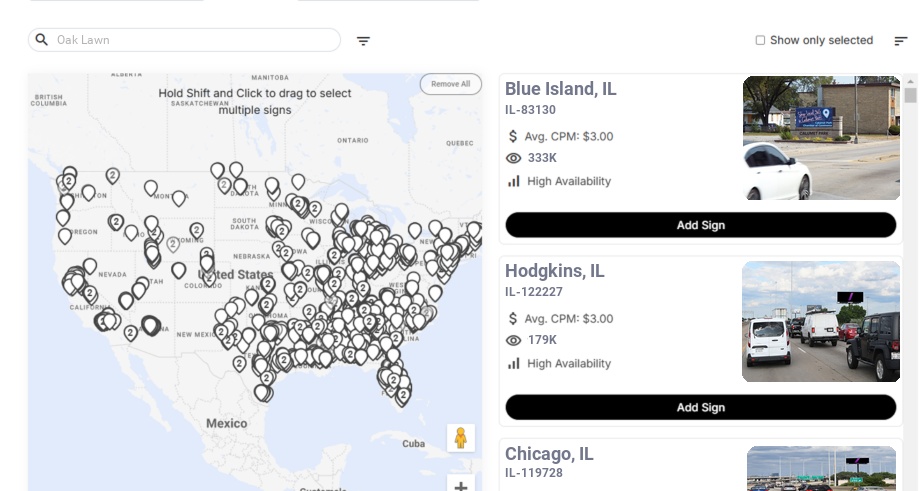
Our digital billboards serving the Oak Lawn area are located within roughly 10 miles in key surrounding suburbs, including Chicago Ridge, Worth, Alsip, Bedford Park, Hodgkins, Justice, Summit, and Blue Island. This network of billboards near Oak Lawn makes it easy to reach local audiences without paying downtown Chicago prices. By using our network of 41 digital billboards serving the Oak Lawn area, we can help you reach not only Oak Lawn residents but also the estimated tens of thousands of commuters and shoppers flowing through neighboring communities each day.
What kind of people does Blip reach in Oak Lawn, Illinois?
Oak Lawn is one of southwest Cook County’s largest and most stable suburbs, with roughly 57,000 residents and a balanced mix of families, young professionals, and older adults. The Oak Lawn area features a racially and ethnically diverse community, including significant White, Hispanic/Latino, Black, and Arab-American populations. In many neighborhoods, more than 20–25% of residents speak a language other than English at home.
When is the best time to run billboard ads in Oak Lawn, Illinois?
Understanding when people are moving is just as important as where they are. Morning commute traffic is heavy from 6–9 a.m., midday works well for local errand and lunch trips from 11 a.m.–2 p.m., and the evening commute from 4–7 p.m. is often the heaviest return-home period. Saturdays often see increased traffic to retail hubs, big-box stores, automotive services, and the mall.
What roads and traffic corridors in Oak Lawn, Illinois get the most billboard visibility?
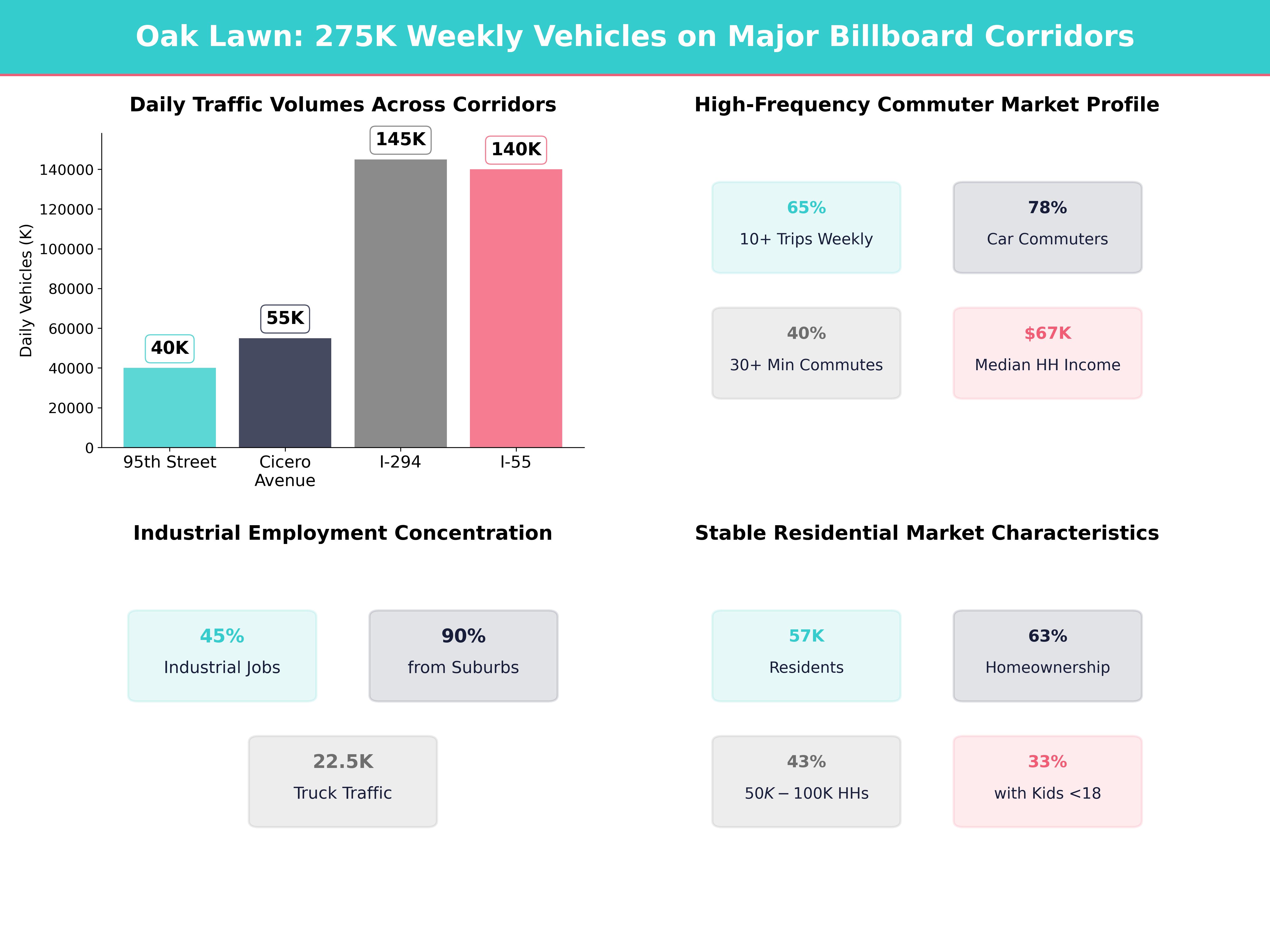
95th Street (US-20) is one of the busiest east-west corridors in the Oak Lawn area, with segments near Oak Lawn and Chicago Ridge often carrying around 35,000–45,000 vehicles per day. Cicero Avenue (IL-50) is a major north-south route with nearby segments frequently exceeding 50,000–60,000 vehicles per day, and I-294 and I-55 near Bedford Park, Hodgkins, Summit, and Justice commonly surpass 130,000–150,000 vehicles daily. These roads create strong reach for retail, dining, commuting, and regional branding campaigns.
Do I need a contract to advertise with Blip in Oak Lawn?
No, Blip has no long-term contracts or minimum commitments. You can start, pause, or stop your campaign at any time.
How fast can I launch a billboard campaign with Blip in Oak Lawn?
You can have your campaign live in minutes. Create a free account, select your locations, set your budget, upload your design, and start running once approved.
Where can I advertise with Blip in Oak Lawn?
Blip has digital billboards in Oak Lawn. You can browse available locations on a map, choose the ones that fit your audience, and start advertising right away.
Still have questions? Launch a campaign in minutes — no contracts, no commitments.
Start Your CampaignOak Lawn Billboard Advertising Guide
Village of Oak Lawn sits at the heart of Chicago’s southwest suburbs, with dense neighborhoods, busy retail corridors, and major regional highways all converging nearby. With 41 digital billboards serving the Oak Lawn area from surrounding communities like Village of Chicago Ridge, Village of Worth, Village of Alsip, Village of Bedford Park, Village of Justice, City of Blue Island, Village of Summit, and Village of Hodgkins, we can help advertisers put targeted, data-driven messages in front of the people who live, work, shop, and commute near Oak Lawn every day. This network of billboards near Oak Lawn makes it easy to reach local audiences without paying downtown Chicago prices.
Understanding the Oak Lawn Area Market
Oak Lawn is one of southwest Cook County’s largest and most stable suburbs. According to recent local estimates, the village has roughly 57,000 residents, with a balanced mix of families, young professionals, and older adults. The median age is in the upper‑30s (around 38–39 years), and household sizes average around 2.7–2.8 people, reflecting a strong family presence. Approximately 60–65% of occupied housing units are owner‑occupied, which helps support long-term neighborhood stability and consistent daily travel patterns.
A few key characteristics that matter for billboard advertisers in the Oak Lawn area:
- Commuter community: In the broader southwest Cook County area, about 75–80% of workers commute by car, and roughly 40% have commute times of 30 minutes or longer. Many Oak Lawn residents travel toward Chicago or other suburbs via major arterials like 95th Street, Cicero Avenue, Southwest Highway, and nearby expressways I‑294 and I‑55. Average commute times in the region are around 30–35 minutes, creating two strong daily peaks where the same drivers pass key billboard locations multiple times per day.
- Diverse population: The Oak Lawn area features a racially and ethnically diverse community, including significant White, Hispanic/Latino, Black, and Arab-American populations. In nearby south and southwest suburbs, it’s common for no single group to represent more than 55–60% of residents. In many neighborhoods, more than 20–25% of residents speak a language other than English at home. Messaging that is inclusive, culturally aware, and visually clear tends to perform best.
- Strong local anchors: Institutions like Advocate Christ Medical Center Oak Lawn Community High School, and nearby Chicago Ridge Mall draw visitors from across the southwest suburbs, expanding your reach beyond just local residents. Advocate Christ operates as a major regional hospital campus with more than 700 beds and several thousand employees on site; daily patient and visitor volumes can easily exceed 5,000–7,000 people. Chicago Ridge Mall has more than 130 stores and regularly attracts tens of thousands of shoppers per week, with foot traffic spikes of 30–40% on peak holiday and back‑to‑school weekends.
- Stable incomes, value-conscious consumers: Median household incomes in Oak Lawn and neighboring suburbs generally fall in the mid‑$60,000s to low‑$70,000s, with many nearby ZIP codes clustered in the $60,000–$80,000 range. In similar southwest Cook County communities, about 40–45% of households fall into the $50,000–100,000 band, supporting a strong middle‑class consumer base that is price-sensitive but willing to spend on quality goods, healthcare, dining, and family entertainment. Local consumer expenditure data typically show households in this range spending $6,000–$7,500 annually on food away from home and $3,000–4,000 on entertainment and recreation.
By using our network of 41 digital billboards serving the Oak Lawn area, we can help you reach not only Oak Lawn residents but also the estimated tens of thousands of commuters and shoppers flowing through neighboring communities like Chicago Ridge, Alsip, and Bedford Park each day. For advertisers evaluating Oak Lawn billboards versus other southwest suburban options, this broader coverage can deliver more impressions per dollar.
Where Our Billboards Reach Around Oak Lawn
Our digital billboards serving the Oak Lawn area are located within roughly 10 miles in key surrounding suburbs:
- Chicago Ridge (about 1.5 miles from Oak Lawn) – Near high-traffic retail centers, including Chicago Ridge Mall, which draws tens of thousands of visitors weekly and can see daily shopper counts climb 20–30% on Saturdays compared with weekdays. Segments of 95th Street and Ridgeland Avenue near the mall routinely carry well over 25,000–30,000 vehicles per day, making these boards ideal when you want billboards near Oak Lawn that specifically target retail traffic.
- Worth (2.8 miles) and Alsip (3.2 miles) – Close to Southwest Highway and busy north‑south connectors, capturing daily commuter traffic. Local traffic counts on Southwest Highway and 111th Street commonly range from 18,000–30,000 vehicles per day, depending on the specific segment, meaning a single board can easily produce hundreds of thousands of weekly impressions.
- Bedford Park (4.3 miles) and Hodgkins (6.4 miles) – Industrial and logistics corridors near I‑55 and I‑294, ideal for B2B, hiring, and driver-focused campaigns. These communities host dozens of warehouses and distribution facilities and tens of thousands of jobs; in some Bedford Park industrial zones, more than 90% of workers commute in from other suburbs, ensuring a constant flow of inbound and outbound traffic past nearby billboards.
- Justice (5.1 miles) and Summit (6.1 miles) – Adjacent to the I‑55 Stevenson Expressway and local freight routes, with strong visibility among commuters headed toward Chicago. Daily traffic volumes on expressway-adjacent segments near these villages often exceed 130,000 vehicles, and truck traffic alone can represent 10–15% of that flow.
- Blue Island (5.8 miles) – A historic rail hub and commercial center south of Oak Lawn, giving you additional reach into the broader south suburbs. With more than 20,000 residents and multiple Metra and freight rail lines, Blue Island adds both residential and worker audiences to your coverage.
These placements are designed to intercept:
- Oak Lawn residents leaving and returning home each day. In typical suburban markets, 60–70% of workers make at least 10 round trips per week on the same main corridors, which supports consistent billboard frequency.
- Shoppers traveling to Chicago Ridge Mall, local plazas, and strip centers. Retail zones often see Saturday vehicle counts 10–25% higher than weekday averages, amplifying weekend campaigns.
- Hospital staff, patients, and visitors heading to the Advocate Christ Medical Center campus, which can generate thousands of trips per day along 95th Street, Kilbourn Avenue, and nearby arterials.
- Industrial, logistics, and office workers commuting through Bedford Park and Hodgkins, where daytime employment in some industrial clusters outnumbers resident population by a ratio of 3:1 or higher.
Instead of relying on a single location, you can use Blip to selectively buy impressions across multiple boards near Oak Lawn, creating a “halo” of coverage around the community that can easily total hundreds of thousands of weekly impressions at modest budgets. This flexible approach to billboard advertising near Oak Lawn allows you to weight your spend toward the corridors that matter most to your business.
Traffic Patterns and High-Impact Corridors
To maximize your campaign’s impact, we should match your schedules to real-world traffic flows near Oak Lawn. Local traffic counts from agencies such as the Illinois Department of Transportation and regional planning organizations show consistently high volumes on the major roads that frame the area.
Key arterial roads:
- 95th Street (US‑20): One of the busiest east‑west corridors in the Oak Lawn area, with segments near Oak Lawn and Chicago Ridge often carrying around 35,000–45,000 vehicles per day and some signalized intersections seeing even higher peaks at rush hour. Over a 7‑day period, this translates to roughly 250,000–300,000 vehicle trips, providing strong reach for retail, dining, and quick‑service promotions.
- Cicero Avenue (IL‑50): A major north‑south route with nearby segments frequently exceeding 50,000–60,000 vehicles per day; closer to Midway Airport, daily counts can top 70,000. This route reaches commuters, shoppers, and airport‑bound traffic, and in some sections more than 15% of vehicles are commercial or truck traffic—valuable for B2B and logistics messaging.
- Southwest Highway & 111th Street: Important local commuter routes connecting Oak Lawn with Worth, Alsip, and other adjacent suburbs. Typical daily volumes range from 18,000–30,000 vehicles, with weekday PM peaks often 20–30% higher than off‑peak periods.
Expressways near our boards:
- I‑294 (Tri‑State Tollway): Near Bedford Park and Hodgkins, daily traffic volumes commonly surpass 140,000–150,000 vehicles. On some segments, weekday truck volumes alone can reach 20,000–25,000 vehicles per day. This is ideal for wide‑area branding, logistics, recruitment, and regional service businesses that benefit from repeated exposure to the same commuter base.
- I‑55 (Stevenson Expressway): Near Summit and Justice, daily traffic volumes are also often in the 130,000–150,000 vehicle range, capturing long‑distance commuters and freight. Peak congestion hours can see speeds drop below 30 mph, effectively increasing viewing time for digital billboard messages.
With Blip, we can daypart your campaign (e.g., morning rush, evening rush, weekends) to coincide with these peak flows, so your budget focuses on periods with the highest potential impressions. For example, shifting spend into the 6–9 a.m. and 4–7 p.m. windows—roughly 6 hours that can account for 40–50% of daily traffic on some corridors—can significantly improve cost-per-impression efficiency.
Timing Your Campaign: When Oak Lawn Area Residents Are on the Road
Understanding when people are moving is just as important as where they are. Typical suburban traffic data patterns around Oak Lawn show clear weekday and weekend differences.
Weekday patterns:
-
Morning commute (6–9 a.m.): Heavy outbound traffic toward downtown Chicago and industrial zones like Bedford Park, Hodgkins, and Alsip. On many arterials, traffic during these hours is 30–40% higher than midday volumes. Great for:
- Coffee, breakfast, and quick‑service restaurant promotions that can capture early-day decisions.
- Workforce recruitment (“Now Hiring” messages) when workers are thinking about job options.
- Healthcare reminders (flu shots, urgent care hours) that can influence same-day or after-work visits.
-
Midday (11 a.m.–2 p.m.): Local errand and lunch trips around 95th Street, Cicero Avenue, and shopping centers like Chicago Ridge Mall. In retail corridors, midday can represent 25–30% of total daily traffic. Perfect for:
- Retail sales, limited‑time offers, and service businesses.
- Healthcare, dental, or financial services targeting nearby workers on lunch breaks.
-
Evening commute (4–7 p.m.): The heaviest return‑home period, often matching or slightly exceeding morning volumes. Many drivers are exposed to the same boards twice per day, yielding high frequency. Use this for:
- Grocery and dining specials (“Dinner for 4 under $25”).
- Family activities, gyms, and entertainment.
- Political and cause‑based messaging during election cycles, especially in the 30–45 days before Election Day when turnout messaging ramps up.
Weekend patterns:
- Saturdays often see increased traffic to retail hubs, big-box stores, automotive services, and the mall; it’s common for major shopping corridors to have Saturday vehicle counts 10–25% higher than a typical weekday. Sundays skew more toward dining, religious services, family outings, and sports, with late morning and early evening as key peaks.
- We can increase your weekend frequency if your business depends on these high‑intent trips (e.g., auto dealers, furniture stores, kids’ activities, and events). For some categories, 30–40% of weekly sales may occur on just Saturday and Sunday, so increasing impressions 20–30% on those days can be especially effective.
Because Blip lets you choose specific hours and days, you don’t pay for low-value impressions when your audience is less active, such as late nights on commuter-only boards.
Key Audience Segments in the Oak Lawn Area
The Oak Lawn area’s diversity translates into several high‑value audience groups. Local school and employment patterns, combined with regional survey data, help illustrate how large these segments can be.
-
Families with Children
- In many Oak Lawn and nearby ZIP codes, roughly 30–35% of households include children under 18, and the share of married-couple families with kids typically lands around 20–25%. Many neighborhoods feature single‑family homes, local parks, and strong school districts (Oak Lawn Community High School, local elementary schools in districts such as Oak Lawn-Hometown School District 123 and Ridgeland School District 122
- Families commonly account for a large share of local spending on dining, entertainment, and healthcare; in similar suburban communities, family households can generate 50% or more of local retail demand.
- Focus on: pediatric healthcare, family dining, tutoring and enrichment, youth sports, and after‑school activities.
- Creative tip: Use short, family-oriented messages (“Kids Eat Free Tuesdays,” “Same‑Day Pediatric Visits”) with bright, high‑contrast visuals and clear directional cues (“2 minutes from 95th & Cicero”).
-
Healthcare Workers and Patients
- Advocate Christ Medical Center
- Healthcare and social assistance jobs can account for 10–15% of total employment in many south and southwest Cook County communities, making it one of the top local sectors.
-
Target employees with:
- Banking, insurance, and real estate services tailored to shift workers.
- Fitness centers and healthy dining options geared toward quick breaks or post‑shift visits.
- Hiring messages for adjacent medical or allied health services.
-
Target patients and visitors with:
- Pharmacy, specialty clinics, outpatient services.
- Hotels, restaurants, and transportation near the campus.
- Clear, simple wayfinding (“3 minutes west of Advocate Christ on 95th”).
-
Retail Shoppers
- Chicago Ridge Mall and major strip centers along 95th Street and Cicero Avenue draw residents from Oak Lawn, Chicago Ridge, Worth, Alsip, and beyond. In typical regional malls of this scale, annual foot traffic can reach several million visits; key weekends (Black Friday, mid‑December, back‑to‑school) may see daily traffic more than double an average weekday.
- Local spending data in comparable suburbs often show 25–30% of annual retail sales concentrated in the November–December period, and another 10–15% around back‑to‑school season.
-
Use short‑term campaigns for:
- Weekend sales, clearance events, and new store openings.
- Seasonal promotions (back‑to‑school, Black Friday, holiday sales).
- Blip’s flexibility lets you ramp up impression volume for key retail weekends while staying lean on slower days, so your cost per incremental visit stays efficient.
-
Industrial and Logistics Workforce
- Nearby Bedford Park, Summit, Hodgkins, and Alsip host a dense cluster of distribution centers, manufacturers, and logistics firms, including facilities that serve the Chicago region and national supply chains. In some of these communities, employment in manufacturing, transportation, and warehousing can represent 40–50% of all local jobs.
- Many of these workers commute from a wide radius; commuter data for similar industrial suburbs show more than 80% of employees living outside the village where they work, dramatically increasing cross‑suburban traffic along I‑55, I‑294, and connecting arterials.
-
This creates strong demand for:
- Hiring campaigns (CDL drivers, warehouse staff, skilled trades).
- B2B services (equipment leasing, safety training, logistics tech).
- Billboards near I‑55 and I‑294 are particularly useful for messages focusing on drivers and shift workers, as truck and commercial traffic can account for 10–20% of total vehicles on these corridors.
-
Commuters to Chicago
- Many Oak Lawn area residents use major roads and transit like Pace and Metra’s SouthWest Service Oak Lawn Metra station
- Regionwide data show that in many Cook County suburbs, 10–15% of workers use transit or carpooling for their commute, while the majority still drive. That blend makes roadside billboards uniquely efficient for reaching both drivers and transit users passing through the same corridors.
-
Great audience for:
- Professional services (attorneys, accountants, financial planners).
- Colleges, trade schools, and continuing education.
- Events and entertainment in Chicago and the southwest suburbs, especially when paired with weekend or evening schedules.
Crafting Effective Creative for the Oak Lawn Area
Strong creative is essential to turn impressions into outcomes. With vehicle speeds on arterials often in the 30–40 mph range and 55–65 mph on expressways, drivers usually have just a few seconds to process your ad.
1. Keep text concise and legible
- Aim for 6–10 words total. Drivers on I‑294 or 95th Street often have only 3–5 seconds to absorb your message; studies of roadside readability suggest that exceeding 10–12 words significantly reduces recall.
- Use large fonts (think billboard first, web second) and avoid thin or overly stylized typefaces.
- High contrast color schemes: dark background with light text or vice versa. Strong contrast can improve legibility by 20–30% compared with low-contrast designs, especially in varied weather conditions.
2. Reflect local geography and identity
-
Use local references Oak Lawn area residents will immediately recognize:
- “Minutes from 95th & Cicero”
- “Across from Chicago Ridge Mall”
- “Just west of Advocate Christ”
- Show real local imagery: southwest suburban streetscapes, families, and workers. Ads featuring locally relevant visuals and landmarks often achieve higher recognition and trust than generic stock imagery.
- Avoid generic skyline shots unless directly relevant; local cues perform better for area‑specific targeting.
3. Highlight urgency and clear calls to action
-
For promotions, include:
- Deadlines: “This Weekend Only,” “Ends Sunday.” Limited‑time offers can boost response rates by 10–20% compared with evergreen messages.
- Simple CTAs: “Exit at Cicero,” “Call Today,” “Book Online.”
- For services: emphasize convenience and proximity (“Same‑Day Appointments Near Oak Lawn,” “5 Minutes from 95th & Cicero”).
- Consider adding easy-to-remember URLs or short vanity domains; billboard campaigns that use simple, memorable web addresses can see significantly higher direct-visit rates.
4. Use multiple creatives and rotate
-
With digital billboards, you’re not limited to one static design:
- Rotate between branding, offer-based, and directional creatives.
- Tailor versions by time of day (breakfast vs. dinner specials, hiring ads timed to shift changes).
- Advertisers that test 2–3 creative variations often see 10–30% performance differences between versions; rotating allows you to focus spend on the winners.
- Blip allows creative A/B testing: run two versions in similar time slots and monitor which correlates better with web traffic, calls, or in‑store visits.
Leveraging Blip’s Flexibility Near Oak Lawn
Our platform lets you buy digital billboard “blips” (brief ad displays) rather than full-time slots, which is especially powerful in the Oak Lawn area where you may want to:
- Hyper-focus on specific corridors such as 95th Street or I‑294 by prioritizing boards in Chicago Ridge, Bedford Park, and Hodgkins. If a single board on a 40,000‑vehicle-per-day corridor delivers an average of 8–10 ad plays per minute across all advertisers, even a small share of those plays can yield thousands of daily impressions.
-
Daypart aggressively to align with local behavior:
- Morning and evening on commuter-heavy boards.
- Midday and weekends on retail-focused boards.
-
Scale up or down quickly:
- Boost impressions leading up to major events, sales, or deadlines (e.g., increasing spend by 50–100% during a key 7–10 day retail window).
- Pause or reduce spend during off-seasons or when budgets tighten.
For businesses exploring billboard rental near Oak Lawn, this pay-as-you-go flexibility means you can start with a small test budget and scale only when you see results, rather than committing to a long-term static contract.
Examples of tactical use:
-
A local restaurant near 95th Street can:
- Run breakfast ads 6–9 a.m. on weekdays when local traffic is 30–40% higher than off‑peak morning hours.
- Shift to lunch ads 11 a.m.–2 p.m. to reach workers and shoppers.
- Focus on family dinner or takeout promotions 4–7 p.m. and weekends, when many quick‑service and casual dining locations see 50–60% of their daily sales.
-
A trade school recruiting in the Oak Lawn area can:
- Concentrate on late afternoon and evening slots when potential students are heading home from work.
- Emphasize enrollment deadlines in the weeks leading up to class start dates, temporarily raising impression frequency to drive last‑minute sign‑ups.
Seasonal and Event-Based Opportunities
The Oak Lawn area has clear seasonal rhythms advertisers can tap into. Local retail, school, and healthcare patterns mirror broader Chicago-area trends but are concentrated along key corridors like 95th Street and Cicero Avenue.
Spring & Summer
- Outdoor dining, festivals, and parks draw more local travel. In many suburbs, park and outdoor venue visits increase 30–50% between May and August compared with winter months.
- Construction and home improvement spending typically rise; national home improvement chains often report spring/summer sales 20–30% higher than winter.
-
Focus on:
- Landscaping, roofing, and remodeling.
- Summer camps, youth sports, and family activities—many local programs push registration windows from March through June.
- Healthcare screenings and elective procedures, promoted to commuters and local families who may have more flexible schedules in summer.
Back-to-School (August–September)
- Heavy activity around local schools and Chicago Ridge Mall for clothing, supplies, and electronics. In many suburban markets, retailers see a 10–20% sales lift during peak back‑to‑school weeks.
-
Ideal for:
- Retailers, tutoring centers, pediatric care, and extracurricular programs.
- Automotive services and quick oil changes for families prepping for school routines; service shops often report 15–25% more appointments during late‑summer tune‑up periods.
Fall & Winter
- Holiday shopping spikes at malls and big-box retailers around the Oak Lawn area. November and December can account for 25–30% of many retailers’ annual sales, with some weekends generating 2–3 times typical traffic.
- Healthcare needs increase (flu season, urgent care). Flu shot and urgent care campaigns are especially important from October through February, when respiratory illness visits commonly surge.
-
Focus on:
- Holiday sales, gift cards, and seasonal menus.
- Flu shots, urgent care, and telehealth services.
- Heating, plumbing, and home services, as cold snaps and freeze‑thaw cycles drive demand.
You can adjust your Blip budget and creatives in real time to sync with these seasonal peaks, instead of committing to a single static message for months. Short 2–4 week bursts tied to specific events or sales windows often outperform generic 3‑month runs in terms of measurable ROI, particularly when paired with Oak Lawn billboards on the highest-traffic corridors.
Connecting with Local Institutions and Media
To keep your messaging aligned with what matters to Oak Lawn area residents, it helps to stay plugged into local information sources. Monitoring local calendars and news can alert you to road projects, festivals, school events, or storms that may temporarily shift traffic patterns or consumer needs.
-
Government and civic sites:
- Village of Oak Lawn
- Village of Chicago Ridge
- Village of Worth
- Village of Alsip
- Village of Bedford Park
- Village of Justice
- Village of Summit
- Village of Hodgkins
- City of Blue Island
- Local parks and recreation, such as the Oak Lawn Park District, which posts seasonal events that draw regional visitors.
-
Business & commerce:
- Oak Lawn Chamber of Commerce
- Nearby business groups and chambers in Chicago Ridge, Alsip, and Worth often promote merchant events and shopping nights that can benefit from short-term billboard pushes.
-
Local news:
- Oak Lawn Patch
- Daily Southtown via Chicago Tribune
- Regional outlets like WTTW News and ABC7 Chicago frequently cover south and southwest suburban stories, including transportation and development that may affect traffic.
By watching local news, village updates, and chamber announcements, we can time and tailor your creatives to local events, school schedules, road projects, or community initiatives that affect traffic and consumer behavior—for example, ramping up impressions during a village festival week or shifting boards if a major construction project detours traffic from one corridor to another.
Measuring and Optimizing Your Campaign
To ensure you’re getting the most from your investment in digital billboards near the Oak Lawn area, we recommend a structured approach to measurement. Advertisers who follow a test‑and‑optimize process often see 20–40% better results over their first few months.
-
Define specific goals upfront
- Examples: increase web visits by 20%, generate 50 more calls per week, drive a 10% lift in weekend foot traffic, or add 100 new patient inquiries in a quarter.
- Tie goals to realistic baselines (e.g., if you currently average 250 weekly web leads, a 15–20% lift is a strong, achievable target).
-
Use trackable elements
- Unique URLs or landing pages that only appear on billboards.
- Distinct phone numbers or promo codes for billboard campaigns.
- Simple “How did you hear about us?” questions at checkout; in many campaigns, 10–30% of new customers report first learning about a business from out‑of‑home ads when asked directly.
-
Align reporting windows
- Compare your KPIs (calls, site visits, sales) during periods when your Blip flights are running versus periods when they’re paused or reduced.
- Look at at least 2–4 week windows to smooth out day‑to‑day variability. If an average two‑week flight on Oak Lawn‑area boards correlates with a 12–18% uptick in lead volume, that’s a strong indicator of impact.
-
Refine over time
- Shift spend toward boards and dayparts that correlate with better results—for example, doubling impressions on I‑294 boards if you see a spike in leads from hiring campaigns targeting drivers.
- Replace underperforming creatives with new concepts or clearer offers; even small tweaks (simpler URL, bigger phone number) can move response rates by several percentage points.
Because Blip campaigns can be adjusted in real-time, you’re not locked into a long-term guess; you can continually optimize your presence on the 41 billboards serving the Oak Lawn area to follow what’s working and quickly pivot away from what isn’t. This agile model of billboard rental near Oak Lawn makes it easier to run ongoing experiments and steadily improve your return.
By combining a detailed understanding of the Oak Lawn area’s demographics, traffic flows, and anchor institutions with the flexibility of Blip’s digital billboard platform, we can help you reach the right people, at the right times, on the right roads. Whether you’re a local business serving Oak Lawn families or a regional brand looking to dominate key corridors like 95th Street, Cicero Avenue, I‑55, and I‑294, our network around Oak Lawn is ready to support a smart, data‑driven out-of-home strategy and make billboard advertising near Oak Lawn a measurable, repeatable part of your marketing mix.