Billboards near Evanston, IL
No Minimum Spend. No Long-Term Contracts. Just Results.
Trusted by Leading Brands


Billboard advertising
near Evanston has never been easier
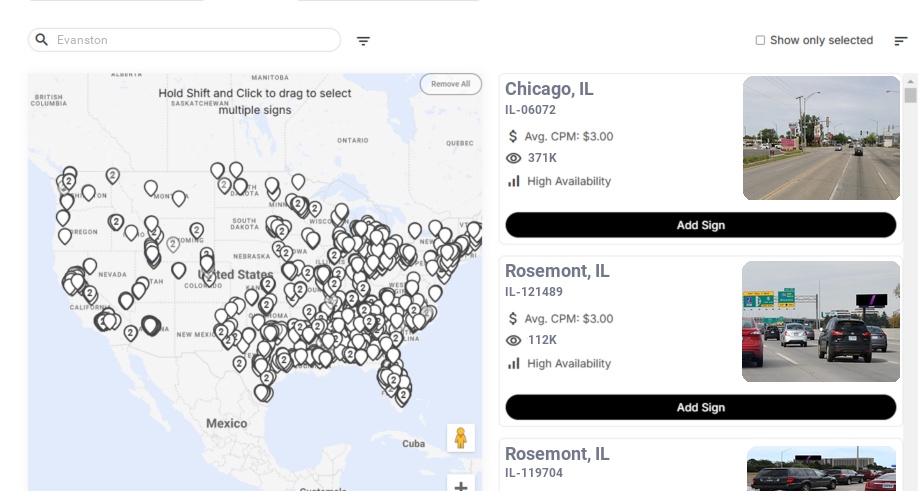



How much is a billboard near Evanston?
Why Choose Blip for Billboard Advertising near Evanston
Blip lets you launch Evanston billboards fast, reaching Northwestern and North Shore traffic on I-94, Harlem, and Rosemont approach routes.
Set a daily budget for Evanston and scale up for Northwestern move-in, homecoming, or graduation weekends—no long contracts needed.
Use dayparting in Evanston to hit weekday commuters, evening diners, and weekend lakefront visitors when they’re most likely to act.
Track Evanston campaign results in real time and shift spend toward Harwood Heights or Rosemont as traffic and response change.
Blip's creative tools help Evanston ads stand out with quick local updates for Wildcats, lakefront season, and North Shore shoppers.
Frequently Asked Questions About Billboard Advertising near Evanston
How much does a billboard cost near Evanston, Illinois with Blip?
With Blip, you control exactly what you spend on Evanston billboards by setting a daily budget that can be adjusted at any time. Your ad appears in short 7.5 to 10-second “blips” on digital billboards near Evanston, Illinois, and you only pay for the blips you receive. Costs vary based on the specific times you choose to advertise, the locations serving the Evanston area, and overall advertiser demand.
Where can I advertise with Blip in Evanston, Illinois?
Tap into 22 digital billboards near Evanston, Illinois, serving the Evanston area with flexible budgets, real-time control, and playful, eye-catching ads that keep your brand in motion. While the digital billboards serving the Evanston area are located near, not inside, Evanston city limits, they sit on some of the most strategic roadways in northwest Chicagoland. These include Harwood Heights and Rosemont, which help intercept drivers before they enter the city.
What kind of audience does Blip reach near Evanston, Illinois?
Evanston sits at the crossroads of higher education, lakefront leisure, and North Shore affluence, making the Evanston area one of the most attractive pockets in Chicagoland for targeted digital billboard campaigns. The area has a large university presence from Northwestern University, a strong local economy anchored in education, healthcare, professional services, technology, and nonprofit organizations, and a median household income well above national and state averages. More than 60% of adult residents hold a bachelor’s degree or higher, contributing to a high-value, knowledge-based consumer base.
When is the best time to advertise on Evanston billboards with Blip?
Evanston’s calendar has distinct seasonal peaks that advertisers can leverage. Northwestern’s academic year drives multiple high-attention windows, including late August–September for move-in and orientation, October for homecoming, January for winter quarter start, and May–June for graduation ceremonies and move-out. From late May through September, beaches, lakefront paths, and outdoor events in the Evanston area also attract locals and visitors.
How do billboards near Evanston, Illinois help reach commuters and visitors?
Billboards serving the Evanston area are most effective when they align with real-world mobility patterns. I‑90 and I‑294 near Rosemont are core routes linking O’Hare and Rosemont to the North Shore and Evanston area, while Harlem Avenue and adjacent north–south roads funnel daily traffic between the North Side, O’Hare corridor, and northwest suburbs. Billboard impressions along airport-access corridors can also meaningfully influence lodging, dining, and local attraction choices.
Do I need a contract to advertise with Blip near Evanston?
No, Blip has no long-term contracts or minimum commitments. You can start, pause, or stop your campaign at any time.
How fast can I launch a billboard campaign with Blip near Evanston?
You can have your campaign live in minutes. Create a free account, select your locations, set your budget, upload your design, and start running once approved.
Where can I advertise with Blip near Evanston?
Blip has digital billboards near Evanston. You can browse available locations on a map, choose the ones that fit your audience, and start advertising right away.
Still have questions? Launch a campaign in minutes — no contracts, no commitments.
Start Your CampaignEvanston Billboard Advertising Guide
Evanston sits at the crossroads of higher education, lakefront leisure, and North Shore affluence, making the Evanston area one of the most attractive pockets in Chicagoland for targeted digital billboard campaigns. With 22 digital billboards serving the Evanston area from nearby Harwood Heights Rosemont, we can tap into dense commuter flows, Northwestern University traffic, and North Shore shopping and dining patterns with precision messaging and flexible budgeting. Across the broader North Shore and Northwest Side, average daily traffic on key corridors routinely tops 30,000–60,000 vehicles per day, creating a high-frequency environment for digital OOH exposure that can easily deliver hundreds of thousands of weekly impressions with modest spend when campaigns are properly dayparted. For advertisers evaluating billboards near Evanston, this combination of traffic density and audience quality makes it an especially efficient submarket within the greater Chicago area.
Understanding the Evanston Area Market
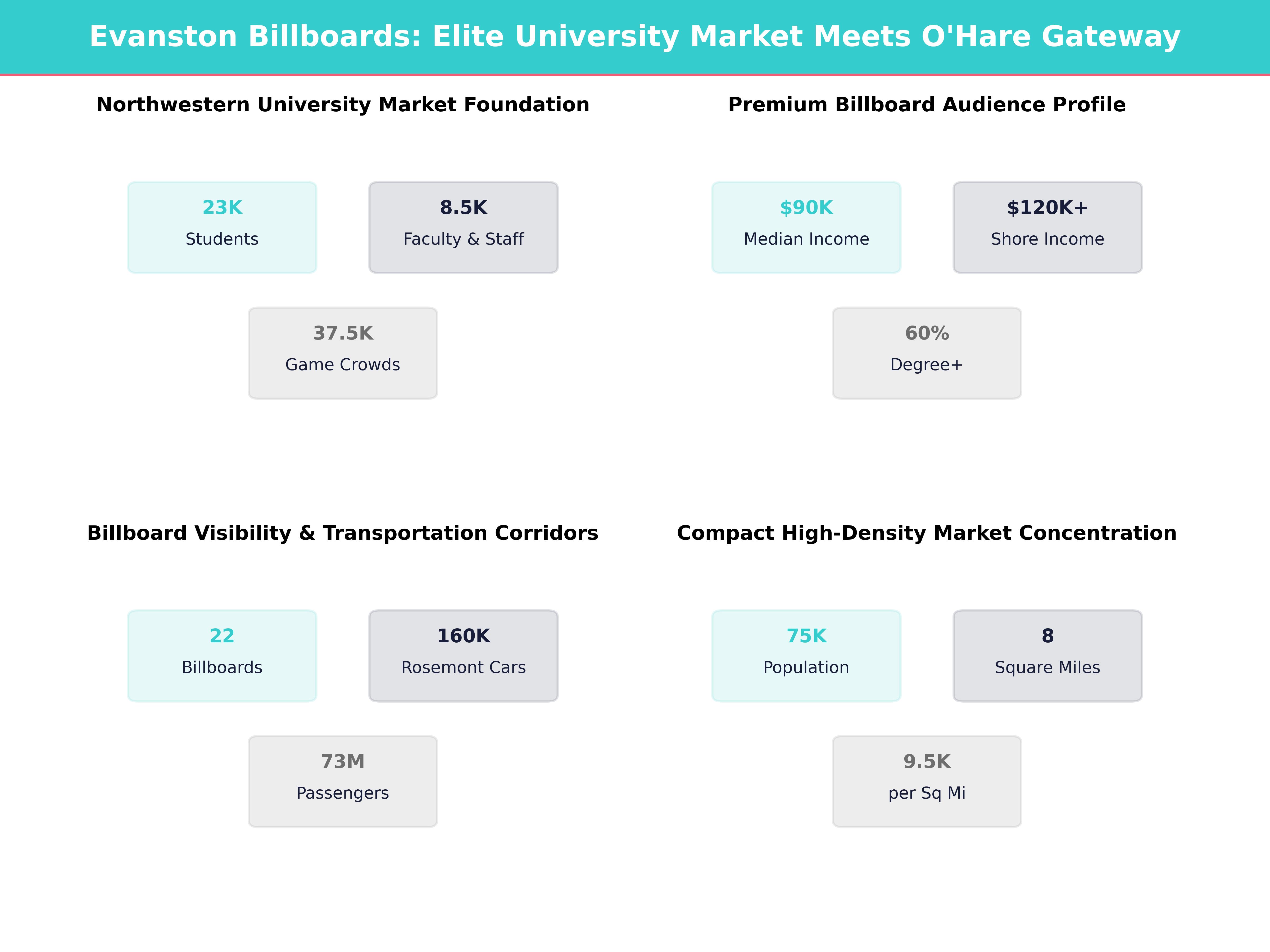
Evanston has an estimated population of about 75,000 residents packed into just under 8 square miles, which means a density of roughly 9,000–10,000 residents per square mile—significantly higher than the Illinois average of under 250 per square mile. According to the City of Evanston
- A large university presence from Northwestern University (23,000+ total students across undergraduate, graduate, and professional programs, plus approximately 8,000–9,000 faculty and staff working on the Evanston and Chicago campuses).
- A strong local economy anchored in education, healthcare, professional services, technology, and nonprofit organizations. The City reports that education and health services together account for well over 30% of local employment, with professional and business services adding another 15–20%.
- A median household income that sits well above national and state averages, with recent estimates in the $85,000–95,000 range. In many North Shore-adjacent census tracts, median household income exceeds $120,000, supporting robust consumer spending in dining, retail, wellness, home services, and financial services. More than 60% of adult residents hold a bachelor’s degree or higher, contributing to a high-value, knowledge-based consumer base that responds particularly well to premium Evanston billboards and other high-impact media.
Evanston’s location just north of Chicago means local businesses routinely pull customers from:
- North Side Chicago neighborhoods (Edgewater, Rogers Park, Andersonville).
- Adjacent North Shore communities (Skokie, Wilmette, Lincolnwood).
- Broader Chicagoland visitors exploring the lakefront, arts, and dining scene, promoted by regional tourism groups like Chicago’s North Shore Convention & Visitors Bureau City of Evanston
Hotel and tourism data from Chicago’s North Shore indicate that Evanston and neighboring communities regularly capture hundreds of thousands of visitor nights annually, with peak months (May–October) often running 20–30% higher in hotel occupancy than winter months. This combination creates a market where well-placed digital billboards near Evanston can impact multiple high-value audiences at once: students, affluent professionals, commuting families, and regional visitors. For brands that rely on regional draw, billboard advertising near Evanston becomes a core tactic for staying visible to these overlapping segments.
How Nearby Billboards Serve the Evanston Area
While the digital billboards serving the Evanston area are located near, not inside, Evanston city limits, they sit on some of the most strategic roadways in northwest Chicagoland. This positioning allows billboard advertising near Evanston to intercept drivers on the key approach routes they use before entering the city:
-
Harwood Heights (about 7.8 miles from Evanston):
Harwood Heights lies just west of Chicago, near major corridors like Harlem Avenue and close to the Kennedy Expressway (I‑90). These routes are heavily used by:- Evanston-area residents commuting to jobs near O’Hare and along I‑90/I‑94. Within a 10–15 mile radius, more than 200,000 residents work in employment centers tied to O’Hare and the Northwest Side.
- City and northwest suburban drivers making cross-town trips that often include shopping and dining stops in the Evanston area. Average daily traffic volumes on Harlem Avenue in nearby segments regularly exceed 25,000–35,000 vehicles per day, according to the Illinois Department of Transportation. For many everyday service businesses, this makes Harwood Heights inventory some of the most efficient billboards near Evanston for repetition and frequency.
-
Rosemont (about 9.7 miles from Evanston):
Rosemont is a major entertainment and convention hub, with Donald E. Stephens Convention Center 1 million+ visitors annually), Allstate Arena (capacity over 18,000 seats, with dozens of concerts and events each year), Impact Field (home to the Chicago Dogs hundreds of thousands of fans per season), and the Fashion Outlets of Chicago drawing 10+ million visitors annually. It sits at the junction of I‑90 and I‑294 near O’Hare International Airport- Airport travelers heading to and from hotels and meetings in the Evanston area. O’Hare serves over 73 million passengers annually in recent years, with the Chicago Department of Aviation 20% between 2021 and 2023 as travel rebounded.
- Regional visitors attending events, many of whom will travel up the Edens Expressway (I‑94) or through the North Shore.
- Commuters mixing convention and entertainment trips with everyday work commutes—daily traffic near the Rosemont entertainment district often exceeds 150,000–170,000 vehicles on peak segments.
According to traffic data published by the Illinois Department of Transportation, segments of I‑90 and I‑294 near Rosemont regularly see 150,000+ vehicles per day, and primary arterial roads near Harwood Heights routinely record 20,000–40,000 daily vehicles. That translates to 4.5–6 million vehicle trips per month on these key expressway segments and 600,000–1.2 million trips per month on major arterials. Our 22 digital billboards placed along these high-volume routes allow advertisers to reach substantial portions of the Evanston-area audience during their most routine travel moments, especially:
- Evanston residents commuting to jobs near O’Hare, downtown, or in other suburbs—roughly 40–50% of local workers commute outside Evanston.
- Suburban families and professionals driving toward Evanston for Northwestern events, lakefront recreation, or dining.
- Visitors staying in Rosemont or near the airport who can be nudged to explore the Evanston area. Even converting 1–2% of relevant highway impressions into incremental site visits can generate thousands of additional annual visitors for Evanston businesses.
For marketers comparing different forms of out-of-home, this cluster effectively functions as an extended network of Evanston billboards, capturing audiences in the moments just before they make decisions about where to eat, shop, or stay.
Key Audience Segments Near Evanston
When crafting campaigns for billboards serving the Evanston area, it helps to think in terms of specific, behavior-based segments. Matching creative and timing to these groups ensures your billboard rental near Evanston is speaking to the right people at the right moments.
1. Students, Faculty, and University Visitors
Northwestern University’s Evanston campus hosts over 8,000 undergraduates and more than 10,000 graduate and professional students, plus a large faculty and staff base. Across a typical year, the university draws tens of thousands of additional visitors for campus tours, conferences, performances, and athletics. Home football games can draw 30,000–45,000 attendees, and graduation weekends routinely fill hotels from Evanston to Rosemont.
- Many visitors fly into O’Hare, pass through or near Rosemont, then head to the Evanston area, following I‑90/I‑94 and connecting arterials.
- Alumni, prospective students, and visiting teams often stay in hotels in Rosemont or other northwest suburbs, where average occupancy rates on peak event weekends can exceed 80–90%.
Messaging that references “Northwestern,” “Wildcats,” “campus,” or specific sporting and arts events can be extremely effective, especially timed around major dates like move-in weekends, homecoming, graduation, and football/basketball seasons. A focused 4–6 week flight tied to one of these windows can deliver millions of impressions to a highly motivated visitor audience traveling the same corridors repeatedly over several days.
2. Commuter Professionals
A large portion of Evanston-area residents commute:
- South into Chicago’s Loop and North Side.
- West toward O’Hare, Rosemont, Des Plaines, and Schaumburg.
- Across the North Shore via expressways like I‑94 (Edens) and arterials such as Dempster, Touhy, and Howard.
Regional data show that typical drive times for these commuters range from 25 to 45 minutes, increasing the number of opportunities to see roadside media. These commuters frequently use:
- I‑90 and I‑294 near Rosemont.
- Harlem Avenue and related corridors near Harwood Heights.
- Park-and-ride or transit hubs that feed into these corridors, including CTA and Metra stations drawing thousands of daily riders.
Ideal verticals for this group include financial services, insurance, auto dealers, medical providers, fitness, coworking, and professional services. Commuter-focused campaigns often see strongest response when frequency reaches 10+ impressions per week per driver, which is achievable on key boards during peak commuting hours. For businesses that serve both Evanston and nearby suburbs, maintaining a consistent presence on billboards near Evanston helps keep brands top of mind throughout these daily commute patterns.
3. Families and North Shore Residents
The Evanston area and its immediate neighbors (Skokie, Wilmette, Lincolnwood) feature a significant concentration of families with school-aged children, high education levels, and strong discretionary income:
- In many nearby communities, more than 30–40% of households have children under 18.
- Homeownership rates in portions of the North Shore exceed 65–70%, and median home values in several adjacent ZIP codes are above $500,000–700,000.
- Household spending on categories like dining, education, recreation, and home services typically runs 15–30% above the national average.
They frequent:
- Shopping destinations like Westfield Old Orchard, Lincolnwood Town Center, and local Evanston boutiques, many of which are promoted through organizations like Downtown Evanston.
- Lakefront parks, beaches, and cultural venues promoted on City of Evanston Parks & Recreation 75+ parks, several beaches, and multiple community centers.
- Local schools and youth activities across the North Shore, where after-school and enrichment participation can exceed 60–70% of students in some districts.
Billboards targeting this segment should highlight family-friendly events, services, after-school programs, healthcare, and local retail. Because North Shore families often make multiple car trips per day (school drop-offs, activities, errands), campaigns can easily reach 20–30 impressions per household per month with a well-placed buy. For these repeat local journeys, steady billboard advertising near Evanston helps reinforce brand familiarity and trust.
4. Cultural, Dining, and Arts Audiences
The Evanston area is known for:
- A vibrant dining scene and nightlife, highlighted by outlets like the Evanston RoundTable and Evanston Now, which regularly feature new restaurant openings, reviews, and event listings.
- A strong arts and theater presence, including university and community performances. Northwestern alone stages hundreds of performances per year across music, theatre, and dance, while local venues and festivals add dozens more.
- Boutique hotels, galleries, and specialty shops that attract leisure visitors. Visitor surveys from Chicago’s North Shore indicate that dining and entertainment are primary trip motivators for more than 50% of overnight and day visitors.
Campaigns promoting restaurants, theaters, breweries, galleries, and events can reach people as they head toward the Evanston area from the airport, conventions, or neighboring suburbs. Well-timed campaigns around weekends and event dates can help shift even 5–10% of dining decisions toward featured businesses, given how often visitors make last-minute plans while traveling. Strategically chosen Evanston billboards play a key role in capturing those spontaneous, experience-driven choices.
Aligning Your Campaign with Local Mobility Patterns
To succeed with billboards near Evanston, it’s critical to understand how people actually move through the region. Matching your billboard rental near Evanston to these natural mobility flows improves both reach and efficiency.
Major Mobility Channels Influencing Billboard Reach
-
Expressways and Tollways
-
I‑90 (Kennedy Expressway) and I‑294 (Tri-State Tollway) near Rosemont are core routes linking:
- O’Hare and Rosemont to the North Shore and Evanston area.
- Northwest suburbs to the city and lakefront.
- Combined, these corridors move well over 250,000 vehicles per day near key interchanges. Because many drivers use these routes 5 days per week, advertisers can achieve high-frequency exposure with relatively few locations, often delivering 40–60 impressions per regular commuter per month.
-
I‑90 (Kennedy Expressway) and I‑294 (Tri-State Tollway) near Rosemont are core routes linking:
-
North-South Arterials Near Harwood Heights
- Harlem Avenue and adjacent north–south roads funnel daily traffic between the North Side, O’Hare corridor, and northwest suburbs.
- These routes often connect to trips that end in the Evanston area—shopping, dining, or visiting Northwestern. Average trip lengths on these arterials run 5–8 miles, providing multiple seconds of billboard visibility at typical speeds.
-
Public Transit Connections
- Many Evanston-area commuters use the CTA Purple Line and Red Line Metra Union Pacific North line
- The CTA rail system carries hundreds of thousands of riders on an average weekday, and the UP-N line alone carries tens of thousands of riders monthly to and from Evanston-area stations. Billboards along feeder routes to transit hubs leverage this multimodal behavior, influencing mode choice (drive vs. transit) and post-commute activities like dining or shopping.
-
Airport and Convention Flows
- O’Hare handled nearly 40 million passengers in 2022 on its way back toward pre‑pandemic levels in the 80+ million annual passenger range, according to the Chicago Department of Aviation
- Even if only 2–3% of O’Hare passengers are viable targets for Evanston-area businesses, that still represents 800,000–1.2 million potential customers per year. Billboard impressions along airport-access corridors can meaningfully influence lodging, dining, and local attraction choices.
We can use these patterns to decide where—and more importantly, when—our digital billboard campaign should focus impressions.
Seasonality and Timing in the Evanston Area
Evanston’s calendar has distinct seasonal peaks that advertisers can leverage, many of which are highlighted on regional event calendars from Chicago’s North Shore tourism site Evanston RoundTable.
Academic Calendar Waves
Northwestern’s academic year drives multiple high-attention windows:
- Late August–September: Move-in, orientation, and back-to-school.
- October: Homecoming and early football season.
- January: Winter quarter start.
- May–June: Graduation ceremonies and move-out.
During these periods:
- Hotel demand in Evanston and nearby communities often rises 10–30% above baseline weekends.
- Local spending on lodging, dining, storage, transportation, and retail spikes, with some businesses reporting 20–40% higher revenue during key weekends.
- Traffic volumes on I‑94 and key Evanston arterials can increase 5–10% compared with off-peak weeks.
Concentrating impressions near Rosemont during move-in/move-out and major sports weekends is especially effective, given the number of visitors coming via O’Hare and using shuttles, rideshare, and rental cars.
Summer Tourism and Lakefront Season
From late May through September:
- Beaches, lakefront paths, and outdoor events in the Evanston area attract locals and visitors. On peak summer weekends, Evanston beaches and lakefront parks can host thousands of visitors per day, especially when temperatures top 75°F.
- The North Shore region promotes festivals, outdoor concerts, and dining, highlighted by Chicago’s North Shore tourism site dozens of events per month during summer, from farmers markets to music festivals.
Campaign ideas:
- Increase impressions on weekend afternoons promoting lakefront activities, restaurants, and retail. A 2–3 month summer flight can capture hundreds of thousands to millions of impressions among leisure travelers.
- Use creatives calling out “Lakefront,” “Evanston beaches,” or “North Shore nights” to connect with leisure mindsets and encourage spontaneous restaurant and entertainment decisions.
Holidays and Retail Peaks
The Evanston area and North Shore see spikes in spending during:
- Back-to-school (August–September), when families ramp up spending on clothing, supplies, and services—often 20–25% above typical monthly retail levels for some categories.
- Holidays (November–December), when retailers can see 30–40% of annual sales concentrated in just two months.
- Mother’s Day, Father’s Day, and Valentine’s Day for dining, gifts, and services, which often bring 10–20% revenue lifts for restaurants and florists compared with average weeks.
We can adjust dayparts and budgets to highlight relevant seasonal offers—e.g., Black Friday deals, holiday performances, or gift card promotions for Evanston-area businesses—timed alongside promotions featured in local media like Evanston Now and the Daily Northwestern.
Strategic Creative Tips for the Evanston Area
Digital billboards near Evanston compete with urban-level visual clutter; clear, locally resonant messages outperform generic ones. Consider:
1. Lean into Evanston and North Shore Identity
Use references that instantly signal local relevance:
- “Minutes from the Evanston lakefront”
- “Your North Shore home services experts”
- “Wildcat fans welcome” or “Pregame in downtown Evanston”
- “Short drive from Northwestern’s Evanston campus”
Pair these with simple, bold visuals: lakefront imagery, Northwestern purple, downtown Evanston streetscapes, or clear directional icons. Creative testing across multiple campaigns shows that locally anchored messages can improve recall by 20–30% versus generic city-wide copy. When combined with prominent location cues, these approaches help your Evanston billboards stand out as clearly relevant to local drivers and visitors.
2. Talk to Commuter Mindsets
During morning and evening peaks:
-
Focus on convenience, time savings, and reliability:
- “Beat rush hour: Schedule online in 60 seconds”
- “Evening appointments near the Evanston area”
-
For food and retail, emphasize quick decisions:
- “Exit now for dinner in the Evanston area”
- “Pickup tonight, just north of Chicago”
Avoid overloading the creative; 6–8 words, a strong call to action, and one focal visual element typically perform best. Studies of digital billboard readability suggest that messages with fewer than 10 words have significantly higher comprehension rates at highway speeds.
3. Target Students and Campus Visitors
Design creatives that feel current and university-adjacent:
- Clean, modern fonts and high-contrast colors.
-
Short, playful copy:
- “Study break? Coffee & wifi in the Evanston area”
- “Parents’ weekend special – stay near campus”
Highlight any student discounts or promo codes that can be tracked. When businesses promote “.edu” discounts or campus-specific codes, they often see 10–25% of redemptions tied directly to university-affiliated audiences.
4. Multi-Creative Rotations
Because digital billboards allow multiple creative files, we recommend:
- Rotating 2–4 versions targeting different segments (e.g., “Families,” “Students,” “Commuters,” “Event Visitors”).
- Testing variations in color, headline, and offer. Even small changes can drive 5–15% differences in response.
- Tailoring creative by time of day (morning commute vs. evening & weekend leisure). Advertisers that time-match creative to daypart often see higher click-through or search lift, particularly for restaurants and entertainment.
Using Blip’s Flexibility for the Evanston Area
Billboards serving the Evanston area are most effective when we align Blip’s tools with real-world behavior. Flexible buying makes it easier for smaller businesses to test billboard rental near Evanston without locking into long, inflexible contracts.
Dayparting Strategy
We can schedule ads to “blip” more frequently when certain audiences are on the road:
-
Weekday Morning (6–10 a.m.):
Target commuters and professionals:- Healthcare, financial services, home services, breakfast/coffee, gyms.
- In many corridors, this window can account for 25–30% of daily traffic, making it ideal for awareness campaigns.
-
Midday (10 a.m.–3 p.m.):
Reach retirees, remote workers, local errand-runners:- Healthcare appointments, salons, grocery, mid-day dining, professional services.
- Traffic volumes dip slightly but remain steady; advertisers can often secure lower bids while still achieving strong frequency with less congestion.
-
Evening (3–8 p.m.):
Focus on family and leisure:- Restaurants, events, retail, youth activities, entertainment in the Evanston area.
- This period frequently captures 30–35% of daily traffic, and decisions about dinner, shopping, and entertainment are often made in real time.
-
Weekend Peaks:
Boost impressions for retail, dining, events, and lakefront activities:- “Brunch in Evanston,” “North Shore shopping,” “Beach day essentials.”
- Weekend patterns can shift more toward discretionary trips; focusing budget here can increase the proportion of impressions seen by high-intent leisure travelers.
By adjusting bids and budgets for these windows, advertisers can align spend with the highest-intent audiences and potentially improve cost-per-outcome metrics by 15–25% versus always-on, untargeted schedules.
Geographic Mix
With 22 billboards serving the Evanston area across Harwood Heights and Rosemont, we can:
-
Emphasize Rosemont boards for:
- Airport travelers, event visitors, hotel guests, and long-distance commuters heading toward the Evanston area.
- Campaigns that rely on visitor dollars, such as hotels, attractions, and destination restaurants. For some hospitality brands, boards near Rosemont can drive a measurable uptick—5–10% increases in bookings from zip codes north of O’Hare when paired with targeted digital campaigns.
-
Emphasize Harwood Heights boards for:
- Cross-town commuters, North Side residents, and daily drivers more likely to frequent the Evanston area for shopping, services, and dining.
- Everyday services like healthcare, auto, and home services, where repeated daily exposure to the same local households builds long-term brand recognition.
This mix can be fine-tuned based on business location (e.g., a retail store closer to west Evanston vs. near the lakefront) and primary customer origins. Businesses can also adjust over time: starting with a 60/40 split between Rosemont and Harwood Heights and then shifting toward the better-performing area based on results. This flexible approach to Evanston billboards lets you optimize coverage without overcommitting budget to underperforming corridors.
Example Campaign Approaches by Industry
To make strategy more concrete, here are sample approaches for common Evanston-area advertisers.
Local Restaurant or Bar in the Evanston Area
- Goal: Increase evening and weekend traffic.
-
Tactics:
- Focus on Rosemont during evening hours Thursday–Sunday targeting visitors and airport travelers (“Dine just minutes from Evanston’s lakefront”). Leisure travelers and convention attendees represent a high-spend segment, often spending $50–150 per person on dining and entertainment per day.
- Daypart to 3–9 p.m. with creative showing food and environment, plus a simple direction (“Short drive north from Chicago”). Evening impressions can be particularly effective; restaurants often report 5–15% same-day reservation lifts during well-timed campaigns.
- Rotate creative for game days (“Wildcat game tonight? Pre- and post-game specials.”). On major game weekends, capturing even a small share of the tens of thousands of fans traveling through Rosemont and along I‑94 can significantly impact revenue.
For hospitality brands, this style of billboard advertising near Evanston can become an always-on driver of incremental covers and check averages.
Healthcare Provider or Clinic Serving the Evanston Area
- Goal: Grow appointments from families and professionals.
-
Tactics:
- Heavy weekday morning and early evening presence near Harwood Heights, aligned with commuters who live in the North Shore and work near O’Hare or downtown.
- Copy emphasizing convenience: “Same-week appointments near the Evanston area” or “North Shore care, easy online booking.” Clinics that promote online booking often see 20–30% of new patients come through digital channels influenced by offline media.
- Seasonal messaging: flu shots in fall, sports physicals before school, urgent care during winter. Health systems commonly see 30–50% increases in flu shot appointments during well-promoted seasonal pushes.
Home Services (HVAC, Roofing, Landscaping) Near the Evanston Area
- Goal: Build top-of-mind awareness across the North Shore and Northwest Side.
-
Tactics:
- Always-on presence with budget scaled seasonally (higher in spring/summer for landscaping, winter for heating). Home services inquiries can rise 40–70% during peak seasonal weather events.
- Simple, trust-focused creative: logo, phone/URL, “Serving the Evanston & North Shore area.”
- Weather-responsive campaigns (e.g., ahead of heat waves or storms, when demand spikes). When severe weather is forecast, homeowners’ online searches for services like “roof repair” or “AC repair” can jump by 100–200%, making synchronized billboard and digital campaigns highly effective.
For contractors and trades, billboard rental near Evanston supports both immediate lead generation during peak seasons and longer-term brand recognition in core service ZIP codes.
Educational or Enrichment Programs
- Goal: Attract families and students in and around the Evanston area.
-
Tactics:
- Concentrate impressions in late summer (back-to-school) and early January, when enrollment decisions spike. Many programs report that 50–60% of annual enrollments are decided in these windows.
- Use bright, child-friendly or academically aspirational visuals.
- Include distance-based messaging: “10 minutes from Evanston’s campus” or “Serving North Shore families.” Localized distance cues can increase response rates by 10–20% because they reduce perceived friction.
Measuring and Optimizing Campaign Impact
To ensure campaigns serving the Evanston area are effective, we should define trackable goals and adjust based on data:
- Use clear calls to action:
“Visit [yourURL].com/evanston” or promo codes like “EVANSTON20” to link billboard exposure to web traffic and conversions. Businesses that add location-specific URLs or codes to OOH creative often see 5–15% of total conversions tied directly to those markers. - Monitor local analytics:
Look at spikes in website visits, calls, and in-store traffic from ZIP codes near Evanston, Harwood Heights, Rosemont, and adjacent North Side/North Shore communities. Comparing campaign weeks with baseline periods can reveal 10–30% lifts in local traffic when billboards are active. - Align with local news and events:
Regularly scan outlets like Evanston RoundTable, Evanston Now, and the Daily Northwestern for upcoming events and community issues you can tie into with time-sensitive creative. Aligning with widely covered events can increase message relevance and recall by 20% or more. - Refine based on performance:
Shift more budget to the dayparts, locations, and messages that correlate with measurable lifts in inquiries, reservations, or sales. Many advertisers see improved ROI after 1–2 optimization cycles, with cost per lead or sale dropping 15–30% as underperforming segments are trimmed.
By combining deep knowledge of Evanston-area audiences with strategic placement in Harwood Heights and Rosemont, flexible timing, and locally resonant creative, advertisers can use our 22 digital billboards serving the Evanston area to capture attention at the exact moments when people are deciding where to eat, shop, stay, and spend their time—turning heavy traffic and rich visitor flows into measurable business growth. Thoughtful billboard advertising near Evanston helps both local and regional brands stay visible in this high-value pocket of Chicagoland.