Billboards in Hoffman Estates, IL
No Minimum Spend. No Long-Term Contracts. Just Results.
Trusted by Leading Brands


Billboard advertising
in Hoffman Estates has never been easier



How much is a billboard in Hoffman Estates?
Why Choose Blip for Billboard Advertising in Hoffman Estates
Blip lets you launch Hoffman Estates billboards in minutes, reaching I-90 commuters and nearby shoppers without traditional media buying delays.
Set flexible budgets on Hoffman Estates, Illinois billboards with Blip and stay in control as traffic shifts from school runs to NOW Arena event nights.
Use Blip's dayparting in Hoffman Estates to hit 6:30-9 a.m. rush, afternoon school pickup, and evening diners on IL-59 and Higgins Road.
No contracts make Hoffman Estates easy to test for Woodfield spillover, family households, and high-income professionals on their daily routes.
Track Hoffman Estates billboard performance in real time with Blip, then tweak creative fast for shopping peaks, winter weather, or event weekends.
Blip's creative tools help Hoffman Estates ads stay bold and local, with short messages built for fast reads at highway speed on I-90.
Frequently Asked Questions About Billboard Advertising in Hoffman Estates
How much does a billboard cost in Hoffman Estates, Illinois with Blip?
With Blip, you control exactly what you spend on Hoffman Estates billboards by setting a daily budget that can be adjusted anytime, so your ad never runs beyond what you’re comfortable paying. Each “blip” is a brief 7.5–10 second display, and you only pay for the blips you receive, with prices varying based on time, location, and advertiser demand. Blip makes billboards in Hoffman Estates, Illinois accessible on virtually any budget, so you can start reaching drivers and pedestrians right away.
Where should I place a Blip billboard in Hoffman Estates, Illinois to reach the most traffic?
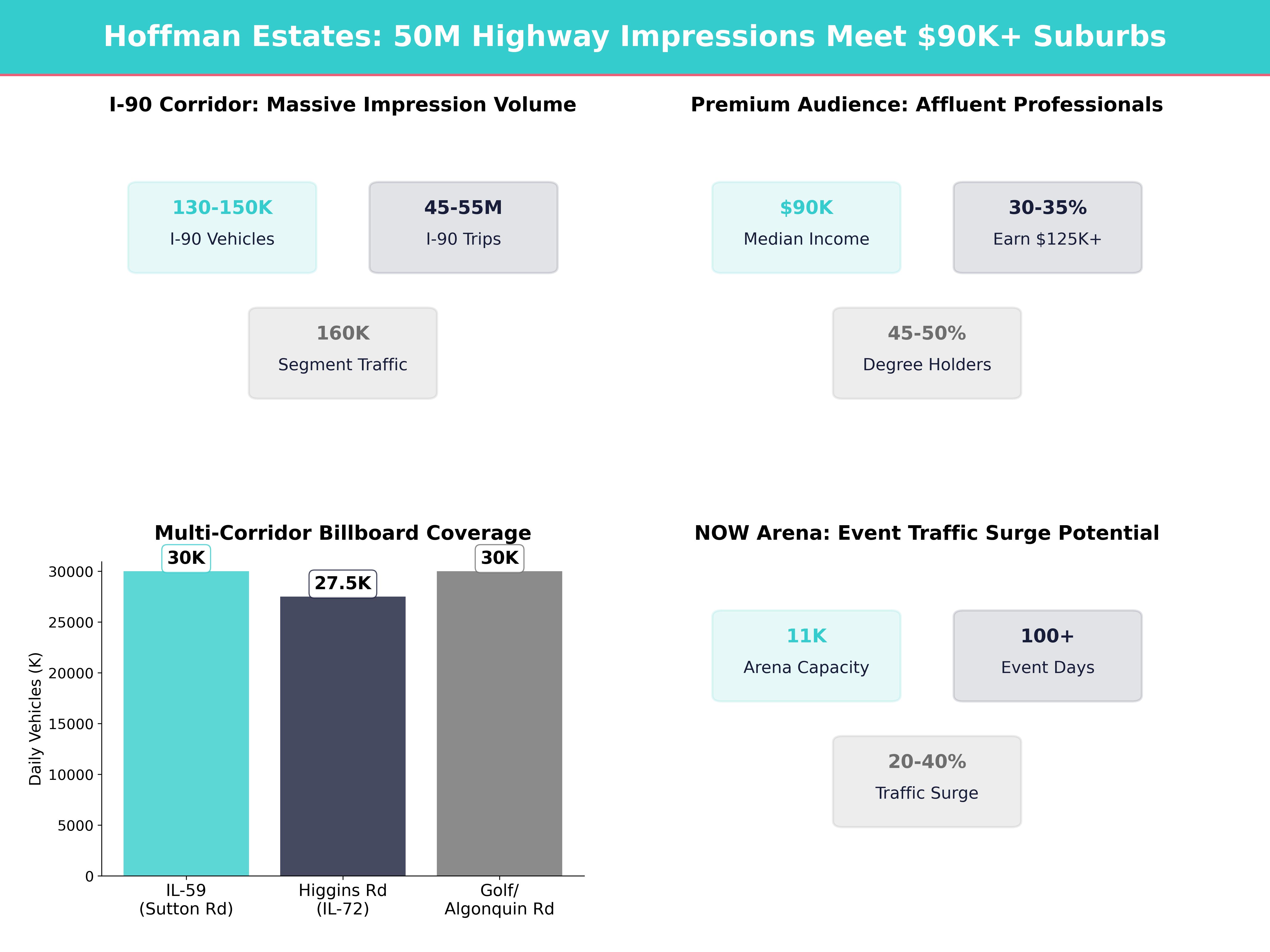
I‑90 is the primary east‑west backbone in Hoffman Estates and carries well over 130,000–150,000 vehicles per day through this corridor, with some nearby segments exceeding 160,000 vehicles per day on average. Major arterials like IL‑59, Higgins Road (IL‑72), and Golf Road / Algonquin Road also see heavy daily traffic and connect neighborhoods to shopping, schools, and retail nodes. These routes are crucial for reaching shoppers, commuters, and local families repeatedly throughout the week.
Who do Hoffman Estates, Illinois billboards with Blip reach the best?
Hoffman Estates is a mature, high‑income suburb with a population of roughly 51,000–52,000 residents, and the median household income is in the low‑to‑mid $90,000s. A majority of employed residents work in white‑collar or professional roles, and homeownership rates are commonly in the 65–70% range. This makes the market a strong fit for family‑oriented, trust‑building, and professional service campaigns.
When is the best time to run billboards in Hoffman Estates, Illinois with Blip?
Morning drive (6:30–9:00 a.m.) and evening (4:00–7:30 p.m.) are high‑value windows for impressions because many people are commuting, heading to practices, or traveling to events. Weekdays are best for workday services and commuter‑driven offers, while weekends are strong for shopping, real estate, events, and leisure activities. Blip also lets you use time‑of‑day and day‑of‑week controls so you can match your creative to local behavior.
How can I use Hoffman Estates, Illinois billboards for events like NOW Arena with Blip?
NOW Arena in Hoffman Estates seats approximately 11,000 and hosts minor league and professional sports, concerts, touring shows, and family entertainment. On event days, traffic on nearby arterials and I‑90 exits can surge 20–40% above typical patterns in the late afternoon and early evening. Scheduling heavier Blip impressions 2–3 hours before event start times can help you capture that traffic surge.
Do I need a contract to advertise with Blip in Hoffman Estates?
No, Blip has no long-term contracts or minimum commitments. You can start, pause, or stop your campaign at any time.
How fast can I launch a billboard campaign with Blip in Hoffman Estates?
You can have your campaign live in minutes. Create a free account, select your locations, set your budget, upload your design, and start running once approved.
Where can I advertise with Blip in Hoffman Estates?
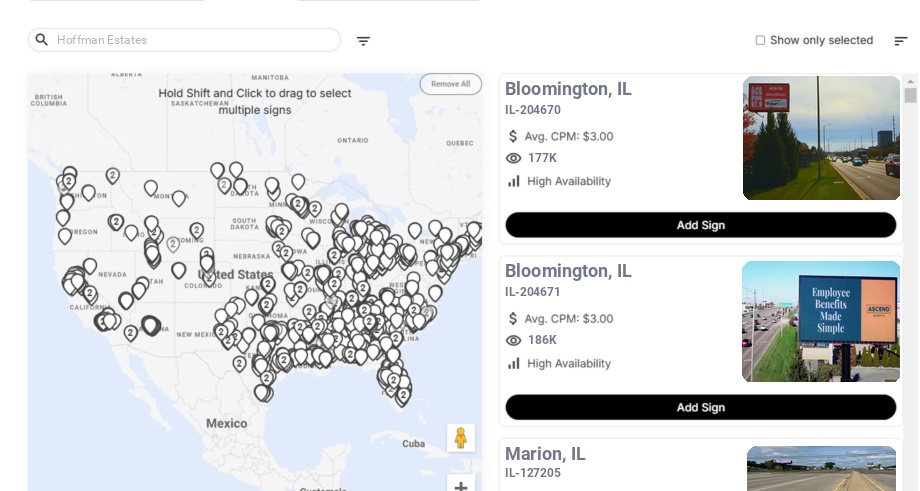
Blip has digital billboards in Hoffman Estates. You can browse available locations on a map, choose the ones that fit your audience, and start advertising right away.
Still have questions? Launch a campaign in minutes — no contracts, no commitments.
Start Your CampaignHoffman Estates Billboard Advertising Guide
Hoffman Estates, Illinois, sits at the crossroads of suburban affluence, regional shopping, and commuter traffic between Chicago and the northwest suburbs. With more than 50,000 residents and immediate access to I‑90, this is a market where well‑planned digital billboard campaigns can repeatedly reach high-income families, professionals, and event-goers on their daily routes. Below, we explore how to tailor creative, timing, and placement to make Blip campaigns and other Hoffman Estates billboards as effective as possible.
Understanding the Hoffman Estates Market
Hoffman Estates is a mature, high‑income suburb in Cook and Kane Counties with a population of roughly 50,000–52,000 residents, according to recent village demographic estimates published by the Village of Hoffman Estates. Several data points shape how we should think about billboard messaging here and how to approach Hoffman Estates billboard advertising as a whole:
-
Population & households
- Population: approximately 51,000–52,000 residents
- Median age: around 38–39 years, slightly older than the Chicago metro median, indicating a strong base of established households rather than transient renters.
- Household size: about 2.8–3.0 persons per household, reflecting a high share of family households.
- Roughly 30–35% of households include children under 18, based on local school enrollment patterns reported by districts serving Hoffman Estates.
-
Income
- Median household income is in the low‑to‑mid $90,000s, well above the Illinois median in the mid‑$70,000s, pointing to strong spending power for family‑oriented and discretionary products.
- An estimated 30–35% of households earn more than $125,000 annually, supporting demand for premium services, vehicles, and home upgrades.
-
Education & occupations
- Local demographic summaries from the Village of Hoffman Estates
- A majority of employed residents work in white‑collar or professional roles such as management, business, science, and office occupations, aligning well with campaigns for financial, healthcare, technology, and B2B services.
-
Housing & stability
- Homeownership rates are commonly in the 65–70% range, suggesting many long‑term residents who repeatedly use the same commuting and shopping routes—perfect for frequency‑driven billboard campaigns.
- Local housing data shared through the Hoffman Estates Chamber of Commerce & Industry show median home sale prices often in the $300,000–350,000 range in recent years, further confirming a solid middle‑to‑upper‑middle‑income base.
-
Commuter character
- Village transportation and planning documents indicate that average one‑way commute times for residents are commonly 28–32 minutes, slightly higher than the national average, confirming a strong daily driving culture.
- A significant share of residents commute to jobs in Schaumburg
- Regional transit providers like Pace Suburban Bus and Metra
This mix of stable, higher‑income households, regional shopping, and commuter traffic means our billboard campaigns should emphasize:
- Clear value propositions rather than generic awareness only
- Family‑friendly, trust‑building messaging
- Calls to action that can be acted on later (website, search, social handles) because many impressions occur while people are in motion
Key Traffic Corridors and Placement Strategy
Hoffman Estates is defined by a few high‑volume transportation arteries. Using them smartly is essential to maximizing impressions per dollar and choosing the right Hoffman Estates billboard advertising placements.
I‑90 (Jane Addams Memorial Tollway)
The Illinois Tollway and IDOT traffic counts show that I‑90 carries well over 130,000–150,000 vehicles per day through this corridor, with some nearby segments exceeding 160,000 vehicles per day on average. Over the course of a year, that can translate to 45–55 million vehicle trips passing near Hoffman Estates in each direction.
This is the primary east‑west backbone connecting:
- Hoffman Estates and Schaumburg to O’Hare International Airport
- Elgin, Rockford, and beyond to the west
Advertising by I‑90 captures:
- Office workers commuting to Schaumburg, Rosemont, and Chicago
- Long‑distance travelers heading to/from O’Hare International Airport (which serves over 73 million passengers annually)
- Regional shoppers traveling to destinations like Woodfield Mall
For I‑90 boards, we should:
- Use large, bold headlines (5–7 words) that can be processed at 65–70 mph
- Prioritize short URLs or branded keywords that are easy to remember
- Lean toward brand visibility and simple offers, rather than complex directions
- Assume typical visibility windows of 5–8 seconds at highway speeds and design creative accordingly
Major Arterials: IL‑59, IL‑72, Golf/Algonquin Roads
According to IDOT roadway data
- IL‑59 (Sutton Road): Commonly 25,000–35,000 vehicles per day, connecting neighborhoods to I‑90 and major retail nodes.
- Higgins Road (IL‑72): Often in the 25,000–30,000 vehicles per day range near busy commercial sections and access points to NOW Arena.
- Golf Road / Algonquin Road (IL‑58 / IL‑62): Heavily traveled corridors linking Hoffman Estates and Schaumburg, frequently seeing 30,000+ vehicles per day in nearby segments, which can exceed 10–11 million vehicle trips per year.
These routes are crucial for:
- Reaching shoppers heading to strip malls, big‑box stores, auto dealers, and restaurants
- Capturing local parents on school drop‑off and pick‑up runs to campuses within Schaumburg School District 54, Township High School District 211, and Community Unit School District 300
- Repeatedly reaching the same neighborhood drivers throughout the week—commuters, caregivers, and local employees often use these roads 5 days per week or more
On these roads, we can use:
- Slightly more detailed creative (e.g., 8–10 word headlines or “Exit at IL‑59”-style copy)
- Locational cues like “2 miles ahead” or “Next right after IL‑59”
- Time‑of‑day specific offers (morning coffee specials, evening dining, weekend events) using Blip’s scheduling tools to get more value from billboard rental in Hoffman Estates
Demographic Segments to Prioritize
Hoffman Estates and the wider northwest suburban region share a similar demographic profile that lends itself to specific targeting strategies and informs how we deploy billboards in Hoffman Estates.
Families with Children
The area is served by school districts such as Schaumburg School District 54, Township High School District 211, and Community Unit School District 300, with multiple elementary, middle, and high schools drawing daily traffic. Collectively, these districts educate well over 40,000–45,000 students across Hoffman Estates, Schaumburg, and neighboring communities, creating robust morning and afternoon traffic near schools.
Local parks and recreation programs run by the Hoffman Estates Park District enroll thousands of children annually in sports, aquatics, and camps, generating additional regular vehicle trips to facilities and fields.
What this implies for our campaigns:
- Emphasize family‑oriented products and services: after‑school programs, pediatric care, quick‑serve restaurants, entertainment venues, and retail.
- Focus billboards near paths to major schools or youth sports complexes with after‑school and weekend dayparts prioritized, especially 3:00–7:00 p.m.
- Use visuals featuring kids and families, and copy like “After practice tonight?” or “Weeknight family deal.”
- Promote seasonal sign‑ups (sports, camps, tutoring) 4–8 weeks before registration deadlines to match real decision windows for parents.
Affluent Professionals and White‑Collar Workers
The presence of corporate offices (including legacy headquarters spaces, business parks, and neighboring Schaumburg’s office towers) means a strong base of professionals working in:
- Technology and IT services
- Insurance and financial services
- Healthcare and professional services
Regional economic development data from Meet Chicago Northwest and the Village of Hoffman Estates Economic Development
- Higher‑ticket services (home improvement, luxury autos, financial planning, private education)
- B2B campaigns targeting decision‑makers who commute through the area
- Membership‑based services like gyms, coworking spaces, and professional certifications
Scheduling tips for this group:
- Run heavier schedules during morning rush (6:30–9:00 a.m.) and afternoon/evening (4:00–6:30 p.m.) on weekdays.
- Use messaging that acknowledges work life: “Upgrade your home office,” “After‑work happy hour,” or “Plan your financial future on your commute.”
Multicultural Communities
The northwest suburbs, including Hoffman Estates, have seen growth in Asian, Hispanic/Latino, and other immigrant communities. Local schools and community events consistently highlight cultural diversity, and nearby Schaumburg and Streamwood Village of Hoffman Estates
For advertisers, this opens opportunities to:
- Use inclusive visuals and, where appropriate, bilingual or dual‑language taglines (especially for food, banking, and education)
- Sponsor and promote cultural festivals, with billboards leading up to event weekends
- Highlight services tailored to immigrant families—immigration law, remittance services, language schools, etc.
- Promote local businesses that already draw diverse consumers, such as multicultural grocery stores and restaurants, and tie in with event traffic patterns.
Seasonal and Event‑Driven Opportunities
Hoffman Estates hosts and neighbors several high‑visibility attractions that create spikes in traffic and attention, making flexible Hoffman Estates billboard advertising especially powerful.
NOW Arena (Formerly Sears Centre Arena)
The NOW Arena in Hoffman Estates seats approximately 11,000 and hosts:
- Minor league and professional sports
- Concerts and touring shows
- Family entertainment and special events
According to arena and tourism summaries from Meet Chicago Northwest, NOW Arena can host 100+ event days per year, drawing hundreds of thousands of attendees annually. On event days, traffic on nearby arterials and I‑90 exits can surge 20–40% above typical patterns in the late afternoon and early evening, particularly around gates opening time.
How we can leverage this:
- Schedule heavier Blip impressions 2–3 hours before event start times on event days.
- Run event‑themed creative: “Heading to the show? Stop by after!” or “Park once, dine here first.”
- Promote parking alternatives, ride‑share pickup zones, or nearby attractions.
- Use short, high‑contrast creative that can cut through the visual clutter of event traffic and temporary signage.
Regional Shopping Peaks
Hoffman Estates is just west of Woodfield Mall in Schaumburg—one of the largest shopping centers in the Midwest—and is surrounded by power centers and strip malls. According to local economic and tourism sources like Meet Chicago Northwest, Woodfield Mall alone attracts over 20 million visitors annually, which spills shopping traffic across neighboring communities like Hoffman Estates. Nearby shopping corridors along Golf Road, Higgins Road, and Barrington Road see weekend and holiday volume spikes of 15–30% compared with non-peak weeks.
We should:
- Concentrate retail and restaurant campaigns heavily in November–December (holiday shopping), with additional spikes around back‑to‑school (late July–August) and spring sales (March–April).
- Use limited‑time language: “3‑day sale,” “This weekend only,” or “Tonight only after 5 p.m.”
- Highlight curbside pickup, online order pickup, and special parking conveniences, as regional surveys show that over 60% of shoppers consider convenience a major factor in where they shop during peak seasons.
- Consider co‑promotions with nearby hotels or attractions since the Chicago Northwest region reports millions of annual visitor overnights, many of whom pass through Hoffman Estates to reach shopping and entertainment zones.
Weather‑Driven Messaging
Northern Illinois experiences all four seasons prominently:
- Winter: Frequent snow and ice; average January highs in the upper 20s °F and lows in the teens.
- Summer: Warm and humid; average July highs in the low‑to‑mid 80s °F, with heat index values frequently exceeding 90 °F on peak days.
- Spring and fall: Unpredictable swings, with temperatures sometimes shifting 20–30 degrees within a few days.
This creates several seasonal verticals:
- Winter (Dec–Feb): auto service, HVAC, home repair, tax prep, indoor entertainment. Campaigns can align with the region’s 20+ average snow days per year to push snow‑removal, tire, and heating services.
- Spring (Mar–May): landscaping, home improvement, real estate, kids’ sports registrations. Local housing data often shows listing spikes of 20–30% in spring, making this prime time for real estate messaging.
- Summer (Jun–Aug): festivals, outdoor dining, amusement parks, summer camps. Park and recreation departments report high participation in outdoor programs, and traffic to pools and parks increases sharply on hot days.
- Fall (Sep–Nov): back‑to‑school, healthcare (flu shots, checkups), financial services (year‑end planning), and holiday pre‑promotion. Local school calendars show classes beginning in mid‑August, so July and early August are key for school‑related campaigns.
With digital billboards, we can update creative throughout the year—sometimes even multiple times per month—to stay aligned with Hoffman Estates’ weather patterns and consumer needs.
Creative Best Practices for Hoffman Estates
Given the driving speeds, demographics, and commute patterns, creative strategy should follow a few principles so Hoffman Estates billboards deliver the strongest possible impact.
Keep It Fast and Legible
- Aim for 6–8 words in the main headline. Studies of roadside advertising consistently show steep drops in recall when copy exceeds about 8–10 words.
- Use fonts at least 18–24 inches high in real‑world scale for highway boards (translate to strong visual hierarchy in your digital artwork).
- High contrast color pairings: white/yellow on dark backgrounds or dark text on light backgrounds.
- Avoid thin scripts; bold sans‑serifs perform best for at‑a‑glance reading at 55–70 mph.
- Limit to 1–2 key visuals and 1 primary call to action so drivers can process your message in under 3 seconds.
Emphasize Locality
- Include locality cues: “Hoffman Estates,” “At IL‑59 & Higgins,” or “5 minutes from NOW Arena.”
- Use arrows or simple maps only on slower arterials; for I‑90, keep it to “Exit at IL‑59” or “Next 2 exits.”
- Where relevant, incorporate local pride or recognition of nearby institutions (without implying official endorsement): “Serving Hoffman Estates families since 1995,” “Near Woodfield,” etc.
- Reference familiar landmarks such as the Hoffman Estates Village Hall Hoffman Estates Park District facilities, or well‑known shopping plazas to make your Hoffman Estates billboard advertising feel immediately relevant.
Align Visuals to Audience
- For family‑focused campaigns, show multi‑generational groups or parents with children; this resonates with the area’s household composition where roughly one‑third of households include minors.
- For professional services, favor clean, modern aesthetics that mirror downtown‑Chicago‑style branding—residents are accustomed to seeing metro‑level design quality through media and their workplaces.
- For multicultural targeting, reflect diverse faces and, when helpful, short bilingual phrases.
- Match imagery to seasons (snow, fall colors, summer outdoor scenes) to increase relevance—season‑aligned creatives typically produce higher recall and engagement in outdoor campaigns compared with generic imagery.
Use Strong Calls to Action
Because many impressions occur during commutes:
- Use short URLs, brand names, or search phrases: “Search: ABC Orthodontics” or “Visit LocalLawFirm.com.”
- For time‑sensitive offers, try countdown or urgency: “Sale ends Sunday,” “Tonight only,” or “Enroll by Sept. 15.”
- Consider adding unique vanity URLs or promo codes like “/Hoffman” for tracking responses from the campaign.
- Keep phone numbers to 10 or fewer total characters (e.g., vanity numbers) and display them only when you’re targeting slower roads where drivers have extra seconds to read.
Using Time‑Based Targeting and Budgets Strategically
Blip allows us to schedule our messages by time of day and day of week, which is critical for a commuter‑driven suburb like Hoffman Estates and helps you get more from every dollar spent on billboard rental in Hoffman Estates.
Daypart Strategies
-
Morning drive (6:30–9:00 a.m.)
- Promote coffee, breakfast, quick‑serve restaurants, traffic‑oriented apps, transit alternatives, and B2B services.
- Messaging like “On your way to the office?” or “Beat rush hour: leave earlier tomorrow, try…” fits this mindset.
- Local traffic data show that many corridors hit peak volumes between 7:00 and 8:30 a.m., making this one of the highest‑value windows for impressions.
-
Midday (10:00 a.m.–3:00 p.m.)
- Target stay‑at‑home parents, retirees, shift workers, and local employees running errands.
- Good for healthcare, grocery, home services, weekday dining specials, and local attractions.
- Midday traffic is typically lighter than rush hour but more steady, supporting campaigns that favor frequency and recall among local residents.
-
Evening (4:00–7:30 p.m.)
- High‑value window for families heading home, to practices, or to NOW Arena events.
- Promote dinner, family activities, local retail, and gyms.
- On event nights, traffic near NOW Arena and I‑90 interchanges can remain heavy until 9:00–10:00 p.m., so extending schedules later can pay off for entertainment and dining brands.
-
Late evening (after 8:00 p.m.)
- Use selectively; best for entertainment venues, streaming services, and messages targeting night‑shift workers or event crowds.
- Consider lower bids or more limited rotations to capture efficient impressions without overspending in this lower‑volume window.
Day‑of‑Week Tactics
- Weekdays (Mon–Thu): Focus on workday services, B2B marketing, recurring needs like childcare and fitness, and commuter‑driven offers. Many households in markets similar to Hoffman Estates report that 60–70% of weekday restaurant visits are quick‑serve or fast casual, ideal for simple dinner-focused creative.
- Fridays: Transition to weekend‑oriented messaging—dining, entertainment, retail, family activities. Traffic around shopping areas often starts increasing by midday Friday, with some corridors seeing 10–15% more volume than earlier weekdays.
- Weekends (Sat–Sun): Heavy emphasis on shopping, real estate open houses, events, and leisure activities, especially around peaks at Woodfield and NOW Arena. Regional tourism data show weekends driving a substantial share of hotel stays and out‑of‑town visitor trips to the Chicago Northwest area.
We can stretch smaller budgets by:
- Concentrating impressions on the highest‑value dayparts instead of running thin 24/7.
- Rotating creatives seasonally rather than trying to say everything at once.
- Focusing on fewer boards that closely match the target audience’s routes rather than over‑spreading across the region.
- Testing short flighted bursts (e.g., heavy exposure 2 weeks on, 2 weeks off) around key events or promotions rather than always‑on schedules, then evaluating performance.
Industry‑Specific Ideas for Hoffman Estates Advertisers
Different sectors can capitalize on local patterns in unique ways when planning billboards in Hoffman Estates.
Retail & Restaurants
- Target boards along IL‑59, IL‑72, and routes feeding into major shopping centers and big‑box clusters.
- Run lunch specials 10:30 a.m.–1:30 p.m. near office parks, and family dinner offers 4:30–7:00 p.m. near residential areas.
- Highlight proximity: “2 minutes from this exit,” “Across from NOW Arena,” or “Next to Target on Higgins Rd.”
- Consider promoting online ordering and delivery—regional consumer surveys show that over half of households use delivery or carryout at least once per week.
Healthcare and Wellness
- Primary care, dental, orthodontics, urgent care, and vision services perform well in suburban, family‑heavy markets. Hoffman Estates’ mix of 65–70% homeowners and a strong presence of children under 18 supports consistent demand for family medicine and pediatric services.
- Use trust‑oriented copy: “Same‑day appointments,” “Open evenings & Saturdays,” “Serving Hoffman Estates families for 20+ years.”
- Schedule heavier rotations during back‑to‑school and flu seasons, typically August–October, when medical providers commonly report increased appointment volume.
- For fitness and wellness, focus on New Year’s resolution season (January), spring (April–May), and late summer (August) when gym and program sign‑ups often spike.
Home Services and Real Estate
- With higher homeownership rates, there’s steady demand for roofing, HVAC, landscaping, remodeling, and real estate services.
- For real estate, feature concise claims: “Homes sold in 10 days on average,” or “0% listing fee option.”
- For contractors, include simple proof points: “Rated 4.9★ from 500+ reviews,” “Free estimates within 24 hours.”
- Time campaigns with weather and housing cycles: spring and early summer are typically peak listing seasons, while fall and pre‑winter (September–November) are ideal for promoting roof inspections, insulation, and furnace checks.
Education, Camps, and Kids’ Activities
- Highlight enrollment periods for preschools, tutoring centers, private schools, and sports leagues, including offerings from organizations such as the Hoffman Estates Park District and local clubs.
- Use kid‑oriented visuals and copy like “STEM camps in Hoffman Estates,” “Math help that kids love,” or “Try your first class free.”
- Concentrate impressions 4–8 weeks before the desired registration dates; for summer camps, this often means February–April, and for fall sports or after‑school programs, June–August.
- Position messages along routes parents routinely use—near schools, community centers, and popular retail corridors where families shop together.
Entertainment and Events
- Use boards around NOW Arena and major corridors to promote concerts, festivals, and seasonal attractions.
- Run countdown campaigns: “3 days until the show,” “This weekend only.” Countdown creatives have been shown in industry studies to lift response rates by 10–20% compared with static date mentions.
- If you’re a bar, restaurant, or attraction near NOW Arena, create creative explicitly for event nights with copy like “Show your ticket, get 10% off.”
- Leverage regional event calendars from the Village of Hoffman Estates Meet Chicago Northwest to align your flights with high‑traffic weekends.
Measuring and Refining Campaign Performance
To get the most from Hoffman Estates billboards, we should plan from the start how we’ll measure success and optimize, especially when managing ongoing billboard rental in Hoffman Estates.
Measurement Tactics
- Website analytics: Track traffic spikes by time and day. If you concentrate Blips 7–9 a.m., watch for corresponding direct or branded search traffic. Many advertisers see noticeable lifts in direct and branded search (often in the 5–20% range) after starting well‑targeted out‑of‑home campaigns.
- Vanity URLs & promo codes: Use short URLs specific to your billboard creative (e.g., “Brand.com/HE”) and track visits and conversions.
- Call tracking numbers: Use a unique phone number on your billboards to measure inbound calls directly attributable to the campaign.
- In‑store questions: Train staff to ask “How did you hear about us?” and record “billboard” responses. Over a 4–8 week flight, these qualitative signals can confirm what analytics are showing.
- Geo‑based comparisons: Compare sales, leads, or visits from ZIP codes closest to your boards versus farther‑away ZIPs in the same time frame to approximate lift.
Iteration
Based on early performance (in the first 2–4 weeks):
- Shift more budget to the best‑performing dayparts and corridors.
- Test A/B creatives: one emphasizing price, one emphasizing convenience or quality, and compare results.
- Refresh creative every 6–8 weeks for ongoing campaigns to avoid “banner blindness” among regular commuters—especially important in stable commuter markets like Hoffman Estates where many drivers take the same route 200+ workdays per year.
- Adjust messaging seasonally and around key local events (major NOW Arena dates, village festivals, back‑to‑school) using calendars from the Village of Hoffman Estates and local media such as the Daily Herald.
Bringing It All Together in Hoffman Estates
Hoffman Estates offers a powerful combination of high‑income residents, strong commuter flows, regional shopping draw, and headline events at venues like NOW Arena. By:
- Aligning our creative with fast‑moving freeway and arterial traffic
- Targeting family and professional audiences with clear, localized messaging
- Using time‑of‑day and day‑of‑week controls to match real‑world behavior
- Adapting seasonally to weather, shopping peaks, and event calendars
we can build digital billboard campaigns with Blip that deliver sustained, measurable impact across the Hoffman Estates market and make the most of Hoffman Estates billboard advertising opportunities.
For additional local context, event calendars, and business resources, explore the Village of Hoffman Estates, regional tourism information from Meet Chicago Northwest, and coverage from local outlets such as the Daily Herald and the Journal & Topics Media Group. These sources help us stay aligned with what residents are seeing, doing, and caring about—so our billboard campaigns always feel timely, relevant, and effective.