Billboards near Godfrey, IL
No Minimum Spend. No Long-Term Contracts. Just Results.
Trusted by Leading Brands


Billboard advertising
near Godfrey has never been easier
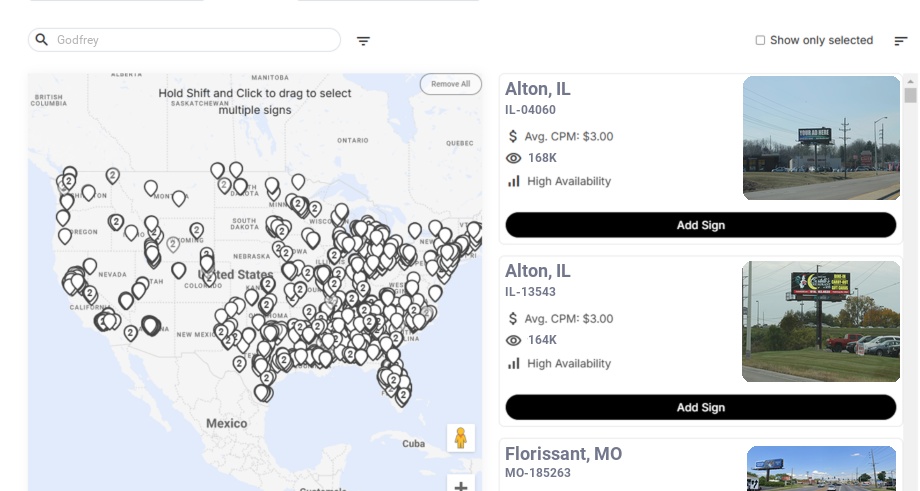



How much is a billboard near Godfrey?
Why Choose Blip for Billboard Advertising near Godfrey
Blip lets you launch Godfrey billboards in minutes, reaching US-67 and IL-255 commuters without big-agency hassle.
Set flexible budgets for Godfrey, so you can spend more during morning and evening rush on the Alton commute.
No contracts with Blip means Godfrey advertisers can test weekend campaigns for Great River Road visitors and pause anytime.
Use real-time analytics to see what works in Godfrey, then shift spend toward peak traffic near Lewis and Clark Community College.
Blip's creative tools make it easy to tailor simple, local ads for Godfrey's riverbend families, students, and seasonal festival crowds.
Frequently Asked Questions About Billboard Advertising near Godfrey
How much does a billboard cost near Godfrey, Illinois with Blip?
With Blip, you set your own daily budget and let the system automatically serve short 7.5–10 second blips on digital Godfrey billboards serving the Godfrey area. Because you only pay per blip, you’re always in control of exactly how much you spend, and you can adjust your budget or pause your campaign at any time. The price of each blip varies based on when you choose to advertise and local advertiser demand, so smaller budgets can still access great locations and times.
Where can I advertise with Blip near Godfrey, Illinois?
With digital billboards nearby in Alton serving the Godfrey area, advertisers can tap into daily commuting, local shopping patterns, and regional tourism along the Great River Road. Our digital boards in nearby Alton are strategically placed to intercept daily life in the Godfrey area, giving advertisers billboards near Godfrey that tap into both local and pass-through traffic. These corridors collectively carry well over 50,000 vehicle trips on an average day within a 10–15-minute drive of Godfrey.
What kind of audience do Godfrey, Illinois billboards reach?
When we advertise near the Godfrey area, we are speaking to several overlapping audiences, including local families and homeowners, students and educators, regional commuters, and outdoor and riverfront enthusiasts. The village has a population of roughly 17,500–18,000 residents, and many households have lived in their homes for 10 years or more. A sizable student and young adult population also comes from Lewis and Clark Community College, which enrolls roughly 4,000–5,000 credit students each year.
When is the best time to run Blip ads near Godfrey, Illinois?
The Godfrey area does not have the round-the-clock bustle of a downtown core, which means timing your Blips gives you a real advantage. Morning (6–9 a.m.) and evening (4–7 p.m.) are especially strong for commuter traffic, while midday captures lunch trips, errands, and college student movement. Weekends and seasonal peaks are best for leisure travel, events, and tourism along the river.
What traffic patterns should I know before buying billboards near Godfrey, Illinois?
US-67 and IL-3 link the Godfrey area to Alton and into the rest of the metro, while IL-255 provides fast access toward Edwardsville, I-270, and the Missouri side of the river. Segments of US-67 near Godfrey commonly see average daily traffic in the 20,000–25,000-vehicle range, and IL-255 is estimated between 25,000 and 35,000 vehicles daily. These corridors see sharp peaks during morning and evening commutes, when up to 40–45% of daily traffic occurs.
Do I need a contract to advertise with Blip near Godfrey?
No, Blip has no long-term contracts or minimum commitments. You can start, pause, or stop your campaign at any time.
How fast can I launch a billboard campaign with Blip near Godfrey?
You can have your campaign live in minutes. Create a free account, select your locations, set your budget, upload your design, and start running once approved.
Where can I advertise with Blip near Godfrey?
Blip has digital billboards near Godfrey. You can browse available locations on a map, choose the ones that fit your audience, and start advertising right away.
Still have questions? Launch a campaign in minutes — no contracts, no commitments.
Start Your CampaignGodfrey Billboard Advertising Guide
The Godfrey, Illinois area offers advertisers a powerful mix of small‑town stability and big‑market reach. With digital billboards nearby in Alton serving the Godfrey area, we can tap into daily commuting, local shopping patterns, and regional tourism along the Great River Road to put your message in front of both residents and visitors at exactly the right moments. For brands specifically looking for billboards near Godfrey, this combination of local loyalty and regional travel makes roadside media especially efficient.
Understanding the Godfrey Area Market
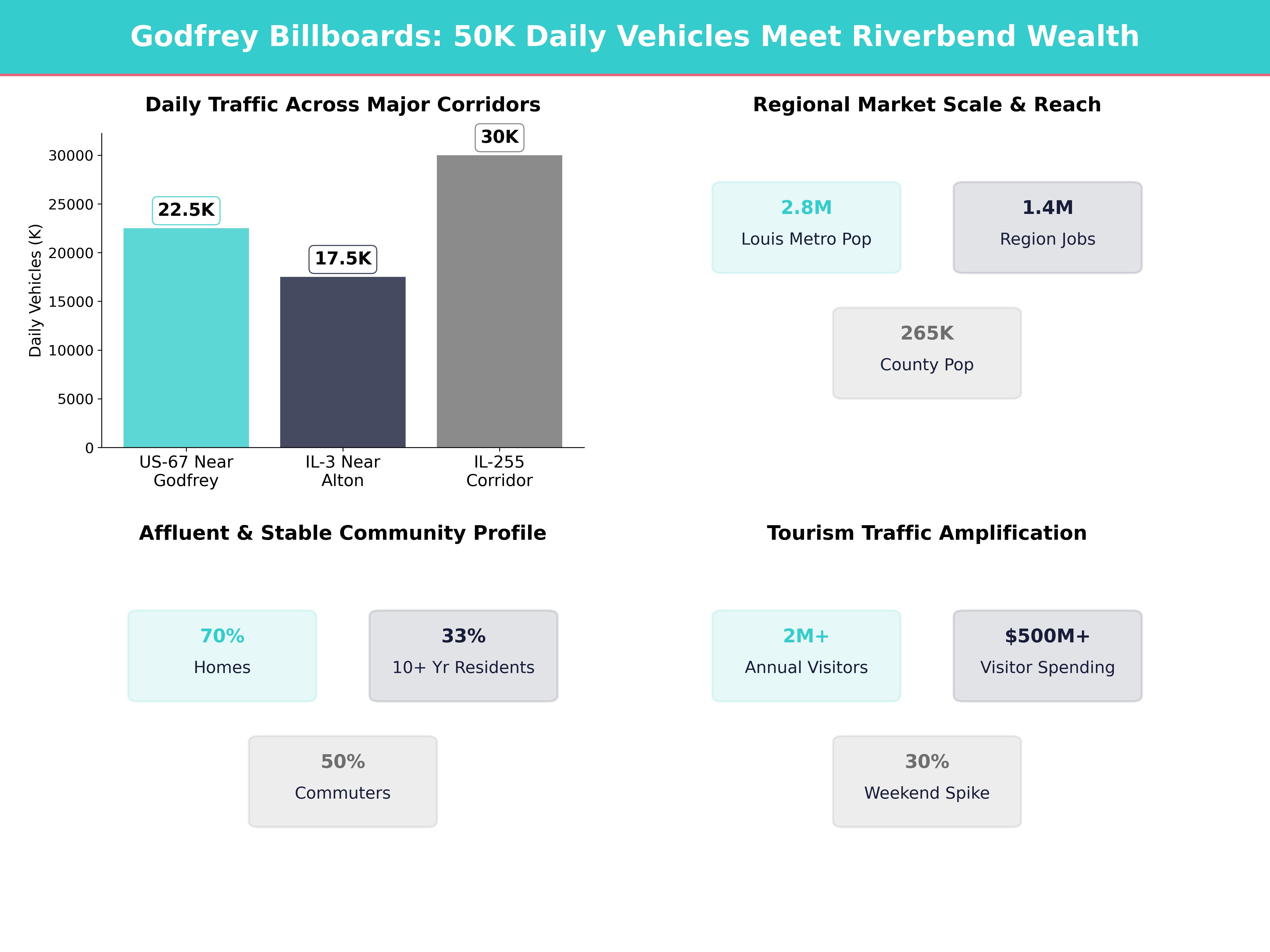
The Village of Godfrey sits at the northern edge of the St. Louis metropolitan region in Madison County. According to recent local planning and demographic summaries from the Village of Godfrey and Madison County government, the village has a population of roughly 17,500–18,000 residents, while Madison County as a whole has around 265,000 people. Regional economic and transportation agencies report the greater St. Louis metro at more than 2.8 million residents, with over 1.4 million jobs spread across the bi‑state region. That means campaigns near Godfrey can speak to a loyal local base while also reaching a much larger regional audience, especially when you use Godfrey billboards to bridge local neighborhoods with nearby commuter routes.
Key local context:
-
Community profile
- Predominantly residential, with a high homeownership rate; local planning data indicates that more than 70% of occupied housing units in the Godfrey area are owner‑occupied, and many households have lived in their homes for 10 years or more.
- A sizable student and young adult population thanks to Lewis and Clark Community College, which enrolls roughly 4,000–5,000 credit students each year and serves more than 10,000 individuals annually across for‑credit, non‑credit, and workforce programs.
- Strong pride in outdoor amenities and riverfront access, highlighted by the Great Rivers & Routes tourism region. Tourism reports for the region note that visitors take part in more than 100 scheduled festivals, riverfront events, and community celebrations each year.
-
Economic drivers
- Education and healthcare: Lewis and Clark Community College employs several hundred faculty and staff members, while nearby hospitals and clinics in Alton and the broader Madison County area collectively support thousands of healthcare jobs.
- Retail and services clustered along major corridors connecting Godfrey and Alton. Local economic development data from the City of Alton notes hundreds of active business licenses in sectors like restaurants, automotive, banking, and personal services within a short drive of Godfrey.
- Many residents commute into Alton, Edwardsville, and across the river toward the St. Louis job centers. Regional commute studies show that in Madison County, more than 50% of workers travel to a different municipality for work, with average one‑way commute times in the 23–27‑minute range. This regular travel creates repeated exposure opportunities for billboard advertising near Godfrey on the main approach roads.
-
Civic and news ecosystem
- Local issues and events are covered closely by outlets like RiverBender.com and the Alton Telegraph, which together reach tens of thousands of readers each week via web, print, and social channels.
- Community information and planning insights are available from the Village of Godfrey and Madison County government websites, which publish updates on development, transportation, public safety, and community events.
All of this supports campaigns that focus on community ties, practical value, and trusted local presence. Messaging that feels “neighborly” and grounded in the riverbend lifestyle tends to resonate strongly near Godfrey and performs especially well when paired with consistent billboard advertising near Godfrey along the main commuting and shopping corridors.
Where Traffic Flows Near Godfrey
Our digital boards in nearby Alton are strategically placed to intercept daily life in the Godfrey area, giving advertisers billboards near Godfrey that tap into both local and pass‑through traffic.
Important movement patterns to keep in mind:
-
Commuter corridors
- US‑67 and IL‑3 link the Godfrey area to Alton and into the rest of the metro. According to traffic count summaries from the Illinois Department of Transportation, segments of US‑67 near Godfrey commonly see average daily traffic (ADT) in the 20,000–25,000‑vehicle range, while IL‑3 near Alton carries roughly 15,000–20,000 vehicles per day.
- IL‑255 provides fast access toward Edwardsville, I‑270, and the Missouri side of the river. Recent IDOT estimates place average daily traffic on IL‑255 between 25,000 and 35,000 vehicles, with higher volumes near major interchanges.
- These corridors collectively carry well over 50,000 vehicle trips on an average day within a 10–15‑minute drive of Godfrey, with sharp peaks during morning (6–9 a.m.) and evening (4–7 p.m.) commutes when up to 40–45% of daily traffic occurs. Well‑placed Godfrey billboards or nearby digital faces can capture this rush‑hour surge multiple times per week.
-
Local shopping and services
- Residents commonly head toward Alton for larger retail options, restaurants, healthcare, and banking. Retail trade data shared by Madison County’s economic development office shows that Alton captures a significant share of regional spending, with retail sales measured in the hundreds of millions of dollars annually.
- This means your ads on boards near Alton are naturally hitting Godfrey residents at “errand time” when they are already in a decision‑making mindset—national out‑of‑home studies consistently show that more than 60% of drivers make shopping decisions while in the car or shortly after a trip.
-
Tourism and leisure
- The Meeting of the Great Rivers National Scenic Byway attracts visitors for scenic drives, eagle‑watching, cycling, and riverfront events. Regional tourism reports from Great Rivers & Routes Tourism Bureau indicate that the broader region draws well over 2 million visitors per year, generating visitor spending above $500 million annually in lodging, dining, retail, and attractions.
- Weekends and seasonal peaks (fall foliage, winter eagle season, spring river events) see noticeable increases in non‑local traffic throughout the riverbend. During signature events—such as large riverfront festivals or the peak winter eagle‑watching months—local tourism officials often report weekend visitor spikes of 20–40% above typical off‑season levels.
By aligning your Blip campaigns with these flow patterns—commutes, shopping trips, and scenic travel—we can maximize impressions from the exact audience you care about most and make your billboard rental near Godfrey work harder for every dollar.
Who You’ll Reach Near Godfrey
When we advertise near the Godfrey area, we are speaking to several overlapping audiences:
-
Local families and homeowners
- Many households have lived in the area for years and value stability, safety, and community relationships. In many Madison County riverbend neighborhoods, more than one‑third of residents have lived in the same home for 10+ years, reflecting strong roots.
- Household‑level data cited by local planners shows that the majority of area households are family households, with average household sizes around 2.4–2.6 people. Practical, benefit‑driven offers (saving money, supporting local, helping kids) perform especially well with this demographic.
-
Students and educators
- Thousands of students, faculty, and staff move in and out of the Lewis and Clark Community College campus, plus area high schools. Lewis and Clark Community College serves students from more than 40 high schools and dozens of municipalities across the region, and its main campus is only a few minutes from Godfrey’s residential neighborhoods.
- This creates strong opportunities for campaigns about education, training, entertainment, quick‑serve restaurants, housing, and entry‑level jobs—especially given that young adults (18–34) typically over‑index on dining out, streaming, and entertainment spending compared with older age groups.
-
Regional commuters
- A large share of residents commute to larger employment hubs, making them frequent billboard viewers several times per week. In many Madison County communities, more than 70% of workers commute by car alone, which means repeated daily exposure to roadside media.
- They are time‑pressed but routine‑oriented—perfect for repetition‑based messaging like “Your daily coffee stop,” “Your drive‑home dentist,” or “Weekend plans start here.” Out‑of‑home industry benchmarks show that simple, repetitive messages can lift brand awareness by 20–30% within a few weeks when commuters see them multiple times.
-
Outdoor and riverfront enthusiasts
- The riverbend region draws hikers, cyclists, boaters, and scenic‑drive travelers. The Meeting of the Great Rivers corridor includes more than 30 miles of scenic byway and access to hundreds of miles of biking and hiking trails, including those managed by Madison County Transit’s trail system.
- They skew toward dining, lodging, attractions, and events—prime sectors for time‑sensitive promotions. Tourism snapshot surveys from regional partners show that overnight visitors spend 2–3 times more per trip than day‑trippers, particularly on lodging and dining, making targeted weekend and event‑based messaging especially valuable.
Understanding which of these audiences you want to prioritize will shape everything from your creative to your scheduling strategy and help determine which Godfrey billboards or nearby faces you should emphasize.
Timing and Seasonality in the Godfrey Area
The Godfrey area does not have the round‑the‑clock bustle of a downtown core, which means timing your Blips gives you a real advantage.
Key temporal patterns to consider:
-
Daily patterns
- Morning (6–9 a.m.): Strong commuter volume toward Alton and beyond; local traffic profiles indicate that roughly 20–25% of weekday traffic on major corridors can occur in this window. Great for coffee shops, breakfast spots, auto service, and quick health reminders.
- Midday (11 a.m.–2 p.m.): Lunchtime trips, local errands, and college student movement. This period typically captures another 20–25% of daily traffic, and out‑of‑home industry data shows lunch and mid‑day shoppers are highly responsive to impulse offers and nearby dining cues. Ideal for restaurants, retail, medical appointments, and local government or community messages.
- Evening (4–7 p.m.): Heaviest commuter return traffic; it’s common for 25–30% of weekday traffic to occur in this narrow window. Perfect for grocery promos, family activities, and “stop tonight” service offers.
-
Weekly patterns
- Monday–Thursday: Routine commutes and errands—ideal for “everyday” services (healthcare, banking, auto repair, professional services). Local business associations in the riverbend area often report that Monday–Thursday accounts for 60–70% of weekly service and professional appointments.
- Friday–Sunday: More leisure travel, events, and tourism along the river; best for entertainment, dining, weekend sales, and local festivals. Tourism and hospitality businesses in the Alton–Godfrey market commonly see weekend revenue shares of 40–60% of their weekly totals.
-
Seasonal patterns
- Spring: Home improvement, landscaping, outdoor recreation, spring sports, and graduation‑related services. Hardware, garden, and home‑service sectors in the Midwest typically see double‑digit sales lifts (10–25%) in March–May compared with winter months.
- Summer: Tourism spikes, family outings, youth activities, and college recruitment. Great Rivers & Routes points to summer as a prime season for river cruises, biking, and regional festivals, with hotel occupancy often several percentage points higher than in the shoulder seasons.
- Fall: Back‑to‑school, fall sports, scenic drives, and holiday shopping ramp‑up. Scenic byway traffic increases with fall color, and retailers often log strong September–November sales as holiday planning begins.
- Winter: Holiday retail, indoor entertainment, heating and auto maintenance, and eagle‑watching tourism along the river. The region’s eagle‑watching season can draw thousands of additional visitors on key weekends, and local reports often highlight substantial increases in winter weekend occupancy tied to eagle events.
Blip’s flexible scheduling allows us to concentrate your budget into the specific times of day, days of week, and seasons when your target audience is actually on the road near Godfrey, making your billboard rental near Godfrey more targeted and cost‑effective.
Crafting Effective Creative for the Godfrey Area
Digital billboard artwork near Godfrey should reflect local sensibilities: straightforward, neighborly, and easy to read at a glance.
Consider these best practices:
-
Use simple, direct value statements
- Speak to practical needs: “Save on your heating bill,” “Same‑day appointments,” “Locally owned since 19XX.”
- Limit copy to 7–10 words; out‑of‑home readability tests show that messages with 10 words or fewer are processed 20–30% faster than more text‑heavy creatives, which is crucial at 45–55 mph.
-
Lean into local and regional identity
- References to the Mississippi River, Great River Road, local schools, or “Riverbend” terminology help ads feel truly local. Including a recognizable local reference can lift message recall by 10–15% in many creative testing studies.
- Phrases like “Proud to serve the Godfrey area,” “On your commute from Godfrey,” or “Just minutes from Godfrey” reinforce geographic relevance without overstating location and subtly signal that these are true Godfrey billboards in terms of who they reach.
-
Design for quick comprehension
- High‑contrast colors (for example, dark background with bright text) stand out in varying daylight conditions; research on digital out‑of‑home suggests that high‑contrast designs can improve legibility at distance by 30% or more.
- Large, bold fonts and strong focal imagery make your message clear in under two seconds, which matches typical glance times measured in driver eye‑tracking studies.
- Include a short web address, phone, or call to action (“Exit at…”, “Search: [Brand] Godfrey”). Even simple URLs or search prompts have been shown to increase follow‑up actions by 15–25% compared with branding‑only creatives.
-
Multiple creatives for multiple audiences
-
For the same campaign, you might rotate:
- A family‑oriented message during school commute hours.
- A value/discount message at midday.
- A leisure/entertainment message on weekends.
- Blip makes it easy to upload and rotate several creatives at once, so we can test what performs best. Many advertisers see 10–20% higher engagement (calls, web visits, redemptions) when they run at least two tailored creatives versus a single generic design.
-
For the same campaign, you might rotate:
Using Blip’s Capabilities Strategically Near Godfrey
Our digital billboards in nearby Alton give us precision that traditional static boards cannot match. Here’s how to leverage the platform specifically for the Godfrey area:
-
Dayparting to match commuters and students
- Set Blips to run heavier during morning and evening drive times for service businesses like auto shops, medical clinics, and quick‑serve restaurants. For example, you might allocate 50–60% of weekday impressions to 6–9 a.m. and 4–7 p.m., mirroring traffic peaks.
- Target midday pulses for lunch spots, retailers, and on‑campus offers aimed at Lewis and Clark students. With thousands of students and staff on campus each term, even capturing a small share—say 2–5% responding to your message—can translate into meaningful foot traffic.
-
Geo‑aware messaging without overclaiming
- Use language like “Serving the Godfrey area” or “A short drive from Godfrey” so viewers clearly understand you’re close and convenient.
- If you have multiple locations, display directional cues (“5 minutes south of Godfrey, in Alton”). Simple distance/time markers (e.g., “2 minutes off IL‑255”) have been shown in out‑of‑home case studies to increase store‑visit lift by 10–20%.
-
Budget concentration instead of “always on”
- With Blip, you can spend more per hour during your key windows instead of spreading a fixed budget thin over 24 hours. For instance, instead of buying 24 hours of low‑frequency coverage, you might buy 8–10 peak hours per day at 2–3 times the frequency.
- For example, a small business might focus 70% of its budget on weekday rush hours and 30% on weekend mid‑days when tourism and shopping are highest, matching the reality that a majority of their weekly sales may come from those specific windows.
-
Seasonal flighting
- Increase frequency around local events and tourism spikes promoted by Great Rivers & Routes—for example, river festivals, holiday markets, or eagle‑watching season. Many local events report attendance jumps of 10–30% when supported by coordinated digital and out‑of‑home promotion.
- Run shorter, intense bursts for sales events (e.g., a 3‑day retail sale) rather than light coverage over many weeks. Retail case studies often show that a high‑frequency, 7–10‑day flight can produce more incremental revenue than a low‑frequency 4‑week campaign with the same budget.
-
Creative testing with multiple Blips
- Run two or three creatives simultaneously and watch which ones correlate with spikes in website visits, calls, coupon redemptions, or in‑store foot traffic. Even basic A/B testing can reveal 15–30% performance differences between headlines or offers.
- Once you see a winner, shift your budget toward that message and refresh periodically to avoid fatigue—most advertisers find that rotating new creative every 6–8 weeks keeps results strong without overloading design resources.
Campaign Ideas Tailored to the Godfrey Area
To make this more concrete, here are sample strategies by sector that fit the Godfrey market’s realities:
-
Local retail and services
- Message: “Save on home comfort – Furnace tune‑ups serving the Godfrey area.”
- Timing: Heavy September–November, weekday evenings and Saturday mornings—mirroring the period when heating and cooling companies in the Midwest often see 30–40% of their annual maintenance calls.
- Creative: Clear service benefit, phone number, and “Locally trusted since [year].” Consider adding a limited‑time discount (e.g., “$20 off this month”) to spur quicker action.
-
Restaurants and cafés
- Message: “Lunch near Godfrey? Daily specials in Alton – Exit [X].”
- Timing: 11 a.m.–2 p.m. weekdays; extended coverage Friday evenings and weekends. Restaurant benchmarks typically show lunch and early‑evening dayparts accounting for 60–70% of weekly traffic.
- Creative: Mouth‑watering food image, short URL, and quick distance/time indicator (“5 minutes from Godfrey on US‑67”). Mentioning fast service (“In and out in 30 minutes”) can be especially persuasive for commuters and college students.
-
Colleges and training centers
- Message: “Advance your career without leaving the Godfrey area.”
- Timing: Recruitment pushes before each semester; heavier during morning and evening commutes when working adults are on the road. Enrollment campaigns often see the highest response 4–8 weeks before term starts.
- Creative: Simple headline, program highlight (e.g., nursing, trades, IT), website. Including a clear stat—“Graduate in as little as 18 months” or “Over 90% job placement in [program]”—can significantly boost perceived value.
-
Healthcare providers
- Message: “Same‑day appointments near the Godfrey area – New patients welcome.”
- Timing: Consistent year‑round with slightly higher frequency during flu season and back‑to‑school periods, when clinics in the region typically see visit volumes 10–25% higher than summer lows.
- Creative: Trust‑focused—local faces, simple reassurance, web and phone. Healthcare research shows that highlighting convenience (“Walk‑ins welcome,” “Open evenings & Saturdays”) can increase appointment requests by double‑digit percentages.
-
Tourism, attractions, and events
- Message: “Weekend on the Great River Road? Stay, dine & explore near Godfrey.”
- Timing: Weekends and seasonal peaks (spring–fall; special winter events). Great Rivers & Routes and Visit Alton frequently promote themed weekends and signature events that you can align with.
- Creative: Scenic imagery of the river or bluffs, clear event dates, and event website. Tourism case studies show that including a specific date and URL can increase event awareness and attendance by 10–20% compared with generic seasonal messaging.
These ideas can be scaled up or down depending on your budget for billboard rental near Godfrey and your desired reach in the wider metro.
Aligning With Local Regulations and Community Values
Madison County and the local municipalities near Godfrey value scenic preservation, particularly along the riverfront and major corridors. While our Blip billboards already comply with relevant regulations, advertisers should also consider community expectations:
- Avoid overly aggressive or sensational content that may conflict with the area’s family‑oriented identity. Local feedback gathered by municipalities like the Village of Godfrey and City of Alton often highlights a preference for clean, positive, and community‑minded visuals.
- Emphasize safety, community, and environmental respect where appropriate—especially for outdoor, recreational, or youth‑focused campaigns. Referencing local stewardship efforts or family‑friendly messaging aligns well with community surveys that consistently rank safety and quality of life as top priorities.
- When in doubt, review your approach alongside local information from the Village of Godfrey or Madison County for alignment with broader community priorities, including any guidelines administered by departments such as Planning & Development.
Measuring and Refining Performance
Because the Godfrey area is a defined yet connected market, small changes in your Blip strategy can yield clear results.
To get the most from your campaigns:
- Track website traffic patterns by hour and day when your Blips are active. Many advertisers see 10–30% bumps in direct and branded search traffic during strong out‑of‑home flights.
- Use simple landing pages or promo codes specific to your billboard message (e.g., “/riverbend” or “Mention ‘GODFREY’ for 10% off”). Distinct URLs and codes make it easier to tie revenue directly to your campaign.
-
Watch for correlations between campaign flights and:
- Phone inquiries
- Store visits
- Event registrations
- Online quote or appointment requests
Then, adjust:
- Increase budgets around time windows that correlate with stronger responses—if you see that 60–70% of conversions happen in certain dayparts, weight your Blips accordingly.
- Refresh creatives every 4–8 weeks to maintain visibility without causing viewer fatigue; out‑of‑home norms show that creative wear‑out typically begins after 6–10 weeks of exposure.
- Test new angles—more local emphasis, a clearer discount, or a different call to action—and see what moves the needle. Even modest improvements (5–10% higher response) compound over multiple flights.
By understanding the rhythms, values, and movement patterns of the Godfrey area—and by using Blip’s flexibility to match those realities—we can build digital billboard campaigns that feel local, hit at the right moments, and drive measurable results for your organization. Whether you are seeking billboards near Godfrey for brand awareness or tightly targeted billboard advertising near Godfrey for short‑term promotions, this approach helps you turn local traffic into real business outcomes.