Billboards near Glenview, IL
No Minimum Spend. No Long-Term Contracts. Just Results.
Trusted by Leading Brands


Billboard advertising
near Glenview has never been easier
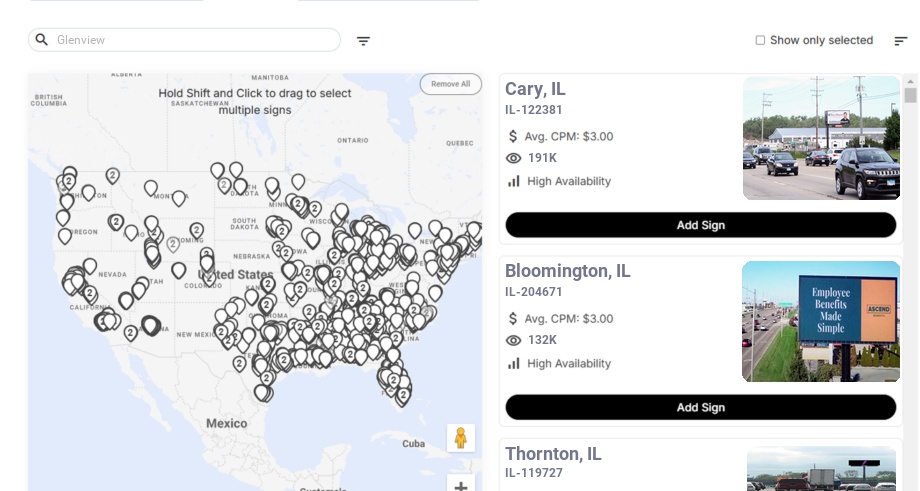



How much is a billboard near Glenview?
Why Choose Blip for Billboard Advertising near Glenview
Blip lets you launch on Glenview routes tied to I-294 and I-94 commuter traffic with self-serve control in minutes.
Use Blip in Glenview to daypart around school runs and 6:30–9 a.m. rushes, reaching parents and professionals when they drive.
No contracts mean Glenview advertisers can test high-income North Shore messaging, then shift budget fast as results come in.
Blip’s real-time analytics help Glenview campaigns adapt to weekend retail, O’Hare travel, and after-work traffic on nearby corridors.
Create polished Glenview ads fast with Blip’s creative tools, then tailor them for families, commuters, and the North Shore audience.
Frequently Asked Questions About Billboard Advertising near Glenview
How much does a billboard cost near Glenview, Illinois with Blip?
With Blip, you control exactly what you spend on Glenview billboards by setting a daily budget that can be as small or as large as you like, and Blip automatically keeps your campaign within that amount. Each ad is a short “blip” on rotating digital billboards near Glenview, Illinois, and you only pay for the blips you receive, similar to pay-per-click advertising online. That depends on when and where you choose to appear in the Glenview area and on current advertiser demand, but you can adjust your budget at any time.
Where can I advertise near Glenview, Illinois with Blip?
There are 21 digital billboards serving the Glenview area from nearby City of Des Plaines, Village of Rosemont, Village of Harwood Heights, and Village of Schiller Park. These locations are clustered in high-traffic corridors within about 10 miles, particularly around Des Plaines, Rosemont, Harwood Heights, and Schiller Park. If you are looking for billboards near Glenview that reach both locals and through-traffic, these locations give you broad, efficient coverage.
Who sees Glenview, Illinois billboards near Blip locations?
Glenview sits at the heart of Chicago’s North Shore, with high-income households, strong schools, and steady commuter traffic flowing toward downtown Chicago and O’Hare. Glenview is a prime target market for brands looking to reach affluent families and professionals, which makes Glenview billboards especially valuable for local and regional advertisers. Many residents work in management, business, finance, healthcare, tech, and professional services, and a substantial share work outside the village.
What is the best time to run Blip ads near Glenview, Illinois?
Morning commute, midday, afternoon school and after-work, and late night all present different opportunities for Glenview area campaigns. Regional traffic data consistently shows that more than half of daily vehicle volume on major corridors occurs during peak commute and school windows, making smart timing one of the highest-leverage decisions in your campaign. With Blip’s dayparting tools, we can prioritize your budget during the specific hours when your Glenview area audience is most active.
How can Blip help target commuters around Glenview, Illinois?
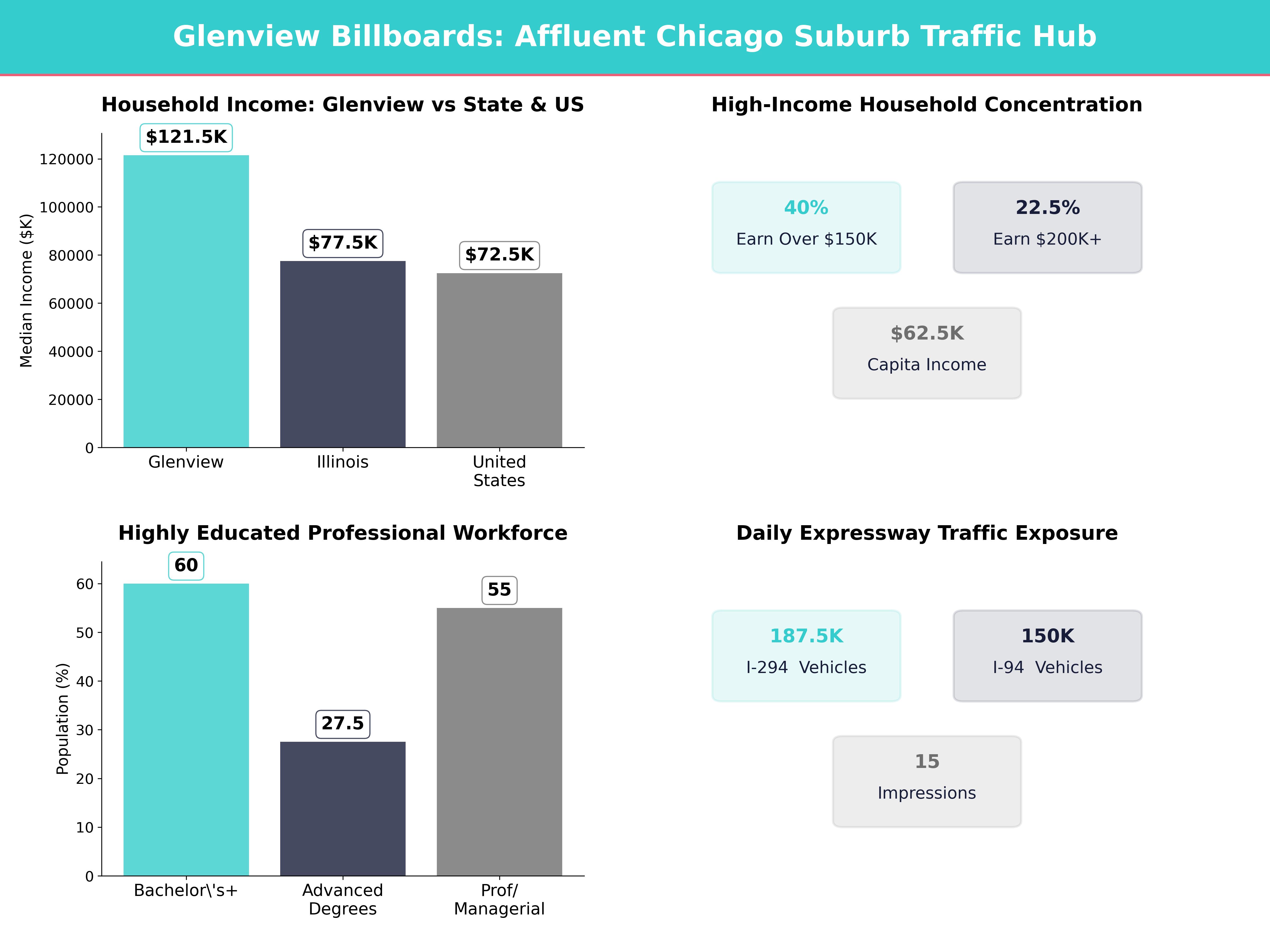
I-294, west of Glenview, often exceeds 180,000–195,000 vehicles per day on busy segments, and I-94, east of Glenview, carries 140,000–160,000 vehicles per day depending on the segment. Milwaukee Avenue and Waukegan Road typically handle 25,000–35,000 vehicles per day on busy segments, while Willow Road, Lake Avenue, and Glenview Road often carry 15,000–25,000 vehicles per day on key stretches. These routes connect residents to shopping districts, schools, park district facilities, downtown Chicago, and O’Hare.
Do I need a contract to advertise with Blip near Glenview?
No, Blip has no long-term contracts or minimum commitments. You can start, pause, or stop your campaign at any time.
How fast can I launch a billboard campaign with Blip near Glenview?
You can have your campaign live in minutes. Create a free account, select your locations, set your budget, upload your design, and start running once approved.
Where can I advertise with Blip near Glenview?
Blip has digital billboards near Glenview. You can browse available locations on a map, choose the ones that fit your audience, and start advertising right away.
Still have questions? Launch a campaign in minutes — no contracts, no commitments.
Start Your CampaignGlenview Billboard Advertising Guide
Glenview sits at the heart of Chicago’s North Shore, with high-income households, strong schools, and steady commuter traffic flowing toward downtown Chicago and O’Hare. With 21 digital billboards serving the Glenview area from nearby City of Des Plaines Village of Rosemont, Village of Harwood Heights Village of Schiller Park, we can help you get your message in front of residents, commuters, and travelers who live, work, shop, and play near Glenview. If you are looking for billboards near Glenview that reach both locals and through‑traffic, these locations give you broad, efficient coverage.
Understanding the Glenview Area Audience
Glenview is a prime target market for brands looking to reach affluent families and professionals, which makes Glenview billboards especially valuable for local and regional advertisers.
-
Population & households
- The Village of Glenview reports a population of about 48,700 residents and roughly 19,000 households, with residential growth of roughly 6–8% over the last decade according to village community profiles.
- Average household size is just over 2.5 people, indicating a mix of families and professionals living alone or as couples. About 65–70% of households are family households, and around 30–35% are non-family or single-person households.
- Owner-occupied housing is typical of a stable, invested community: roughly 75–80% of housing units are owner-occupied, with median home values well above $500,000, placing Glenview among the higher-priced North Suburban markets.
- Source for community stats: Village of Glenview – Community Profile
-
Income & spending power
- Median household income in Glenview is around $118,000–$125,000, significantly above the Illinois median (roughly in the $75,000–$80,000 range) and the U.S. median (around $70,000–$75,000).
- More than 40% of households earn over $150,000, and a sizable share—often reported at 20–25%—earn $200,000 or more.
- Per capita income is typically reported in the $60,000–65,000 range, which is nearly 1.7–1.8x the statewide per-capita figure.
- This supports higher-price-point offerings: home services, financial advisors, specialty healthcare, autos, private education, and premium retail, where average transaction values can exceed $1,000–$5,000 for key decisions (e.g., elective medical procedures, remodeling projects, financial services). Well-placed billboard advertising near Glenview can introduce these services at scale to households with the means to respond.
-
Education & professions
- Over 60% of adults in Glenview hold a bachelor’s degree or higher, compared with roughly 38–40% statewide. In many village reports, advanced degrees (master’s, professional, or doctorate) account for 25–30% of adults.
- Many residents work in management, business, finance, healthcare, tech, and professional services, with professional/managerial occupations accounting for 50–60% of workers.
- Commuting patterns show that a substantial share—often 60–70%—work outside the village, frequently traveling to Chicago’s CBD, O’Hare business parks, and corporate campuses in nearby Village of Northbrook, Village of Deerfield, and Village of Skokie.
- This skews your audience toward time-poor, information-rich decision makers who respond well to concise, benefit-first billboard messaging and who are comfortable making purchases or booking services online and via mobile.
-
Family and school-centric community
- Roughly 30–35% of households include children under 18, supporting strong demand for school- and family-focused services.
- Glenview is served by strong school districts such as Glenview District 34 and Glenbrook High School District 225, which consistently report high standardized test scores, graduation rates at or above 95%, and a large share of graduates (often 85–90%+) pursuing college.
- The Glenview Park District 850 acres of parkland, 13+ playgrounds, multiple pools, golf, and recreation centers, drawing thousands of visits per week in peak season.
- A large share of households have children under 18, making education, enrichment, healthcare, sports, and family entertainment strong verticals for billboard campaigns near Glenview.
-
Cultural diversity
- Glenview has a significant Asian population (around 18–20%), including large Korean and Indian communities, plus a growing multi-ethnic mix. Many community snapshots show foreign-born residents at around 20–25% of the population.
- Households where a language other than English is spoken at home can represent 25–30% of the community, with Korean, Hindi, and other Asian languages well represented.
- English messaging works best for reach, but some brands can test subtle cultural cues or occasional Korean or other language callouts that align with their target segments, especially for healthcare, banking, and education serving specific communities.
These demographics suggest that in the Glenview area, effective billboard campaigns should emphasize quality, trust, and convenience, not just price. Short, polished messaging, quality photography, and clear calls to action are essential for any brand investing in billboard advertising near Glenview.
Key Traffic Corridors and Where Our Billboards Are Located
Our 21 digital billboards serving the Glenview area are clustered in high-traffic corridors within about 10 miles, particularly around Des Plaines, Rosemont, Harwood Heights, and Schiller Park—areas dominated by interstate traffic and the O’Hare business ecosystem. Illinois Department of Transportation traffic counts show that key nearby expressway segments routinely see 100,000–200,000+ vehicles per day, giving your campaigns substantial daily reach and making these some of the most efficient billboards near Glenview for broad audience coverage.
For additional local transportation context, see:
- Illinois Tollway – Tri‑State Tollway (I‑294)
- Illinois Department of Transportation District 1
Major routes influencing Glenview area traffic
Even though our boards are in nearby municipalities, they intersect the everyday movement of Glenview residents:
-
I‑294 (Tri‑State Tollway), west of Glenview
- Traffic volumes near the Glenview/O’Hare area often exceed 180,000–195,000 vehicles per day on busy segments, with weekday peaks accounting for 60–65% of weekly volume.
- Typical rush-hour speeds can drop below 35 mph, increasing dwell time and message visibility.
- Key for reaching North–South commuters headed between the North Shore, O’Hare, the western suburbs, and the South suburbs.
-
I‑94 (Edens Expressway), east of Glenview
- Carries 140,000–160,000 vehicles per day depending on the segment, with weekend volumes staying at 80–90% of weekday traffic due to shopping and leisure trips.
- Important for Glenview-area commuters heading to downtown Chicago or up toward Lake County employment centers.
- Chronic congestion on some segments increases exposure duration, giving well-designed creatives multiple seconds of viewing time.
-
Milwaukee Avenue (IL‑21) and Waukegan Road (IL‑43)
- Major north–south arterials cutting between Glenview and neighboring suburbs, typically handling 25,000–35,000 vehicles per day on busy segments, with signalized intersections pushing stop‑and‑go traffic during peaks.
- These routes connect residents to shopping districts in Village of Niles, Northbrook, and Glenview, as well as major retail hubs like Golf Mill Shopping Center
- Capture local, errand-focused trips: shopping, dining, schools, and appointments where proximity-driven calls to action (“5 minutes from here”) perform especially well.
-
Willow Road, Lake Avenue, and Glenview Road
- Primary east–west streets that carry heavy school, residential, and retail traffic, often in the 15,000–25,000 vehicles per day range on key stretches.
- These roads serve as the primary access routes to The Glen Town Center, local schools, and park district facilities, with traffic spikes tied to school start/end times and after‑work peaks.
Why Des Plaines, Rosemont, Harwood Heights, and Schiller Park matter
Our digital billboards in these nearby cities intercept three especially valuable flows of people connected to the Glenview area:
-
O’Hare International Airport & convention traffic (Rosemont, Schiller Park, Harwood Heights)
- O’Hare International Airport 73.9 million passengers in 2023, up significantly from pandemic lows and approaching pre‑COVID levels (over 79 million in peak years).
- O’Hare supports more than 40,000 on‑airport jobs, with tens of thousands more in surrounding logistics, hotel, and office corridors—many of whom commute from the North Shore and Northwest suburbs.
- Rosemont is home to the Donald E. Stephens Convention Center, which hosts 1 million+ visitors annually across trade shows, consumer shows, and corporate events, as well as Allstate Arena and the entertainment district at Parkway Bank Park
- Neighboring municipalities such as the Village of Rosemont, Village of Schiller Park, and Village of Harwood Heights
-
Glenview residents and local professionals frequently travel through this area for flights, events, and work. Billboards here are ideal for:
- Travel services, restaurants, and hospitality targeting locals heading to O’Hare.
- B2B brands targeting conference attendees and business travelers who also stay or work in the Glenview area.
-
Commuter traffic between Glenview and Chicago (Des Plaines, Harwood Heights)
- Many Glenview residents commute to Chicago or surrounding office clusters; regional surveys often show 70–75% of workers in nearby suburbs driving alone or carpooling, with average commute times near 30–35 minutes.
-
Routes skirting the City of Des Plaines
- Chicago’s Northwest Side and Loop.
- Industrial and office parks near O’Hare, Elk Grove Village, and Franklin Park.
- Metra Milwaukee District North Line and Milwaukee District West Line, along with CTA Blue Line
- Placing messaging on these boards at commute times ensures repeated exposures, often 10–20+ impressions per week for regular commuters, building strong recall among high-value local professionals.
-
Regional retail and weekend traffic
- Destinations like The Glen Town Center in Glenview, Golf Mill Shopping Center in Niles, and entertainment hubs in Rosemont draw weekend and evening traffic from across the North and Northwest suburbs. Many of these centers report millions of visits annually, with weekends accounting for 35–45% of weekly traffic.
- Rosemont’s Parkway Bank Park entertainment district alone hosts hundreds of events each year, from concerts to family attractions, driving consistent evening traffic past nearby billboards.
- Pairing your campaigns with these travel patterns helps you reach families and groups in a leisure mindset, ideal for retail, dining, and entertainment offers.
Timing Your Blip Campaign Around Local Rhythms
Because Blip allows you to buy digital billboard “blips” in flexible increments, we can align your spend with when Glenview area audiences are most likely to be on the road and receptive. This is especially useful if you want your billboard rental near Glenview to focus only on the highest-value hours.
Regional traffic data from IDOT and the Illinois Tollway consistently shows that more than half of daily vehicle volume on major corridors occurs during peak commute and school windows, making smart timing one of the highest‑leverage decisions in your campaign.
Daily timing: commute, school, and evening peaks
Based on regional traffic and commuter behavior:
-
Morning commute (6:30–9:00 a.m.)
- Morning peaks on I‑294 and connecting arterials typically account for 25–30% of weekday traffic, with volumes starting to build by 6:30 a.m. and peaking around 7:30–8:30 a.m.
- Hit professionals heading from Glenview toward Chicago, O’Hare, or nearby corporate campuses.
-
Best for:
- Financial services, professional services, healthcare, and B2B.
- Quick “top-of-mind” brand reminders (logos + simple benefits).
-
Midday (11:00 a.m.–2:00 p.m.)
- Midday periods often retain 50–60% of peak traffic levels but with slower, more errand-driven trips.
-
Captures:
- Parents running errands, retirees, remote/hybrid workers heading to lunch.
- Service calls for home improvement, medical appointments, or local retail trips.
- Good window for local retail, healthcare, education, and home services—especially brands that want to reach decision makers when they can actually pick up the phone or book online.
-
Afternoon school and after-work (3:00–7:00 p.m.)
- Afternoon peaks routinely match or exceed morning volumes, representing another 25–30% of daily traffic on many routes.
- Families heading to practices, activities, parks, and dining in the Glenview area.
- Evening commuters returning via Des Plaines/Rosemont corridors.
-
Ideal for:
- Restaurants, QSR, fitness, youth programs, tutoring, and local attractions.
- Messaging can include time-bound offers: “Tonight only,” “This week,” or “After school special.”
-
Late night (9:00 p.m.–midnight)
- Lower overall volume—often 20–30% of daytime levels—but cheaper impressions.
-
Useful for:
- Nightlife, streaming, delivery services, or campaigns needing extra frequency on a tight budget.
- Also effective for high‑frequency, long‑term branding where cost‑per‑thousand impressions is critical.
With Blip’s dayparting tools, we can prioritize your budget during the specific hours when your Glenview area audience is most active.
Weekly and seasonal patterns
-
Weekdays vs. weekends
- Weekdays: heavier on work commutes and school traffic, typically accounting for 70–75% of weekly vehicle trips on commuter corridors.
- Weekends: more leisure trips to shopping, dining, and events around Glenview and Rosemont; Saturday volumes on key arterials can reach 80–90% of weekday levels, but with longer average trip durations and higher leisure spending.
-
For many brands, we recommend:
- 60–70% of spend on weekdays, focusing on commute hours.
- 30–40% on weekends, especially Saturday late morning to early evening for retail and family activities.
-
School calendar
- The Glenview area’s rhythm closely follows the K–12 calendar, with enrollment in local districts and private schools totaling many thousands of students across elementary, middle, and high schools.
-
Consider:
- August–September: back-to-school, tutoring, extracurriculars, pediatric and dental care—search and enrollment activity for education and youth programs can spike 20–40% versus summer.
- May–June: camps, summer programs, travel, and family activities; park district and private camps frequently report filling a large share of slots by late spring.
- Use Blip to ramp up during these windows and ease back during winter breaks if your product is school-dependent.
-
Weather and seasonal behavior
- Winters are cold and snowy, with average January temperatures near 20°F and measurable snow on 20–25 days per season, driving more visits to indoor activities (gyms, malls, medical, entertainment).
- Summers bring average highs in the 80°F range and longer daylight, with heavy use of parks and outdoor venues run by the Glenview Park District, plus trips to nearby attractions such as the Chicago Botanic Garden and Ravinia Festival in Highland Park, which together attract hundreds of thousands of visitors each season.
-
We often suggest:
- Winter focus: healthcare, fitness, home improvement, financial planning, and indoor attractions.
- Summer focus: events, festivals, outdoor dining, landscaping, recreation, and local staycations.
-
Local events
- Glenview hosts and neighbors multiple community events (e.g., Glenview Summer Fest thousands of attendees in a single weekend.
-
Tie your campaigns to these dates with time-sensitive creatives like:
- “Summer Fest weekend special – 10% off with this message.”
- “Heading to the fireworks? Stop by [Your Business] on Lake Ave.”
- For exact event calendars and planning, check the Village of Glenview events page Visit Chicago North Shore
Crafting Effective Creative for the Glenview Area
Strong creative is especially important for Glenview area audiences, who are used to polished messaging from national and regional brands. Studies of out‑of‑home (OOH) effectiveness commonly show that clear, simple designs can increase ad recall by 20–40% compared with cluttered creatives—a key advantage in a premium market like Glenview, where well-designed Glenview billboards can quickly distinguish your brand from competitors.
Visuals and copy style
-
Lead with sophistication and trust
- Use clean layouts, limited colors, and professional photography or illustration.
- Highlight quality, reliability, and expertise more than “cheap” or “lowest price,” unless you are clearly a value leader.
- Including credibility markers such as “Locally owned since 19XX” or “Serving 1,000+ local clients” can measurably improve response rates.
-
Keep it simple: 6–8 words max
- In heavy traffic on I‑294 or near O’Hare, drivers have only 3–6 seconds to absorb your message, and eye‑tracking research on highway billboards suggests that average glances are often under 1 second.
-
Aim for:
- One main message.
- One logo.
- One call to action (e.g., website, “Exit XX,” or location name).
-
Location-driven messaging
-
Glenview residents respond well to seeing their community referenced:
- “Trusted by Glenview families since 1995”
- “Serving Glenview area businesses”
- Just make sure phrasing accurately reflects that your billboards are near Glenview or serving the Glenview area, especially when placed in Des Plaines, Rosemont, Harwood Heights, or Schiller Park.
-
Glenview residents respond well to seeing their community referenced:
-
Use numbers and specifics
-
Affluent, educated audiences respond to concrete proof:
- “Over 1,000 Glenview families served”
- “Rated 4.9★ on Google”
- “Average client savings: $2,300/year”
- Response analytics from many advertisers show that including a specific benefit or savings figure can boost click‑through and call rates by 10–30% versus generic claims.
-
Affluent, educated audiences respond to concrete proof:
Colors and legibility
- High-contrast combinations (e.g., white/yellow on dark blue or black) work best for visibility at highway speeds; OOH legibility guidelines often recommend minimum font heights of 18–24 inches for primary copy, which translates roughly to large, bold type on digital boards.
- Avoid thin fonts, script fonts, or low-contrast palettes that blend into the background; these can reduce readability by 30–50% at typical viewing distances.
-
For night visibility near O’Hare and major roads:
- Avoid large white backgrounds that cause glare.
- Use darker backgrounds with bright text for eye comfort and to comply with local brightness standards enforced by municipalities and departments of transportation.
Local tone and cultural cues
- Maintain a professional but friendly tone that fits North Shore expectations; many residents work in sectors like finance, consulting, and healthcare where polished, credible messaging is standard.
-
If your target includes specific communities (e.g., Korean, Indian, or other groups), test:
- One creative that includes a small line of translated text or a culturally familiar image.
- Another creative with mainstream English-only messaging.
- Use Blip’s flexible scheduling to A/B test which approach drives more website visits, calls, or store traffic—many advertisers see 15–25% performance differences between their best and worst creatives, making testing highly valuable.
Using Blip Tools Strategically Near Glenview
Blip’s on-demand model for digital billboards lets us treat your out-of-home campaign more like a digital ad buy—targeted, testable, and adjustable. This is especially powerful in a market like Glenview, where each incremental customer or client often represents hundreds or thousands of dollars in lifetime value and where efficient billboard rental near Glenview can significantly improve your return on ad spend.
Budget flexibility and bidding
- You can start with a modest daily budget (even in the tens of dollars per day, such as $10–$25/day) and scale up once you see results.
-
Because the 21 digital billboards serving the Glenview area span different roads and traffic levels, we can:
- Bid higher on premium commuter-facing boards near Rosemont or Des Plaines during rush hour, where cost per thousand impressions (CPM) is higher but reach and audience quality are strong.
- Bid lower on boards at off-peak times to build frequency at a low effective cost, often driving CPMs down substantially while still reinforcing your message.
Dayparting for Glenview area audiences
We can schedule your ads to appear only during:
- Morning or evening commutes for professional services and B2B.
- School-drop and pick-up windows for education, family, and healthcare.
- Weekend daytime for retail, dining, entertainment, and local attractions.
This ensures your message appears when Glenview area residents are most likely to notice and act, rather than paying for overnight impressions that might not serve your goals. In practice, concentrating spend into high‑value hours can increase your effective exposure rate by 20–40% without raising your overall budget.
A/B testing creatives
Use Blip’s ability to run multiple creatives simultaneously on the same boards:
-
Test different:
- Headlines (“Glenview’s Trusted Orthodontist” vs. “Braces & Invisalign Near Glenview”).
- Offers ($0 consult vs. $500 off).
- Visual styles (family photo vs. product shot).
-
Monitor response via:
- Unique URLs or promo codes on each creative.
- Changes in call volume or web sessions correlated with campaign periods.
- Many advertisers find that after 2–4 weeks of testing, the top‑performing creative can outperform the weakest by 30–50% in response metrics, allowing you to quickly optimize spend.
Within 2–4 weeks, you can identify top-performing messaging and then allocate more of your impressions toward those winners.
Geo-strategy within the Glenview area
Because our boards are near Glenview in different directions, you can target messaging by sub-audience:
-
North/West commuters (Des Plaines, Rosemont)
- Great for professionals and frequent travelers passing through the O’Hare corridor and surrounding office parks.
- Promote parking, airport services, car care, lawyers, accountants, and B2B solutions that appeal to decision‑makers in transit.
-
South/East flows (Harwood Heights, Schiller Park)
- Capture those connecting to Chicago’s Northwest Side or Loop via arterials and the CTA Blue Line.
- Promote city-adjacent experiences but with a “close to home in Glenview area” angle—for example, parking, dining, and services just outside Chicago’s higher‑priced core.
We can even deploy different creatives on different boards:
- One tailored to “Glenview professionals heading to O’Hare”
- Another tailored to “Families heading to weekend outings”
This kind of geographic segmentation can increase relevance and response by 10–20% compared with one‑size‑fits‑all creative and helps you get more value from every billboard advertising near Glenview that you book.
Campaign Ideas for Common Business Types in the Glenview Area
Below are practical examples of how different businesses can leverage digital billboards serving the Glenview area.
Local retail and dining
- Target times: Lunchtime (11 a.m.–2 p.m.) and evenings/weekends, when retail districts like The Glen, downtown Glenview, and Rosemont see some of their highest foot traffic.
-
Creative angles:
- “Date night near Glenview? Try [Restaurant Name] – 5 minutes off I‑294.”
- “Shop local: [Store Name] at The Glen Town Center – Exit [X].”
- Feature simple offer lines: “Kids eat free Tuesdays” or “20% off this weekend.”
- Retail and restaurant campaigns that include a specific offer often see higher redemption rates and can track lift in sales during the campaign window versus baseline weeks.
Healthcare and wellness
- Target times: Weekdays 7–9 a.m. and 3–7 p.m., when parents and working professionals are most likely to plan appointments.
-
Creative angles:
- “Pediatric care trusted by Glenview families.”
- “New patient special – Glenview area dentist, same-day appointments.”
- Use proof points: “Rated 4.9★ by 500+ local patients.”
- Healthcare providers often measure success as increases of 10–30% in new‑patient calls or appointment requests during active billboard campaigns.
Education, tutoring, and youth programs
- Target times: After school (3–7 p.m.), weekends, and back-to-school season (August–September).
-
Creative angles:
- “Math tutoring near Glenview – Raise scores this semester.”
- “Summer camp for Glenview kids – Registration now open.”
- Add urgency: “Sessions filling fast” or “Enroll by June 1.”
- Back‑to‑school enrollment pushes can concentrate 60–70% of annual new sign‑ups in a few months; well‑timed OOH can help you capture a larger share of that seasonal demand.
Home services (HVAC, roofing, landscaping, remodeling)
- Target times: Early morning and early evening; ramp up seasonally.
-
Seasonal focus:
- Spring–summer: roofing, windows, exterior work, landscaping, when home‑improvement search interest typically rises 20–40%.
- Fall–winter: HVAC, insulation, snow services, interior remodeling.
-
Creative angles:
- “Glenview area homes: AC tune-up $99 – Call today.”
- “New roof before winter – financing available.”
- Many home‑service businesses attribute 5–15% of inbound leads to visible branding like billboards in targeted local corridors.
Professional and financial services
- Target times: Weekday commute windows when white‑collar professionals from Glenview and nearby suburbs are on the road.
-
Creative angles:
- “Glenview area investors: Schedule your free financial review.”
- “Business law firm serving Glenview area companies.”
- Emphasize trust: years in business, local office, credentials (“CFP®,” “CPA,” etc.).
- For high‑ticket professional services, even a small lift—such as 5–10 new client inquiries per month—can produce a substantial return on a modest billboard budget.
B2B and corporate services
With so many firms around O’Hare and the North Shore, B2B campaigns can be particularly effective:
- Targets: Executives and decision makers commuting through Des Plaines and Rosemont, including thousands of employees working in logistics, aviation, technology, and corporate offices.
-
Creative angles:
- “IT support for Glenview area offices – Cut downtime by 50%.”
- “Commercial cleaning trusted by North Shore businesses.”
- QR codes can work at slower-traffic locations; elsewhere, keep the URL short and memorable.
- B2B advertisers often report that a handful of closed deals traced back to billboard exposure can justify months of media spend, due to high contract values.
Putting It All Together
Reaching the Glenview area efficiently means understanding who lives there (affluent, educated, family-oriented professionals), where they drive (I‑294, I‑94, Milwaukee Ave, Waukegan Rd, and routes around O’Hare), and when they are most receptive (commutes, school runs, leisure trips). With local corridors carrying tens of thousands to nearly 200,000 vehicles per day, even a tightly targeted campaign can achieve meaningful reach in a short period with well-planned billboard advertising near Glenview.
By combining:
- The 21 digital billboards serving the Glenview area from Des Plaines, Rosemont, Harwood Heights, and Schiller Park,
- Flexible budgeting and scheduling through Blip,
- Data-driven creative tailored to Glenview’s unique demographics and travel patterns,
we can build campaigns that not only generate impressions, but also drive real-world results—more calls, more visits, and more customers from the Glenview area. Whether you are testing billboards near Glenview for the first time or expanding a larger out-of-home strategy, Blip gives you the tools to rent and optimize placements with minimal risk and maximum control.
For local context and event timing as you plan, we recommend regularly checking:
- Village of Glenview
- Glenview Park District
- Visit Chicago North Shore
- Local news via the Chicago Tribune – Glenview
- Community updates from nearby municipalities such as the City of Des Plaines Village of Rosemont, Village of Schiller Park, and Village of Harwood Heights
From there, we can work together to align your Blip campaign with the real rhythms of life near Glenview and turn those daily drive times into measurable growth for your business through smart, flexible billboard rental near Glenview.