Billboards in Bellwood, IL
No Minimum Spend. No Long-Term Contracts. Just Results.
Trusted by Leading Brands


Billboard advertising
in Bellwood has never been easier
How much is a billboard in Bellwood?
Why Choose Blip for Billboard Advertising in Bellwood
Blip lets you launch Bellwood billboards in minutes and reach I-290 commuters without long-term hassle.
Set any budget in Bellwood, then let Blip keep spend tight while you test Mannheim Rd and North Ave traffic.
Daypart Bellwood ads for 6–9 a.m. and 3–7 p.m. to hit daily commuters headed to Chicago, Melrose Park, and Hodgkins.
No contracts make Bellwood easy to test for weekend shoppers near North Riverside Park Mall or Rosemont events.
Track Bellwood campaign results in real time and shift creative fast as traffic flows change on I-294, Harlem Ave, and Cermak Rd.
Use Blip creative tools to build bold Bellwood ads for fast-moving highway traffic and family routes alike.
Frequently Asked Questions About Billboard Advertising in Bellwood
How much does a billboard cost near Bellwood, Illinois with Blip?
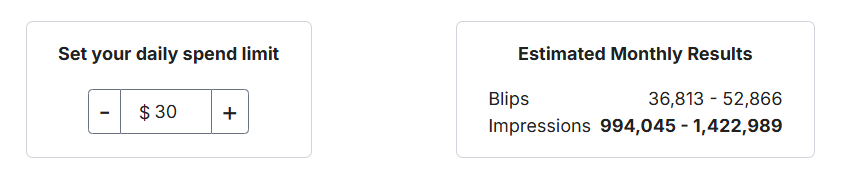
With Blip, you can advertise on Bellwood billboards on any budget, because you only pay per blip—a single 7.5 to 10-second ad display on a rotating digital billboard serving the Bellwood area. You set a daily budget, and Blip automatically keeps your campaign within that limit, while letting you adjust it anytime. The price of individual blips on billboards near Bellwood, Illinois changes based on time, location, and advertiser demand, so your total cost is simply the sum of the blips you receive over time.
Where can I advertise with Blip near Bellwood, Illinois?
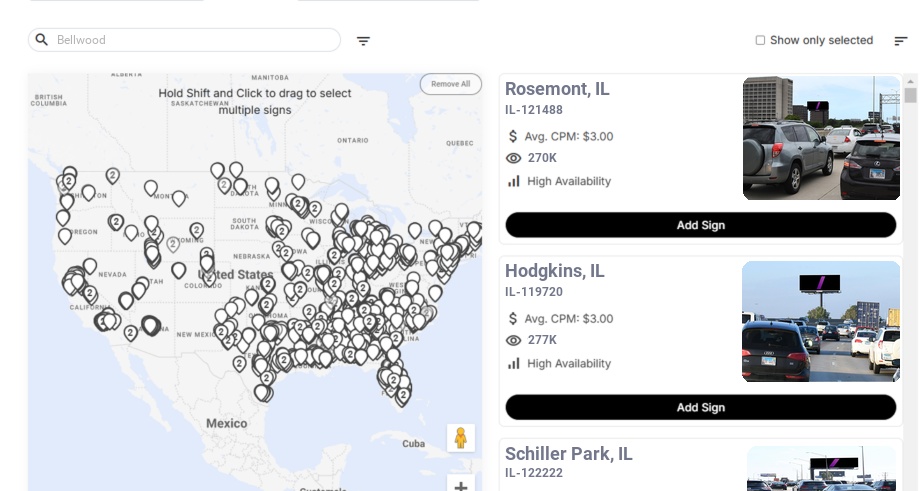
Our 51 digital billboards serving the Bellwood area are positioned in a ring of nearby suburbs, within about 10 miles of Bellwood. Key nearby locations include Stone Park, Melrose Park, North Riverside, Schiller Park, Rosemont, Hodgkins, Bedford Park, and Justice. These placements reach drivers, commuters, shoppers, airport travelers, and industrial workers moving through the area every day.
What kind of audience do Bellwood, Illinois billboards reach?
Bellwood is a compact, highly connected village in western Cook County with a heavily residential base and strong commuter patterns. More than 75% of Bellwood workers are employed outside the village, with many commuting to Chicago and nearby industrial and logistics hubs. The area also has a working-age concentration and family-oriented households, which makes it a strong market for many types of advertisers.
When is the best time to run Blip billboard ads near Bellwood, Illinois?
For commuter-focused messaging, the strongest windows are often 6–9 a.m. and 3–7 p.m., when traffic is heaviest. Midday windows from 10 a.m.–3 p.m. can be ideal for reaching stay-at-home parents, seniors, and shift workers. Weekend-heavy corridors around North Riverside, Rosemont, and shopping districts also see pronounced Saturday and Sunday surges.
What roads and corridors around Bellwood, Illinois get the most billboard traffic?
Bellwood’s location near I-290, I-294, and U.S. 45/La Grange Road ensures a high proportion of residents are on the road multiple times per day. Illinois Department of Transportation traffic counts show segments of I-290 near the Bellwood area carrying roughly 140,000–160,000 vehicles per day, and portions of I-294 near the nearby suburbs reaching or exceeding 190,000–210,000 vehicles per day. Major arterials like Mannheim Road, North Avenue, and Harlem Avenue often see 25,000–45,000 vehicles per day on key segments.
Do I need a contract to advertise with Blip in Bellwood?
No, Blip has no long-term contracts or minimum commitments. You can start, pause, or stop your campaign at any time.
How fast can I launch a billboard campaign with Blip in Bellwood?
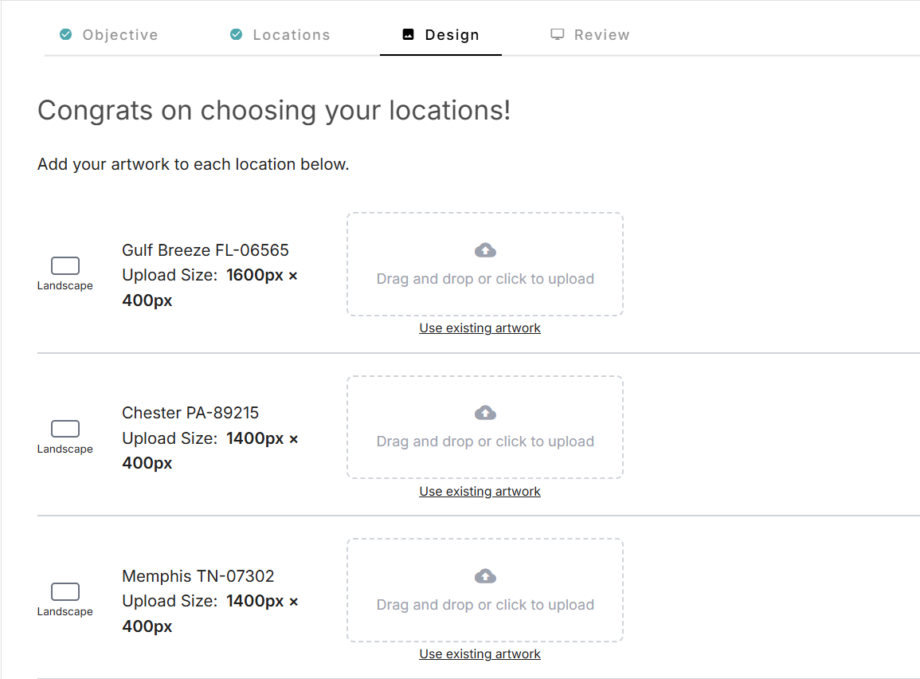
You can have your campaign live in minutes. Create a free account, select your locations, set your budget, upload your design, and start running once approved.
Where can I advertise with Blip in Bellwood?
Blip has digital billboards in Bellwood. You can browse available locations on a map, choose the ones that fit your audience, and start advertising right away.
Still have questions? Launch a campaign in minutes — no contracts, no commitments.
Start Your CampaignBellwood Billboard Advertising Guide
Bellwood, Illinois sits at the heart of Chicago's near-west suburbs, surrounded by dense residential neighborhoods, industrial corridors, and major highway interchanges. With 51 digital billboards serving the Bellwood area from nearby communities like Stone Park, Melrose Park, North Riverside, and Rosemont, we can reach drivers, commuters, and shoppers who move through this tightly connected suburban network every day. This guide focuses on how to use those nearby billboards to effectively reach audiences in the Bellwood area using Blip’s flexible, data-driven tools, and how to think strategically about billboards near Bellwood as part of your broader marketing mix.
Understanding the Bellwood Area Market
Bellwood is a compact, highly connected village in western Cook County. According to the Village of Bellwood Chicago Metropolitan Agency for Planning, the Bellwood area is:
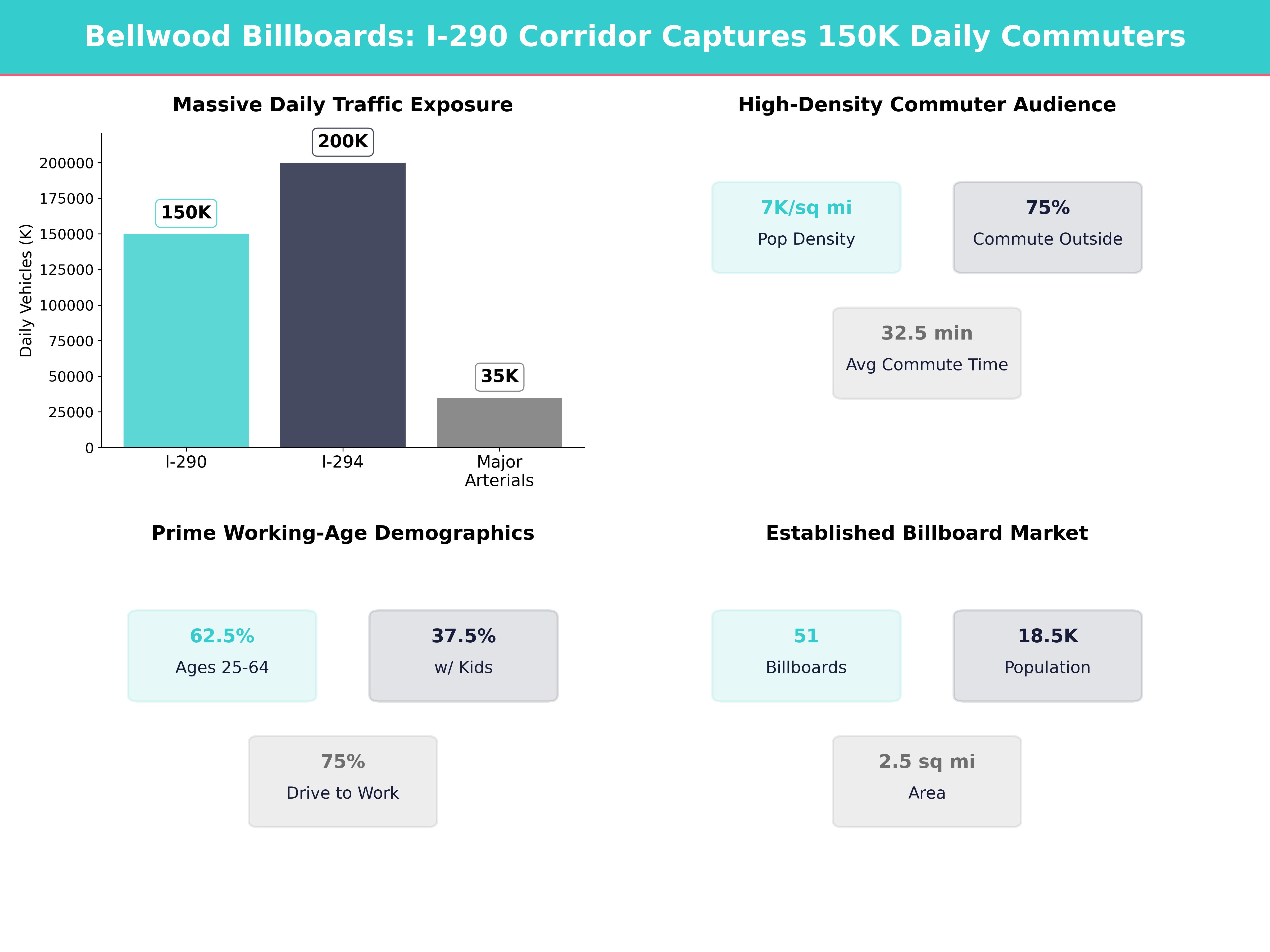
- Heavily residential: Bellwood covers about 2.5 square miles with an estimated population of roughly 18,000–19,000 residents, translating to a density of more than 7,000 people per square mile—substantially higher than the overall Cook County density of around 5,500 per square mile. The housing stock is predominantly single‑family and small multi‑unit buildings, helping sustain steady local traffic throughout the day and making Bellwood billboards and nearby placements highly visible to local residents.
- Tightly linked to Chicago employment centers: American Community Survey data indicate that more than 75% of Bellwood workers are employed outside the village, with a large share commuting to Chicago and nearby industrial/logistics hubs such as Melrose Park, Northlake, Broadview, and Hodgkins. Average one‑way commute times in many near‑west suburbs fall in the 30–35 minute range, which supports repeated daily billboard exposures.
- Part of the broader Chicagoland economy, one of the largest metro economies in the U.S., with about 9.4 million residents in the metro area and a regional gross product exceeding $760 billion. Logistics, manufacturing, healthcare, and retail collectively account for hundreds of thousands of jobs in Cook County alone, many concentrated within 10–15 miles of Bellwood.
Key demographic characteristics of the Bellwood area suggest strong opportunities for targeted messaging:
- Working-age concentration: Roughly 60–65% of residents in Bellwood and adjacent near‑west suburbs fall between ages 25 and 64. This prime consumer and decision‑making age range is ideal for campaigns in automotive, financial services, higher education, and home services.
- Family-oriented households: In Bellwood and neighboring communities, around 35–40% of households include children under 18, higher than the share in the City of Chicago overall. This favors advertisers in family dining, pediatric and family healthcare, retail, after‑school programs, and youth sports.
- Commuter culture: Regional survey data show that more than 75% of suburban Cook County workers commute by car, truck, or van, with transit accounting for another 10–15%. Bellwood’s location near I‑290 (Eisenhower Expressway), I‑294 (Tri‑State Tollway), and U.S. 45/La Grange Road ensures a high proportion of residents are on the road multiple times per day, creating built‑in frequency for billboard campaigns.
These fundamentals mean that when we advertise on digital billboards near Bellwood, we are tapping into a commuter‑heavy, family‑focused audience that sees the same roads day after day—ideal for building brand recognition, driving response, and supporting long‑term campaigns. For many brands, billboard advertising near Bellwood is one of the most efficient ways to stay visible to this consistent daily audience.
Where the 51 Nearby Billboards Reach Bellwood-Area Drivers
Our 51 digital billboards serving the Bellwood area are positioned in a ring of nearby suburbs, within about 10 miles of Bellwood:
- Stone Park (1.5 miles) and Melrose Park (1.7 miles): These locations tap into traffic along North Avenue (IL‑64), Mannheim Road (US‑12/45), and industrial corridors with a high concentration of warehouses and logistics centers. The Village of Melrose Park and Village of Stone Park note extensive industrial and commercial properties that draw workers from Bellwood and surrounding suburbs, making these some of the most valuable billboards near Bellwood for daily commuter reach.
- North Riverside (3.2 miles) and Summit (7.2 miles): These boards reach shoppers going to North Riverside Park Mall and traffic using Harlem Avenue, Cermak Road, and the Stevenson Expressway (I‑55). The Village of North Riverside reports that the mall and nearby retail generate thousands of visits each week, especially on weekends and holidays.
- Schiller Park (4.4 miles), Rosemont (7.1 miles), and Des Plaines: These placements reach travelers and workers around O’Hare International Airport Village of Rosemont estimates millions of annual visitors to its entertainment, convention, and shopping venues, including the Allstate Arena and Fashion Outlets of Chicago.
- Harwood Heights and Hodgkins (8.6 miles): These boards capture north–south flows on Harlem Avenue and traffic heading to the Hodgkins industrial and retail area. The Village of Harwood Heights
- Bedford Park (9.0 miles) and Justice (9.8 miles): These locations reach freight, logistics, and service industry workers in major industrial zones and along the Tri‑State Tollway and Archer Avenue. The Village of Bedford Park and Village of Justice both describe significant warehouse, rail, and trucking operations that support thousands of jobs.
Many of these corridors record heavy vehicular volumes. Illinois Department of Transportation (IDOT) traffic counts, via IDOT, show:
- Segments of I‑290 near the Bellwood area carrying roughly 140,000–160,000 vehicles per day.
- Portions of I‑294 near the nearby suburbs reaching or exceeding 190,000–210,000 vehicles per day.
- Major arterials like Mannheim Road, North Avenue, and Harlem Avenue often seeing 25,000–45,000 vehicles per day on key segments.
By strategically rotating your Blips across these 51 boards, we can follow Bellwood‑area residents and workers as they commute to jobs, shop at regional malls, attend events in Rosemont or North Riverside, or travel to O’Hare and the city. This type of regional board mix is what turns a group of Bellwood billboards and nearby placements into a cohesive coverage network for your brand.
The Role of Transit and Commuting Patterns
Beyond highways, the Bellwood area is shaped by strong transit connections that influence when and where people travel:
- Metra: The Bellwood Metra Station
- CTA and Pace: Bus routes along Mannheim Road, Roosevelt Road, and nearby arterial streets connect the area to the CTA rail network Pace Bus routes. CTA and Pace together carry hundreds of thousands of passenger trips on an average weekday throughout the region, including key connections to the Blue and Green Lines and to job centers near O’Hare and along I‑55.
- O’Hare employment: The O’Hare area, accessed easily from nearby Schiller Park, Rosemont, and Des Plaines, supports a major employment cluster. City and airport statistics regularly cite more than 30,000 airport‑related jobs on‑site at O’Hare, with tens of thousands more in surrounding hotels, freight forwarders, and logistics companies. Many of these workers reside in near‑west and near‑north suburbs such as Bellwood, Melrose Park, Franklin Park, and Schiller Park.
For advertisers, this pattern suggests:
- Strong morning (6–9 a.m.) and evening (3–7 p.m.) peak windows for commuter‑focused messaging such as financial services, QSR, coffee, and job recruitment. In many commuter corridors, 40–50% of daily traffic can occur in these combined peak periods.
- Midday windows (10 a.m.–3 p.m.) that are ideal for reaching stay‑at‑home parents, seniors, and shift workers headed to retail or healthcare appointments, especially on major arterials where midday volumes remain at 50–70% of peak.
- Weekend-heavy corridors, especially around North Riverside, Rosemont, and shopping districts, which see pronounced Saturday and Sunday surges; regional mall data commonly show weekend days accounting for 35–40% of weekly shopper traffic.
We can use Blip’s scheduling tools to bid more aggressively for these peak commuting and shopping periods while lowering bids during off‑peak times to stretch your budget without sacrificing reach. This flexibility is especially valuable if you are testing billboard advertising near Bellwood for the first time and want to learn which time windows deliver the best return.
Key Corridors and How to Match Messaging
To effectively reach the Bellwood area, it helps to align your creative and scheduling with how specific corridors are used:
-
I-290 / I-294 Influence (via Melrose Park, Hodgkins, Bedford Park, Justice)
- Primary audience: Regional commuters, logistics workers, truck drivers, and motorists headed to Chicago or the south/west suburbs. IDOT data indicate that in some locations, trucks can account for 10–15% of daily traffic on these interstates.
-
Best for:
- B2B and logistics/industrial services
- Staffing and employment campaigns
- Higher‑ticket purchases (auto, finance, home improvement, higher education)
-
Creative tips:
- Use simple, bold offers like “Hiring in Bellwood – up to $XX/hr – Exit at ___” or “Bellwood Area Home Services – Call XXX‑XXX‑XXXX”.
- High‑contrast designs that can be read at highway speeds in under 3 seconds, with large logos and minimal copy.
-
Mannheim Road / North Avenue (via Stone Park, Melrose Park)
- Primary audience: Local residents, retail shoppers, and drivers going to big‑box stores, supermarkets, auto dealers, and restaurants. Daily volumes of 25,000–35,000 vehicles on certain segments provide strong local frequency.
-
Best for:
- Local retail, grocery, and restaurants
- Health clinics, dental offices, and urgent care
- Community events and churches in the Bellwood area
-
Creative tips:
- Emphasize proximity: “Just 5 minutes from Bellwood,” “2 miles east on North Ave.”
- Feature recognizable landmarks (e.g., “Near Mannheim & North Ave”).
- Include short URLs for mobile look‑ups, since average urban speeds here are lower than on the interstate.
-
Harlem Avenue / Cermak Road / I-55 (via North Riverside, Summit, Hodgkins)
- Primary audience: Shoppers at North Riverside Park Mall, recreational visitors to riverfront and forest preserve areas, and industrial workers along the I‑55 corridor. Traffic volumes of 30,000+ vehicles per day on Harlem and Cermak intersect with I‑55 flows of well over 100,000 vehicles per day.
-
Best for:
- Weekend events, family attractions, restaurants and nightlife
- Retail promotions and seasonal sales
-
Creative tips:
- Promote time‑specific offers: “This Weekend Only”, “Sunday Brunch”, “Back‑to‑School Sale Ends Saturday”.
- Use countdown or urgency framed to specific days that you schedule Blips for, especially Thursday–Sunday.
-
O’Hare / Rosemont / Des Plaines Corridors
- Primary audience: Airport employees, travelers, convention attendees at Rosemont’s entertainment district, and hotel guests along I‑90 and River Road. O’Hare handles tens of millions of passengers per year, and Rosemont’s convention and entertainment venues host hundreds of events annually.
-
Best for:
- Hospitality, parking, ride services, and dining near the Bellwood area
- Brand‑awareness campaigns for companies headquartered in or serving Bellwood‑area residents
- Recruitment for airport, hotel, and logistics jobs
-
Creative tips:
- Use concise, brand‑forward messages rather than directions, since final destinations vary widely.
- Consider bilingual ads if you serve diverse traveler groups or multilingual local communities.
- Include clear icons (plane, fork/knife, bed, car) to communicate offers quickly at highway speeds.
Timing Your Campaign for Maximum Impact
In the Bellwood area, daily and weekly rhythms are consistent with broader Chicagoland, but there are nuances we can exploit:
Weekday Patterns
Regional traffic and transit data suggest:
-
6–9 a.m.: Often 25–30% of daily traffic volume on major roads. Highest concentration of commuters heading east toward Chicago or major job centers.
- Best for: coffee, quick‑service breakfast, transit/parking, job recruitment, and broad awareness campaigns.
-
11 a.m.–2 p.m.: Midday movement for service workers, seniors, and local errand runs; volumes may still be 60–70% of peak levels on key arterials.
- Best for: lunch specials, medical and dental services, retail, and government/community messages.
-
3–7 p.m.: After‑school and commuting peak, frequently accounting for another 30–35% of daily traffic.
- Best for: family dining, grocery, child‑oriented services (tutoring, sports, childcare), and home services.
Weekend Patterns
- Fridays: Commuter volume plus early leisure and shopping trips; retailers frequently report Friday–Sunday as their top three revenue days, sometimes representing 40–50% of weekly sales. An ideal day to launch or highlight weekend promotions.
- Saturdays: Strong retail and entertainment traffic to malls, big‑box centers, and movie theaters in nearby suburbs such as North Riverside, Melrose Park, and Rosemont.
- Sundays: Church attendance plus family dining and big‑ticket shopping (furniture, vehicles, appliances). Church service times typically cluster between 8 a.m. and 1 p.m., making early‑day impressions especially valuable for faith‑adjacent or family‑oriented messaging.
With Blip, we can:
- Increase bids and frequency during commute peaks for campaigns that rely on repetition and top‑of‑mind awareness.
- Focus weekend daytimes for retail, restaurant, and event promotions.
- Use late‑night slots (after 9 p.m.) for cost‑efficient brand awareness, nightlife‑related messaging, or 24‑hour services (urgent care, emergency dental, towing).
This kind of precise scheduling is what makes flexible billboard rental near Bellwood more effective than one‑size‑fits‑all buys that ignore how and when locals actually travel.
Creative Best Practices for Bellwood-Area Drivers
To convert impressions into real action among Bellwood‑area audiences, we recommend:
-
Keep It Local and Recognizable
- Reference local place names: “Serving the Bellwood area,” “Minutes from Bellwood on Mannheim Rd.”
- Mention adjacent suburbs locals know well, such as Melrose Park, Stone Park, North Riverside, or Broadview.
- Use local imagery when possible—Chicago skyline silhouettes, expressway visuals, or recognizable intersections like Mannheim & North Ave or the I‑290/25th Ave area.
-
Design for Fast-Moving Traffic
- Word count: Aim for about 7 words or fewer for the core message and no more than 12–14 total words on the board.
- Font size: Large, sans‑serif fonts that are readable from 500–700 feet on highways and 300–500 feet on arterials.
- Contrast: Light text on dark backgrounds or vice versa; avoid busy photos that compete with the text. Clear contrast can improve recall by 20–30% compared with low‑contrast designs in outdoor settings.
- Hierarchy: One main idea (offer or benefit), one call to action, and one brand/logo.
-
Use Clear Calls to Action Suited to Driving
- Easy‑to‑remember URLs or shortened links: “Visit BellwoodAuto.com”.
- Phone numbers only if short/vanity: “CALL 708‑BELLWOOD” is much easier to recall than a random 10‑digit number.
- Location‑based CTAs: “Exit at Harlem Ave”, “2 miles east of Mannheim”, “Just off I‑290 at 25th Ave”.
-
Leverage Bilingual and Multicultural Messaging Where Appropriate
- The near‑west suburbs include diverse communities with significant Spanish‑speaking populations; in many nearby municipalities, 25–50% of residents identify as Hispanic or Latino.
- Consider bilingual English/Spanish creatives for health, education, retail, and public service campaigns.
- Ensure translations are professionally done to maintain credibility and avoid cultural missteps.
-
Rotate Multiple Creatives
- Use 2–4 rotating creatives to keep content fresh for repeat commuters; commuters on key corridors may pass the same billboard 10 or more times per week.
-
For example, a dental clinic might run:
- “New Patients in the Bellwood Area Welcome”
- “Same‑Day Appointments Near Bellwood”
- “Emergency Dental – Call Today”
- Adjust versions for weekday vs weekend or morning vs evening emphasis.
Blip makes it easy to upload multiple creatives and rotate them across different boards or time slots, so you can test which messages drive the strongest response. Over time, this type of testing helps you understand which styles of billboard advertising near Bellwood resonate most with your audience.
Using Blip’s Flexibility to Target the Bellwood Area
Because our platform lets you buy individual “blips” of airtime rather than long‑term fixed contracts, we can tailor your campaign around Bellwood‑area behavior patterns and the known strengths of each corridor:
-
Geographically targeted board selection
- Prioritize boards in Stone Park and Melrose Park for dense daily exposure to Bellwood‑area residents using North Avenue, Mannheim Road, and I‑290.
- Add North Riverside and Summit boards when promoting shopping, entertainment, or weekend‑specific offers near major retail centers and I‑55.
- Layer in Rosemont, Schiller Park, and Des Plaines for broader brand reach, especially if your business serves airport workers, convention attendees, or frequent travelers.
- Include Bedford Park and Justice for strong visibility among logistics and industrial workers using I‑55 and I‑294.
- This mix essentially functions as a flexible network of Bellwood billboards and nearby boards that you can dial up or down as your needs change.
-
Daypart bidding strategy
- Set higher max bids during weekday morning and evening rush hours, when impressions are most valuable for commuter‑driven categories.
- Lower bids overnight or midday to capture cheaper impressions while maintaining consistent visibility, especially for brand‑building campaigns where cost per thousand (CPM) efficiency is critical.
-
Short flights aligned with events and seasons
-
Run 7–14 day bursts tied to:
- Back‑to‑school (late August/early September), when local school districts and retailers see spikes in spending on clothing and supplies.
- Tax refund season (February–April), when many households make larger discretionary purchases.
- Holiday and end‑of‑year retail (November–December), which often accounts for 20–30% of annual retail sales for some segments.
- Local events featured in sources like Village of Bellwood’s calendar
- Schedule extra impressions during community events, sports playoffs, or festivals that draw Bellwood‑area residents, using day‑specific scheduling to concentrate your spend.
-
Run 7–14 day bursts tied to:
-
Testing and optimization
- Start with multiple creatives, dayparts, and a mix of highway and arterial boards.
- After 2–4 weeks, review performance indicators such as website traffic, online order volume, search queries for your brand name, or direct inquiries and coupon redemptions.
- Shift budget to the best‑performing boards, times, and creatives while pausing lower‑performing combinations, refining over time to improve ROI.
This approach turns billboard rental near Bellwood into a measurable, optimizable channel rather than a static line item.
Example Campaign Ideas for Common Bellwood-Area Advertisers
Local Retailer or Restaurant
- Objective: Increase foot traffic from Bellwood‑area neighborhoods.
-
Strategy:
- Focus on boards in Stone Park, Melrose Park, and North Riverside that reach 25,000–40,000 vehicles per day.
- Run ads Thursday–Sunday, 11 a.m.–9 p.m., aligning with peak dining and shopping hours.
-
Creatives:
- “Family Dinner Near Bellwood – Kids Eat Free Tuesday”
- “Bellwood Area Takeout – Order at [short URL]”
- “Lunch Specials – 5 Minutes from Bellwood on Mannheim Rd”
- Result: Strong reach among families and commuters who regularly drive those corridors, with repeated exposures over a typical week.
Healthcare or Dental Clinic
- Objective: Attract new patients from the Bellwood area.
-
Strategy:
- Use weekday 7–9 a.m. and 3–7 p.m. time windows, when commuter and school‑related trips are at their peak.
- Boards: Stone Park, Melrose Park, Summit, North Riverside, and Des Plaines if you also serve O’Hare‑area workers.
-
Creatives:
- “New Patients – Same‑Day Appointments – 5 Min from Bellwood”
- “Most Insurance Accepted – Call XXX‑XXXX”
- Spanish/English versions highlighting “Citas el Mismo Día” if you serve bilingual communities.
- Result: Repetitive, trust‑building exposure to commuters who have flexibility to switch providers, especially when combined with online reviews and local search optimization.
Hiring / Workforce Campaign
- Objective: Recruit workers for industrial or logistics jobs in nearby industrial parks.
-
Strategy:
- Emphasize boards in Melrose Park, Hodgkins, Bedford Park, and Rosemont, where many industrial and logistics workers travel daily.
- Run heavily early morning (5–8 a.m.) and late afternoon (3–6 p.m.), when shift changes and commutes occur.
-
Creatives:
- “Now Hiring – $XX/hr – Bellwood Area Warehouse Jobs”
- “Full Benefits – Apply Today – [short URL]”
- “Overtime Available – Start This Week”
- Result: Reach active and passive job seekers along their daily commute, complementing online job postings and referrals.
Local Context, Regulations, and Community Alignment
While Blip manages the technical and regulatory aspects of digital billboard placement with local jurisdictions, it’s wise for advertisers to understand the community context and align messages with local values:
- The Village of Bellwood
- Local news outlets like the Chicago Sun-Times and Chicago Tribune frequently cover issues relevant to Bellwood and the near‑west suburbs—such as transportation projects, economic development, public safety, and local schools. Staying in tune with these topics can help you craft timely campaigns that feel current and relevant.
- Nearby municipal sites such as Cook County, the Village of Melrose Park, and the Village of North Riverside often publish information about major road work, festivals, or public initiatives that may affect traffic patterns or community interests.
- For non‑profits, schools, and public agencies, digital billboards are effective for sharing community information, public health campaigns, and event announcements. Research on public‑service campaigns shows that adding out‑of‑home media to digital efforts can increase overall reach by 20–30%, especially among on‑the‑go audiences.
We always recommend:
- Avoiding overly cluttered or sensational content that could be perceived negatively in family‑oriented corridors or near schools and churches.
- Aligning public‑service or governmental messaging with information available on official sites such as the Village of Bellwood Cook County, Metra CTA Pace Bus.
- Considering local sensitivities around topics like traffic safety, schools, and community development when crafting your headline and imagery.
Bringing It All Together
The Bellwood area sits at a powerful crossroads of residential neighborhoods, commuter corridors, industrial employment centers, and regional attractions. With 51 digital billboards in nearby suburbs like Stone Park, Melrose Park, North Riverside, Schiller Park, and Rosemont, we can:
- Reach Bellwood‑area residents multiple times per week along their normal routes, on roads that collectively carry hundreds of thousands of vehicles per day.
- Tailor messages to specific times of day and days of the week that match commuting, school, and shopping patterns.
- Customize creative and board selection to match your exact audience, from local families and small‑business owners to logistics workers, airport staff, and air travelers.
By combining local insight, reliable regional data, and Blip’s flexible scheduling and budgeting tools, we can build a campaign that doesn’t just show your message near Bellwood—it shows it at the right moments, on the right roads, to the people most likely to respond. When you approach billboard rental near Bellwood this way, your out‑of‑home investment becomes a targeted, data‑driven channel that consistently supports your broader marketing goals.