Billboards in Riverside, IL
No Minimum Spend. No Long-Term Contracts. Just Results.
Trusted by Leading Brands


Billboard advertising
in Riverside has never been easier



How much is a billboard in Riverside?
Why Choose Blip for Billboard Advertising in Riverside
Blip lets Riverside brands launch fast on I-55 or I-294 with self-serve digital billboards and no contracts.
Set a flexible daily budget in Riverside and pay only when your ad plays — ideal for Harlem, Ogden, and First Avenue traffic.
Use Blip's dayparting to reach Riverside commuters at 6-9 a.m. and 3-7 p.m., then shift to weekend zoo and mall shoppers.
Track Riverside campaign results in real time and move spend toward the corridors driving more action.
Blip's creative tools help Riverside ads stand out for historic village audiences, Brookfield Zoo visitors, and Midway travelers.
Frequently Asked Questions About Billboard Advertising in Riverside
How much does a billboard cost in Riverside, Illinois with Blip?
Blip’s billboard advertising in Riverside is designed to fit a wide range of budgets. You set a daily budget, and you only pay when your ad actually displays, starting at just $0.01 per blip. Because pricing is dynamic, the cost per blip can change based on time of day, location, and advertiser demand.
Where can I advertise with Blip in Riverside, Illinois?
Riverside sits in a west-suburban corridor where digital billboards can reach both local residents and nearby communities. The page highlights major options along I-55, I-294, Ogden Avenue, Harlem Avenue, First Avenue, and Cermak Road. These roads support both broad awareness and more local, action-oriented campaigns.
What kind of audience can billboard ads reach in Riverside, Illinois?
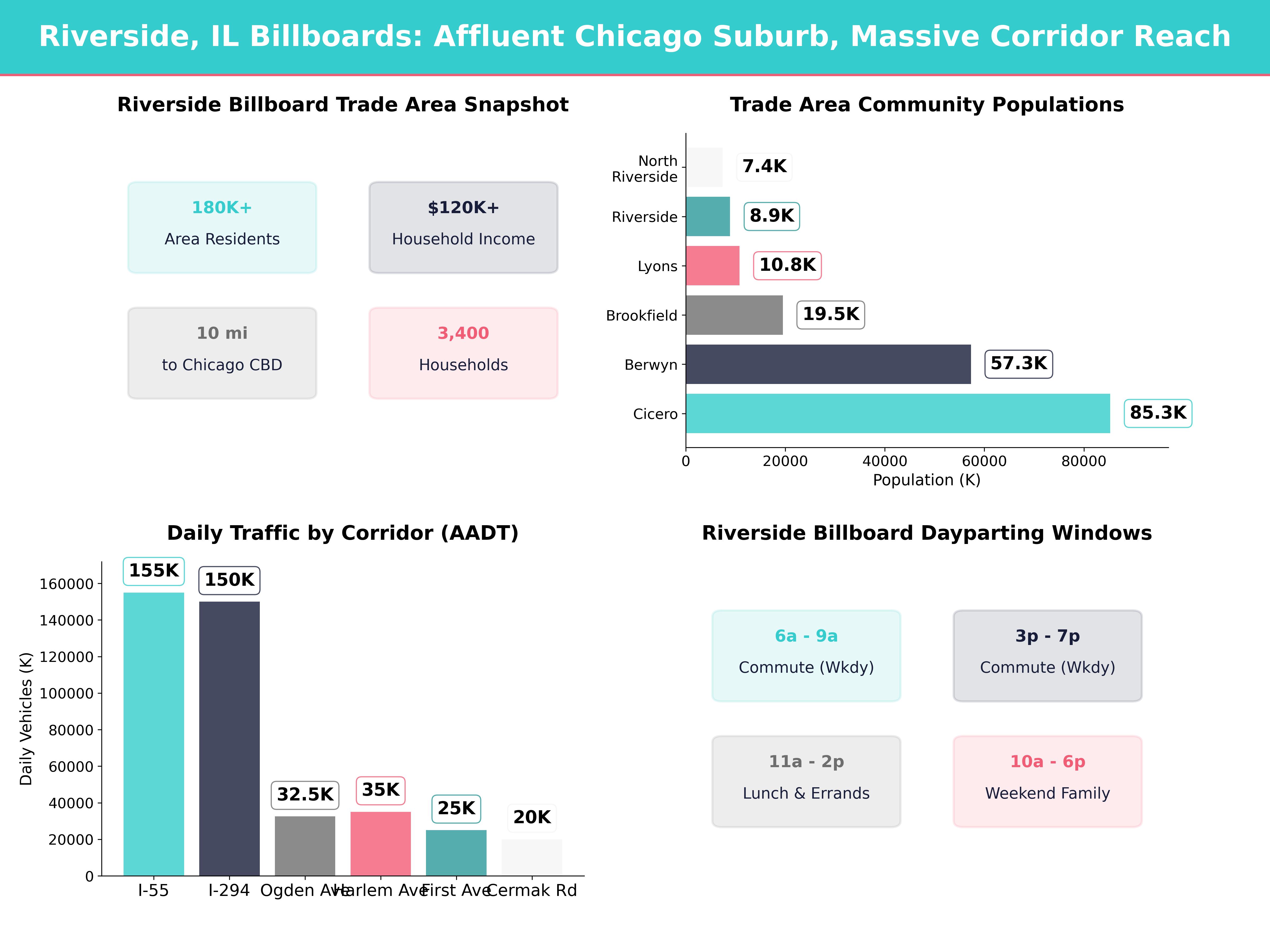
Riverside has about 8,875 residents, and the surrounding communities add more than 180,000 people within a short drive. Community data place median household income above $120,000, which supports strong demand for healthcare, home services, legal services, financial planning, dining, specialty retail, and family recreation. The market also includes commuters, families, tourists, and regional visitors.
When is the best time to run billboard ads in Riverside, Illinois with Blip?
Riverside responds well to dayparting because its traffic purposes are distinct. Weekday commuting is strongest in the 6 a.m. to 9 a.m. and 3 p.m. to 7 p.m. windows, while lunch and errand advertisers often perform well from 11 a.m. to 2 p.m. Family attractions, dining, and retail often benefit from weekend concentration between 10 a.m. and 6 p.m.
Why is Riverside, Illinois a strong market for billboard advertising?
Riverside gives advertisers a rare mix of village-scale trust and metro-scale reach. It sits only 10 miles west of downtown Chicago and is close to more than 180,000 nearby residents in surrounding communities. The area also benefits from commuter traffic, tourism, and access to Brookfield Zoo Chicago and Chicago Midway International Airport.
Do I need a contract to advertise with Blip in Riverside?
No, Blip has no long-term contracts or minimum commitments. You can start, pause, or stop your campaign at any time.
How fast can I launch a billboard campaign with Blip in Riverside?
You can have your campaign live in minutes. Create a free account, select your locations, set your budget, upload your design, and start running once approved.
Where can I advertise with Blip in Riverside?
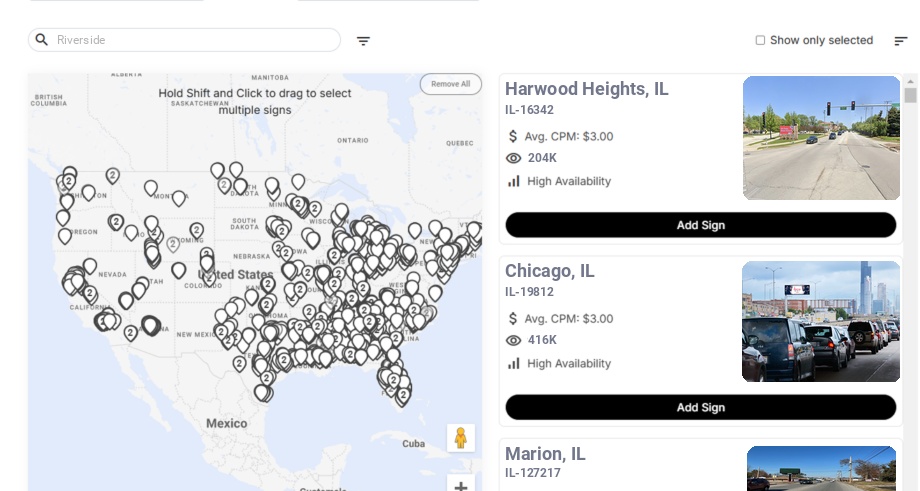
Blip has digital billboards in Riverside. You can browse available locations on a map, choose the ones that fit your audience, and start advertising right away.
Still have questions? Launch a campaign in minutes — no contracts, no commitments.
Start Your CampaignRiverside Billboard Advertising Guide
Riverside, Illinois, gives us a rare mix of village-scale trust and metro-scale reach. Chicago Metropolitan Agency for Planning community data place Riverside at about 8,875 residents, and the village sits only 10 miles west of downtown Chicago, with another 180,000+ residents close by in Brookfield, Berwyn Cicero, Lyons, and North Riverside Cook County still happen by road, so digital billboards can build frequency fast across commutes, errands, school runs, and weekend outings. Tourism adds another layer through Brookfield Zoo Chicago, Riverside’s Olmsted-designed streets, and visitor flow from Chicago Midway International Airport, which handled more than 22 million passengers in 2023, making the area strong for both local and regional advertisers.
Riverside, Illinois Market Overview
Riverside is a small municipality, but it does not behave like an isolated small town. It sits inside a dense west-suburban consumer corridor where residents routinely cross village boundaries to shop, dine, work, study, and seek services. That matters for billboard advertisers because our message is not limited to Riverside alone. It can reach a compact, mobile, high-value trade area of 180,000+ nearby residents with median household income above $120,000 every day.
Demographics and buying power in Riverside
According to CMAP, Riverside has about 8,875 residents and roughly 3,400 households. The surrounding municipalities add substantial scale, including about 19,476 residents in Brookfield, 57,250 in Berwyn 85,268 in Cicero, 10,817 in Lyons, and 7,426 in North Riverside 180,000 people within a short drive of Riverside.
Riverside also brings attractive household economics. Community data place median household income above $120,000, which supports strong demand for healthcare, home services, legal services, financial planning, dining, specialty retail, and family recreation. Because the village is mature and stable rather than boom-and-bust, we can plan campaigns around consistent replacement demand instead of waiting for a one-time growth spike.
Riverside’s identity adds another advantage. The Village of Riverside 1875, and the community has been recognized as a National Historic Landmark since 1970. That heritage makes Riverside especially receptive to advertisers that present themselves as established, trustworthy, design-conscious, and community-aware.
Mobility and commute behavior around Riverside
Even with access to Metra Pace, and the broader Regional Transportation Authority 70% of working residents in this kind of west-suburban market still commute by car, whether driving alone or carpooling. That is exactly the kind of routine, repeated exposure environment where digital billboards shine.
Riverside is especially well positioned because shoppers and workers move in several directions, not just toward downtown Chicago. Some head east toward the city, some move north-south along Harlem Avenue and First Avenue, and many travel west or southwest toward retail, healthcare, school, and industrial destinations. That pattern gives us more than one useful billboard strategy. We can run for regional reach on interstates, or we can focus on shorter-radius action near local commercial corridors.
Key Traffic Corridors for Riverside Billboards
The roads around Riverside are compact enough to be targeted, but busy enough to deliver real scale. Illinois Department of Transportation and Illinois Tollway traffic data show that the area benefits from both six-figure interstate volumes and high-value arterial traffic. That combination lets us choose between reach, frequency, and near-destination relevance.
Interstate 55 near Riverside
The Stevenson Expressway is one of the biggest reach drivers near Riverside. IDOT traffic maps place nearby I-55 segments in roughly the 140,000 to 170,000 AADT range, especially around major interchanges tied to Harlem Avenue, First Avenue, and the Tri-State corridor. This is a strong route for advertisers who need broad awareness quickly.
We should favor I-55 when we want to reach:
- Healthcare systems, legal firms, and financial brands, because weekday commuters see those messages repeatedly.
- Entertainment, hospitality, and airport-related businesses, because travelers using Midway and regional event venues are already in trip-planning mode.
- Regional retail and e-commerce brands, because the corridor pulls consumers from multiple suburban markets in a single daily flow.
The key creative lesson on I-55 is speed. Drivers have less time to absorb detail, so we should lean into short offers, a bold brand mark, and one clear action.
Interstate 294 and the Tri-State approach
The nearby Tri-State Tollway is another elite regional corridor. Segments around the I-55 interchange often carry around 150,000+ vehicles per day. This route is especially valuable because it captures cross-suburban and airport-connected traffic, not just traditional downtown commuters.
We should use I-294 for:
- B2B and industrial services, because it reaches operators, fleet buyers, contractors, and service managers moving between job sites.
- Medical, education, and staffing campaigns, because it covers a broad labor shed rather than one neighborhood.
- Hotels, parking, attractions, and event promotions, because it connects well with Midway, Bridgeview, and southwest suburban destinations.
If our goal is scale beyond Riverside proper, I-294 is often the fastest route to it.
Ogden Avenue and Harlem Avenue
For local and mid-funnel advertisers, the arterial network is just as important as the interstates. Recent IDOT counts commonly place Ogden Avenue segments around this market in the 25,000 to 40,000 AADT range, while Harlem Avenue segments near Riverside, Berwyn, and North Riverside often run in the 30,000 to 40,000 AADT range. These are excellent roads for same-day action because drivers are closer to stores, restaurants, clinics, and service destinations.
These corridors work especially well for:
- Restaurants, coffee shops, and quick-service brands, because drivers can act on a lunch or dinner message almost immediately.
- Auto repair, insurance, banking, and urgent care, because the audience is local, frequent, and highly intent-driven.
- Bilingual retail and community services, because Harlem and Ogden pull from Riverside, Berwyn, Cicero, Lyons, and adjacent neighborhoods with varied demographics and shopping habits.
Harlem Avenue, in particular, is useful when we want to bridge affluent Riverside households with larger, more price-sensitive audiences in nearby communities.
First Avenue and Cermak Road
First Avenue and Cermak Road are strong action corridors for west suburban advertisers. Around Riverside and neighboring communities, First Avenue commonly lands in the 20,000 to 30,000 AADT range, while Cermak Road often falls between 15,000 and 25,000 vehicles per day. Those are healthy counts for boards that need to drive store visits, family entertainment, healthcare appointments, and service calls.
We should look closely at these corridors when we want to reach:
- Families heading to Brookfield Zoo Chicago, North Riverside Park Mall, and nearby dining clusters.
- Parents, students, and school staff, because these roads support everyday education and activity travel.
- Home services and neighborhood healthcare, because drivers on these roads are usually close to home and ready to act.
If our business depends on local conversion instead of metro-wide reach, First Avenue and Cermak Road often outperform broader highway options.
Audience Segments We Can Reach Around Riverside
Riverside is most effective when we think in audience layers rather than municipal borders. A good campaign here can speak to affluent homeowners, everyday commuters, working families, students, tourists, and service workers within the same geography. The right billboard choice depends on which of those groups matters most.
Riverside commuters and reverse commuters
Commuters are the base audience. We can reach them on I-55, I-294, Harlem Avenue, Ogden Avenue, and First Avenue, and we can reinforce that exposure with Metra Pace awareness in the background. Riverside’s location means commuters are not all heading in one direction. Some go into Chicago, while others travel toward suburban hospitals, schools, industrial employers, and retail centers.
That matters because commuter boards support a wide range of categories, including healthcare, law, insurance, financial services, higher education, recruiting, and home improvement. These are all services people often consider during repeated weekly travel, not just once.
Riverside families, students, and school communities
Family audiences are especially important here. Riverside School District 96 serves about 1,550 students, and Riverside Brookfield High School enrolls about 1,600 more. Add nearby Morton College, youth sports, music lessons, tutoring, camps, and after-school programs, and we get a steady stream of parent-led trips through the market.
That makes Riverside a strong fit for:
- Pediatric, dental, orthodontic, and urgent care providers, because parents are making recurring household decisions.
- Tutoring, childcare, camps, and enrichment programs, because the audience is time-sensitive and calendar-driven.
- Grocery, dining, and family retail, because many trips combine errands with school pickup or weekend activities.
The family audience also reinforces weekend value. Parents are often choosing what to do next, not just what to buy next.
Tourists, day-trippers, and eventgoers around Riverside
Tourism is not the only story in Riverside, but it is definitely part of the story. Brookfield Zoo Chicago opened in 1934 and remains one of the region’s signature family attractions. Riverside itself has tourism appeal through the Frederick Law Olmsted Society of Riverside, the Riverside Arts Center, and the village’s landmark street plan and architecture.
The broader visitor market matters too. The Chicago Department of Aviation 22 million passengers in 2023, and nearby SeatGeek Stadium Bridgeview seats 20,000. That gives us a meaningful audience of leisure travelers, sports fans, concertgoers, and out-of-area visitors moving through the southwest side and west suburbs.
That audience is excellent for restaurants, entertainment, attractions, hotels, medical specialists, and any advertiser that benefits from regional exposure.
Diverse neighborhood shoppers and working households near Riverside
Riverside also sits next to larger, denser communities with different purchasing patterns and strong everyday traffic. Cicero has 85,268 residents, Berwyn 57,250, and Brookfield has 19,476. This creates a blended audience that supports both premium positioning and value-first messaging.
For many advertisers, this is where bilingual and price-led creative becomes smart. Retail, wireless, legal, tax, dental, quick-service dining, and automotive service brands often benefit from running different versions of the same campaign on different corridors. A refined Riverside-facing message may work best near the village center, while a bolder, offer-driven message may perform better on Harlem or Ogden.
Seasonal and Timing Opportunities in Riverside
Riverside is a four-season market with real swings in trip purpose. Weather, school calendars, zoo traffic, and holiday shopping all affect when we should advertise and what we should say. If we time campaigns correctly, we can make the same geography work much harder.
Spring and summer in Riverside
Spring and summer are strong for family outings, home improvement, outdoor dining, and event promotion. Illinois State Climatologist 84°F, which supports patio traffic, park use, zoo visits, and weekend retail trips. This is the right period for HVAC, landscaping, roofing, camps, fitness, elective healthcare, restaurants, and local entertainment.
It is also a good time to increase message immediacy. Phrases like “This Weekend,” “Open Late,” “5 Minutes Ahead,” and “Book Today” work especially well when people are already out and mobile.
Back-to-school and fall timing around Riverside
The local school rhythm matters. Riverside School District 96 and Riverside Brookfield High School generally restart in late August and run into early June, which creates dependable surges in parent travel, student activities, and routine service decisions. Fall is especially strong for tutoring, orthodontics, sports medicine, family restaurants, pharmacies, and community events.
We should also think about fall as decision season. Families are settling into schedules, planning holidays, and addressing healthcare, education, and household needs before winter arrives.
Winter and holiday opportunities in Riverside
Winter changes the ad environment in our favor. Chicago-area average January highs are around 31°F, and annual snowfall is roughly 37 inches, according to the Illinois State Climatologist
This is a strong season for:
- Auto service, tire shops, and roadside assistance, because weather-related need rises quickly.
- Healthcare, urgent care, and pharmacy brands, because winter illness increases demand.
- Retail, dining, and entertainment, because holiday outings and gift buying intensify.
- Tax, legal, and financial services, because planning activity ramps up from January into spring.
Brookfield Zoo Chicago also helps extend winter relevance through holiday programming, which keeps family and visitor traffic active even in colder months.
Weekly timing and dayparting in Riverside
Riverside responds well to dayparting because its traffic purposes are distinct. Weekday commuting is strongest in the 6 a.m. to 9 a.m. and 3 p.m. to 7 p.m. windows. Lunch and errand advertisers often perform well from 11 a.m. to 2 p.m. on Ogden, Harlem, and First. Family attractions, dining, and retail often benefit from weekend concentration between 10 a.m. and 6 p.m..
When we align board choice with time of day, we usually get a better result than running every message at every hour.
Billboard Design Tips for the Riverside Market
Riverside is not a generic suburban market, so our creative should not look generic either. The village has a design-conscious identity, a strong family base, and immediate adjacency to larger, more diverse commercial corridors. Good creative here feels local, clear, and deliberate.
Match Riverside’s historic and design-aware identity
Because Riverside is tied to Frederick Law Olmsted Society of Riverside, preserved streetscapes, and a well-kept village center, polished creative usually outperforms visual clutter. We should favor clean typography, high contrast, and a restrained palette such as forest green, navy, cream, charcoal, or deep red when targeting the village core. Imagery that suggests tree-lined streets, family life, architecture, or neighborhood trust can feel more natural than loud hard-sell visuals.
This does not mean our creative should be timid. It means our message should look intentional.
Build separate creative for Riverside and its neighboring corridors
One of the smartest moves in this market is versioning. A single campaign can have one creative style for Riverside and another for Harlem, Ogden, or Cicero-facing inventory. Near Riverside, we can lean into trust, quality, expertise, or heritage. Near Berwyn and Cicero, we may do better with clearer pricing, stronger urgency, bilingual copy, or a direct offer.
In practical terms, we should often build at least 2 versions of the same ad. That keeps the campaign relevant to the audience actually using each road.
Use direction and immediacy on action-oriented roads
First Avenue, Cermak Road, Harlem Avenue, and zoo-adjacent routes reward directional language. “Next Right,” “2 Miles Ahead,” “Open Today,” and “Exit Now” are useful because the driver is close enough to act. On I-55 and I-294, we should simplify further and keep major copy to about 6 words or fewer plus a strong brand cue.
Riverside is not the place for a paragraph. It is a place for one sharp idea.
Reflect the local mix of families, visitors, and bilingual shoppers
The most locally resonant campaigns usually acknowledge who is actually on the road. Family visuals work well near Brookfield Zoo Chicago and North Riverside Park Mall. Professional, reassuring creative fits healthcare and legal categories near commuter routes. Bilingual English-Spanish creative is often worth testing on Harlem, Ogden, and Cicero-adjacent boards because those corridors serve broader west suburban populations, not just Riverside residents.
Regional Strategies Around Riverside
The best Riverside campaigns usually combine more than one sub-area. We should think of the market as several overlapping zones, each with a different job.
Riverside village center and downtown strategy
The Village of Riverside
If our goal is local credibility, this is the place to start.
Brookfield Zoo Chicago and North Riverside retail strategy
The corridor around Brookfield Zoo Chicago, North Riverside Park Mall, and nearby First Avenue traffic is a weekend and family engine. Here, we should focus on immediate-action creative, strong hours, distance cues, and family-friendly imagery. Restaurants, entertainment venues, museums, kid-focused brands, retail, and seasonal attractions all benefit here.
This zone also works well for campaigns that need Saturday and Sunday concentration more than weekday commuter dominance.
Berwyn, Cicero, and Harlem-Ogden commercial strategy
The commercial edges touching Berwyn Cicero are stronger for everyday retail and service response. We should lean into urgency, offers, bilingual messaging, and clear category cues. Auto repair, immigration law, tax prep, dental, urgent care, furniture, wireless, discount retail, and quick-service food all fit naturally.
This is the zone where frequency and relevance often matter more than prestige.
Interstate, Midway, and regional gateway strategy near Riverside
For broader awareness, we should use boards connected to I-55, I-294, Bedford Park, and Chicago Midway International Airport. These placements are ideal when our service area is larger than Riverside itself. Hospitals, universities, staffing firms, events, hotels, parking operators, and region-wide retailers can all win here.
This strategy is also valuable when we need to reach travelers before they decide where to stop, eat, book, or buy.
Lyons, La Grange, and surrounding residential-service strategy
The residential belt around Lyons, La Grange Brookfield, and Riverside is especially good for home services, healthcare, grocery, pet care, and family retail. We should look for boards that sit on habitual errand routes rather than just commuter trunks. A plumber, HVAC company, pediatric clinic, or orthodontist usually needs the board that feels close and familiar, not simply the board with the largest traffic count.
Using Blip Tools and Capabilities in Riverside
Riverside is exactly the kind of market where Blip’s flexibility becomes strategically useful. We do not need to guess once and lock in forever. We can test, learn, and shift based on how each corridor behaves.
Test Riverside corridors before we scale
A smart Riverside launch often starts with a small test across 2 or 3 board types, such as one interstate board for reach, one arterial board for action, and one family-oriented board near Brookfield or North Riverside. That lets us compare what actually moves the business. In a compact market like this, the difference between “lots of traffic” and “the right traffic” matters.
Daypart around Riverside’s real travel rhythms
Because the market has strong commuter, school, lunch, and weekend patterns, dayparting can make our spend more efficient. We can weight weekdays toward rush hours, shift restaurants into lunch and evening, and move family attractions and retail toward weekends. That approach is usually more effective than running the same schedule all day across all boards.
Localize creative without rebuilding the whole campaign
Blip’s artwork tools make it easy for us to create multiple local versions of one message. We can run a premium, trust-focused version near Riverside, a stronger offer-led version on Harlem or Ogden, and a directional version near the zoo or mall. That kind of localization is a major advantage in a market where one village borders several very different consumer profiles.
Use analytics to keep Riverside campaigns honest
Real-time campaign data help us avoid staying too long on the wrong board mix. If one corridor is producing better engagement signals, store traffic, or lead lift, we can shift budget there quickly. Riverside is not a market where we should assume every high-count road behaves the same.
Getting Started with Billboard Rental in Riverside
Renting a billboard in Riverside gets easier when we start with the business goal, not the map. The right board for a dental office in Riverside is not automatically the right board for a regional hospital system, event venue, or airport hotel. Once we define what success looks like, location choice becomes much more straightforward.
Start with one Riverside objective
We should first decide whether the campaign is trying to do one of four things: build broad awareness, drive local visits, support a timed event, or reinforce an existing brand. Broad awareness usually points us toward I-55 or I-294. Local visits usually point us toward Harlem, Ogden, First, or Cermak. Family events usually point us toward Brookfield and North Riverside. Professional services often benefit from a blend of commuter and neighborhood boards.
Evaluate Riverside boards by decision point, not just by traffic
A useful Riverside board usually answers one of these questions clearly:
- Can the audience act within a few minutes?
- Is the board upstream from a major exit or turn decision?
- Does the road serve our audience at the time we need them?
- Is the message simple enough for the speed of the corridor?
A board on I-55 may deliver huge reach, but a board on First Avenue may deliver more immediate conversions for a nearby business. We should choose based on outcome, not vanity.
Expect a faster and simpler process with Blip in Riverside
Traditional billboard buying often pushes fixed schedules, longer commitments, and slower changes. Blip makes Riverside much more manageable because we can choose boards on a map, control timing, swap creative, and adjust budget without a long negotiation cycle. That matters in a market where one campaign may need to behave differently on weekdays, weekends, and around seasonal attractions.
Launch lean, measure, and expand
For most Riverside advertisers, a practical starting plan is simple. We should launch with 2 to 3 creative versions, run for 2 to 4 weeks, and review results by corridor and time of day. Then we can expand the locations that are earning their budget and trim the ones that are not.
That process usually gives us a better Riverside campaign than trying to buy the biggest board first. In a compact, high-mobility market like this one, precision almost always beats guesswork.