Billboards in Forest View, IL
No Minimum Spend. No Long-Term Contracts. Just Results.
Trusted by Leading Brands


Billboard advertising
in Forest View has never been easier



How much is a billboard in Forest View?
Why Choose Blip for Billboard Advertising in Forest View
Blip lets you launch in Forest View fast and self-serve, reaching I-55 commuters and I-294 travelers without a traditional buy.
Set flexible budgets in Forest View and pay only when your ad runs, ideal for testing against 150,000+ I-55 traffic and Harlem Ave drivers.
Use Blip-optimized campaigns in Forest View to auto-choose the best boards for commuters, airport traffic, and Midway-bound audiences.
Daypart Forest View ads for 6-10 a.m. and 3-7 p.m., matching peak commuter flow on I-55, Ogden, and Harlem Ave.
Track Forest View performance in real time, then shift spend toward the I-55, I-294, or Brookfield Zoo traffic that performs best.
Blip's creative tools make it easy to build clear, bilingual Forest View billboards for Cicero and Berwyn's diverse household audience.
Frequently Asked Questions About Billboard Advertising in Forest View
How much does a billboard cost in Forest View with Blip?
With Blip, the cost of billboard advertising in Forest View is flexible and easy to control. You set a daily budget, and Blip’s algorithm uses it to bid for open ad slots on rotating digital billboards, so you only pay when your ad actually appears. Pricing starts at just $0.01 per display, with the cost changing based on time of day, location, and advertiser demand.
Where can I advertise with Blip in Forest View?
Forest View is one of those rare billboard markets where size on the map matters far less than position on the road, especially when nearby I-55 segments carry 150,000+ vehicles per day and I-294 carries 140,000+ at key interchanges. Harlem Avenue is the most important local arterial around Forest View, and Ogden Avenue and First Avenue also reach valuable nearby traffic. For advertisers, Forest View works best as a high-frequency pass-by market with regional reach, not as a village-only population play.
What kind of audience does Forest View reach for billboard ads?
Forest View sits inside a much larger southwest Cook County travel shed between the City of Chicago, Chicago Midway International Airport, and Brookfield Zoo Chicago. That puts messages in front of commuters, industrial workers, family shoppers, and leisure visitors moving through one of the busiest urban-suburban interfaces in Illinois. The area is also highly bilingual, which makes English-only and bilingual English-Spanish creative worth testing.
Why is Forest View a strong market for Blip billboard advertising?
Forest View sits in Cook County, which had about 5.3 million residents in the 2020 Census, and it is part of the Chicago Metropolitan Agency for Planning region of 7 counties and roughly 8.6 million people. Nearby corridors like I-55, Harlem Avenue, and I-294 create constant repetition from weekday commuters, industrial traffic, and regional visitors. That means the market is stronger than its village footprint suggests.
What are the best times to run billboard ads in Forest View?
A commuter campaign can concentrate on 6 a.m. to 10 a.m. and 3 p.m. to 7 p.m. windows. Weekends from late morning through early evening are strong for zoo, retail, and family entertainment traffic. In winter and during the holiday season, travel and indoor-service categories can become especially relevant.
Do I need a contract to advertise with Blip in Forest View?
No, Blip has no long-term contracts or minimum commitments. You can start, pause, or stop your campaign at any time.
How fast can I launch a billboard campaign with Blip in Forest View?
You can have your campaign live in minutes. Create a free account, select your locations, set your budget, upload your design, and start running once approved.
Where can I advertise with Blip in Forest View?
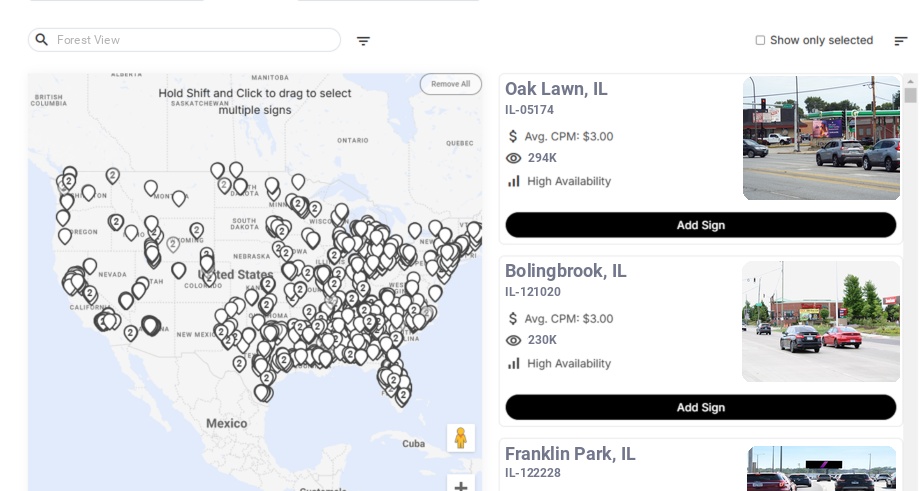
Blip has digital billboards in Forest View. You can browse available locations on a map, choose the ones that fit your audience, and start advertising right away.
Still have questions? Launch a campaign in minutes — no contracts, no commitments.
Start Your CampaignForest View Billboard Advertising Guide
Forest View 150,000+ vehicles per day and I-294 carries 140,000+ at key interchanges. Although Forest View is a compact village of about 698 residents in roughly 0.4 square miles, it sits inside a much larger southwest Cook County travel shed between the City of Chicago, Chicago Midway International Airport, and Brookfield Zoo Chicago. That puts our messages in front of commuters, industrial workers, family shoppers, and leisure visitors moving through one of the busiest urban-suburban interfaces in Illinois, with 150,000+ daily vehicles on I-55 and 140,000+ on I-294 nearby. For advertisers, Forest View works best as a high-frequency pass-by market with regional reach, not as a village-only population play.
Forest View Market Overview for Billboard Advertisers
Forest View sits in Cook County, which had about 5.3 million residents in the 2020 Census, and it is part of the Chicago Metropolitan Agency for Planning region of 7 counties and roughly 8.6 million people. That matters because a Forest View billboard is really a southwest Chicagoland buy. We are tapping a dense, mature, constantly moving audience rather than waiting for growth on a distant suburban edge.
Forest View is tiny, but the surrounding trade area is not
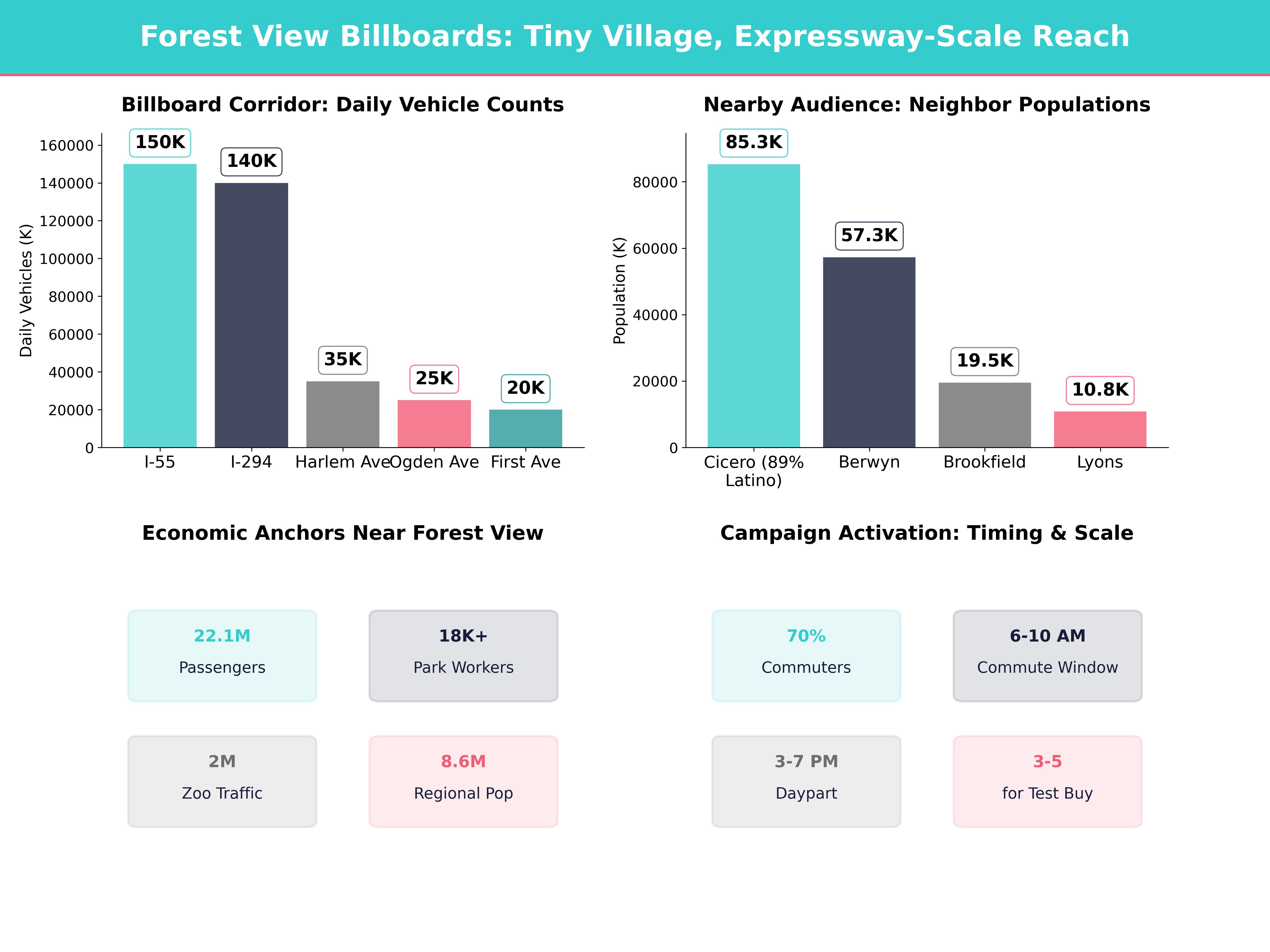
Within only a few miles of Forest View, we can reach several larger nearby communities. Cicero had 85,268 residents in 2020, Berwyn 57,250, Brookfield had 19,476, and Lyons had 10,817. Those four nearby communities alone total 172,811 residents, and they sit along the same corridors that feed Forest View traffic every day.
This is also a built-out, infill market, which changes our strategy. We are not buying Forest View because a master-planned subdivision is adding thousands of new rooftops. We are buying it because the surrounding population base is already established, repeat travel is constant, and the same drivers often pass the same roadway assets multiple times per week.
The local economy is stronger than the village footprint suggests
The southwest Cook County economy around Forest View is supported by transportation, industrial, retail, healthcare, and airport activity. Nearby Bedford Park reports 700+ businesses and 18,000+ employees, which makes the I-55, Harlem Avenue, and I-294 area valuable for B2B, recruiting, staffing, logistics, and service businesses.
Forest View also benefits from adjacency to major visitor and transportation anchors. Chicago Midway International Airport handled about 22.1 million passengers in 2023, or roughly 60,000 passengers per day. Brookfield Zoo Chicago draws about 2 million visitors annually. That means our campaign can speak to workers on weekdays and to leisure audiences on weekends without changing geographies.
What demographics and commute patterns mean for advertisers
Forest View itself does not function like a pedestrian downtown. It functions like a windshield market. Recent community profiles generally place drive-alone commuting at roughly 7 in 10 workers locally, and the road network around the village reinforces that auto dependence.
Forest View has no CTA rail line or Metra station inside the village, so the strongest ad impressions come from drivers using expressways and arterials, not from foot traffic. The area is also highly bilingual. In nearby Cicero, Hispanic or Latino residents make up about 89% of the population, and Berwyn also has a large bilingual household base. That gives us a clear creative signal: many advertisers should test English-only and bilingual English-Spanish versions rather than assuming one message fits the entire corridor.
Key Traffic Corridors Around Forest View
Forest View’s real advertising value comes from road volume. According to the Illinois Department of Transportation Illinois Tollway, the main corridors around the village deliver the kind of daily repetition that billboard campaigns need.
Stevenson Expressway, I-55, near Forest View
I-55 is the headline corridor for Forest View. Nearby segments commonly exceed 150,000 vehicles per day on the busiest stretches around Harlem Avenue and First Avenue. This route connects southwest suburbs, Joliet Chicago, which gives us a blend of long-haul commuters, suburban workers, and regional visitors.
This corridor is especially strong for several advertiser categories:
- Healthcare, dental, and legal services perform well because they benefit from repeated weekday exposure to adults with established commute routines.
- Retail, restaurants, and entertainment perform well because I-55 carries people toward Chicago on weekdays and back toward southwest suburbs in the afternoon and evening.
- B2B, staffing, and recruiting perform well because the expressway reaches industrial and warehouse labor moving between Bedford Park, McCook, Summit, and farther southwest markets.
If we want broad reach with relatively fast audience accumulation, I-55 is usually the first corridor we evaluate.
Harlem Avenue, IL 43, through the Forest View area
Harlem Avenue is the most important local arterial around Forest View. IDOT counts in the area generally run 35,000+ vehicles per day, and some nearby segments push closer to 40,000. Harlem connects residential neighborhoods, retail strips, industrial zones, and access points to I-55, so it gives us slower-speed visibility than the expressway and often better local relevance.
Harlem Avenue is a strong fit for advertisers who need action, not just awareness. That includes:
- Auto services, because drivers are already on a car-oriented corridor and often make fast decisions about repairs, tires, and oil changes.
- Clinics, urgent care, and dental providers, because the audience is local enough to act on proximity.
- Quick-service restaurants and grocery retailers, because arterial traffic can convert to same-day visits more easily than distant expressway traffic.
For advertisers with a tight radius, Harlem often outperforms a broad metro buy because it captures intention closer to the destination.
Ogden Avenue, US 34, in Lyons and Berwyn
Ogden Avenue is one of the most useful retail corridors near Forest View. Nearby segments often carry 25,000 to 30,000 vehicles per day, and the road links Lyons, Berwyn
We like Ogden for advertisers such as:
- Home services, because it reaches owner-heavy, established neighborhoods.
- Insurance, tax, and financial services, because it delivers adult household decision-makers in a practical errand environment.
- Retail, furniture, and discount stores, because shoppers are already moving through commercial strips with strong comparison-shopping behavior.
If the goal is neighborhood-level frequency instead of region-wide exposure, Ogden can be more efficient than an expressway-only plan.
First Avenue and the McCook-Brookfield approach
First Avenue, which helps connect the I-55 area to McCook, Brookfield, and nearby industrial land, generally carries 20,000+ vehicles per day on relevant segments. It is not as massive as I-55, but it is strategically useful because it blends family, industrial, and visitor traffic.
This route can work well for:
- Family entertainment and dining, especially for campaigns tied to Brookfield Zoo Chicago, which sits roughly 3 miles west of Forest View.
- Industrial suppliers and trade services, because the road touches employment-heavy areas.
- Local institutions, such as schools, colleges, and healthcare providers, that want repeated visibility in adjacent communities.
I-294, the Tri-State Tollway, and Midway-bound traffic
The Illinois Tollway reports that segments of I-294 near the I-55 interchange commonly clear 140,000+ daily vehicles. That makes the wider Forest View area relevant far beyond local shoppers. I-294 brings in freight, airport traffic, hotel guests, and business travel from across the metro.
We see strong fit here for:
- Hotels, parking, and travel services, because travelers value convenience and clear directional copy.
- Freight, trucking, and industrial recruiting, because the corridor serves a major logistics workforce.
- Regional attractions and large venues, because people on I-294 are often traveling to something rather than just passing through a neighborhood.
Forest View Audience Segments We Can Reach
Forest View’s best campaigns start with audience selection. The village sits where several valuable groups overlap, and that overlap is what makes the market stronger than its population count alone suggests.
Commuters and workforce traffic in Forest View
The biggest audience is still weekday commuters. Between I-55 at 150,000+ daily vehicles, Harlem at 35,000+, and Ogden at 25,000+, Forest View offers constant impression opportunities to workers moving between home, job sites, and service destinations. Nearby Bedford Park, with 700+ businesses and 18,000+ employees, amplifies that workforce base.
This audience is ideal for healthcare, legal, insurance, banking, higher education, recruiting, and multi-location retail. These categories usually benefit from repetition, and Forest View provides repetition naturally.
Bilingual family households across the nearby suburbs
The residential audience around Forest View is diverse, practical, and family-oriented. Cicero brings 85,268 residents, Berwyn 57,250, and Cicero’s population is about 89% Latino. That mix makes bilingual creative especially effective for categories such as healthcare, restaurants, schools, tax preparation, legal services, cellular providers, and value retail.
For many local advertisers, this is the most actionable segment in the market. These households are close enough to visit the same day, and many already know the corridor.
Leisure visitors, shoppers, and weekend traffic
Forest View sits near a surprisingly strong family and leisure cluster. Brookfield Zoo Chicago covers 235 acres, houses 500+ species, and draws about 2 million annual visitors. North Riverside Park Mall has 130+ stores, which adds another strong shopper base to the trade area.
That creates a weekend and school-break audience for:
- Restaurants and dessert brands that want pre-visit or post-visit traffic.
- Entertainment and attractions that can piggyback on family outing patterns.
- Retail, health clubs, and service brands that benefit from repeated family decision-making trips.
Event, airport, and business-travel audiences
Forest View also benefits from major regional destinations. SeatGeek Stadium Bridgeview seats 20,000 people, and Chicago Midway International Airport handled 22.1 million passengers in 2023. Farther east, McCormick Place offers 2.6 million square feet of exhibit space and pulls convention traffic through the I-55 approach into Chicago.
This audience is useful for hotels, bars, restaurants, parking operators, event services, trade schools, and regional entertainment brands. It is also useful for advertisers who want to look bigger than a single suburb.
Seasonal and Timing Opportunities in Forest View
Forest View is a year-round billboard market, but the best schedules usually match local movement patterns instead of running the same message all year.
Spring and summer in Forest View
Spring and summer are the strongest seasons for leisure and family traffic. Brookfield Zoo Chicago activity rises with warmer weather, summer break, and weekend outings. Home services, patios, quick-service dining, family attractions, and medical practices often benefit from heavier spring and summer visibility.
We usually like these timing patterns:
- Weekday mornings from 6 a.m. to 10 a.m. for commuter-oriented messages.
- Afternoons from 3 p.m. to 7 p.m. for return-home traffic and dinner decisions.
- Weekends from late morning through early evening for zoo, retail, and family entertainment traffic.
Back-to-school and fall in the Forest View trade area
Late July through September is a strong reset period in southwest Cook County. Families return to structured routines, Morton College and local school districts are active again, and healthcare, orthodontics, tutoring, family dining, and value retail all tend to benefit from high-frequency reminders.
Fall also brings sports and event traffic. SeatGeek Stadium
Holiday and winter opportunities around Forest View
Winter can be excellent for billboards in this market because more decisions happen in the car and fewer happen on foot. Holiday travel boosts the Midway area, zoo holiday events create family trips, and cold-weather categories such as urgent care, heating and plumbing, comfort food, and indoor entertainment become more relevant.
The holiday season is also one of the best times to tighten geography. A message near Midway should speak to travelers and airport workers. A message near Brookfield should speak to families. A message on I-55 should stay broad enough for commuters and regional visitors.
Forest View Billboard Design Tips for the Local Market
Creative that works in Forest View usually looks more practical than flashy. We are speaking to drivers in an industrial, expressway, and inner-suburban setting, so clarity beats cleverness.
Use bilingual creative when the Forest View audience calls for it
Because nearby Cicero and Berwyn add a strong bilingual audience, many advertisers should test Spanish-language or bilingual creative. We do not need to translate everything word for word. We simply need to respect how households in the area actually shop, compare, and decide.
A strong local approach often includes:
- One headline in 5 to 7 words, because I-55 traffic moves fast.
- One offer or one benefit, because clutter disappears at expressway speed.
- One action path, such as a short URL, brand name, or “next exit” cue.
Match imagery to southwest Cook County, not generic suburbia
Forest View sits between industrial land, heavy arterials, airport traffic, and established residential neighborhoods. Creative should feel like it belongs here. Images of local dining, family outings, skyline access, warehouses, trucks, or neighborhood storefronts tend to land better than generic rural imagery or luxury beach visuals.
Color choice matters too. On gray expressways and industrial backdrops, high-contrast combinations such as black and yellow, blue and white, or red and white can punch through better than muted palettes.
Make proximity obvious in Forest View campaigns
This market rewards practical copy. “Next exit,” “5 minutes away,” “Harlem & Ogden,” or “Near Midway” can outperform softer brand language because drivers here are often making immediate route-based choices. That is especially true for urgent care, restaurants, car service, hotels, and event parking.
Lead with value for Forest View’s everyday buyers
The nearby household base is broad, but much of it is price-aware and routine-driven. Value cues, financing cues, same-day availability, and convenience cues often work well. A clear statement such as “Open Late,” “Walk-Ins Welcome,” or “Free Estimate” may be more powerful than a purely image-driven campaign in this corridor.
Regional Strategies Around Forest View
Forest View works best when we treat it as a cluster of submarkets instead of a single tiny village. Different roads around the village support different goals.
Forest View, McCook, and Bedford Park for workforce and industrial reach
The Forest View-McCook-Bedford Park side of the market is ideal for recruiting, industrial services, trucking support, equipment rental, workwear, safety products, and B2B vendors. This is where proximity to 18,000+ Bedford Park employees and heavy I-55 traffic becomes especially useful.
If our audience is workers rather than shoppers, we should favor commute-heavy routes and weekday schedules.
Berwyn, Cicero, and Stickney for dense local households
Berwyn Cicero, and Stickney give us dense household reach. This is where bilingual consumer messaging shines. Healthcare, food, schools, legal services, tax prep, auto repair, and community institutions often perform best here because the audience is close, familiar with the corridor, and likely to act locally.
Brookfield, Riverside, and North Riverside for family spending
Brookfield, Riverside North Riverside Brookfield Zoo Chicago and North Riverside Park Mall creates a consumer environment that is more weekend-sensitive and family-oriented than the industrial side of the market.
Midway, Bridgeview, and the I-294 approach for regional scale
If we want Forest View to function as part of a larger Chicagoland campaign, we should connect it to Midway, Bridgeview, and the I-294 corridor. This strategy is ideal for hotels, parking, event-driven dining, airport services, entertainment venues, and region-wide brand awareness.
Using Blip Tools and Capabilities in Forest View
Forest View is a good market for both hands-on control and automated optimization. If we know we want I-55, Harlem, or a specific southwest Cook County cluster, we can manually choose boards that match the route and direction of travel. If we care more about efficient reach across the broader area, we can let Blip optimize across the market while we set the audience and budget priorities.
How we would apply Blip in Forest View
We can use dayparting to align creative with real local behavior. A commuter campaign can concentrate on 6 a.m. to 10 a.m. and 3 p.m. to 7 p.m. windows. A zoo-adjacent restaurant campaign can push harder on weekend afternoons. A recruiting campaign can emphasize outbound weekday traffic near industrial centers.
We can also rotate creative by submarket. One version can target bilingual family households near Cicero and Berwyn. Another can target airport or event audiences near Midway and Bridgeview. Real-time analytics then help us see which corridor, time block, or message is producing the most efficient delivery.
For smaller advertisers, this flexibility matters. Forest View is a market where a tightly focused plan often beats a one-size-fits-all citywide buy.
Getting Started with Billboard Rental in Forest View
Renting a billboard in Forest View starts with a simple question: are we trying to reach commuters, local families, industrial workers, airport travelers, or some combination of all four? Once we answer that, the right roads become much clearer.
What to look for in a Forest View billboard location
We should evaluate each location based on practical fit, not just price. The best boards in this market usually have a combination of strong traffic volume, clean sightlines, clear directionality, and proximity to the action we want.
We usually recommend checking these factors:
- Direction of travel should match the moment when the audience is most likely to act.
- Distance from the destination should be close enough for a same-trip decision if immediate response matters.
- Road speed and lane count should match the complexity of the message.
- Nearby land use should reinforce the goal, whether that is industrial recruiting, family dining, or airport services.
How Blip simplifies the Forest View rental process
Traditional billboard buying often pushes advertisers into longer commitments, fixed packages, and slower revision cycles. Forest View does not always reward that approach, because the market has distinct commuter, family, and event rhythms. Blip makes it easier for us to test a corridor, compare submarkets, adjust schedules, and change creative without rebuilding the whole campaign.
A smart first test in Forest View often uses 3 to 5 relevant boards across one expressway corridor and one arterial corridor. We can then run for 2 to 4 weeks, compare performance by time of day and location, and scale into the boards that match the real audience response.
How to choose the right Forest View strategy for our goals
If the goal is broad awareness, we should start with I-55 and possibly add I-294 exposure. If the goal is local foot traffic, Harlem and Ogden usually deserve more weight. If the goal is family spending, the Brookfield and North Riverside side of the market becomes more important. If the goal is recruiting or B2B, Forest View’s industrial adjacency and Bedford Park workforce should lead the plan.
Forest View is not a giant geography, but it sits inside a giant movement pattern. When we match the message to the right corridor, the right time of day, and the right nearby audience, it can be one of the most efficient billboard markets in southwest Chicagoland.