Billboards near Carol Stream, IL
No Minimum Spend. No Long-Term Contracts. Just Results.
Trusted by Leading Brands


Billboard advertising
near Carol Stream has never been easier



How much is a billboard near Carol Stream?
Why Choose Blip for Billboard Advertising near Carol Stream
Blip lets you launch Carol Stream billboards fast and self-serve, reaching I-90 commuters and Hoffman Estates workers without the usual buying hassle.
Carol Stream's industrial and logistics corridor rewards flexible budgets—Blip helps you start small, then scale as your campaign proves out.
Daypart your Carol Stream ads for AM/PM commutes, lunch breaks, or weekend family traffic from Schaumburg and DuPage County.
No contracts means Carol Stream businesses can test seasonal plays for winter HVAC, spring home services, or back-to-school without long commitments.
Use Blip's real-time analytics to see what's working in Carol Stream, then shift spend toward the messages that hit commuters and suburban families best.
Blip's creative tools make it easy to build bold, simple ads for Carol Stream drivers, from multilingual messages to quick-read offers on busy suburban roads.
Frequently Asked Questions About Billboard Advertising near Carol Stream
How much does a billboard cost near Carol Stream, Illinois with Blip?
With Blip, you choose your own daily budget for Carol Stream billboards, and Blip automatically keeps your campaign within that amount, so you can start small and scale up whenever you’re ready. Each ad is a brief “blip” on rotating digital billboards near Carol Stream, Illinois, and you only pay for the blips you receive. Costs per blip vary based on the times you select, the locations serving the Carol Stream area, and advertiser demand, making it easy to match your spend to your goals.
Where can I advertise with Blip near Carol Stream, Illinois?
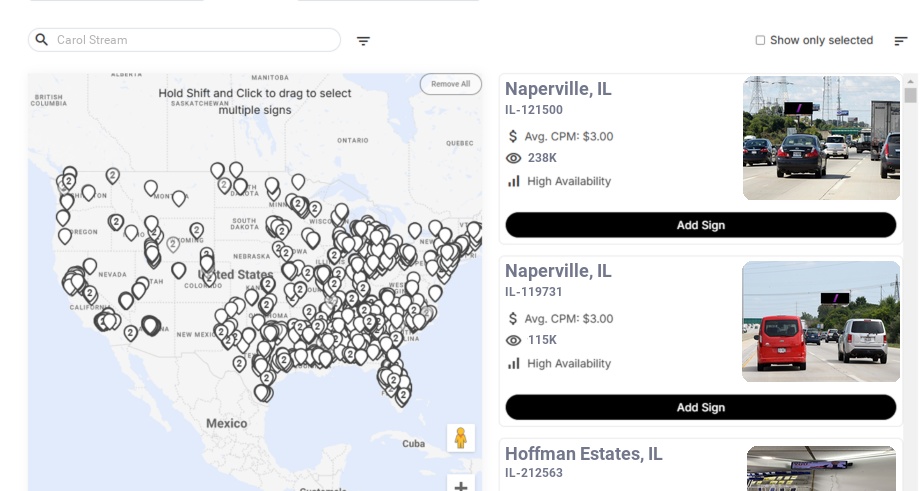
The Carol Stream area is served by 7 Blip digital billboards from nearby Hoffman Estates, about 9 miles away. These boards help you reach commuters, workers, shoppers, and families as they move through one of Chicagoland’s most economically active suburbs. Because the billboards serve the Carol Stream area from nearby Hoffman Estates, they can intercept residents, employees, and visitors traveling between Carol Stream, Schaumburg, and other nearby hubs.
Who does Blip reach in the Carol Stream, Illinois area?
Within a 5-mile radius of Carol Stream’s core, you tap into a trade area of well over 150,000 residents across Carol Stream, Bloomingdale, Glendale Heights, Wheaton, and unincorporated DuPage. Carol Stream is a village of roughly 39,000 residents in north-central DuPage County, and the area includes a strong mix of young families, mid-career professionals, and established homeowners. Household vehicle ownership is high—well over 90% of households have at least one vehicle—so most adults are regular drivers who will pass digital billboards multiple times per week.
When is the best time to run Blip billboards near Carol Stream, Illinois?
Target AM and PM drive times to reach commuters from the Carol Stream area heading to and from job centers near Hoffman Estates and Schaumburg. Midday flights are great for lunch spots, delivery services, retail offers, and B2B campaigns targeting local workers. For seasonal campaigns, increase impression frequency 2–4 weeks before major peaks like late March–May for spring home services or October–November for healthcare enrollment and holiday retail.
Do I need a contract to advertise with Blip near Carol Stream?
No, Blip has no long-term contracts or minimum commitments. You can start, pause, or stop your campaign at any time.
How fast can I launch a billboard campaign with Blip near Carol Stream?
You can have your campaign live in minutes. Create a free account, select your locations, set your budget, upload your design, and start running once approved.
Where can I advertise with Blip near Carol Stream?
Blip has digital billboards near Carol Stream. You can browse available locations on a map, choose the ones that fit your audience, and start advertising right away.
Still have questions? Launch a campaign in minutes — no contracts, no commitments.
Start Your CampaignCarol Stream Billboard Advertising Guide
The Carol Stream area sits at the heart of DuPage County’s industrial, logistics, and family‑suburban corridor, making it an exceptionally strong market for digital billboard campaigns and businesses searching for billboards near Carol Stream. With 7 Blip digital billboards serving the Carol Stream area from nearby Hoffman Estates (about 9 miles away), we can help you reach commuters, workers, shoppers, and families as they move through one of Chicagoland’s most economically active suburbs.
Industry research shows that out‑of‑home (OOH) media reaches about 82–85% of U.S. adults every week and roughly 70% every day, and digital OOH is one of the fastest‑growing ad channels by spend growth in major metros. In a dense, high‑income, suburban corridor like northwest DuPage County, that reach becomes especially valuable for billboard advertising near Carol Stream.
Understanding the Carol Stream Area Market
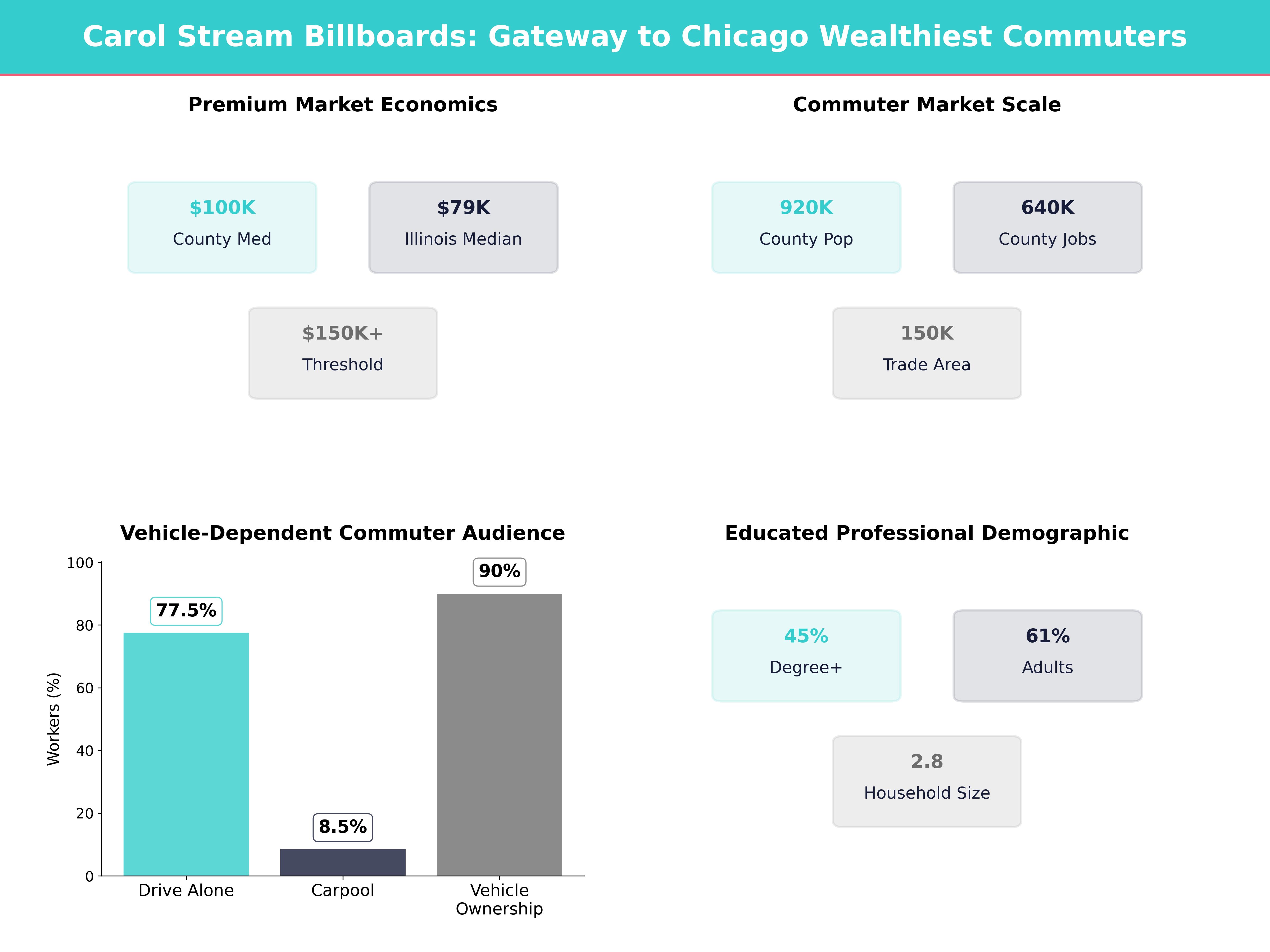
Carol Stream is a village of roughly 39,000 residents in north-central DuPage County. DuPage County as a whole has about 920,000 residents and is one of the most affluent counties in the Midwest, with a median household income around $100,000. Carol Stream itself sits close to that benchmark, which means strong spending power for retail, home services, healthcare, and discretionary purchases.
Within a 5‑mile radius of Carol Stream’s core, you tap into a trade area of well over 150,000 residents across Carol Stream, Bloomingdale, Glendale Heights Wheaton, and unincorporated DuPage. That gives a single well‑placed campaign the ability to touch tens of thousands of unique drivers in a typical week, maximizing the impact of Carol Stream billboards.
Key local context:
-
Population and households
- Around 39,000 residents and roughly 14,000 households in the Carol Stream area.
- Average household size is about 2.8 people, pointing to a predominance of family and multi‑person households.
- In DuPage County overall, more than 330,000 housing units translate to a large base of homeowners and renters who make daily local purchase decisions.
-
Income and education
- DuPage County’s median household income is about $100,000, substantially higher than the statewide median (around $79,000), and a sizable share of households exceed $150,000 in annual income.
- Over 45% of adults in DuPage County hold a bachelor’s degree or higher, indicating a well‑educated audience receptive to information‑heavy or value‑driven messaging.
- Higher education levels often correlate with greater use of professional services (financial planners, healthcare specialists, private education), all strong billboard categories.
-
Economic base
- Carol Stream is known for distribution, manufacturing, and printing; local industrial parks and business centers host hundreds of companies and thousands of jobs, with large numbers of workers traveling in daily from surrounding communities.
- DuPage County hosts more than 640,000 jobs overall, with major concentrations in professional services, healthcare, manufacturing, and logistics.
- A significant share of local employment is in sectors that depend on repeat local purchases—auto services, retail, dining, healthcare, and home services—making repeated billboard impressions especially valuable.
Local official and business resources—such as the Village of Carol Stream DuPage County, Choose DuPage, and the Carol Stream Chamber of Commerce—underline how much of the daily activity revolves around business parks, industrial corridors, and retail centers rather than a single downtown. Your billboard strategy should tap into these movement patterns.
Because our 7 digital billboards serve the Carol Stream area via nearby Hoffman Estates, we can intercept residents, employees, and visitors as they travel between Carol Stream, Schaumburg
Who You’ll Reach Near Carol Stream
To tailor effective messaging, it helps to understand the Carol Stream area’s demographic mix:
Age profile
- Children and teens (under 18): roughly 23–25% of the population – strong family focus and steady demand for schools, youth activities, healthcare, and family dining.
- Working‑age adults (18–64): around 60–62% – a large base for employment‑related, financial, and lifestyle products.
- Seniors (65+): about 13–15%, an important segment for healthcare, financial services, and home maintenance.
- The combination of a strong youth cohort and a meaningful senior share supports multi‑generation messaging and cross‑selling (for example, “care for kids and grandparents”).
Household & life stage
- High share of owner‑occupied housing in DuPage County (around 72%), meaning many long‑term residents making ongoing investments in homes, vehicles, and local services.
- In many DuPage communities similar to Carol Stream, more than half of married‑couple households have both adults in the labor force, indicating a significant presence of dual‑income households with limited time but higher discretionary budgets.
- Strong mix of young families, mid‑career professionals, and established homeowners nearing retirement.
- Household vehicle ownership is high—well over 90% of households have at least one vehicle—so most adults are regular drivers who will pass digital billboards multiple times per week.
Cultural and language considerations
- Carol Stream and nearby communities in DuPage County are ethnically diverse, with substantial White, Asian, Hispanic/Latino, and Black communities.
- In many DuPage communities, 25–30% of residents speak a language other than English at home; Spanish, Polish, and several Asian languages are frequently spoken in the region.
- For some campaigns, lightly bilingual creative (for example, a headline in English with a short Spanish callout) can increase resonance without cluttering the board.
- Diverse imagery that mirrors local neighborhoods can increase ad recall; national OOH studies show that culturally relevant creative can lift ad effectiveness by 20% or more.
How this shapes your creative:
- Emphasize family benefits, reliability, and value.
- Use visuals that reflect a diverse, suburban audience—families, professionals, and active seniors.
- Home, auto, education, and healthcare themes are especially powerful in the Carol Stream area.
- Because many households are time‑pressed dual‑income families, highlight convenience (“same‑day,” “online check‑in,” “open late”) and proximity (“minutes from Carol Stream”).
Commuter Patterns and Why Hoffman Estates Placement Works
Even though our Blip boards are located near Hoffman Estates, they effectively serve the Carol Stream area because of intense cross‑suburban commuting, allowing billboard advertising near Carol Stream to influence drivers at multiple points in their daily routines.
Commuting reality
- Average commute times in DuPage County hover around 28–30 minutes, similar to the broader Chicago metro.
- In many collar‑county suburbs, approximately 75–80% of workers drive alone to work, with another 7–10% carpooling—meaning well over 8 in 10 commuters are in vehicles and eligible to see roadside media.
-
Many Carol Stream area residents work in:
- Nearby employment centers like Schaumburg, Hoffman Estates, Wheaton, and Naperville.
- The I‑90 and I‑290 corridors feeding into Chicago.
- DuPage County has tens of thousands of workers commuting in daily, particularly into industrial parks and corporate campuses.
- Reverse commuting is also common, with Chicago‑based residents traveling to jobs along I‑90 and into DuPage County job clusters.
According to the Illinois Department of Transportation, major expressways near Hoffman Estates (such as I‑90) often see 150,000–190,000 vehicles per day on certain segments. A sizable portion of that traffic comes from or is headed toward suburbs like Carol Stream, Bloomingdale, and Glendale Heights. Even capturing 1–2% of that daily traffic with repeated exposures can mean 1,500–3,000 impression opportunities per day per board from your core target area.
Transit and regional flow
- Commuters pair driving with Metra rail service, particularly the UP‑West line serving nearby Wheaton, Glen Ellyn, and other stops; the line carries tens of thousands of riders on a typical weekday. Learn more via Metra
- Pace Bus routes connect many of the office and industrial zones around Hoffman Estates, Schaumburg, and DuPage County, with local routes often carrying thousands of passenger trips daily.
- Even among transit users, access to stations and park‑and‑ride facilities usually involves a car trip, creating additional billboard‑viewing moments near ramps and major arterials.
How this informs your billboard strategy near Carol Stream:
- Target AM and PM drive times to reach commuters from the Carol Stream area heading to and from job centers near Hoffman Estates and Schaumburg.
- Run midday flights to catch service workers, sales reps, and delivery drivers traveling between business parks and industrial facilities.
- Use directional or regional language, such as “Serving families in the Carol Stream area” or “Now open near Carol Stream and Hoffman Estates,” to clarify relevance.
- Emphasize quick benefit statements (e.g., “Exit now,” “Under 10 minutes away”) that help drivers mentally place your business on their route.
Seasonal Patterns and When to Turn Up Your Blips
Because Blip lets you choose exactly when your creative appears, we can match your schedule to local seasonality in the Carol Stream area.
Weather and seasonality
- Winters are cold and snowy; average January highs hover around 30°F, with frequent snow events and seasonal snowfall commonly in the 30–40 inch range for the Chicago suburbs.
- Summers are warm and humid; average July highs reach around 84°F, with multiple stretches above 90°F each year.
- Spring and fall shoulder seasons can swing rapidly between cold and warm days, driving short, intense bursts of demand for HVAC, auto care, and home maintenance.
-
Seasonal extremes drive demand cycles:
- Winter: auto repair, heating/insulation, healthcare (urgent care, flu shots), indoor recreation.
- Spring: home improvement, landscaping, outdoor services, real estate.
- Summer: festivals, park districts, summer camps, tourism, outdoor dining.
- Fall: back‑to‑school, financial planning, healthcare open enrollment, home maintenance.
Local events and anchors
- The Village of Carol Stream
- Regional attractions and events promoted by Discover DuPage draw both locals and visitors to parks, shopping centers, and cultural events across the county; tourism in DuPage generates hundreds of millions of dollars in visitor spending annually, boosting retail, dining, and entertainment demand.
- The Carol Stream Park District operates recreation centers, athletic programs, and seasonal events that bring in steady family traffic during evenings and weekends.
- Nearby Hoffman Estates hosts arena‑scale events, sports, and large community festivals that draw attendees from Carol Stream and other DuPage communities; see the Village of Hoffman Estates for major event calendars. Single large events can bring in thousands of attendees, creating spikes in traffic around billboard locations.
Strategy tips:
-
Increase impression frequency 2–4 weeks before major seasonal peaks:
- Late March–May for spring home services.
- July–August for back‑to‑school messaging.
- October–November for healthcare enrollment and holiday retail.
-
Tie copy and visuals to weather or season:
- “Snow won’t stop Carol Stream drivers—be ready with winter tires.”
- “Carol Stream area families: Get your backyard summer‑ready.”
- Coordinate with village and park district calendars so your campaigns run during high‑traffic community activities like concerts, parades, and sports tournaments.
Crafting High‑Impact Creative for the Carol Stream Area
Digital billboards only give drivers a few seconds. Clear, locally relevant creative is crucial.
Studies of OOH effectiveness show that concise, high‑contrast creative can improve ad recall by 30–40% compared with cluttered designs, and that adding a clear call‑to‑action increases response rates by 15–20%.
Core creative rules
- Use one key message and one clear call‑to‑action.
- Limit text to 7 words or fewer whenever possible.
- Prioritize large, high‑contrast fonts and simple color schemes.
- Make your logo and URL/short domain large and legible.
- Consider using a trackable URL or short code specifically for the Carol Stream area (e.g., “/CS”) so you can measure response.
Local resonance tips
-
Reference local identity:
- “Trusted by Carol Stream area homeowners since 1998.”
- “Proudly serving Carol Stream area businesses.”
-
Highlight proximity:
- “10 minutes from Carol Stream – Exit ___.”
- “Free delivery throughout the Carol Stream area.”
-
Family and community focus:
- Feature multi‑generation families, youth sports, or school‑related imagery, aligning with the strong family presence.
-
Use everyday destinations as anchors:
- Mention being near major shopping corridors, industrial parks, or well‑known intersections (without overcrowding the board).
- Reference local institutions when appropriate, such as nearby high schools, the Carol Stream Public Library, or popular retail centers, to help drivers quickly place you.
Color and design choices
- Winters are gray and overcast, so bright, warm colors (oranges, yellows, saturated blues) can break through visual clutter.
- In busy commercial corridors, avoid small detailed photos; instead, go for large, simple imagery that reads instantly.
- Use high‑contrast combinations (e.g., white or yellow text on dark backgrounds) to maintain legibility in all weather and lighting conditions.
- Keep motion and animation subtle—brief transitions that complete in under 1 second—so the message can be understood at a glance.
Using Blip’s Flexibility to Target the Carol Stream Area
Blip’s model—buying “blips” (individual ad plays) instead of fixed time blocks—means you can finely tune when and where your ad shows on boards serving the Carol Stream area. This makes Blip an especially useful platform for billboard rental near Carol Stream, whether you are testing the market or running a long‑term brand campaign.
Key tactics:
-
Dayparting
- AM commute (6–9 a.m.): Ideal for coffee shops, breakfast concepts, gyms, transit parking, and school‑related services. In many commuter corridors, this period can account for 25–30% of weekday traffic.
- Midday (11 a.m.–2 p.m.): Great for lunch spots, delivery services, retail offers, and B2B campaigns targeting local workers.
- PM commute (4–7 p.m.): Best for family dining, grocery, home services, and entertainment; another 30%+ of weekday traffic typically passes during this window.
- Late evening (after 8 p.m.): Often lower competition, good for brand awareness and budget‑conscious campaigns; CPMs (cost per thousand impressions) can be lower due to reduced advertiser demand even as a steady stream of drivers remains on the road.
-
Day‑of‑week strategy
- Weekdays: Emphasize commuters and B2B messaging tied to the Carol Stream area’s industrial and office workforce.
- Weekends: Focus on family recreation, shopping, dining, and events as Carol Stream area residents travel around the northwest suburbs. In many suburban markets, weekend retail and dining traffic can be 15–25% higher than weekday averages.
-
Budget control
- Start with a test budget (for example, $10–$20 per day) across select boards.
- Increase spend on the top‑performing times/days or creatives after a 2–4 week test period.
- Use shorter, intensive flights (e.g., 10–14 days) for promotions and events; longer, steady flights for brand building.
- Monitor cost‑per‑result (per call, per lead, per visit) to ensure your spend aligns with your revenue per customer.
Campaign Ideas by Business Type
Here are example approaches tailored to common business categories in and around the Carol Stream area.
Local Retail & Dining
With higher‑than‑average incomes and a family‑heavy demographic, retail and restaurants can do very well on digital billboards.
-
Highlight time‑sensitive offers:
- “Tonight only: Kids eat free – 10 min from Carol Stream.”
-
Use distance‑based CTAs:
- “2 miles off I‑90 – Exit at ___, serving the Carol Stream area.”
- Focus on weekend and evening dayparts when families go out.
-
Tie offers to peak local shopping periods such as:
- Back‑to‑school (late July–September).
- Holiday season (November–December).
- Summer weekends tied to events listed on Discover DuPage and the Village of Carol Stream
Home Services & Contractors
Owner‑occupied homes and year‑round weather challenges make this a prime category.
-
Align campaigns with seasonal needs:
- Spring: roofing, landscaping, remodeling.
- Summer: HVAC, exterior painting, decks, patios.
- Fall/Winter: insulation, furnace checks, snow removal.
-
Example line:
- “Carol Stream area roofs inspected in 24 hours – Call ___.”
- Because many home projects are high‑ticket (roofing, windows, major HVAC often exceed $5,000–$10,000), even a modest response rate from repeated billboard impressions can generate a strong return on ad spend.
- Run heavier flights in months when weather‑related insurance claims and upgrades are common (e.g., after major storms, during freeze–thaw cycles).
Healthcare & Professional Services
Hospitals, clinics, dentists, and financial planners can use billboards to build trust and name recognition.
-
Emphasize credibility and access:
- “Same‑day appointments near the Carol Stream area.”
- “Serving Carol Stream area families for 25+ years.”
-
Run consistent, year‑round campaigns with heavier bursts during:
- Back‑to‑school (sports physicals, dental).
- Open enrollment periods (health plans, Medicare).
- Tax and financial planning season (January–April).
- In healthcare, name recognition significantly influences choice; repeated OOH exposure can boost brand awareness by 20–30%, which often translates into more search and direct‑type traffic to your practice website.
Education, Activities & Nonprofits
The youth share of the population is high, making the Carol Stream area excellent for promoting schools, camps, churches, and community organizations.
- Target afternoon and evening slots as parents pick up kids or head to events.
-
Creative examples:
- “STEM summer camp for Carol Stream area kids – Enroll now.”
- “Join us Sunday – Welcoming Carol Stream area families.”
- Align campaign timing with school calendars from local districts such as Community Consolidated School District 93 and nearby high schools, as well as with youth sports seasons promoted by the Carol Stream Park District.
- For nonprofits, OOH can help drive attendance at fundraisers and community events; pairing dates and a simple URL can boost awareness without overwhelming the design.
Leveraging Local Media and Data to Refine Your Strategy
To keep campaigns grounded in real local trends, we encourage staying connected to Carol Stream area news and civic sources:
- Village of Carol Stream
- DuPage County – county‑wide initiatives, infrastructure projects, and economic development updates.
- Discover DuPage – tourism trends, event calendars, and visitor data.
- Daily Herald – DuPage County News – coverage of local business, schools, and developments.
- Village of Hoffman Estates – event schedules and development news near the billboard locations.
- Illinois Department of Transportation – traffic counts and construction information on major corridors.
- Local education, library, and park sites like Community Consolidated School District 93, the Carol Stream Public Library, and the Carol Stream Park District for family‑focused event timing.
Practical applications:
- If IDOT announces major road work shifting traffic flows, shift or increase your spend on boards that capture detour traffic.
- When the Daily Herald highlights a popular annual festival or a new shopping destination, time a campaign that intercepts attendees traveling from the Carol Stream area.
- Use county and village calendars to plan pre‑event and during‑event campaigns (for example, 1–2 weeks before and during a large community festival).
- Track how your in‑store or online traffic changes around major local stories or events, then align your billboard messaging to ride those waves of attention.
Testing, Measurement, and Optimization
To get the most from your digital billboard investment near the Carol Stream area, treat your campaign as an ongoing test‑and‑learn process. This is especially important if you are new to billboard advertising near Carol Stream and want clear evidence of what works.
Set clear metrics from the start
- For local service businesses: call volume, quote requests, and web form submissions from ZIP codes in and around Carol Stream.
- For restaurants and retail: foot traffic and same‑store sales changes during campaign periods.
- For e‑commerce or lead gen: unique URLs or promo codes shown only on billboard creative.
-
Calculate simple key performance indicators (KPIs), such as:
- Cost per call or lead.
- Cost per in‑store visit uplift.
- Revenue generated during campaign divided by campaign spend (return on ad spend).
A/B test creatives
-
Run 2–3 variations targeting the Carol Stream area:
- Version A: Emphasizes savings (e.g., “$50 off for Carol Stream area homeowners”).
- Version B: Emphasizes speed or convenience (“Same‑day service near Carol Stream”).
- Version C: Emphasizes community or longevity (“Serving Carol Stream area families since 1995”).
- After 2–4 weeks, compare performance via your tracked metrics and keep the winner.
- Industry benchmarks suggest that strong A/B optimization can improve response rates by 10–30% over your initial creative.
Iterate with timing and frequency
- If you see higher response rates during evening commutes, shift more blips into the 4–7 p.m. window.
- For event‑driven campaigns, look at how early impressions translate into attendance and adjust lead time on your next promotion.
- As you build history, consider segmenting campaigns by season and daypart so you can compare performance across similar time periods year over year.
By combining the Carol Stream area’s strong demographics, commuter flows into hubs like Hoffman Estates and Schaumburg, and the flexibility of Blip’s digital billboards, we can design campaigns that are both highly targeted and cost‑efficient. With 7 digital billboards serving the Carol Stream area, you can reach residents, workers, and visitors at exactly the moments they are most likely to notice—and act on—your message, while enjoying flexible billboard rental near Carol Stream that scales with your goals and budget.