Billboards in Dixmoor, IL
No Minimum Spend. No Long-Term Contracts. Just Results.
Trusted by Leading Brands


Billboard advertising
in Dixmoor has never been easier
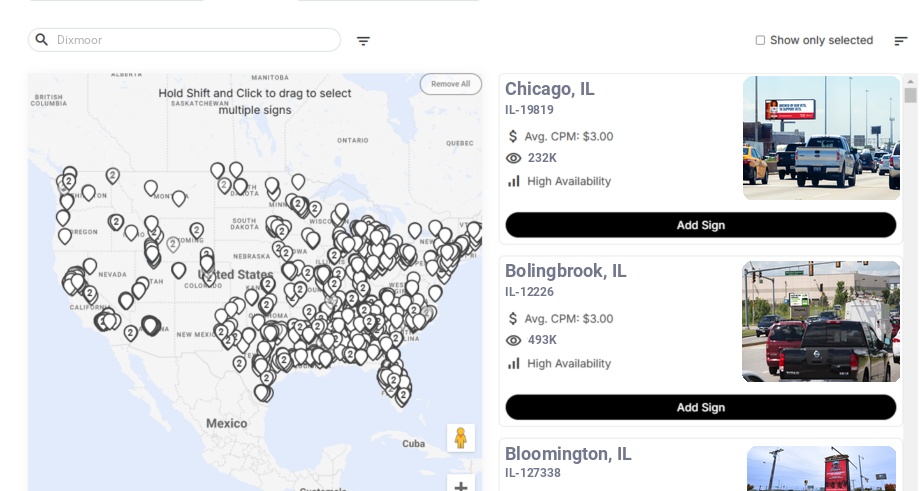



How much is a billboard in Dixmoor?
Why Choose Blip for Billboard Advertising in Dixmoor
Blip lets you launch in Dixmoor fast, with self-serve control to target I-57, I-294, I-80, or 159th Street corridors in minutes.
In Dixmoor, Blip-optimized campaigns can auto-place your ads where south Cook commuters, shoppers, and shift workers are moving most.
No contracts or minimums make Dixmoor billboard testing easy, so you can start small and scale around local traffic on U.S. 6 and Halsted.
Use dayparting in Dixmoor to hit 6-9 a.m. and 3-7 p.m. rushes, plus pre-event traffic for Tinley Park and SeatGeek Stadium.
Track Dixmoor results in real time with Blip, then shift spend toward the boards and times working best for Cook County commuters.
Blip's creative tools help your Dixmoor ad stay bold and clear for fast-moving drivers on I-57, I-294, and nearby arterials.
Frequently Asked Questions About Billboard Advertising in Dixmoor
How much does a billboard cost in Dixmoor with Blip?
With Blip, billboard advertising in Dixmoor can be a practical option for almost any budget because you only pay when your ad actually appears. Each “blip” is a 7.5-to-10-second display on a rotating digital billboard, and pricing starts at just $0.01 per display. Since cost per blip changes based on time of day, location, and advertiser demand, you can start small, adjust anytime, and pause whenever you need to.
Where can I advertise with Blip in Dixmoor?
Dixmoor is positioned near I-57, I-294, I-80, U.S. 6, and Illinois Route 1, with steady traffic from Harvey, Markham, Posen, Hazel Crest, Homewood, Tinley Park, and the broader Chicago metro. For most advertisers, I-57 is the first corridor to evaluate, and I-294 and I-80 are also important regional connectors. The local street network matters as much as the interstate system, especially Illinois Route 1, Halsted Street, U.S. 6, 159th Street, and 147th Street.
Who does Dixmoor billboard advertising reach with Blip?
Dixmoor’s strength is not raw population alone; its value comes from location, movement, and adjacency. The effective audience expands into nearby communities such as Tinley Park, Orland Park, Homewood, and Flossmoor, and when widened to the city level, Chicago adds more residents to the region’s economic gravity. It also reaches commuters, service workers, shift-based employees, families, students, adult learners, and eventgoers.
When is the best time to run a Dixmoor billboard campaign?
Morning and evening rush windows are especially important near Dixmoor, with strong relevance from about 6:00 to 9:00 a.m. and again from roughly 3:00 to 7:00 p.m. Spring and summer are strong for entertainment and outdoor movement, while fall is especially good for education, healthcare, and retail. Winter is underrated too, because sunset arrives before 4:30 p.m. in the Chicago area and illuminated boards gain visual punch during the evening commute.
What kind of billboard messaging works best in Dixmoor with Blip?
Creative that works in Dixmoor usually feels grounded, local, and useful. The page recommends using south suburban geography in the message, such as “Near I-57,” “Off 159th,” or “In Harvey,” and keeping higher-speed board copy short and clear. Dixmoor and the surrounding south suburbs respond well to practical advertising that highlights price, speed, proximity, and credibility.
Do I need a contract to advertise with Blip in Dixmoor?
No, Blip has no long-term contracts or minimum commitments. You can start, pause, or stop your campaign at any time.
How fast can I launch a billboard campaign with Blip in Dixmoor?
You can have your campaign live in minutes. Create a free account, select your locations, set your budget, upload your design, and start running once approved.
Where can I advertise with Blip in Dixmoor?
Blip has digital billboards in Dixmoor. You can browse available locations on a map, choose the ones that fit your audience, and start advertising right away.
Still have questions? Launch a campaign in minutes — no contracts, no commitments.
Start Your CampaignDixmoor Billboard Advertising Guide
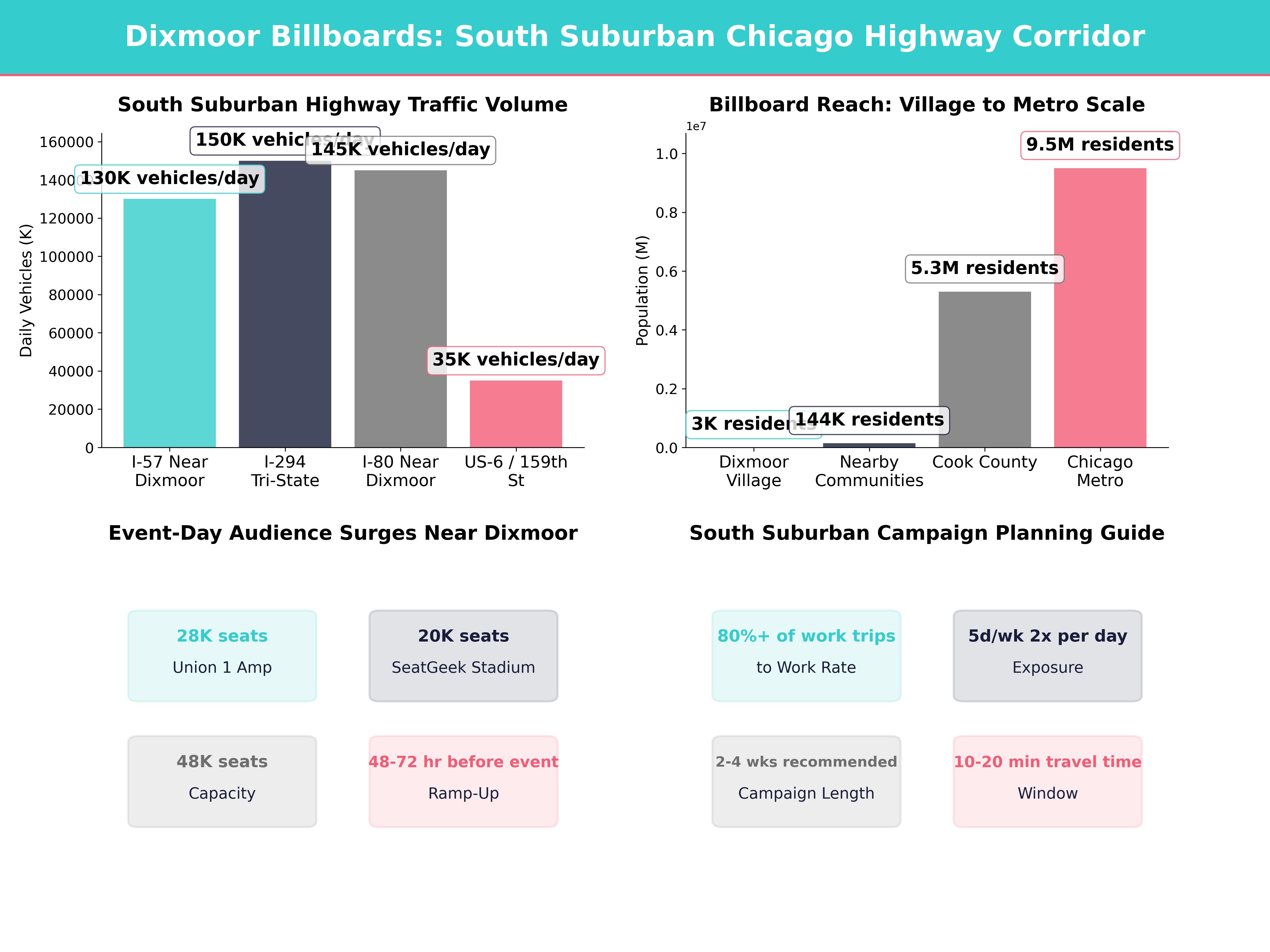
Dixmoor is a small village with a 2020 population of 2,973, but it sits in a much larger south suburban travel shed that is unusually strong for billboard advertising, with major corridors regularly carrying 120,000+ vehicles per day and with more than 5.2 million people in Cook County and roughly 9.5 million in the Chicago metro area. We are not limited to village boundaries here, because Dixmoor is positioned near I-57, I-294, I-80, U.S. 6, and Illinois Route 1, with steady traffic from Harvey Markham Posen Hazel Crest, Homewood Tinley Park, and the broader Chicago metro. That matters in Cook County, where 5,275,541 residents create a dense mix of commuters, shoppers, patients, students, and eventgoers. When we pair Dixmoor’s local frequency with south suburban regional reach, digital billboards can work for both neighborhood businesses and brands that need scale.
Dixmoor Market Overview
Dixmoor’s strength is not raw population alone. Its value comes from location, movement, and adjacency. We can start with the village’s 2,973 residents, but our effective audience expands quickly into nearby communities such as Tinley Park, with 55,971 residents, Orland Park 58,703, Homewood 19,323, and Flossmoor 144,000 residents. When we widen our lens to the city level, Chicago adds 2,746,388 more residents to the region’s economic gravity.
The south suburban economy is practical and diverse. We see demand driven by logistics, healthcare, education, municipal services, dining, automotive businesses, and destination entertainment. Institutions such as South Suburban College, Governors State University, UChicago Medicine Ingalls Memorial Hospital SeatGeek Stadium Tinley Park Convention Center all help pull people through the south Cook corridor.
From a mobility standpoint, Dixmoor fits an auto-oriented market. CMAP tracks the Chicago region’s commuting patterns, and in many south suburban municipalities, driving routinely accounts for more than 80% of work trips when we combine drive-alone and carpool travel. Transit is still meaningful, especially through Metra 11 lines and 242 stations, and Pace, which runs more than 200 routes. Even so, roadside media remains powerful because so much of the region’s daily decision-making still happens from a car, a truck, or a rideshare.
For advertisers, the implication is straightforward. Dixmoor is a compact place where we can build repeat exposure efficiently, while the surrounding south suburban network gives us enough traffic and enough destination behavior to support awareness, retail, healthcare, recruiting, and event-driven campaigns.
Key Traffic Corridors for Dixmoor Billboards
Dixmoor advertising works best when we plan around the roads people actually use. According to traffic mapping from the Illinois Department of Transportation and corridor data from the Illinois Tollway, the interstates and arterials nearest Dixmoor carry the kind of volume that makes billboard frequency realistic.
I-57 near Dixmoor
For most advertisers, I-57 is the first corridor to evaluate. South suburban segments near Dixmoor, Harvey, and Markham commonly run in the 120,000 to 140,000 AADT range, depending on the exact count station and year. This route funnels commuters between south Cook communities and Chicago job centers, and it also captures shoppers moving toward 159th Street retail clusters.
We like I-57 placements for several categories:
- Retail and restaurants, because we can intercept daily commuters before evening decision windows.
- Healthcare, because patients and caregivers often travel regionally for care.
- Education and training, because south suburban students and workforce learners move across municipal lines every day.
- Home services, because frequency matters when people are repeatedly seeing the same brand on their normal route.
Morning and evening rush windows are especially important here. We usually expect strong relevance from about 6:00 to 9:00 a.m., and again from roughly 3:00 to 7:00 p.m.
I-294, the Tri-State Tollway, east of Dixmoor
The Illinois Tollway system spans 294 miles, and the I-294 Tri-State Tollway is one of the most important regional connectors for Dixmoor campaigns. South suburban Tri-State segments near Markham and the I-80 interchange commonly reach about 140,000 to 160,000 vehicles per day.
This is the corridor we prioritize when we want broader regional reach. I-294 carries local commuters, long-haul traffic, airport trips, vendor traffic, and a significant share of commercial vehicle movement. That mix makes it especially useful for:
- B2B advertisers, because fleet managers, contractors, distributors, and industrial buyers are frequently on this route.
- Recruiting campaigns, especially for logistics, warehouse, healthcare, and trades employers.
- Travel, hospitality, and entertainment, because the corridor ties the south suburbs to larger regional destinations.
Because the audience is more regional here, our creative should usually emphasize brand recognition, location cues, and a clear next step rather than hyperlocal neighborhood language alone.
I-80 in the south suburban freight and commuter belt
I-80 is one of the most strategically important east-west highways in the Midwest, and south suburban segments near the I-57 and I-294 junctions often fall in the 130,000 to 160,000 AADT range. In practice, that means we are reaching a mix of commuters, truck traffic, regional shoppers, and long-distance travelers.
I-80 is especially effective for:
- Auto dealers and auto service, because vehicle-related needs map naturally to long-distance driving.
- Hotels, casinos, and entertainment, because travelers often make decisions mid-trip.
- Industrial services and staffing, because the freight economy is visible here.
- Healthcare systems, because large hospitals and specialty practices draw patients from multiple counties.
When we want south suburban scale without buying deep into downtown Chicago, I-80 gives us a strong regional spine.
Illinois Route 1, Halsted Street, U.S. 6, and 147th/159th Street arterials
The local street network matters just as much as the interstate system. Near Dixmoor, Illinois Route 1 and Halsted Street often carry roughly 20,000 to 30,000 vehicles per day, U.S. 6 and 159th Street frequently land in the 30,000 to 40,000 AADT band, and 147th Street commonly falls around 15,000 to 25,000 AADT depending on the segment.
These are the roads we use when we want action, not just awareness. Local corridors are ideal for:
- Quick-service restaurants, because we can trigger same-day stops.
- Medical clinics and urgent care, because convenience is the message.
- Grocery, discount retail, and banking, because people are close to point of purchase.
- Community organizations, churches, and local events, because neighborhood relevance is high.
In Dixmoor, the strongest campaigns usually combine at least 1 interstate layer for reach and 1 local corridor layer for conversion.
Audience Segments We Can Reach from Dixmoor
Dixmoor lets us reach several distinct audiences without leaving south Cook County. That versatility is one of the market’s best features.
Commuters, service workers, and shift-based employees
This is the core audience. With I-57, I-294, I-80, and local arterials all feeding the same area, we can reach office commuters, healthcare workers, municipal workers, warehouse employees, and service staff throughout the week. Because many south suburban work trips are car-based, a well-placed billboard can deliver repeated exposure 5 days a week, sometimes 2 times per day.
This audience responds well to practical messages such as price, convenience, hiring, same-day service, and route-based proximity. Copy like “Off I-57,” “Near 159th,” and “10 Minutes Ahead” tends to make sense in this market.
Families in the south suburbs
The villages and suburbs around Dixmoor give us access to stable household audiences. Tinley Park has 55,971 residents, Orland Park has 58,703, Homewood has 19,323, and Flossmoor has 9,704—together roughly 144,000 residents. These are meaningful family markets for healthcare, home improvement, insurance, youth programs, dining, and retail.
When we want to reach household decision makers, we usually plan boards along routes that connect residential areas to schools, shopping districts, and medical campuses. In this part of the region, family-oriented advertisers often benefit from weekday afternoon and early evening emphasis, especially from 3:00 to 6:30 p.m.
Students, adult learners, and education-minded households
The south suburban education market is wider than it first appears. South Suburban College and Governors State University bring in students from across the region, and many learners here balance school with work and family schedules. That means they are often driving on the same corridors at predictable times.
Education campaigns in Dixmoor work well for:
- College recruitment, especially for adult or transfer programs.
- Trade schools and certificate programs, because career mobility is a major motivator.
- Tutoring, childcare, and after-school programs, because parents are often making quick local decisions during the school year.
Eventgoers, concert fans, and regional visitors
Dixmoor is also close enough to benefit from the Chicago Southland entertainment economy. SeatGeek Stadium Bridgeview 20,000, and Credit Union 1 Amphitheatre in Tinley Park seats 28,000. Those venues create useful pre-event and post-event traffic patterns during the warmer months, with a combined capacity of roughly 48,000.
The wider visitor economy matters too. Midway International Airport handled about 22.1 million passengers in 2023, and O’Hare International Airport handled about 73.9 million. Even when those travelers are not headed directly to Dixmoor, the regional visitor flow supports hotels, restaurants, event venues, and service businesses across the south suburbs. Choose Chicago Southland
Seasonal and Timing Opportunities in Dixmoor
Timing matters in Dixmoor because traffic patterns are steady, but intent changes by season.
Spring and summer in Dixmoor
From roughly May through September, we usually see the strongest entertainment and outdoor movement. This is the period when Credit Union 1 Amphitheatre, SeatGeek Stadium Visit Chicago Southland
This is a strong season for:
- Concert-related dining and nightlife.
- Auto service and tire shops, because road-trip volume rises.
- Home improvement, lawn care, and outdoor services.
- Tourism and entertainment.
For event-driven buys, we often increase activity 48 to 72 hours before major shows or tournaments, then concentrate spend on late afternoon and early evening windows.
Fall rhythms in Dixmoor
From late August through November, we shift toward back-to-school, healthcare enrollment, workforce recruiting, and holiday lead generation. College and school routines stabilize, and road traffic tends to become highly predictable again after summer travel fluctuations.
Fall is especially strong for:
- Education and training.
- Healthcare screenings and primary care.
- Retail promotions.
- Tax, legal, and financial services that want early awareness before year-end.
It is also a good season for family messaging, because school-year structure makes weekday impressions more consistent.
Winter and holiday opportunities in Dixmoor
Winter is underrated for digital billboards in the south suburbs. In December, sunset arrives before 4:30 p.m. in the Chicago area, typically around 4:20 to 4:30 p.m., which means illuminated boards gain visual punch during the evening commute. Cold weather also pushes more decision-making into the car, where people notice urgent, simple, practical offers.
From November through December, we like to emphasize retail, food, entertainment, giftable services, and holiday events. From January through March, we often pivot to healthcare, tax prep, legal services, gyms, and auto repair. Weather-responsive scheduling is valuable here, because snow, rain, and early darkness can change traffic intensity within a single day.
Billboard Design Tips for the Dixmoor Market
Creative that works in Dixmoor usually feels grounded, local, and useful. We are speaking to people who know the roads, know the towns, and often make decisions while in motion.
Use south suburban geography in the message
Generic copy underperforms in a market like this. We should use recognizable place language such as “Near I-57,” “Off 159th,” “In Harvey,” “Near Homewood,” or “Tinley Tonight.” Those cues reduce friction immediately, especially for drivers who are comparing options in real time.
On higher-speed boards, we usually keep the read short, often around 6 to 8 words plus a logo or URL. That is not because Dixmoor audiences dislike information. It is because nearby interstate traffic moves quickly, and clarity beats cleverness.
Lead with value, trust, and convenience
Dixmoor and the surrounding south suburbs respond well to practical advertising. Our strongest creative often highlights:
- Price or savings.
- Speed, such as same-day or walk-in availability.
- Proximity, such as minutes from a route or interchange.
- Credibility, such as years in business, professional affiliation, or community presence.
For healthcare, education, staffing, and financial services, we should look trustworthy first and stylish second. For restaurants, auto service, and retail, we should emphasize the offer and the location.
Match the visual tone of the market
The south suburban audience is diverse, hardworking, and community-oriented. Creative that features families, professionals, tradespeople, live events, or familiar suburban settings often feels more authentic than abstract stock imagery.
We also need to design for local weather and road conditions. Gray skies, rain, salt-streaked winters, and fast-moving traffic all favor bold contrast. Deep blues, blacks, reds, and whites usually read better than pale palettes in this environment. If we serve bilingual neighborhoods or mixed-language trade areas, testing English and Spanish variants can improve relevance without changing the core visual system.
Regional Strategies Around Dixmoor
The best Dixmoor billboard plans are regional by design. We should not think of the market as one uniform blob.
Dixmoor, Harvey, and nearby local-service zones
In the immediate Dixmoor area, including Harvey and surrounding corridors, we prioritize frequency and local action. These boards are best for:
- Neighborhood healthcare and dental offices.
- Auto service, towing, and repair.
- Quick-service food and convenience retail.
- Community events and public messaging.
Here, repeated impressions matter more than broad prestige. We want to be the brand people keep seeing on the roads they already drive.
Markham, Hazel Crest, and the I-57 service corridor
As we move toward Markham, Hazel Crest, and nearby I-57 retail and medical zones, we gain a more regional service audience. This is where healthcare systems, legal firms, colleges, staffing agencies, and household services often perform well.
These submarkets work because people are already traveling for appointments, shopping, and errands. We can use billboard copy to reassure them that our location is easy to reach from the road they are already on.
Homewood, Flossmoor, Tinley Park, and Orland Park
When we want higher household spending power, stronger dining traffic, or more destination retail behavior, we extend outward. Homewood, with 19,323 residents, Flossmoor, with 9,704, Tinley Park, with 55,971, and Orland Park, with 58,703, give us a substantial family and lifestyle audience, totaling roughly 144,000 residents.
This broader ring is a strong fit for:
- Home remodeling and furniture.
- Family entertainment.
- Higher-ticket dining and hospitality.
- Specialty healthcare and elective services.
In these areas, we can support a longer consideration cycle, not just immediate stops.
The I-80 and I-294 logistics belt
For B2B campaigns, recruiting, industrial supply, trucking services, and warehouse staffing, we should treat the I-80 and I-294 network as its own market. The road volume, freight relevance, and regional connectivity make it a separate strategy from neighborhood retail.
This is where simple, direct messages work best. Hiring, certifications, pay, equipment, and route convenience should take priority over branding flourishes.
Blip Tools and Capabilities for Dixmoor Campaigns
Blip’s flexibility is useful in Dixmoor because this market rewards both precision and adaptation.
When we should use manual campaign control
If our goal is route-specific coverage, manual selection usually makes sense. We can hand-pick boards near I-57, I-294, I-80, 159th Street, or local service corridors and align them with a store, clinic, campus, or venue. That approach works especially well when geography is part of the message.
When Blip-optimized delivery makes sense in Dixmoor
If we want broader south suburban awareness, Blip-optimized campaigns are often the better fit. We can define the audience and budget, then let the system spread impressions across the most useful mix of inventory. That is especially helpful when we want reach across multiple municipalities instead of just one corridor.
How we would test, learn, and scale locally
Dixmoor is a good market for structured testing. We can launch a 2- to 4-week campaign, compare 2 or 3 creative variants, and study which corridors respond best by time of day. For example, we might run commuter-focused creative from 6:00 to 9:00 a.m., family-service creative from 3:00 to 6:30 p.m., and event creative from 4:00 to 8:00 p.m. on show nights.
Because digital inventory changes with demand, real-time analytics are valuable here. We can shift spend quickly toward the boards, times, and messages that reflect actual south suburban behavior rather than assumptions.
Getting Started with Billboard Rental in Dixmoor
Renting a billboard in Dixmoor becomes much easier when we begin with geography and intent, not with the board itself.
Start with one goal and one trading area
We should first define what success looks like. If we want neighborhood traffic, we can focus on a 3- to 5-mile zone around the business. If we want regional awareness, we can widen to a 10- to 15-mile south suburban radius. If we want trucking, logistics, or recruiting reach, we should emphasize I-80, I-294, and I-57.
A few common starting points work well:
- Local storefronts should emphasize nearby arterials and inbound commuter routes.
- Service-area businesses should cover both local roads and at least 1 interstate corridor.
- Regional brands should layer multiple corridors for broader frequency.
- Event and entertainment advertisers should plan around venue calendars and pre-event traffic windows.
Evaluate Dixmoor billboard locations the practical way
When we compare boards, we should ask a few simple questions. Are drivers heading toward us or away from us. Are they making a decision soon, or are they still 10 to 20 minutes away from action. Is the road a daily commute route, a shopping corridor, or a regional throughway. Does the creative need immediate response, or is it building memory over time.
In Dixmoor, the best boards usually do one of 2 things well. They either capture repetitive commuter traffic, or they intercept people close to a purchase decision.
Why digital billboard rental is simpler here
Traditional billboard buying often revolves around fixed locations, longer commitments, and 4-week posting cycles that can be hard for smaller or time-sensitive advertisers to manage. Digital makes more sense in a market like Dixmoor because traffic patterns change by daypart, season, and event calendar.
With Blip, we can start smaller, learn faster, and adjust as the south suburban market responds. We can test a message near 159th Street, expand to I-57, add an event push toward Tinley Park, or pause and relaunch without rebuilding the entire plan. That flexibility is especially valuable in a market where a 7.5- to 10-second billboard message needs to meet the right driver at the right moment.
Dixmoor gives us a smart entry point into the south suburban Chicago market. When we combine the village’s local repetition with the reach of Cook County’s commuter corridors, we can build billboard campaigns that feel both efficient and surprisingly large.