Billboards near North Aurora, IL
No Minimum Spend. No Long-Term Contracts. Just Results.
Trusted by Leading Brands


Billboard advertising
near North Aurora has never been easier



How much is a billboard near North Aurora?
Why Choose Blip for Billboard Advertising near North Aurora
Blip lets you launch North Aurora ads fast, so you can reach I-88 commuters and Route 59 shoppers without waiting on a contract.
Set a flexible budget for North Aurora and focus spend on peak commute hours or Saturday outlet traffic when demand is highest.
Use Blip's dayparting to hit North Aurora families on evening return trips, then shift to midday for Naperville and Aurora shoppers.
Track North Aurora campaigns in real time and adjust as traffic flows change between I-88, Orchard Road, and Randall Road.
Blip's creative tools help you build clear, local ads for North Aurora—perfect for Fox River visitors, school families, and bilingual audiences.
Frequently Asked Questions About Billboard Advertising near North Aurora
How much does a billboard cost near North Aurora, Illinois with Blip?
With Blip, you set your own daily budget for North Aurora billboards and only pay for the brief ad plays, or “blips,” you receive. Each blip is a 7.5 to 10-second display, and the price for each one depends on when and where you choose to advertise, along with current advertiser demand in the North Aurora area. Your total spend is simply the sum of all your blips over time, and you can pause or adjust your budget whenever you like.
Where can I advertise with Blip near North Aurora, Illinois?
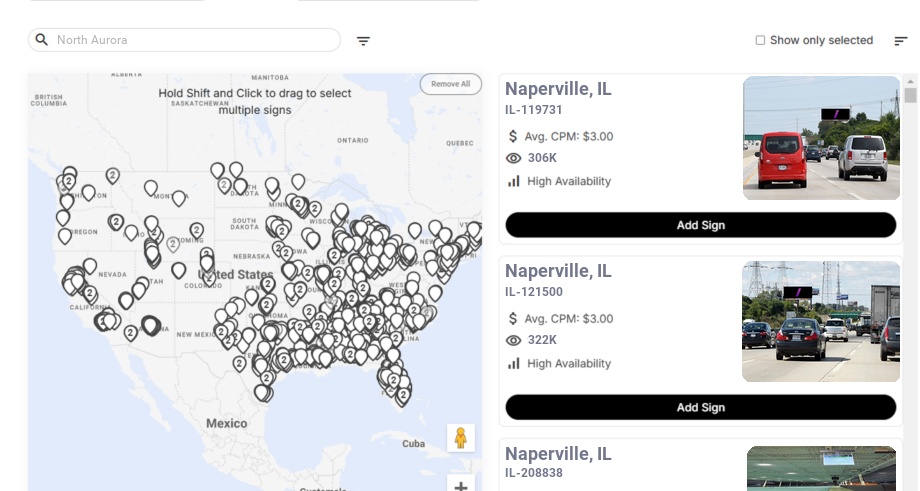
Blip makes it easy to run eye-catching ads on 16 digital billboards near North Aurora, Illinois, serving the North Aurora area with flexible budgets, real-time control, and playful, attention-grabbing campaigns. The 16 digital billboards serving the North Aurora area are primarily in and around Naperville, aligned with major traffic corridors that North Aurora residents and visitors frequently use. These faces give you flexible, local reach for ongoing brand presence or short-term campaigns.
What kind of people do North Aurora, Illinois billboards reach?
North Aurora sits at the heart of Chicago’s far western suburbs, adjacent to Aurora and a short drive from Naperville. The area is part of a high-income, family-oriented market that includes residents, commuters, and visitors moving through the region. The broader Fox Valley and Naperville area also has a large share of adults ages 30–54, many family households, and strong homeownership rates.
What roads get the most traffic for North Aurora, Illinois billboard advertising with Blip?
I-88 is one of the most critical east-west routes in northern Illinois, with western suburban counts commonly showing 80,000–110,000 vehicles per day and some sections peaking above 120,000. Orchard Road and Randall Road connect North Aurora with nearby suburbs and often carry 25,000–40,000 vehicles per day, while Route 59 and Butterfield Road serve busy retail and commercial corridors. Naperville arterials like Ogden Avenue, Diehl Road, and Washington Street also carry dense commuter, shopping, and dining traffic.
When is the best time to run North Aurora, Illinois billboards with Blip?
Weekday morning commute peaks from 6–9 a.m. and evening peaks from 4–7 p.m. are the strongest times for reaching commuters around North Aurora. Midday can capture parents on errands, shift workers, and visitors, while weekends are especially strong on shopping and entertainment corridors. You can schedule your ads down to specific hours and days, and increase your bid during peak commuter or weekend shopping hours.
Do I need a contract to advertise with Blip near North Aurora?
No, Blip has no long-term contracts or minimum commitments. You can start, pause, or stop your campaign at any time.
How fast can I launch a billboard campaign with Blip near North Aurora?
You can have your campaign live in minutes. Create a free account, select your locations, set your budget, upload your design, and start running once approved.
Where can I advertise with Blip near North Aurora?
Blip has digital billboards near North Aurora. You can browse available locations on a map, choose the ones that fit your audience, and start advertising right away.
Still have questions? Launch a campaign in minutes — no contracts, no commitments.
Start Your CampaignNorth Aurora Billboard Advertising Guide
North Aurora sits at the heart of Chicago’s far western suburbs, adjacent to Aurora and a short drive from Naperville. With 16 digital billboards near North Aurora (all within roughly 10 miles and concentrated in Naperville), we can help you reach residents, commuters, and visitors moving through this high‑income, family‑oriented market with precise, data‑driven campaigns. Whether you need ongoing brand presence or short‑term billboard advertising near North Aurora for a special event or sale, these faces give you flexible, local reach.
Understanding the North Aurora Area Market
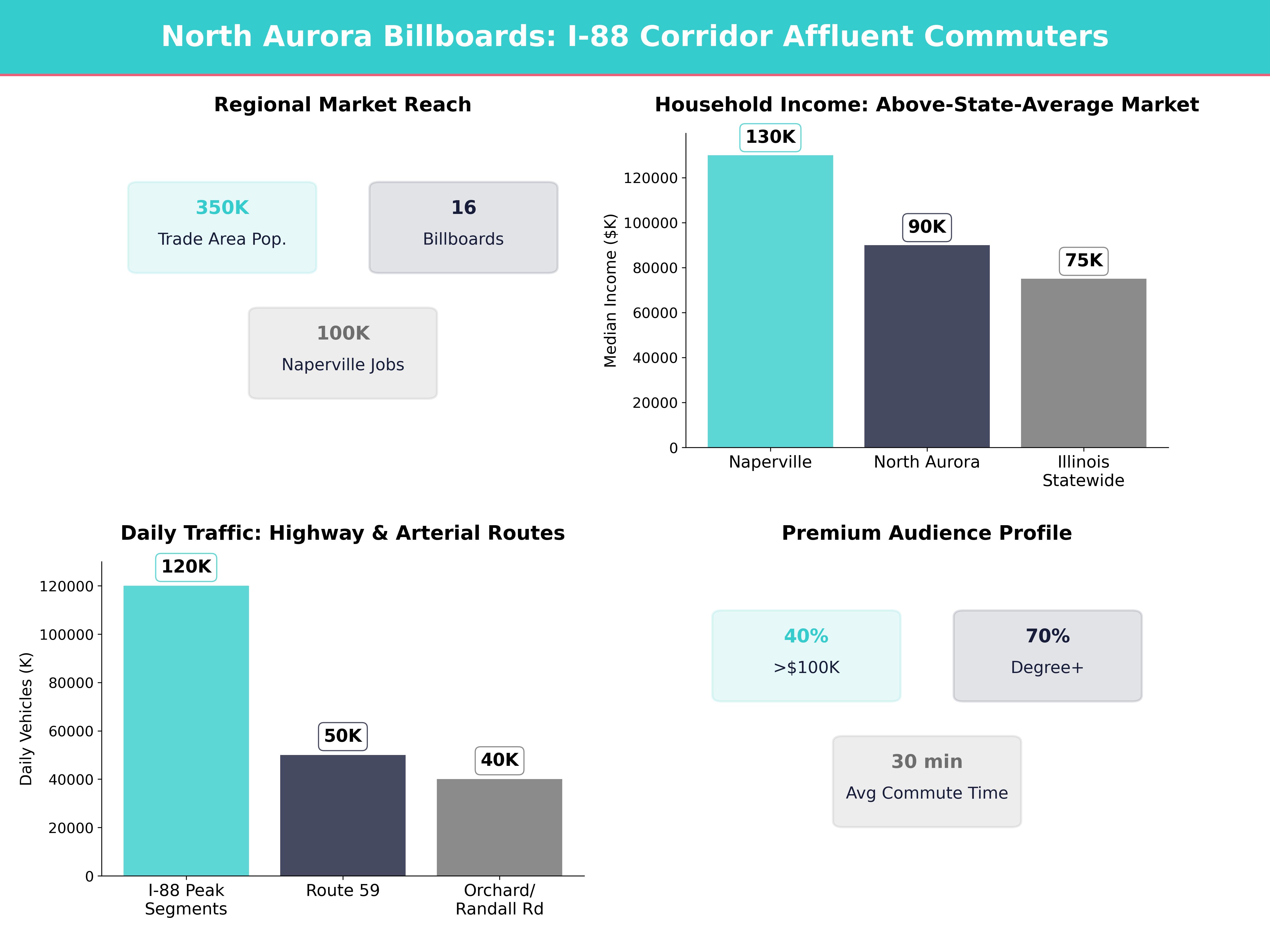
North Aurora is a fast‑growing village along the Fox River in Kane County. As of 2020 data, it has roughly 18,000–19,000 residents (commonly cited around 18,000–18,500), up from about 15,000 in 2000—an increase of more than 20–25% over two decades, reflecting strong suburban growth. Nearby Aurora has more than 180,000 residents, while Naperville is home to about 150,000 residents, creating a combined local trade area of well over 350,000 people within a short drive of our boards. You can find local community and economic details from the Village of North Aurora City of Aurora, the City of Naperville Kane County.
Key characteristics in the North Aurora area:
-
Population density
North Aurora’s density is around 3,000–3,500 residents per square mile, which is significantly higher than many outlying exurban communities that often fall below 2,000 residents per square mile. This provides a compact, easy‑to‑reach local audience and supports strong frequency when your boards are placed on key corridors, especially when choosing North Aurora billboards that sit along the main commuter paths. -
Income
- North Aurora’s median household income is frequently reported in the $90,000–$100,000 range, well above the Illinois statewide median (around $75,000).
- Nearby Naperville’s median household income is even higher, commonly estimated at $130,000–$140,000+.
- Within a 10–15‑minute drive shed that includes North Aurora, western Aurora, and southern Naperville, it is common to see 40–50% of households above $100,000 in income.
This means many viewers of billboards near North Aurora have strong purchasing power and are prime prospects for higher‑ticket products and services.
-
Education
In the broader Fox Valley and Naperville area, more than 50–60% of adults have at least some college education, and Naperville alone has over 70% of adults with a bachelor’s degree or higher. In some Naperville neighborhoods, bachelor’s‑degree attainment exceeds 80%. Messaging can assume a relatively high level of education, professional employment, and tech adoption. -
Commuting and employment
- Average one‑way commute times in the surrounding suburbs often run 28–32 minutes, creating extended exposure windows along major routes.
- Naperville’s employment base exceeds 100,000 jobs, with large concentrations in technology, healthcare, finance, and corporate headquarters.
- Aurora supports 80,000+ jobs, anchored by healthcare, manufacturing, logistics, and public sector employers.
- A sizable share of residents in North Aurora and the Fox Valley commute into corridor job centers (Aurora, Naperville, Warrenville, Lisle, Oak Brook), generating daily flows of tens of thousands of vehicles past our 16 digital billboards.
The area is also a regional draw for shopping and entertainment. The Aurora Area Convention & Visitors Bureau notes that the region welcomes millions of visitors each year, driven by attractions such as Chicago Premium Outlets 100 stores and one of the top outlet centers in the Midwest), Hollywood Casino Aurora, and extensive Fox River recreation. This visitor traffic expands your audience beyond residents to include shoppers and tourists from across the suburbs and northern Illinois—valuable for tourism, entertainment, and retail advertisers using billboard advertising near North Aurora to tap regional demand.
Where Traffic Flows: High‑Impact Corridors Near North Aurora
The 16 digital billboards serving the North Aurora area are primarily in and around Naperville, aligned with major traffic corridors that North Aurora residents and visitors frequently use. When you plan billboard rental near North Aurora, these corridors determine who sees your message and how often.
Key routes and traffic patterns to consider:
- I‑88 (Ronald Reagan Memorial Tollway)
Running just south of North Aurora, I‑88 is one of the most critical east‑west routes in northern Illinois. Illinois Department of Transportation (IDOT) and tollway counts along I‑88 in the western suburbs commonly show 80,000–110,000 vehicles per day, with some sections near Naperville business parks and major interchanges peaking above 120,000 vehicles per day. Commuters from North Aurora headed toward Aurora, Naperville, Lisle, and Oak Brook repeatedly pass through these segments, often 5 days per week, yielding high frequency opportunities. - Orchard Road and Randall Road
These north‑south arterials link North Aurora with Batavia, Geneva, and St. Charles to the north and Montgomery/ Oswego 25,000–40,000 vehicles per day range, with p.m. peaks particularly strong near retail clusters and I‑88 access points. Orchard Road has been expanded in recent years to handle growing volumes, underscoring long‑term stability of these traffic counts. - Route 59 & Route 56 (Butterfield Road)
Route 59 is one of the busiest retail corridors in the Chicago suburbs, feeding Naperville and Aurora malls, big‑box centers, and restaurants. Many segments post 40,000–50,000+ vehicles per day, and at major intersections, weekend shopping peaks can rival weekday rush‑hour volumes. Butterfield Road (Route 56) similarly serves major commercial clusters, industrial parks, and office campuses, with key segments generating 25,000–35,000 vehicles per day. - Naperville arterials
In Naperville itself, roads like Ogden Avenue, Diehl Road, and Washington Street experience dense commuter, shopping, and dining traffic, especially around the I‑88 interchanges and corporate campuses. It is common for these arterials to carry 20,000–35,000 vehicles per day, with elevated flows around lunchtime and early evening.
Because our 16 digital faces are placed along such corridors, campaigns near North Aurora can capture:
- Morning and evening commuters between North Aurora, Aurora, Naperville, and other suburbs (often 10+ trips per week per regular commuter)
- Shoppers and diners heading to major retail centers such as Chicago Premium Outlets
- Students and families traveling to schools, parks, and events in districts like West Aurora School District 129, Batavia Public School District 101, Indian Prairie School District 204, and Naperville Community Unit District 203
- Visitors drawn to outlets, casino, and Fox River attractions highlighted by Enjoy Aurora
When you select boards and dayparts in the Blip platform, it pays to think in terms of these specific flows—e.g., targeting eastbound commuters on I‑88 toward Naperville in the morning and westbound traffic returning toward North Aurora in the evening, or focusing on Saturday midday when shopping trips and outlet visits spike. This approach helps ensure that billboard advertising near North Aurora aligns with the real‑world travel patterns of your best prospects.
Who You’re Reaching: Demographics & Lifestyles
The North Aurora area is part of the broader Fox Valley and Naperville suburban region, which combines family neighborhoods, established professionals, and a diverse mix of ethnic communities.
Important demographic and lifestyle insights:
-
Age distribution
- A large share of residents in the North Aurora–Naperville–Aurora area fall into the 30–54 age range, which typically accounts for 35–40% of the population—prime working and spending years.
- Children and teens (under 18) often make up 23–27% of local populations, reflected in strong local school districts such as West Aurora and Batavia (covered by the Illinois Report Card) and nearby Indian Prairie/Naperville school systems.
- This age mix supports campaigns for family‑oriented services, youth activities, and education.
-
Household composition
- Many suburbs in this corridor show 60–70% of households as family households, with married‑couple families and multi‑child households especially common in residential areas near North Aurora and Naperville.
- Dual‑income households are prevalent, with two working adults generating more disposable income but also more reliance on convenient, time‑saving services (dining out, delivery, childcare, home services).
-
Diversity
- Nearby Aurora is one of Illinois’ most diverse cities; in some Aurora neighborhoods, residents from Hispanic/Latino backgrounds comprise 40–45% or more of the population, and there are meaningful Black and Asian communities as well.
- North Aurora has become more diverse over the last decade, with notable growth in Hispanic/Latino and Asian populations.
- In many nearby ZIP codes, more than 20–30% of residents speak a language other than English at home, with Spanish being most common. Bilingual (English/Spanish) billboard creative can significantly broaden reach, especially for service businesses, healthcare, education, and events.
-
Homeownership
- Homeownership rates are high, often 70–80% in nearby suburbs such as North Aurora, Batavia, and Naperville.
- High ownership correlates with sustained demand for home services, remodeling, landscaping, roofing, HVAC, and local professional services (insurance, financial planning, real estate).
-
Digital and mobile behavior
- With higher incomes and education levels, smartphone adoption and broadband usage are extremely high, frequently above 85–90% of households.
- Suburban residents in this corridor routinely rank above national averages for online shopping, food delivery, and app‑based services.
- Pairing digital billboards with mobile, social, or search campaigns can reinforce your message and support direct response; national out‑of‑home studies have found that nearly 50% of adults report visiting a website or searching online after seeing an OOH ad.
These characteristics mean that billboard campaigns near North Aurora work especially well for:
- Home and family services (healthcare, childcare, education, home improvement)
- High‑value consumer purchases (autos, financial services, real estate)
- Dining, entertainment, and local attractions
- Recruitment for regional employers and staffing firms targeting skilled and semi‑skilled labor
For additional context on community life and local trends, you can monitor coverage from regional outlets like the Daily Herald, the Kane County Chronicle, and the Aurora Beacon‑News.
Timing Your Campaign: When Impressions Matter Most
With Blip, you can schedule your ads down to specific hours and days. Around North Aurora, timing strategy should align with traffic and lifestyle patterns so that your North Aurora billboards deliver impressions when they are most likely to influence action.
Weekday commute peaks
-
Morning (6–9 a.m.) – Heaviest outbound traffic toward Naperville, Aurora, and other job centers along I‑88 and Route 59. On many segments, 40–45% of daily traffic passes through during the combined a.m. and p.m. peaks.
- Ideal for: coffee shops, quick‑service restaurants with breakfast, gas stations, mass transit promos, time‑sensitive service offers (e.g., “Call today, we come this afternoon”).
-
Evening (4–7 p.m.) – Return traffic to the North Aurora and Fox Valley neighborhoods, including commuters and after‑school trips. Shopping trip frequency tends to rise after 4 p.m., especially Thursday–Saturday.
- Ideal for: dining, grocery stores, fitness centers, family activities, events happening that night or weekend.
Midday and afternoon (10 a.m.–3 p.m.)
- Captures parents on errands, shift workers, and retirees, plus regional visitors shopping and exploring. In many retail corridors, midday traffic can represent 25–30% of daily volumes.
- Ideal for: retailers, medical/dental offices, salons/spas, home improvement showrooms, and B2B services targeting local business owners moving between meetings.
Weekends
- Weekend traffic on shopping and entertainment corridors such as Route 59, Orchard Road, and around Chicago Premium Outlets Saturday accounting for the single highest day of in‑store traffic, with Sunday a close second for certain categories.
- Saturday is particularly strong for big‑ticket shopping; Sunday afternoon is strong for family activities and grocery.
- Ideal for: malls, independent retailers, entertainment venues, weekend events, and faith‑based organizations.
You can use Blip’s tools to:
- Increase your bid during peak commuter or weekend shopping hours to gain more share of voice.
- Dial back spend during lower‑value hours while still maintaining a baseline presence.
- Run short “bursts” for special events (e.g., a Saturday festival, limited‑time sale) on just 1–2 days, synchronized with event calendars from the Village of North Aurora Enjoy Aurora.
Crafting Effective Creative for the North Aurora Area
Because drivers typically have only 6–8 seconds to absorb a billboard, simple, locally resonant creative is critical. Industry studies consistently show that ads with 7 words or fewer in the primary headline achieve significantly better recall than text‑heavy designs. This is especially true for fast‑moving traffic viewing billboards near North Aurora on I‑88 and the main arterials.
Make it hyper‑local
-
Reference local geography drivers recognize:
- “Minutes from the Fox River in the North Aurora area”
- “Just off I‑88, 2 exits from North Aurora”
- Use visual cues: Fox River, local parks (promoted by Fox Valley Park District), or Chicago Premium Outlets
-
If your physical location is in Aurora or Naperville, clarify proximity:
- “10 minutes from North Aurora on Route 59”
- “Next to Chicago Premium Outlets
- Local consistency across billboards and your Google listing or website address can improve navigation success and reduce friction for first‑time visitors.
Highlight value quickly
- Aim for 7 words or fewer in your main headline and no more than 2–3 key elements (headline, image, logo/URL).
- Use large, high‑contrast fonts; avoid heavy paragraphs or long lists.
-
One strong offer or message per creative:
- “New Patients: Exam + X‑Rays $79”
- “Oil Change – No Appointment – Exit 119”
- Clear value statements are especially important in high‑income markets where consumers have many choices and limited time.
Consider bilingual opportunities
-
In corridors that draw heavily from Aurora, a concise bilingual line (English + Spanish) may increase reach. In some nearby ZIP codes, 30%+ of residents speak Spanish at home.
- “Seguro de Auto / Auto Insurance – Call Today”
- Keep bilingual text even more concise to remain legible—ideally 5–6 total words per language at most.
Use color and contrast for visibility
- High contrast combinations (white/yellow on dark blue/black) stand out in bright sun and at night.
- Avoid thin scripts or light pastels that wash out on overcast days or under LED glare.
- Nighttime brightness standards on modern digital billboards help, but strong contrast further improves legibility at 55–65 mph highway speeds.
Rotate multiple creatives
Digital boards serving the North Aurora area allow easy rotation:
- Version A: General brand awareness
- Version B: Limited‑time promotion or seasonal special
- Version C: Directional creative with distance/time (“5 Minutes from North Aurora”)
Rotating multiple creatives is a proven best practice; advertisers who run at least 2–3 variations typically see higher recall and better coupon or URL response rates than those running a single static message. Rotate these across the 16 billboards to keep messages fresh and test what performs best, especially if you are investing in ongoing billboard rental near North Aurora.
Aligning Campaigns with Local Seasons & Events
The North Aurora area has strong seasonality. Tying your campaign to what’s happening locally can significantly improve relevance and response.
Spring (March–May)
- Home improvement, landscaping, roofing, HVAC tune‑ups, and real estate listings surge as temperatures rise and snow risk fades. Many home‑service businesses report 25–40% of annual revenue in spring and early summer.
- Outdoor recreation on the Fox River and local parks increases as trails and playgrounds managed by the Fox Valley Park District see rising visits.
- Tax season and graduation planning create demand for financial services, party venues, and catering. Consider countdown or date‑specific messages (“File by April 15,” “Book Your Grad Party”).
Summer (June–August)
- Families are more mobile—traveling to pools, parks, festivals, and shopping. Local event calendars often show dozens of festivals, concerts, and community events across Aurora, North Aurora, and Naperville.
- Target parents with camp, sports leagues, and educational programs; many programs close registration in late May or early June, so run heavier spring/early‑summer flights.
- Leverage local event calendars from the Village of North Aurora Enjoy Aurora for festival and event‑based promos.
Fall (September–November)
- Back‑to‑school and youth sports drive frequent trips to schools and fields. Districts like West Aurora 129, Batavia 101, IPS 204, and Naperville 203 collectively serve tens of thousands of students, creating dense family travel patterns.
- Strong period for healthcare (flu shots, check‑ups), after‑school programs, and tutoring, as parents reset routines.
- Retail ramps up with early holiday shoppers in Naperville and Aurora corridors, often starting in October for higher‑income households.
Winter (December–February)
- Holiday shopping at Chicago Premium Outlets 20–30% of annual sales in November–December, and outlet centers often track even higher seasonal concentration.
- Emphasize gift cards, seasonal promotions, and dining; quick‑service and sit‑down restaurants typically see noticeable December lifts from office parties and family gatherings.
- After New Year’s, focus on fitness, health, financial planning, and home services—gym membership sign‑ups, weight‑loss programs, and tax prep services often spike in January and February.
You can use Blip to launch short, intense bursts aligned with specific events—such as a three‑day outlet sale, a church Christmas program, or a one‑week restaurant promotion, timed precisely to dates advertised on the Village of North Aurora City of Aurora community calendars. This kind of agile billboard advertising near North Aurora is especially powerful when tied to tight promotional windows.
Strategy by Industry: What Works Well Near North Aurora
Different sectors can leverage the same 16 billboards serving the North Aurora area in unique ways. National out‑of‑home research shows that roughly 70% of consumers notice roadside billboards, and about 1 in 3 say OOH ads have prompted them to visit a business in person—making these faces powerful tools across categories.
Retail & E‑commerce
- Target weekend and evening traffic on Naperville and I‑88 corridors, when shopping trip frequency is highest; many households consolidate errands into 1–2 major trips per week.
- Use price points or clear offers: “50–70% Off This Weekend Only.”
- For e‑commerce, pair simple URLs or QR codes with geo‑targeted mobile ads for retargeting. Studies show that adding a digital retargeting layer to OOH can improve online conversion rates by 20–40%.
Restaurants & Entertainment
-
Focus creatives on appetizing imagery and proximity:
- “Family Pizza Night – 8 Minutes from North Aurora”
- Use time‑of‑day rotation: lunch offers 11 a.m.–2 p.m.; happy hour/dinner 3–8 p.m. Restaurants often see 30–40% of daily revenue during the dinner window, making those impressions especially valuable.
- Promote shows, concerts, and events in Aurora and Naperville—coordinate with local listings from outlets like the Daily Herald, Kane County Chronicle, and Aurora Beacon‑News.
Healthcare & Professional Services
- Highlight convenience and trust: “Same‑Day Appointments Near the North Aurora Area.”
- Use directional cues: “Across from Rush Copley / 10 minutes from North Aurora.”
- For legal and financial services, focus on credibility: years in business, local roots, recognitions; for example, “Serving the Fox Valley for 25+ Years” can build trust in a market where many households have complex financial and legal needs.
Education & Youth Programs
- Promote enrollment windows for private schools, tutoring centers, and enrichment programs. Many programs fill 50–70% of seats during a short 4–8 week enrollment period, so concentrated billboard flights can make a measurable difference.
- Run heavier schedules in August–September and January registration periods.
- Emphasize outcomes and safety: test scores, scholarships, small class sizes, or graduation rates, as reported on the Illinois Report Card.
Home Services & Real Estate
- Use seasons aggressively—roofing and exterior work in spring/summer; interior and HVAC in fall/winter. Weather‑related searches for roofing and HVAC often spike 50–100% during the first major spring storms or cold snaps.
- Directional creative works well for new developments and model homes: “New Homes from the $400s – 3 Miles South of North Aurora.”
- For agents, focus on social proof: “#1 Team in the North Aurora Area – Call Today” or “Over 100 Fox Valley Homes Sold in 12 Months.” These types of messages stand out especially well when placed on high‑visibility North Aurora billboards close to residential neighborhoods.
Recruiting & Employer Branding
- Target commute corridors that employees from the North Aurora area use to reach regional employers. Many local warehouses, hospitals, and manufacturers draw labor from a 10–20‑mile radius, making regional billboard coverage ideal.
- Messages such as “Hiring Now – $22/hr + Benefits – Exit 119” can drive applications quickly; clear pay rates on recruiting billboards have been shown to meaningfully boost response.
- Time ads during early morning and evening commute when job dissatisfaction is top of mind and when many workers check their phones for job searches before and after shifts.
Using Blip’s Tools to Maximize Impact
To fully leverage the 16 digital billboards near North Aurora, we recommend:
1. Start with a clear geographic strategy
-
Prioritize boards along:
- I‑88 and Diehl Road (regional commuters)
- Route 59 and key Naperville arterials (shopping and dining)
- Layer in boards closer to your physical location (if in Aurora/Naperville) for directional messaging. For example, if you are located near downtown Aurora or the Fox River, boards on Orchard Road and Route 31 will reach both North Aurora residents and in‑town visitors.
This kind of location‑first planning ensures your billboard rental near North Aurora is focused on the stretches of roadway that matter most to your business.
2. Use flexible budgeting and bidding
- Set a daily or campaign‑length budget that fits your goals; many small businesses begin with $10–$30 per day and scale up after seeing initial results.
- Bid higher during peak periods (e.g., 7–9 a.m., 4–6 p.m., Saturday afternoons) and lower overnight or mid‑day if your audience is less active then.
- Consider “always‑on” brand presence at a modest budget, with short high‑intensity bursts for promotions. Advertisers who maintain year‑round visibility often see stronger long‑term brand lift than those who appear only seasonally.
3. Test and iterate creative
- Run at least two creative variations at the same time.
-
Track response using:
- Unique URLs or discount codes
- Dedicated phone numbers
- Google Analytics campaign tags
- Identify which message (offer vs. brand vs. directional) yields better engagement and allocate more budget to the winner. Even modest tests—such as A/B testing two headlines—can lift response by 10–30%.
4. Coordinate with other media
- Align billboard messages with campaigns on local news sites such as the Daily Herald or Aurora Beacon‑News.
- Use similar visuals and taglines across social media, search ads, and email to reinforce recognition; consistent cross‑channel branding has been shown to increase overall campaign effectiveness by 20% or more.
- Time on‑air radio, streaming, or print ads with digital billboard bursts for maximum lift, especially around major promotions or openings.
Measuring Success in the North Aurora Area
While billboards are primarily an upper‑funnel channel, campaigns near North Aurora can be measured and optimized using:
-
Web analytics
Look for:- Spikes in direct and branded search during your flight dates
- Traffic from ZIP codes near North Aurora, Aurora, Naperville, and surrounding suburbs
- Increases in mobile traffic during peak impression windows (e.g., within 30–60 minutes of your heaviest billboard rotations)
-
Offer redemptions
Track promo codes or “Show this ad” discounts in‑store or online. Even a modest redemption rate (e.g., 0.1–0.5% of total impressions) can represent a strong return for higher‑margin products and services. -
Call tracking
Use a unique phone number on your billboard creative. Comparing call volume during billboard dates vs. baseline weeks will give you a concrete read on impact. -
Foot traffic
If you use location analytics tools, compare visits from the North Aurora area during campaign periods vs. non‑campaign periods. Retailers often see 5–15% lifts in visit volume during strong OOH campaigns, particularly when paired with a compelling offer.
By tying these data points to your creative variations and scheduling choices, you can continuously improve performance and justify scaling up spend across the 16 digital faces serving this market. Over time, an optimized mix of North Aurora billboards and complementary digital channels can become a reliable driver of awareness and in‑store or online activity.
By understanding how North Aurora residents move through nearby corridors, what they value, and when they are most likely to see your message, we can help you design a digital billboard campaign that makes the most of all 16 boards serving the North Aurora area. With smart targeting, compelling creative, thoughtful timing, and well‑planned billboard advertising near North Aurora, you can turn those daily commutes and shopping trips into consistent visibility—and real, measurable results for your business.