Billboards in Lake Bluff, IL
No Minimum Spend. No Long-Term Contracts. Just Results.
Trusted by Leading Brands


Billboard advertising
in Lake Bluff has never been easier



How much is a billboard in Lake Bluff?
Why Choose Blip for Billboard Advertising in Lake Bluff
Blip lets you self-serve Lake Bluff billboards fast, reaching I-94's 132K-153K daily vehicles without a sales cycle.
Use Blip in Lake Bluff to daypart commuter windows like 6-9 a.m. and 3-7 p.m. for peak North Shore visibility.
No contracts or minimums in Lake Bluff mean you can start small on US 41 or local arterials and scale when results prove out.
Blip-optimized campaigns can auto-pick Lake Bluff boards and timing to match your budget, from weekday commuters to summer visitors.
Track Lake Bluff results in real time and shift spend quickly between I-94, Metra routes, and nearby Lake Forest or Gurnee traffic.
Use Blip's creative tools to build clean Lake Bluff ads that stand out in winter darkness and on fast-read suburban corridors.
Frequently Asked Questions About Billboard Advertising in Lake Bluff
How much does a billboard cost in Lake Bluff with Blip?
With Blip, you can launch digital billboard ads on your terms and only pay when your ad plays. Each “blip” is a 7.5-to-10-second display, with pricing starting at just $0.01 per display, and the cost can vary based on time of day, location, and advertiser demand. Your total cost is simply the sum of each blip over time, giving you full control over your spend.
Where can I advertise with Blip in Lake Bluff?
Lake Bluff’s value comes from the way local and regional routes overlap, so you can choose broad-reach placements or tighter local corridors. The biggest regional corridor is I-94 on the Tri-State Tollway, and US 41 is the most important non-toll north-south route for Lake Bluff itself. Local arterials like Waukegan Road, Rockland Road, and Townline Road are also meaningful suburban volumes for nearby households.
Why is Lake Bluff a good market for billboard advertising with Blip?
Lake Bluff sits inside a much larger advertising economy shaped by Lake County, regional commuter traffic, and year-round destination travel. The county had 714,342 residents in 2020, and Lake Bluff is positioned between Lake Forest and North Chicago with easy access to US 41 and nearby I-94. Roughly 4 in 5 workers commute by car, which gives digital billboards repeated visibility in a car-oriented suburban market.
When is the best time to run billboard ads in Lake Bluff?
Lake Bluff is not a flat, same-every-month billboard market, so timing should follow school calendars, summer recreation, shopping cycles, and Midwest weather. The biggest seasonal opportunity runs from Memorial Day through Labor Day, while late August through October is also strong for back-to-school and fall campaigns. In December, sunset arrives before 4:30 p.m., making winter a good time for high-contrast creative.
What kind of audience can Blip reach around Lake Bluff?
Lake Bluff works best when billboard locations match the audience that actually uses each corridor. The area includes commuters and North Shore professionals, families and homeowners in nearby communities, students and healthcare workers, and visitors drawn by recreation and entertainment. That mix makes it useful for healthcare, financial services, home services, private education, restaurants, retail, and event marketing.
Do I need a contract to advertise with Blip in Lake Bluff?
No, Blip has no long-term contracts or minimum commitments. You can start, pause, or stop your campaign at any time.
How fast can I launch a billboard campaign with Blip in Lake Bluff?
You can have your campaign live in minutes. Create a free account, select your locations, set your budget, upload your design, and start running once approved.
Where can I advertise with Blip in Lake Bluff?
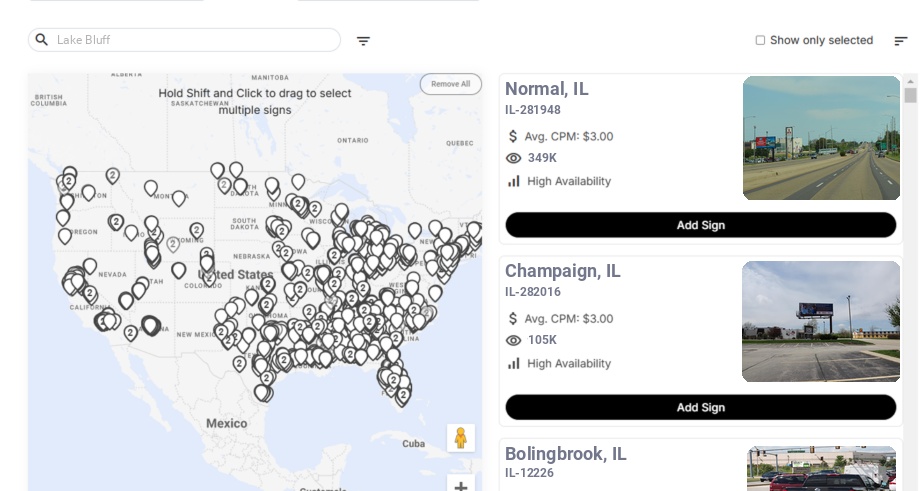
Blip has digital billboards in Lake Bluff. You can browse available locations on a map, choose the ones that fit your audience, and start advertising right away.
Still have questions? Launch a campaign in minutes — no contracts, no commitments.
Start Your CampaignLake Bluff Billboard Advertising Guide
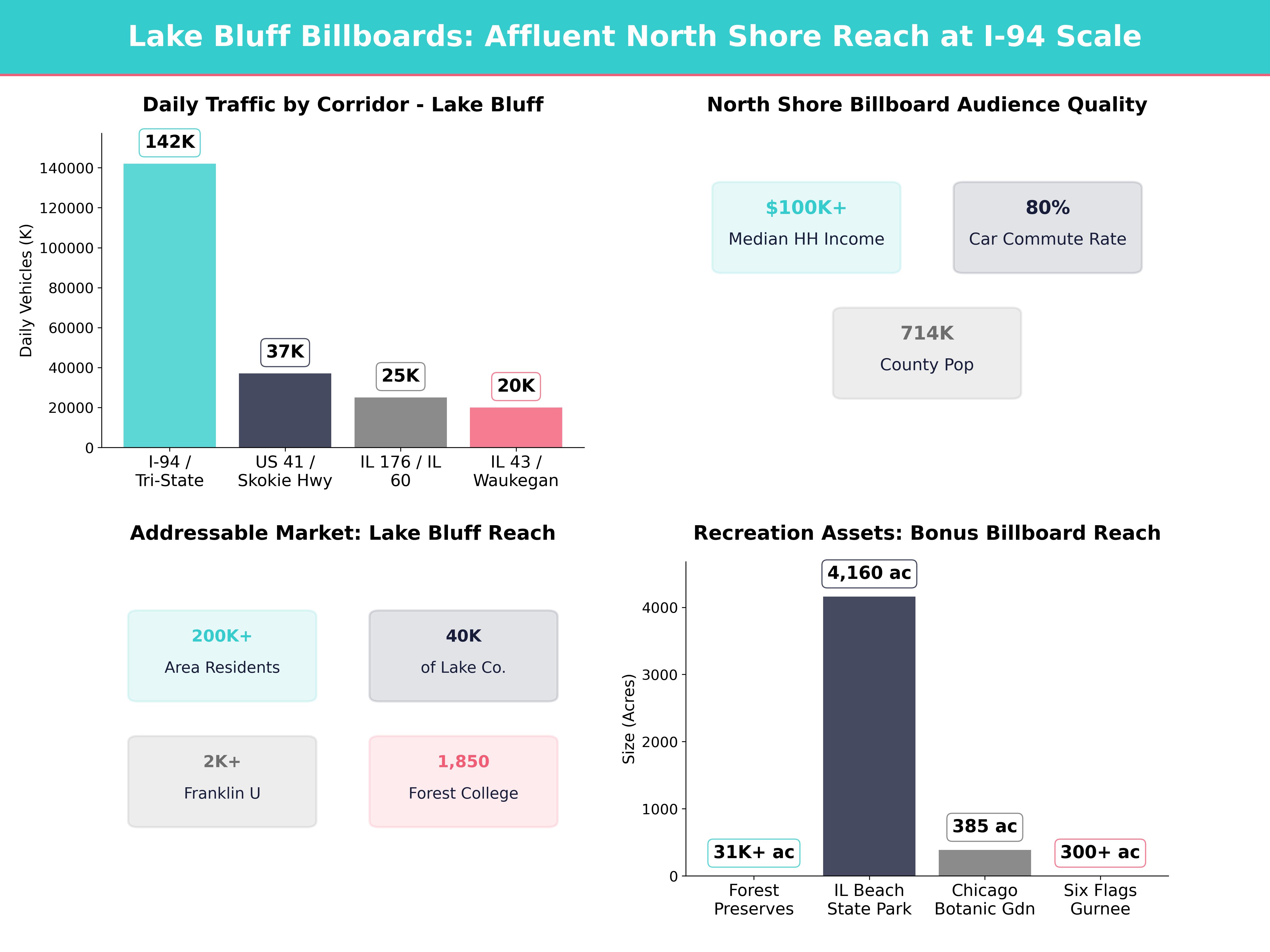
Lake Bluff is a small North Shore Lake County I-94 segments that carry roughly 132,000 to 153,000 vehicles per day. The county had 714,342 residents in 2020, and Lake Bluff benefits from being positioned between Lake Forest and North Chicago, with easy access to US 41 and nearby I-94. We also benefit from a market where daily life is strongly car-oriented, with roughly 4 in 5 workers commuting by car, which gives digital billboards the repeated visibility that suburban brands need. For advertisers that want affluent households, active commuters, local families, students, and seasonal visitors in one plan, Lake Bluff gives us a very efficient place to build reach across a 200,000-plus resident nearby trade area.
Lake Bluff Market Overview
When we plan campaigns in Lake Bluff, we are really planning for a broader southern Lake County Chicago Metropolitan Agency for Planning data show that Lake County grew from 703,462 residents in 2010 to 714,342 in 2020, which is an increase of about 1.5% and a gain of roughly 10,880 residents. That is not explosive Sun Belt growth, but it is the kind of steady, durable population base that supports consistent local advertising.
Lake Bluff is about 35 miles north of downtown Chicago, and it sits near a cluster of communities that give billboard advertisers far more scale than the village alone suggests. Within a short drive, Lake Forest, North Chicago, Libertyville, Vernon Hills Waukegan, and Gurnee add well over 200,000 additional residents to our practical reach.
The market also stands out economically. Regional data from CMAP and economic development resources from Lake County Partners place Lake County’s median household income above $100,000, which matters because affluent suburban audiences often respond well to brand-building media. That makes Lake Bluff especially useful for healthcare systems, financial services, home services, private education, automotive dealers, and premium retail brands that can justify higher customer acquisition costs.
Commuting patterns strengthen the case. In Lake County, roughly 4 in 5 workers still commute by car when we combine solo driving and carpooling, according to regional planning data from CMAP. That means our ads can benefit from repetition, habit, and route memory in a way that many online formats cannot match. We should think of Lake Bluff as a high-quality suburban attention market, not just a small village buy.
Key Traffic Corridors for Lake Bluff Billboards
Lake Bluff’s value comes from the way local and regional routes overlap. We can choose broad-reach placements that catch countywide movement, or we can choose tighter local corridors that reinforce brand familiarity among nearby households.
I-94 / Tri-State Tollway near Lake Bluff
The biggest regional corridor is I-94 on the Tri-State Tollway. The Illinois Tollway has reported that the I-94 corridor between O’Hare and the Wisconsin state line carries roughly 132,000 to 153,000 vehicles per day on major segments. For Lake Bluff advertisers, that matters because nearby interchanges feed traffic toward Lake Forest, Libertyville, Vernon Hills, Gurnee, and the rest of southern Lake County.
This corridor is especially useful when we want scale.
- Healthcare advertisers can use it to reach households moving between communities and medical campuses.
- Retail and entertainment brands can use it to capture shoppers headed toward regional destinations.
- Legal, insurance, and education advertisers can use it because the tollway delivers repeat exposure to adults with long suburban commutes.
US 41 / Skokie Highway in the Lake Bluff area
US 41 is the most important non-toll north-south route for Lake Bluff itself. Recent Illinois Department of Transportation traffic maps commonly place south Lake County segments of US 41 in the 30,000 to 45,000 vehicles per day range, depending on the exact segment. That makes it a strong corridor for advertisers that want frequency without relying entirely on the tollway.
US 41 works especially well for:
- Home services, because it reaches stable residential neighborhoods repeatedly.
- Automotive dealers and repair shops, because drivers are already in a transportation mindset.
- Hospitals, urgent care, and specialty clinics, because it connects residential areas with employment and healthcare nodes.
Waukegan Road, Rockland Road, and Townline Road around Lake Bluff
Local arterials matter in Lake Bluff because they are where intent starts to sharpen. IL 43 / Waukegan Road commonly runs in the 15,000 to 25,000 vehicles per day band on nearby suburban segments, while IL 176 / Rockland Road and IL 60 / Townline Road can move past 20,000 and, near larger junctions, can top 30,000 vehicles per day. Exact counts vary by segment, but these are meaningful suburban volumes.
We should use these roads when we want to drive action from nearby households instead of broad countywide awareness.
- Restaurants and local retail benefit because these roads capture errands and routine trips.
- Real estate, dentistry, and family services benefit because these roads reach people close to home.
- Community events and local nonprofits benefit because the audience is geographically relevant.
Metra station access routes in Lake Bluff
Lake Bluff is also served by the Metra Union Pacific North Line 70 minutes, which tells us the market includes both local residents and city-bound professionals. Even when rail riders are part of the audience, they usually begin and end their trips by car, whether at station parking, drop-off points, or nearby feeder roads.
That makes station-adjacent approaches useful for:
- Professional services, because they reinforce messages with commuters who have high lifetime value.
- Colleges and continuing education brands, because train-oriented audiences often include students and faculty.
- Restaurants, fitness, and healthcare providers, because station routes catch morning and evening routine traffic.
Audience Segments We Can Reach Around Lake Bluff
Lake Bluff works best when we match billboard locations to the audience that actually uses each corridor. In this market, the audience is more varied than the village’s size might suggest.
Lake Bluff commuters and North Shore professionals
Commuters are the foundation. With roughly 80% of Lake County workers traveling by car, and with the Tri-State Tollway carrying 132,000 to 153,000 vehicles daily on major segments, repeated weekday exposure is one of the market’s biggest strengths. These are ideal conditions for service businesses, healthcare brands, recruiters, and regional consumer brands that need familiarity before conversion.
We should especially prioritize commuter windows such as 6:00 to 9:00 a.m. and 3:00 to 7:00 p.m. when our goal is brand recall.
Families and homeowners around Lake Bluff
The residential audience is another major asset. Lake Bluff sits near a dense suburban belt of families in Lake Forest, Libertyville, Vernon Hills Deerfield North Chicago, and Waukegan. That gives us access to a local household base of well over 200,000 nearby residents, with many communities known for strong schools, stable housing, and high-value service demand.
This audience is a good match for:
- Roofing, remodeling, landscaping, and HVAC brands.
- Pediatric, dental, and family healthcare brands.
- Banks, insurance agencies, and wealth advisors that want steady local visibility.
Students, faculty, and healthcare workers near Lake Bluff
Lake Bluff also sits in an education and healthcare corridor. Lake Forest College enrolls about 1,850 students, Rosalind Franklin University serves more than 2,000 students, and College of Lake County serves roughly 40,000 students annually across credit and noncredit programs. Nearby healthcare anchors add another layer of daily movement, including Northwestern Medicine Lake Forest Hospital, which is a 201-bed hospital.
That mix gives us strong reasons to advertise:
- Degree and certificate programs.
- Scrubs, housing, and moving services.
- Healthcare recruitment, urgent care, and specialty clinics.
Visitors and leisure travelers in the Lake Bluff region
Leisure traffic expands the market well beyond residents. Lake County Forest Preserves 31,000 acres, Chicago Botanic Garden spans 385 acres, Ravinia Festival presents 100-plus events in a typical summer season, and Six Flags Great America covers more than 300 acres in nearby Gurnee. To the north, Illinois Beach State Park 4,160 acres of shoreline and habitat.
For advertisers, that means weekend and seasonal audiences are very real here. Hospitality, restaurants, tourism partners, retail centers, and event marketers can all benefit from campaigns timed to leisure travel.
Seasonal and Timing Opportunities in Lake Bluff
Lake Bluff is not a flat, same-every-month billboard market. Our timing should follow school calendars, summer recreation, shopping cycles, and the realities of Midwest weather.
Spring and early summer in Lake Bluff
From April through June, we usually see strong conditions for home services, landscaping, exterior improvement, healthcare checkups, summer camps, and private school marketing. Families start planning summer activities before school ends, and the area’s affluent homeowner base is often responsive to service offers before the busiest contractor months fill up.
This is also a good window for branding campaigns that want to mature before peak summer traffic arrives.
Peak summer visitor season around Lake Bluff
The biggest seasonal opportunity runs from Memorial Day through Labor Day. Lakefront recreation, local beaches through the Lake Bluff Park District, forest preserve use, Ravinia nights, and Gurnee entertainment all increase movement. Ravinia Festival alone brings 100-plus performances, while Six Flags Great America gives us a more than 300-acre destination that draws family traffic from across the region. The Lake County Fair adds a concentrated 5-day burst of traffic in late July.
In summer, we should consider:
- Thursday through Sunday emphasis for leisure-oriented brands.
- Afternoon and early evening timing for entertainment, dining, and event messaging.
- Tourism and retail creative that speaks to families, day-trippers, and local staycation traffic.
Back-to-school and fall in Lake Bluff
Late August through October brings another useful shift. School resumes, commuters settle back into routine, and institutions such as Lake Forest College and College of Lake County restart campus activity. This is a strong season for tutoring, healthcare, flu-season messaging, fitness, local dining, and home services that want to close business before winter.
Fall creative can also feel especially local here. Messages tied to North Shore routine, school-year structure, and community trust often perform better than overly broad regional slogans.
Holiday and winter opportunities near Lake Bluff
Winter rewards advertisers who respect visibility conditions. In December, sunset arrives before 4:30 p.m., which makes the evening commute feel like nighttime for much of the season. Nearby holiday shopping at Hawthorn, a retail center with about 1.3 million square feet of space, creates strong seasonal consumer traffic in the broader trade area.
This is an excellent time for:
- Retail, gift, and dining campaigns.
- Healthcare, urgent care, and wellness reminders.
- High-contrast creative that stays readable in dark, snowy, or wet conditions.
Lake Bluff Billboard Design Tips
Good creative in Lake Bluff should feel like it belongs in the North Shore. We usually get better results when our design feels polished, confident, and locally aware.
Match the Lake Bluff and North Shore aesthetic
Lake Bluff is not a market where loud discount-style design always wins. We should lean into clean layouts, restrained color palettes, strong typography, and concise claims. Navy, forest green, white, charcoal, and lake-inspired blues often feel more native to the area than neon-heavy palettes, unless we are promoting entertainment or youth-focused events.
Phrases such as “North Shore,” “Lake County,” “Lake Forest,” and “Gurnee” can help anchor the message geographically when those references are relevant.
Build for fast reads on Lake Bluff corridors
On I-94 and US 41, we should assume quick glances, not long reading sessions. That means one headline, one offer or value proposition, and one clear action are usually enough. Short URLs are better than phone numbers, and location-driven copy often works better than abstract branding alone.
A message like “North Shore Orthopedic Care” or “Lake County Roof Repair” usually fits the way people process information on suburban commuter routes.
Use imagery that feels local to Lake Bluff
Local cues matter here. Tree-lined neighborhoods, lakefront visuals, polished home exteriors, sports and school imagery, and professional healthcare photography all tend to fit the market. If we are targeting families, we should show family life that feels authentic to the North Shore. If we are targeting commuters, we should keep the image simple enough that the message stays dominant.
Design for weather, season, and light
Winter and shoulder-season visibility matter in northern Illinois. Because darkness arrives before 4:30 p.m. in midwinter, we should favor high contrast, bold type, and uncluttered layouts. In summer, we can shift toward brighter event-driven creative and leisure-oriented imagery. Rotating creative by season is especially smart in Lake Bluff because the audience mix changes so noticeably from January to July.
Regional Strategies Around Lake Bluff
A strong Lake Bluff campaign usually works best when we divide the market into practical sub-areas instead of treating the whole region as one audience.
Downtown Lake Bluff and the east side
Near downtown Lake Bluff and the Metra
South from Lake Bluff toward Lake Forest and Deerfield
Heading south, the audience becomes even more weighted toward affluent households, professional commuters, and healthcare consumers. Lake Forest and Deerfield
West from Lake Bluff toward Libertyville and Vernon Hills
A roughly 20-minute drive west opens up one of the region’s strongest retail and family-shopping zones. Libertyville gives us a vibrant local downtown audience, while Vernon Hills Hawthorn and its 1.3 million square feet of retail space. Campaigns for dining, entertainment, healthcare, automotive, and family services often perform well when we connect Lake Bluff awareness with westward retail intent.
North from Lake Bluff toward North Chicago, Waukegan, and Gurnee
To the north, the market becomes more mixed and more scale-oriented. North Chicago, Waukegan, and Gurnee bring workforce audiences, students, healthcare staff, and destination travelers into the picture. This is where recruiting, education, budget-conscious healthcare, and entertainment offers can broaden efficiently. It is also where Six Flags Great America and countywide events can create weekend spikes that look very different from weekday commuter behavior.
Using Blip Tools in Lake Bluff
Blip works especially well in a market like Lake Bluff because the audience shifts by corridor, by season, and by time of day. We can use that flexibility to avoid wasting impressions.
Let our Lake Bluff campaign structure follow the map
When we want precision, we can build a manual campaign around specific Lake Bluff-area boards on I-94, US 41, or feeder roads like Waukegan Road and Townline Road. When we want efficient countywide awareness, we can use a Blip-optimized approach and let the platform spread delivery across the best-fitting inventory in southern Lake County.
Use timing controls for Lake Bluff routines
Lake Bluff has clear timing patterns, so dayparting matters. We should usually test weekday commute windows such as 6:00 to 9:00 a.m. and 3:00 to 7:00 p.m. for service, healthcare, and recruiting campaigns. We should also test Friday through Sunday timing for tourism, dining, entertainment, and event-driven messaging.
Rotate creative by audience and season
Because Lake Bluff touches commuters, families, students, and leisure travelers, one creative version rarely covers every use case. We should consider at least 2 creative variants when the campaign goal allows it, such as one message for weekday professionals and one for weekend family traffic.
Use analytics to rebalance quickly
Real-time reporting is especially useful here because the difference between a tollway board and a neighborhood arterial board can be substantial. If one corridor is outperforming another, we can shift our spend quickly instead of waiting through a long traditional buying cycle.
Getting Started with Billboard Rental in Lake Bluff
Renting a billboard in Lake Bluff is easiest when we start with geography and intent, not with format alone. Our first question should be whether we want hyperlocal awareness, regional commuter reach, or seasonal visitor traffic.
Start with a clear Lake Bluff goal
We should define whether our target area is a tight 5- to 10-mile radius around Lake Bluff, a broader southern Lake County footprint, or a corridor-based plan tied to I-94 or US 41. That decision shapes everything else, including budget, timing, and creative style.
Choose Lake Bluff locations by audience behavior
A board is a good fit only if its traffic pattern matches our customer journey.
- If we need local households, we should favor roads like Waukegan Road, Rockland Road, and nearby suburban connectors.
- If we need broad commuter scale, we should prioritize I-94 and US 41.
- If we need weekend and leisure traffic, we should include boards that connect Lake Bluff with Gurnee, Vernon Hills, and seasonal destinations.
Launch small in Lake Bluff, then expand
We do not need to overbuild on day one. A 2- to 4-week test on 1 or 2 key corridors is often enough to show us whether our message resonates. After that, we can expand into adjacent submarkets such as Lake Forest, Vernon Hills, or Gurnee based on actual results.
Expect a simpler process than traditional billboard buying
Traditional billboard buying in suburban Chicago often means long sales cycles, fixed packages, and less flexibility once the campaign starts. With Blip, we can evaluate boards on a map, upload or refine creative, adjust timing, and adapt quickly as we learn. In a layered market like Lake Bluff, that flexibility is not just convenient. It is a real strategic advantage.