Billboards in Forest Park, IL
No Minimum Spend. No Long-Term Contracts. Just Results.
Trusted by Leading Brands


Billboard advertising
in Forest Park has never been easier



How much is a billboard in Forest Park?
Why Choose Blip for Billboard Advertising in Forest Park
Launch with Blip in Forest Park in minutes, then reach I-290 commuters and Harlem Avenue drivers without traditional buying hassle.
Set any budget for Forest Park billboards and lean into Madison Street shoppers, diners, and nearby North Riverside traffic.
Use dayparting in Forest Park to hit rush-hour Blue Line commuters, then switch to evenings for restaurant and event crowds.
No contracts on Blip means Forest Park campaigns can flex with St. Patrick’s Day parade surges, holiday shopping, or slower weeks.
Track Forest Park performance in real time and shift spend toward I-290, Roosevelt Road, or Cermak Road ads that drive the best response.
Use Blip’s creative tools to test bold Forest Park messages for commuters, retail visitors, and nearby industrial workers in Melrose Park.
Frequently Asked Questions About Billboard Advertising in Forest Park
How much does a billboard cost near Forest Park, Illinois with Blip?
With Blip, advertising on Forest Park billboards is flexible and budget-friendly because you only pay per “blip,” a 7.5–10 second ad display on a rotating digital billboard serving the Forest Park area. You choose your own daily budget, and Blip automatically keeps your campaign within that amount, while still giving you the freedom to adjust your budget anytime. Costs for billboards near Forest Park, Illinois vary based on when and where your ad runs and overall advertiser demand, so you’re always paying a fair market rate for the exposure you receive.
Where can I advertise with Blip in the Forest Park, Illinois area?
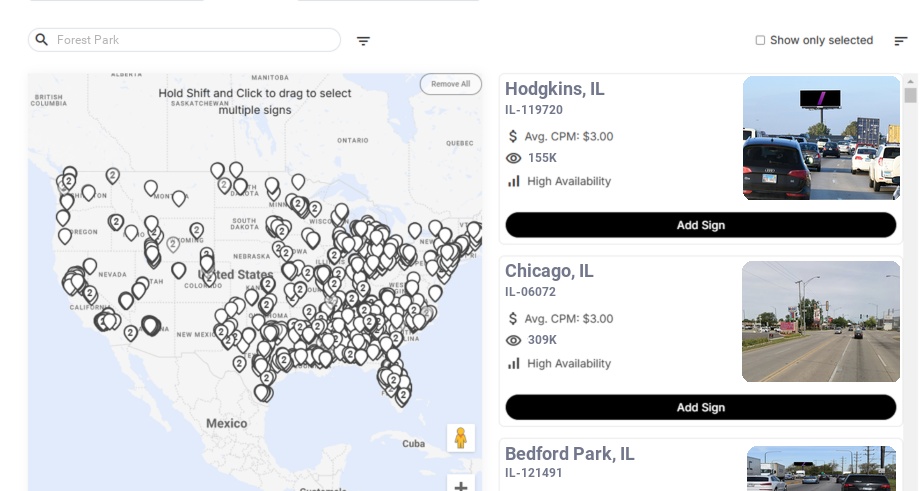
Our 92 digital billboards serving the Forest Park area are spread across a ring of nearby cities within about 10 miles, including North Riverside, Melrose Park, Stone Park, Summit, Chicago, Harwood Heights, Schiller Park, Hodgkins, Justice, Rosemont, and Des Plaines. By choosing boards strategically across these communities, we can surround Forest Park–area residents and commuters on both their local and regional trips. This gives you robust options for billboard rental near Forest Park that can scale with your goals.
Who can Forest Park, Illinois billboards reach for my Blip campaign?
The Forest Park area is ideal for campaigns targeting commuters, diners, retail shoppers, and families who routinely travel through nearby communities where our 92 digital billboards are located. The area is anchored by the I‑290 (Eisenhower Expressway) terminus, and key segments in this corridor carry roughly 140,000–160,000 vehicles per day. Nearby retail and dining corridors, plus the CTA and Metra, create repeated weekday exposure for your message.
When should I run billboard ads in Forest Park, Illinois with Blip?
For the Forest Park area, weekday rush hours from 6–10 AM and 3–7 PM are strong for commuters on I‑290, Harlem Avenue, Roosevelt Road, and Cermak Road. Midday and early afternoon can be cost-efficient for shoppers, retirees, service workers, and students, while evenings and weekends are best for families, social groups, and entertainment seekers. With Blip, you can adjust your schedule to buy more impressions during your best-performing time blocks and scale down during off times.
What makes Forest Park, Illinois a strong market for billboard advertising?
Forest Park is a compact, transit-rich near-west suburb of Chicago with a population of around 14,000 residents and a median age in the upper 30s. The broader near-west Cook County ring around Forest Park adds well over 150,000 additional residents within a roughly 10-minute drive, creating a dense, repeat-exposure audience for outdoor advertisers. Strong commuter traffic, retail and dining magnets, and the regional draw of Chicago and Rosemont all contribute to consistent billboard demand.
Do I need a contract to advertise with Blip in Forest Park?
No, Blip has no long-term contracts or minimum commitments. You can start, pause, or stop your campaign at any time.
How fast can I launch a billboard campaign with Blip in Forest Park?
You can have your campaign live in minutes. Create a free account, select your locations, set your budget, upload your design, and start running once approved.
Where can I advertise with Blip in Forest Park?
Blip has digital billboards in Forest Park. You can browse available locations on a map, choose the ones that fit your audience, and start advertising right away.
Still have questions? Launch a campaign in minutes — no contracts, no commitments.
Start Your CampaignForest Park Billboard Advertising Guide
With its dense mix of commuters, shoppers, and diners along the I‑290 corridor, the Forest Park area offers outsized impact for digital billboard advertisers. With 92 digital billboards serving the Forest Park area from neighboring communities like North Riverside, Melrose Park, Stone Park, and Chicago, we can help you tap into the daily movement of tens of thousands of residents, workers, and visitors who pass near Forest Park every day. If you’re looking for billboards near Forest Park that can efficiently reach both local and regional audiences, this network provides broad, flexible coverage.
Understanding the Forest Park Area Market
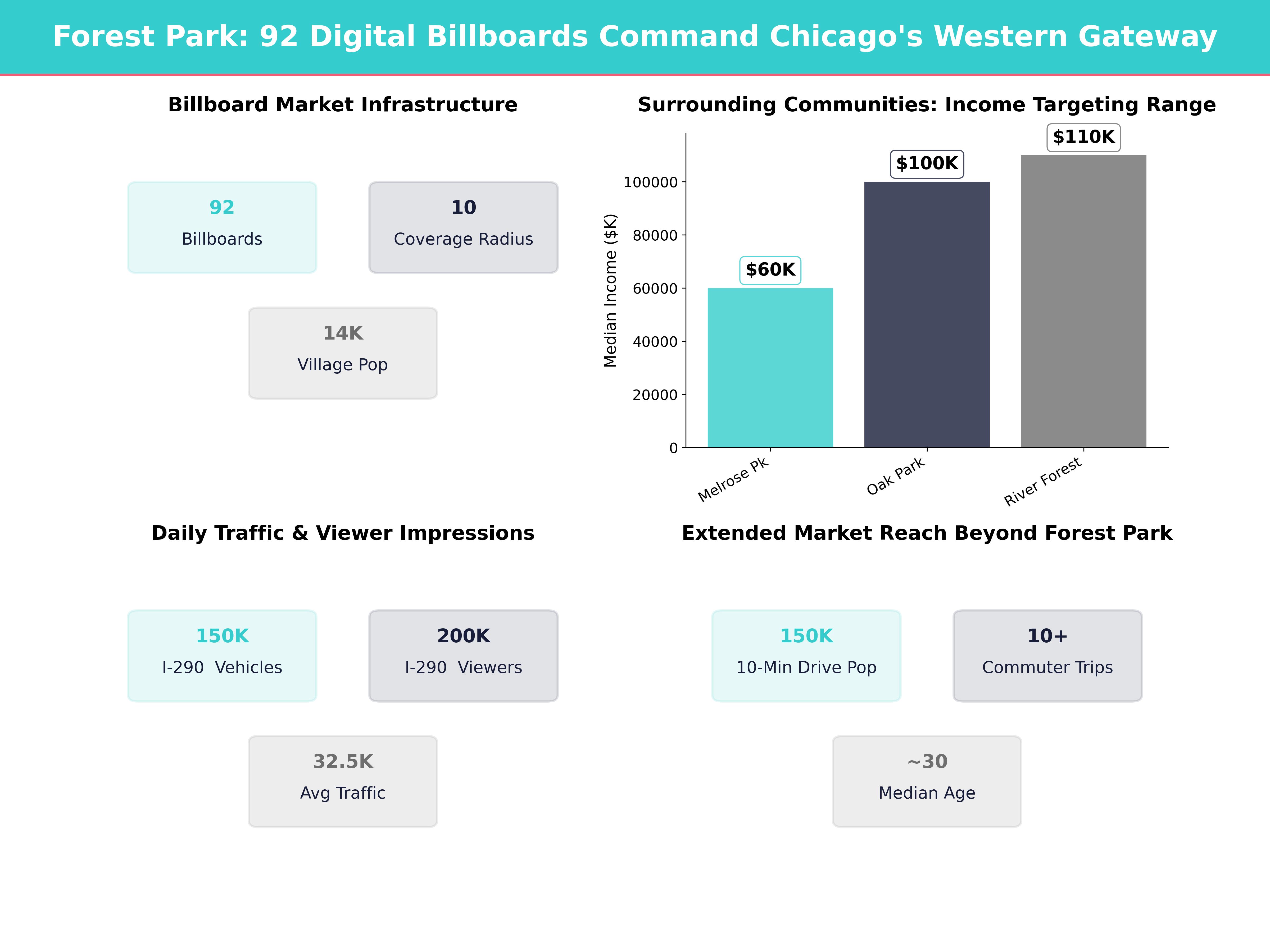
Forest Park is a compact, transit‑rich near‑west suburb of Chicago. Recent estimates place the village’s population at around 14,000 residents with a median age in the upper 30s, skewing slightly younger than many outer suburbs. The broader near‑west Cook County ring around Forest Park (including Oak Park, River Forest, North Riverside, Melrose Park, and others) adds well over 150,000 additional residents within a roughly 10‑minute drive, creating a dense, repeat‑exposure audience for outdoor advertisers and a strong base for Forest Park billboards.
Neighboring communities such as Oak Park and River Forest, highlighted by the Village of Oak Park and the Village of River Forest, contribute a strong daytime and evening population due to their schools, medical centers, and commercial districts. Combined, these near‑west suburbs support tens of thousands of jobs, keeping traffic volumes high throughout the week and supporting consistent billboard advertising near Forest Park.
Key local characteristics that matter for billboard advertisers:
-
Strong commuter base:
- The Forest Park area is anchored by the I‑290 (Eisenhower Expressway) terminus, a major route connecting downtown Chicago to the western suburbs. Illinois Department of Transportation counts show segments of I‑290 in this corridor carrying roughly 140,000–160,000 vehicles per day, creating millions of monthly impressions for well‑placed billboard campaigns.
- Major arterials such as Harlem Avenue, Roosevelt Road, Cermak Road, and North Avenue each handle on the order of 25,000–40,000 vehicles per day on key stretches, according to regional traffic count data published by agencies like Cook County.
- The CTA and nearby Metra lines funnel daily commuters from the area into downtown Chicago and back, increasing traffic on arterial streets such as Harlem Avenue and Des Plaines Avenue. In recent years, Forest Park’s Blue Line station has seen thousands of weekday entries as part of the CTA’s system‑wide ridership, which exceeded 240 million rides annually in the early 2020s.
- Balanced income mix: The near‑west suburbs around Forest Park include both solidly middle‑income neighborhoods and pockets of higher‑income households. Median household incomes in nearby communities range from the low‑$60,000s in working‑class suburbs like Melrose Park to $100,000+ in Oak Park and well over $110,000 in River Forest. This blend supports campaigns ranging from value‑focused retail to premium healthcare, financial services, and professional offerings.
-
Retail and dining magnets:
- Forest Park’s Madison Street commercial district, promoted by the Village of Forest Park, features dozens of bars, restaurants, and boutiques. Local business groups report that Madison Street attracts thousands of visitors on busy weekends and regularly serves diners from Oak Park, River Forest, Berwyn, and Chicago’s West Side.
- The North Riverside Park Mall in nearby North Riverside, highlighted by the Village of North Riverside, anchors a major retail cluster. Commercial real estate reports have estimated 7–9 million annual shopper visits to the mall and its surrounding big‑box centers, feeding consistent traffic to boards along Cermak Road and Harlem Avenue.
- Additional shopping corridors in Melrose Park, Stone Park, Harwood Heights, and Schiller Park—supported by local governments such as the Village of Melrose Park, Village of Stone Park, Village of Harwood Heights Village of Schiller Park—add layers of grocery, home improvement, and specialty retail destinations within a short drive of Forest Park.
- Regional draw of Chicago and Rosemont: With billboards near Chicago and Rosemont, we can reach Forest Park–area residents as they travel to events, work, and entertainment in the city and around O’Hare International Airport. According to the Chicago Department of Aviation 70–80 million passengers per year, while the Rosemont entertainment district—promoted by the Village of Rosemont—draws millions of annual visitors to its arenas, convention center, and outlets.
Combining these pieces, the Forest Park area is ideal for campaigns targeting commuters, diners, retail shoppers, and families who routinely travel through nearby communities where our 92 digital billboards are located, giving you robust options for billboard rental near Forest Park that can scale with your goals.
Where Our Billboards Reach Around Forest Park
Our 92 digital billboards serving the Forest Park area are spread across a ring of nearby cities within about 10 miles, including:
- North Riverside (1.5 miles) – High visibility for shoppers headed to North Riverside Park Mall and Cermak Road big‑box retail. With thousands of daily vehicles on Harlem Avenue and Cermak Road, boards here can generate hundreds of thousands of weekly impressions and are a strong complement to billboards near Forest Park itself.
- Melrose Park & Stone Park (4.3 miles) – Industrial and commercial corridors with a high volume of workers and truck traffic, plus retail along North Avenue and Lake Street. Local reports from the Village of Melrose Park note extensive manufacturing and distribution uses, which support large daytime worker populations and heavy commercial traffic.
- Summit & Bedford Park (5.6–7.1 miles) – Strong exposure to industrial parks, logistic hubs, and drivers connecting to I‑55 and I‑294. The industrial and logistics cluster near these suburbs, including the Village of Summit and the Village of Bedford Park, encompasses dozens of warehouses and distribution centers, making it ideal for B2B and hiring messages.
- Harwood Heights & Schiller Park (6.4–6.5 miles) – Access to Harlem‑Irving Plaza, dense residential neighborhoods, and routes toward O’Hare Airport. Retail destinations like Harlem‑Irving Plaza alone draw millions of shopper visits yearly, amplifying exposure for boards along Harlem Avenue and adjacent arterials.
- Chicago (about 7.1 miles from Forest Park’s center) – Key boards on major city arterials and expressways capturing Forest Park–area commuters on their way to and from work or entertainment downtown. Segments of Chicago expressways near this corridor routinely exceed 150,000 vehicles per day, delivering high‑frequency impressions to repeat travelers.
- Hodgkins & Justice (7.9–8.8 miles) – Close to large distribution centers and retail clusters near I‑294 and I‑55. These interchanges, serving communities like the Village of Hodgkins and the Village of Justice, carry tens of thousands of vehicles daily, including a high share of commercial trucks.
- Rosemont & Des Plaines (8.5–9.5 miles) – Boards near the Allstate Arena dozens of major events each year, often drawing 10,000–18,000 attendees per event, while the Rosemont convention center and outlets bring in steady visitor traffic year‑round. Nearby Des Plaines
By choosing boards strategically across these communities, we can surround Forest Park–area residents and commuters on both their local and regional trips, extending your reach to hundreds of thousands of unique drivers and passengers each week with Forest Park billboards and nearby inventory.
Who You Can Reach Near Forest Park
To build a smart campaign, it helps to define the audiences you can reach via billboards serving the Forest Park area:
-
Daily Commuters (Work & School)
- The I‑290 corridor carries a massive commuter load between the western suburbs and downtown Chicago, with 140,000–160,000 vehicles per day on key segments. Many Forest Park–area residents commute east, while workers from Chicago and further west travel through or near the area to jobs in healthcare, education, retail, and logistics. With typical vehicle occupancy around 1.5 people per car, that translates into over 200,000 potential daily viewers on the expressway segment alone.
- Nearby employers include hospitals and medical centers in Oak Park and Maywood, logistic hubs in Bedford Park and Summit, and office clusters in Rosemont and Chicago’s West Loop. Collectively, these employment centers support tens of thousands of jobs, creating repeated weekday exposure for your message as workers make 10+ trips per week past key billboard locations.
-
Shoppers and Diners
- Retail trips are highly concentrated along corridors like Madison Street (Forest Park), Harlem Avenue, Roosevelt Road, Cermak Road, and North Avenue, which together carry well over 100,000 vehicles per day across their major segments in the near‑west area.
- North Riverside Park Mall alone draws shoppers from a several‑mile radius, with millions of annual visits. Regional shopping destinations like Harlem‑Irving Plaza (near Harwood Heights) and outlets and entertainment in Rosemont add another layer of high‑intent consumers moving through these road networks. For many stores and restaurants along these corridors, 50–70% of sales are driven by visitors from outside the immediate municipality, making regional billboard coverage and billboard advertising near Forest Park especially valuable.
-
Event-goers & Tourists
- Forest Park’s own events—such as local festivals and the well-known St. Patrick’s Day parade—attract visitors from around the near‑west Chicago suburbs. Parade days can bring thousands of spectators into the village, significantly boosting both auto and foot traffic on Madison Street and adjoining routes.
- Proximity to Chicago and Rosemont means Forest Park–area residents frequently attend concerts, sports, and conventions. Data from tourism agencies like Choose Chicago show that Chicago welcomes 50+ million visitors annually in recent years. Many of these visitors arrive via O’Hare, I‑290, I‑90, or I‑55, traveling through near‑west corridors served by our billboards and generating high‑value impressions for entertainment, hospitality, and attraction advertisers.
-
Local Families & Long-term Residents
- Forest Park and nearby suburbs have stable housing stock with a large proportion of long-term residents and families. In many near‑west communities, over half of households have lived in the area for 5+ years, and a significant share of homes are owner‑occupied.
- This is ideal for campaigns in education, healthcare, financial services, and home services, where repeated brand impressions build trust over time. A family that drives the same route to school, work, and shopping can see your message dozens of times per month, reinforcing recall and word‑of‑mouth referrals.
Best Campaign Objectives for the Forest Park Area
Based on local patterns, billboard campaigns serving the Forest Park area can be especially effective for:
- Retail & E‑commerce – Driving traffic to local stores in Forest Park, North Riverside, Melrose Park, Oak Park, or Chicago’s West Side, or using geographic messaging (“Free delivery to Forest Park area”) for online brands. Near‑west retail corridors regularly capture tens of thousands of vehicle trips per day, giving you a large funnel to convert into foot traffic and online orders.
- Dining & Nightlife – Promoting Forest Park’s Madison Street bars and restaurants, Chicago and Oak Park eateries, or entertainment in Rosemont and downtown Chicago. Busy weekend evenings can see local restaurant districts approach near‑full capacity, so even a small lift of 5–10 additional parties per night can materially impact revenue.
- Local Services – Medical practices, dental offices, attorneys, real estate agents, home services, and auto repair shops that draw from the near‑west Cook County population. With 150,000+ residents in the near‑west ring and thousands of local businesses, there is strong demand for repeat‑use services.
- Education & Training – Community colleges, trade schools, and training centers catering to nearby residents and commuters. Commuters who pass the same board twice daily are especially receptive to education, certification, and career‑advancement messaging.
- Events & Venues – Concerts, fairs, seasonal attractions, and local festivals that benefit from short, focused bursts of awareness. Digital billboards allow you to concentrate impressions in the 2–4 weeks leading up to an event, when awareness lifts are most closely tied to ticket sales.
With Blip’s flexibility, you can start with a small budget to test messages and board locations, then scale what works as you see measurable changes in store visits, calls, and web traffic from your Forest Park billboards and nearby placements.
Timing Your Blips: When to Show Your Ads
One of the biggest advantages of digital billboards is precise control over when your ads appear. For the Forest Park area, consider these time-based strategies:
Weekday Rush Hours (6–10 AM, 3–7 PM)
- Who you reach: Commuters on I‑290, Harlem Avenue, Roosevelt Road, and Cermak Road; workers heading to industrial areas in Bedford Park, Summit, and Melrose Park; commuters parking at the CTA Forest Park Blue Line station. During peak hours, traffic speeds often slow, increasing dwell time and allowing more seconds of exposure per impression.
-
Best for:
- Service businesses (auto repair, healthcare, financial services) looking for top-of-mind awareness.
- Retailers, fuel stations, and quick-service restaurants promoting quick stops before or after work.
-
Creative tips:
- Use fast, directive language: “Tune-up this weekend,” “Stop at Madison Street tonight,” “Beat traffic—shop online now.”
- Include morning/evening cues: coffee, sunrise/sunset imagery, or “On your way home?” messaging.
Midday and Early Afternoon (10 AM–3 PM)
- Who you reach: Shoppers, retirees, stay‑at‑home parents, service workers, and students. In many retail corridors, midday volumes can reach 40–60% of peak‑hour traffic, offering cost‑efficient impressions with less congestion.
-
Best for:
- Grocery and big-box retail.
- Restaurants promoting lunch specials in areas like Madison Street, North Riverside, and Chicago’s West Loop.
- Healthcare and personal services such as salons, optometry, and physical therapy.
-
Creative tips:
- Promote specific offers (“$5 Lunch Specials on Madison Street”) or short windows (“Today Only”).
- Use bright, upbeat visuals matching mid‑day energy.
Evenings & Weekends
- Who you reach: Families, social groups, and entertainment seekers heading to Forest Park dining, Chicago nightlife, or events in Rosemont and downtown. Weekends often see higher leisure and shopping trip rates, with many retail centers reporting their strongest foot traffic on Saturdays and Sundays.
-
Best for:
- Entertainment venues, bars, festivals, and seasonal events.
- Restaurants in Forest Park, Oak Park, North Riverside, Chicago, and Rosemont.
- E‑commerce or streaming services that benefit from leisure‑time browsing.
-
Creative tips:
- Lean into fun, aspirational copy: “Tonight on Madison Street,” “Make Saturday Family Day,” “Pre‑game here.”
- Promote time-bound nightlife or event-specific messages (e.g., “This Friday Only”).
With Blip, you can adjust your schedule to buy more impressions during your best-performing time blocks and scale down during off times—maximizing ROI and aligning your spend with actual customer behavior patterns in and around billboards near Forest Park.
Geographic Strategy: Which Boards to Use for Which Goals
Within the 10‑mile radius around Forest Park, different clusters of boards lend themselves to different goals. Consider a layered geographic strategy:
-
Core Forest Park Area Reach
- Prioritize boards in North Riverside, Melrose Park, Stone Park, and Summit—these locations intercept drivers using main local routes that Forest Park residents regularly travel for shopping, work, and errands. Taken together, these corridors see tens of thousands of daily trips, making them ideal for campaigns that depend on frequent local touches.
- This is especially important if your primary customer base lives within a few miles of Forest Park and you want to reach them multiple times per week along their normal routines with highly visible Forest Park billboards.
-
Commuter & City-Focused Reach
- Add boards in Chicago, Harwood Heights, Schiller Park, and Rosemont to reach Forest Park–area residents as they commute toward downtown, the Northwest Side, or O’Hare. These routes are used by thousands of near‑west commuters each weekday, many of whom travel 20+ days per month, creating powerful repetition.
- Ideal for professional services, education, and higher-ticket items where repeated impressions along commute routes are valuable and where buyers may need several weeks of exposure before taking action.
-
Industrial & Worker Reach
- Include boards in Bedford Park, Summit, Hodgkins, Justice, and Des Plaines if you target industrial workers, logistics companies, or B2B buyers. In these corridors, the share of heavy trucks is significantly higher than in purely residential areas, and many facilities run multiple shifts, so traffic is spread across early mornings, evenings, and overnight hours.
- These corridors see heavy truck and commercial traffic, making them excellent for recruiting, staffing firms, trucking, and equipment suppliers that benefit from messaging in front of a large, specialized workforce.
With Blip’s platform, you can select specific billboard locations, then monitor performance over time and shift your budget toward the boards that best match your audience and deliver the strongest response per dollar spent. This makes it simple to fine-tune billboard rental near Forest Park as your needs change.
Crafting Effective Creative for the Forest Park Area
Forest Park and its surrounding communities have a distinctive, community-oriented vibe. Your creative should reflect that local character while staying simple and legible.
Keep It Local and Relatable
-
Reference recognizable local points:
- “Just off Madison Street in the Forest Park area”
- “5 minutes from the Forest Park Blue Line”
- “Near North Riverside Mall”
- Show imagery that feels “near‑west Chicago” rather than generic cityscapes: tree-lined streets, brick storefronts, neighborhood gatherings, or families. Local outlets like Forest Park Review and Wednesday Journal of Oak Park and River Forest are good references for the look and feel of nearby neighborhoods.
Use Simple, High-Contrast Design
Billboards are viewed at high speeds, especially on I‑290 and major arterials:
- Aim for 7 words or fewer in your main headline; studies of outdoor advertising consistently show that shorter copy improves recall, especially for drivers with only 3–6 seconds of viewing time.
- Use large, bold fonts and high contrast (e.g., white or yellow text on dark backgrounds).
- Feature one key visual—a logo, product shot, or strong lifestyle image—rather than cluttered collages. Clear hierarchy boosts comprehension, which is critical when vehicles are moving at 30–60 mph.
Align Messaging With Travel Purpose
- For boards near malls and retail corridors (North Riverside, Harwood Heights): emphasize sales, offers, and store proximity (“2 minutes ahead on Cermak,” “Next right for Madison Street dining”).
- For boards along commuter routes into Chicago: promote brand awareness, credibility, and professional services, not just one-time discounts, to take advantage of the high frequency of repeat commuters.
- For boards near industrial zones (Bedford Park, Summit): emphasize hiring, logistics, and B2B services, with clear calls to action like “Apply Today” or “Same‑Day Freight Quotes.”
Seasonal and Event-Based Opportunities
The Forest Park area has distinct seasonal patterns that can influence your campaign calendar:
-
Winter (January–March)
- Promote tax services, healthcare, home improvement planning, and indoor entertainment. Many households schedule medical visits and financial planning early in the year, driving demand for local professionals.
- Take advantage of Forest Park’s high‑profile St. Patrick’s Day parade by running campaigns that tap into increased traffic and footfall, both before and after parade day. Parade attendance can swell to several thousand visitors, amplifying impressions on nearby routes.
-
Spring & Summer (April–August)
- Focus on outdoor dining, festivals, home improvement, landscaping, and family activities. Warmer months typically bring higher pedestrian and bike traffic as well as more discretionary trips for dining and recreation.
- As Chicago’s tourism season ramps up (tracked by organizations like Choose Chicago), more regional travelers move through nearby expressways and arterials. Chicago’s peak summer months account for a significant share of its 50+ million annual visitors, boosting the value of boards near downtown and O’Hare‑bound routes.
-
Back-to-School (August–September)
- Ideal for after-school programs, tutoring, clothing, technology, and medical checkup promotions. Families in the Forest Park area and nearby districts adjust routines, often adding new school and activity commutes that change which boards they see most frequently.
- Local schools and colleges across the near‑west suburbs serve thousands of students, making this a prime window for education and youth‑oriented campaigns.
-
Holiday Season (November–December)
- Emphasize retail, gifting, events, and dining. Regional data show many retailers generate 20–30% of their annual sales in the holiday period, amplifying the importance of strong awareness.
- Boards near shopping districts and malls (North Riverside, Harwood Heights, Chicago outlets) become particularly valuable as parking lots and roadways fill with holiday shoppers making multiple trips per week.
Use Blip’s scheduling tools to “pulse” your campaign around these windows, ramping up your presence when consumer intent is highest and scaling back when activity slows.
Integrating Billboards With Digital and Local Media
Billboards serving the Forest Park area work best when integrated with other channels:
-
Pair with local news and community outlets
- Outlets like the Forest Park Review (forestparkreview.com) and regional papers such as the Chicago Tribune’s suburban coverage (chicagotribune.com) reach many of the same residents you’ll reach on billboards.
- Additional local voices such as Wednesday Journal of Oak Park and River Forest and municipal updates from the Village of Forest Park help shape community conversation.
- Coordinate messaging across billboards and local digital or print ads for stronger recall; consistent cross‑channel campaigns have been shown to increase ad effectiveness by 20–30% compared with single‑channel efforts.
-
Reinforce with social and search
- Target Forest Park–area and near‑west suburb ZIP codes in your social and search campaigns, mirroring language used on your billboards (“Near Madison Street in the Forest Park area”).
- Use UTM tags and geofencing on your digital campaigns to measure lift during periods when your billboard ads are running. Many advertisers see noticeable increases in brand‑name search volume and direct website visits coinciding with billboard flights.
-
Track store and web performance
- Monitor changes in store traffic, online search volume for your brand, and web visits from near‑west Cook County ZIP codes when your campaign is live. Even a 5–10% lift in key metrics during your billboard flight can signal a strong return on ad spend.
- Short experimental flights (2–4 weeks) on select boards can give you directional data to refine your next wave, helping you identify which corridors and time windows deliver the lowest cost per desired action.
Practical Tips to Launch a Successful Campaign
To get the most from digital billboards serving the Forest Park area, we recommend:
-
Define a Tight Primary Audience
- Example: “Families living within 5 miles of Forest Park who shop at North Riverside Park Mall and dine on Madison Street.”
- Or: “Commuters from the Forest Park area heading downtown via I‑290 and the Blue Line.”
- A clearly defined audience makes it easier to choose from the 92 boards in the region and focus on the 5–10 that matter most to your goals.
-
Set Clear, Measurable Goals
- Increase restaurant covers by 15% on weekends.
- Drive 20% more web traffic from near‑west ZIP codes.
- Generate 50 more leads per month for a local service business.
- Having numeric targets allows you to evaluate whether increased exposure—potentially tens of thousands of impressions per week—is converting into meaningful outcomes.
-
Choose 3–8 Core Boards to Start
- Mix a few boards near Forest Park‑adjacent corridors (North Riverside, Melrose Park, Stone Park) with a few on key commuter or retail routes (Chicago, Harwood Heights, Rosemont).
- Expand to additional boards after you see what performs best, using performance data over 4–8 weeks to guide optimizations.
-
Rotate 2–4 Creative Variations
- Test different headlines (“Family Night on Madison Street” vs. “Happy Hour Near Forest Park Blue Line”).
- Use Blip’s ability to upload multiple creatives and monitor which messages correlate with better results—strong performers may deliver significantly higher response rates even with the same impression counts.
-
Adjust Budget by Time of Day and Day of Week
- Invest more in rush-hour impressions if you’re targeting commuters.
- Shift more budget to evenings and weekends if you’re a restaurant, bar, or entertainment venue.
- Over time, you can reallocate spend toward the top‑performing 20–30% of your time slots, improving efficiency without necessarily increasing total budget.
Tapping Into Local Resources
To deepen your understanding of the Forest Park area and align your campaign with local dynamics, explore:
- The Village of Forest Park – for community news, events, and development updates.
- Forest Park Review – local reporting and insight into neighborhood trends.
- Cook County – information on regional infrastructure, economic development, and public facilities that drive traffic and job growth.
- Choose Chicago – for regional tourism patterns and major events that impact traffic flows into and out of downtown.
- The Village of North Riverside, Village of Oak Park, Village of River Forest, and Village of Rosemont – for local business, zoning, and event information that can shape when and where you advertise.
- Regional transit agencies like the Chicago Transit Authority Metra
By combining these local insights with Blip’s flexible digital billboard platform, we can help you design campaigns that effectively reach residents, commuters, and visitors moving through the Forest Park area—driving awareness, foot traffic, and measurable results for your business with targeted billboard advertising near Forest Park.