Billboards in Villa Park, IL
No Minimum Spend. No Long-Term Contracts. Just Results.
Trusted by Leading Brands


Billboard advertising
in Villa Park has never been easier



How much is a billboard in Villa Park?
Why Choose Blip for Billboard Advertising in Villa Park
Blip lets Villa Park advertisers launch fast on I-290, I-294, and North Ave without old-school buying hassles.
Set a flexible daily budget in Villa Park and reach commuters headed through DuPage County on your terms.
Daypart your Villa Park ads for rush hour, school pickup, or Rosemont event nights to match local traffic spikes.
No contracts with Blip means Villa Park businesses can test campaigns near North Riverside, Melrose Park, and Des Plaines, then scale what works.
Track Villa Park performance in real time and use creative tools to swap commuter, family, or weekend shopper messages fast.
Frequently Asked Questions About Billboard Advertising in Villa Park
How much does a billboard cost near Villa Park, Illinois with Blip?
With Blip, you set your own daily budget for Villa Park billboards, so you’re always in control of how much you spend while reaching drivers and commuters in the Villa Park area. Each “blip” is a short 7.5 to 10-second ad, and you only pay for the individual blips you receive, making digital billboards near Villa Park, Illinois accessible even on a modest budget. Costs vary depending on when and where your ads run and on advertiser demand, but you can start small, test what works, and then scale up at your own pace.
Where can I advertise with Blip near Villa Park, Illinois?
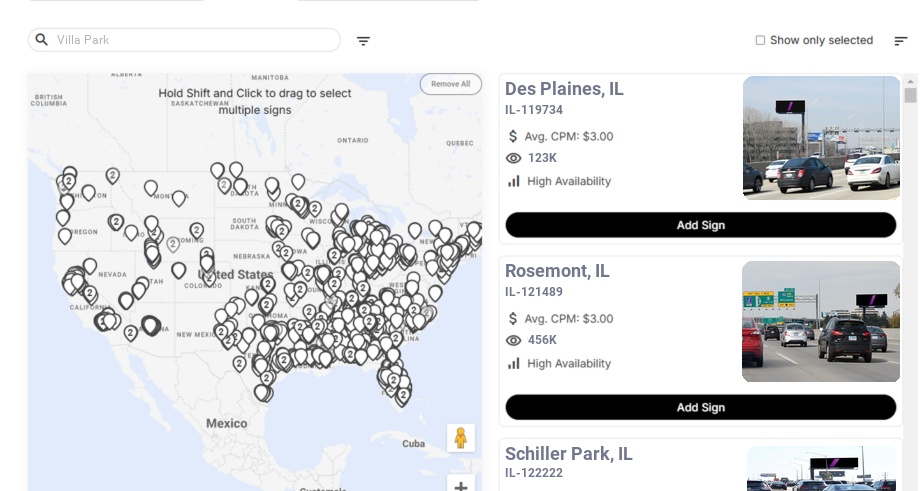
There are 25 digital billboards serving the Villa Park area from nearby communities like Stone Park, Melrose Park, Schiller Park, Rosemont, North Riverside, and Des Plaines. These billboards are positioned along heavily traveled routes and major retail corridors in nearby cities. By combining placements near Villa Park’s commuter routes with boards near major shopping, work, and entertainment destinations, we can build campaigns that follow your audience through a full day.
What kind of people does Blip reach near Villa Park, Illinois?
When we plan a campaign for the Villa Park area, we’re effectively talking to a mix of suburban families, blue- and white-collar commuters, retail and entertainment shoppers, and airport- and hotel-area travelers. Villa Park residents are highly connected to the region, with well over 60% of workers commuting to other municipalities in DuPage or Cook Counties. This makes billboard advertising near Villa Park especially effective for reaching on-the-move consumers.
When is the best time to run Villa Park, Illinois billboards with Blip?
We can dial in timing based on what you sell, with heavy blips 6–9 a.m. and 4–8 p.m. for restaurants and QSR, weekday daytime rotations for professional services, and Friday afternoon through Sunday night for tourism and entertainment. In many Chicago-area corridors, 60–70% of daily traffic occurs during the combined morning and evening peak periods. Because Blip runs on flexible budgets, you can apply surge budgets during particularly important windows and then scale back afterward.
How can Blip help target commuters around Villa Park, Illinois?
The Villa Park area is framed by major arteries like I-290, I-294, North Avenue, and Mannheim Road, which carry heavy daily traffic. Villa Park commuters frequently merge via North Avenue and St. Charles Road, and Pace and Metra also add a steady flow of riders. For billboard strategy, these patterns suggest commute-direction targeting in the morning and evening to intercept both legs of daily travel.
Do I need a contract to advertise with Blip in Villa Park?
No, Blip has no long-term contracts or minimum commitments. You can start, pause, or stop your campaign at any time.
How fast can I launch a billboard campaign with Blip in Villa Park?
You can have your campaign live in minutes. Create a free account, select your locations, set your budget, upload your design, and start running once approved.
Where can I advertise with Blip in Villa Park?
Blip has digital billboards in Villa Park. You can browse available locations on a map, choose the ones that fit your audience, and start advertising right away.
Still have questions? Launch a campaign in minutes — no contracts, no commitments.
Start Your CampaignVilla Park Billboard Advertising Guide
Villa Park sits in the heart of Chicago’s western suburbs and punches far above its weight as a commercial and commuter hub. With 25 digital billboards serving the Villa Park area from nearby communities like Stone Park Melrose Park, Schiller Park, North Riverside, Rosemont, and Des Plaines
Understanding the Villa Park Area Market
Villa Park is a classic “sweet spot” suburb: dense enough to support strong local business, but close enough to Chicago to benefit from regional traffic and make Villa Park billboards a powerful connector between local and city audiences.
Key market facts:
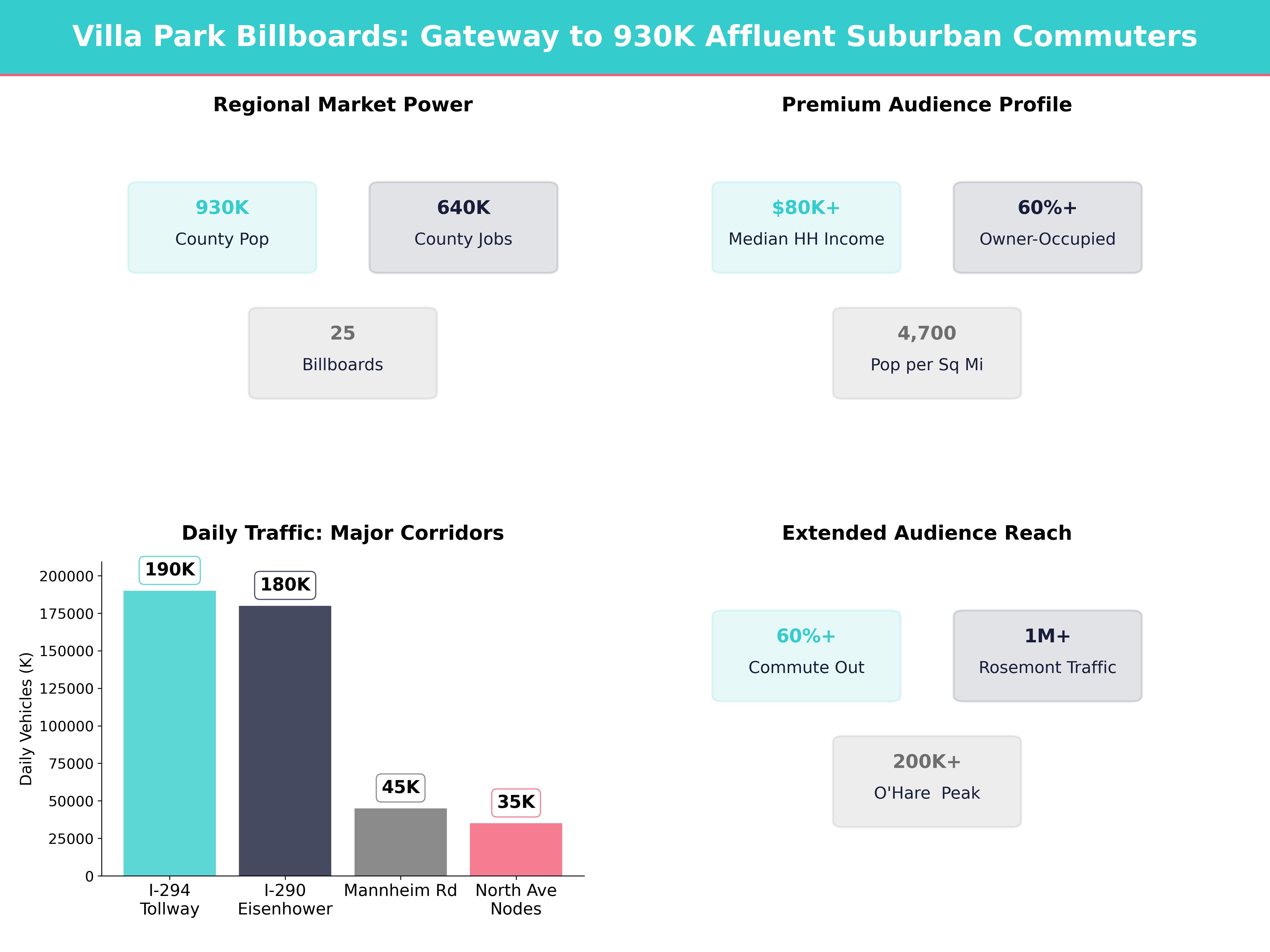
- The Village of Villa Park reports a population of about 22,000 residents (just over 4,700 residents per square mile) with a median household income above $80,000—local estimates place it in the mid‑ to high‑$80,000s—positioning it as a solidly middle‑ to upper‑middle‑income community.
(Source: Village of Villa Park and local planning summaries) - Villa Park is part of DuPage County, which has roughly 930,000 residents and an economy with an estimated 640,000+ jobs across sectors like professional services, logistics, advanced manufacturing, and healthcare. DuPage’s unemployment rate often tracks 1–2 percentage points below the statewide average, indicating a stable labor market and strong consumer spending power.
(Source: Choose DuPage Economic Development Alliance and DuPage County) - Villa Park residents are highly connected to the region: local and regional planning summaries indicate that well over 60% of workers commute to other municipalities in DuPage or Cook Counties, and in some neighboring suburbs more than 70% of employed residents work outside their home community. Many of these commuters use major corridors like I‑290, I‑294, and North Avenue (IL‑64), making billboard advertising near Villa Park especially effective for reaching on‑the‑move consumers.
Our 25 digital billboards serving the Villa Park area are positioned along these heavily traveled routes and major retail corridors in nearby cities, forming a tight network of billboards near Villa Park:
- Stone Park & Melrose Park (approx. 5 miles): intense local retail and industrial traffic along North Avenue, Mannheim Road, and close to I‑290. Selected North Avenue segments through these communities carry around 30,000–35,000 vehicles per day, according to Illinois Department of Transportation traffic counts.
(See: Village of Stone Park Village of Melrose Park) - Schiller Park & Rosemont (6–9 miles): gateway to O’Hare International Airport Village of Rosemont reports roughly 6,000 hotel rooms and more than 1 million annual visitors to its convention and entertainment venues.
- North Riverside (about 8 miles): anchored by North Riverside Park Mall and big‑box retail, with high shopping trip volumes; regional mall benchmarks indicate that similar centers can draw 5–10 million visits per year.
- Des Plaines (about 9 miles): strong commuter and entertainment traffic (including Rivers Casino), plus residential neighborhoods and arterial routes. Rivers Casino Des Plaines has consistently ranked among the highest‑grossing casinos in Illinois, generating hundreds of millions of dollars in annual adjusted gross receipts and attracting thousands of visitors per day.
(See: City of Des Plaines
By combining placements near Villa Park’s commuter routes with boards near major shopping, work, and entertainment destinations, we can build campaigns that follow your audience through a full day—morning commute, work, errands, and evening activities—using a smart mix of Villa Park billboards and nearby locations.
Who You’re Reaching Near Villa Park
When we plan a campaign for the Villa Park area, we’re effectively talking to a mix of:
-
Suburban families
- Villa Park’s housing stock is largely single‑family homes and small multi‑unit buildings; local data show that well over 60% of occupied housing units are owner‑occupied, with many blocks made up of single‑family homes and 2–4‑unit buildings.
- Median age in many nearby west‑suburban communities, including Villa Park, Lombard, and Elmhurst, falls in the mid‑ to late‑30s, with 20–25% of residents typically under age 18—indicating a strong presence of parents with school‑age children and teens.
- This supports campaigns for grocery, healthcare, family entertainment, education/tutoring, and home services. Area school districts regularly serve thousands of students, and youth sports participation is high, underscoring the “family‑first” lifestyle.
(See: Villa Park – Lombard District 45 and DuPage County)
-
Blue‑ and white‑collar commuters
- DuPage County’s job base of 640,000+ positions is spread across office parks, distribution centers, industrial corridors, and healthcare and education campuses. Communities within a 10‑mile radius—such as Oak Brook, Elmhurst, Addison, Itasca, and Rosemont—host tens of millions of square feet of office, industrial, and retail space.
- For example, Oak Brook alone has more than 13 million square feet of commercial space when including office, retail, and hospitality, anchored by destinations like Oakbrook Center. Many Villa Park area residents work in these job centers or commute into downtown Chicago via expressways and Metra.
- This makes commuter‑focused messaging (auto dealers, quick‑service restaurants, coffee, gyms, personal finance, higher‑ed) especially effective when paired with billboard advertising near Villa Park along these key commuter paths.
-
Retail and entertainment shoppers
-
Nearby regional destinations include:
- Oakbrook Center and other Oak Brook retail centers just southwest of Villa Park. Oakbrook Center features more than 160 stores and restaurants and over 2 million square feet of retail space, drawing shoppers from across the western suburbs.
(See: Oakbrook Center and Discover DuPage) - Rosemont’s Entertainment District and Fashion Outlets of Chicago, which together attract millions of visitors annually—including a high share of out‑of‑town guests and convention attendees.
- North Riverside Park Mall and big‑box corridors along Cermak Road and Harlem Avenue, with multiple national retailers packed into a compact footprint.
- Oakbrook Center and other Oak Brook retail centers just southwest of Villa Park. Oakbrook Center features more than 160 stores and restaurants and over 2 million square feet of retail space, drawing shoppers from across the western suburbs.
- Shoppers often travel across multiple suburbs to visit these centers, giving your message broad geographic reach with a suburban mindset. DuPage and near‑west Cook County retail trade areas commonly span 10–15 miles, so billboard impressions in one suburb often influence purchase decisions in several neighboring towns, especially when those boards are part of a coordinated network of billboards near Villa Park.
-
Nearby regional destinations include:
-
Airport- and hotel‑area travelers
- Rosemont and Des Plaines boards are especially powerful when targeting O’Hare‑area visitors, airline staff, and business travelers. O’Hare International Airport
- The Donald E. Stephens Convention Center
- Event dates, large conventions, and major concerts can easily be layered into Blip day‑part schedules to maximize impact when visitor counts spike.
Understanding this audience mix helps us tailor creative and scheduling: family‑centric promotions during school commute windows, commuter offers during peak inbound/outbound periods, and airport/entertainment messaging in Rosemont and Des Plaines in the evenings and on weekends, all supported by flexible billboard rental near Villa Park and its neighboring communities.
Traffic & Commuter Patterns to Leverage
The Villa Park area is framed by some of Chicagoland’s most important arteries. While exact counts vary by segment, state and regional data show:
- I‑290 (Eisenhower Expressway) to the north: carries well over 150,000 vehicles per day on many segments between Elmhurst and Chicago, with some stretches in near‑west Cook County exceeding 180,000 average daily vehicles. Villa Park commuters frequently merge via North Avenue and St. Charles Road.
(See: Illinois Department of Transportation) - I‑294 (Tri‑State Tollway) slightly to the east: routinely exceeds 170,000 vehicles per day between the O’Hare/Rosemont and I‑55 segments, with certain sections surpassing 190,000 vehicles per day when freight and commuter traffic are combined.
(See: Illinois Tollway) - North Avenue (IL‑64): one of the busiest east‑west arterials in the western suburbs, with multiple retail corridors and average daily traffic commonly above 30,000 vehicles per day in nearby stretches (Stone Park/Melrose Park). Some signalized segments at key commercial nodes can approach or exceed 35,000 vehicles per day.
- Mannheim Road / La Grange Road (US‑12/20/45): high volumes connecting O’Hare, west suburbs, and I‑55, supporting boards in Stone Park, Melrose Park, and North Riverside. Combined average daily traffic on certain Mannheim segments near O’Hare exceeds 40,000–45,000 vehicles.
On top of roadway traffic, transit adds another layer of movement:
- The Metra UP‑West Line
- Pace Suburban Bus routes connect Villa Park with surrounding employment and shopping centers, particularly along North Avenue and Roosevelt Road. Pace reports tens of thousands of average weekday riders system‑wide, and local trunk routes in the I‑290/I‑294 corridors contribute a consistent flow of riders transferring between bus and rail.
For billboard strategy, these patterns suggest:
-
Commute‑direction targeting:
- Morning: emphasize quick‑decision offers (coffee, breakfast, gas, convenience retail) on boards eastbound/northbound toward employment centers. In many Chicagoland corridors, 60–70% of daily traffic occurs during the combined morning and evening peak periods, so prioritizing these windows significantly increases efficient reach.
- Evening: switch to messages about dinner, home services, retail stops, or streaming/entertainment as people head back toward the Villa Park area. Well‑placed billboard advertising near Villa Park can intercept both legs of this daily travel.
-
Weekend & mid‑day shopping waves:
- Boards in North Riverside, Rosemont, and Des Plaines are ideal for weekend campaigns tied to mall visits, outlet shopping, events, and family outings. Regional mall parking counts often show 30–40% higher traffic on Saturdays compared with a typical weekday.
- Advertisers can increase Blip budgets for Saturday–Sunday mid‑day windows to intercept these trips.
-
Event‑driven spikes:
- Conventions and concerts in Rosemont, sports events, or seasonal attractions near O’Hare and the Des Plaines River corridor cause substantial evening and weekend traffic spikes. Single large conventions or concerts can draw 10,000–20,000+ attendees, many of whom travel along the same expressways and arterials where our billboards are located.
- Using Blip, we can schedule heavier rotation only on event days, lowering spend on off days while still owning prime impressions when crowds surge.
How to Use Blip’s Flexibility in the Villa Park Area
Because Blip sells exposure one “blip” at a time, we can precisely map spend to Villa Park‑area behavior instead of buying rigid, multi‑week traditional placements. This makes modern billboard rental near Villa Park accessible to businesses of all sizes.
Practical ways to do this near Villa Park:
-
Target by board cluster:
- Use our locations in Stone Park and Melrose Park to capture Villa Park commuters and nearby industrial/retail workers. These corridors combine tens of thousands of daily vehicle trips with dense, working‑class and middle‑income neighborhoods.
- Add Rosemont and Des Plaines boards when you want broader regional exposure, O’Hare traffic, or to elevate brand status with higher‑income travelers and business guests. Hotel guests in the O’Hare/Rosemont market often spend above the regional average on dining and entertainment, according to local tourism data.
- Layer North Riverside boards when the call‑to‑action involves mall or big‑box shopping, aligning with North Riverside’s concentration of national retail brands.
(See: Village of North Riverside)
-
Day‑part aggressively:
- Run higher frequency during 6–9 a.m. and 3–7 p.m. drive times to reach Villa Park residents commuting along North Avenue, I‑290, and I‑294. In many Chicago‑area corridors, these windows account for roughly half of daily traffic.
- Shift to 10 a.m.–3 p.m. for campaigns tied to retirees, stay‑at‑home parents, or B2B audiences in industrial and office parks, when parking lots are full and decision‑makers are on the move for meetings and errands.
- Emphasize 6–11 p.m. rotations on Rosemont/Des Plaines boards for entertainment, hospitality, and late‑night restaurant offers, matching the busiest hours for event venues and casinos.
-
Seasonal and hyperlocal timing:
- Align messaging with Villa Park’s community calendar and DuPage‑area events promoted by the Village of Villa Park and Discover DuPage. Local festivals, parades, and sports tournaments can draw several thousand attendees per day from across the region.
- Use heavier impressions during back‑to‑school, holiday shopping (November–December), and key local festivals or sports seasons, when retail and service spending typically spikes 20–40% above average monthly levels for many categories.
By adjusting budget, location, and timing inside Blip’s platform, you can move from a broad awareness campaign to highly tactical bursts—without reprinting or reinstalling any physical materials, and with the ability to scale billboard advertising near Villa Park up or down as your needs change.
Crafting Creative That Works for the Villa Park Area
The Villa Park area audience is busy, mobile, and often multitasking. Effective billboard artwork here is clear, local, and benefits‑driven.
We suggest focusing on:
1. Hyper‑local relevance
Highlight what makes you “right here” for Villa Park residents, even if your business is in a neighboring town:
- “5 minutes from Villa Park on North Ave”
- “Just east of York St – Elmhurst location”
- “Next to [local landmark] in Lombard”
Use simple distance or landmark references: shoppers in this area regularly cross into Elmhurst, Lombard, Addison, and Oakbrook Terrace, so mentioning the nearest major intersection or shopping center dramatically increases clarity. In local consumer surveys, proximity and drive time are frequently ranked among the top 2–3 factors in choosing retailers and service providers, which reinforces how powerful billboards near Villa Park can be when they clearly communicate location.
2. Clear, quick‑read offers
Traffic speeds on expressways and arterials demand ultra‑simple creative:
- Keep copy to 7 words or fewer where possible; out‑of‑home industry studies consistently show that shorter copy improves recall by 20–30% compared with longer messages.
- Use one dominant visual (product, smiling customer, or bold icon).
-
Emphasize a single CTA:
- “Exit at North Ave – Order Ahead”
- “Book Free Estimate – Villa Park Area”
- “Walk‑in Urgent Care – Open Late”
This is especially important on high‑speed corridors near Rosemont, Des Plaines, and the Tri‑State Tollway, where vehicles may be traveling 55–65 mph.
3. Suburban family tone
Because many Villa Park area households are families, creative that reflects:
- Kids, school events, youth sports
- Home improvement and comfort
- Safety, reliability, and community involvement
tends to resonate better than purely edgy or ultra‑urban imagery. In family‑oriented suburbs, brands that emphasize trust and community ties often see stronger long‑term customer loyalty and higher repeat‑visit rates.
Ideas:
- Local HVAC or roofing: “Protect Your Villa Park Home Before Winter”
- Youth activities: “Soccer Leagues for Villa Park Kids – Enroll Today”
- Healthcare: “Same‑Day Pediatric Appointments – Minutes from Villa Park”
4. Use dynamic messaging strategically
Blip makes it easy to swap or rotate creatives:
- Morning vs. evening versions (e.g., “Coffee Now” vs. “Dinner Tonight”).
- Weekday commuter creative vs. weekend family outing creative.
- Weather‑responsive angles—on cold or snowy days, highlight indoor services, heating, delivery, or remote options.
Rotating 2–4 creatives across the same billboard set can improve engagement without diluting your main brand message. Advertisers who regularly A/B test billboard creative often see double‑digit improvements in response metrics such as unique URL visits or promo code redemptions. This is especially true when those creatives are consistently shown on Villa Park billboards that reach the same audience multiple times per week.
Best Timing Strategies for Villa Park Area Campaigns
We can dial in timing based on what you sell:
-
Restaurants & QSR:
- Heavy blips 6–9 a.m. (breakfast/coffee) and 4–8 p.m. (dinner) on commuter routes, especially Stone Park / Melrose Park units. Restaurant sales data typically show that 60–70% of daily revenue is concentrated in these meal windows.
- Add Rosemont/Des Plaines evenings Thursday–Saturday to catch event‑goers and hotel guests, when entertainment districts often experience 20–30% higher foot traffic than early‑week nights.
-
Retail & services (salons, gyms, auto):
- Focus 7–10 a.m. and 3–7 p.m. on weekdays plus 10 a.m.–6 p.m. Saturdays for maximum shopping intent. Big‑box retailers often report Saturdays as their single busiest day, with sales 20–40% above weekday averages.
- Pump up impressions during key retail seasons—back‑to‑school, Black Friday weekend, and late December—when many merchants see monthly sales increase by 30–50% compared with off‑season months.
-
Professional services (banks, insurance, medical, legal):
- Focus on weekday daytime rotations (7 a.m.–6 p.m.), when decision‑makers are at work or running errands.
- Consider directional messaging to nearby office or medical campuses in Lombard, Oakbrook Terrace
(See: Village of Lombard and Oakbrook Terrace
-
Tourism & entertainment:
- Leverage Friday afternoon through Sunday night on Rosemont, North Riverside, and Des Plaines boards. Weekend visitors to entertainment districts, casinos, outlet malls, and conventions can represent a disproportionate share of weekly revenue—often 40–50% for some venues.
- Align bursts with key events listed on local tourism calendars and Rosemont event listings
Because Blip runs on flexible budgets, you can apply “surge” budgets during particularly important windows (e.g., grand openings, sales events, or limited‑time offers) and then scale back to baseline brand awareness afterward. This flexibility is one of the biggest advantages of digital billboard rental near Villa Park compared with traditional static boards.
Strategy Examples by Business Type
To make this concrete, here’s how we’d think about different advertisers in the Villa Park area.
Local restaurant or café
- Goal: More dine‑ins and online orders from Villa Park residents and nearby office workers.
-
Strategy:
- Use Stone Park and Melrose Park boards on North Avenue with short‑radius messaging (“2 miles west of Mannheim on North Ave”). This captures both Villa Park residents and the thousands of workers in nearby industrial and commercial zones.
- Run breakfast creative 6–10 a.m., lunch 11 a.m.–2 p.m., dinner 4–8 p.m. on weekdays. Many fast‑casual locations see 70–80% of weekday revenue across these combined periods.
- Add weekend midday rotations for brunch traffic, particularly on Saturdays, when restaurant visits can be 20–30% higher than a typical weekday.
- Include a simple offer: “Kids Eat Free Tues” or “Free Coffee Refill – Villa Park Locals.” Clear, easy‑to‑remember offers tend to generate the highest redemption rates for billboard campaigns, especially when paired with consistent exposure on billboards near Villa Park.
Home services (HVAC, roofing, plumbing, lawn care)
- Goal: Own mindshare across the Villa Park area and surrounding suburbs.
-
Strategy:
- Maintain a constant, low‑to‑moderate baseline of impressions year‑round to build familiarity. In service categories with long sales cycles, brand recognition is often the deciding factor when emergencies happen.
- Increase spend during peak seasons: early fall and late winter for HVAC, spring for roofing and lawn care. Heating and cooling contractors in the Midwest often see seasonal swings of 50–100% in call volumes around extreme temperature periods.
- Use distance‑based copy: “Serving Villa Park, Elmhurst, Lombard & Nearby.”
- Focus on readability and trust‑builders: years in business, “locally owned,” emergency availability (e.g., “24/7 Emergency Service”).
Healthcare & dental
- Goal: Attract new patients within a 10–15‑minute drive.
-
Strategy:
- Target midday and early evening on boards serving major Villa Park commute corridors, when parents are shuttling kids to appointments or returning from work.
- Highlight convenience first: “Same‑Day Appointments,” “Open Until 8 p.m.,” “Walk‑In Urgent Care.” Practices that extend hours beyond 5 p.m. frequently report capturing a larger share of working families.
- Emphasize proximity: “Near North Ave & [Major Cross Street].” Many patients prefer providers within a 5‑mile radius of home or work.
- Use family‑oriented imagery to match the area’s household profile and reinforce trust.
Multi‑location retailer or franchise
- Goal: Drive traffic to multiple western‑suburban stores.
-
Strategy:
- Use all 25 boards serving the Villa Park area, with a single brand template and location‑specific footers. This maintains consistent brand recognition while clearly signaling local convenience.
- Rotate creatives that highlight different nearby stores (Elmhurst, Lombard, Oakbrook Terrace, North Riverside, Rosemont). Multi‑location brands often see stronger aggregate results when at least 2–3 stores are featured within a single trade area.
- Increase frequency on weekends and around paydays (1st and 15th of the month) for promotional campaigns, when many households have the greatest discretionary spending power.
Tying It All Together With Measurement
To get full value from Villa Park area billboards, we encourage a simple but disciplined approach to measurement:
-
Define a geographic “impact zone”:
- For most Villa Park area advertisers, this will be a radius of 3–8 miles around your location, covering Villa Park plus key nearby suburbs such as Lombard, Elmhurst, Oakbrook Terrace, and Addison. This radius typically captures 70–90% of your realistic customer base for most local services and everyday retail.
-
Track response by ZIP code or city:
- Monitor website sessions, online orders, lead forms, and call volumes by ZIP code. Many web analytics platforms let you filter by city or postal code; use this to watch changes in areas that overlap with your billboard coverage.
- Look for increases from Villa Park and the specific suburbs aligned with your chosen Blip boards (e.g., Melrose Park, Schiller Park, North Riverside). Even a modest 5–10% lift in leads or sales from your defined impact zone can represent a strong return on a focused billboard investment.
-
Use clear, trackable CTAs when possible:
- Dedicated vanity URLs or promo codes (“VILLA10”) used only on billboards.
- “Mention this billboard for [offer]” to measure direct mentions in‑store or on the phone. In many local campaigns, 10–30% of new customers will reference a promotion when prompted by staff.
-
Compare before, during, and after:
- Run a 4–8 week campaign focused on the Villa Park area.
- Compare sales or leads in your impact zone to the same period the prior year (or to a pre‑campaign baseline) to estimate lift. Short bursts of high‑frequency exposure can often produce noticeable movement in key metrics within the first 2–4 weeks.
Local media like the Daily Herald and Villa Park Patch
By understanding how people move through the Villa Park area, where they shop and work, and what resonates with suburban families and commuters, we can use Blip’s 25 nearby digital billboards to deliver tightly targeted, flexible campaigns. With the right mix of locations, timing, and creative, your brand can stay top‑of‑mind from Villa Park’s residential streets to the busy corridors of Stone Park, Rosemont, and beyond, making billboard advertising near Villa Park a reliable driver of local awareness and response.