Billboards near Bensenville, IL
No Minimum Spend. No Long-Term Contracts. Just Results.
Trusted by Leading Brands


Billboard advertising
near Bensenville has never been easier
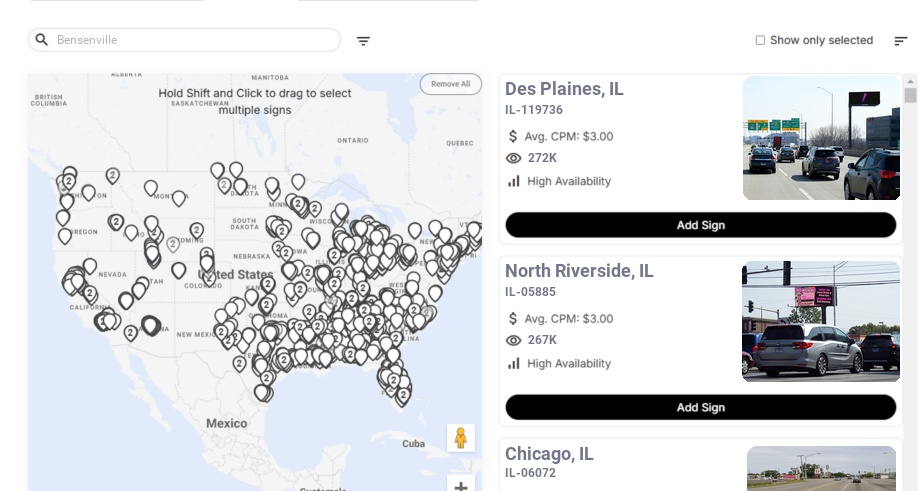



How much is a billboard near Bensenville?
Why Choose Blip for Billboard Advertising near Bensenville
-
Blip lets you launch fast on Bensenville's I-294, I-90, and Mannheim Road corridors without sales reps or delays.
-
In Bensenville, daypart your ads for 6–9 a.m. shift workers and 3–7 p.m. commuters near O'Hare and the industrial corridor.
-
No contracts mean Bensenville brands can test Rosemont and Schiller Park traffic, then scale what works.
-
Track Bensenville campaign results in real time and shift budget toward the best-performing airport, retail, or commuter corridors.
-
Use Blip's creative tools to make bilingual, high-contrast ads that pop for Bensenville's Spanish-speaking families and travelers.
Frequently Asked Questions About Billboard Advertising near Bensenville
How much does a billboard cost near Bensenville, Illinois with Blip?
With Blip, you choose exactly how much you want to spend each day advertising on Bensenville billboards, and our system automatically keeps your campaign within that budget. Each 7.5–10 second "blip" on digital billboards near Bensenville, Illinois is individually priced based on when and where it runs and current advertiser demand, so you only pay for the blips you actually receive. That means your total spend over time is simply the sum of all those individual blips.
Where can I advertise with Blip near Bensenville, Illinois?
We have 30 digital billboards serving the Bensenville area, all within roughly 10 miles. These signs are strategically located in nearby communities that function as the transportation and commercial "shell" around Bensenville, including Schiller Park, Des Plaines, Rosemont, Melrose Park, Stone Park, Harwood Heights, and North Riverside. Because digital billboards cycle multiple advertisers, we can schedule "blips" on a subset or all of these locations to shape a geographic pattern of exposure around the Bensenville area.
What kind of people can I reach with Bensenville billboards?
Bensenville is one of the more diverse communities in the northwest suburbs, with roughly half of residents identifying as Hispanic or Latino and a substantial share of households using Spanish at home. The area also has a strong industrial base, working-age adults, and young families, supported by its transit-oriented community and nearby schools. This creates opportunities to reach local residents and families, industrial and logistics workers, O’Hare travelers, and Chicago-bound commuters.
When is the best time to run Blip billboards in Bensenville, Illinois?
Digital billboards serving the Bensenville area let us control when your ads appear—down to specific hours, days, and budgets. Morning peak hours from 6–9 a.m. are ideal for employment, coffee, transit, and B2B campaigns, while midday works well for retail, healthcare, and dining. Afternoon and late evening can be especially strong for family dining, entertainment, hotel offers, and event-driven traffic near Rosemont.
Why is Bensenville, Illinois a strong market for billboard advertising with Blip?
The Bensenville area sits at a powerful crossroads of neighborhood life, industrial activity, and regional travel. The greater O’Hare industrial corridor is one of the largest industrial concentrations in the country, and the airport alone supports roughly 40,000–50,000 on-airport jobs. Major nearby roads like I‑294, I‑90, I‑190, Mannheim Road, North Avenue, and Irving Park Road bring heavy commuter and traveler traffic through the area.
Do I need a contract to advertise with Blip near Bensenville?
No, Blip has no long-term contracts or minimum commitments. You can start, pause, or stop your campaign at any time.
How fast can I launch a billboard campaign with Blip near Bensenville?
You can have your campaign live in minutes. Create a free account, select your locations, set your budget, upload your design, and start running once approved.
Where can I advertise with Blip near Bensenville?
Blip has digital billboards near Bensenville. You can browse available locations on a map, choose the ones that fit your audience, and start advertising right away.
Still have questions? Launch a campaign in minutes — no contracts, no commitments.
Start Your CampaignBensenville Billboard Advertising Guide
The Bensenville area sits at a powerful crossroads of neighborhood life, industrial activity, and regional travel. With O’Hare International Airport Illinois Tollway and Illinois Department of Transportation. For brands specifically seeking billboards near Bensenville, this cluster of locations offers one of the most efficient ways to stay visible across the full daily travel cycle.

Understanding the Bensenville Area Market
The Village of Bensenville describes itself as a “vibrant, transit-oriented community” with a strong industrial base and a growing residential appeal, supported by its own Metra station
-
Population and households
- Recent demographic estimates place Bensenville’s population at about 18,800–19,000 residents, in line with 2020 federal counts, with tens of thousands more in bordering communities such as Wood Dale, Elk Grove Village, Schiller Park, and Franklin Park. For example, nearby Wood Dale Elk Grove Village
- The Village of Bensenville highlights a family-oriented community with a median age in the mid-30s (recent estimates show around 35–36 years), meaning a strong representation of working-age adults and young families. Around one in four residents is under age 18, and the average household size is just under 3 people, which supports campaigns focused on family services, education, and youth activities.
- Within a 10‑mile radius of Bensenville, the combined population of nearby suburbs (including Rosemont, Des Plaines, Schiller Park, Franklin Park, Melrose Park, Stone Park, and Harwood Heights) climbs well above 300,000 residents, according to recent county and municipal profiles, giving advertisers both hyper-local and regional reach for billboard advertising near Bensenville.
-
Economic and employment profile
- The greater O’Hare industrial corridor—covering Bensenville, Elk Grove Village, Franklin Park, and Rosemont—is one of the largest industrial concentrations in the country. Regional economic development agencies and industrial market reports estimate the broader O’Hare submarket includes 150–160 million square feet of industrial space with vacancy rates often in the single digits (typically 4–7%), and supports well over 100,000 jobs in logistics, distribution, warehousing, aviation support, and manufacturing.
- Bensenville is part of DuPage County, which reports a median household income above $95,000 according to Choose DuPage; more recent multi-year estimates place DuPage County’s median household income closer to $105,000–$110,000, significantly higher than the Illinois statewide median, indicating strong consumer spending power. Nearby Cook County suburbs like Des Plaines Rosemont add thousands of additional middle- and upper-income households, particularly in professional services and airport-related industries.
- The O’Hare area is also a powerful employment destination: the airport alone supports roughly 40,000–50,000 on-airport jobs (airlines, security, concessions, maintenance, and support services), while surrounding industrial parks in Bensenville, Franklin Park, and Elk Grove Village add tens of thousands more. This means that on weekdays, the daytime “population” within a short drive of Bensenville can swell well beyond resident counts as workers commute in, making well-placed Bensenville billboards especially valuable during commute peaks.
-
Diversity and language
- Bensenville is one of the more diverse communities in the northwest suburbs. Recent community and school district profiles show that roughly half of residents (around 50–55%) identify as Hispanic or Latino, with sizable non-Hispanic White, Asian, and Black populations making up the balance. Local school data from Bensenville School District 2 also reflects this diversity, with a majority of enrolled students identified as Hispanic and a broad mix of other backgrounds.
- A substantial share of households use Spanish at home—various demographic profiles suggest around 40–50% of residents speak a language other than English at home, predominantly Spanish. This has direct implications for bilingual or Spanish-forward billboard messaging, especially for services like healthcare, financial products, retail, and family activities.
- Surrounding communities such as Melrose Park and Stone Park also report majority or near-majority Hispanic populations, strengthening the case for Spanish-language creative along corridors like North Avenue (IL‑64) and Lake Street (US‑20).
-
Commuter and visitor traffic
- The nearby O’Hare International Airport handled over 73 million passengers in 2023, according to Chicago O’Hare International Airport
-
Major roadways such as I‑294 (Tri‑State Tollway), I‑90 (Jane Addams Memorial Tollway), I‑190 to O’Hare, Mannheim Road (US‑12/45), North Avenue (IL‑64), and Irving Park Road (IL‑19) all traverse the surrounding communities serving the Bensenville area. Illinois Department of Transportation and Illinois Tollway counts often show:
- I‑294 near O’Hare: roughly 180,000–200,000 vehicles per day
- I‑90 near the Kennedy/O’Hare interchange: frequently above 250,000 vehicles per day
- I‑190 into O’Hare: generally 80,000–100,000 vehicles per day
- North Avenue (IL‑64) near Melrose Park: often 40,000–50,000 vehicles per day
- Irving Park Road (IL‑19) through Schiller Park and near Bensenville: typically 25,000–35,000 vehicles per day
- The Metra Milwaukee District West Line
This combination—dense industrial employment, family neighborhoods, high incomes in the broader DuPage area, and continuous airport-related movement—creates a fertile environment for digital billboard campaigns when we target the right corridors near Bensenville. For advertisers exploring billboard rental near Bensenville, understanding these dynamics helps determine which boards and time slots will deliver the strongest returns.
Where Our Billboards Reach Near Bensenville
We have 30 digital billboards serving the Bensenville area, all within roughly 10 miles. These signs are strategically located in nearby communities that function as the transportation and commercial “shell” around Bensenville, effectively operating as billboards near Bensenville even when they sit just over the village boundary:
- Schiller Park (about 3.1 miles away) – A core O’Hare gateway, with heavy traffic along Irving Park Road (IL‑19) and Mannheim Road. Schiller Park has around 11,000–12,000 residents but sees daily volumes of 30,000+ vehicles on key arterial segments. This is a prime corridor for reaching Bensenville area commuters heading to and from the airport or Chicago, as well as workers at nearby hotels, parking facilities, and freight operations.
- Des Plaines (about 4.3 miles) – A significant residential and employment hub north of O’Hare, intersected by I‑294 and major arterials. Des Plaines
- Rosemont (about 4.5 miles) – Home to Allstate Arena, the Donald E. Stephens Convention Center Fashion Outlets of Chicago, and entertainment districts. The Village of Rosemont reports that its entertainment and convention facilities attract millions of visitors annually; the convention center alone hosts more than 70 trade shows and events per year, while Allstate Arena has a busy schedule of concerts and sports. Rosemont draws regional visitors, business travelers, and event attendees, creating high-visibility opportunities to influence people traveling near the Bensenville area.
- Melrose Park & Stone Park (about 4.7–4.8 miles) – Major retail and industrial corridors along North Avenue (IL‑64) and near the I‑290 system, pulling traffic from the west side of Chicago and western suburbs. Melrose Park has roughly 24,000 residents, and nearby Stone Park adds about 5,000 residents, but North Avenue and Lake Street combine to draw tens of thousands of vehicles daily, much of it headed toward industrial, auto, and retail destinations.
- Harwood Heights (about 7.7 miles) – A dense near-northwest suburb bordering Chicago’s NW side, offering access to city-bound traffic that also moves through the Bensenville area. Harwood Heights
- North Riverside (about 9.4 miles) – A strong retail destination anchored by regional shopping centers along Cermak Road and Harlem Avenue, capturing west suburban shoppers. The Village of North Riverside hosts the North Riverside Park Mall and adjacent big-box and strip retail, generating millions of shopper visits annually and daily traffic on Cermak Road that often exceeds 30,000 vehicles.
Because digital billboards cycle multiple advertisers, we can schedule “blips” (individual ad plays) on a subset or all of these locations to shape a geographic pattern of exposure around the Bensenville area rather than relying on a single static board. By shifting impression weight between these communities, we can follow where the highest densities of your target customers live, work, and travel, creating a flexible framework for billboard advertising near Bensenville that can change as your goals evolve.
Key Audiences You Can Reach Near Bensenville
Thinking clearly about who travels near the Bensenville area—and when—helps us use Blip’s flexibility effectively and ensures your investment in Bensenville billboards aligns with real-world behavior.
1. Local residents and families
- Bensenville, Wood Dale, and nearby villages have thousands of households with children and working-age adults. Recent school enrollment figures show that Fenton High School District 100 serves roughly 1,400–1,500 students, and Bensenville School District 2 serves around 2,000–2,200 K‑8 students, signaling a substantial youth base for family-focused messaging. The Bensenville Park District
- Household-oriented messaging such as family dining, youth activities, healthcare, home services, and local retail should emphasize convenience (“minutes from O’Hare,” “just off Route 83,” etc.) and bilingual clarity where applicable. With an estimated 65–70% of local households in Bensenville and adjacent communities occupied by families, advertisers can confidently focus on multi-person households rather than purely single-occupant living.
2. Industrial and logistics workers
- The O’Hare industrial corridor employs tens of thousands of workers across warehouses, trucking companies, freight forwarders, and industrial firms situated near Bensenville. Industrial market summaries for the O’Hare and west Cook/DuPage submarkets often estimate over 4,000–5,000 industrial and logistics firms operating in this zone, including small logistics companies and large national distributors.
- Shift-based work patterns often start early (5–7 a.m.) and run late. Many employers operate two or three shifts, meaning worker traffic spikes not only at the traditional 8–9 a.m. and 5 p.m. peaks, but also around 6–7 a.m., 2–3 p.m., and 10–11 p.m. Ads for employment, training programs, safety services, or B2B offerings should focus on these early-morning and late-evening commuting windows along routes like IL‑83, Irving Park Road, and the Tri‑State Tollway, where billboards near Bensenville can intercept workers heading into and out of the corridor.
3. O’Hare travelers and hospitality visitors
- With more than 73 million passengers in 2023, O’Hare is a massive feeder of hotel stays, dining, and shopping in surrounding communities like Rosemont, Des Plaines, and Schiller Park. Hotel market reports for the O’Hare/Rosemont area often cite tens of thousands of hotel rooms within a short radius of the terminals and average occupancy rates that climb into the 70–80% range during peak convention and summer travel seasons.
- Visitors frequently pass through nearby corridors on shuttles, rideshare vehicles, and rental cars. A significant share of airport passengers—industry estimates suggest 30–40% in big hub markets—rely on rideshare, taxi, or hotel shuttles, concentrating their routes along I‑190, Mannheim Road, and adjacent arterials. Hotel, restaurant, tourism, and attraction advertisers can use boards in Rosemont and Schiller Park to intercept these audiences with “next exit” or “5 minutes away” style messages, including references to local draws promoted by outlets like Enjoy Illinois – Chicago’s North Suburbs tourism partners Rosemont tourism bureau.
4. Chicago-bound and regional commuters
- Many Bensenville area drivers commute toward Chicago via the Kennedy Expressway (I‑90), the Eisenhower (I‑290), or arterial routes like North Avenue and Irving Park Road. Regional transportation surveys indicate that well over 50% of workers in many west suburban communities commute outside their home municipality, with a large portion traveling toward Chicago or other job centers along the expressway corridors.
- Placing ads on digital billboards near Harwood Heights, Rosemont, Des Plaines, and North Riverside lets us catch this flow both inbound in the morning and outbound in the afternoon, increasing repetition for daily commuters. With typical weekday commute times in the Chicago region averaging 30–35 minutes, drivers will often pass the same billboards multiple times per week, building familiarity and recall for well-crafted creative that highlights your Bensenville locations or service areas.
Timing Your Campaign: When to Show Your Ads
Digital billboards serving the Bensenville area let us control when your ads appear—down to specific hours, days, and budgets. We can align this with local traffic rhythms and seasonal patterns so your billboard rental near Bensenville performs efficiently rather than spreading impressions thinly across low-traffic times.
Daily traffic patterns
Traffic data from IDOT and the Chicago Metropolitan Agency for Planning confirm that the region’s peak periods are consistent and pronounced, with some expressway segments seeing 40–45% of daily traffic during the combined morning and afternoon rush windows.
-
Morning peak (6–9 a.m.)
Heavy commuter and industrial shift traffic moves along IL‑83, IL‑19, and Tollway routes near O’Hare. These hours typically show the highest hourly volumes of the day, especially in the 7–8 a.m. window. This is ideal for:- Employment and hiring campaigns
- Coffee shops and quick breakfast options
- Transit and parking services
- B2B services targeting industrial and logistics decision-makers
-
Midday (10 a.m.–3 p.m.) Traffic includes shoppers, service workers, and airport-related travel. Retail centers in North Riverside, Melrose Park, Des Plaines, and Rosemont report strong daytime footfall, especially on Fridays and weekends. Use this window for:
- Retail and grocery promotions
- Healthcare and appointments (dental, clinics, etc.), as many offices schedule the bulk of visits between 9 a.m. and 4 p.m.
- Tourism, attractions, and lunchtime restaurant offers
-
Afternoon peak (3–7 p.m.) Returning commuters, school pickups, and second-shift workers dominate. School dismissal times around 2:30–3:30 p.m. and typical workday end times between 4–6 p.m. converge to create a strong second peak of the day. Great for:
- Family dining and quick-service restaurants
- After-school programs and sports
- Local entertainment, gyms, and personal services
-
Late evening (7–11 p.m.) Entertainment and hospitality become more prominent, especially near Rosemont’s venues. When Allstate Arena or the Rosemont entertainment district hosts major events, local roads can experience sharp spikes in evening traffic, sometimes adding thousands of additional vehicles in the 2–3 hours surrounding showtimes. Boards in Rosemont and Des Plaines can push:
- Events at Allstate Arena or nearby venues
- Bars, lounges, and late-night dining
- Hotel “tonight only” or weekend stay offers
Seasonal considerations
-
Winter (Nov–Feb):
Darker commutes amplify the visibility of illuminated digital billboards, with sunset as early as 4:20 p.m. in December in the Chicago area. Snow, ice, and cold also increase demand for vehicle and home services. Focus on:- Auto services (tires, repair, towing, collision repair) as crash and breakdown rates rise in winter months
- Cold-weather retail (coats, heating, indoor attractions)
- Holiday shopping and seasonal events in nearby centers like North Riverside and Rosemont, where holiday campaigns can drive significant traffic spikes in November and December
-
Spring (Mar–May):
Construction and moving season picks up; local building permit activity in DuPage and west Cook counties generally rises in spring. B2C and B2B campaigns for:- Home improvement, landscaping, contractors, and garden centers
- Real estate and apartments, as many leases and home listings turn over in late spring and early summer
- Recruitment for seasonal industrial jobs near the Bensenville area, particularly in logistics, warehousing, and construction
-
Summer (Jun–Aug):
Festivals, travel, and family activities surge. Tourism offices for the Chicago region often report their highest hotel occupancy and attraction attendance of the year in June–August. Highlight:- Local pools, parks, and events promoted by the Village of Bensenville Bensenville Park District
- Attractions and concerts in Rosemont’s entertainment district and nearby venues
- Tourism and family outings for regional visitors, including day trips from the city and surrounding suburbs
-
Fall (Sep–Oct):
Back-to-school and pre-holiday planning. Local school districts return in mid- to late-August, and by September, routines stabilize—valuable for predictable commuter exposure. Emphasize:- Education, tutoring, and youth programs
- Healthcare checkups and flu shots, as clinics often see vaccination campaigns ramp up from September onward
- Retail and early holiday promotions to capture shoppers before November’s peak
Because Blip lets us adjust schedule and budget in real time, we can react quickly to weather, events, or news covered by local outlets like the Daily Herald’s Bensenville coverage and Chicago Tribune’s suburban sections, as well as hyperlocal sources like Journal & Topics Newspapers that cover O’Hare-area communities. This agility is especially useful when fine-tuning billboard advertising near Bensenville around sudden demand spikes.
Crafting Effective Creative for the Bensenville Area
To connect with drivers near the Bensenville area, we should adapt billboard artwork to local culture, language, and travel motivations so every second of your billboard rental near Bensenville works as hard as possible.
1. Use concise, high-contrast messaging
- Aim for 7 words or fewer on the main line; studies of roadside advertising show that recall drops significantly when copy exceeds 8–10 words, especially at highway speeds of 45–60 mph. For example:
“Fast Dental Care – 5 Minutes from O’Hare” - High-contrast color pairs (white on dark blue, yellow on black) ensure readability in bright daylight and nighttime conditions, especially during Chicago’s cloudy winters and low sun angles. Simple sans-serif fonts and large letter heights (often 12–24 inches on standard boards) further improve legibility.
2. Reflect local geography and landmarks
Anchor your creative to places Bensenville area drivers recognize:
- Mention nearby routes: “Just off IL‑83,” “Near Irving Park & York Rd.”
- Reference O’Hare or Rosemont landmarks: “Across from Allstate Arena” or “Shuttle from O’Hare in 10 Minutes.”
- Consider including simple icons for airports, trains (Metra), or highways to reinforce wayfinding. Many wayfinding best practices suggest that clear directional cues (“Next Exit,” “2 Miles Ahead”) can boost follow-through rates by 10–20% compared to generic branding alone.
3. Consider bilingual or Spanish-forward creative
Given the strong Hispanic presence around Bensenville and neighboring communities like Melrose Park and Stone Park:
- Test Spanish-only or bilingual designs for services targeting local households (restaurants, healthcare, retail, financial services). With Spanish spoken at home in an estimated 40–50% of Bensenville and nearby households, Spanish-language creative can resonate strongly.
- Keep translations short and direct. For example:
“Seguros de Auto en Minutos – Salida Irving Park” - Avoid trying to fit full bilingual paragraphs; instead, use one clear primary language with a short supporting phrase if needed. Data from out-of-home case studies commonly show higher recall for ads that prioritize a single, dominant language and message.
4. Align visuals with commuter intent
Think about what your audience is likely doing when they see your ad:
- Morning commuters: Emphasize speed, convenience, and savings. “Oil Change in 15 Minutes – Walk‑In Welcome.” Many local drivers face 25–40 minute commutes; offers that save time or combine errands can be particularly persuasive.
- Evening and weekend travelers: Show appealing food, comfortable hotel rooms, or family activities, especially when targeting visitors staying in O’Hare/Rosemont hotels.
- Industrial workers: Feature sturdy, practical images of tools, equipment, or workplace settings if you’re recruiting or marketing B2B services. In tight labor markets, local employers frequently advertise starting wages, signing bonuses, or benefits—include specific figures (“Starting at $20/hr”) to stand out.
5. Use clear calls-to-action tailored to on-the-go viewers
Billboard viewers near the Bensenville area are driving, often at highway speeds, so:
- Prioritize “Exit Now,” “Next Light,” “2 Miles Ahead” style CTAs, particularly on segments where exits or major intersections are within 1–3 miles of your board.
- Use short URLs, recognizable brand names, or clear search prompts (“Search ‘Bensenville Storage’”). Research on mobile search behavior shows that a large share of customers—often 60–70% for local services—will type a brand or service into a search engine rather than a full URL after seeing an ad.
- Phone numbers should be simple (vanity numbers) or secondary to brand/web; many drivers will remember the name and search later, especially on congested corridors where drivers may not feel safe dialing while moving.
Strategic Location Planning Around Bensenville
Because our 30 digital billboards near the Bensenville area are spread across multiple nearby communities, we can design location strategies tailored to your goals and create a customized network of Bensenville billboards that fits your audience.
1. Hyper-local saturation for residents
To reach people who live, shop, and go to school near the Bensenville area:
- Prioritize boards in Schiller Park, Melrose Park, and Stone Park, where local shopping, manufacturing, and commuting intersect. These towns together account for more than 40,000 residents and tens of thousands of daily vehicle trips on North Avenue, Lake Street, Mannheim Road, and Irving Park Road.
- Focus on corridors feeding Bensenville: IL‑19 (Irving Park), IL‑83, North Avenue, and routes that connect to Bensenville’s neighborhoods and commercial districts, including access routes highlighted by the Village of Bensenville and DuPage County.
- Use frequency-based buying: show short, frequent blips during morning and evening commutes for consistent exposure. Industry benchmarks suggest that seeing a message 3–7 times within a couple of weeks significantly improves recall compared to one‑off exposures.
2. Airport and hospitality funnel
If your goal is to capture O’Hare travelers and overnight visitors:
- Lean heavily on Rosemont and Schiller Park locations at times aligned with typical flight arrivals and event schedules (early morning, late afternoon, and late evening). Travel analytics for major hubs show that arrivals and departures are often densest between 6–10 a.m. and 3–8 p.m., mirroring heavy traffic on I‑190 and connecting corridors.
- Emphasize maps, arrows, and “X minutes from O’Hare” messaging. Many O’Hare-area hotels and parking services market 5–15 minute travel times from terminals; highlighting exact minute counts helps compete in a crowded field.
- Strategically schedule more impressions around large events at Allstate Arena or the convention center, when traffic surges. The Donald E. Stephens Convention Center
3. Regional reach into Chicago and western suburbs
For brands drawing from a wider area:
- Create a ring of exposure with boards in Des Plaines, Harwood Heights, Melrose Park, Stone Park, and North Riverside to catch both north–south and east–west flows. Together, these communities sit along Harlem Avenue, Mannheim Road, North Avenue, Cermak Road, and I‑294/I‑290 access points, each carrying tens of thousands of vehicles daily.
-
Time your buys to the heaviest commuting windows in each direction:
- Morning: more impressions on boards facing east and south (toward Chicago).
- Evening: more impressions facing west and north (toward the Bensenville area and DuPage County).
- This “ring” strategy helps you tap into a regional labor and shopper pool that extends well beyond Bensenville’s nearly 19,000 residents and into a metro population of several million, all influenced by billboard advertising near Bensenville as they move through this network of roads.
4. B2B and industrial corridor targeting
If you’re targeting businesses or industrial workers near the Bensenville area:
- Focus on boards along routes connecting industrial parks, freight facilities, and the airport: Irving Park Road, Mannheim Road, I‑294 corridor approaches, and arterials feeding Bensenville’s industrial districts. Industrial clusters near Bensenville and Franklin Park contain hundreds of warehouses and distribution centers, many of which employ 50–200 workers each, creating concentrated pockets of B2B decision-makers and potential recruits.
- Use message variants tailored to different segments (e.g., “Warehouse Space Available” for one board set and “Logistics Staffing Today” for another) and test which corridors produce more website or inbound lead activity. B2B advertisers often see stronger response when they explicitly mention industry pain points—such as “Same-Day Freight,” “24/7 Dock Access,” or “On-Site Staffing in 24 Hours.”
Using Blip’s Flexibility to Test and Optimize
The strength of digital billboards near the Bensenville area is that we’re not locked into one message, one board, or one fixed schedule. With Blip, we can structure billboard rental near Bensenville to behave more like a digital campaign than a traditional static buy:
-
Start small and scale up
Launch a campaign with a modest daily budget limited to a subset of boards (for example, only Schiller Park and Rosemont during weekdays 6–10 a.m.), then grow into additional locations or dayparts as results justify. Many advertisers begin with a few dollars per day per board and scale to larger spends once they see uplift in calls, web traffic, or in‑store visits. -
A/B test creative
Run two versions of your ad:- English-only vs. bilingual
- Price-focused vs. brand-focused
- “From O’Hare” vs. “From Bensenville” driving directions
Compare downstream performance—phone calls, searches, and web visits—from the periods when each design was active. Even a 10–20% difference in response between creatives can guide where to invest more impressions.
-
Adapt to events and local news
Use local calendars and headlines from the Village of Bensenville’s event listings and outlets like the Daily Herald to:- Promote one-time events (street festivals, school performances, sports tournaments, park district programs).
- Respond to time-sensitive needs (e.g., last-minute ticket sales, special airport parking offers during holiday peak travel when O’Hare passenger volumes can spike by 20–30% over average weeks).
- Align ads with weather swings—such as major snowstorms or heat waves—that drive demand for specific services (snow removal, HVAC repair, auto repair).
-
Geo-rotate based on performance
If you see better response when your ads are more concentrated around Rosemont (perhaps driven by tourist and airport traffic), we can shift your budget there. If a hiring campaign is more successful in Melrose Park and Stone Park, we can ease back on evening impressions in North Riverside and reinvest where applications spike. Over time, this data-driven rotation helps you move budget toward the top-performing 20–40% of boards, improving cost-effectiveness and maximizing the value of your billboard advertising near Bensenville.
Measuring Impact and Aligning With Other Channels
Even though billboard advertising near the Bensenville area is a top-of-funnel channel, we can still track its impact and align it with your other marketing efforts.
-
Use trackable offers and URLs
- Short URLs or landing pages dedicated to your billboard campaign (e.g.,
YourBrand.com/Bensenville) help us see uplift. If direct traffic and landing page visits rise 10–30% during your billboard flight compared to prior weeks, that’s a strong indicator of impact. - Unique promo codes (“BEN10”) for in-store or online use give a concrete measure of conversions from billboard exposure. Many advertisers see a measurable share of redemptions—sometimes 5–15% of promo code use—tied to out-of-home campaigns.
- Short URLs or landing pages dedicated to your billboard campaign (e.g.,
-
Monitor search and traffic lifts
- Watch branded search volume and direct traffic to your site during and shortly after campaign periods using tools like Google Analytics.
- Compare weeks with and without billboard activity while holding other marketing steady. Even modest lifts of 5–10% in branded search can be meaningful in high-value categories like healthcare, legal, or home services.
-
Coordinate with local digital and print media
- Synchronize billboard flights with stories or ads in local outlets like the Daily Herald, the Chicago Tribune, or community bulletins from the Village of Bensenville.
- Use similar visuals and taglines across social media, geofenced mobile ads, and billboards to reinforce recognition. Cross-channel studies often show that campaigns running on multiple platforms can improve overall ad recall by 20–40% versus single-channel efforts.
-
Gather on-the-ground feedback
- Ask staff at your Bensenville area locations to note when customers mention seeing your sign “by O’Hare,” “on Irving Park,” or “near North Avenue.” Track how many customers report billboards as a source over a 4–8 week period to get a baseline.
- Encourage customers to share where they heard about you through small in-person or digital surveys. Even if only 5–10% of customers respond, the patterns in their answers can help refine which corridors and creatives are working best.
Putting It All Together for the Bensenville Area
The Bensenville area’s combination of diverse residential neighborhoods, a vast industrial workforce, and world-class airport proximity makes it a uniquely powerful market for digital billboards. By:
- Understanding local demographics and traffic flows, including nearly 19,000 Bensenville residents and hundreds of thousands of daily vehicle trips on nearby expressways and arterials,
- Choosing board locations in nearby cities like Schiller Park, Rosemont, Des Plaines, Melrose Park, Stone Park, Harwood Heights, and North Riverside that mirror your target’s travel patterns,
- Tailoring creative to bilingual audiences, commuter behaviors, and O’Hare-linked travel with concise, high-contrast, and locally grounded messaging,
- And using Blip’s scheduling and budgeting tools to test, refine, and focus your spend based on performance data,
we can build campaigns that deliver real visibility and measurable impact for businesses aiming to grow near the Bensenville area. Whether you’re experimenting with billboard rental near Bensenville for the first time or optimizing an established out-of-home strategy, this market offers a flexible, data-informed environment to reach the audiences that matter most to your brand.