Billboards in Broadview, IL
No Minimum Spend. No Long-Term Contracts. Just Results.
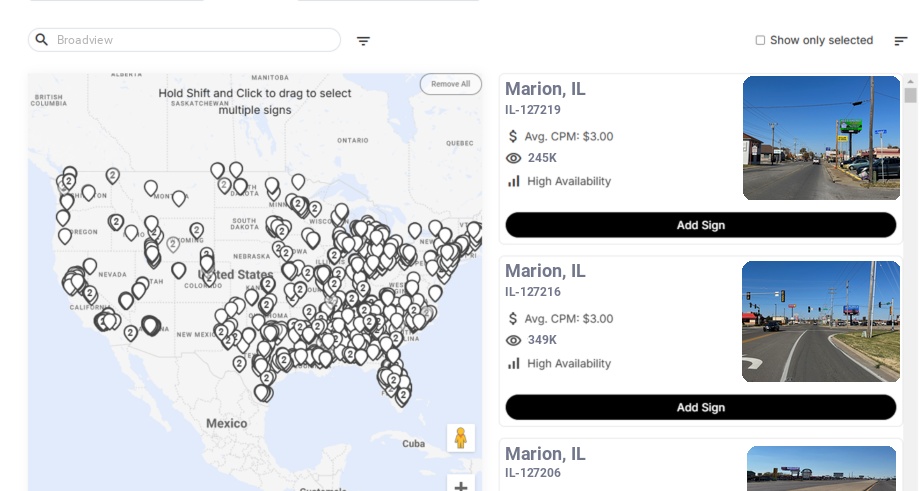
Give your brand a little billboard sparkle in Broadview with Blip. Choose digital screens on a map, set your budget, and launch ads that only play when they’re live—no contracts, no fuss, just bold visibility.
Trusted by Leading Brands


Billboard advertising
in Broadview has
never been easier
How much is a billboard in Broadview?
Why Choose Blip for Billboard Advertising in Broadview
Blip lets you launch Broadview billboard ads self-serve in minutes, reaching I-290 commuters and I-294 travelers without traditional buying hassle.
Use Blip-optimized campaigns in Broadview to auto-pick the best boards and timing for west-suburban commuters, shoppers, and O'Hare traffic.
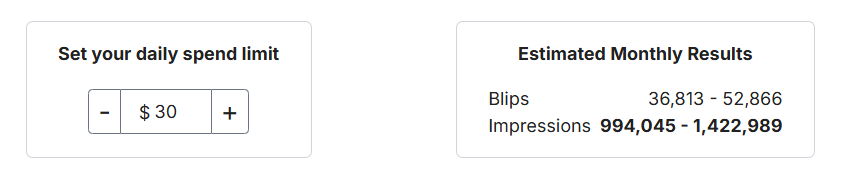
Set flexible budgets in Broadview and pay only when your ad runs, ideal for testing on Roosevelt Road or near Broadview's local corridors.
Daypart Broadview ads for rush-hour I-290 traffic, lunch errand runs, or weekend Oak Brook shoppers, all with Blip control.
No contracts in Broadview means you can pause or scale fast as traffic shifts between Chicago, Oak Brook, and Rosemont routes.
Track real-time analytics in Broadview and use Blip's creative tools to sharpen messages for commuters, families, and airport-bound drivers.
Frequently Asked Questions About Billboard Advertising in Broadview
How much does a billboard cost in Broadview with Blip?
Where can I advertise with Blip in Broadview?
Why is Broadview a good billboard market for Blip?
What kind of traffic and commuters does Broadview reach on Blip billboards?
When is the best time to run Broadview billboard ads with Blip?
Do I need a contract to advertise with Blip in Broadview?
How fast can I launch a billboard campaign with Blip in Broadview?
Where can I advertise with Blip in Broadview?
Still have questions? Launch a campaign in minutes — no contracts, no commitments.
Start Your CampaignBroadview Billboard Advertising Guide
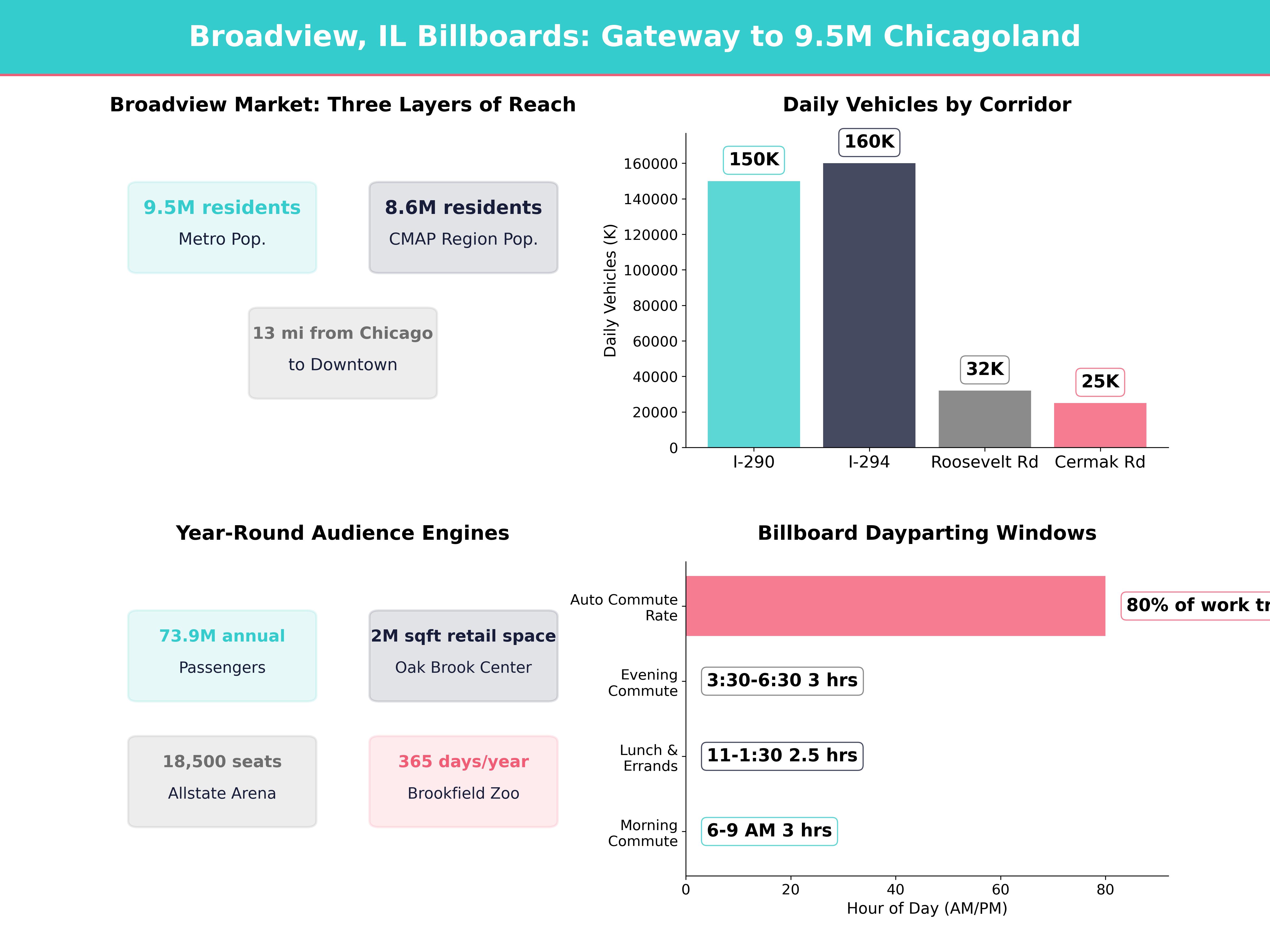
Broadview is one of those small Illinois communities that delivers an outsized billboard opportunity because it sits inside the daily movement patterns of the western Cook County suburbs. The village itself had a 2020 population of 7,403, but it is surrounded by a county of roughly 5.27 million residents and a Chicago Metropolitan Agency for Planning region of more than 8.6 million people across 7 counties. From Broadview, we can tap commuter traffic on I-290, regional traffic on I-294, and destination traffic heading toward Chicago, Oak Brook Rosemont, and O'Hare International Airport. That combination makes Broadview especially effective for advertisers who want weekday frequency, weekend reach, and steady year-round visibility.
Broadview Market Overview for Billboard Advertisers
Broadview is small, but the real market is much larger
Broadview works best when we think beyond the village limits. The community covers about 1.7 square miles, sits about 13 miles west of downtown Chicago, and touches a dense cluster of nearby markets including Maywood, Bellwood Hillside Westchester, Melrose Park, Forest Park, and Oak Park. Because the village is built out rather than sprawling outward, the advertising value comes less from new rooftops and more from established travel habits.
That is good news for billboard advertisers. Mature suburban traffic patterns tend to be predictable, and predictable traffic makes it easier for us to build frequency. In a compact area like Broadview, a billboard just outside the village can still function like a Broadview placement if it captures the same shoppers, workers, and commuters.
Demographics, commuting, and economic context
Broadview is part of a diverse near-west suburban trade area with a strong mix of families, service workers, healthcare employees, students, small-business owners, and regional travelers. Community profiles compiled through CMAP show that driving remains the dominant way people get to work in Broadview and similar nearby suburbs, with auto commuting accounting for roughly 4 out of 5 work trips when driving alone and carpooling are combined. For billboard planning, that matters more than almost any other local statistic because it confirms that roadside media meets people where they already spend time.
The local economy is also supported by several large regional demand engines. Oak Brook Center offers about 2 million square feet of retail space and more than 160 shops and restaurants. O'Hare International Airport handled roughly 73.9 million passengers in 2023, which reinforces the strength of the western suburban visitor economy. McCormick Place brings convention traffic to the metro area with 2.6 million square feet of exhibit space, while the Donald E. Stephens Convention Center in Rosemont adds another 840,000 square feet of exhibition space in a corridor that Broadview-area drivers regularly access via I-294 and I-290.
For advertisers, the takeaway is simple. Broadview is not just a local-village buy. It is a strategic west-suburban access point inside the nation’s third-largest metro market, with about 9.5 million residents in the Chicago metro area.
Key Traffic Corridors Around Broadview
Broadview’s billboard performance is driven by a handful of high-visibility roads that connect local errands to regional movement. We should match each corridor to a specific audience and decision moment.
I-290, the Eisenhower Expressway, is Broadview’s weekday backbone
According to Illinois Department of Transportation traffic count maps, mainline segments of I-290 near Broadview commonly run in the 130,000 to 170,000 vehicles per day range, depending on the exact segment and count year. That makes the Eisenhower the core commuter corridor for reaching west-suburban residents traveling to Chicago, Oak Park, Forest Park, Maywood, Hillside
This corridor is especially effective for several advertiser types.
- Retail, dining, and entertainment brands benefit because I-290 captures repeat weekday exposure and impulse decision-making for after-work stops.
- Healthcare providers, colleges, and service businesses benefit because the route connects residential communities with job centers, medical campuses, and schools.
- Legal, insurance, financial, and home-service brands benefit because commuters see the same boards again and again, which helps memory-based categories.
Because traffic can slow significantly during peak periods, a good I-290 board often delivers both volume and dwell time.
I-294, the Tri-State Tollway, adds regional and airport reach
The nearby Illinois Tollway segment of I-294 is one of the most important regional arteries available to Broadview advertisers. IDOT and tollway counts around the Hillside area frequently place I-294 in the 150,000 to 170,000-plus vehicles per day range. That traffic is different from pure neighborhood commuting. It includes airport trips, freight and logistics movement, suburban-to-suburban business travel, and convention traffic moving between Rosemont, Oak Brook
We usually favor I-294 when we want broader market reach.
- Hotels, event venues, restaurants, and attractions can use it to intercept travelers before they choose where to stop.
- B2B advertisers can use it to reach contractors, distributors, healthcare vendors, and sales teams moving between suburban business centers.
- Regional consumer brands can use it when Broadview is just one part of a west-suburban footprint.
Roosevelt Road in Broadview reaches local shoppers and short-trip drivers
Roosevelt Road, also known as Illinois Route 38, is a practical arterial for local frequency. IDOT counts on comparable Broadview-area segments often land in the 25,000 to 40,000 AADT range. While that is lower than the expressways, Roosevelt Road offers something equally valuable: slower speeds, more retail adjacency, and stronger local intent.
Roosevelt works well for advertisers such as urgent care clinics, dentists, grocery stores, auto repair shops, quick-service restaurants, childcare providers, and community events. If we want to drive a near-term action within Broadview, Maywood, Bellwood Forest Park, or Oak Park, arterial placements can outperform a more expensive regional board.
Cermak Road, 17th Avenue, and nearby connectors support neighborhood conversion
Broadview also depends on local connector routes such as Cermak Road, also known as 22nd Street, and north-south roads like 17th Avenue and 1st Avenue. IDOT traffic maps often show Broadview-area portions of Cermak Road in the 20,000 to 30,000 vehicles per day range, while major local connectors can top 20,000 daily vehicles on key segments.
These roads are useful when our goal is not just awareness, but conversion. A board near a turn, intersection, or exit can move people to act quickly, especially for categories like food, fuel, healthcare, banking, and local retail. In Broadview, “close to the next decision point” often matters as much as raw volume.
Broadview Audience Segments We Can Reach
West-suburban commuters are the primary audience
The first audience we should plan for is the daily commuter. Broadview’s location between I-290 and I-294 means we can reach residents moving east toward Chicago, west toward DuPage County, north toward Rosemont and O’Hare, and south toward the I-55 corridor. Since auto commuting accounts for about 80% of work trips in the local pattern, roadside visibility stays central even in a region with strong transit.
Nearby transit still adds useful context. The CTA 24 hours a day, and nearby Metra
Airport, convention, and entertainment travelers expand the audience
Broadview also benefits from regional visitor flow. O’Hare International Airport handled about 73.9 million passengers in 2023, and the airport’s economic gravity radiates well into the western suburbs. Convention and event travelers add another layer of demand through McCormick Place, with its 2.6 million square feet of exhibit space, and the Donald E. Stephens Convention Center in Rosemont, with 840,000 square feet.
Entertainment traffic matters too. Allstate Arena seats roughly 18,500, and Rosemont Theatre seats about 4,400. Those are not Broadview venues, but Broadview-area roads help funnel the suburban side of that audience. If we advertise hotels, restaurants, nightlife, rideshare services, or event-adjacent businesses, Broadview can be a smart interception point rather than a final destination.
Families, shoppers, and weekend leisure visitors are highly valuable
Broadview sits near some of the region’s strongest family and shopping draws. Brookfield Zoo Chicago spans 235 acres and operates 365 days a year, which creates year-round weekend traffic near the west-southwest suburban corridor. Oak Brook Center adds another major shopping audience with 2 million square feet and more than 160 stores and restaurants.
This audience is ideal for family entertainment, restaurants, retailers, healthcare practices, youth programs, financial services, and seasonal promotions. Weekends around Broadview are not just about local residents running errands. They are also about destination visitors choosing where to eat, shop, and stop on the way.
Students, healthcare audiences, and institutional traffic add frequency
Broadview also sits near a useful cluster of educational and healthcare institutions. Within a short drive, we can reach students and staff from Triton College, Dominican University, and Concordia University Chicago, giving us 3 nearby higher-education audiences. We can also reach hospital employees, patients, and caregivers moving to and from Loyola Medicine in Maywood and Rush Oak Park Hospital in Oak Park.
These audiences respond well to practical messaging. Healthcare, education, housing, legal services, wireless, grocery, and value-forward retail all tend to fit well in this part of the market.
Ready to reach your audience in Broadview?
Start Your Campaign →Seasonal and Timing Opportunities in Broadview
Broadview winters reward practical, service-oriented campaigns
From January through March, Broadview advertising usually performs best when creative feels useful and immediate. Winter weather makes drivers think about healthcare, auto service, insurance, tax preparation, home repair, heating, and indoor entertainment. Commute-heavy boards remain valuable because people still drive even when weather is unpleasant.
This is also a smart time for advertisers to lean into repetition. When days are shorter and routines are narrower, frequent commuter impressions can build strong recall.
Broadview spring and summer open the tourism and outing window
From April through August, we usually see broader lifestyle traffic. Brookfield Zoo Chicago, Choose Chicago events, youth sports, graduations, weddings, and patio-season dining all support higher weekend mobility. Home improvement, outdoor retail, summer camps, attractions, restaurants, and family entertainment all become stronger categories.
If we want to capture leisure traffic, we should usually increase share on Friday afternoons, Saturday middays, and Sunday return-home periods. Broadview sits in a sweet spot for intercepting both local outings and regional drive trips.
Broadview fall campaigns benefit from school and business travel patterns
August through October brings back-to-school routines, college move-ins, and the return of more predictable weekday traffic after summer vacations. This is a strong window for colleges, tutoring, healthcare, sports programming, wireless, grocery, and family services. It is also a strong B2B season because convention and business travel remain active across Rosemont and Chicago.
For many advertisers, fall is the best balance of commuter reliability and discretionary spending.
Broadview holiday advertising should focus on shopping and gatherings
From late November through December, Broadview campaigns should account for holiday shopping, family visits, dining out, and seasonal entertainment. Oak Brook Center becomes a major retail draw, and Brookfield Zoo Chicago holiday programming brings families into the area. Restaurant gift cards, retail offers, urgent care, winter events, and service businesses can all benefit.
During the holidays, late-afternoon and early-evening inventory often becomes especially useful because that is when shopping and social trips overlap.
Broadview Billboard Design Tips for Local Results
Broadview creative should match high-speed roads and short viewing windows
Much of Broadview’s billboard strength comes from expressway traffic, so we should design for motion. On I-290 and I-294, we usually want 7 to 10 words of core copy, one dominant visual, and a single call to action. If the message cannot be understood in about 2 seconds, it is probably too dense for this market.
High-contrast color combinations tend to work best because west-suburban boards compete with heavy roadway signage and visual clutter. Strong whites, dark blues, bold reds, and clean yellows usually read better than subtle palettes.
Broadview messaging works best when it feels geographically credible
Broadview audiences respond well to messaging that feels rooted in actual travel behavior. Phrases like “Off I-290,” “Near Loyola,” “Next exit,” “Minutes from Oak Brook,” or “On Roosevelt Road” feel more believable than vague lifestyle slogans. We should use named destinations carefully, but specific local cues often increase response because they match how drivers orient themselves.
This is especially important in a compact market. A board in Hillside Maywood may be influencing a Broadview errand run. Local cues help close that psychological distance.
Broadview creative should reflect a diverse, practical audience
Broadview sits in a diverse west-suburban environment, so inclusive imagery matters. We usually recommend visuals that reflect multigenerational families, working adults, healthcare workers, students, and practical everyday life rather than overly stylized luxury concepts. Value, convenience, trust, and proximity are strong emotional levers here.
If bilingual creative fits the actual customer experience, it can work well in this market. We should only use bilingual messaging when the landing page, store staff, or call center can support it. Authenticity matters more than novelty.
Regional Strategies for Broadview and Nearby Submarkets
Broadview, Maywood, and Bellwood favor local-service advertising
When we focus on Broadview, Maywood, and Bellwood
In this submarket, creative should feel direct, accessible, and price-aware.
Hillside, Westchester, and Oak Brook favor retail and higher-spend audiences
When we shift toward Hillside Westchester, and Oak Brook Oak Brook Center is especially useful as a mental anchor because its 2 million square feet and 160-plus tenants attract consumers from well beyond one suburb.
If our brand wants a more affluent or destination-oriented audience, this is often the west-suburban pocket to emphasize.
Rosemont and O’Hare favor hospitality, events, and regional awareness
The Rosemont and O’Hare corridor is a good complement to Broadview when we want to extend from local frequency into regional reach. This strategy makes sense for hotels, conferences, restaurants, entertainment venues, staffing, B2B services, and visitor-facing brands. The mix of 73.9 million annual airport passengers, 840,000 square feet of convention space in Rosemont, and arena and theater attendance creates a very different audience from the purely local commuter.
A Broadview campaign can become much more powerful when we pair neighborhood-facing boards with one or two regional-travel placements.
Oak Park, River Forest, and Forest Park favor education, culture, and healthcare
The Oak Park, River Forest, and Forest Park corridor is useful for institutions, healthcare, specialty retail, dining, and cultural programming. Visit Oak Park promotes a strong visitor brand for architecture, dining, and arts, while nearby campuses and hospitals add everyday movement. This is a good area for brands that want a more educated, destination-curious, or service-oriented audience.
In practice, Broadview often works best as part of a west-suburban ring rather than as a stand-alone municipal buy.
Ready to reach your audience in Broadview?
Start Your Campaign →Using Blip Tools to Execute a Broadview Strategy
We can use manual selection when route precision matters
Manual selection makes the most sense in Broadview when the exact corridor matters more than broad reach. If we want commuters on I-290, local shoppers on Roosevelt Road, or airport-oriented drivers near I-294, choosing boards ourselves helps us align message and geography. That is especially helpful for restaurants, local clinics, dealerships, schools, and event promotions with a tight radius.
A good Broadview manual strategy often starts with 1 or 2 primary corridors instead of trying to cover everything at once.
We can use Blip optimization when Broadview is part of a larger west-suburban plan
When the goal is regional awareness rather than one hyperlocal action, Blip optimization is often the better fit. We can set the audience and budget, then let the platform find the most efficient mix across Broadview and nearby suburban inventory. That approach works well for franchise brands, healthcare systems, law firms, multi-location retailers, and regional events.
This is especially useful in a market where the same customer may live in one suburb, work in another, shop in a third, and fly out of O’Hare a few times each year.
We should use dayparting and analytics around Broadview travel rhythms
Broadview campaigns usually improve when we separate audiences by time of day.
- Morning commuter messaging often performs best from about 6:00 a.m. to 9:00 a.m.
- Lunch and errand messaging often fits the 11:00 a.m. to 1:30 p.m. window on local roads.
- Evening commuter and retail messaging often performs well from about 3:30 p.m. to 6:30 p.m.
- Weekend leisure messaging usually deserves a different creative approach than weekday commuting.
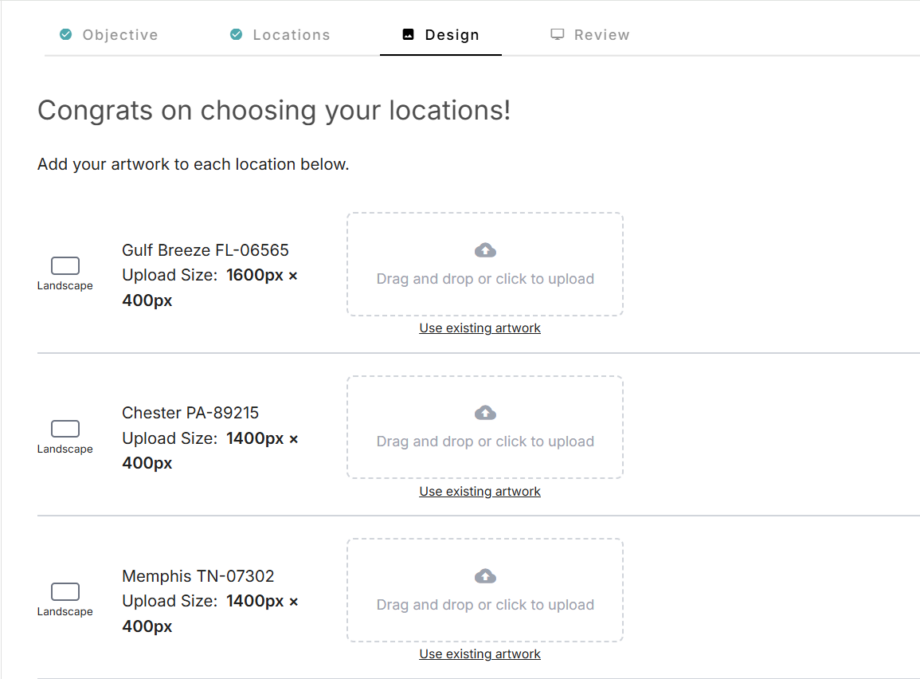
We should also take advantage of Blip’s analytics and artwork tools to test 2 or 3 creative versions. In Broadview, small differences in wording such as “Next Exit,” “Order Ahead,” or “Near Oak Brook” can materially change performance.
Getting Started With Billboard Rental in Broadview
We should begin with a clear local objective
Before we rent any Broadview-area billboard, we should decide what success looks like. Are we trying to reach Broadview residents specifically, west-suburban commuters generally, shoppers headed to Oak Brook, or travelers moving through the tollway network? In this market, those are different buys.
Because Broadview is compact, the best-performing board may not sit inside the village itself. A placement in Hillside Maywood, or along an I-290 approach can still be the right Broadview billboard if it reaches the audience we want.
We should evaluate billboard locations by travel behavior, not just proximity
When we compare locations, we should look at more than a pin on a map. We should ask the following questions.
- Does the board face the direction our customers actually travel?
- Is the board placed before or after the decision point, such as an exit, retail turn, or interchange?
- Is the audience moving at expressway speeds or arterial speeds?
- Is the goal broad awareness, or is the goal immediate action within the next few miles?
In Broadview, those distinctions matter a lot. A high-volume expressway board can be excellent for brand lift, while a smaller local-road board can be better for same-day traffic.
Blip simplifies Broadview billboard rental for testing and scaling
Traditional billboard buying in suburban Chicago can feel rigid, especially when availability changes across multiple municipalities and corridors. Blip makes Broadview easier because we can launch quickly, test without long commitments, and adjust based on actual response. We can start with a commuter-focused plan on I-290, add an arterial layer on Roosevelt Road, then expand toward Rosemont or Oak Brook
That flexibility is especially valuable in a market like Broadview, where the right strategy often emerges from live traffic behavior rather than assumptions. If we begin with a clear audience, a locally relevant message, and a handful of well-chosen west-suburban boards, Broadview can deliver efficient frequency and strong regional reach.