Billboards near Wilmette, IL
No Minimum Spend. No Long-Term Contracts. Just Results.
Trusted by Leading Brands


Billboard advertising
near Wilmette has never been easier



How much is a billboard near Wilmette?
Why Choose Blip for Billboard Advertising near Wilmette
-
Blip lets you launch Wilmette billboards in minutes and reach commuters on US-41, I-94, and I-294 without the usual setup hassle.
-
Use Wilmette's commuter peaks—6:30-9:30 a.m. and 3:30-7:30 p.m.—to show your ad when North Shore drivers are most alert.
-
No contracts or minimums make Wilmette testing easy, so you can scale around New Trier, Old Orchard, and O'Hare traffic as results come in.
-
Track Wilmette campaign performance in real time and shift budget toward Rosemont events, Des Plaines routes, or school-season spikes fast.
-
Blip's creative tools help tailor Wilmette ads for affluent families, New Trier parents, and high-income commuters with polished, fast-read messages.
-
Set flexible daily budgets for Wilmette and focus spend on weekends, back-to-school, or holiday travel when O'Hare and North Shore traffic surges.
Frequently Asked Questions About Billboard Advertising near Wilmette
How much does a billboard cost near Wilmette, Illinois with Blip?
With Blip, you control exactly what you spend on Wilmette billboards by setting a daily budget that can be adjusted anytime, so you’re never locked into a large, fixed contract. Each ad, or “blip,” is a 7.5 to 10-second display, and you only pay for the blips you receive, making billboards near Wilmette, Illinois accessible to local businesses of virtually any size. Because prices vary based on time, location, and advertiser demand, you can start with a modest daily budget and scale up as you see results.
Where can I advertise with Blip near Wilmette, Illinois?
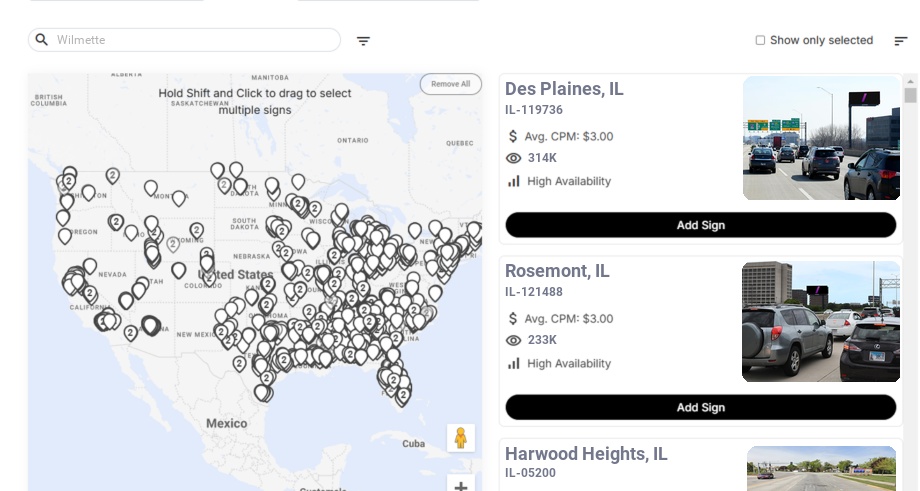
To reach the Wilmette area effectively, we rely on clusters of high-impact locations in nearby cities that together give you practical access to billboards near Wilmette. Key locations include Harwood Heights, Des Plaines, and Rosemont, which are positioned to capture Wilmette area commuters and regional travelers. These boards sit along high-volume corridors near I-90, I-294, and other major routes used by North Shore residents.
Who are Wilmette area billboards reaching?
Wilmette is a compact but powerful market, with roughly 27,000–28,000 residents and about 10,000–11,000 households within just 5.4 square miles of land. Median household income is above $200,000, and more than 60% of households earn $150,000+ annually, placing Wilmette among the top-earning municipalities in Illinois. More than 80% of residents 25+ hold a bachelor’s degree or higher, and owner-occupancy rates exceed 85%.
When is the best time to run billboards in Wilmette with Blip?
Commuter-heavy dayparts matter most in the Wilmette area, especially weekday mornings from 6:30–9:30 a.m. and weekday evenings from 3:30–7:30 p.m. Wilmette’s strong school system also creates heavy traffic before school, after school, and during sports practices, music lessons, tutoring, and club activities. Friday evenings and weekends are also strong for travel, shopping, and entertainment-related messaging.
Why are digital billboards around Wilmette a good fit for local businesses?
Wilmette area residents are less price-sensitive and more value-driven, so creative should emphasize quality, status, design, and trust rather than discounts alone. The area also has strong family and education themes, plus a community-oriented audience that responds well to local, responsible messaging. Digital billboards serving the Wilmette area give you control over budget, timing, and location that static boards can’t match.
Do I need a contract to advertise with Blip near Wilmette?
No, Blip has no long-term contracts or minimum commitments. You can start, pause, or stop your campaign at any time.
How fast can I launch a billboard campaign with Blip near Wilmette?
You can have your campaign live in minutes. Create a free account, select your locations, set your budget, upload your design, and start running once approved.
Where can I advertise with Blip near Wilmette?
Blip has digital billboards near Wilmette. You can browse available locations on a map, choose the ones that fit your audience, and start advertising right away.
Still have questions? Launch a campaign in minutes — no contracts, no commitments.
Start Your CampaignWilmette Billboard Advertising Guide
Wilmette, Illinois is one of the Chicago North Shore Harwood Heights Des Plaines Rosemont within about 10 miles—we can help you build a flexible, data‑driven campaign that follows local residents along their daily routes and functions as turnkey billboard advertising near Wilmette for brands of all sizes.

Understanding the Wilmette Area Audience
Wilmette is a compact but powerful market, which is why demand for Wilmette billboards and nearby placements is consistently strong.
- Population: The Village of Wilmette has roughly 27,000–28,000 residents according to recent community data. The village includes about 10,000–11,000 households, providing a dense, high‑value base of potential customers within just 5.4 square miles of land.
- Income: Median household income in Wilmette is above $200,000, and more than 60% of households earn $150,000+ annually, placing Wilmette among the top‑earning municipalities in Illinois and far above the Chicago metro median (around the low‑$80,000s).
- Education: More than 80% of residents 25+ hold a bachelor’s degree or higher, and in many Wilmette census tracts, 40–50% hold a graduate or professional degree. This is more than double typical U.S. educational attainment.
-
Housing and stability:
- Owner‑occupancy rates exceed 85%, with median single‑family home values typically in the $800,000–$1,000,000+ range.
- Average household size is around 2.7–2.8 persons, reflecting a high share of families with children.
-
Age and family structure:
- Around 30–35% of residents are under 18, and a significant share of households are married couples with children, supported by highly ranked schools like New Trier High School Township District 203 (New Trier Township High School District 203) and local K‑8 districts such as Wilmette Public Schools District 39
- The area also includes a substantial population of established professionals and empty nesters in the 45–64+ age brackets, a high‑spending segment for travel, healthcare, home improvement, and financial services.
What this means for your messaging:
- Premium positioning: With household incomes more than 2x the national median and high home values, residents are accustomed to high‑end brands and services. Creative should emphasize quality, status, design, and trust—rather than discounts alone—when you use billboards near Wilmette.
- Family and education themes: With roughly one‑third of residents under 18 and a major feeder into New Trier (enrollment around 4,000 students across its campuses), references to academics, enrichment, youth sports, and college prep resonate strongly.
- Community‑oriented tone: Wilmette area residents are active in civic life, local schools, and neighborhood organizations. The Village of Wilmette reports dozens of active boards, commissions, and community events each year. Messaging that feels local, responsible, and community‑minded tends to perform better than generic national creative.
How People Move Through the Wilmette Area
Wilmette sits along Lake Michigan just north of Chicago, but most heavy‑traffic corridors are slightly west and southwest—exactly where our digital billboards near Harwood Heights, Des Plaines, and Rosemont are positioned to act as billboards near Wilmette for daily commuters.
Key mobility patterns:
-
Commuting to Chicago and suburbs
- In the broader North Shore and North Suburban region, 65–70% of workers commute by car, truck, or van, and only a minority rely solely on transit. Wilmette mirrors this pattern, with many professionals commuting to downtown Chicago and to corporate campuses in the northern and western suburbs.
- Many residents drive south on US‑41 and I‑94 (Edens Expressway), then connect to highways closer to the city and O’Hare.
- Others work in employment hubs near O’Hare International Airport Village of Rosemont notes that its business and entertainment district draws tens of thousands of workers and visitors daily, significantly amplifying exposure for billboard campaigns.
-
Transit use
- Wilmette is served by Metra’s Union Pacific North Line ( Metra CTA
- Even with these options, car dependency is high: more than 95% of Wilmette households own at least one vehicle, and over 60% own two or more, due to income levels and family needs. This keeps daily vehicle volumes strong on regional arterials where our boards sit, supporting efficient billboard advertising near Wilmette without needing signs inside the village itself.
-
Shopping and leisure
- Residents often shop at Westfield Old Orchard in neighboring Skokie (Westfield Old Orchard), which features 100+ stores and restaurants and draws millions of visits per year.
- Many visit downtown Chicago for culture and dining, or travel via O’Hare for leisure and business. O’Hare handled roughly 80 million passengers annually pre‑pandemic, and traffic has rebounded into the 70+ million range in recent years, according to FlyChicago
- Rosemont and Des Plaines host major attractions—Allstate Arena ( Allstate Arena Rivers Casino Des Plaines), and the Rosemont Entertainment District (Village of Rosemont)—that attract both Wilmette residents and visitors. Single events at Allstate Arena can draw 10,000–18,000 attendees, while Rivers Casino operates 24/7, generating consistent traffic.
According to the Illinois Department of Transportation, many arterial roads near Rosemont, Harwood Heights, and Des Plaines carry average daily traffic (ADT) volumes exceeding 100,000 vehicles, with segments of I‑90 and I‑294 often surpassing 140,000–160,000 vehicles per day. Our 20 digital billboards leverage these high‑volume corridors to consistently capture Wilmette area commuters and regional travelers and function as a de facto network of Wilmette billboards along their regular routes.
Implications for your campaign:
- Focus on commuter routes serving the Wilmette area rather than small neighborhood streets; a single well‑placed digital board on a major interstate can deliver hundreds of thousands of impressions per week.
- Use boards that align with southbound morning traffic and northbound/eastbound evening traffic to target residents going to and from work, O’Hare, and downtown Chicago.
- Consider that your boards will also reach affluent North Shore neighbors from Evanston Kenilworth, Winnetka, and Glencoe who use the same road network; together, these adjacent communities add another 60,000–70,000 residents with similarly high incomes and education.
Where Our Billboards Are Positioned Around the Wilmette Area
To reach the Wilmette area effectively, we rely on clusters of high‑impact locations in nearby cities that together give you practical access to billboards near Wilmette:
-
Harwood Heights (approx. 8.8 miles from Wilmette)
- Dense inner‑ring suburb of about 9,000 residents, surrounded by Chicago on three sides, with limited land area—just over 0.8 square miles—which concentrates traffic on a small number of arterial streets.
- Strong exposure to Wilmette area residents cutting across the Northwest Side toward downtown or near‑north neighborhoods. Traffic along major connectors near Harwood Heights can exceed 30,000–40,000 vehicles per day, according to regional traffic counts.
- For more local context, see the Village of Harwood Heights
-
Des Plaines (approx. 9.5 miles from Wilmette)
- A larger city of roughly 60,000 residents, Des Plaines sits at the junction of I‑294 and major commuter routes, with thousands of jobs in logistics, professional services, and hospitality.
- The City of Des Plaines
- Ideal for targeting Wilmette area residents who work in corporate offices, logistics, and professional services near O’Hare and are regularly exposed to billboard advertising near Wilmette on these corridors.
-
Rosemont (approx. 9.5 miles from Wilmette)
- A powerful regional draw despite its small population (around 4,000 residents). Rosemont’s business, convention, and entertainment district generates an estimated 75,000–100,000 daily visitors on peak days.
- Features the Donald E. Stephens Convention Center, which hosts over 1 million visitors annually, Allstate Arena, the Fashion Outlets of Chicago (over 130 designer outlets and millions of visitors yearly), and multiple hotels and entertainment venues (Village of Rosemont).
- Critical for capturing Wilmette area travelers using O’Hare, attending events, or shopping at outlet centers.
Strategy tip: Combine placements across all three nearby cities to form a coverage ring around the Wilmette area. This lets you intercept residents:
- On weekday work commutes (often 10–20+ miles each way)
- On weekend shopping and entertainment trips to regional destinations
- On airport runs via O’Hare, which for North Shore households can occur multiple times per year, particularly around school breaks and holidays
This multi‑city approach effectively gives you Wilmette billboards in all the places residents already drive, without overpaying for low‑traffic, hyperlocal streets.
Timing Your Campaign Around Wilmette Area Routines
Because many Wilmette residents follow predictable, high‑value patterns, timing matters as much as location when you plan billboard rental near Wilmette.
Commuters in the North Shore typically spend 25–35 minutes each way on their daily trip, and about 60–70% leave home between 6:00–9:00 a.m. Digital billboards along regional highways are visible for these same windows.
Commuter‑heavy dayparts
-
Weekday mornings (6:30–9:30 a.m.)
- Target professionals headed from the Wilmette area toward Chicago and O’Hare.
- Ideal for financial services, B2B, healthcare, coffee chains, and news/media awareness, as commuters may be checking email, news, and calendars upon arrival.
-
Weekday evenings (3:30–7:30 p.m.)
- Capture them returning to the North Shore; outbound traffic from downtown and O’Hare begins to spike just after 3:30 p.m. and can remain elevated beyond 7:00 p.m. on busy days.
- Great for restaurants, grocery, retail, fitness, and home services when consumers are planning same‑day or next‑day purchases.
School‑related activity
Wilmette’s strong school system and proximity to New Trier mean heavy traffic around:
- Before‑school (7:00–8:30 a.m.) and after‑school (3:00–5:30 p.m.) timeframes, when thousands of students and parents are on the road.
- Sports practices, music lessons, tutoring, and club activities, which can extend traffic into the early evening (5:00–8:00 p.m.) across the wider North Shore.
If you cater to families—tutoring centers, pediatric clinics, sports training, arts programs—prioritize afternoons and early evenings Monday–Friday, when parents are making time‑sensitive decisions and mobile search activity is high, and align your billboard advertising near Wilmette with these decision windows.
Weekend and leisure windows
-
Friday evenings and weekends drive trips to:
- O’Hare for travel, where passenger volumes spike around major holidays and school breaks
- Shopping at Old Orchard and Rosemont’s Fashion Outlets
- Sports, concerts, and events at Allstate Arena and downtown Chicago venues
-
Use weekend‑heavy schedules for:
- Travel brands, hotels, attractions
- Restaurant groups, casual dining, fine dining
- Retail, auto dealers, and luxury goods, as discretionary spending is more likely to occur Friday–Sunday
Crafting Billboard Creative for the Wilmette Area
With a highly educated audience, your creative can afford to be slightly more sophisticated—but it must still be clear and fast to read at highway speeds for people encountering billboards near Wilmette on the move.
Key creative principles for this market
-
Lead with benefits, not just price
Wilmette area residents are less price‑sensitive and more value‑driven. With median incomes exceeding $200,000 and a high concentration of professional and executive roles, proof points and outcomes matter. Instead of “Lowest Price in Town,” try:- “College Counseling with 95% Top‑Tier Acceptance”
- “Concierge Medicine with Same‑Day Appointments”
- “Custom Interiors Installed in 10 Days”
-
Visual polish and minimalism
- Use high‑resolution lifestyle imagery that reflects North Shore tastes: clean design, calm color palettes, modern architecture, and understated luxury.
- Limit text to 7–10 words plus your URL/logo to match typical 3–6 second highway viewing times.
- Make one element dominate: either a bold image or a short, high‑impact message.
-
Local cues build trust
- Mention “Serving the Wilmette area”, “North Shore families,” or “Minutes from the Wilmette area” instead of generic regional labels.
- References to New Trier, Loyola Academy ( Loyola Academy
-
Directional and travel‑oriented messages
-
If your business is near Rosemont/O’Hare/Old Orchard, simple directional messages work very well on commuters:
- “Exit at Touhy – Next to Old Orchard”
- “5 Minutes from O’Hare – Covered Parking”
- For Wilmette area residents traveling to these zones, emphasize convenience and time: “Door to Terminal in 15 Minutes from the North Shore.”
-
If your business is near Rosemont/O’Hare/Old Orchard, simple directional messages work very well on commuters:
-
Testing multiple creatives
-
Create 2–4 variations:
- One brand‑heavy
- One offer‑focused
- One testimonial or proof‑driven (“Rated #1 North Shore Orthodontist”)
- One seasonal (“Back‑to‑School Tutoring for New Trier Students”)
- Rotate them using Blip’s scheduling tools and watch for performance differences in web traffic, search volume, or promo code usage. Even small lifts—e.g., a 10–20% increase in branded search or a 5–10% higher conversion rate—can compound significantly over time in a high‑value market.
-
Create 2–4 variations:
Using Blip’s Flexibility to Match Wilmette Area Behavior
Digital billboards serving the Wilmette area give you control over budget, timing, and location that static boards can’t match, making flexible billboard rental near Wilmette simple to manage.
Budgeting for an affluent, niche audience
- You do not need wall‑to‑wall coverage; the Wilmette area is relatively small, and its residents are concentrated along a few major travel corridors. A focused cluster of boards on I‑90, I‑294, and key connectors can deliver repeated weekly exposure to the same 20,000–30,000+ Wilmette and nearby North Shore commuters.
- Put more budget into peak commuter hours on fewer, high‑impact boards instead of low‑intensity, all‑day coverage everywhere.
- Consider heavier weighting on Rosemont and Des Plaines where trip density and event‑related traffic spike—especially on days with large conventions or arena events that can boost traffic by 10–30% over typical levels.
Dayparting and day‑of‑week strategies
- Professional services & B2B: Monday–Thursday, 6:30–9:30 a.m. and 3:30–7:00 p.m., when decision‑makers are commuting and more likely to note services they’ll research later.
- Retail & restaurants: Thursday–Sunday, late afternoon through evening, aligning with the 40–50% of weekly restaurant spend that often occurs from Thursday night through the weekend in affluent suburbs.
- Family services & healthcare: Weekdays 2:30–7:30 p.m., plus Saturday mornings, when parents are juggling school pickups, activities, and appointment scheduling.
With Blip, you can dial these patterns up or down in near real time—e.g., increasing impressions around major events at Allstate Arena or during school milestones like graduation season and back‑to‑school, when household spending on education, apparel, and activities can jump by 20–30%.
Aligning With Local News, Events, and Seasonality
Wilmette area residents are plugged into regional news outlets and community activities, which you can mirror in your billboard advertising near Wilmette.
- Regional news and business coverage:
-
Hyperlocal coverage:
- The Record North Shore
- Village of Wilmette – Community Events
Use these sources to identify:
- Major school events (New Trier and local elementary districts), such as first days of school, finals, graduation, and big games.
- Community festivals and fundraisers, like Wilmette’s summer events and North Shore arts festivals, which can bring thousands of additional visitors into the area over a weekend.
- Regional sports and entertainment around Rosemont and downtown Chicago, where a single concert or sports event can add 10,000–40,000 attendees to local traffic.
Campaign ideas:
- Run “Good Luck New Trier Grads” or “Welcome Back to School, North Shore” creatives during key school periods, reinforcing community ties while aligning with heightened family spending.
- Time campaigns around major concerts, sports events, and conventions in Rosemont, when tens of thousands of additional visitors are passing through the same highways Wilmette residents use.
- During heavy travel seasons (Thanksgiving, winter holidays, spring break), push airport parking, luggage, travel packages, or rideshare services toward O’Hare routes, as holiday passenger counts can spike 10–20% above average months according to FlyChicago
For broader visitor patterns across the North Shore, you can also reference Chicago’s North Shore Convention & Visitors Bureau
Industry‑Specific Opportunities in the Wilmette Area
Because of Wilmette’s demographics, certain verticals align especially well with billboard advertising near the area and gain outsized value from billboards near Wilmette.
- Education & Youth Services
- Test prep, tutoring, music schools, athletic training, college counseling, and enrichment programs are in high demand. In affluent suburbs like Wilmette, families can spend several thousand dollars per year per child on supplemental education, camps, and activities.
- New Trier’s enrollment of around 4,000 students and strong feeder elementary districts in Wilmette, Kenilworth, and Winnetka create a deep, ongoing market for education services.
-
Messaging examples:
- “ACT + SAT Prep for New Trier Students – 10 Min from Wilmette”
- “Travel Hockey Training for North Shore Athletes”
- Concentrate impressions on weekday afternoons and early evenings, plus Saturday mornings, when parents are planning schedules and sign‑ups.
- Healthcare and Wellness
- Concierge practices, dental and orthodontic clinics, dermatology, mental health, and physical therapy all resonate strongly with high‑income households who prioritize quality and access.
- In affluent communities, out‑of‑pocket spending on health and wellness (from orthodontics to boutique fitness) can run 20–40% above national averages.
-
Messaging examples:
- “Same‑Day Pediatric Appointments – Serving the Wilmette Area”
- “Discreet Orthodontics for Busy Professionals – Near O’Hare & the North Shore”
- Home Services and Home Improvement
With older housing stock and high property values, the Wilmette area spends heavily on:
- Renovations, landscaping, roofing, HVAC, interior design, and smart home upgrades. Average major remodels in high‑value North Shore homes can easily exceed $50,000–$100,000.
- Directional ads work well when tied to contractor showrooms or design centers near Rosemont or Des Plaines, where warehouse and showroom space is more available and accessible from I‑294 and I‑90.
- Financial and Professional Services
- Wealth management, estate planning, insurance, law, and accounting are natural fits for a market where a large share of households have significant home equity, retirement assets, and college‑planning needs.
-
Use proof‑based claims:
- “Trusted by 500+ North Shore Families”
- “Fee‑Only Fiduciary Advisors Near the Wilmette Area”
- High‑net‑worth households often work with multiple advisors over time; even a small shift—converting 1–2 new clients per month—can more than justify a focused billboard campaign.
- Travel, Hospitality, and Entertainment
- O’Hare‑proximate hotels, airport parking, car services, and downtown entertainment venues can all reach Wilmette area residents and travelers via Rosemont and Des Plaines boards.
- O’Hare handled over 80 million passengers annually prior to the pandemic according to FlyChicago
- Entertainment offers tied to Rosemont, downtown Chicago, or the broader North Shore can use event‑based scheduling to align with spikes in attendance.
Measuring Success From the Wilmette Area
Because the Wilmette area is affluent and digitally savvy, your audience frequently uses search and smartphones as a follow‑up when they see an ad. Smartphone ownership rates in similar high‑income communities routinely exceed 90%, and broadband adoption is also high, making online tracking tools especially effective for campaigns using billboard rental near Wilmette.
Ways to measure your campaign:
-
Branded search lift
- Track search volumes for your brand name and key service terms during the campaign versus before. A 10–30% uptick in branded search in ZIP codes like 60091 (Wilmette) can be a strong sign of billboard impact.
-
Dedicated URLs or landing pages
- Use short, memorable URLs on your billboard (e.g., brand.com/northshore) to attribute visits. Even if only 1–3% of total site visitors use the vanity URL, the trend line can help validate performance.
-
Promo codes or vanity phone numbers
- Include a simple, billboard‑specific code (e.g., “Mention NORTH SHORE for…”) to track calls and leads. In many local service categories, 20–40% of new customers will mention a promotion if it’s easy to recall.
-
Geo‑based performance
- Look at lead and sales volume from ZIP codes commonly associated with the Wilmette area (e.g., 60091 and neighboring North Shore ZIPs) before and after your campaign.
- Compare metrics such as call volume, form fills, online bookings, and store visits. Even a 5–10% lift sustained over several months can represent substantial incremental revenue in a high‑value market.
Over time, you can adjust your Blip schedule—time of day, locations near Harwood Heights, Des Plaines, and Rosemont, and creative mix—based on which patterns correlate with stronger results, fine‑tuning your billboard advertising near Wilmette for maximum impact.
By understanding how Wilmette area residents live, work, commute, and spend—and by taking full advantage of the flexibility of digital billboards—we can design campaigns that place your message exactly where this high‑value audience is paying attention: along the highways, near the airport, and around the entertainment and shopping zones they use every week, all through a smart network of billboards near Wilmette that you can scale up or down as needed.