Billboards in Lincolnwood, IL
No Minimum Spend. No Long-Term Contracts. Just Results.
Ready to get your brand seen on the go? Blip makes it easy to launch eye-catching ads on Lincolnwood billboards and billboards near Lincolnwood, Illinois, serving the Lincolnwood area with flexible budgets, real-time control, and playful creative options.
Billboard advertising
in Lincolnwood has
never been easier
HERE'S HOW IT WORKS
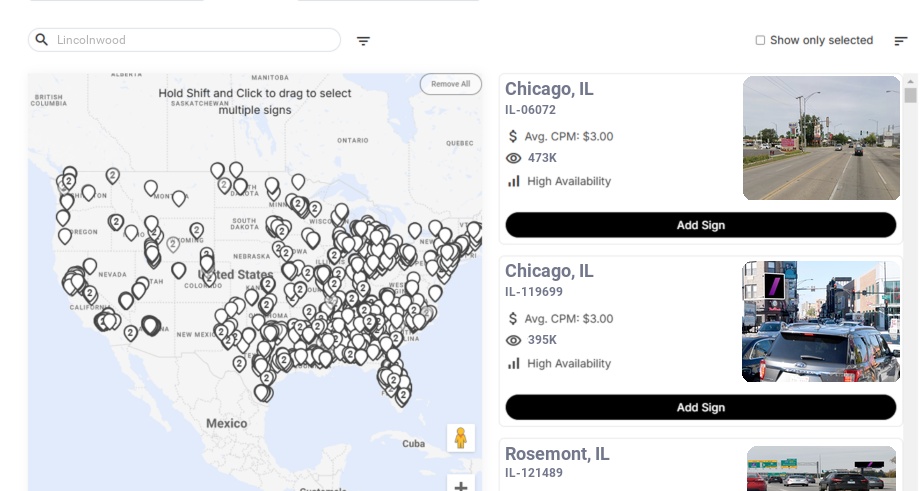
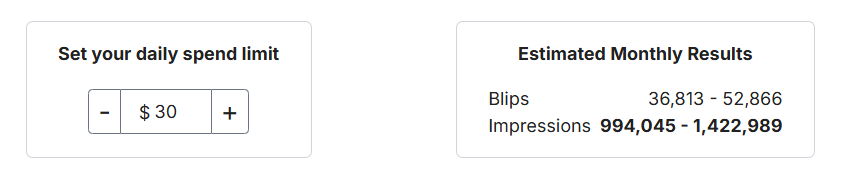
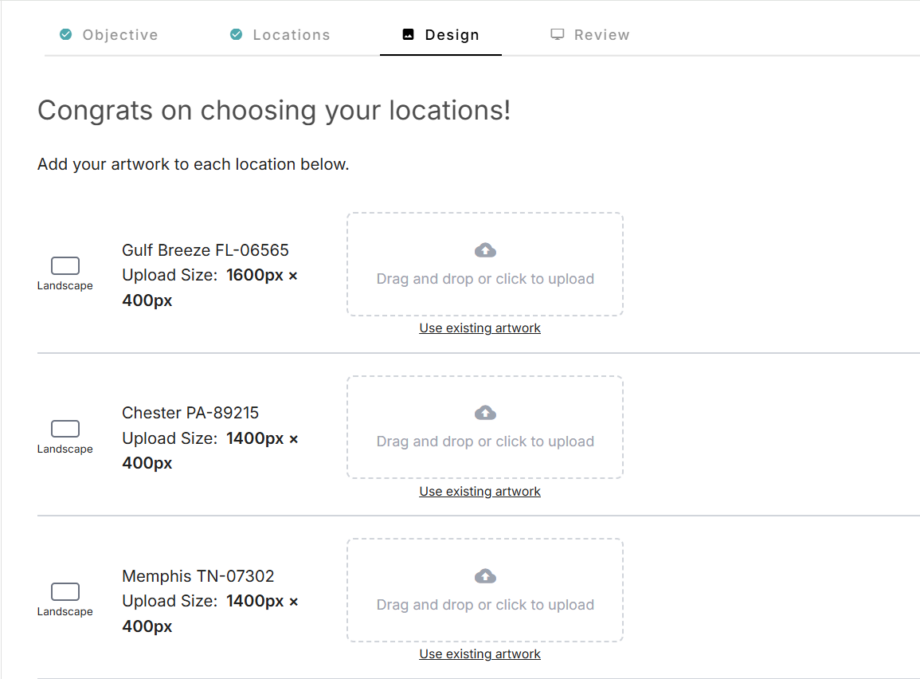
How much is a billboard in Lincolnwood?
Billboards in other Illinois cities
Lincolnwood Billboard Advertising Guide
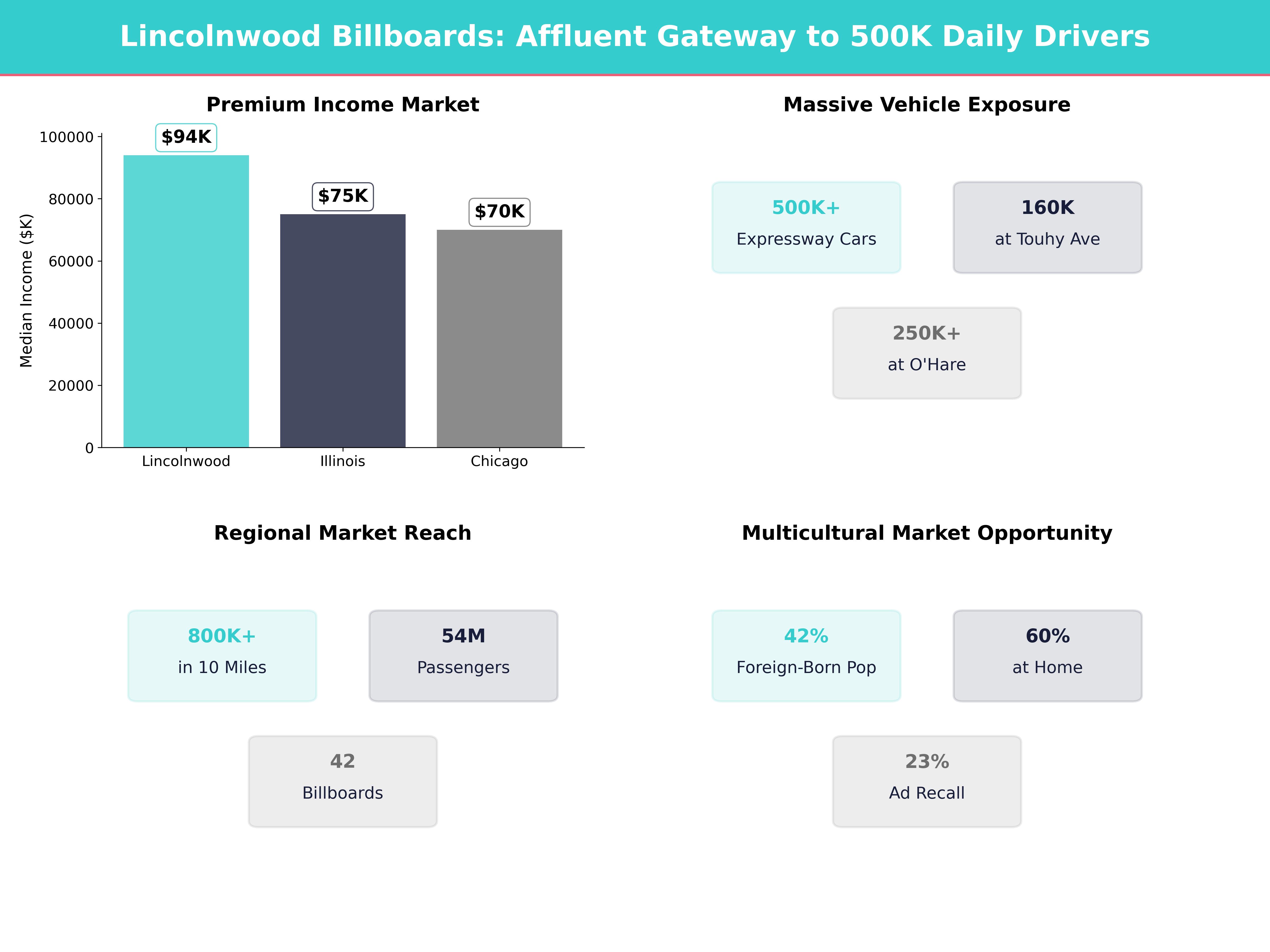
The Lincolnwood area sits at a powerful crossroads between Chicago’s North Side, O’Hare International Airport, and affluent near‑north suburbs. With 42 digital billboards serving the Lincolnwood area within roughly 10 miles, we can help you tap into a dense, mobile audience that lives, shops, commutes, and flies through this corridor every day. Within a 10‑mile radius, you’re tapping into a broader catchment of well over 800,000 residents and daily traffic on major expressways that easily exceeds 500,000 vehicles per day combined, making billboards near Lincolnwood a high‑impact option for regional reach.
Understanding the Lincolnwood Area Market
Lincolnwood itself is a compact but high‑value village of about 13,400 residents as of 2020, packed into only 2.7 square miles. Its location along the Edens Expressway (I‑94), Touhy Avenue, and Lincoln Avenue makes it far more visible than its size suggests. The village’s proximity to downtown Chicago (about 10–11 miles to the Chicago Loop Chicago O’Hare International Airport 9–10 miles) gives advertisers access to both local and regional audiences and helps Lincolnwood billboards punch far above their weight.
Key demographic and economic indicators for the Lincolnwood area:
-
Population & density
- Lincolnwood: ~13,400 residents, with a density of about 4,900 people per square mile, higher than many nearby suburbs and more comparable to Chicago’s denser neighborhoods.
- The broader Niles Township and adjacent portions of Chicago’s North Side add well over 300,000 residents within a 5–6 mile radius, contributing to an everyday trade area that significantly exceeds the village’s boundaries.
- Cook County as a whole has roughly 5.1 million residents, meaning Lincolnwood sits inside one of the largest county‑level markets in the United States.
-
Income & spending power
- Lincolnwood’s median household income is around $93,000–$95,000, well above the Illinois median (around $75,000) and also above the Chicago city median (in the low $70,000s).
- In many nearby census tracts stretching into Skokie, Niles, and Chicago’s Sauganash/Forest Glen areas, median household incomes commonly range from $85,000 to $120,000+, signaling strong discretionary spending on dining, travel, healthcare, and private education.
- Homeownership in Lincolnwood is roughly 75–80%, considerably higher than the City of Chicago’s homeownership rate (around 45–50%), which typically correlates with higher spending on home services, furnishings, and improvement projects that can be effectively promoted with billboard advertising near Lincolnwood.
-
Cultural diversity
- Roughly 40–45% of Lincolnwood residents are foreign‑born, with particularly strong Jewish, South Asian, Middle Eastern, and East Asian communities and a long history as a gateway suburb for new arrivals.
- More than 60% of residents speak a language other than English at home, including Spanish, Urdu, Gujarati, Arabic, Korean, and others. In some nearby pockets of Skokie and West Rogers Park, non‑English usage at home can exceed 70%.
- This diversity makes the area highly receptive to culturally tailored campaigns, religious‑holiday‑specific offers, and multilingual messaging.
-
Commuting behavior
- Around 70–75% of workers commute by car, with an average one‑way commute time of about 30–32 minutes, slightly above the U.S. average commute.
- Fewer than 10–12% of local commuters rely primarily on transit, walking, or biking, underlining the reach advantage of roadside media in this market.
- The Edens (I‑94), I‑90, I‑294, and arterial roads like Touhy, Cicero, and Harlem funnel daily commuters between downtown Chicago, the North Shore, O’Hare, and the northwest suburbs, intersecting with the Regional Transportation Authority
These numbers tell us the Lincolnwood area audience is affluent, diverse, and heavily car‑dependent—ideal conditions for well‑targeted digital billboard campaigns that rotate creative by neighborhood, time of day, and language. Industry studies consistently show that 70%+ of drivers notice roadside billboards and that digital out‑of‑home (DOOH) can increase brand awareness by 20–30% when layered with online and mobile campaigns, making this corridor a high‑ROI environment for billboard advertising near Lincolnwood.
For local context and events that can influence your campaigns, the Village of Lincolnwood and Lincolnwood Chamber of Commerce
Where Our Billboards Serve the Lincolnwood Area
Our 42 digital billboards serving the Lincolnwood area are located in high‑traffic nearby cities, all within about 10 miles. These locations give advertisers access to billboards near Lincolnwood that behave like a connected, regional network rather than isolated placements:
- Harwood Heights (about 4.4 miles away)
Dense residential neighborhoods and key arterials feeding into Chicago’s Northwest Side. The village of Harwood Heights 30,000–40,000 vehicles per day. - Rosemont (about 6.9 miles away)
Home to O’Hare‑adjacent hotels, the Donald E. Stephens Convention Center, Parkway Bank Park, and the Fashion Outlets of Chicago. The Village of Rosemont estimates that its entertainment, convention, and retail district attracts upwards of 18 million visitors annually, driven by the airport, arena events, and shopping. - Des Plaines (about 7.5 miles away)
A major commuter suburb with I‑90 access and traffic to and from O’Hare and the northwest suburbs. The City of Des Plaines 60,000 residents and sits at the intersection of multiple Metra lines, I‑90, and major arterials like Mannheim and River Road. - Schiller Park (about 8.8 miles away)
Industrial, logistics, and hotel clusters surrounding the east and south edges of O’Hare. The Village of Schiller Park hosts numerous distribution centers and airport‑related businesses, with heavy truck and employee traffic throughout the day and night. - Chicago (about 9.3 miles away)
Select boards on the city’s Northwest and North Sides, intercepting traffic to and from Lincolnwood, the Loop, and the lakefront. The City of Chicago population is just under 2.7 million, and the Northwest Side includes dense neighborhoods like Jefferson Park, Portage Park, and Irving Park with traffic counts on key arterials often surpassing 20,000–35,000 vehicles daily.
These locations are strategically positioned along corridors Lincolnwood area residents and visitors actually use, making them ideal for cost‑effective billboard rental near Lincolnwood:
- I‑90 / Kennedy Expressway and I‑94 / Edens Expressway
- I‑294 Tri‑State Tollway
- Arterials such as Touhy, Devon, Harlem, Cicero, Milwaukee, and Cumberland
On these segments, combined average daily traffic between O’Hare and Chicago’s North Side easily tops 400,000–500,000 vehicles per day, according to Illinois Department of Transportation and tollway data. By mixing boards near O’Hare, on suburban arteries, and on Chicago approach routes, we can surround Lincolnwood area audiences as they commute, shop, travel, and attend events.
Audience Segments You Can Reach Near Lincolnwood
Because the Lincolnwood area functions as a bridge between city and suburb, it offers a wide variety of valuable audience segments that can be reached efficiently with Lincolnwood billboards and nearby digital displays:
-
Affluent Suburban Families
- Many households in Lincolnwood and nearby Skokie, Niles, and Sauganash have incomes above $100,000 and own at least one vehicle; in many blocks it’s common for households to own 2 or more cars.
- Nearby retail nodes such as Lincolnwood Town Center, Westfield Old Orchard in Skokie, Fashion Outlets of Chicago in Rosemont, and big‑box clusters along Touhy and Cicero collectively draw tens of thousands of shoppers on a typical weekend.
- Ideal for: family‑oriented products, restaurants, after‑school programs, health care, home services, and financial services.
-
Business Travelers and Tourists via O’Hare
- Chicago O’Hare International Airport 54 million passengers in 2023, rebounding steadily toward pre‑pandemic peaks over 80 million passengers.
- The airport supports more than 230 destinations worldwide and accommodates an average of over 1,800 daily flight operations, feeding a continuous stream of business travelers and tourists into Rosemont, Schiller Park, and Des Plaines.
- Many of these travelers drive or ride through hotel corridors and event districts along I‑90, I‑294, and River Road, where digital billboards can capture both first‑time and repeat visitors.
- Ideal for: hotels, attractions, events, casinos, shopping, city tours, and airport‑area dining.
-
City–Suburban Commuters
- Hundreds of thousands of workers commute daily between Chicago and the northwest/north suburbs across I‑90, I‑94, and supporting arterials. In the broader Chicago region, more than 60% of workers travel outside their home municipality for work, creating high cross‑boundary traffic flows.
- In Cook County overall, more than 1.3 million workers commute by car each day, and many of those routes pass near Lincolnwood’s main corridors or the O’Hare‑Rosemont axis.
- Ideal for: employers recruiting talent, higher‑education institutions, medical providers, quick‑service restaurants, and auto dealers.
-
Local Small‑Business Patrons
- Lincolnwood’s small‑business scene along Touhy and Lincoln includes ethnic groceries, restaurants, medical offices, salons, and specialty retailers, supported by a village unemployment rate that typically trends 1–2 percentage points below major‑city averages.
- Digital billboards near Lincolnwood area corridors let local businesses compete visually with regional and national brands on major roads without the high fixed costs of traditional static boards, making billboard rental near Lincolnwood especially attractive to budget‑conscious owners.
-
Ethnic and Faith‑Based Communities
- With high shares of Jewish and South Asian residents, plus vibrant Middle Eastern and East Asian communities, culturally nuanced messaging performs particularly well here.
- Within a short drive are numerous synagogues, mosques, churches, and community centers that regularly host events—ranging from holidays like Passover, Eid, and Diwali to school fundraisers and cultural festivals—that can be amplified through time‑limited billboard campaigns.
- In similar diverse markets, advertisers who use culturally relevant creative have reported 15–30% higher ad recall compared with generic messaging, making this an important lever in your strategy.
Traffic Patterns and Why They Matter for Timing
Billboard visibility near the Lincolnwood area is shaped by specific traffic behaviors. Understanding these patterns helps us maximize impressions during the most valuable hours and get more from billboard advertising near Lincolnwood.
Key travel corridors and data points:
-
Edens Expressway (I‑94) near the Lincolnwood area
- Segments near Touhy Avenue often carry 150,000–170,000 vehicles per day according to Illinois Department of Transportation traffic counts
- Average travel speeds during peak rush hour can drop below 25 mph, especially during incidents or bad weather, significantly increasing dwell time and message exposure for drivers.
-
I‑90 / Kennedy Expressway and I‑294 Tri‑State
- Combined volumes on key segments near O’Hare and Rosemont commonly exceed 250,000 vehicles per day.
- On some stretches approaching the airport, trucks can make up 10–15% of overall traffic, extending your reach to logistics workers and corporate fleets.
- Morning inbound to the city (6–9 a.m.) and evening outbound (3–7 p.m.) are prime windows to reach Lincolnwood area commuters and O’Hare workers.
-
Touhy Avenue Corridor
- Touhy acts as a commercial spine, linking the Lincolnwood area with Niles, Skokie, Park Ridge, Rosemont, and O’Hare.
- In busy retail segments near Lincolnwood, Niles, and Skokie, daily traffic often ranges from 20,000 to 35,000 vehicles, with noticeable spikes on weekends and during holiday shopping periods.
- Heavy midday and weekend traffic to shopping centers means non‑rush‑hour campaigns can still achieve strong impressions.
-
O’Hare Adjacent Corridors
- Hotel and convention traffic around Rosemont and Schiller Park spikes during major events at the Stephens Convention Center, Allstate Arena, and entertainment districts such as Parkway Bank Park.
- On large convention or concert days, Rosemont often sees tens of thousands of additional visitors, with parking facilities around the arena and convention center filling to capacity and generating sustained pre‑ and post‑event traffic.
From a scheduling standpoint, this implies:
- Commuter campaigns: prioritize early morning (6–9 a.m.) and late afternoon (3–7 p.m.) on I‑90, I‑94, and I‑294, when you can frequently reach the same drivers multiple times per week.
- Retail & dining: emphasize lunchtime (11 a.m.–2 p.m.) and evening (5–9 p.m.), especially Thursday–Sunday when shopping and dining trips peak; many restaurants report 20–30% higher traffic on weekends compared with weekdays.
- Tourism & entertainment: increase frequency Thursday–Sunday evenings and during large conventions or sports events near Rosemont and Des Plaines, when event calendars show elevated attendance.
Crafting Creative That Resonates in the Lincolnwood Area
The Lincolnwood area’s demographics and context suggest specific creative best practices for advertisers investing in Lincolnwood billboards or digital displays on nearby routes:
-
Reflect Cultural Diversity
- Use inclusive visuals—families and individuals from varied ethnic backgrounds—to reflect the area’s mix of Jewish, South Asian, Middle Eastern, and East Asian communities.
-
Consider bilingual or multilingual elements in neighborhoods with concentrated language communities:
- English + Spanish for broader Cook County audiences, where roughly 25–30% of residents speak Spanish at home.
- English + a key community language (e.g., Urdu, Arabic, Korean) for niche campaigns near specific corridors or areas with high community concentrations.
- Keep non‑English text short and high‑impact (e.g., single keywords, offers, or taglines) to maintain readability at highway speeds. Research on OOH effectiveness suggests that reducing copy to under 7–10 words can increase comprehension by 20–25% at standard urban driving speeds.
-
Leverage Local Landmarks and References
- Mention nearby anchors like “near Lincolnwood Town Center,” “minutes from Village Crossing
- References to familiar institutions—like local school names, neighborhoods (e.g., “Sauganash,” “Skokie,” “Niles”), or well‑known streets (Touhy, Cicero, Harlem)—make ads feel local and trustworthy and can boost relevance scores in brand‑lift studies.
-
Use High‑Contrast, Simple Design
- High‑speed roads around the Lincolnwood area demand 7 words or fewer of main copy when possible.
-
Rely on:
- Large, bold fonts
- High contrast (light text on dark background or vice versa)
- One strong focal visual (product image, smiling face, or recognizable logo)
- Given the frequent congestion on the Edens and Kennedy, you can support slightly more detail than rural highways, but clarity still wins. Studies show that digital billboards with a single clear message can enjoy up to 60% higher recall than cluttered designs.
-
Highlight Value and Proximity
-
This is an educated, value‑conscious market. Specific value statements outperform vague branding:
- “New patient special: $59 exam & X‑rays”
- “$10 off your first order—use code LINCOLNWOOD”
-
Add clear directional cues:
- “Next exit from the Edens”
- “2 miles west on Touhy”
- “5 minutes from the Lincolnwood area”
- Including a time‑bound incentive (“This week only”) can increase immediate response rates by 10–15% in many retail categories.
-
This is an educated, value‑conscious market. Specific value statements outperform vague branding:
-
Align Tone with a Sophisticated, Urban‑Suburban Audience
-
The Lincolnwood area audience toggles between Chicago and suburbia. Smart, concise, slightly witty lines can resonate:
- “Stuck on the Edens? At least your finances don’t have to be.”
- “Traffic is bad. Our tacos make it better. Touhy just west of Cicero.”
- Light humor and confident, expert tone often perform well with higher‑income audiences who are used to seeing polished urban advertising downtown and at O’Hare.
-
The Lincolnwood area audience toggles between Chicago and suburbia. Smart, concise, slightly witty lines can resonate:
Using Dayparting and Budget Controls Strategically
With digital billboards serving the Lincolnwood area, you can choose when your ads appear and how often, allowing you to align spend with peak relevance. Because digital slots can be purchased in smaller impression blocks than static placements, even modest budgets can achieve meaningful presence if scheduled precisely, especially when you focus on the strongest billboards near Lincolnwood.
Here’s how to think about timing:
-
Weekday Commuter Focus (Mon–Fri, 6–9 a.m. & 3–7 p.m.)
- Ideal for employers hiring from both city and suburbs; commute‑time campaigns for job openings can generate higher direct‑response rates than off‑peak placements when targeted near employment hubs.
- Great for universities, coding bootcamps, and vocational schools targeting working adults who are thinking about career mobility while they travel.
- Effective for subscription services (gyms, meal kits) and drive‑time radio/podcasts that align naturally with in‑car behavior.
-
Midday & Early Evening (10 a.m.–2 p.m. & 4–8 p.m.)
- Strong for quick‑service restaurants, coffee shops, and local retail that depend on lunchtime and after‑work spending. Many QSR brands see 40–50% of daily traffic in these windows.
- Perfect to promote lunch specials and “after‑work” happy hours near corridors serving the Lincolnwood area.
-
Weekend & Event‑Driven Flights
- Increase frequency around big events at the Allstate Arena, concerts, festivals, and major sports games, when attendance can run from 10,000 to 18,000 visitors per event.
-
Use flexible scheduling to:
- Spike impressions during high‑tourism weekends (summer, holidays).
- Pause or reduce spend during extreme weather when road traffic falls and people stay local—or conversely, increase local‑radius boards to capture nearby residents.
-
Short Bursts for Promotions
- Run 3–7 day “blitz” campaigns for grand openings, limited‑time offers, and seasonal sales. Short bursts around key retail dates (Black Friday, back‑to‑school, tax season) can significantly lift short‑term store traffic.
- Combine O’Hare‑adjacent boards (for travelers) with northwest‑side Chicago boards (for locals) to create the feeling of an omnipresent launch.
Budget‑sensitive advertisers can focus only on those specific time windows rather than buying all‑day exposure, stretching smaller budgets further while still reaching core audiences multiple times per week with targeted billboard advertising near Lincolnwood.
Geographic Targeting: Surrounding the Lincolnwood Area
Because our boards are located near Lincolnwood rather than inside the village itself, placement strategy becomes a powerful lever. Many successful campaigns in this corridor use a layered, “surround and funnel” approach that mirrors real‑world travel patterns documented by regional transportation and planning agencies.
Consider a layered geographic approach:
-
Core Local Radius (0–5 miles)
- Target boards in Harwood Heights and relevant Chicago neighborhoods on the Northwest Side. Corridors like Harlem, Cicero, and Devon at this distance regularly see 20,000+ vehicles per day.
- Purpose: capture residents and workers who regularly pass near Lincolnwood for shopping, schools, or services.
- Best for: hyperlocal businesses (dentists, car washes, independent restaurants, salons, neighborhood clinics) looking for focused billboard rental near Lincolnwood without wasting impressions far outside their trade area.
-
Regional Shopping & Commuter Belt (5–10 miles)
- Mix in boards in Rosemont, Des Plaines, and Schiller Park, as well as select Chicago boards.
- Purpose: reach shoppers traveling to regional malls, major grocery/warehouse stores, and commuters flowing between city and suburb. Retail analysis often shows that households within 5–10 miles account for a large majority (sometimes 60–80%) of sales for brick‑and‑mortar locations in suburban Chicago.
- Best for: multi‑location chains, car dealerships, regional health systems, and financial institutions.
-
O’Hare & Convention Zone
- Emphasize boards near Rosemont and Schiller Park around O’Hare.
- Purpose: capture both travelers and local residents attending conventions, concerts, and events. The O’Hare‑Rosemont zone is one of the Chicago region’s largest concentration points for hotel rooms, with thousands of keys within a few square miles.
- Best for: hotels, attractions, event promoters, airport parking, and ride‑share services.
By adjusting your geographic mix over time, you can start with a tight radius around the Lincolnwood area and then expand as you measure response, drawing on zip‑code‑level performance data to determine which corridors justify more impressions and which specific billboards near Lincolnwood consistently deliver the best results.
Campaign Ideas by Business Type
To make this more concrete, here are example strategies tuned to the Lincolnwood area:
Local Restaurant or Café Near Lincolnwood
- Target boards in Harwood Heights and nearby Chicago corridors used by Lincolnwood area residents, especially those leading to Touhy, Lincoln, and Devon.
- Timing: heavy on weekday commute and lunch hours; add weekend emphasis when restaurant visits often spike 20–40% versus weekdays.
-
Creative:
- “Craving shawarma? 5 minutes from the Lincolnwood area on Touhy & Lincoln.”
- Mouth‑watering food imagery, simple call‑to‑action like “Open late tonight.”
-
Tactics:
- Run higher frequency during cold months when indoor dining spikes and when local news outlets like WGN-TV ABC7 Chicago forecast bitter weather that keeps people close to home.
- Promote seasonal items tied to local events (e.g., “Festival weekend special”) pulled from the Village of Lincolnwood or Choose Chicago event calendars.
Medical or Dental Practice Serving the Lincolnwood Area
- Target boards near I‑94 access points and major arterials Lincolnwood area patients use to reach your office, such as Touhy, Peterson, or Cicero.
- Timing: daytime (8 a.m.–6 p.m.), with a little early morning to reach parents and working professionals. Many practices report higher scheduling activity during standard daytime hours.
-
Creative:
- “New family dentist near the Lincolnwood area—Evening & Saturday appointments.”
- Include phone, website, and a short unique offer (e.g., “Free whitening consult”).
-
Tactics:
- Run consistent low‑level presence year‑round, plus higher‑frequency bursts during back‑to‑school and benefits enrollment seasons, when preventive‑care visits often jump by 10–20%.
- Use unique URLs or phone numbers tied to specific corridors (e.g., Touhy vs. Peterson) to see which directions generate more patients.
Retailer or Service Brand with Multiple Locations
- Target boards across Chicago, Rosemont, Des Plaines, and Harwood Heights to blanket the northwest corridor frequented by Lincolnwood area residents.
- Timing: mix commute, midday, and weekend slots to reach different customer journeys—weekday commuters, weekend shoppers, and O’Hare travelers.
-
Creative:
-
Rotating creative for different store locations, each with a directional cue:
- “Just west of the Lincolnwood area on Touhy”
- “Across from Fashion Outlets – Rosemont”
- Use consistent brand colors and logo so multiple messages feel unified; brand‑consistency studies show recognition lifts of 20% or more when colors and logos are kept uniform.
-
Rotating creative for different store locations, each with a directional cue:
-
Tactics:
- Use different creatives by neighborhood to promote the nearest store.
- Rotate seasonal promotions (back‑to‑school, holiday, tax‑refund season) without incurring printing costs, taking advantage of the flexibility of digital to swap copy in hours instead of weeks.
Higher Education or Training Program
- Target boards near O’Hare, Rosemont, and Chicago’s Northwest Side where working adults commute, often spending 60+ minutes per day in their vehicles.
- Timing: commute hours and late evening (when people think about career changes and continuing education).
-
Creative:
- “Upgrade your career—Evening classes 10 minutes from the Lincolnwood area.”
- Add a specific credential (“IT certifications in 6 months”) and a simple URL.
-
Tactics:
- Concentrate spend 4–6 weeks before application deadlines, when inquiry volumes typically surge.
- Use different creatives for undergraduate vs. adult learner programs, and test including tuition discounts or scholarships, which can improve response rates significantly among cost‑conscious prospects.
Using Local News and Events to Stay Relevant
To keep your messages timely and aligned with what Lincolnwood area residents are thinking about, monitor local news and event calendars:
- Village of Lincolnwood – civic events, construction updates, community alerts that can affect traffic or local interest.
- Lincolnwood Chamber of Commerce
- Choose Chicago and Rosemont’s official site – citywide and suburban tourism events affecting traffic and visitor flows.
- Local news outlets like the Chicago Tribune, WGN-TV ABC7 Chicago – weather, sports, and major news that can inform tone and timing. Game days for the Bears, Bulls, Blackhawks, Cubs, and White Sox often drive noticeable shifts in traffic flows and viewing patterns.
Examples of how to use this information:
- Increase frequency on days with major storms when traffic slows and billboards get more “dwell time,” while also tailoring creative (“Drive safe—We’re open late when you get off the road”).
- Promote warm, comfort‑oriented offers during cold snaps, or outdoor experiences on clear summer evenings; in Chicago, average January highs hover in the low 30s°F, while July highs reach the low 80s°F, creating very distinct seasonal behavior patterns.
- Time campaigns around major sports events or concerts when traffic near Rosemont and key highways surges and visitors from outside the immediate trade area are present.
Measuring and Optimizing Your Campaign
While billboard campaigns are primarily an upper‑funnel and mid‑funnel channel, there are clear ways to gauge and improve performance around the Lincolnwood area:
-
Unique URLs and promo codes
- Use short, location‑specific URLs such as
yourbrand.com/lincolnwoodor codes likeLINCOLNWOOD20to track conversions tied to local campaigns. - In many categories, unique promo codes can attribute 10–30% of incremental sales directly back to specific billboard flights when used consistently.
- Use short, location‑specific URLs such as
-
Call tracking numbers
- Display a unique phone number on your billboards serving the Lincolnwood area to attribute inbound calls to the campaign.
- Call analytics can reveal peak response times and days, letting you align dayparting with real engagement rather than assumptions.
-
Traffic and sales lift
- Compare store traffic, reservations, or sales within certain ZIP codes (60630, 60646, 60659, 60712, 60714, etc.) before and after your campaign.
- Even a 3–5% lift in store visits over a measured period can translate into substantial incremental revenue in high‑ticket categories like healthcare, automotive, or home improvement.
-
A/B test creative
- Rotate 2–3 versions of your message across different boards or time slots, then compare response to each URL/code to identify winning creative themes.
- Testing small differences—price vs. value messaging, photo vs. illustration, humor vs. straightforward—can reveal patterns that improve long‑term ROI.
-
Adjust geography and timing
- If you see better response from travelers (e.g., more redemptions near O’Hare hotels), shift a larger share of impressions to boards serving Rosemont and Schiller Park.
- If local residents are responding more strongly, increase budget during weekday commute times on corridors most used by Lincolnwood area commuters, and consider tightening geography to your highest‑performing ZIP codes.
Bringing It All Together
The Lincolnwood area offers a uniquely concentrated blend of affluent families, diverse communities, and heavy commuter and traveler flows. With 42 digital billboards serving the Lincolnwood area from nearby cities like Harwood Heights, Rosemont, Des Plaines, Schiller Park, and Chicago, we can build campaigns that:
- Surround your audience along their daily routes, tapping into traffic that reaches hundreds of thousands of drivers and passengers every day with billboards near Lincolnwood.
- Tailor messages to specific neighborhoods, languages, and lifestyles in one of suburban Chicago’s most diverse and globally connected corridors.
- Flex timing and budget to peak hours, events, and seasons, maximizing visibility when people are most ready to act with carefully planned billboard advertising near Lincolnwood.
- Continuously refine creative and placement based on measurable results from URLs, call tracking, and sales data so your billboard rental near Lincolnwood becomes more efficient over time.
By grounding your strategy in the local data, patterns, and behaviors outlined above—and by leveraging trusted local resources like the Village of Lincolnwood, Rosemont, and major Chicago news outlets—you’ll be positioned to run digital billboard campaigns that genuinely move the needle for your business near Lincolnwood.