Billboards in Peoria, IL
No Minimum Spend. No Long-Term Contracts. Just Results.
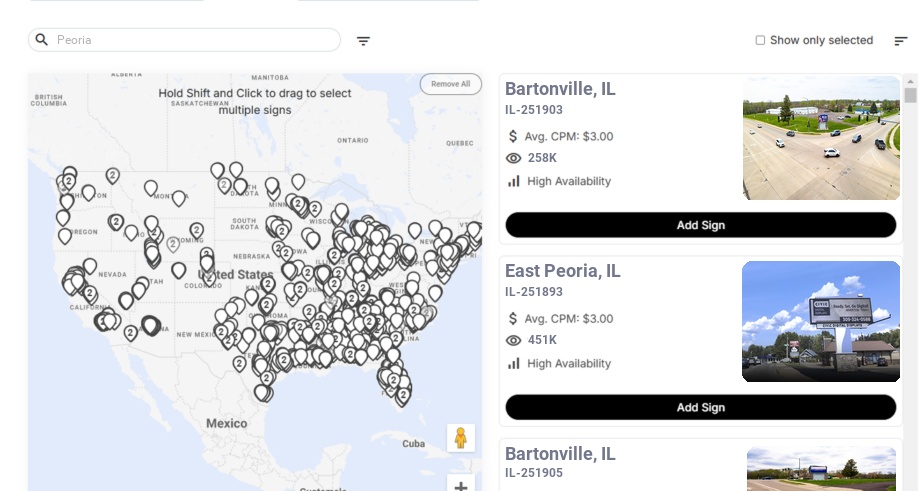
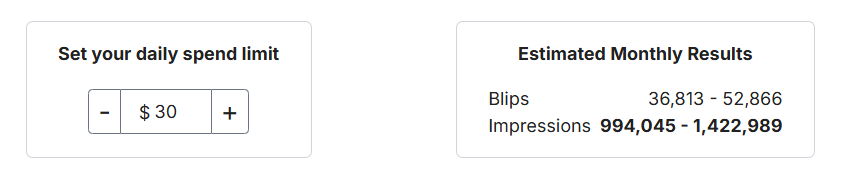
Turn heads in the Peoria area with Peoria billboards made easy. Blip lets you launch eye-catching ads on digital billboards near Peoria, Illinois, on any budget, with playful creative control, flexible timing, and real-time results at your fingertips.
How much is a billboard in Peoria?
Billboards in other Illinois cities
Peoria Billboard Advertising Guide
Peoria sits at the center of one of downstate Illinois’ most important economic and cultural hubs, drawing workers, shoppers, and visitors from across the Illinois River Valley. With four digital billboards near Peoria serving the area from nearby East Peoria and Bartonville, we can help you get in front of commuters, suburban families, and regional visitors at the exact moments they’re moving, spending, and making decisions.
Why the Peoria Area Is a Strategic Billboard Market
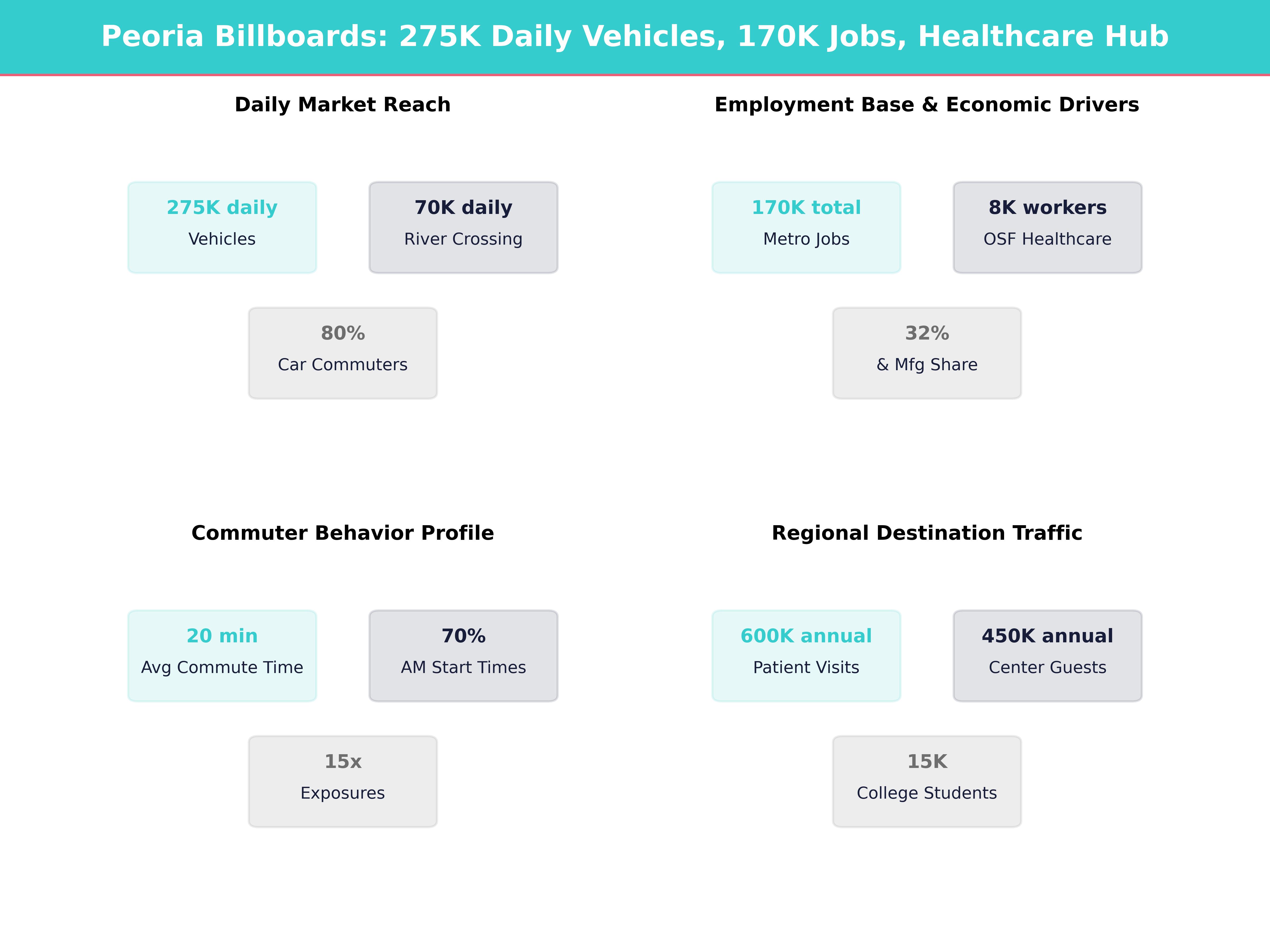
Peoria itself has roughly 110,000 residents, and the broader Peoria metropolitan area (including Tazewell and Woodford counties) is home to roughly 400,000 people. The metro generates billions in annual economic output and anchors employment for much of central Illinois. As the core city for central Illinois, Peoria concentrates jobs, healthcare, and entertainment that attract daily traffic from surrounding communities like East Peoria, Pekin, Washington, and Morton.
A few reasons the Peoria area is particularly strong for digital billboards and other Peoria billboards:
- Regional employment center: According to the City of Peoria, more than 8,000 people work at OSF HealthCare’s headquarters and Saint Francis Medical Center, and Caterpillar Inc. maintains major operations and offices in the area. Greater Peoria Economic Development Council
- Healthcare hub: OSF HealthCare, UnityPoint Health, and other systems make Peoria a medical destination for central Illinois. OSF alone reports more than 600,000 outpatient visits annually at its Saint Francis Medical Center and clinics, and UnityPoint Health’s Peoria facilities add hundreds of thousands more patient encounters each year. Patients routinely travel 30–60 miles for specialty care, meaning your message on billboards near Peoria can reach both locals and regional visitors.
- Education center: Bradley University 5,400 students and employs more than 900 faculty and staff on its Peoria campus, and Illinois Central College 8,000–9,000 students across its campuses in East Peoria, Peoria, and Pekin. Together with local K‑12 districts, that creates a steady 18–35 demographic with high exposure to out‑of‑home media along main commuting corridors.
- Visitor traffic: The Discover Peoria Peoria Riverfront Museum Peoria Civic Center, and the Peoria Park District, which manages more than 9,000 acres of parks and open space and over 50 miles of trails. The Peoria Civic Center alone often hosts 400+ events per year, with total attendance commonly reaching 400,000–500,000 visitors annually, many of whom drive through the same corridors covered by our digital billboards.
All of this adds up to a compact market with repeat daily travel patterns—Tri‑County Regional Planning Commission data show that more than 80% of workers in the area commute alone by car—ideal for frequency‑based message delivery using flexible digital Peoria billboards and smart scheduling.
Understanding Peoria Area Audiences
To build effective creative, it helps to think of the Peoria area in terms of its main audience clusters:
1. Commuters and Working Professionals
- Where they’re going: The downtown government and business core, OSF HealthCare and UnityPoint Health campuses, Caterpillar facilities, and the Peoria Civic Center. Major employers in the city core support thousands of daily trips into Downtown Peoria from surrounding suburbs and rural communities.
- How they travel: Major commute routes cross the Illinois River from East Peoria via I‑74 (Murray Baker Bridge) and US‑150/IL‑116 (Bob Michel Bridge), then loop around the city via I‑474 and local arterials such as University Street, Knoxville Avenue, and War Memorial Drive. Typical one‑way commute times for Peoria‑area workers fall in the 18–23 minute range, which translates into hundreds of weekly minutes spent on the road and a high number of potential billboard impressions.
- What matters to them: Time‑sensitive services (auto repair, banking, healthcare, QSR, coffee), B2B services, and commuting conveniences. With approximately 60–65% of regional workers on daytime schedules, morning and late‑afternoon peaks are especially valuable.
For these audiences, short, direct copy (5–8 words) and strong brand logos work best, especially during morning and evening peak hours when cognitive load is high and drivers are most likely to notice billboard advertising near Peoria’s main bridges and interstates.
2. Suburban Families and Shoppers
East Peoria, Washington, Morton, Dunlap, and Bartonville host a significant share of area families. Retail areas near East Peoria’s shopping districts and Bartonville’s commercial corridors see repeat weekly trips for groceries, dining, and errands. Towns like Washington and Morton each have tens of thousands of residents within a 10–20 minute drive of Peoria’s core.
- The Peoria Public Schools district serves roughly 13,000 students across more than 25 schools, reflecting a large base of K‑12 households and frequent family travel for drop‑offs, pick‑ups, and activities.
- The Peoria Park District reports over 2 million visits annually to its facilities, including destinations such as the Peoria Zoo, Peoria PlayHouse Children’s Museum, and Owens Center, indicating strong family‑oriented activity levels and regular cross‑town trips.
- Nearby Tazewell County communities like Pekin and Morton—highlighted by the Pekin Area Chamber of Commerce and Morton Chamber of Commerce
Billboards serving the Peoria area from East Peoria and Bartonville are ideal for:
- Retail promotions (weekend sales, seasonal clearance)
- Family‑oriented entertainment and attractions
- Healthcare, dental, and orthodontic practices
- After‑school programs and youth sports
These types of campaigns benefit from prominent Peoria billboards on family shopping and school commute routes.
3. College Students and Young Adults
Bradley University sits just west of downtown Peoria, and Illinois Central College’s East Peoria campus puts thousands of students on routes that intersect with Peoria‑area billboard corridors. Between Bradley, ICC, and other nearby institutions, the Peoria region supports well over 15,000 college and vocational students.
This group is heavy on mobile usage—national studies routinely show smartphone ownership above 95% for ages 18–29—and highly responsive to short‑term offers and event‑based messaging.
Messages that perform well with this group include:
- Events (concerts, nightlife, local festivals)
- Quick‑serve restaurants and coffee shops
- Apartment complexes and student housing
- Entry‑level job and internship opportunities
For students, highlight clear calls to action (“Exit at…”, “Apply by…”, “Text PEORIA to…”) and short URLs or QR codes (if they’re large and high‑contrast) so your billboard advertising near Peoria easily translates into quick mobile actions.
Key Corridors and Where Digital Billboards Shine
Our four digital billboards are located in East Peoria and Bartonville, within about 10 miles of Peoria, and are well positioned to intercept:
- I‑74 traffic near East Peoria: Illinois Department of Transportation (IDOT) traffic counts in the Peoria area show daily volumes on I‑74 frequently in the 60,000–80,000 vehicles per day range near the river crossings and interchanges. This is one of the highest‑exposure corridors serving the Peoria area and carries a mix of commuters, regional shoppers, and through‑traffic between Bloomington, Galesburg, and the Quad Cities.
- I‑474 and US‑24 near Bartonville: These routes handle a mix of commuter, industrial, and regional traffic, including access to General Wayne A. Downing Peoria International Airport 600,000–700,000 passengers per year. Segments of I‑474 near Peoria often see 25,000–35,000 vehicles per day, ideal for repeated frequency among regular commuters and logistics traffic connecting to industrial parks and river terminals along the Illinois River.
When planning your Blip campaign and evaluating billboard rental near Peoria, consider these corridor dynamics:
-
East Peoria placements are powerful for targeting:
- Commuters heading into downtown Peoria and the medical district over the Murray Baker and Bob Michel bridges
- Shoppers visiting East Peoria’s retail centers before or after work
- Visitors attending events at the Peoria Civic Center and riverfront venues promoted by Discover Peoria
-
Bartonville placements are strong for:
- Industrial and logistics traffic heading toward industrial parks, the airport, and the Greater Peoria area’s manufacturing zones
- South‑side commuters and residents accessing Peoria‑area services
- Travelers connecting between I‑474 and US‑24 toward Pekin or the Peoria airport
By rotating your blips across both East Peoria and Bartonville boards, you can effectively “wrap” the Peoria area from east and south, improving reach and frequency among the roughly 250,000–300,000 vehicles that move through these corridors on a typical weekday and maximizing the value of your billboard advertising near Peoria.
Timing Your Campaign with Peoria’s Daily and Seasonal Rhythms
Digital billboards with Blip allow you to pay only for the exact hours and days you want your ads shown. For the Peoria area, three timing dimensions matter most:
1. Time of Day
Use Blip’s dayparting tools to align with real‑world patterns:
- 5:30–9:00 a.m. (Morning commute): Reach downtown workers, healthcare staff on early shifts, and students heading to school. In a market where more than 70% of workers start between 7:00 and 9:00 a.m., this window is prime for coffee, breakfast, traffic‑driving offers, and reminder‑style messages (“Today is the last day to…”).
- 11:00 a.m.–2:00 p.m. (Midday): Hit office workers and hospital staff on lunch breaks. Restaurant specials, quick errands, and appointment‑based services perform well, especially near hospital campuses and retail clusters.
- 3:00–6:30 p.m. (Evening commute): Ideal for family‑oriented promotions, retail, and entertainment. Many parents are in “errand mode” picking up kids or heading to activities; local schools and youth sports leagues account for thousands of daily after‑school trips.
- Evening and late night (after 7:00 p.m.): Useful for branding, nightlife, and entertainment, especially around Civic Center events and weekend activities highlighted on the Peoria Civic Center schedule.
Because commute‑heavy time slots often have higher demand, you can test both peak and off‑peak hours to see where your cost per thousand impressions (CPM) and response look best.
2. Day of Week
Peoria‑area behavior shifts significantly between weekdays and weekends:
- Monday–Thursday: Strong for B2B, healthcare, education, and recurring errands. Focus on service awareness and appointment scheduling. Many medical practices and offices report their highest call volumes and online appointment bookings early in the week.
- Friday–Sunday: Retail, restaurants, events, and attractions should ramp up. The Discover Peoria 5,000–20,000 visitors over a few days, creating opportunities for short, intensive campaigns.
Use Blip to:
- Concentrate impressions Thursday–Saturday when promoting weekend events.
- Emphasize Monday–Wednesday schedules for professional services, healthcare, and recruiting.
3. Seasonality
Peoria is a four‑season market, and consumer behavior shifts with the weather:
-
Winter (Dec–Feb):
- Colder temperatures and snow push more people to indoor attractions like the Peoria Civic Center, Riverfront Museum, and shopping centers. Indoor facilities operated by the Peoria Park District and local malls see visitor bumps on cold and snowy days.
- Great window for promoting indoor entertainment, healthcare (flu shots, urgent care), and auto services (tires, maintenance, collision repair).
-
Spring (Mar–May):
- Schools and universities ramp up activities; tax season and home improvement spending kick in. Hardware and garden centers often report double‑digit percentage increases in sales compared with winter months.
- Home services, landscaping, outdoor recreation, and tax/accounting services can gain from increased outdoor visibility and higher miles driven as weather improves.
-
Summer (Jun–Aug):
- The Peoria Park District tens of thousands of attendees over the season.
- Ideal for attractions, family activities, seasonal dining, and tourism‑related businesses, especially those courting visitors from within a 50–75 mile radius.
-
Fall (Sep–Nov):
- Back‑to‑school, Bradley and ICC schedules, and the start of basketball and hockey events at the Civic Center create steady traffic. Local high school football and Bradley Braves athletics add weekly surges in evening and weekend travel.
- Education, healthcare (annual checkups, vaccines), and retail (back‑to‑school and early holiday) perform strongly.
Because Blip is contract‑free, you can dial your budget up during big event windows and reduce or shift it in slower periods, giving you flexibility that’s ideal for ongoing billboard rental near Peoria.
Creative Strategies That Resonate in the Peoria Area
The Peoria area’s blend of blue‑collar roots, healthcare and education professionals, and students means your creative should be clear, direct, and locally grounded.
1. Keep It Legible for Highway Speeds
For boards serving the Peoria area from East Peoria and Bartonville:
- Aim for 6–8 words of main copy, maximum; drivers typically have 6–8 seconds to absorb a billboard at highway speeds.
- Use large, high‑contrast fonts (no thin scripts).
- Avoid clutter: one main image, one logo, one call‑to‑action.
An effective layout might be:
- Top: Short headline (“Need a Doctor Today?”)
- Center: Big visual (smiling patient or doctor)
- Bottom: Brand + a simple directional or digital call‑to‑action (“OSF Walk‑In • 5 Minutes from Downtown” or “Visit PeoriaUrgentCare.com”).
This kind of clear structure helps Peoria billboards stand out along fast‑moving interstates.
2. Localize Your Message
Peoria audiences respond well to local pride and clear geographic relevance. Consider:
-
Referencing local landmarks or districts:
- “3 minutes from the Riverfront”
- “On University, just past Bradley”
- “Across from the Civic Center”
-
Using local teams and events (within brand guidelines):
- Tying into Bradley Braves sports seasons
- Highlighting sponsorships at the Peoria Civic Center or local high schools like those in Peoria Public Schools
You can also leverage local news cycles; the Peoria Journal Star and 25News WEEK often cover major events, business openings, and community stories that you can mirror in timely campaigns.
3. Design for Multiple Creatives
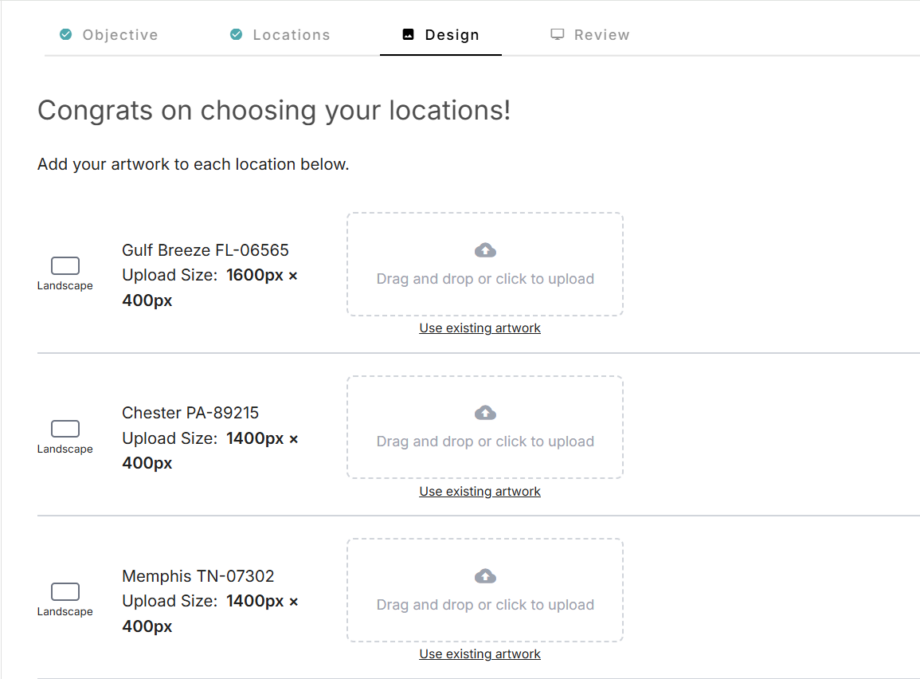
Because you can upload multiple pieces of artwork and rotate them with Blip:
- Use one creative for awareness (brand + tagline).
- Use a second for offer/promotion (limited‑time discount, event date).
- Use a third for social proof (e.g., “Rated #1 in Peoria‑area Roofing – Over 500 5‑Star Reviews”).
Rotating creatives helps combat ad fatigue for frequent commuters—many of whom will pass your board 10–20 times per month—and lets you test different messages against similar audiences.
Using Blip Tools to Target the Peoria Area Efficiently
Blip’s flexible platform is well‑suited to a mid‑sized market like Peoria, where smart targeting and budget control can yield outsized impact.
1. Start with Clear Geographic Coverage
Set your campaign to show on:
- East Peoria boards for river‑crossing commuters, Civic Center traffic, and shoppers headed to or from Peoria‑area retail.
- Bartonville boards for I‑474 and US‑24 commuters, industrial/logistics workers, and south‑side residents, including those traveling to and from Peoria International Airport
If you draw customers from multiple directions (e.g., a regional medical clinic, big‑box retailer, or auto dealer), use all four boards to maximize touchpoints around the Peoria area and capture drivers from Peoria, Tazewell, and Woodford counties. This multi‑directional coverage is one of the simplest ways to get the most value from billboard rental near Peoria.
2. Use Bid Controls to Match Demand
Because different hours and days have different levels of demand:
- Bid higher during peak commute hours if you need maximum reach in a short window (e.g., two weeks before a big event at the Peoria Civic Center or a seasonal sale).
- Lower your bid and run more hours if you’re focused on long‑term brand awareness and want to maximize total impressions over several weeks or months.
Test at least two bid levels for one to two weeks each, then compare impression counts and results (site traffic, calls, store visits). Many advertisers see meaningful differences—sometimes 20–40% more impressions—by slightly adjusting bids and dayparts.
3. Align Flight Dates with Key Local Calendars
Reference local schedules as you plan:
- Bradley University academic calendar
- Illinois Central College events and registration
- Discover Peoria event calendar Peoria Civic Center schedule for tourism, hospitality, and nightlife.
- Major community events in neighboring cities, such as festivals promoted by the City of Pekin and City of Washington, which can bring thousands of visitors onto Peoria‑area roads.
Launch campaigns 2–4 weeks before big events or seasonal shifts so your message has time to build frequency on key billboards near Peoria.
Practical Tips by Industry for the Peoria Area
Here are tailored recommendations for several common advertiser types:
Healthcare and Dental
With multiple hospital systems and clinics, healthcare advertising is competitive in the Peoria area. Healthcare and social assistance together account for roughly 1 in 5 local jobs, so residents are accustomed to seeing medical messages.
- Emphasize speed and convenience: “Same‑Day Appointments Near Downtown” or “Walk‑In Clinic • Open 7 Days.”
- Target commute hours and lunch breaks for workers at OSF, UnityPoint, and downtown offices.
- Use East Peoria boards to catch inbound Illinois River traffic headed to hospital campuses and specialty clinics clustered near downtown and the medical district.
- Consider seasonal pushes: flu vaccines in fall, urgent care and telehealth in winter, sports physicals and dental checkups in late summer.
For these campaigns, consistent billboard advertising near Peoria’s medical corridors helps keep your name top of mind when care decisions are made.
Retail and Restaurants
Retail trade and food services represent a sizable share of Greater Peoria’s economy, with thousands of jobs concentrated in shopping corridors around East Peoria, North Peoria, and Bartonville.
- Promote specific offers: “Kids Eat Free Tuesdays,” “20% Off This Weekend Only,” or “Happy Hour 3–6 PM.”
- Increase blips Thursday–Sunday, when residents are most likely to dine out or shop; many restaurants report 30–40% of weekly sales on Friday and Saturday alone.
- Use simple directions: “Exit I‑74 at Washington St” or “Next to East Peoria Costco.”
- Tie into major retail periods like back‑to‑school (August–September) and holiday shopping (November–December), when consumer spending spikes.
Retailers that rely on drive‑by visibility often see strong returns from Peoria billboards placed along their primary access routes.
Education and Training
For universities, community colleges, and trade schools:
- Align campaigns with enrollment windows and job fairs. Many institutions see 50–70% of annual inquiries occur in the 2–3 months before term starts.
- Use straightforward CTAs like “Apply by June 1 at…” or “Register for Fall Classes.”
- Rotate different messages: one for traditional students, another for adult/part‑time learners in need of upskilling or career changes.
- Target commuter routes from outlying towns like Pekin, Washington, and Morton to reach prospective students who may not be on campus daily.
Because so many students commute, billboard advertising near Peoria’s bridges and arterials can complement digital campaigns by reinforcing your brand every school day.
Home Services and Contractors
Given Peoria’s aging housing stock and four‑season climate, demand for maintenance and renovation is steady:
- Focus on spring and fall for roofing, HVAC, landscaping, and remodeling—months when homeowners are preparing for temperature extremes. Contractors often report 20–30% higher inquiry volumes in these shoulder seasons versus mid‑winter.
- Use before/after visuals and trust markers (“Serving Peoria‑area Homes Since 1998,” “Over 1,000 Local Roofs Installed”).
- Run heavier schedules after major weather events that make repairs urgent, especially along corridors where storm damage is most visible.
- Target both East Peoria and Bartonville to cover residential neighborhoods on the east and south sides of the metro.
For service businesses that draw from multiple ZIP codes, flexible billboard rental near Peoria allows you to cover several neighborhoods without the cost of separate campaigns in each town.
Events, Attractions, and Tourism
Peoria‑area events often draw attendees from across central Illinois, southern Illinois, and even neighboring states:
- Start campaigns 2–3 weeks before event dates; for large festivals or trade shows, consider 4 weeks to build awareness among out‑of‑town visitors.
- Increase frequency the week of the event, especially Thursday–Saturday, when last‑minute planners decide where to go.
- Use countdown style copy: “Riverfront Festival – 3 Days Away,” “This Weekend Only at the Civic Center.”
- Highlight easy directions and parking: “Downtown Peoria • Follow Riverfront Signs” or “Free Parking at Civic Center Garage.”
- Cross‑promote with tourism and event listings from Discover Peoria Peoria Journal Star to reinforce your message across channels.
These strategies help ensure your investment in billboard advertising near Peoria’s highest‑traffic corridors translates into real‑world attendance.
Measuring Success and Optimizing Over Time
To get the most out of your Peoria‑area billboard campaign, tie your Blip data to simple, trackable metrics:
- Watch for spikes in web traffic or online searches for your brand from Peoria‑area ZIP codes when campaigns are live. Many advertisers see 10–30% traffic lifts during active billboard flights, especially when combined with digital campaigns.
- Use unique URLs or promo codes on your billboards to attribute responses (“Show Code PEORIA at checkout” or “Visit BrandName.com/Peoria”).
- Ask new customers how they heard about you and track the share referencing “billboards,” “signs,” or “digital boards.” Even a 10–15% share attributed to out‑of‑home can indicate strong performance relative to budget.
- If you run call centers or track inbound calls, monitor call volumes by hour and day; align spikes with your Blip schedules.
Over time, adjust:
- Locations: Shift budget between East Peoria and Bartonville boards based on which routes deliver more customers. For example, an airport‑focused campaign may lean more heavily on Bartonville, while a downtown retail or medical campaign may favor East Peoria.
- Dayparts: Double down on hours and days that correlate with higher response and reduce spending during low‑performing windows.
- Creative: Keep top‑performing designs in rotation and retire underperformers; iterative testing on headlines, offers, and imagery can yield significant improvements in response rates over a few campaign cycles.
By combining these data‑driven adjustments with a solid understanding of Peoria‑area traffic patterns and audience behavior, you can use our four digital billboards near Peoria serving the area to build a campaign that is both cost‑efficient and highly visible to the people most likely to become your customers.