Billboards in Malden, MA
No Minimum Spend. No Long-Term Contracts. Just Results.
Put your message in lights with Malden billboards through Blip—easy, flexible, and fun. With 19 billboards near Malden, Massachusetts serving the Malden area, you set the budget, timing, and creative while Blip handles the rest of your roadside spotlight.
Trusted by Leading Brands


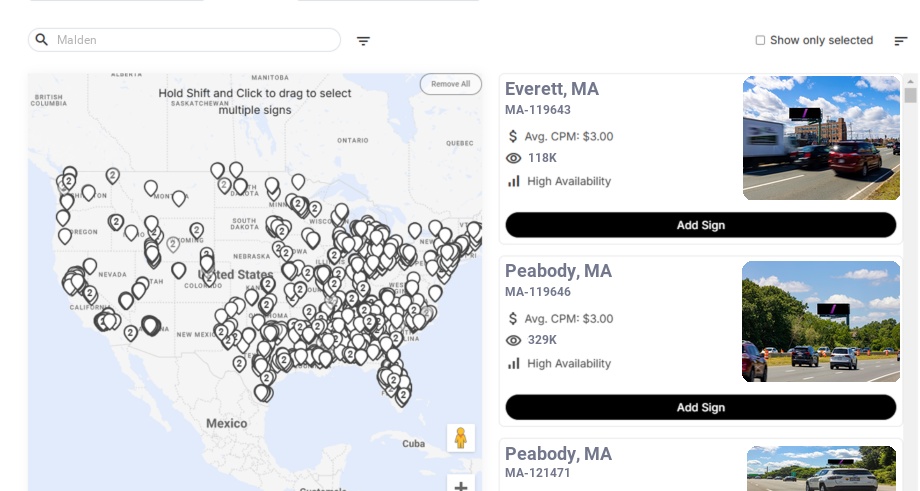
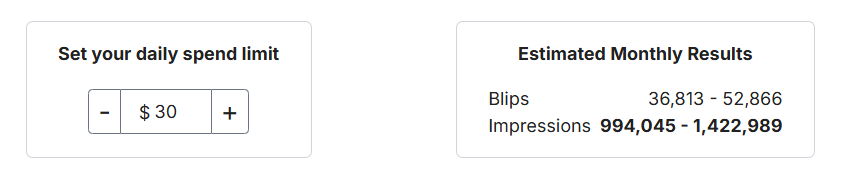
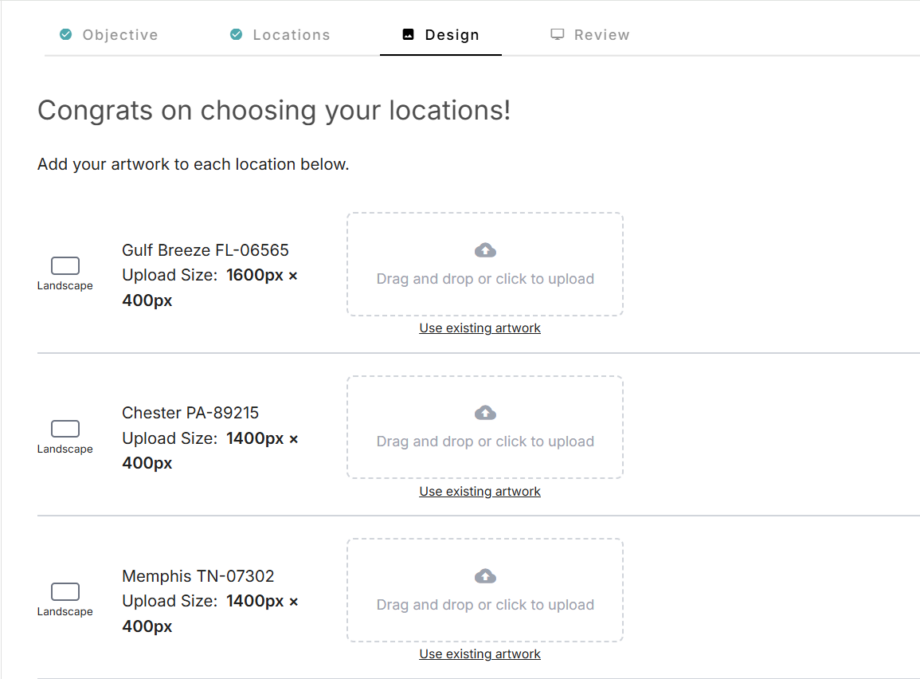
How much is a billboard in Malden?
Billboards in other Massachusetts cities
Malden Billboard Advertising Guide
The Malden, Massachusetts area sits at the crossroads of neighborhood life and major regional commuting patterns, making it an especially powerful place to use digital billboards. With 19 Blip digital billboards serving the Malden area from nearby Everett Chelsea, Boston, and Peabody, we can help you reach residents, workers, and visitors as they move between home, downtown Boston, and the North Shore. For advertisers searching for billboards near Malden that tap into both local and regional traffic, this cluster of locations offers broad coverage without needing to buy boards deep in downtown Boston.
Why the Malden Area Is a High-Value OOH Market
Malden is a dense, transit-rich city that punches above its weight for advertisers and makes Malden billboards especially efficient:
- The City of Malden reports a population of roughly 66,000–67,000 residents in just 5.5 square miles, putting density above 12,000 people per square mile—nearly double the statewide density and higher than many Boston suburbs like Woburn or Braintree.
-
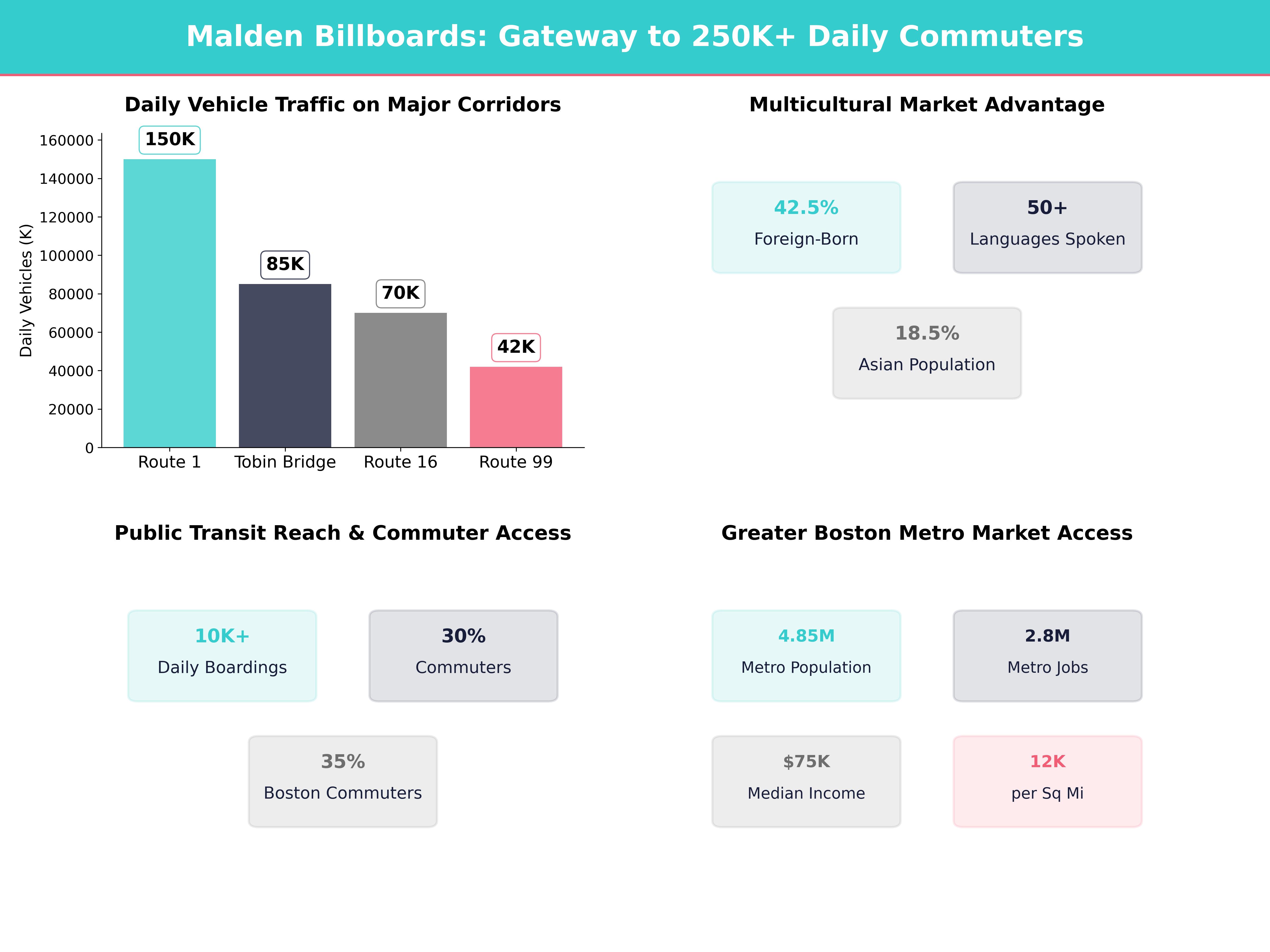
Malden sits only about 5 miles north of downtown Boston, and is directly connected via the MBTA Orange Line and key roadways like Route 1, Route 16, and Route 99. On a typical weekday, these corridors carry well over 250,000 vehicle trips combined, including:
- Route 1 near Chelsea: frequently 140,000–160,000 vehicles per day
- Route 16 through Everett and Chelsea: often 60,000–80,000 vehicles per day
- Route 99 through Malden and Everett: commonly 35,000–50,000 vehicles per day
You can explore regional traffic data through the MassDOT Highway Division
- Greater Boston’s metro population exceeds 4.8–4.9 million people, and the broader labor market includes more than 2.8 million jobs, with Malden-area commuters feeding into key employment hubs in Boston, Cambridge, Somerville, and the Route 128 corridor.
- Malden is also a strong transit market. The MBTA Orange Line’s Malden Center and Oak Grove stations together see well over 10,000 weekday boardings in a typical year, according to the MBTA, making them some of the busiest stations north of Boston.
Because Malden is both a “bedroom community” and a bustling local center, our boards near Malden reach:
- Residents commuting toward Boston and Cambridge in the morning and returning in the evening. In many north-of-Boston communities, 30–40% of workers commute into the core Boston/Cambridge area.
- Shoppers traveling to regional retail hubs such as Assembly Row in Somerville, which attracts an estimated 10+ million visitors annually, Gateway Center in Everett tens of thousands of weekend visits), and Northshore Mall over 120 stores and strong regional draw from across the North Shore.
- Visitors heading to major attractions like Encore Boston Harbor in Everett, which has reported millions of visits annually (over 5 million in a recent year), or downtown Boston events, where venues like TD Garden and Fenway Park can each bring 35,000–40,000 people into the city on a single game or concert night.
This blend of local and regional traffic creates multiple opportunities to align your Blip schedule with how and when your ideal customers travel, especially if you’re looking for flexible billboard advertising near Malden that can adapt to commuter and shopping patterns.
Where Our Digital Billboards Reach People Near Malden
We have 19 digital billboards serving the Malden area, all within about 10 miles, positioned in high-traffic nearby cities. This network functions much like a ring of Malden billboards that follow your audience through their daily routines:
- Everett (≈1.5 miles from Malden):
Ideal for catching Malden residents heading toward Boston via Route 16 or Route 99, and for reaching visitors going to Encore Boston Harbor. According to the City of Everett 48,000 residents live in just 3.7 square miles, with Route 16 and Route 99 acting as primary commuter arteries. Everett is a natural “gateway” for Malden traffic and a prime spot if you want billboards near Malden without paying downtown Boston premiums. - Chelsea (≈2.3 miles from Malden):
A key corridor for drivers heading toward the Tobin Bridge, downtown Boston, and Logan Airport. The City of Chelsea notes that the city’s 36,000+ residents live in only 2.5 square miles, and the Tobin Bridge funnels 80,000–90,000 vehicles per day toward Boston. Many Malden residents and workers funnel through Chelsea on commutes or airport trips, making it a strategic location for billboard advertising near Malden that reaches both locals and visitors. - Boston (≈6.6 miles from Malden):
Boards in Boston serve Malden-area commuters as they arrive in the city for work, school, and events. Boston’s daytime population swells to more than 1.2 million people when students and workers are included, and downtown Boston plus the Seaport and Back Bay collectively host hundreds of thousands of workers and visitors on a busy weekday. This is ideal for reinforcing your brand message at both ends of a commute, extending the impact of Malden billboards into the core of the metro area. - Peabody (≈8.1 miles from Malden):
A major North Shore retail and employment hub. The City of Peabody has roughly 55,000 residents, and its regional shopping cluster around Route 128—including Northshore Mall and adjacent big-box centers—draws shoppers from across 20+ surrounding communities. Shoppers from Malden regularly travel to Peabody for big-box retail and the Northshore Mall, giving you strong weekend and evening visibility and making Peabody placements an important part of any billboard rental near Malden.
By blending placements across these four cities, we can help you “surround” Malden audiences—reaching them close to home, near work, and on key shopping and entertainment trips with a coordinated set of billboards near Malden.
Understanding Malden Audiences and Demographics
Malden is one of the most diverse communities in Massachusetts, which has important implications for your creative and targeting:
- The population is roughly 46–50% White, 17–20% Asian, 15–18% Black or African American, and 10–15% Hispanic or Latino by many recent local estimates. No single racial group constitutes a majority, which is rare among mid-sized Massachusetts cities.
- Around 40–45% of residents are foreign-born, one of the highest shares in the state, and more than 50 languages are reported in homes across the city, including Portuguese, Spanish, Haitian Creole, Chinese, Vietnamese, and Arabic.
- Median household income is in the mid-to-upper $70,000s, with a sizable share of households earning $100,000+ alongside a strong working- and middle-class base.
- Roughly 23–25% of residents are under 20, and around 30–35% of households include children, making family-focused messaging particularly effective.
- Educational attainment is strong: in many recent estimates, around 35–40% of adults hold a bachelor’s degree or higher, feeding demand for professional services, higher education, and enrichment programs.
- Commuting patterns are mixed: approximately 50–55% of workers drive alone, 25–35% use public transit (primarily the Orange Line and MBTA buses), and the remainder walk, bike, or work from home—meaning your audience is split between highway corridors and transit-accessible destinations.
What this means for your billboard strategy:
- Multicultural messaging: Consider inclusive imagery and, when appropriate, brief bilingual copy (for example, English plus Portuguese, Spanish, or Chinese) to connect with key communities. In a city where nearly 1 in 2 residents was born outside the U.S., culturally aware creative can meaningfully lift relevance and response.
- Family-focused offers: With more than 10,000 school-aged children in Malden Public Schools and nearby districts, families respond well to promotions for after-school programs, youth sports, family dining, and weekend activities.
- Commuter professionals: Many residents work in sectors like healthcare, education, tech, and finance in Boston and Cambridge. The Boston region has over 500,000 jobs in knowledge and professional services alone, so offers for professional services, higher education, and financial products can perform well.
To better understand the civic and community context, explore the City of Malden website, which lists neighborhood resources, events, and local initiatives that can inspire localized creative. The Malden Redevelopment Authority also shares data on business districts, new developments, and downtown activity—useful context when you’re planning billboard advertising near Malden that feels genuinely local.
Timing Your Blip Campaign Around Local Traffic Patterns
With Blip, you can schedule your ads to appear only at specific times of day or days of the week. In the Malden area, it pays to align with real-world traffic and behavior:
Weekday Morning Commute (6:30–9:30 a.m.)
-
Malden residents travel toward Boston via:
- Route 99 through Everett
- Route 16 across Everett and Chelsea
- The MBTA Orange Line from Malden Center and Oak Grove
- On a typical weekday, these routes carry tens of thousands of vehicles each hour during peak periods, while Orange Line trains can run every 6–8 minutes with hundreds of riders per train.
- Target this window in Everett and Chelsea to reach commuters before they reach Boston, and in Boston to reinforce your message as they arrive.
Use this daypart for:
- Coffee shops, breakfast spots, and quick-service restaurants—especially when paired with drive-thru or mobile order offers commuters can act on within 15–20 minutes of seeing your ad.
- Transit-accessible gyms or studios (e.g., “Work out before work”) near Orange Line or key bus routes.
- Professional services or B2B offers (“Upgrade your IT support this quarter”) that benefit from morning exposure when decision-makers are planning their day.
Evening Commute (3:30–7:00 p.m.)
- Many workers flow back through Boston, Chelsea, and Everett toward Malden and the North Shore. In some corridors, p.m. peak traffic volumes can be 10–20% higher than mid-day volumes, and travel times can double compared to off-peak.
- This is prime time for offers that can be acted on that night or upcoming weekend.
Consider:
- Restaurant and bar specials (“Tonight only…”), particularly effective when promoted within 3–5 miles of your location.
- Local events, shows, and entertainment at venues in Malden, Everett, or Boston, where same-day or next-day ticket sales can spike with timely reminders.
- Retail and personal services: salons, car washes, fitness, and tutoring, all of which see strong after-work demand.
Weekend and Shopping Peaks
-
Saturday late morning and afternoon: Malden-area residents travel to shopping and entertainment destinations like:
- Gateway Center and Encore Boston Harbor in Everett
- Assembly Row in Somerville
- Northshore Mall in Peabody
- Large centers like Northshore Mall and Assembly Row can each attract tens of thousands of visitors on a busy Saturday, creating a dense concentration of potential impressions.
- Schedule more impressions on Peabody and Everett boards Fridays and Saturdays to catch these trips, especially 10 a.m.–3 p.m. and early evening. This is a smart way to harness billboard rental near Malden for high-intent weekend shoppers.
Event-Driven Spikes
- Major events in Boston (sports games, concerts, conventions) significantly increase regional traffic. A single sold-out game or concert at TD Garden or Fenway can draw 30,000–40,000+ attendees, many of whom travel along the same routes Malden residents use.
- Check regional calendars from Meet Boston and the Massachusetts Office of Travel & Tourism
- For airport-related travel, keep in mind that Boston Logan International Airport has handled 30–40 million passengers annually in recent years, contributing to steady traffic flows on Route 1 and Route 16 via Chelsea.
Creative Strategies That Resonate in the Malden Area
Because digital billboards near Malden reach a mixed audience of commuters, families, and multicultural communities, your creative should be:
1. Hyper-Clear and Location-Aware
-
Use simple, directive copy:
- “Exit in Everett – 5 Minutes from Malden”
- “On Route 1, Just 10 Minutes from Malden Center”
-
Mention local anchors that Malden residents instantly recognize:
- “Near Malden Center T Station”
- “Next to Gateway Center in Everett”
- “Short drive from Ferry Street in Malden”
- Studies of out-of-home (OOH) effectiveness consistently show that messages with 7 words or fewer and clear directional cues have significantly higher recall, which is critical on fast-moving roads like Route 16 and Route 99.
2. Culturally Inclusive
- Reflect the diversity of Malden in your imagery—families of different backgrounds, multicultural groups, and inclusive visuals. In a city where roughly half the population is non-White and nearly 45% is foreign-born, representation can materially improve brand affinity.
-
If you use bilingual copy, keep it ultra-brief. Example for a restaurant:
- “Family Dinner Tonight / Jantar em Família Hoje”
- “Order Now – Entrega em Malden Area”
3. Commuter-Friendly Messages
-
Speak directly to commuters’ mindsets:
- Morning: “Skip Cooking Tonight – Order Ahead Now”
- Evening: “Classes Start at 7 pm – Enroll by Friday”
- Keep text under 7–8 words whenever possible. Traffic moves quickly on Route 16, Route 99, and near Boston, and drivers often have only 5–8 seconds to absorb your message.
- Use high-contrast colors and large fonts; research shows legibility can drop sharply beyond 250–300 feet if fonts are too small or low-contrast.
4. Offer-Driven With Clear CTAs
-
Use strong calls to action that can be completed on a phone:
- “Book at maldenlaw.com”
- “Text MALDEN to 55555 for 20% Off”
- Consider unique promo codes for boards near Malden (e.g., “MALDEN20”) to measure impact. OOH advertisers who use unique codes or vanity URLs often see 10–30% higher attribution clarity versus using generic offers.
- Highlight urgency (“This Week Only,” “Ends Sunday”) to capitalize on the 3–7 day window when many viewers are most likely to act after seeing an OOH ad.
For inspiration on local stories and tone, scan local outlets like the Malden Observer Boston.com, or The Boston Globe to see how regional brands talk to residents. You can also look at hyperlocal coverage via the Malden Advocate on Advocate News or regional public radio at WBUR for examples of how organizations tailor messages to Greater Boston audiences and how they speak to people who regularly see billboards near Malden.
Using Blip Tools to Target the Malden Area Efficiently
Blip’s flexibility is especially powerful in a tight, urban-suburban market like Malden. Here are ways to use our tools to your advantage:
1. Focus on Key Corridors Serving Malden
-
Use more impressions on boards:
- In Everett to reach Route 16 and Route 99 traffic.
- In Chelsea to intercept travelers toward the Tobin Bridge.
- In Boston to boost your brand at the city end of the commute.
- In Peabody to reach Malden shoppers heading to the North Shore.
These corridors collectively handle hundreds of thousands of daily trips, so even a modest share of impressions can translate into tens of thousands of daily views for your campaign and give your billboard advertising near Malden real scale.
You can start with a balanced mix—say, 40% Everett, 25% Chelsea, 25% Boston, 10% Peabody—and then adjust based on performance and where you see more web traffic, calls, or store visits.
2. Dayparting for Budget Control
-
Concentrate budget where your audience is most active:
- Parents: morning school runs (7–9 a.m.) and early evening (4–7 p.m.).
- Nightlife & dining: late afternoon through late evening Thursday–Saturday (3–10 p.m.).
- B2B: weekday rush hours and lunchtime (7–10 a.m., 11:30 a.m.–1:30 p.m.).
If you have a modest daily budget, narrow your schedule to the single most valuable 2–4 hour window each day. Many advertisers see higher effective reach per dollar when they focus on peak relevance instead of running thinly across the full day.
3. Rotate Multiple Creatives
-
Use 2–4 different creatives in a single campaign:
- Version A: brand awareness (“We’re Malden’s New Dental Office”)
- Version B: offer (“$99 New Patient Special”)
- Version C: urgency (“Book This Week – Limited Openings”)
- Version D: location cue (“Near Malden Center T – Walk-Ins Welcome”)
- Over a 2–4 week period, you can see which message drives more web traffic, calls, or walk-ins. Advertisers who test multiple creatives often see 10–25% improvements in response by shifting spend toward top-performing messages.
4. Flighting Around Paydays and Events
-
Increase your Blip budget around:
- 1st and 15th of the month (common pay periods), when discretionary spending often spikes.
- Back-to-school weeks (late August/early September), when families are making high-intent purchases on clothing, supplies, and activities.
- Major holidays and local celebrations listed on the City of Malden Events Calendar, as well as regional events on Meet Boston’s events calendar.
Then pull back slightly during lower-intent periods, while still keeping a baseline presence. Research on OOH “always-on” strategies suggests that maintaining at least 30–40% of your peak spend between major pushes can help preserve brand awareness.
Vertical-Specific Ideas for the Malden Area
Different industries can lean into distinct behavior patterns in the Malden area, using Malden billboards and nearby placements to match how customers move through the region:
Local Restaurants, Cafés, and Grocers
- Target evenings and weekends with boards in Everett, Chelsea, and Boston to capture commuters and weekend shoppers. In many metro areas, 50–60% of restaurant visits occur Thursday–Sunday, with strong peaks on Friday and Saturday nights.
-
Use time-sensitive copy:
- “Order by 6 pm, Pickup in Malden Area at 7 pm”
- “Weekend Brunch – 10 Minutes from Malden Center”
- If you offer delivery to Malden, say it explicitly: “Free Delivery in the Malden Area.”
- Consider highlighting app-based ordering or QR codes; surveys show that over 80% of adults now own smartphones, and mobile-friendly CTAs often drive higher response from commuters.
Retail, Auto, and Services
- Focus on Peabody and Everett locations during Saturday and Sunday afternoons, when residents drive to big-box stores and malls. Weekend foot traffic at major malls and power centers can be 30–50% higher than typical weekdays.
-
For auto sales and repair:
- “Need Service? Exit in Everett – Same-Day Appointments”
- “Malden Drivers: Free Inspection This Week.”
- Auto-related businesses often see success when they pair directional cues (“Next Exit,” “On Route 1”) with limited-time offers; combining both can boost response by double-digit percentages versus branding alone. These strategies are especially effective when combined with billboard rental near Malden that keeps your brand visible along regular commuting and shopping routes.
Education, Training, and Child-Focused Services
-
Malden’s many families and students respond well to:
- After-school programs
- Tutoring and test prep
- Colleges and trade schools accessible by the Orange Line or Route 1
- In Greater Boston, higher-ed and training providers tap into a regional student population of 250,000+ college students plus tens of thousands of adult learners, many of whom live or commute through North Shore communities.
-
Use morning and early evening dayparts with copy like:
- “Boost Grades – Tutoring Near Malden Station”
- “Career Training on Orange Line – Classes Start Sept. 15.”
Healthcare and Professional Services
-
Target weekday daytimes and early evenings on commuter routes:
- “New Patients Welcome – Malden Area Clinic, Evening Hours”
- “Malden Families: Schedule Your Dental Checkup Online Today.”
- Highlight convenience (parking, T access, evening/weekend hours). In surveys of healthcare consumers, convenience and access are often cited by more than 60% of respondents as top reasons for choosing a provider.
- For legal, financial, and insurance services, consider paydays and tax season peaks (January–April) to align with heightened demand and ensure your billboard advertising near Malden is visible when people are most likely to act.
Entertainment, Events, and Hospitality
- Coordinate with major shows, sports, and concerts listed on Meet Boston’s events calendar. TD Garden alone hosts 200+ events per year, providing frequent spikes in regional traffic.
-
If you’re promoting a local event in the Malden area:
- Run heavier bursts Thu–Sun.
- Use countdown-style creatives: “Festival in Malden This Saturday – Don’t Miss It.”
- Hotels and attractions that are within a 15–20 minute drive of Malden can use directional cues from Everett, Chelsea, and Peabody boards to capture visitors who might otherwise stay closer to downtown Boston.
Measuring and Optimizing Your Campaign
To make the most of your Malden-area billboard investment, connect your Blip campaign to clear metrics:
- Use trackable URLs with UTM parameters (e.g.,
yourdomain.com/malden) to see visits from people likely exposed to your boards. Many advertisers find that OOH can drive 5–15% of total website traffic during active flights when measured this way. -
Create billboard-only offers:
- “Mention ‘Malden Billboard’ for 10% Off.”
- “Use code MALDEN19 (for our 19 billboards) at checkout.”
-
Monitor traffic around your primary locations:
- Compare store visits, calls, or web leads during weeks with higher Blip budgets versus baseline weeks. Even a 5–10% lift in key metrics can represent strong ROI given OOH’s typically lower CPM compared to many digital channels.
-
Refine your schedule:
- If you see more conversions during specific times, shift your Blip dayparts and spend accordingly. Advertisers who optimize based on performance data often see 15–30% improvements in cost per result over several campaign cycles.
Putting It All Together
The Malden area combines dense neighborhoods, heavy commuter traffic, and diverse communities, all within minutes of Boston and the North Shore. By leveraging our 19 digital billboards in nearby Everett, Chelsea, Boston, and Peabody, you can:
- Reach Malden residents on their daily routes along Route 1, Route 16, Route 99, and the Orange Line corridors.
- Align your creative with the city’s multicultural, family-oriented audience, where nearly half of residents are foreign-born and roughly one-quarter are under 20.
- Use Blip’s scheduling and budgeting tools to show the right message at the right time—especially around rush hours, weekends, paydays, and major events.
When you tailor your messaging and timing to how people actually move through the Malden area, digital billboards become a highly efficient, flexible way to grow awareness and drive measurable action for your brand. Whether you’re exploring billboard rental near Malden for the first time or scaling an existing campaign, this market offers the reach and targeting options to support real, trackable results.