Billboards in North Lauderdale, FL
No Minimum Spend. No Long-Term Contracts. Just Results.
Turn heads and spark curiosity with North Lauderdale billboards powered by Blip. Our flexible platform lets you launch eye-catching messages on digital billboards near North Lauderdale, Florida, serving the North Lauderdale area with budget-friendly control, real-time insights, and endlessly playful creative possibilities.
Billboard advertising
in North Lauderdale has
never been easier
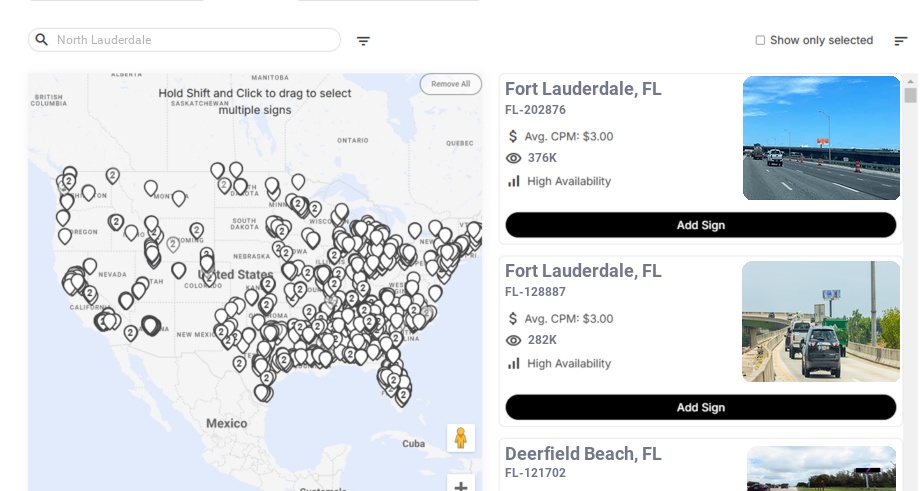
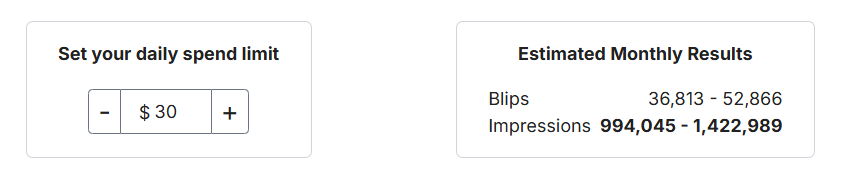
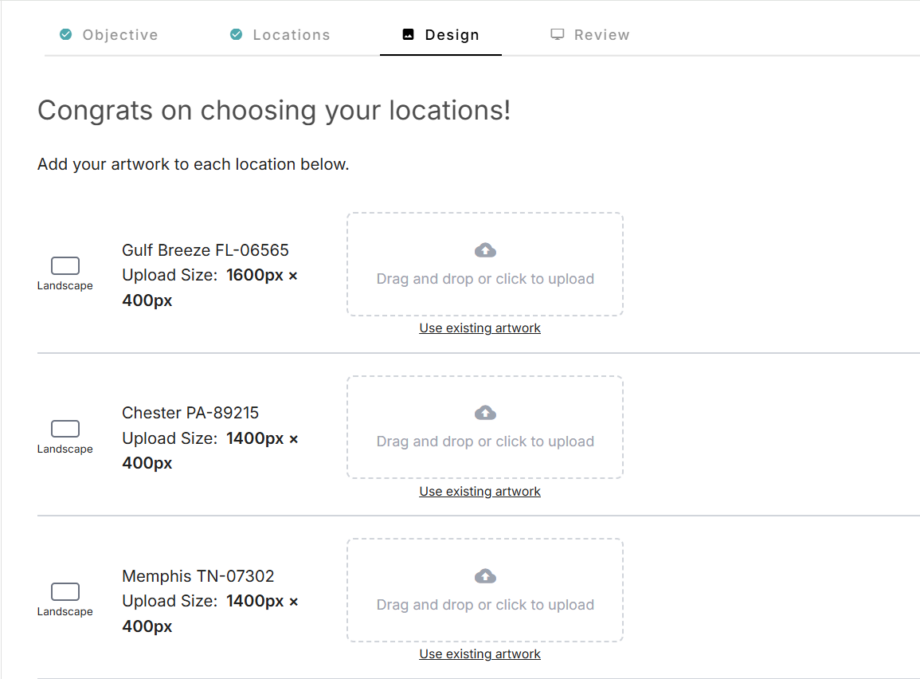
HERE'S HOW IT WORKS
How much is a billboard in North Lauderdale?
Billboards in other Florida cities
North Lauderdale Billboard Advertising Guide
The North Lauderdale area sits at the heart of central Broward County, surrounded by major commuter corridors, dense neighborhoods, and year‑round tourism. With 34 digital billboards serving the North Lauderdale area from nearby cities like Oakland Park, Wilton Manors, Fort Lauderdale Deerfield Beach, and Sunrise
Understanding the North Lauderdale Area Market
The North Lauderdale area is compact but densely populated and highly connected to the rest of Broward County:
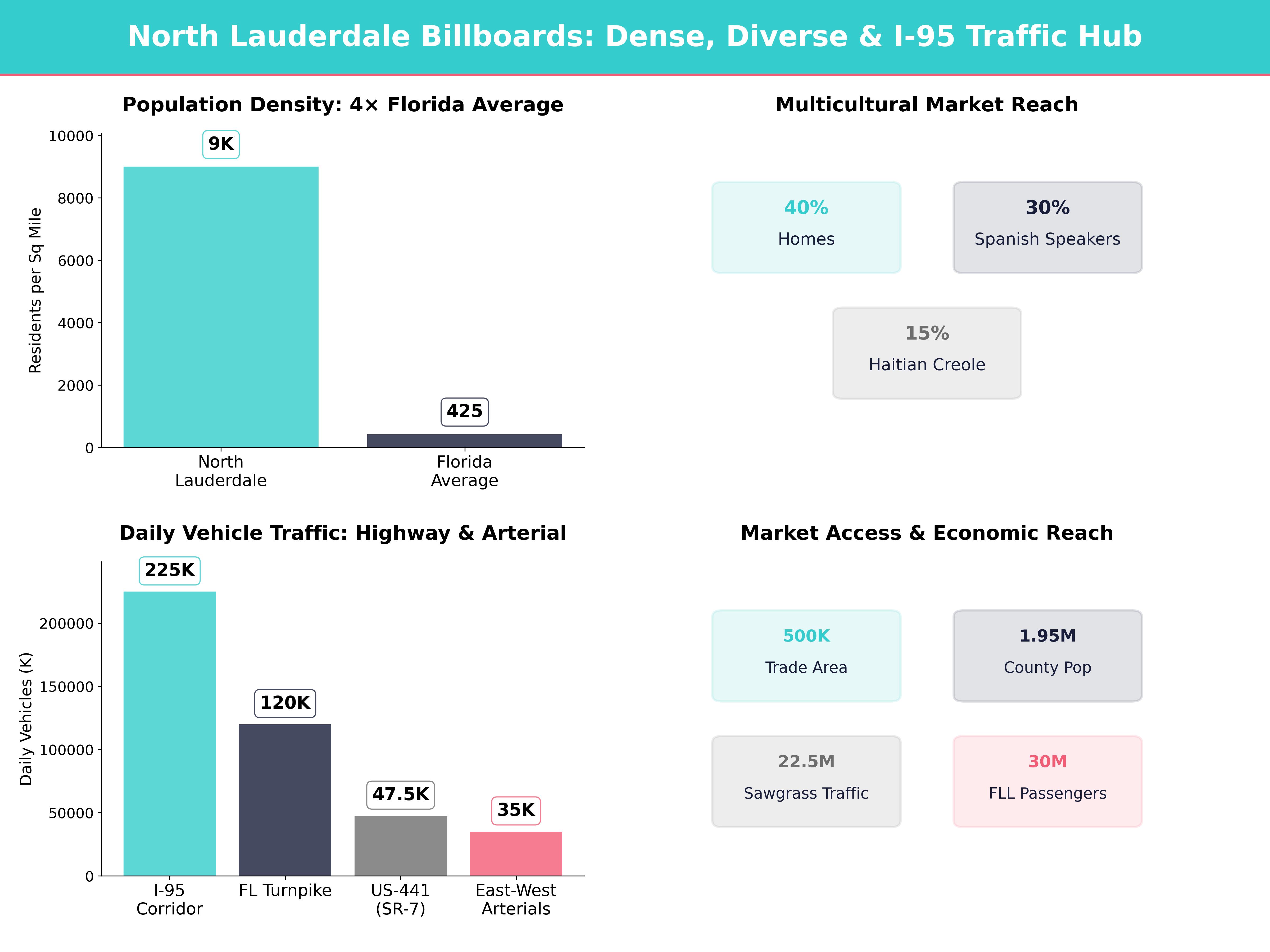
- The City of North Lauderdale has a population of about 46,000 residents across roughly 5 square miles, which works out to more than 9,000 residents per square mile—over 4× denser than the Florida statewide average density of roughly 400–450 residents per square mile.
- Broward County as a whole has over 1.95 million residents, according to Broward County government, making it the 2nd‑most populous county in Florida and part of a 6‑million‑plus tri‑county metro (Miami‑Dade, Broward, Palm Beach). Advertisers can tap both a local neighborhood audience and a large regional market using North Lauderdale billboards and nearby placements.
- The median age in North Lauderdale is in the early 30s (roughly 31–33 years), compared with a Broward County median of about 40 years, which means a heavier concentration of working‑age adults and young families than many nearby coastal communities.
- Around 65–70% of occupied housing units in North Lauderdale are renter‑occupied, versus about 45–50% countywide, which supports categories like insurance, mobile services, fast casual dining, and flexible financial products.
- More than 30% of residents in much of central Broward speak a language other than English at home, with some North Lauderdale‑area tracts seeing 40%+ non‑English‑at‑home usage. Spanish and Haitian Creole are especially prominent, along with other Caribbean languages.
- Within a 20‑minute drive of North Lauderdale, the broader central Broward trade area reaches 500,000+ residents, driven by connections to Tamarac, Lauderhill Margate, Pompano Beach, Oakland Park, and Fort Lauderdale.
For advertisers, this environment suggests:
- You are speaking to busy, commuting households with children and multi‑generational homes; average household sizes in North Lauderdale and nearby cities are typically 3.0–3.3 people, above the national average of about 2.5.
- Culturally relevant, bilingual, or multilingual creative can perform especially well; in some nearby ZIP codes, 1 in 4 or more residents are foreign‑born.
- Frequent, everyday buying decisions—groceries, health care, auto services, insurance, and dining—are particularly well suited to billboards serving the North Lauderdale area, since over 60% of area consumer spending typically goes to these recurring categories rather than big‑ticket items.
Where Our 34 Digital Billboards Reach the North Lauderdale Area
While the billboards serving the North Lauderdale area sit in nearby cities, they naturally capture the daily movements of North Lauderdale residents and are ideal when you’re looking for billboards near North Lauderdale that still reach regional traffic:
- Oakland Park (5 miles away) and Wilton Manors (6 miles away): These cities are closely tied to North Lauderdale via Commercial Boulevard, Oakland Park Boulevard, and Dixie Highway, with strong dining, nightlife, and retail clusters. According to the City of Oakland Park, more than 45% of its land is dedicated to residential neighborhoods, and nearby corridors routinely see 30,000–45,000 vehicles per day, creating frequent, repeated exposure.
- Fort Lauderdale (6.7 miles away): A major regional job center, beach destination, and nightlife hub drawing residents from across Broward. The City of Fort Lauderdale 180,000 residents, but the city’s daytime population swells significantly as well over 100,000 workers commute in. Thousands of North Lauderdale residents commute toward Fort Lauderdale daily via I‑95, US‑441 (SR 7), and the Florida Turnpike, feeding daily traffic counts that can exceed 200,000 vehicles on key freeway segments.
- Deerfield Beach (8.3 miles away): A coastal and employment hub to the north, with strong traffic to beach areas and large business parks. The City of Deerfield Beach notes that tourism and manufacturing/warehouse employment combine to attract tens of thousands of non‑resident workers and visitors on peak days.
- Sunrise (8.7 miles away): Home to major retail, including Sawgrass Mills Amerant Bank Arena (formerly BB&T Center), and large office parks, attracting regional shoppers and workers. Sawgrass Mills alone draws an estimated 20–25 million visitors annually, and Amerant Bank Arena seats about 19,000 for major events, making nearby boards ideal for retail and event‑driven campaigns.
These locations put your message along the natural travel paths of people who live, work, and shop in the North Lauderdale area. With Blip, we can time your ads to appear when those residents are most likely to be driving through Oakland Park, Wilton Manors, Fort Lauderdale, Deerfield Beach, and Sunrise—often multiple times per week, generating high cumulative weekly reach and frequency from billboard advertising near North Lauderdale.
Key Roadways and Traffic Patterns to Target
The North Lauderdale area is woven into a web of heavily traveled roads and highways. Based on Florida Department of Transportation District 4
- I‑95 near Oakland Park and Fort Lauderdale typically carries 200,000–250,000 vehicles per day on busy segments, placing it among the highest‑volume corridors in Florida. Even conservative estimates suggest 1.4–1.7 million vehicle trips per week on these stretches.
- Florida’s Turnpike through central Broward often exceeds 120,000 vehicles per day, serving north–south commuters from Miami‑Dade up through Palm Beach County and visitors heading to/from Fort Lauderdale‑Hollywood International Airport.
- US‑441 (State Road 7), which runs west of the North Lauderdale area, commonly sees 40,000–55,000 vehicles per day on many central Broward segments, making it a vital commercial strip with constant local traffic.
- Major east‑west connectors such as Commercial Boulevard, McNab Road, and Oakland Park Boulevard each carry 25,000–45,000 vehicles per day, funneling traffic between North Lauderdale, Tamarac, Oakland Park, and Fort Lauderdale. Over the course of a month, that can translate to 750,000–1.3 million vehicle trips per corridor.
- According to the Broward Metropolitan Planning Organization, more than 90% of Broward workers commute by car, truck, or van (including carpools), concentrating eyeballs along these roadways during morning and evening peaks.
We can align your campaigns with these traffic flows:
- Focus your commuter targeting on boards near I‑95, the Turnpike, and US‑441, especially during 7–9 a.m. and 4–7 p.m., when north–south commuting peaks and volumes can be 20–40% higher than mid‑day.
- Use midday and weekend dayparts near retail corridors in Fort Lauderdale, Sunrise, and Deerfield Beach to reach North Lauderdale families running errands, going to the beach, or shopping—times when shopping and leisure trips can account for 30–40% of vehicle volume on key arterials.
- When events are happening downtown or at the beach (often highlighted by Visit Lauderdale and local outlets like the South Florida Sun Sentinel), shift more impressions toward Fort Lauderdale‑area boards; major festivals and sports events can spike traffic by 10–25% around venues and entertainment districts.
Commuters, Workers, and Daily Life: Who You Reach
The North Lauderdale area is strongly commuter‑oriented:
- A large portion of residents work outside the immediate city, often in Fort Lauderdale, Sunrise, Deerfield Beach, and Pompano Beach. In many central Broward communities, 60–70% of workers commute to jobs in other municipalities.
- Average commute times across central Broward hover around 27–30 minutes, compared with a national average of about 26 minutes, meaning extended daily exposure to roadside media and repeated billboard impressions.
- According to regional transportation profiles from Broward County Transit and planning agencies, roughly 3–5% of workers use public transit, 2–3% walk or bike, and the rest rely on personal vehicles or carpools—so the overwhelming majority of residents are reachable via roads where our boards are located.
- Many workers in service, retail, and hospitality roles work non‑traditional hours, generating meaningful traffic outside the standard 9–5 window, especially between 6–8 a.m., noon–2 p.m., and 8–11 p.m..
What this means for your messaging:
- Emphasize convenience and time savings: “10 minutes from here,” “Same‑day service,” or “No appointment needed,” which strongly appeal to commuters with 25–30‑minute drive times and limited free time.
- Use strong directional copy: “On Commercial Blvd next to [landmark],” “Just west of US‑441,” or “Exit now at Sunrise Blvd,” which can increase recall; out‑of‑home studies often find that directional language can lift response by 15–30%.
- Make commuting life easier: auto repair, car washes, child care, after‑school programs, fitness clubs, tax prep, and health care services are all ideal categories for billboards serving the North Lauderdale area, since commuting and school runs can account for 40%+ of weekday vehicle trips.
Demographics, Diversity, and Language Considerations
The North Lauderdale area reflects Broward County’s rich diversity:
- North Lauderdale and nearby central Broward cities have high shares of Black, Hispanic/Latino, and Caribbean residents, including a large Haitian community. In several nearby ZIP codes, 40–50% of residents identify as Black or African American and 25–35% as Hispanic/Latino.
- In many nearby ZIP codes, over 60% of residents identify as non‑white, and 20–30%+ speak Spanish at home, with a substantial Haitian Creole presence as well. In parts of central Broward, 10–15% of households speak Haitian Creole.
- Household incomes vary broadly, from under $40,000 in some neighborhoods to $70,000+ in others, with a large middle‑income segment in the $45,000–65,000 range. This creates opportunities both for value‑driven offers and for premium brands targeting upwardly mobile households.
- Family structure is also diverse: in several nearby communities, 30–40% of households include children under 18, and multigenerational homes are common, increasing demand for education, child care, health care, and family dining.
To maximize impact:
- Consider bilingual English/Spanish or English/Creole creative if your business serves these communities. Even one key phrase or call‑to‑action in a second language can dramatically increase resonance; local multicultural marketing case studies often show double‑digit percentage lifts in awareness when ads reflect the audience’s language.
- Feature people and imagery that reflect Broward County’s diversity—families of varying backgrounds, multigenerational households, working professionals, and service workers. Inclusive creative has been associated with 5–15% higher ad recall in many brand‑lift studies.
- If you serve value‑conscious households, highlight clear price points, promotions, and financing options; if you are targeting higher‑income segments (for example, in Sunrise or coastal Fort Lauderdale), lean into quality, lifestyle, and brand prestige, noting that some nearby coastal ZIP codes have median household incomes exceeding $90,000.
Tourism and Seasonal Opportunities Near North Lauderdale
Even though North Lauderdale itself is more residential, it sits just minutes from Broward’s massive tourism engine, led by Fort Lauderdale and surrounding beaches:
- Visit Lauderdale reports millions of visitors annually to Greater Fort Lauderdale; recent tourism reports have shown visitor totals in the 15–20 million range in strong years, with overall economic impact in the billions of dollars (commonly $10–15 billion+ including direct and indirect spending).
- Fort Lauderdale–Hollywood International Airport (FLL) handles over 30 million passengers per year, or roughly 80,000–90,000 passengers per day. A significant share use I‑95, US‑1, the Turnpike, and other connecting corridors visible from boards that also serve the North Lauderdale area.
- The Greater Fort Lauderdale/Broward County Convention Center hosts hundreds of events and meetings annually, drawing tens of thousands of business travelers and attendees, many of whom stay in nearby hotels and travel through central Broward.
- Peak tourism periods include December–April, holiday weekends, and spring break, with additional spikes during large events and cruises. Cruise traffic from Port Everglades can exceed 3–4 million passengers annually, boosting seasonal traffic volumes.
- Tourism‑related employment accounts for a significant share of local jobs; in Broward County, leisure and hospitality often represent 10–12% of total employment, supporting a large base of workers traveling at off‑peak times.
How to tap into this with Blip:
- If you serve visitors (hotels, restaurants, nightlife, attractions, transportation services), increase your budget and frequency on Fort Lauderdale and Deerfield Beach boards during peak months; in‑season, some beach and downtown corridors can see 20–30% more traffic than summer lows.
- For local North Lauderdale area businesses, use this traffic to reach residents commuting toward tourist zones—for example: “Beat the beach traffic—get your car serviced in the North Lauderdale area first.”
- Pair event calendars from Visit Lauderdale and local news outlets like WPLG Local 10 or NBC 6 South Florida with your campaigns. When big festivals, concerts, or sports events occur, we can ramp up your impressions on nearby boards and align with days that may see tens of thousands of extra trips near venues.
Timing Your Campaign: Dayparts and Weekly Patterns
Billboards serving the North Lauderdale area perform differently by time of day and day of week. With Blip, you only pay for the “blips” (ad plays) you choose, so smart scheduling is crucial.
Based on typical central Broward traffic and activity patterns, consider:
Morning (6–10 a.m.)
- Heavy commuter volume southbound and eastbound toward Fort Lauderdale, Sunrise office parks, and coastal areas. On some corridors, inbound traffic between 7–9 a.m. can be 30–40% higher than the hourly average.
- Ideal for: coffee shops, breakfast spots, gas stations, auto repair, day‑care centers, and time‑sensitive services (“Walk in before work”).
Midday (10 a.m.–3 p.m.)
- More local, errand‑driven traffic from stay‑at‑home parents, retirees, shift workers, and service providers. Midday accounts for roughly 25–30% of daily traffic on many arterials.
- Ideal for: medical clinics, salons, retail stores, furniture and appliance outlets, and lunch specials.
Evening Rush (3–7 p.m.)
- Return commute to the North Lauderdale area from Fort Lauderdale, Sunrise, and Deerfield Beach. Outbound traffic volumes can mirror morning peaks, often 20–35% above mid‑day levels.
- Ideal for: restaurants, grocery stores, gyms, tutoring and after‑school programs, family activities, and live events.
Late Evening & Night (7 p.m.–midnight)
- Leisure and nightlife traffic especially toward downtown Fort Lauderdale, Wilton Manors, and coastal areas. On weekends, evening and late‑night periods can account for 35–40% of total day‑long traffic in entertainment zones.
- Ideal for: bars, lounges, entertainment venues, delivery services, and streaming/entertainment apps.
Weekdays vs. Weekends
- Weekdays: Strong commuter patterns; focus on routine services and B2B messaging. Monday–Thursday often show consistent patterns, while Fridays may see 5–10% higher evening volumes due to outings and errands.
- Weekends: Heavier traffic to malls, beaches, and entertainment centers; ideal for retail, events, tourism, and family outings. Major centers like Sawgrass Mills and coastal beaches often report weekend spikes of 20–30% more visitors versus weekdays. Target Sunrise and Fort Lauderdale boards more heavily on Saturdays and Sundays.
With Blip’s scheduling tools, we can:
- Run different creative by daypart (e.g., “Breakfast Special” in the morning, “Family Dinner Deal” in the evening).
- Bid more aggressively for Friday and Saturday evenings if you’re nightlife or dining‑focused, when customer intent to spend on entertainment is typically highest.
- Reduce spending during lower‑value hours (such as mid‑afternoon midweek for some businesses) and reinvest into peak times that match your audience, potentially improving cost‑per‑response by 20–40% compared with unscheduled, around‑the‑clock buying.
Crafting Effective Creative for the North Lauderdale Area
Billboards serving the North Lauderdale area are viewed at highway and arterial speeds, so clarity is critical. To stand out:
Keep it simple and bold
- Aim for 7 words or fewer of main copy. Out‑of‑home research commonly finds that messages with 7 words or less have significantly higher recall than more text‑heavy designs.
- Use large, high‑contrast fonts; think white or yellow on dark backgrounds or vice versa. High‑contrast designs can be 20–25% more legible at a distance.
- Prioritize one clear call‑to‑action: “Exit at Commercial Blvd,” “Call 954‑XXX‑XXXX,” or “Order at [ShortURL].com.”
Use local cues
- Mention landmarks and nearby areas: “Just off US‑441,” “Minutes from the North Lauderdale area,” “Near Sawgrass Mills in Sunrise,” or “5 minutes from North Lauderdale City Hall.”
- Refer to local life: back‑to‑school (Broward County Public Schools serves more than 250,000 students), hurricane season (June–November), summer camps, holiday shopping, tax time.
Leverage cultural and language relevance
- If your team can handle Spanish or Creole clients, say so explicitly: “Se habla español” or “Nou pale kreyòl.” In many South Florida campaigns, bilingual elements have been associated with 10–20% higher engagement among targeted audiences.
- Consider alternating creatives: one in English, one bilingual, using Blip’s ability to rotate multiple designs. Rotating messages can help you test which language mix or offer produces better results.
Design for mobile follow‑through
-
People often see your billboard, then search later. Use:
- A short, memorable URL (ideally under 15 characters and no more than 2–3 words).
- An easy phone number or a simple phrase that’s easy to Google (“Sunrise Dental North Lauderdale”).
- Consider using a single keyword or offer code (“Mention ‘BLIP10’ for 10% off”) to measure performance. Many local businesses find that 10–30% of new customers mention billboard‑specific offers when trained staff consistently ask “How did you hear about us?”
Local Business Types That Perform Well on Area Billboards
Given the demographics and traffic serving the North Lauderdale area, we often see strong potential for:
- Medical & dental: urgent care, pediatric clinics, dental offices, vision centers. In a trade area of 500,000+ residents, even capturing 0.5–1% of households annually can mean thousands of patient visits.
- Auto‑related: repair shops, tire centers, car washes, used car dealers, insurance. In car‑oriented communities where 90%+ of workers commute by vehicle, demand for auto maintenance and insurance is constant.
- Education & youth services: charter schools, tutoring centers, after‑school programs, early learning centers. With 30–40% of households including children in many nearby neighborhoods, youth‑focused services can scale quickly with strong local visibility.
- Food & beverage: quick‑service restaurants, family dining, bakeries, coffee shops, Caribbean and Latin cuisine. In dense communities, food away from home often accounts for 40–50% of food spending, making repeated impressions crucial.
- Home services: plumbing, HVAC, roofing, impact windows and doors, landscaping—especially during hurricane season and summer, when demand for storm‑readiness and cooling can spike by 20–40%.
- Financial & legal: tax preparers, immigration attorneys, injury law, payday and installment lenders, credit unions, and local banks. Tax season (January–April) and mid‑year immigration policy changes often create short, high‑demand windows where billboard visibility pays off.
- Retail & fitness: gyms, martial arts studios, furniture stores, cell phone retailers, and beauty supply shops. In a high‑density, renter‑heavy area, turnover and new‑mover activity support ongoing acquisition for these categories.
We can use your budget to concentrate impressions on boards closest to the neighborhoods and shopping hubs your customers frequent and adjust over time as you see which locations drive the best responses—sometimes reallocating 20–30% of impressions from underperforming boards to top performers to steadily improve ROI from billboard advertising near North Lauderdale.
Using Data and Local Media to Refine Your Strategy
To get the most from your campaigns serving the North Lauderdale area, pair Blip’s flexibility with local data sources:
-
City and County Resources
- City of North Lauderdale for community news, events, and development projects, including updates on parks, road work, and neighborhood programs.
- Broward County for county‑wide initiatives, transportation updates, and growth areas, including information from Broward County Transit and airport/port operations.
- The Broward Metropolitan Planning Organization for transportation plans, traffic studies, and long‑range mobility projects that may shift travel patterns over the next 5–20 years.
-
Tourism & Events
- Visit Lauderdale for seasonal visitor trends, major festivals, and convention dates.
-
Local News
These outlets help you anticipate spikes in traffic or interest—storms, elections, big games, or city initiatives—that can influence where and when people drive.
Use this information to:
- Time campaigns around school calendars, hurricane season (June–November), tax season, and major shopping holidays like Black Friday and back‑to‑school, when consumer spending can rise 20–40% above baseline.
- Launch short, high‑impact burst campaigns around openings, rebrands, or big sales, concentrating your budget into 2–4 crucial weeks instead of spreading it thinly all year.
- Continuously test messages (“$0 down,” “Same‑day,” “Open late,” “Se habla español”) and see which align with the response you’re getting; many advertisers find that refining creative and scheduling over 2–3 campaign cycles leads to significant gains in response.
Building a Measurable Billboard Strategy Near North Lauderdale
Billboard advertising serving the North Lauderdale area doesn’t have to be guesswork. With Blip, you can treat it like a flexible, data‑driven channel:
-
Define your North Lauderdale area audience clearly
- Households within 3–5 miles of your location.
- Commuters traveling between North Lauderdale and Fort Lauderdale/Sunrise/Deerfield Beach, often spending 30+ minutes in the car each way.
- Specific language or cultural communities (for example, Spanish‑dominant or Creole‑speaking households).
-
Choose boards aligned with real travel patterns
- Commuter boards near I‑95, the Turnpike, and US‑441 that collectively see hundreds of thousands of daily impressions.
- Shopper boards near major retail hubs in Sunrise, Fort Lauderdale, and Deerfield Beach (Sawgrass Mills, regional malls, big‑box corridors).
- Lifestyle boards near nightlife and entertainment areas in Wilton Manors and downtown Fort Lauderdale.
-
Start with focused dayparts and a clear message
- One or two strong offers with specific numbers (e.g., “$29 exam,” “$0 down,” “2‑for‑$20”).
- A single call‑to‑action and tracking mechanism (URL, code, or phone number). Ensure staff track responses for at least 4–8 weeks to spot patterns.
-
Measure and refine
- Watch website traffic, call‑volume, and in‑store mentions during your campaign windows; look for lifts of 10% or more versus non‑campaign weeks.
- Adjust locations and dayparts every few days or weeks based on performance, shifting budget toward the top‑performing 20–30% of boards.
-
Scale what works
- When you see results, expand to more boards among our 34 serving the North Lauderdale area, add creative variations, or extend to more hours and days.
- Consider seasonal “up‑weighting,” where you increase your budget by 25–50% during your peak months (for example, tax season, back‑to‑school, or hurricane prep season).
Whether you’re exploring billboard rental near North Lauderdale for the first time or optimizing an existing out‑of‑home plan, combining a deep understanding of the North Lauderdale area’s people, roads, and rhythms with Blip’s flexible digital billboard platform helps you build campaigns that are not only visible, but also precisely targeted, culturally relevant, and measurable—all while keeping you in full control of your budget and allowing you to respond quickly to real‑time data and local events.