Billboards in Florida City, FL
No Minimum Spend. No Long-Term Contracts. Just Results.
Trusted by Leading Brands


Billboard advertising
in Florida City has never been easier




How much is a billboard in Florida City?
Why Choose Blip for Billboard Advertising in Florida City
Blip lets Florida City advertisers launch fast on U.S. 1 and the Turnpike exit, reaching Keys-bound drivers without long-term contracts.
In Florida City, set flexible daily budgets to capture winter tourist surges and weekend traffic to Everglades and Biscayne.
Use Blip dayparting in Florida City to hit commuters 6–9 a.m. and dinner travelers 4–7 p.m. on the way to the Keys.
Florida City campaigns track in real time, so you can shift spend as U.S. 1 traffic swells or quiets with seasonal demand.
Blip's creative tools help Florida City brands run bilingual ads for Hispanic households and out-of-town visitors headed south.
Frequently Asked Questions About Billboard Advertising in Florida City
How much does a billboard cost near Florida City, Florida with Blip?
With Blip, you choose a daily budget that works for you, and our pay-per-blip model means you only pay for the individual 7.5–10 second ad displays your message receives on digital Florida City billboards serving the Florida City area. Costs adjust based on when and where your ads appear and on advertiser demand, so smaller budgets can still get meaningful visibility on billboards near Florida City, Florida. With the ability to change your budget at any time and pay only for the blips you receive, it’s easy to start testing digital billboard advertising in the Florida City area and scale your campaign as you see real-world results.
Where can I advertise with Blip in Florida City, Florida?
Florida City sits at one of Florida’s most strategic crossroads: the junction of U.S. 1, the Florida Turnpike, Everglades National Park, Biscayne National Park, and the only highway leading to the Florida Keys. With four digital billboards nearby in Homestead serving the Florida City area, you can tap into a powerful mix of local residents, commuters, and millions of annual visitors headed to some of the state’s most iconic destinations. These placements are ideal if you are looking for billboards near Florida City that capture both local and through traffic.
What kind of audience do Florida City billboards with Blip reach?
The Florida City–Homestead area reflects the broader diversity of Miami-Dade County, with a particularly strong Hispanic presence and a young, working-class profile. Median ages in Florida City and Homestead tend to fall in the low 30s, and roughly 25–30% of residents in many South Dade neighborhoods are under age 18. In the Florida City–Homestead corridor, many neighborhoods have Hispanic majorities, alongside significant Black and Afro-Caribbean communities.
When is the best time to run Florida City billboards with Blip?
Weekday morning, midday, evening peak, and late night each capture different types of traffic in the Florida City area. Weekend trips to the Keys and national parks spike on Fridays, Saturdays, and holiday weekends, and winter brings the heaviest tourist season. With Blip, you can schedule by hour, daypart, and day of week, and adjust your bid levels to match these traffic patterns.
What traffic should I expect on billboards near Florida City, Florida?
Our four digital billboards in Homestead, located within about 3 miles of Florida City, sit near major traffic arteries that funnel both daily commuters and long-distance travelers. U.S. 1 near the Homestead–Florida City line often carries annual average daily traffic in the 45,000–60,000 vehicle range, and the Florida Turnpike terminus can push tens of thousands more vehicles onto U.S. 1. Taken together, it’s reasonable to expect 60,000–90,000+ daily vehicle exposures across key approach segments feeding the Florida City–Homestead boards.
Do I need a contract to advertise with Blip in Florida City?
No, Blip has no long-term contracts or minimum commitments. You can start, pause, or stop your campaign at any time.
How fast can I launch a billboard campaign with Blip in Florida City?
You can have your campaign live in minutes. Create a free account, select your locations, set your budget, upload your design, and start running once approved.
Where can I advertise with Blip in Florida City?
Blip has digital billboards in Florida City. You can browse available locations on a map, choose the ones that fit your audience, and start advertising right away.
Still have questions? Launch a campaign in minutes — no contracts, no commitments.
Start Your CampaignFlorida City Billboard Advertising Guide
Florida City sits at one of Florida’s most strategic crossroads: the junction of U.S. 1, the Florida Turnpike, Everglades National Park, Biscayne National Park, and the only highway leading to the Florida Keys. With four digital billboards nearby in Homestead serving the Florida City area, we can help you tap into a powerful mix of local residents, commuters, and millions of annual visitors headed to some of the state’s most iconic destinations through highly visible billboards near Florida City.
Understanding the Florida City Area Market
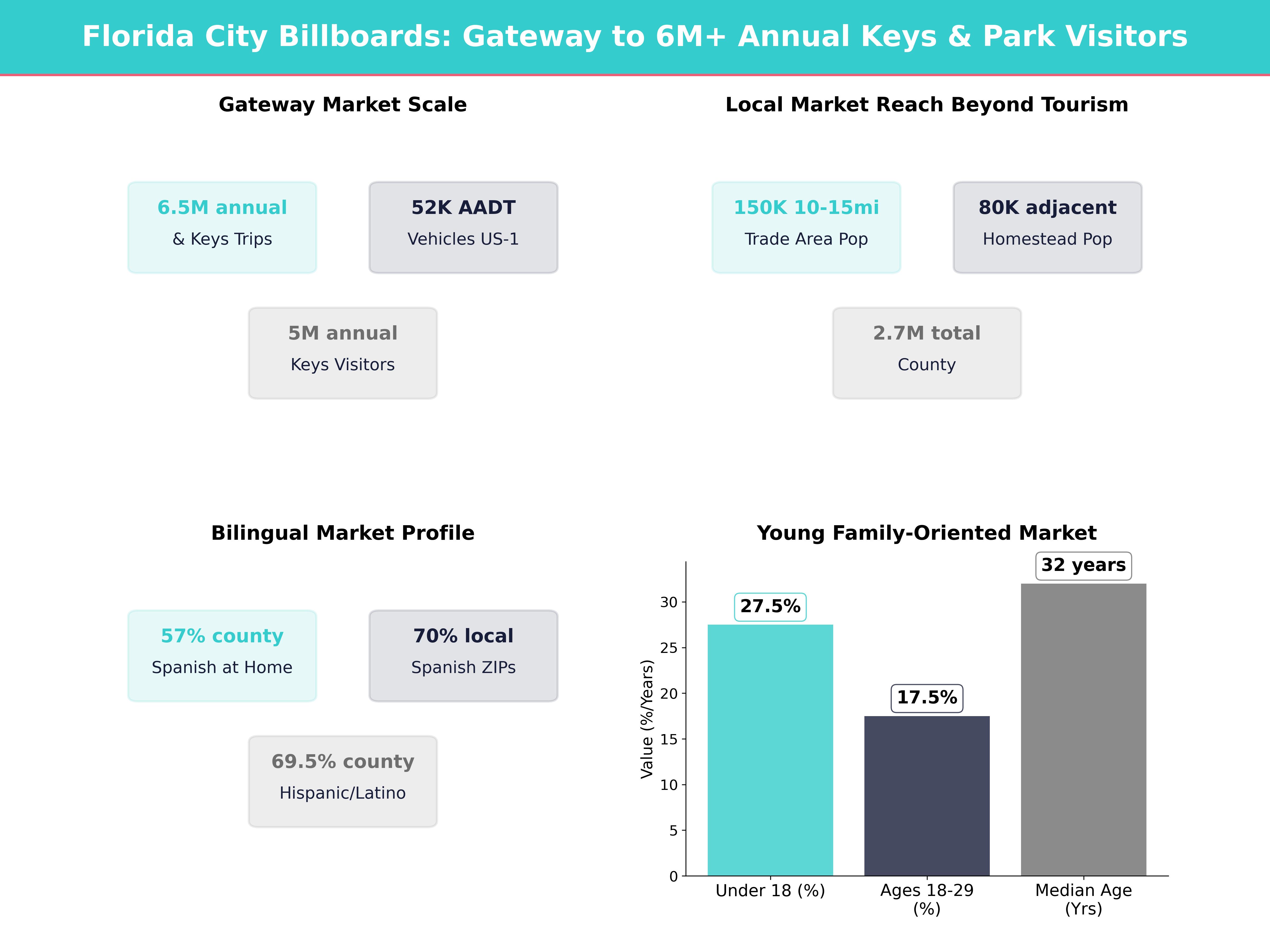
Florida City itself has a population of roughly 12,000–13,000 residents, while neighboring Homestead is home to more than 80,000 people, according to recent municipal estimates from the City of Florida City and the City of Homestead. Together, these communities sit at the southern edge of Miami-Dade County, which has about 2.7 million residents according to recent county estimates from Miami-Dade County Government. That means campaigns near Florida City can capture both a tight, local audience and traffic flowing from the larger Miami metro when you invest in strategic Florida City billboards.
Within a 10–15 mile radius of Florida City–Homestead, the trade area easily exceeds 150,000 residents when you include nearby unincorporated communities like Leisure City, Naranja, Princeton, and Redland. The Miami-Dade Transportation Planning Organization notes that the South Dade area has been one of the county’s faster-growing corridors, with some ZIP codes posting double-digit percentage population growth over the past decade as new housing, logistics, and retail developments come online. This growing base makes billboard advertising near Florida City an increasingly valuable way to stay visible as new residents and businesses move into the area.
Key market characteristics:
-
Gateway to the Keys and national parks
- U.S. 1 through the Florida City area is the only road to the Florida Keys. Monroe County tourism agencies 5 million visitors per year to the Keys in recent years, generating roughly $4–5 billion in annual visitor spending. A large share of those visitors travel by car, and many pass through the Florida City–Homestead corridor on their drive south, seeing Florida City billboards as they approach the Keys.
- Everglades National Park recorded roughly 1.1–1.2 million recreational visits annually in the last several years, with the Homestead National Parks Trolley and park-and-ride services helping funnel traffic through local gateways.
- Biscayne National Park receives over 700,000 visits per year, with some years exceeding 800,000, much of it routed via the Homestead–Florida City approach and nearby marinas.
- Combined, these destinations drive well over 6–7 million annual national park and Keys-related trips, a substantial portion of which feed directly into billboard impressions along U.S. 1 and the Turnpike terminus.
- Tourism and hospitality economy
Hotels, quick-service restaurants, gas stations, and tour operators cluster along U.S. 1 and the Florida Turnpike terminus to serve this visitor flow. Local tourism data shared by the Greater Miami Convention & Visitors Bureau indicates that Miami-Dade typically hosts 24–26 million overnight visitors per year and supports more than 160,000 tourism-related jobs, with South Dade (including Homestead–Florida City) increasingly capturing eco-tourism and drive-market travelers headed to the parks and Keys. Average hotel occupancy in the broader Miami market often runs in the 70–80% range annually, with winter months routinely exceeding 80–85%—creating strong demand for “last-stop-before-the-Keys” lodging and dining that can be promoted effectively through billboards near Florida City. - Local economic base
The area is known for agriculture (winter vegetables, tropical fruit, nurseries), logistics, retail, construction, and public-sector employment tied to Miami-Dade County and nearby military and infrastructure facilities. The Homestead–Florida City Chamber of Commerce hundreds of millions of dollars in annual economic activity and supports thousands of seasonal and permanent jobs. Facilities like Homestead Air Reserve Base Homestead Hospital
For context and local planning updates, we recommend following the City of Florida City, the City of Homestead, and Miami-Dade County Government, along with regional coverage from outlets such as the Miami Herald WPLG Local 10.
When you run digital billboard campaigns near Florida City with us, you can flexibly reach:
- Local households shopping, schooling, and working in the Florida City area
- Miami-Dade residents commuting between Homestead, south Miami suburbs, and the Keys
- Domestic and international tourists on road trips to the Keys and national parks
- Seasonal agricultural and construction workers moving through the corridor, which can number in the thousands of additional workers during peak planting and harvest months
These audiences make billboard advertising near Florida City a versatile option for both local and destination-focused brands.
Audience & Demographics in the Florida City Area
The Florida City–Homestead area reflects the broader diversity of Miami-Dade County, with a particularly strong Hispanic presence and a young, working-class profile that you can address directly through targeted Florida City billboards.
Based on recent county and municipal data:
-
Age profile
- Median ages in Florida City and Homestead tend to fall in the low 30s (around 31–33 years), several years younger than the U.S. median of ~38.
- Roughly 25–30% of residents in many South Dade neighborhoods are under age 18, and another 15–20% are in the 18–29 age band, meaning nearly half the population is under 30.
- A high share of children and young adults means family-focused messaging performs well (education, quick-service restaurants, entertainment, healthcare, and financial services geared to young families).
-
Ethnicity & language
- Miami-Dade County is approximately 69–70% Hispanic or Latino and about 15–17% Black or African American, with a smaller non-Hispanic White population.
- County data show about 54–60% of residents speak Spanish at home, and in some South Dade ZIP codes, Spanish-speaking households exceed 70%.
- In the Florida City–Homestead corridor, many neighborhoods have Hispanic majorities, alongside significant Black and Afro-Caribbean communities (including Haitian Creole speakers).
- Bilingual (English/Spanish) creative or alternating English and Spanish creatives can dramatically expand your reach and improve recall among both residents and visitors from Latin America, who make up a substantial portion of Miami’s international visitor base (often over 30–35%).
-
Income & employment
- Median household incomes in the southern Miami-Dade area generally run 10–25% below the overall county median (which has been in the mid-$50,000s in recent years). In parts of Florida City–Homestead, typical household incomes fall in the $35,000–$50,000 range, with pockets higher and lower.
- A large share of residents work in retail, hospitality, agriculture, construction, logistics, and service sectors—in some tracts, these categories account for 40–50% of local employment.
- Unemployment rates in South Dade have historically run a few percentage points higher than the county average, especially during off-peak agricultural seasons, making value-oriented offers particularly attractive.
- Price-sensitive offers, clear value propositions, and financing or “$0 down” language for big-ticket items resonate strongly.
Implications for your billboards near the Florida City area:
- Use simple, bilingual copy (or separate English and Spanish creatives) to maximize comprehension and appeal across a population where more than half of households use a language other than English at home.
- Emphasize value—sales, bundles, loyalty rewards, and budget-friendly price points that acknowledge median local incomes in the mid–$40,000s rather than luxury-only positioning.
- Highlight family benefits (kids eat free, family passes, pediatric services, after-school programs, family car deals) to connect with a market where roughly 1 in 4 residents is a child.
Traffic Patterns & When to Run Your Ads
Our four digital billboards in Homestead, located within about 3 miles of Florida City, sit near major traffic arteries that funnel both daily commuters and long-distance travelers. These placements are ideal if you are looking for billboards near Florida City that capture both local and through traffic.
Key roadways and flows:
-
U.S. Highway 1 (South Dixie Highway)
FDOT District Six annual average daily traffic (AADT) often in the 45,000–60,000 vehicle range on U.S. 1 near the Homestead–Florida City line, with some segments of South Dixie Highway in South Dade carrying more than 70,000 vehicles per day closer to the urban core. This is the spine for:- Commuters heading north to Cutler Bay, Kendall, and Miami, where the Miami-Dade Transportation Planning Organization reports that South Dade commuter flows into central Miami can exceed 100,000 trips per weekday when transit and roadway users are combined.
- Visitors bound for Key Largo and the rest of the Keys, many of whom travel during weekend peaks and holiday periods when daily volumes spike well above typical weekday averages.
- Florida Turnpike (Homestead Extension terminus)
The Turnpike ends just north of the Florida City area, pushing vehicles onto U.S. 1. FDOT and Florida’s Turnpike Enterprise tens of thousands of vehicles—often 35,000–50,000+ vehicles per day, particularly during peak season and weekends, when southbound vacation traffic and northbound return traffic stack up.
Taken together, it’s reasonable to expect 60,000–90,000+ daily vehicle exposures across key approach segments feeding the Florida City–Homestead boards, translating into hundreds of thousands of potential impressions per week when you account for multiple occupants per vehicle (nationally averaging about 1.5–1.7 persons per vehicle). For advertisers evaluating billboard rental near Florida City, these traffic volumes provide a strong foundation for reach and frequency.
Daily timing strategies:
-
Weekday morning (6:30–9:30 a.m.)
- Focus on commuters heading north: auto dealers, coffee shops, fast-casual breakfasts, daycare, and workplace services.
- In many commuter corridors, roughly 30–35% of daily traffic occurs in morning and evening peaks; capturing these hours ensures your ads hit workforce travelers who make the trip 5 days per week.
- Time-sensitive offers: “Today only”, “Before work”, “Open from 7 a.m.”
-
Midday (11 a.m.–3 p.m.)
- Capture tourists, shift workers, and local errands.
- Tourism and leisure trips nationally are more likely to occur in midday windows, when families stop for lunch, attractions, or check-in.
- Good for restaurants, attractions, medical clinics, and retail.
-
Evening peak (4–7 p.m.)
- Highly effective for quick-service dining, grocery, gyms, and after-work activities. Many corridors see 15–20% of daily traffic in this window alone.
- Also ideal for promoting tourism activities for next day or weekend trips.
-
Late night (9 p.m.–1 a.m.)
- Target budget-conscious travelers arriving late to the Florida City area (motels, 24-hour services, late-night food) at lower ad costs.
- While volumes are lower (often under 10% of daily traffic), competition for ad share is also reduced, making it easier to dominate SOV (share of voice).
Weekend & seasonal traffic:
-
Weekend surges
- Trips to the Keys and national parks spike on Fridays, Saturdays, and holiday weekends. Regional tourism agencies note that occupancy in the Keys often climbs above 85–90% on peak weekends, driving strong same-day demand for gas, food, and last-minute lodging around Florida City.
- Tourism bureaus such as the Greater Miami Convention & Visitors Bureau and Florida Keys & Key West tourism highlight year-round demand, but especially strong winter, spring, and holiday peaks, when road congestion typically worsens and billboard dwell time increases as traffic slows.
-
Seasonality
- Winter (Dec–Mar): Heavy tourist season; snowbirds plus international visitors. Miami-Dade’s hotel performance reports frequently show winter ADR (average daily rate) running 20–40% higher than summer, reflecting higher-spending guests. Increase bids to dominate impressions during high-value travel weekends.
- Spring (Mar–Apr): Spring break and eco-tourism to Everglades/Biscayne. Florida’s spring break period often brings double-digit percentage increases in visitor volumes to coastal and park destinations compared with non-peak weeks.
- Summer (Jun–Aug): Family road trips and local staycations; align offers with school breaks from Miami-Dade County Public Schools, which serves more than 320,000 students across the county.
- Hurricane season (Jun–Nov): Service providers (roofing, insurance, generators) can run preparedness and recovery campaigns timed with local forecasts from outlets like the Miami Herald WPLG Local 10. Major storms can temporarily depress visitor volume but sharply increase demand for home services and insurance.
With Blip, you can schedule by hour, daypart, and day of week, and adjust your bid levels to match these traffic patterns—paying more when the roads are busiest for your audience and scaling back during lower-value times. This flexibility makes billboard rental near Florida City accessible for both small and large advertisers.
Crafting Billboard Creative That Works Near Florida City
In a high-speed, tourism-heavy corridor, your artwork must be instantly legible and emotionally compelling for drivers viewing Florida City billboards at highway speeds.
Design best practices for the Florida City area:
-
Plan for 3–5 second readability
- Limit to 7 words or fewer of main copy; outdoor industry studies consistently show recall dropping sharply beyond 8–10 words.
- Use large fonts (at least 12–18 inches high in print terms), high contrast, and avoid script fonts. Legibility tests indicate that clear sans-serif fonts can be read 20–30% faster at highway speeds.
-
Leverage destination themes
- Reference the Keys (“Next stop: Key Largo”), Everglades, Biscayne Bay, and the “Gateway to the Keys” identity used by local tourism.
- Use visuals of water, palm trees, boats, airboats, or tropical sunsets to align with traveler expectations. Tourism research from MiamiandBeaches.com shows that beach, water, and nightlife imagery consistently rank among the top motivators for choosing Greater Miami.
-
Use clear directional cues for drivers
- Include short directions: “Next Exit,” “1 Mile Ahead on US-1,” or a simple arrow icon.
- Local drivers and out-of-town visitors alike rely on quick, at-a-glance navigation. Studies of roadside wayfinding indicate that adding distance or exit info can increase response rates and exit-lane decisions by 10–20%.
-
Bilingual or dual-language strategy
- Option A: One bilingual creative: headline in English, subline in Spanish (or vice versa).
- Option B: Alternate English and Spanish creatives via Blip’s rotation, so each language appears a defined percentage of the time (for example, 60% Spanish / 40% English to mirror county language use).
- In markets where a majority speak a non-English language at home, bilingual creatives have been shown to improve brand favorability among target groups by up to 20 percentage points in some campaigns.
-
Show value upfront
- Highlight specific prices (e.g., “Rooms from $89,” “Oil Change $39,” “2-for-1 Mojitos 4–7 p.m.”).
- Percent-off deals (“Save 30%”) are effective with price-sensitive local audiences; pricing callouts can increase response by 15–30% versus purely brand-focused boards in value-driven markets.
-
Match creative to time of day & day of week
- Morning: coffee, breakfast, commuting services.
- Afternoon: attractions, shopping, same-day appointments.
- Evening: dining, lodging, entertainment.
With Blip, you can upload multiple creatives and schedule them to run at different times for maximum relevance, effectively turning one billboard location into several time-targeted ad placements.
Consider testing different creative angles—price-focused vs. brand-focused, English-only vs. bilingual—and rotate them via Blip to see which ones generate more calls, website visits, or in-store mentions. Even small improvements in response (for example, a 5–10% lift in coupon redemptions) can significantly improve ROI when scaled over tens of thousands of daily impressions from billboard advertising near Florida City.
Using Blip’s Tools to Target the Florida City Area
Our four digital billboards in Homestead serving the Florida City area give you granular control over where and when your ads appear, making it easy to plan billboard rental near Florida City that fits your goals and budget.
Ways to make the most of Blip:
-
Location-level targeting
- Select the specific boards closest to your business or to key routes like U.S. 1 and the Turnpike terminus. Proximity is powerful: national studies suggest 60–70% of purchase decisions for gas, QSR, and convenience items are made en route.
- If your business is north of Homestead, emphasize boards facing southbound traffic (for people returning from work or the Keys); if south (toward the Keys), focus on northbound travelers as they arrive.
-
Dayparting for precision
- Use Blip’s scheduling to run different messages during commuter peaks versus midday traveler flows.
-
For example:
- 6–10 a.m.: Commuter ads for local services.
- 10 a.m.–4 p.m.: Tourist-focused offers and attractions.
- 4–9 p.m.: Dining and lodging.
- In many markets, advertisers who adopt dayparting see 10–25% reductions in cost per response by concentrating spend into their highest-performing hours.
-
Flexible budgeting
- Set a daily or campaign budget that fits your goals—whether that’s a test flight of a few dollars per day or a heavier push reaching thousands of impressions per hour in peak periods.
- Increase bids on holiday weekends (Memorial Day, July 4th, Labor Day) when Keys-bound traffic surges; FDOT counts often show double-digit percentage increases in vehicle volumes on these dates.
- Dial back during historically slower weeks while maintaining always-on presence at lower bid levels.
-
Creative rotation
- Upload multiple creatives and let Blip rotate them automatically.
- Test variations: Spanish vs. English, different price points, or alternative images (beach vs. Everglades) to see what resonates. Running at least 2–3 creative variations per campaign gives you better odds of finding a top performer.
By combining board selection, dayparting, and creative rotation, you can tailor a sophisticated campaign focused tightly on the Florida City area without the high fixed costs of traditional billboard buys—and with data from your own business to continuously refine performance. This makes Florida City billboards an efficient option for brands seeking flexibility and local reach.
Seasonal & Event-Based Opportunities Near Florida City
The Florida City corridor’s tourist and agricultural cycles create distinct advertising windows that can be maximized with well-timed billboard advertising near Florida City.
Key seasonal opportunities:
-
Winter tourism (Dec–Mar)
- Heavy inflows to Miami, the Keys, and national parks. Winter months can account for 35–40% or more of annual visitor spending in some South Florida destinations.
- Ideal for hotels, vacation rentals, tour companies, charter fishing, eco-tours, and restaurants.
- Consider increasing impressions around major events promoted by MiamiandBeaches.com and the Florida Keys events calendar, such as art fairs, food festivals, and fishing tournaments, which can each bring thousands to tens of thousands of visitors.
-
Agricultural seasons
- The Homestead–Florida City area is a major winter vegetable and nursery region, with planting and harvest cycles that span roughly October through April for many crops.
- Advertise equipment, banking, insurance, and workforce services timed with planting and harvest periods when agricultural cash flow and hiring ramp up. Seasonal employment in agriculture and related sectors can increase local payrolls by millions of dollars over a season, boosting demand for vehicles, housing, and retail.
-
School & youth activities
- Align back-to-school campaigns and youth program promotions with the Miami-Dade County Public Schools calendar (August start, winter/spring breaks). MDCPS is the fourth-largest school district in the U.S., operating more than 390 schools and serving over 320,000 students, many of whom live in South Dade.
- Ideal for tutoring centers, after-school programs, sports leagues, family healthcare, and youth-focused retail.
-
Holidays and long weekends
- Keys-bound traffic spikes on three-day weekends; schedule extra impressions for lodging, dining, fuel, and roadside attractions. In some drive-market destinations, three-day holiday weekends have been shown to generate 20–50% higher traffic volumes compared with typical weekends.
- Use limited-time countdowns: “This Weekend Only”, “Tonight Only”, or “Book Before Midnight” to create urgency.
Blip’s ability to schedule by exact dates and times means you can build micro-campaigns around each of these peaks, rather than running the same message year-round. Even a 3–7 day focused flight around the right event can deliver a measurable bump in calls, web visits, or walk-ins from people who see your Florida City billboards at the perfect moment.
Industry-Specific Ideas for the Florida City Area
Different sectors can leverage the same four billboards near the Florida City area in unique ways, customizing billboard rental near Florida City to match their audience.
Tourism, Lodging & Dining
- Promote “Last stop before the Keys” offers for hotels and motels in the Florida City area. With 5 million annual visitors to the Keys and over 1 million annual visits to nearby national parks, even capturing a tiny fraction—say 0.5–1%—can translate into 50,000–60,000+ potential customers per year.
- Use simple distance cues: “Hotel Name – 2 miles ahead on US-1” or “Next Right at [Street Name].” Wayfinding messages are especially important for late-night arrivals when GPS can be unreliable or hard to read.
- Restaurants can run daypart-specific creatives: breakfast specials in the morning, happy hour and dinner combos in late afternoon and evening. National restaurant data show that properly timed “happy hour” messages can increase traffic during those windows by 10–15%.
Automotive & Fuel
-
With tens of thousands of vehicles on U.S. 1 and the Turnpike terminus daily, auto dealers, repair shops, tire centers, and gas stations can:
- Advertise “Pre-Keys Safety Check” packages. If even 1 in 500 vehicles seeing your message stops, a corridor carrying 50,000 vehicles per day could yield 100+ incremental visits over a short campaign.
- Promote “Exit now for gas & snacks” offers, especially heading into the less-developed stretch between Florida City and Key Largo where service options thin out.
- Push weekend promotions aligned with outbound Keys traffic on Fridays and inbound traffic on Sundays, when traffic volumes often jump by 20–30% compared with midweek.
Local Services & Retail
-
Healthcare clinics, dentists, insurance agents, and financial institutions in the Florida City area can:
- Target weekday commuters with “Same-Day Appointments” or “Walk-Ins Welcome” messaging. In many communities, 40–60% of urgent care and primary care visits are scheduled same-day or within 24 hours.
- Use bilingual creative to build trust across Spanish- and English-speaking audiences in a county where nearly 7 in 10 residents identify as Hispanic or Latino.
- Retailers can promote seasonal sales, tax-free holidays, and back-to-school events. Florida’s Back-to-School Sales Tax Holiday typically runs for around 7–14 days and is heavily covered by local outlets such as the Miami Herald Homestead/Florida City news pages NBC 6 South Florida, creating strong shopper intent that can be captured with timely billboard advertising near Florida City.
Home Services & Construction
-
With ongoing residential growth in southern Miami-Dade, contractors, HVAC companies, roofing firms, and landscapers can:
- Time campaigns around storm season, focusing on preparedness and repairs. After major storms, insurance claims and repair demand can spike by several hundred percent versus typical weeks, overwhelming local providers who advertised early.
- Use simple “Free Estimate” and phone-number-driven creative to generate leads from local commuters. Home services campaigns frequently observe that phone-number-first creatives can yield more direct calls than website-only CTAs in working-class commuter markets.
Education & Community Organizations
-
Charter schools, training centers, and nonprofits serving the Florida City area can:
- Use billboards to promote enrollment deadlines, open houses, or community events. Enrollment periods may only last 4–8 weeks, making short, intense campaigns especially effective.
- Coordinate messaging with local coverage in outlets like the Miami Herald Homestead/Florida City news pages Miami Dade College Homestead Campus.
By tailoring your message to both local residents and transient visitors, you can turn the Florida City corridor into a powerful acquisition channel, leveraging millions of annual drive-by impressions across tourism, commuting, and local daily-life trips with targeted Florida City billboards.
Measuring & Optimizing Campaign Performance
To get the most from your digital billboard campaign serving the Florida City area, plan from the start how you’ll track impact and refine your approach.
Practical measurement tips:
-
Use trackable calls to action (CTAs)
- Special URLs (e.g.,
yourbrand.com/keys) - Unique promo codes (“Mention ‘Keys 10’ for 10% off”)
- Dedicated phone numbers or extensions
Campaigns that use unique promo codes or URLs often see 10–30% more attributable conversions, because they can confidently reinvest in what works.
- Special URLs (e.g.,
-
Align with web & foot-traffic analytics
- Watch for traffic spikes from ZIP codes in the Florida City–Homestead corridor after your campaign launches. For many businesses, a lift of even 5–10% in local web sessions during billboard flights is a strong indicator of impact.
- Track store visits and sales during the specific dayparts when your Blip ads are running; if evening impressions rise 30%, you should see a corresponding shift in evening transaction share.
-
Test and iterate
- Run A/B creative tests—price vs. brand, English vs. bilingual, different imagery. In digital channels, A/B testing frequently unlocks 15–50% improvements in click-through or response; you can mirror this approach with Blip by comparing sales or inquiry volume while each creative is active.
- Shift more budget to the best performers, and adjust underperforming creatives or time slots.
-
Monitor local context
- Keep an eye on local news and updates via the City of Florida City, City of Homestead, and Miami-Dade County, as well as outlets like WPLG Local 10 and the Miami Herald Homestead/Florida City section
- When roadwork, new developments, or events change traffic patterns, adjust your board selection and scheduling accordingly. For example, a major detour on U.S. 1 could temporarily push thousands of vehicles per day onto alternate routes.
By combining hyper-local insights about the Florida City area with Blip’s flexible buying model, we can help you build campaigns that reach the right drivers at the right time with the right message—without locking you into long-term, inflexible contracts, and while making the most of billboard rental near Florida City.