Billboards near Kendall, FL
No Minimum Spend. No Long-Term Contracts. Just Results.
Trusted by Leading Brands


Billboard advertising
near Kendall has never been easier
How much is a billboard near Kendall?
Why Choose Blip for Billboard Advertising near Kendall
Blip lets you launch Kendall billboards fast on US-1, Kendall Drive, and the Turnpike—perfect for reaching daily commuters without the usual hassle.
In Kendall, set flexible budgets and only pay for blips, so you can test peak rush hours and Dadeland shoppers without locking in a long campaign.
Use dayparting in Kendall to hit 6:30-9:30 a.m. commuters, lunch traffic, or evening mall runs near Dadeland and The Falls.
Kendall campaigns need no contracts, so Blip makes it easy to pivot for back-to-school, holiday shopping, or hurricane prep season.
Track Kendall performance in real time and shift spend toward the corridors driving results—like Kendall Drive, US-1, and the Turnpike.
Blip's creative tools help you make bilingual Kendall ads that stand out to Hispanic households, families, and professionals on the move.
Frequently Asked Questions About Billboard Advertising near Kendall
How much does a billboard cost near Kendall, Florida with Blip?
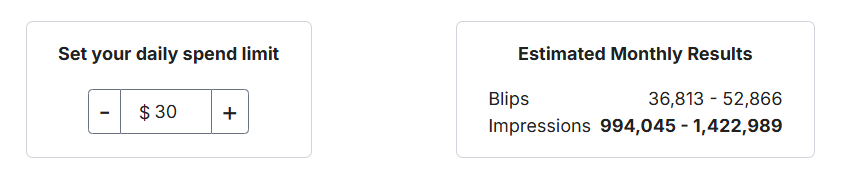
With Blip, you choose your own daily budget for Kendall billboards, and our system automatically keeps your campaign within that limit, so you stay in control. Each “blip” is a brief 7.5 to 10-second ad on digital billboards near Kendall, Florida, and you only pay for the blips you receive. Costs vary based on when and where you choose to advertise in the Kendall area and on advertiser demand, making it easy to match your spend to your goals.
Where can I advertise with Blip in Kendall, Florida?
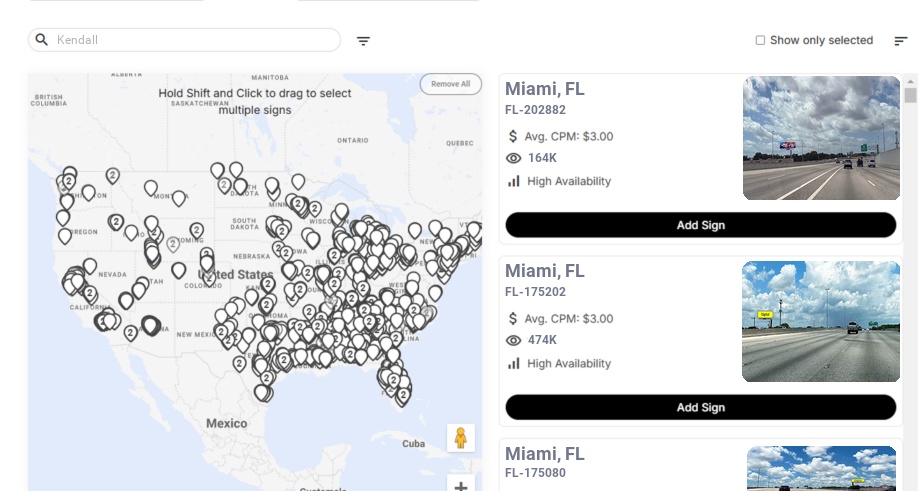
The 13 digital billboards serving the Kendall area are positioned near major Miami thoroughfares that Kendall residents use daily to shop, dine, work, and play. Important corridors and destinations include Kendall Drive, US-1 / South Dixie Highway near Kendall, Florida’s Turnpike, and the Don Shula Expressway. These routes help you reach both residents and visitors when and where they are most engaged with billboards near Kendall.
Who is the Kendall, Florida billboard audience like?
Kendall is one of Miami-Dade County’s most important suburban hubs, and it functions like a city of its own within the greater Miami metro. The area has around 80,000–85,000 residents, a median age around 42–43, and median household income typically reported in the $70,000–75,000 range. Miami-Dade is about 69–70% Hispanic or Latino, and Spanish is spoken at home by roughly 70% of residents, making bilingual or Spanish-first creative a powerful differentiator.
When should I run billboards in Kendall, Florida with Blip?
Commuting and school schedules in the Kendall area create predictable viewership spikes, with morning commute traffic strongest from 6:30–9:30 a.m. and evening commute traffic strongest from 3:30–7:30 p.m. Midday from 11 a.m.–2 p.m. is also a strong lunch and errand window. Seasonal peaks include winter high season from November–April, hurricane preparedness season from June–November, back-to-school in late July–August, and holiday shopping in November–December.
What kinds of businesses do well on billboards near Kendall, Florida?
The market profile suggests strong purchasing power and interest in quality-of-life products, a commuter-heavy lifestyle where roadside media is highly relevant, and high ROI for brands that respect the area’s bilingual, multicultural character. Strong potential categories include healthcare, education, real estate, financial services, auto, insurance, local attractions, and dining. Many of these businesses benefit from repeat local trips along Kendall Drive, US-1, the Turnpike, and other major corridors.
Do I need a contract to advertise with Blip near Kendall?
No, Blip has no long-term contracts or minimum commitments. You can start, pause, or stop your campaign at any time.
How fast can I launch a billboard campaign with Blip near Kendall?
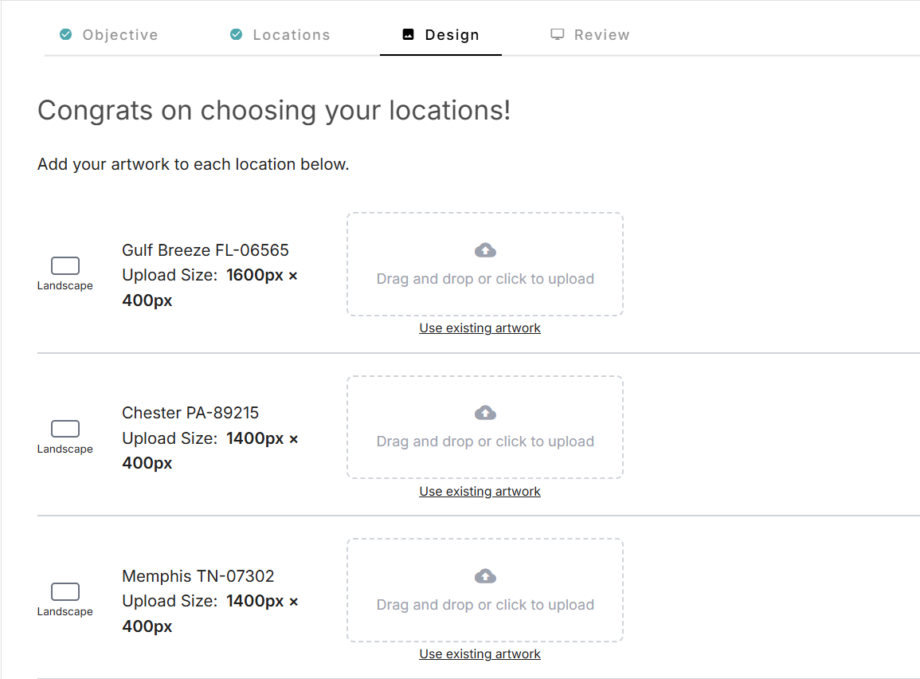
You can have your campaign live in minutes. Create a free account, select your locations, set your budget, upload your design, and start running once approved.
Where can I advertise with Blip near Kendall?
Blip has digital billboards near Kendall. You can browse available locations on a map, choose the ones that fit your audience, and start advertising right away.
Still have questions? Launch a campaign in minutes — no contracts, no commitments.
Start Your CampaignKendall Billboard Advertising Guide
The Kendall, Florida area sits at the crossroads of affluent suburbs, heavy commuter corridors, and major shopping destinations. With 13 digital billboards serving the Kendall area from nearby Miami locations, we can help you tap into daily routines along US-1, Kendall Drive, and the Turnpike to reach both residents and visitors when and where they are most engaged with billboards near Kendall.
Understanding the Kendall Area Market
Kendall is one of Miami-Dade County’s most important suburban hubs. While it’s officially an unincorporated community, it functions like a city of its own within the greater Miami metro, making Kendall billboards a powerful way to build presence with local households.
Local planning and demographic summaries from Miami-Dade County and county-wide research partners show that Kendall combines solid household income, high education levels, and strong car ownership—an ideal mix for roadside media and billboard advertising near Kendall.
Key market facts:
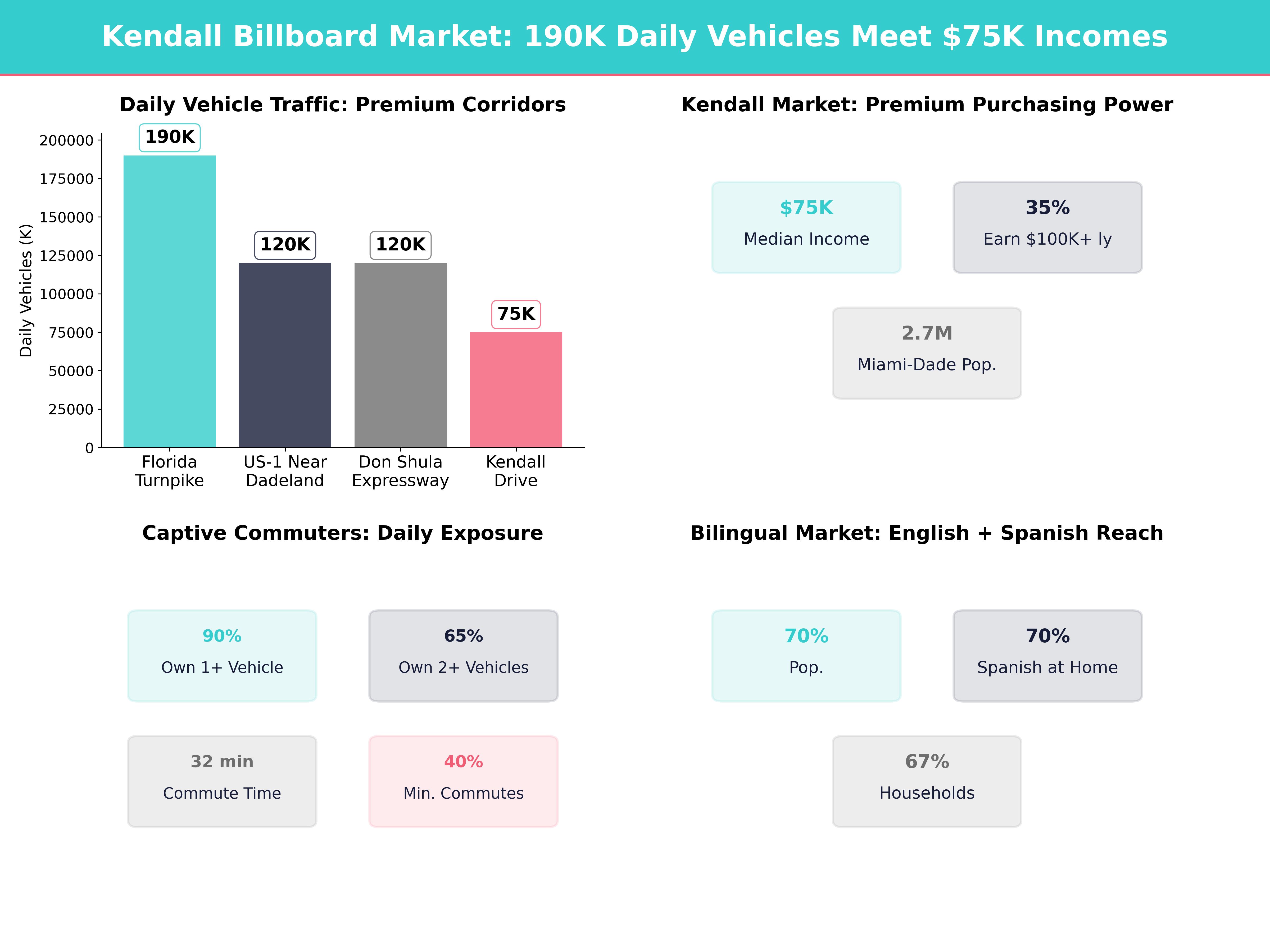
- Population: The Kendall census-designated area has around 80,000–85,000 residents (recent estimates put it at roughly 80,000–82,000), and it is embedded in the larger 2.7+ million–person Miami-Dade County market, according to county and state demographic summaries. Within a 5–7 mile radius of Kendall’s retail core, the total daytime population can easily exceed 200,000 when you account for workers, shoppers, and students.
- Age: The median age in Kendall is around 42–43 years, notably older than the City of Miami’s median in the mid-30s. Roughly 20–22% of residents are 60+ and about 22–25% are under 18, creating a strong base of established professionals, families, and empty nesters.
- Income: Median household income in Kendall is typically reported in the $70,000–75,000 range, higher than the Miami-Dade County median (which is in the low-to-mid $60,000s). More than 30–35% of Kendall-area households earn $100,000+ annually, supporting campaigns for financial services, autos, healthcare, education, and premium retail.
- Housing & stability: Owner-occupancy in many Kendall-area neighborhoods is in the 55–65% range, and typical household sizes run 2.7–3.0 people. That stability and family orientation supports long-term brand-building and repeat local purchases.
- Language: Miami-Dade is about 69–70% Hispanic or Latino, and Spanish is spoken at home by roughly 70% of residents. Kendall follows this pattern, with many neighborhoods where two-thirds or more of households are bilingual or Spanish-dominant, making bilingual or Spanish-first creative a powerful differentiator.
- Education & employment: County data indicate that well over 50% of Kendall-area adults have some college or higher, and about 30–35% hold a bachelor’s degree or above. Kendall has strong concentrations of professionals working in finance, healthcare, IT, government, and education, many of whom commute daily toward central and southern Miami employment hubs.
- Mobility: Local transportation surveys show that around 90%+ of Kendall-area households have at least one vehicle, and about 60–65% have two or more. Average one-way commute times for residents in southern Miami-Dade are close to 30–32 minutes, underscoring how much time your audience spends on the road and how often they encounter Kendall billboards during weekly routines.
For broader context and local initiatives, you can monitor data and plans from Miami-Dade County (miamidade.gov) and the Miami-Dade Transportation Planning Organization. For neighborhood-level updates, Miami-Dade District 7 and District 8 commission pages often share information on projects affecting Kendall that can influence where billboard advertising near Kendall performs best.
From a billboard strategy standpoint, this profile suggests:
- Strong purchasing power and interest in quality-of-life products.
- A commuter-heavy lifestyle where roadside media is highly relevant.
- High ROI for brands that respect and leverage the area’s bilingual, multicultural character.
- Strong potential for healthcare, education, real estate, financial services, and auto categories that rely on mid-to-upper income households.
Key Traffic Corridors Near Kendall Your Billboards Can Reach
The 13 digital billboards serving the Kendall area are positioned near major Miami thoroughfares that Kendall residents use daily to shop, dine, work, and play. Traffic statistics from the Florida Department of Transportation District Six Miami-Dade TPO show that the main corridors around Kendall carry some of the heaviest volumes in South Florida, making them prime locations for billboards near Kendall.
Important corridors and destinations to keep in mind:
-
Kendall Drive (SW 88th Street)
Kendall Drive is the spine of the area, running east–west and connecting residential neighborhoods to Dadeland Mall, local hospitals, and office complexes. FDOT traffic counts for Kendall Drive segments near Dadeland frequently register 60,000–75,000 vehicles per day, with some peak points climbing toward 80,000.- The corridor also connects to key institutions like Baptist Hospital of Miami ( baptisthealth.net Miami Dade College (mdc.edu), driving steady professional and student traffic that passes Kendall billboards consistently.
- Great for: Retail, restaurants, medical practices, schools, gyms, and local services targeting repeat neighborhood trips.
-
US-1 / South Dixie Highway near Kendall
US-1 is a major north–south commuter artery between Kendall, South Miami, Coral Gables, and Downtown Miami. Peak segments near Dadeland and South Miami see well over 100,000–120,000 vehicles per day, based on FDOT’s average annual daily traffic ranges for principal arterials in Miami-Dade ( FDOT District Six 3 million vehicle trips per month.- With direct access to Metrorail and major retail like Dadeland Mall
- Great for: Regional brands, auto dealerships, financial services, major events, and tourism campaigns that need broad reach across south Miami.
-
Florida’s Turnpike & Don Shula Expressway (SR 874)
Kendall residents frequently use these toll roads to reach employment centers around the Airport, Doral, and Downtown. FDOT data show that Florida’s Turnpike segments near Kendall often carry 150,000–190,000+ vehicles daily, while the Don Shula Expressway handles roughly 90,000–120,000 vehicles per day on core links.- The Turnpike system, managed locally with input from agencies such as Florida’s Turnpike Enterprise Miami-Dade Expressway Authority, is heavily used by long-distance commuters and logistics fleets, expanding your reach beyond just Kendall residents. Well-placed billboard rental near Kendall on these expressways can extend your message to regional travelers.
- Great for: Commuter-focused services, B2B, logistics, higher-priced consumer purchases, healthcare, and insurance.
-
Metrorail & Park-and-Ride Influence
Park-and-ride lots at Dadeland South and Dadeland North draw thousands of Kendall residents daily who switch to rail toward downtown. Miami-Dade Transit 15–20 million boardings annually, with the Dadeland stations among the busiest in the system.
Roadways feeding these stations, including US-1 and Kendall Drive, experience intense rush-hour congestion, which amplifies billboard dwell time and message retention for drivers waiting at signals and ramps.
By aligning your Blip schedule with these travel patterns—especially near Miami locations that Kendall drivers frequent—you get repeated exposure as residents head to and from work, school, shopping, and leisure, maximizing the value of your billboard rental near Kendall.
When to Run Your Campaign: Dayparts and Seasonality
Because Blip lets us schedule down to specific hours and days, we can “follow” Kendall audiences through their daily and annual rhythms. Local traffic management reports from Miami-Dade TPO show clearly defined morning and evening peaks on Kendall Drive, US-1, and the Turnpike that match work and school schedules.
Daily and Weekly Patterns
Commuting and school schedules in the Kendall area create predictable viewership spikes:
-
Morning commute: 6:30–9:30 a.m.
Heavy outbound traffic toward Miami’s employment centers. Many arterials near Kendall see morning peak-hour volumes at 8–10% of their entire daily traffic, suggesting strong impression density in a short window.- Best for: Coffee shops, breakfast spots, childcare, schools, healthcare reminders, traffic/commute-related services, and time-sensitive offers (“Today only,” “This morning”).
-
Midday: 11 a.m.–2 p.m.
Strong lunch and errand window. Many local workers and at-home parents are on the road. Retail corridors in south Miami often see 20–25% of their daily traffic during the late-morning to early-afternoon period, driven by restaurant and shopping trips.- Best for: Restaurants, clinics, salons, grocery, and local services.
-
Evening commute: 3:30–7:30 p.m.
Return traffic plus after-school activities and shopping. For many Kendall-area roads, afternoon peak volumes match or slightly exceed morning peaks, reflecting school dismissal and after-work errands.- Best for: Retail, family entertainment, streaming, dining, fitness, and home services.
-
Late evening & weekend nights (after 8 p.m.)
Traffic to restaurants, malls, movies, and nightlife across south Miami. Shopping and entertainment hubs such as Dadeland, The Falls- Best for: Entertainment venues, bars and lounges, streaming/TV, and rideshare or designated-driver messaging.
Traffic studies in Miami-Dade show average commute times close to 30 minutes each way for many residents, and over 40% of workers spend 30+ minutes commuting. That means multiple daily impressions are realistic if we daypart effectively and focus on peak windows, especially on billboards near Kendall that intercept these repeat journeys.
Seasonal Trends in the Kendall Area
Miami-Dade’s tourism and “snowbird” economy significantly influence traffic and spending patterns. According to the Greater Miami Convention & Visitors Bureau, Greater Miami welcomed more than 26 million visitors in strong recent years, with visitor spending surpassing $18–20 billion annually and supporting over 150,000 tourism-related jobs across the county. Many visitors stay in or travel through the southern suburbs to reach attractions and parks, where well-timed Kendall billboards can drive incremental visits.
Consider these key seasons:
-
Winter high season (November–April)
- More visitors, second-home residents, and events; hotel occupancy in Greater Miami frequently runs 10–15 percentage points higher than summer levels, with average daily room rates peaking in this period.
- Higher discretionary spending on dining, shopping, attractions, and medical/dental services as seasonal residents schedule procedures and checkups.
- Ideal for: Tourism, attractions near Zoo Miami (zoomiami.org), retail, high-value healthcare, real estate, and luxury goods.
-
Hurricane & preparedness season (June–November)
- Residents focus on home maintenance, insurance, supplies, and emergency services. Miami-Dade’s emergency management outreach routinely targets more than 1 million households with preparedness messaging.
- Local retailers report notable sales spikes for supplies and home improvement in the weeks leading up to major storm threats.
- Ideal for: Insurance, home improvement, generators, grocery and pharmacy, telecom, and public-service announcements (in partnership with entities like Miami-Dade County Emergency Management, via miamidade.gov).
-
Back-to-school (late July–August)
- Miami-Dade County Public Schools, one of the nation’s largest districts, serves over 330,000 students (per dadeschools.net) across more than 430 schools and centers. A significant share of those families live in or pass through Kendall.
- Retail research regularly shows double-digit percentage increases in spending on clothing, electronics, and school supplies during back-to-school compared with average summer weeks.
- Ideal for: Schools, tutoring centers, kids’ healthcare, retail, electronics, and extracurricular programs.
-
Holiday shopping (November–December)
- Dadeland Mall, The Falls, and other centers near Kendall see major spikes in foot traffic; national chains often report 20–30% of their annual in-store sales during the November–December window, and local malls extend hours to accommodate demand.
- County-wide, sales tax collections in November–December can run 15–25% higher than typical months, reflecting elevated consumer spending.
- Ideal for: Retail, e-commerce, restaurants, entertainment, and special holiday events.
With Blip, you can intensify your buys during these peak windows—without committing to a full, inflexible 4-week traditional flight—making billboard rental near Kendall more efficient and responsive to real demand.
Crafting Effective Creative for the Kendall Area
Because Kendall is both multicultural and commuter-heavy, creative decisions have outsized impact on performance. Studies of roadside advertising commonly show that clear, simple designs can increase recall by 20–30% compared with cluttered layouts, especially at highway speeds.
Language and Cultural Relevance
-
Use bilingual creative when possible. Options:
- English primary with Spanish subline.
- 50/50 rotation: one English-only and one Spanish-only design.
-
Prioritize simple, universal visuals that resonate with a broad Hispanic-majority audience:
- Families, food, education, entrepreneurship, and home ownership themes.
- Reference familiar local touchpoints—Kendall Drive, Dadeland, Zoo Miami, or the Turnpike—so viewers quickly recognize that the message is for them and associate it with Kendall billboards they see daily.
- Avoid long, nuanced copy that relies on wordplay; short, bold phrases work better when translated.
Given typical highway speeds of 35–55+ mph, and rotation intervals of about 6–10 seconds on digital boards, aim for:
- 7 words or fewer of main copy.
- 1 clear call to action (“Exit at Kendall Dr,” “Visit today,” “Scan now,” etc.).
- High-contrast colors and large fonts that are legible from 500–800 feet, helping ensure that more than 80% of passing drivers can read the message at a glance.
Visual Style and Layout
- Use high contrast: dark background + light text or vice versa.
- Include faces and local-feeling imagery: Miami skies, palm trees, neighborhoods, or recognizable shopping centers resonate with Kendall-area audiences and can improve emotional engagement.
- Include a clear location cue: “Near Kendall,” “By Dadeland Mall,” “Off Turnpike Exit,” or a major cross street so viewers connect the message to somewhere they know and recognize your Kendall billboards later.
- Limit to one logo and one primary image to avoid clutter; research on outdoor readability suggests that reducing visual elements can improve message comprehension by up to 40%.
Because digital boards near Miami rotate messages frequently (typically every 6–10 seconds), your ad must be instantly scannable.
Choosing Where to Focus: Matching Board Locations to Your Goals
All 13 digital billboards serving the Kendall area are within about 10 miles, primarily in nearby Miami. We recommend thinking in terms of audience zones and layering in local traffic data from Miami-Dade TPO and FDOT District Six
-
Commuters heading north toward central Miami and Coral Gables
- These flows include thousands of professionals traveling daily along US-1, the Turnpike, SR 874, and connecting arterials. In some peak hours, northbound demand can exceed 6,000–8,000 vehicles per lane per day on the busiest links.
- Ideal for: Employers recruiting Kendall residents, universities, downtown law firms, clinics, or cultural institutions like museums and performing arts centers (e.g., venues promoted through the Miami-Dade County Department of Cultural Affairs).
- Strategy: Emphasize commute benefits (“Beat traffic with telehealth,” “Park once, take Metrorail”) and professional services that save time or simplify life, using billboards near Kendall that align with these commuter flows.
-
Shoppers and diners gravitating to the Kendall–Dadeland retail core
- Includes destinations like Dadeland Mall and The Falls, which collectively attract millions of visits per year and employ thousands of workers. Weekends and holiday periods can see parking lots approach capacity, signaling strong retail demand.
- Ideal for: Retailers, restaurants, entertainment, gyms, and family attractions.
- Strategy: Use time-sensitive offers (“Tonight only,” “Weekend sale”), highlight parking and convenience, and leverage evening/weekend dayparts when shopping trips spike. Focus your Kendall billboards on routes feeding these centers to keep your message top-of-mind before purchase.
-
Local services rooted in Kendall neighborhoods
- Think healthcare clinics, dental offices, schools, realtors, home services, and auto repair. Many of these businesses draw from tight catchment areas within a 3–5 mile radius.
- Strategy: Combine brand awareness (“Your Kendall-area family dentist”) with specific directions from major roads (“2 minutes from Kendall Dr & 117th Ave”). Use consistent directional cues across boards to build mental maps, and choose billboard rental near Kendall that keeps your directions accurate and easy to act on.
Once you share your objectives and approximate customer locations, we can help prioritize nearby Miami boards that your target audience sees most often on their daily routines.
Integrating Billboards With Local Media and Digital Campaigns
Billboards near Kendall work best when they are part of a broader media mix. In a market where local surveys show smartphone ownership among adults above 90%, outdoor messages often trigger immediate mobile searches and social engagement.
-
Coordinate with local news and weather cycles:
- Outlets like the Miami Herald ( miamiherald.com WPLG Local 10 (local10.com), NBC 6 South Florida (nbcmiami.com), Univision 23, and Telemundo 51 ( telemundo51.com
- Hyperlocal platforms such as Miami’s Community Newspapers ( communitynewspapers.com
- Align billboard messaging with major local events, sports, weather patterns, and community issues to stay relevant and make your Kendall billboards feel timely.
-
Sync with digital campaigns:
- Use the same headline and imagery across social, search, and display for stronger recall. Studies of cross-channel campaigns often show 20–30% higher ad recall when creative is consistent across media.
- Promote hashtags or URLs on your billboard that match your online promotions.
- Because roughly 90%+ of adults in the Miami metro own smartphones, including simple URLs, QR codes, or short vanity domains can effectively bridge offline and online.
-
Add geofenced or retargeting layers:
- Serve mobile ads to users frequently near key corridors like Kendall Drive, US-1, Dadeland, or the Turnpike interchanges.
- When people see your billboard near Miami and later browse on their phones, they should encounter consistent messaging and offers—helping convert impressions into measurable actions and strengthening the impact of your billboard advertising near Kendall.
Using Blip’s Flexibility to Test, Learn, and Scale
The Kendall area’s diverse and mobile population makes it perfect for iterative optimization. With Blip, we can:
-
A/B test creative
- Example: Run two designs—English-dominant vs. Spanish-dominant—and monitor which generates more search traffic, QR code scans, or store visits. Even a 10–15% improvement in response rate can justify shifting more impressions to the top performer.
- Rotate “Brand awareness” creative during morning commutes and “Offer-focused” creative during evenings and weekends to match differing audience mindsets.
-
Target by time and budget
- Start with heavier weight during peak drive times (7–9 a.m., 4–7 p.m.) and then extend into off-peak once performance is proven.
- Increase budget seasonally (holiday, tax refund season, back-to-school) instead of maintaining a flat monthly spend, mirroring periods when local consumer spending spikes 10–25% over baseline.
-
Respond quickly to local events
- Severe weather alerts, local sports victories, festival weekends (such as events promoted by Miami-Dade Parks, Recreation and Open Spaces at nearby parks), or road construction can all be leveraged with rapid creative swaps.
- For official emergency information and coordination, refer to Miami-Dade County’s emergency and traffic updates (miamidade.gov) and Miami-Dade TPO traffic planning resources (miamidadetpo.org).
Because you are buying impressions, not a locked-in static face, you can start with modest budgets, measure lift in website visits, calls, or store traffic, and scale up quickly on the best-performing routes and times for billboard rental near Kendall.
Industry and Vertical Opportunities in the Kendall Area
A few sectors are especially well-suited to digital billboards serving the Kendall area, based on local demographics, traffic volumes, and spending data from county and tourism agencies:
-
Healthcare and wellness
- Kendall residents are older on average; with 20%+ of the population in midlife or retirement years, demand for clinics, dental, imaging, urgent care, and fitness is strong.
- Nearby institutions like Baptist Hospital of Miami and regional medical centers draw patients from across South Florida, generating thousands of daily trips along main corridors.
- Emphasize convenience (“Walk-ins welcome,” “Open late,” “Same-day appointments”) and proximity from major roads.
-
Education and tutoring
- With hundreds of thousands of students in Miami-Dade County Public Schools and multiple private schools and academies in Kendall, supplemental education and private schooling are significant.
- Promote registration windows and testing dates—applications, open houses, and exam seasons often cause short, intense spikes in parent research and enrollment activity.
- Highlight registration deadlines, entrance exams, and seasonal promotions (summer camps, test prep).
-
Real estate and home services
- Many Kendall-area households are owner-occupied, middle to upper-middle income, with a substantial share in the $300,000–$600,000+ home value range.
- Home improvement and maintenance spending typically increases 10–20% in early spring and pre-hurricane months, as documented in local building permit trends.
- Billboards can promote realtors, mortgage brokers, remodelers, landscapers, and security companies tied to specific neighborhoods—especially along corridors residents use to enter or leave subdivisions.
-
Auto, finance, and insurance
- Miami-Dade’s car ownership rates are high, and commutes are long; more than 75% of workers commute by car, truck, or van, and daily vehicle miles traveled across the county run into the tens of millions.
- Promote dealerships, leasing, refinancing, and insurance with clear “exit here” or “10 minutes from Kendall Drive” messages.
- Use Spanish-language or bilingual offers to connect with the large Hispanic customer base for auto finance and insurance products and to get more value from billboards near Kendall.
-
Local attractions and dining
- Promote Zoo Miami (zoomiami.org), nearby parks managed by Miami-Dade Parks, Recreation and Open Spaces, shopping centers, theaters, and restaurants.
- Weekends, holidays, and school breaks can see attendance at major attractions rise by 30–50% compared with typical weekdays, amplifying the impact of well-timed billboard campaigns.
- Time campaigns to weekends, holidays, and school breaks, especially around winter and spring visitor peaks, using Kendall billboards that line the main access routes.
Measuring Success and Iterating
To ensure your billboard investment near Kendall delivers, we recommend:
-
Defining clear KPIs before launch
- Examples: lift in direct website traffic, increase in branded search volume, QR code scans, coupon redemptions, or store visits from ZIP codes surrounding Kendall (e.g., 33156, 33176, 33183).
- Even modest lifts—such as a 5–10% increase in branded search or direct traffic during flight periods—can indicate strong billboard contribution.
-
Aligning your analytics setup
- Use custom landing pages, promo codes (“KENDALL10”), or dedicated phone numbers to attribute responses to your billboard flights.
- Track performance by daypart (morning vs. evening) and by key season (back-to-school, holidays, winter visitors) to see when your Kendall audience is most responsive and which Kendall billboards are driving the strongest lift.
-
Monitoring local conditions and adjusting frequently
- Use information from Miami-Dade County, local news outlets, and the Greater Miami Convention & Visitors Bureau to spot spikes in tourism, events, construction, or policy changes that might affect traffic and consumer moods.
- Example: Major construction along a key route can shift 10–20% of traffic to alternate corridors—an opportunity to reallocate impressions to other billboards near Kendall.
-
Refreshing creative every 4–8 weeks
- The Kendall area has high repeat exposure because of daily commuting. Rotate new visuals and offers regularly to avoid creative fatigue; many advertisers see improved results when they refresh creative at least every 1–2 months.
- Maintain consistent brand elements (logo, colors) while updating offers or headlines to stay fresh.
By understanding how Kendall residents move, shop, and communicate—and by using Blip’s flexible, data-friendly tools—we can build campaigns on digital billboards near Miami that consistently reach and influence the Kendall area. With the right mix of bilingual creative, smart dayparting, data-driven testing, and location-aware messaging, your brand can turn billboard advertising near Kendall into a steady driver of awareness and response, becoming a familiar and trusted presence in one of South Florida’s most valuable suburban markets.