Billboards near Myrtle Grove, FL
No Minimum Spend. No Long-Term Contracts. Just Results.
Trusted by Leading Brands


Billboard advertising
near Myrtle Grove has never been easier
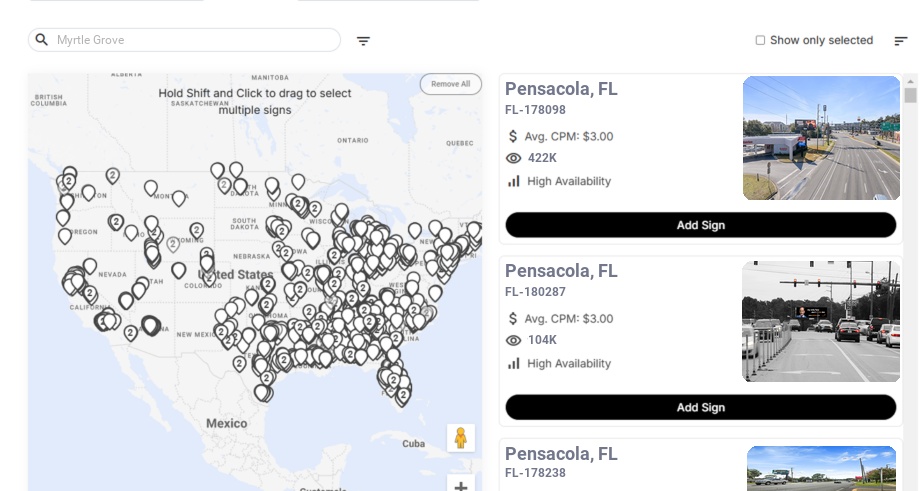



How much is a billboard near Myrtle Grove?
Why Choose Blip for Billboard Advertising near Myrtle Grove
Blip lets Myrtle Grove advertisers launch fast on US-98, Navy Blvd, and FL-295 with self-serve control—no agency delays.
In Myrtle Grove, set any budget and pay only for blips, so you can reach base commuters and beach visitors without overspending.
Use dayparting in Myrtle Grove to hit 6–9 a.m. NAS Pensacola traffic and 4–7 p.m. return commuters.
No contracts means Myrtle Grove businesses can test campaign timing around summer tourism or holiday peaks, then adjust anytime.
Track real-time results in Myrtle Grove and shift spend toward I-10, I-110, or US-98 placements that drive the best response.
Blip's creative tools help Myrtle Grove ads stay bold and clear for fast-moving drivers, with military, family, or beach-ready messaging.
Frequently Asked Questions About Billboard Advertising near Myrtle Grove
How much does a billboard cost near Myrtle Grove, Florida with Blip?
With Blip, you can advertise on Myrtle Grove billboards with any budget by setting a daily amount that Blip will never exceed. Each ad is a brief “blip,” a 7.5–10 second display on digital billboards near Myrtle Grove, Florida, and you only pay for the blips you receive. This pay-per-blip model means the total cost depends on when and where you choose to advertise and local advertiser demand, giving you flexible control over your spend.
Where can I advertise with Blip near Myrtle Grove, Florida?
The Myrtle Grove area sits at the crossroads of suburban neighborhoods, military life, and coastal tourism. With 11 digital billboards nearby in Pensacola (all within about 10 miles), we can help advertisers tap into a steady mix of local residents, base commuters, and visitors moving through corridors that serve the Myrtle Grove area. For brands specifically seeking billboards near Myrtle Grove, this close-by network offers coverage that functions much like an in-neighborhood presence, without needing a structure on every single local roadway.
What kind of audience will Myrtle Grove, Florida billboards with Blip reach?
When we advertise on digital billboards serving the Myrtle Grove area, we’re typically speaking to several high-value audience segments: military & defense community, suburban families & long-time locals, tourists & seasonal visitors, and workers in retail, healthcare, and services. Escambia County’s median age is about 37–38 years, and median household income is in the $58,000–$60,000 range, with more than 55% of households in owner-occupied housing. Military personnel, veterans, and defense civilians together make up well over 15% of the county’s adult population.
When is the best time to run Myrtle Grove, Florida billboards with Blip?
Weekday morning (6–9 a.m.) is strong for commuter flows from the Myrtle Grove area toward Pensacola and NAS Pensacola, while lunchtime (11 a.m.–2 p.m.) and evening (4–7 p.m.) are also effective for reaching workers, families, and return traffic. On weekends, Saturday late morning to afternoon brings higher leisure traffic, and Sunday late afternoon and evening see return traffic from beaches and out-of-town trips. The strongest tourism season is March–August, and December holidays can also be valuable for short, high-impact bursts.
What roads near Myrtle Grove, Florida get the most billboard traffic with Blip?
Myrtle Grove–area drivers connect to major roads like US-98 (Lillian Highway / Navy Boulevard), FL-295 (New Warrington Road), and Blue Angel Parkway (SR 173). Boards located along I-10, I-110, and US-98 in Pensacola capture Myrtle Grove–area commuters heading toward central Pensacola, military traffic traveling between housing and the base, and visitors moving between the airport, hotels, downtown, and beaches. According to FDOT, average annual daily traffic along these corridors typically ranges from 30,000–45,000 vehicles per day on US-98, 50,000–70,000 on I-110, and 60,000–80,000 on I-10.
Do I need a contract to advertise with Blip near Myrtle Grove?
No, Blip has no long-term contracts or minimum commitments. You can start, pause, or stop your campaign at any time.
How fast can I launch a billboard campaign with Blip near Myrtle Grove?
You can have your campaign live in minutes. Create a free account, select your locations, set your budget, upload your design, and start running once approved.
Where can I advertise with Blip near Myrtle Grove?
Blip has digital billboards near Myrtle Grove. You can browse available locations on a map, choose the ones that fit your audience, and start advertising right away.
Still have questions? Launch a campaign in minutes — no contracts, no commitments.
Start Your CampaignMyrtle Grove Billboard Advertising Guide
The Myrtle Grove area sits at the crossroads of suburban neighborhoods, military life, and coastal tourism. With 11 digital billboards nearby in Pensacola (all within about 10 miles), we can help advertisers tap into a steady mix of local residents, base commuters, and visitors moving through corridors that serve the Myrtle Grove area. For brands specifically seeking billboards near Myrtle Grove, this close-by network offers coverage that functions much like an in-neighborhood presence, without needing a structure on every single local roadway.
Understanding the Myrtle Grove Area Market
Myrtle Grove is a dense suburban community in west Escambia County, just southwest of Pensacola Escambia County data and regional planning documents, complemented by estimates from local planning agencies and the City of Pensacola
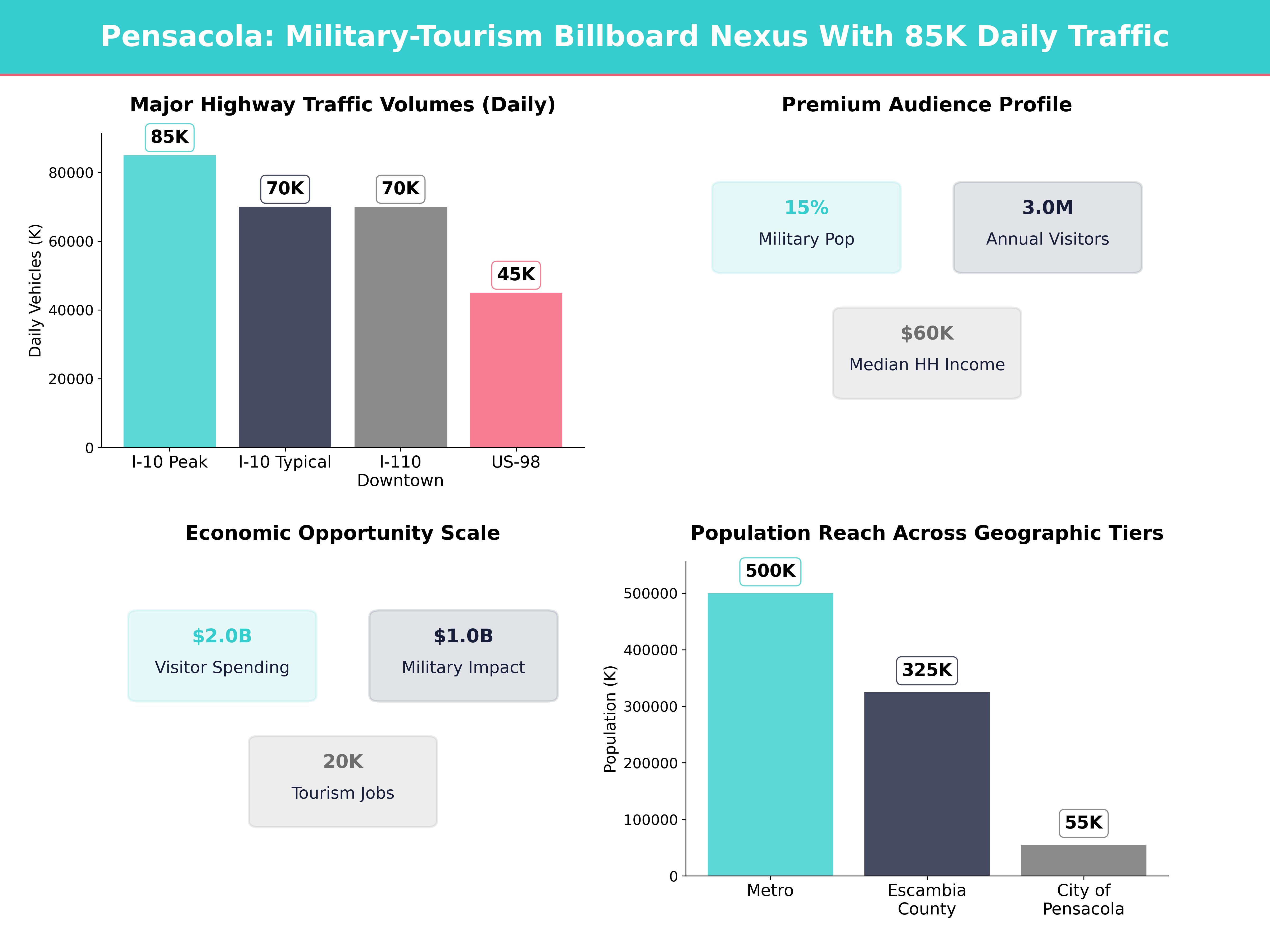
- Escambia County’s population is a little over 325,000 residents, with the City of Pensacola accounting for roughly 54,000–55,000 residents.
- The broader Pensacola metro pulls from nearly 500,000 residents across Escambia and neighboring counties for shopping, healthcare, and entertainment, meaning Myrtle Grove–area roads serve both locals and regional visitors.
- Escambia County’s median age is about 37–38 years, and median household income is in the $58,000–$60,000 range, with more than 55% of households in owner-occupied housing—an attractive profile for financial services, home improvement, and family-oriented brands.
- Military personnel, veterans, and defense civilians together make up well over 15% of the county’s adult population, thanks largely to Naval Air Station (NAS) Pensacola
Visit Pensacola reports that the Pensacola area welcomes roughly 2.5–3.0 million visitors each year, generating around $1.5–$2.0 billion in annual visitor spending and supporting more than 20,000 local jobs in hospitality, retail, and services. Roughly 40–45% of visitors arrive by car from neighboring states such as Alabama, Georgia, and Mississippi, making roadside visibility especially valuable.
Digital billboards in Pensacola, strategically placed along major commuter and visitor routes, are well-positioned to reach these audiences traveling near Myrtle Grove daily. For advertisers evaluating Myrtle Grove billboards as part of a broader Gulf Coast strategy, these locations provide high-frequency impressions without the higher costs often associated with beachside placements. On busier corridors, individual boards can deliver hundreds of thousands of weekly impressions based on Florida DOT traffic volumes, giving even modest Blip budgets meaningful reach.
Who You’ll Reach Near Myrtle Grove
When we advertise on digital billboards serving the Myrtle Grove area, we’re typically speaking to several high-value audience segments:
-
Military & Defense Community
- NAS Pensacola supports thousands of active-duty personnel and civilian staff and trains over 20,000 students annually, according to NAS Pensacola $1 billion per year for the region.
- Local planning estimates indicate that 30–40% of NAS personnel and students live, shop, or commute through the Myrtle Grove and west Pensacola area, using Blue Angel Parkway (SR 173), US-98, and FL-295 as daily connectors.
- These commuters are prime audiences for automotive, insurance, banking, quick-service restaurants, gyms, education, and personal services. Military households typically show above-average spending in categories such as auto, dining out, and education due to frequent relocations and training schedules. Well-placed billboards near Myrtle Grove give these brands daily, repeated exposure during predictable base commute windows.
-
Suburban Families & Long-time Locals
- Neighborhoods near Myrtle Grove have a strong presence of families and multigenerational households; local school enrollment figures indicate that more than one in four Escambia County School District public school students lives in west Pensacola attendance zones.
- About 60–65% of Myrtle Grove–area workers commute outside their immediate neighborhood for employment, with many traveling toward central Pensacola for jobs, shopping, healthcare, and entertainment, and west toward the Alabama line for regional shopping and recreation.
- Household vehicle ownership is high, with more than 90% of households in the broader area having access to at least one vehicle, and more than 40% having two or more—meaning a large share of daily activity flows past roadside media. This heavy car reliance is exactly why Myrtle Grove billboards and nearby digital inventory can keep local businesses top-of-mind during everyday errands.
-
Tourists & Seasonal Visitors
- Visitors often stay in or pass through the Pensacola area on their way to beachfront communities like Perdido Key and Pensacola Beach, highlighted by Visit Pensacola. Visitor surveys show that roughly 70–75% of overnight guests prioritize beach access, while 30–35% also visit downtown Pensacola for dining, nightlife, and events.
- Pensacola International Airport 2 million passengers annually, with a significant portion renting cars and driving along I-110, I-10, and US-98 to reach hotels, vacation rentals, and attractions—routes that intersect with the billboard network serving the Myrtle Grove area.
- Visitors frequently use US-98 and I-110 to get to lodging, restaurants, museums like the National Naval Aviation Museum
-
Workers in Retail, Healthcare, and Services
- Major employers such as Baptist Health Care, Ascension Sacred Heart Pensacola West Florida Healthcare, University of West Florida, and Pensacola State College draw thousands of workers from Myrtle Grove and west Pensacola every day. Healthcare alone accounts for more than 15% of local employment, with several thousand daily commuters.
- Retail centers along Navy Boulevard, New Warrington Road, and in central Pensacola employ hundreds more Myrtle Grove–area residents. These daily commutes create reliable weekday impression patterns that we can target with time-of-day bidding, often aligning with two peak flows on weekdays (morning and late afternoon) and a steady midday baseline. For employers and service brands alike, billboard advertising near Myrtle Grove turns these routine trips into consistent branding opportunities.
Key Travel Corridors Serving the Myrtle Grove Area
Our 11 digital billboards in nearby Pensacola sit along roads that Myrtle Grove–area residents and visitors use frequently. According to the Florida Department of Transportation (FDOT), average annual daily traffic (AADT) along main Pensacola area corridors typically ranges:
- I-10 near Pensacola: often in the 60,000–80,000 vehicles per day range, with peak segments exceeding 85,000 vehicles per day during busy travel months.
- I-110 into downtown Pensacola: commonly 50,000–70,000 vehicles per day, serving as the primary connector between I-10, the airport, and downtown.
- US-98 through Pensacola and towards the west: typically 30,000–45,000 vehicles per day, depending on specific segments, with higher volumes near major intersections and retail nodes.
Myrtle Grove–area drivers connect to these major roads via:
- US-98 (Lillian Highway / Navy Boulevard) – a primary east–west corridor between the Myrtle Grove area, NAS Pensacola, and central Pensacola, carrying upwards of 25,000–35,000 vehicles per day on some segments.
- FL-295 (New Warrington Road) – links Myrtle Grove to major retail and commercial zones and can see 20,000–30,000 vehicles per day, creating strong opportunities for repetition and frequency.
- Blue Angel Parkway (SR 173) – a key route for base traffic and residents commuting north and east, with 15,000–25,000 vehicles per day and heavy military commuter patterns around shift changes.
Boards located along I-10, I-110, and US-98 in Pensacola capture:
- Myrtle Grove–area commuters heading toward central Pensacola employment centers, government offices, and institutions like Escambia County School District.
- Military traffic traveling between housing, the base, and retail areas, particularly along Navy Boulevard and Blue Angel Parkway.
- Visitors moving between the airport, hotels, downtown, and beaches, including high-spend overnight guests who typically spend $150–$250 per party per day on food, shopping, and entertainment.
When planning campaigns, we recommend mapping your customer locations against these corridors and prioritizing boards that best align with your highest-value origin–destination flows. For many advertisers, choosing billboards near Myrtle Grove that sit on these connectors can deliver both local and tourist impressions with a single placement. In practice, two or three boards placed on different approaches to the same destination can outperform a single board with the same total spend, due to increased encounter frequency.
Timing Your Campaign Around Local Patterns
The Myrtle Grove area’s daily and seasonal rhythms are shaped by both military schedules and tourism patterns. With Blip’s flexible scheduling, we can align your impressions to these rhythms.
Weekday vs. Weekend
Traffic counts and local commuting studies show that weekday peaks in the Pensacola area can be 30–40% higher than off-peak hours along I-10 and I-110. In practical terms:
-
Weekday morning (6–9 a.m.) – Strong commuter flows from the Myrtle Grove area toward Pensacola and NAS Pensacola. Many corridors see their highest hourly volumes between 7–8 a.m. Ideal for:
- Coffee shops, breakfast QSR, gas stations.
- Banking, insurance, and service brands focused on top-of-mind awareness before work.
-
Lunchtime (11 a.m.–2 p.m.) – Office workers and base personnel leaving for food and errands. Local counts often show a 15–20% bump over late-morning volumes. Effective for:
- Restaurants and food delivery.
- Healthcare clinics, dental offices, and urgent care centers promoting easy access.
-
Evening (4–7 p.m.) – Return traffic toward the Myrtle Grove area. On some roads, outbound traffic can be 20–30% higher than midday. Best for:
- Retail, grocery, fitness, and family entertainment targeting after-work stops.
- Home services (HVAC, landscaping, roofing) staying visible when homeowners are thinking about projects.
On weekends, traffic patterns shift:
- Saturday late morning to afternoon – Higher leisure traffic as families shop, dine out, and visit attractions. Many retail corridors report 10–25% higher traffic on Saturdays than Sundays.
- Sunday late afternoon and evening – Return traffic from beaches and out-of-town trips moving back through Pensacola, with a noticeable rise along I-10, I-110, and US-98 after 3 p.m.
Seasonal Considerations
Visit Pensacola notes that visitor peaks tend to occur in late spring, summer, and early fall, with holiday spikes as well:
- Hotel and vacation rental occupancy can climb to 70–85% on peak summer weekends, compared to 40–55% in slower months.
- Beach communities like Perdido Key and Pensacola Beach can see double the typical daily traffic on summer Saturdays, pushing more vehicles through Myrtle Grove–adjacent corridors.
That means:
- March–August – Strong tourism season. Ideal for hotels, attractions, restaurants, and seasonal retail to increase budget and frequency. During this window, even modest Blip budget increases of 25–50% can coincide with 30–40% more potential impressions on some roads.
- September–November – Good time for education (trade schools, colleges), healthcare, and home services to lean into localized, resident-focused messaging as visitor volumes moderate and locals refocus on back-to-school and home projects.
- December holidays – Retail, events, and nonprofits can use short, high-impact bursts with Blip’s budget controls. Many local retailers report 20–30% of annual sales occurring in the November–December period, making visibility especially valuable.
With Blip, you can automatically bid more during peak periods and reduce spending during low-traffic seasons or off-hours, ensuring your campaign is cost-effective while still reaching drivers near Myrtle Grove. This flexibility makes billboard rental near Myrtle Grove accessible even for smaller local businesses that need to scale investment up and down throughout the year.
Crafting Effective Creative for Myrtle Grove Audiences
The Myrtle Grove area’s mix of military, locals, and visitors has direct implications for your billboard design.
1. Speak to Military and Working Families
- Use clear, benefit-driven lines like “Military discounts on auto insurance – Next Exit” or “Fast dinner for busy families near Myrtle Grove.”
- Consider acknowledging the military community with simple respect-forward language, especially for brands offering service member discounts. Across many categories, 10–20% off military discounts are common and easy to communicate quickly.
- Keep offers straightforward: “$0 enrollment for military & first responders” works better than complex fine print, especially given that typical billboard view times are only 5–8 seconds on faster highways.
2. Leverage Local Geography
- Refer to recognizable anchors: “Minutes from NAS Pensacola,” “Near Navy Boulevard,” or “Between Myrtle Grove and Downtown Pensacola.”
- For businesses with multiple locations, emphasize the nearest option: “Closest location to Myrtle Grove – on [Street Name] in Pensacola.”
- Including simple drive-time references such as “5 minutes from NAS gate” or “10 minutes to downtown” helps convert impressions into visits, especially for visitors unfamiliar with local street names. Framing your message this way reinforces that your ad is part of a network of billboards near Myrtle Grove, not just generic regional signage.
3. Design for Quick Readability
Drivers on I-10, I-110, and US-98 typically have only a few seconds to see your ad. We recommend:
- 6–10 words max on the main message; campaigns that exceed 12–14 words often see significantly lower recall.
- Large, high-contrast fonts and simple backgrounds. Legibility tests commonly show that high-contrast color pairs can boost on-the-fly readability by 20–30%.
- One key visual (logo, product, or person) rather than cluttered collages.
- Prominent call-to-action: “Exit X,” “Order on [Short URL],” “Scan to Save.”
While QR codes can work at slower intersections, prioritize bold text and branding on faster corridors where average speeds are 40–65 mph.
4. Align Colors and Imagery with the Market
- Beach and water imagery resonates strongly in the Pensacola area, but use it purposefully—especially for tourism, hospitality, and lifestyle brands.
- For local service businesses (plumbers, HVAC, auto repair), clear before/after visuals or recognizable service trucks often outperform generic stock imagery; many advertisers report higher direct-response rates when their physical vehicles or storefronts are visible on creative.
- For healthcare and education, use approachable human imagery and concise value messages (e.g., “Walk-in care in 15 minutes,” “Career training in 9–12 months”), echoing the access-focused positioning of local providers like Baptist Health Care and Pensacola State College.
Local Use Cases: How Different Sectors Can Win Near Myrtle Grove
Local Retail & Restaurants
- Use geo-anchored copy: “5 minutes from Myrtle Grove on Navy Blvd.”
- Time bids to lunchtime and evening commutes. For many quick-service restaurants in commuter corridors, 40–50% of daily sales occur in the lunch and early dinner windows.
- Rotate creatives: one for everyday value, another for limited-time offers, and a third for seasonal items. Advertisers who maintain 2–3 active creative variations often see better recall than those running a single static message. This is especially effective when those creatives are used across multiple Myrtle Grove billboards to reinforce a consistent, localized message.
Automotive Sales & Service
- The Myrtle Grove area has a high share of commuters dependent on personal vehicles; in west Escambia County, over 90% of workers commute by car, truck, or van, with average one-way commute times around 22–25 minutes.
- Promote oil changes, tires, and repairs with strong price points and “No appointment needed” messages, especially along corridors carrying 20,000+ vehicles per day.
- For dealerships, highlight simple offers: “Zero down for qualified military,” “Used trucks starting at $___.” In auto, concise, price-forward messaging routinely outperforms generic branding-only creative. Combined with targeted billboard advertising near Myrtle Grove, these offers can generate both calls and direct lot visits from drivers who pass your message daily.
Healthcare & Dental
- Escambia County’s aging segments and family demographics mean consistent demand for primary care, urgent care, and dental services. Roughly 15–18% of county residents are 65 or older, while children under 18 make up about 20–22%—both groups driving ongoing healthcare demand.
- Use calls-to-action like “Same-day appointments,” “Walk-ins welcome,” or “Open evenings & weekends.” These access cues align with the extended hours promoted by urgent care and walk-in clinics across Pensacola.
- Emphasize convenience for Myrtle Grove residents commuting to Pensacola: “Right off I-110 – 10 minutes from Myrtle Grove.” Convenience-focused healthcare marketing often yields higher appointment conversion rates when tied to simple location cues.
Education & Training
- With thousands of transitioning service members at NAS Pensacola each year, schools and training programs can position billboards as a bridge from service to civilian careers.
- Messages like “Use your GI Bill – Classes in Pensacola” or “Nursing, IT, HVAC training in under 2 years” can resonate strongly. Local institutions like University of West Florida and Pensacola State College serve tens of thousands of students annually, many of whom live or work within the Myrtle Grove–Pensacola commute shed.
- Trade and technical programs can emphasize median wages and job placement rates where available (for example, “HVAC techs earn a median of $X per year locally”), paired with timelines such as “Graduate in 9–18 months.” When paired with billboards near Myrtle Grove, these messages reach both active-duty personnel and spouses considering career changes.
Tourism & Attractions
- Promote museums, tours, and attractions in downtown Pensacola or nearby beaches, particularly during the March–August visitor window when hotel occupancy and road traffic are highest.
- Use simple directional prompts: “Downtown Pensacola – Exit X,” “Historic tours daily – 10 min ahead.” Attractions listed by Visit Pensacola and the City of Pensacola
- Many attractions report that 20–40% of on-site visitors discovered them via roadside or outdoor signage, making billboards a natural complement to online travel planning. Strategic billboard rental near Myrtle Grove can catch visitors both as they arrive and as they plan last-minute activities during their stay.
Using Blip’s Tools Strategically Near Myrtle Grove
Because Blip allows you to buy flexible “blips” of time instead of fixed 4-week contracts, we can tailor campaigns tightly around Myrtle Grove–area behaviors:
-
Daypart Targeting
- Focus budget on morning and evening commutes for work-related or convenience services, when traffic volumes can be 30% higher than mid-day lows on some routes.
- Emphasize midday and weekend slots for retail, dining, and leisure, which often see higher dwell times and more flexible consumer schedules.
-
Board-Level Optimization
- Test multiple Pensacola boards that best intercept Myrtle Grove–area traffic (for example, those along I-110 and US-98). Start by spreading budget across 5–7 boards, then refine.
- After a few weeks, concentrate budget on boards that correlate with higher website visits, calls, or in-store traffic. Many advertisers find that their top 2–3 boards deliver a disproportionate share of attributable results. This approach to billboard rental near Myrtle Grove lets you quickly identify which specific locations truly move the needle for your business.
-
Creative Rotation by Audience & Season
- Run military-specific creative on weekdays during commute hours and more family- or tourist-oriented creative on weekends and peak visitor months.
- Swap graphics for back-to-school, holiday, and spring break periods without any printing costs. With digital boards, you can update messages in hours instead of the days or weeks traditional vinyl often requires.
-
Budget Flexibility for Local Businesses
- Start with modest daily budgets to maintain presence along key corridors—for example, a consistent daily budget that yields a few hundred impressions per board, then scale as results appear.
- Increase spend around local events or promotions highlighted in outlets like the Pensacola News Journal or City of Pensacola 10–30%, magnifying the impact of short-term billboard pushes.
Measuring and Improving Your Campaign
To make the most of digital billboards serving the Myrtle Grove area, we recommend tying your Blip campaign to clear, trackable indicators:
-
Website & Search Activity
- Track branded search volume (e.g., Google searches for your business name) before and after launch. Many advertisers see 10–30% lifts in branded search after a few weeks of consistent billboard exposure.
- Use simple, memorable URLs or vanity domains on your creative, ideally 12 characters or fewer to aid recall.
-
Promo Codes & Phrases
- Use billboard-specific codes like “Show this code: GROVE10” to attribute in-store redemptions.
- Ask new customers “How did you hear about us?” and record “billboard near Pensacola” responses; aim for at least 5–10% of new customers referencing outdoor media during active campaigns.
-
Geofenced Digital Campaigns
- Run parallel digital ads targeted around Pensacola and the Myrtle Grove area and measure lift when billboards are active versus paused. Advertisers often see higher click-through rates and lower cost-per-click in markets where billboards are running because brand awareness is already established.
- Use geofencing around high-traffic corridors like I-110, US-98, and Navy Boulevard to capture mobile impressions from the same drivers who see your billboards.
-
Time-Based Comparisons
- Compare sales or lead volume in time windows that align with your heaviest billboard schedules (for example, those morning commute hours). Look for consistent week-over-week increases during active flights.
- If possible, benchmark key performance indicators (calls, form fills, store visits) for at least 2–4 weeks before your campaign to establish a solid baseline.
By combining flexible scheduling, precise location choices in Pensacola, and Myrtle Grove–specific messaging, we can build billboard campaigns that reach the right people, at the right times, on the roads they actually use every day. Whether you are testing a first small buy or scaling a multi-board strategy, this framework helps you treat Myrtle Grove billboards as a measurable, performance-oriented channel rather than just a branding expense.
With 11 digital billboards within about 10 miles of Myrtle Grove, advertisers have a powerful toolkit for building awareness and driving action across the entire Myrtle Grove area and greater Pensacola market, supported by strong year-round local traffic and a robust, tourism-fueled visitor base. For organizations seeking billboards near Myrtle Grove, this network delivers the reach of a metro market with the specificity and community connection of true neighborhood-focused billboard advertising near Myrtle Grove.