Billboards near South Miami, FL
No Minimum Spend. No Long-Term Contracts. Just Results.
Trusted by Leading Brands


Billboard advertising
near South Miami has never been easier



How much is a billboard near South Miami?
Why Choose Blip for Billboard Advertising near South Miami
Blip lets you launch on South Miami’s US-1 and Sunset Drive corridors in minutes, reaching commuters, shoppers, and UM traffic without traditional barriers.
Set flexible budgets for South Miami and shift spend toward peak rush hours, Dadeland weekends, or South Miami Hospital runs as traffic changes.
No contracts means you can test South Miami creatives for bilingual shoppers, students, and healthcare audiences around Coral Gables and Kendall.
Use real-time analytics to see what works in South Miami, then move budget to the US-1, SR 826, or Sunset Drive routes driving results.
Blip’s creative tools make it easy to swap promos for South Miami’s evening dining, hospital visits, and University of Miami events on the fly.
Frequently Asked Questions About Billboard Advertising near South Miami
How much does a billboard cost near South Miami, Florida with Blip?
With Blip, you control exactly how much you spend on South Miami billboards by setting a daily budget that can be adjusted at any time. Each ad shows for 7.5 to 10 seconds on digital billboards near South Miami, Florida, and you only pay per “blip,” similar to pay-per-click online ads—you’re charged only for the impressions you actually receive. This means the total cost of advertising in the South Miami area is simply the sum of each blip your campaign runs.
Where can I advertise near South Miami, Florida with Blip?
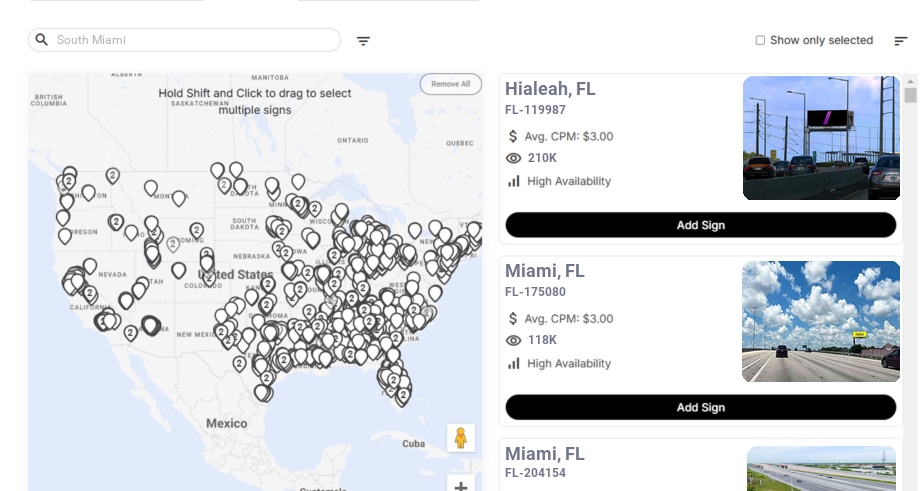
There are 41 digital billboards serving the South Miami area from nearby Miami, with many placements within about 5–10 miles. They are positioned to intercept traffic flowing to and from South Miami on key corridors like US‑1 / South Dixie Highway, Palmetto Expressway (SR 826), Snapper Creek Expressway (SR 878), and Don Shula Expressway (SR 874). Local arterials such as Bird Road, Sunset Drive, and Miller Drive also see heavy traffic and can be strong for hyper-local campaigns.
Who sees South Miami, Florida billboards most often?
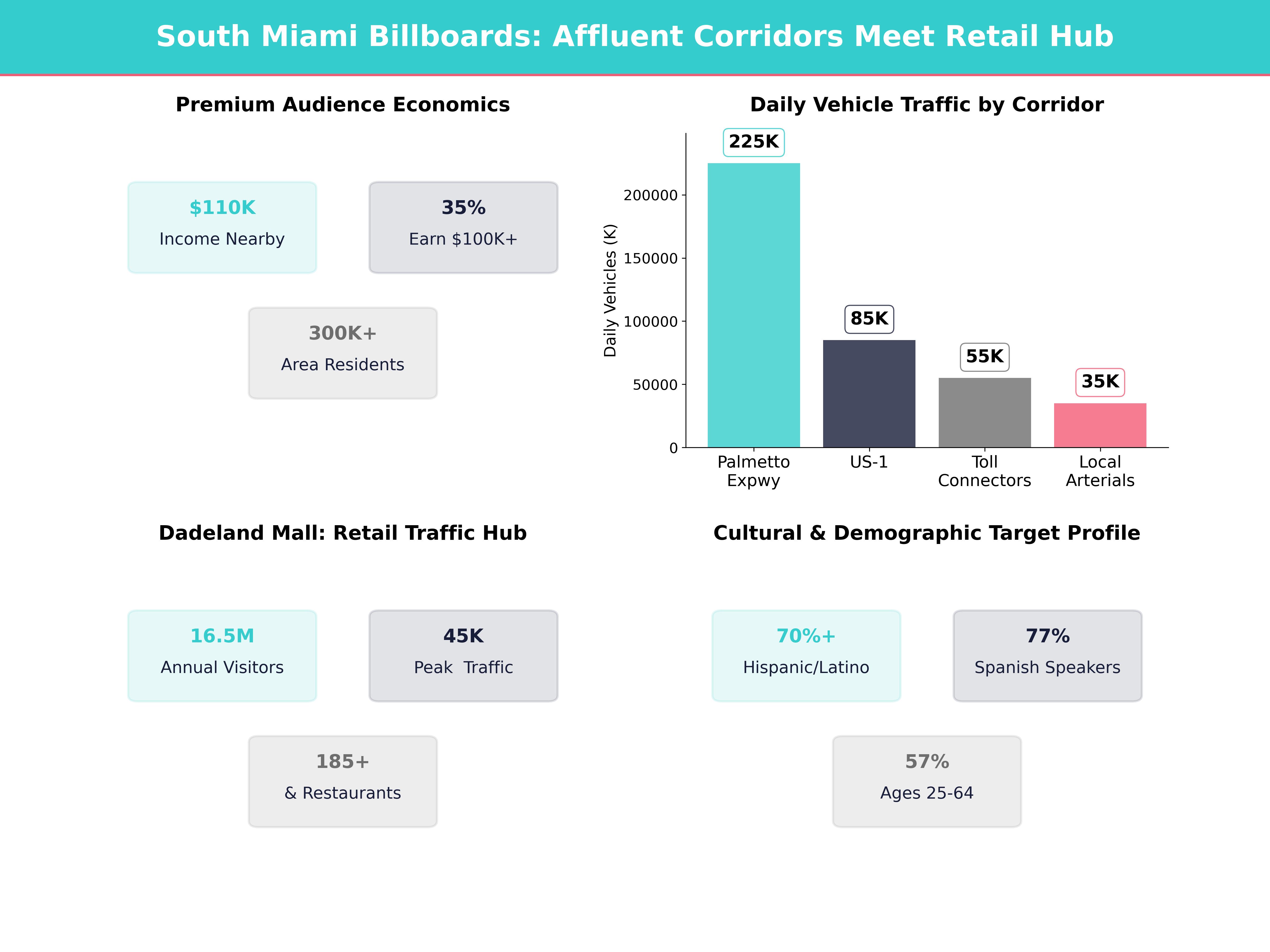
The South Miami area sits at the crossroads of upscale residential neighborhoods, major shopping destinations, top-ranked healthcare facilities, and the University of Miami. With 41 digital billboards serving the area, advertisers can put dynamic, data-driven messages in front of hundreds of thousands of daily commuters, shoppers, students, and visitors. Within a 5-mile radius, you can tap into a trade area of well over 300,000 residents and tens of thousands of daily workers and students.
When is the best time to run Blip ads near South Miami, Florida?
Weekday peaks include the morning commute from 6:30–9:30 a.m., midday from 11:00 a.m.–2:00 p.m., and the evening PM peak from 3:30–7:30 p.m. Weekend traffic is also strong, especially Saturday afternoons and early evenings around malls and dining corridors like Dadeland and Sunset Drive. With Blip, you can concentrate spend on high-value windows like Friday–Sunday afternoons and evenings, or weekday peaks for healthcare and commuter services.
What kind of audience and demographics are there in South Miami, Florida?
South Miami’s median age is around 39–40, with a balance of young professionals, families, and long-time residents. Miami-Dade County is highly diverse, with approximately 70%+ of residents identifying as Hispanic or Latino, and more than 70% of county residents speaking a language other than English at home. In many South Miami-area neighborhoods, the share of Spanish speakers is closer to 75–80%, making bilingual messaging especially effective.
Do I need a contract to advertise with Blip near South Miami?
No, Blip has no long-term contracts or minimum commitments. You can start, pause, or stop your campaign at any time.
How fast can I launch a billboard campaign with Blip near South Miami?
You can have your campaign live in minutes. Create a free account, select your locations, set your budget, upload your design, and start running once approved.
Where can I advertise with Blip near South Miami?
Blip has digital billboards near South Miami. You can browse available locations on a map, choose the ones that fit your audience, and start advertising right away.
Still have questions? Launch a campaign in minutes — no contracts, no commitments.
Start Your CampaignSouth Miami Billboard Advertising Guide
The South Miami area sits at the crossroads of upscale residential neighborhoods, major shopping destinations, top-ranked healthcare facilities, and the University of Miami. With 41 digital billboards serving the South Miami area from nearby Miami—most within about 5–10 miles—advertisers can use Blip to put dynamic, data-driven messages in front of hundreds of thousands of daily commuters, shoppers, students, and visitors. For brands looking specifically for billboards near South Miami, this wide coverage offers flexible, high-impact options.
Why the South Miami Area Is a High-Value Billboard Market
South Miami is small in size but sits at the heart of one of the country’s busiest and most diverse metro areas, making South Miami billboards especially valuable for both local and regional visibility.
- The City of South Miami itself has roughly 12,000 residents, with a land area of just 2.3 square miles, creating a population density of more than 5,200 residents per square mile and a dense, walkable community around its downtown core near Sunset Drive and US‑1. The city oversees about 150+ retail, dining, and service businesses in its central business district, concentrating consumer activity into a compact footprint.
- South Miami is embedded in Miami‑Dade County, which has about 2.7 million residents and has grown by roughly 5–6% over the last decade (Miami‑Dade County Government). The county’s labor force tops 1.4 million workers, with unemployment typically tracking near 2–4% in recent years, supporting steady consumer spending.
- Greater Miami and Miami Beach welcomed approximately 26–27 million overnight visitors in a recent year, plus several million day visitors, with total visitor spending surpassing $20–21 billion, according to the Greater Miami Convention & Visitors Bureau. Roughly 1 in 5 jobs in the area is tied to tourism, which keeps traffic flows strong year‑round and further boosts the reach of billboard advertising near South Miami.
For advertisers, that translates into two crucial advantages:
- Local + regional reach
Businesses based in South Miami can reach both neighborhood residents and county-wide audiences who pass through or near the area to shop at Dadeland Mall 15–18 million visitors per year), visit South Miami Hospital University of Miami, or commute between Kendall, Coral Gables, and central Miami. Within a 5‑mile radius, you can tap into a trade area of well over 300,000 residents and tens of thousands of daily workers and students, all reachable through thoughtfully placed South Miami billboards. - High vehicle exposure
Key arterials near South Miami—especially US‑1 (South Dixie Highway), Palmetto Expressway (SR 826), and nearby expressways—carry tens of thousands to over 200,000 vehicles per day on certain segments, according to regional traffic counts from agencies such as the Miami‑Dade Transportation Planning Organization and FDOT District Six millions of potential views per week across a full campaign, making billboard advertising near South Miami an efficient way to stay visible.
Understanding the South Miami Audience
Positioning your message correctly starts with understanding who spends time in the South Miami area and who will see your billboards near South Miami during their daily routines.
Demographic profile
- South Miami’s median age is around 39–40, reflecting a balance of young professionals, families, and long-time residents. About 22–25% of residents are under 18, while roughly 15% are 65 or older, supporting both family and senior-focused services.
- Households in the immediate area have estimated median incomes in the $75,000–$90,000 range, with many adjacent neighborhoods (Coral Gables, Pinecrest, High Pines, and South Gables) skewing substantially higher, often above $100,000–$120,000. In several nearby ZIP codes, 30–40% of households earn over $100,000 annually, and median single-family home values frequently exceed $700,000–$1 million+.
- Miami‑Dade County is one of the most diverse counties in the U.S.; approximately 70%+ of residents identify as Hispanic or Latino, with large Cuban, Colombian, Venezuelan, Nicaraguan, and other Latin American communities. Non-Hispanic White residents account for roughly 12–15%, and Black or African American residents for about 15–18%, creating a genuinely multicultural marketplace.
- More than 70% of county residents speak a language other than English at home, and Spanish–English bilingualism is extremely common. In many South Miami–area neighborhoods, the share of Spanish speakers is closer to 75–80%, and over half of residents are foreign-born or have at least one foreign-born parent.
Commuting and mobility patterns also matter:
- In the broader South Miami / Coral Gables / Kendall area, an estimated 70–75% of workers commute by car, 8–12% use public transit (including Metrorail and Metrobus), and the rest walk, bike, or work from home.
- Average one-way commute times are around 28–32 minutes, reinforcing the value of messaging that reaches drivers repeatedly during their daily trip.
What this implies for your creative and messaging
- Bilingual or Spanish‑forward messaging is a powerful differentiator. Even a simple bilingual tagline or Spanish call to action (“Llámanos hoy”, “Visítanos en Sunset Drive”) can tap into the 70%+ of residents who are comfortable in Spanish and increase recall among households where Spanish is the primary language at home.
- Emphasizing quality, service, and convenience over deep discounts often aligns better with affluent, family-focused neighborhoods near South Miami, where household discretionary spending on dining, wellness, and home services can exceed $25,000–$35,000 per year.
-
Themes around health, education, lifestyle, and family tend to perform well because of proximity to:
- South Miami Hospital ( Baptist Health South Florida 453‑bed facility that handles tens of thousands of emergency and inpatient visits annually.
- University of Miami in adjacent Coral Gables (University of Miami), with more than 19,000 students and 17,000+ faculty and staff, generating daily traffic and spending.
- High-performing public and private schools in the surrounding communities, several of which rank among the top 10–15% in Florida for test scores and college placement.
Where Our Digital Billboards Reach Drivers Near South Miami
Our 41 digital billboards serving the South Miami area are all located in nearby Miami, with many placements within about 4.8 miles of South Miami. They are positioned to intercept traffic flowing to and from the South Miami area on the region’s most important corridors, giving you practical options for billboard rental near South Miami without sacrificing reach.
While exact board locations vary, you can typically reach South Miami–oriented traffic along:
-
US‑1 / South Dixie Highway
- Daily traffic volumes near the South Miami area commonly range from 70,000 to 100,000+ vehicles per day on different segments, based on recent county and state counts. Over the course of a week, that can translate into 500,000–700,000 vehicle trips along critical stretches connected to South Miami.
-
This route connects downtown Miami, Brickell, Coral Gables, South Miami, and Kendall. It is especially strong for:
- Retail and restaurants near Dadeland, Sunset Drive, and Coral Gables
- Professional services and medical practices
- Auto dealers and service centers
-
Palmetto Expressway (SR 826)
- Certain stretches of SR 826 in southwest Miami‑Dade carry 200,000–250,000 vehicles per day, making it one of the highest-volume roads in the region.
-
Ideal for campaigns targeting:
- County-wide audiences
- Commuters traveling between western suburbs, the airport area, and the South Miami corridor
- Shoppers heading to regional destinations like Dadeland Mall and nearby big-box centers
-
Snapper Creek Expressway (SR 878) & Don Shula Expressway (SR 874)
- These toll connectors funnel traffic between Kendall, the Turnpike, and US‑1 near South Miami, with segments typically carrying 40,000–70,000 vehicles per day.
-
Great for reaching:
- Daily commuters heading toward employment centers
- Shoppers going to Dadeland Mall ( Dadeland Mall
- Residents making hospital and school runs
- Drivers connecting to Metrorail park‑and‑ride facilities such as Dadeland North and Dadeland South stations via Miami‑Dade Transit
-
Local arterials feeding the South Miami area
- Roads such as Bird Road (SW 40th St), Sunset Drive (SW 72nd St), and Miller Drive (SW 56th St) see heavy local traffic, often in the 25,000–45,000 vehicles per day range, especially during school and shopping peaks.
- Boards reaching drivers on these approaches are strong for hyper-local businesses that rely on residents within a 3–7 mile radius and want to influence short, routine trips like school drop-offs, grocery runs, or quick dining decisions.
Using Blip, advertisers can select from the digital billboards that best align with where South Miami customers are coming from—whether that’s Kendall to the south, Coral Gables to the north, or central Miami to the northeast—so your billboard advertising near South Miami is always focused on the routes that matter most.
Timing Your Campaign: When Impressions Spike
Understanding when traffic builds around the South Miami area helps you use Blip’s scheduling tools to stretch your budget and get more value from South Miami billboards.
Weekday patterns
Regional transportation data from agencies such as the Miami‑Dade TPO shows consistent weekday peaks:
-
Morning commute (6:30–9:30 a.m.)
- Heavy inbound traffic toward Coral Gables, the University of Miami, the hospital district, and downtown Miami. On major corridors like US‑1 and SR 826, 30–35% of daily traffic can occur during combined AM and PM peaks.
-
Strong dayparts for:
- Professional services
- Higher education and training programs
- Healthcare and medical practices
-
Midday (11:00 a.m.–2:00 p.m.)
- Lunchtime traffic toward downtown South Miami, South Miami Hospital, and Dadeland-area restaurants and shopping. Many retail and QSR operators see 20–30% of weekday sales during this window.
-
Ideal for:
- Quick-service restaurants
- Retail
- Gyms and wellness services
-
Evening and PM peak (3:30–7:30 p.m.)
- School pick-ups, hospital shifts ending, and commuters heading south and west. PM rush hours often register slightly higher volumes than AM peaks, especially on US‑1.
-
Effective for:
- Family-oriented services and activities
- After-work dining
- Entertainment and events, including venues near The Shops at Sunset Place ( Shops at Sunset Place
Weekend patterns
-
Regional data for Miami‑Dade indicates elevated weekend volumes near major shopping and entertainment centers:
- Saturday afternoons and early evenings see strong surges around malls and dining corridors like Dadeland and Sunset Drive; many centers record 30–40% of weekly foot traffic on Saturdays alone.
- Sunday late morning to early afternoon often spikes around brunch spots, parks, and religious centers, with traffic around popular corridors sometimes approaching weekday peak levels.
-
Tourism and events also influence weekend travel:
- During peak visitor seasons (winter and spring), hotel occupancy in Greater Miami often exceeds 75–80%, with weekend rates even higher, driving additional leisure trips through South Miami–adjacent corridors.
With Blip, we can:
- Concentrate your spend on high-value windows (e.g., Friday–Sunday afternoons and evenings for retail and restaurants, or weekday AM/PM peaks for healthcare and commuter services).
- Reduce or pause during low-intent times unless constant visibility is a strategic goal.
- Test separate weekday vs. weekend creatives and dayparts, then shift budget toward whichever combinations produce more web traffic, calls, or store visits.
Crafting Creative That Resonates in the South Miami Area
Billboards only have a few seconds to communicate. In the fast-moving South Miami area, clarity and cultural relevance are essential, especially when you’re investing in billboard rental near South Miami and want every impression to count.
Core design principles
-
Keep it bold and minimal
- 7–10 words or fewer to fit the 3–5 seconds most drivers have to process your message at highway speeds.
- Large, high-contrast text (white or bright colors on dark backgrounds or vice versa).
- One key visual focal point: a product image, logo, or face.
-
Design for Florida sunlight and rain
- Use high-contrast colors that are readable in bright sun and during afternoon thunderstorms, which are common on more than 100 days per year in South Florida.
- Avoid thin fonts and low-contrast color combinations that can wash out.
-
Localized messaging cues
- References like “Minutes from South Miami Hospital,” “Off Sunset Drive,” or “Near Dadeland” instantly signal relevance.
- Use directional hints: “Next Exit,” “2 Miles Ahead,” or “Off US‑1 by Sunset.”
- Including distance or time (“5 Minutes Away”) can help capture impulse visits, especially when 60–70% of shoppers decide where to stop while already en route.
Language and cultural considerations
-
Consider bilingual campaigns:
- English headline + Spanish subline (or vice versa) can broaden appeal in a market where 7 in 10 residents speak a language other than English at home.
- Use clear, neutral Spanish that’s easily understood across different Latin American backgrounds.
-
Reflect the area’s diversity:
- Inclusive imagery resonates with the multicultural South Miami and wider Miami‑Dade audience.
- Lifestyle visuals showing families, students, and professionals fit the surrounding communities, where roughly 55–60% of adults are in the prime working ages of 25–64.
Offer and call-to-action strategies
-
Use short, memorable CTAs:
- “Book Today,” “Call Now,” “Order Online,” “Visit This Weekend.”
-
Use trackable elements:
- Simple vanity URLs (e.g., BrandNameMiami.com).
- Unique promo codes (“Use code SOUTHMIAMI10”).
- Dedicated phone numbers for billboard campaigns.
-
When possible, align offers with local pay cycles and patterns:
- Many employers in Miami‑Dade pay bi‑weekly; tying promotions to the first and fifteenth of the month or weekends immediately after can boost response.
Because Blip allows rapid creative swapping, you can:
- Run A/B tests with two different headlines or bilingual vs. English-only versions and compare performance over 1–2 week intervals.
- Adjust artwork based on performance data, weather, time of day, or seasonality (e.g., hurricane season messaging in late summer and fall, back-to-school in August, holiday shopping in November–December, and spring break offers in March–April).
Using Blip Tools to Target the South Miami Area
Digital billboards serving the South Miami area via Blip give you flexibility that traditional static boards don’t, and they make it easy to fine-tune billboard advertising near South Miami as your goals change.
1. Geographic precision
-
Select specific boards in nearby Miami that align with:
- Traffic heading to South Miami from Kendall, Pinecrest, or Westchester.
- Commuters traveling between Coral Gables, downtown Miami, and the South Miami corridor.
-
Build clusters of boards around:
- Dadeland Mall and Kendall Drive for retail and QSR campaigns, capturing mall visitors who can exceed 40,000–50,000 people per day during peak seasons.
- South Miami Hospital and medical district for healthcare and wellness, where thousands of employees, patients, and visitors arrive daily.
- University of Miami approaches for education, housing, and student services, targeting not only 19,000+ students but also alumni and visiting families during key campus events.
2. Budget control
- Set a daily or campaign-level budget that fits your needs—whether that’s $10/day for a very targeted local push or a larger spend for metro-wide brand awareness.
-
Since you pay per “blip” (each ad play), you can:
- Increase frequency during key sales periods, like major holiday weekends or the start of the school year.
- Maintain a constant but low-level presence between big pushes, keeping your brand in front of tens of thousands of commuters each week through billboards near South Miami that match your budget.
3. Daypart and calendar control
-
Schedule your ads:
- By time of day (e.g., morning and evening commute only).
- By day of week (e.g., Thursday–Sunday for nightlife and dining, Monday–Wednesday for healthcare and professional services).
- Around specific dates (e.g., University of Miami move-in dates, major concerts, local festivals, or community events listed on the City of South Miami events calendar).
-
This level of control lets you align with periods when your target customers are most active. For example:
- Align restaurant ads with 11 a.m.–2 p.m. and 5 p.m.–9 p.m.
- Promote weekend events Thursday–Saturday when up to 60% of event tickets are often purchased.
4. Creative rotation
-
Upload multiple creatives and let them rotate:
- Different offers for weekday vs. weekend.
- Spanish-focused creative in certain dayparts or on routes with higher Hispanic household concentration.
- Seasonal messages (tax season, hurricane preparation, holiday shopping, spring break).
- Over time, this rotation can reveal which combinations of route + language + offer drive the strongest lift in metrics like website visits and inbound calls, helping you refine which South Miami billboards deliver the best return.
Industry-Specific Tips for South Miami Advertisers
Different sectors can lean into the South Miami area’s unique patterns in different ways and choose billboard rental near South Miami that best fits their audience.
Healthcare & Wellness
With South Miami Hospital and numerous clinics nearby, healthcare is a major regional draw.
- South Miami Hospital alone employs 2,000+ staff and handles thousands of inpatient stays annually, plus extensive outpatient and maternity services, drawing patients from across Miami‑Dade and neighboring counties.
-
Use boards along US‑1 and near hospital access routes to highlight:
- ER and urgent care wait times (“Short Wait, Just Minutes Away Off Sunset”).
- Specialized services (cardiology, maternity, orthopedics).
- Preventive care campaigns timed around the new year (when health resolutions peak) or back-to-school (when families schedule checkups and vaccinations).
-
Wellness and fitness centers can focus on:
- Early-morning commuters (6–9 a.m.) and evening commuters (4–8 p.m.), when 40–50% of daily gym check-ins typically occur.
- Bilingual messaging to reach both English- and Spanish-speaking patients.
Education & Student Housing
The University of Miami enrolls more than 19,000 students (undergraduate, graduate, and professional), many of whom commute or live nearby. The broader student catchment—including local colleges and technical schools—adds tens of thousands more young adults within a 5–10 mile radius, making nearby South Miami billboards a strong channel for student-focused messaging.
-
Time campaigns around:
- Orientation, move-in, and graduation periods, when thousands of parents and family members visit campus.
- Major home games and campus events, which can draw 40,000–60,000 attendees per game at nearby Hard Rock Stadium
-
Promote:
- Student housing, tutoring, and test prep.
- Fitness centers, dining, and nightlife that appeal to students.
- Graduate programs and continuing education, especially during late-spring and early-fall enrollment pushes.
- Use calls to action tailored to mobile behavior; more than 95% of college-aged consumers own smartphones and respond well to short URLs, QR codes, and social handles.
Retail, Restaurants & Entertainment
Destinations like Dadeland Mall, The Shops at Sunset Place, and downtown South Miami attract shoppers from across the county, and billboard advertising near South Miami can nudge these audiences to choose your business as they pass by.
- Dadeland Mall 185 stores and restaurants and annual sales estimated in the hundreds of millions of dollars.
-
Emphasize:
- “Today-only” or weekend offers, particularly ahead of key retail events (Black Friday, holiday shopping, tax-free weekends, back-to-school).
- Proximity (“Across from Dadeland,” “Steps from Metrorail”) to capture last-minute decisions from drivers and transit riders.
-
Use weekend-heavy dayparting to match peak foot traffic:
- Many retailers see 35–45% of weekly sales from Friday to Sunday.
- Restaurants often generate 50%+ of weekly revenue between Thursday night and Sunday.
- Entertainment venues and nightlife can capitalize on evening slots between 6 p.m. and midnight, when social and leisure trips increase.
Real Estate & Home Services
Affluent neighborhoods around South Miami see active real estate markets and ongoing home improvement spending.
- In nearby communities like Pinecrest, Coral Gables, and South Gables, median home prices often exceed $1 million, and annual property sales volumes can total hundreds of millions of dollars.
-
Target:
- Commuters traveling to and from these residential areas, particularly on US‑1, Red Road (SW 57th Ave), and Sunset Drive.
- Weekend traffic during common open house windows (late mornings and early afternoons).
-
Highlight:
- New listings, pre-construction projects, or “Just Sold in Your Area” messages to build social proof.
- High-end remodeling, landscaping, pool, and security services—categories where households in these zip codes often spend $5,000–$15,000+ per year.
- Consider layering QR codes or short URLs on creative; even a 1–2% scan/click rate from high-volume traffic can generate consistent leads.
Tourism, Events & Attractions
Greater Miami’s visitor base flows through corridors that touch the South Miami area.
- Each year, millions of visitors staying in downtown Miami, Brickell, Coral Gables, and Kendall pass near South Miami on the way to attractions, beaches, and shopping.
-
Use boards to promote:
- Festivals, sports events, concerts, and cultural happenings featured on calendars from sites like the Greater Miami Convention & Visitors Bureau and local cities.
- Hotels and attractions reachable via Metrorail or expressways, highlighting quick access (“15 minutes from South Miami via US‑1”).
- Coordinate campaigns with regional tourism messaging and major events (Art Basel, Miami Music Week, boat shows, food and wine festivals), when hotel occupancy and visitor spending spike by 10–20% over average weeks.
Measuring and Optimizing Your Campaign
To get the most from your investment near South Miami, build a measurement plan from day one so you can clearly see how your South Miami billboards are performing.
Before launch
-
Define success metrics:
- Website visits, quote requests, bookings, or in-store visits.
-
Set baselines:
- Track your typical weekly web traffic, call volume, or sales before your boards go live so you can quantify lifts of 10%, 20%, or more once campaigns start.
-
Align geography:
- Use analytics tools to monitor performance in ZIP codes within a 3–10 mile radius of South Miami and along major approach corridors.
During the campaign
-
Use:
- Unique promo codes.
- Dedicated URLs or landing pages.
- Call tracking numbers.
-
Watch for:
- Spikes in direct or branded search traffic during your active dayparts—many advertisers see 10–30% increases in branded search during strong billboard flights.
- Increases in store visits from South Miami–area customers, which you can track via POS ZIP codes or loyalty programs.
After initial run (2–4 weeks)
-
Identify which:
- Dayparts, board locations, or creatives correlate with better results (higher conversion rates, lower cost per lead, or stronger in-store traffic).
-
In Blip, shift:
- More budget to higher-performing boards (for example, routes that lead directly to South Miami, Dadeland, or UM).
- Spend toward the best-performing times and messages, trimming 10–20% of budget from underperforming slots and reallocating to top performers.
- Over 6–12 weeks, consistent measurement and optimization can significantly improve your cost per action and help you build a repeatable local playbook for billboard advertising near South Miami.
For broader market context—economic development, major projects, and mobility initiatives—keep an eye on local news sources like the Miami Herald Local 10 News, as well as infrastructure and planning updates from Miami‑Dade County. These sources can signal when to ramp up campaigns around new openings, road projects, or area events that will affect traffic patterns near South Miami.
By combining South Miami–focused creative, smart use of geography and dayparts, and Blip’s flexible budgeting and creative tools, we can help you build a digital billboard strategy that reaches the right people, on the right roads, at the right time—all in the South Miami area, with billboards near South Miami tailored to your business goals.