Billboards near Lakewood Park, FL
No Minimum Spend. No Long-Term Contracts. Just Results.
Trusted by Leading Brands


Billboard advertising
near Lakewood Park has never been easier



How much is a billboard near Lakewood Park?
Why Choose Blip for Billboard Advertising near Lakewood Park
Blip lets Lakewood Park advertisers launch self-serve on nearby I-95 and U.S. 1 in minutes—no broker or long wait.
Use Blip-optimized campaigns in Lakewood Park to auto-shift spend between Fort Pierce and Vero Beach traffic as goals change.
Set flexible budgets in Lakewood Park and pay only when your ad blips, ideal for commuter-heavy roads where 90% drive.
Daypart Lakewood Park ads for 6-9am, lunch, or 3-6pm—perfect for repeat-route commuters on Indrio Rd and SR 60.
No contracts with Blip means Lakewood Park businesses can test winter snowbird traffic, summer family travel, or storm-season offers.
Track Lakewood Park campaign results in real time and refresh creative fast for healthcare, retail, or beach-season messaging.
Frequently Asked Questions About Billboard Advertising near Lakewood Park
How much does a billboard cost in Lakewood Park with Blip?
You set a daily budget that works for you, and Blip’s algorithm uses it to bid for open ad slots on rotating digital billboards serving the Lakewood Park area. You only pay when your ad actually displays, with each “blip” lasting 7.5 to 10 seconds and starting at just $0.01 per display. Because pricing is dynamic, the cost per blip can vary by time of day, location, and advertiser demand, helping Blip maximize your reach for your budget.
Where can I advertise near Lakewood Park with Blip?
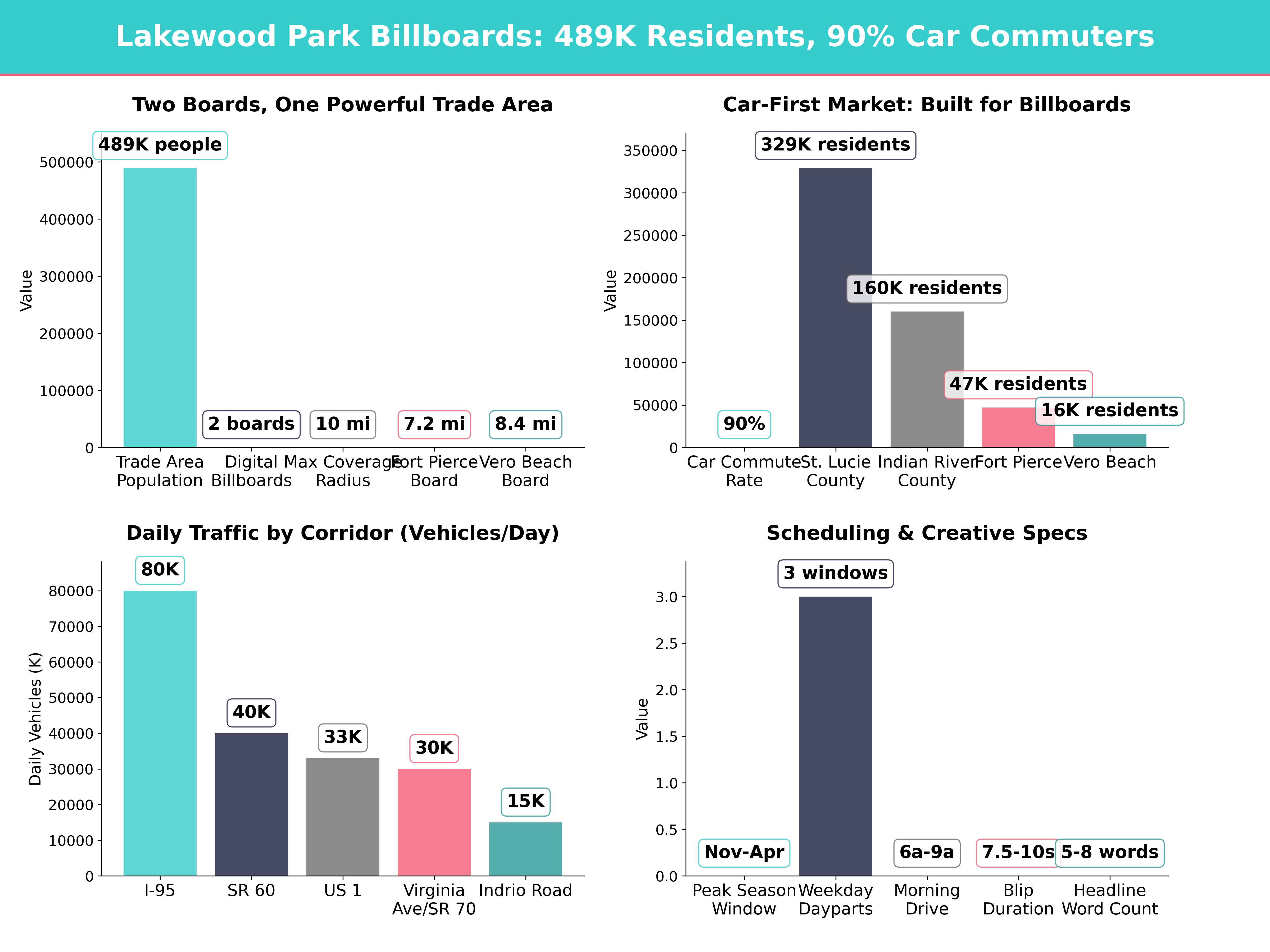
Our 2 digital billboards serving the Lakewood Park area are positioned just 7.2 miles away in Fort Pierce and 8.4 miles away in Vero Beach, so we can reach the market from both directions within 10.0 miles of the community. The area is highly car-oriented, and roughly 90% of workers in St. Lucie and Indian River counties commute by car, whether driving alone or carpooling. That mix of daily commuting, cross-county movement, and year-round coastal activity gives us a strong foundation for billboard campaigns serving the Lakewood Park area.
What kind of traffic and roads does Lakewood Park get for billboard advertising?
The strongest north-south routes serving the Lakewood Park area are I-95 and U.S. 1. On Florida Department of Transportation traffic count maps, I-95 segments near Fort Pierce and Vero Beach commonly land in the 70,000 to 90,000 vehicles per day range, depending on the segment and count year. U.S. 1 is even more important for local decision-making, often running in the 25,000 to 40,000 vehicles per day range in commercial stretches near Fort Pierce and Vero Beach.
When is the best time to run billboard ads in Lakewood Park with Blip?
The strongest seasonal window for many categories runs from November through April. Late winter and early spring create another useful bump, and summer also works well for family-focused messaging, local attractions, quick-service food, cold beverages, healthcare, and indoor entertainment. Back-to-school timing is especially important in August, and Florida’s hurricane season runs from June through November.
Who is the Lakewood Park area good for reaching with billboard ads?
The Lakewood Park area is a strong household-decision market, with families tied to school calendars and activity schedules and retirees and seasonal residents adding steady demand for healthcare, financial planning, home maintenance, and leisure dining. Students and education-related households matter more here than many advertisers expect, and healthcare is another major audience segment. Tourism also broadens the market beyond residents alone, with beaches, the Indian River Lagoon, and regional attractions creating regular leisure movement between Fort Pierce, Vero Beach, and the communities in between.
Do I need a contract to advertise with Blip near Lakewood Park?
No, Blip has no long-term contracts or minimum commitments. You can start, pause, or stop your campaign at any time.
How fast can I launch a billboard campaign with Blip near Lakewood Park?
You can have your campaign live in minutes. Create a free account, select your locations, set your budget, upload your design, and start running once approved.
Where can I advertise with Blip near Lakewood Park?
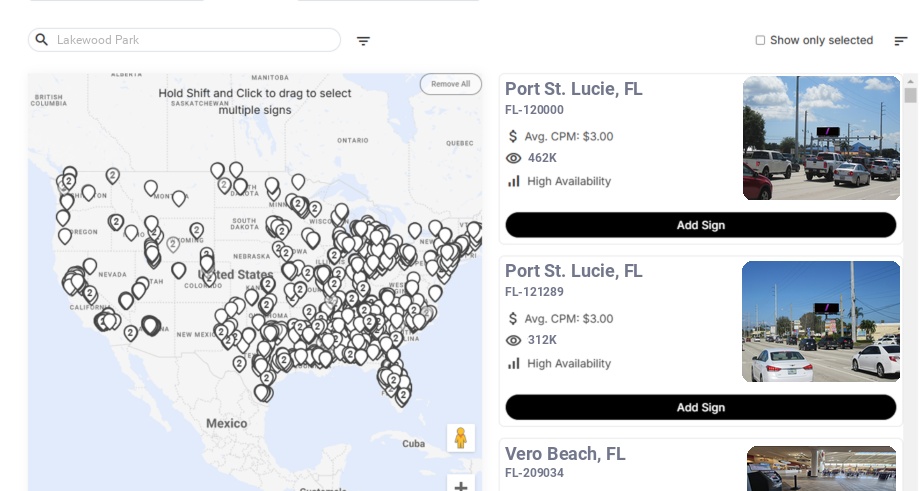
Blip has digital billboards near Lakewood Park. You can browse available locations on a map, choose the ones that fit your audience, and start advertising right away.
Still have questions? Launch a campaign in minutes — no contracts, no commitments.
Start Your CampaignLakewood Park Billboard Advertising Guide
Advertising near Lakewood Park works because this northern St. Lucie County Fort Pierce Vero Beach, two of the Treasure Coast’s most established commercial centers. Our 2 digital billboards serving the Lakewood Park area are positioned just 7.2 miles away in Fort Pierce and 8.4 miles away in Vero Beach, so we can reach the market from both directions within 10.0 miles of the community. The area is highly car-oriented, and roughly 90% of workers in St. Lucie and Indian River counties commute by car, whether driving alone or carpooling, while local residents regularly travel along I-95, U.S. 1, and nearby retail corridors for work, school, healthcare, dining, and errands. That mix of daily commuting, cross-county movement, and year-round coastal activity gives us a strong foundation for billboard campaigns serving the Lakewood Park area.
Lakewood Park Area Market Overview
Population scale and regional reach near Lakewood Park
The Lakewood Park area is large enough to matter on its own and well positioned to benefit from regional spillover. Lakewood Park has a population of about 15,291, and it sits inside St. Lucie County 329,226 residents. Just to the north, Indian River County adds another 159,788 residents, giving advertisers access to a two-county trade area of roughly 489,014 people when we plan campaigns near Lakewood Park.
The nearby commercial anchors are also meaningful. Fort Pierce 47,297 residents, and Vero Beach has about 16,354 residents. For advertisers, that matters because the Lakewood Park area does not behave like an isolated neighborhood. It behaves like a residential community tied to the shopping, medical, education, and employment activity of both cities.
Economic drivers and commuting behavior serving the Lakewood Park area
The broader Treasure Coast Regional Planning Council region is supported by healthcare, education, tourism, marine industries, retail, logistics, construction, and government employment. Fort Pierce Vero Beach adds strong retail, medical, hospitality, and professional-service activity for households near Lakewood Park.
Several regional institutions reinforce that economic pull. Indian River State College serves a 4-county district, with major activity in Fort Pierce and Vero Beach. Healthcare destinations such as HCA Florida Lawnwood Hospital and Cleveland Clinic Indian River Hospital Treasure Coast International Airport Vero Beach Regional Airport
Most important for billboard performance, this is a road-driven market. In both St. Lucie and Indian River counties, roughly 90% of workers commute by car, whether driving alone or carpooling. That means roadside media is not competing with a rail-heavy or walk-heavy commuting pattern. It is meeting people where they already spend time.
Key Traffic Corridors Serving the Lakewood Park Area
North-south routes that capture Lakewood Park area movement
The strongest north-south routes serving the Lakewood Park area are I-95 and U.S. 1. On Florida Department of Transportation traffic count maps, I-95 segments near Fort Pierce and Vero Beach commonly land in the 70,000 to 90,000 vehicles per day range, depending on the segment and count year. That volume makes I-95 a powerful regional connector for commuters, contractors, healthcare visitors, and travelers moving up and down the Treasure Coast.
U.S. 1 is even more important for local decision-making. In commercial stretches near Fort Pierce and Vero Beach, U.S. 1 often runs in the 25,000 to 40,000 vehicles per day range. For the Lakewood Park area, that corridor captures everyday behavior such as grocery trips, quick-service dining, service appointments, auto-related purchases, and local retail stops.
The Lakewood Park area also benefits from proximity to key interstate access points. Indrio Road connects much of the area to I-95 at Exit 138, and State Road 60 provides another major regional connection at I-95 Exit 147 in the Vero Beach market. When we advertise on digital boards in nearby Fort Pierce and Vero Beach, we are effectively intercepting the routes people already use to leave, return to, and circulate around the Lakewood Park area.
East-west connectors and retail corridors near Lakewood Park
East-west routes matter because they lead to shopping districts, beach traffic, schools, and employment centers. State Road 60 in the Vero Beach market often falls in the 30,000 to 50,000 vehicles per day range near major commercial nodes. That makes it especially useful for advertisers trying to reach Lakewood Park area residents who head north for retail, dining, professional services, or coastal recreation.
Closer to Fort Pierce, Virginia Avenue, SR 70, commonly operates in the 25,000 to 35,000 vehicles per day range on busy segments. For brands serving the Lakewood Park area, that corridor helps capture trips toward shopping centers, medical appointments, downtown Fort Pierce activity, and westbound commuter movement.
Indrio Road is also a useful local funnel. Traffic levels on key segments typically fall in the 10,000 to 20,000 vehicles per day range, which is smaller than I-95 but highly relevant because it connects residential areas, U.S. 1, and interstate access. For local advertisers, those are the roads where intent forms before the purchase happens.
Lakewood Park Area Audience Segments
Commuters and daily errand traffic near Lakewood Park
Commuters are one of the easiest audiences to reach near Lakewood Park because regional travel is so car dependent. We typically think about three strong weekday windows for this market: 6 a.m. to 9 a.m., 11 a.m. to 2 p.m., and 3 p.m. to 6 p.m.. Those dayparts align with work trips, lunch breaks, school pickup patterns, and afternoon errands.
This audience is valuable for practical categories. Healthcare, legal services, banking, insurance, quick-service restaurants, auto repair, home services, and local retail all fit naturally because commuters near Lakewood Park are often making repeat-route decisions rather than one-time destination searches. Repetition matters in a market where the same roads are used again and again.
Families, retirees, and household decision-makers in the Lakewood Park area
The Lakewood Park area is also a strong household-decision market. Families are tied to school calendars and activity schedules through St. Lucie Public Schools and the nearby School District of Indian River County. Retirees and seasonal residents add steady demand for healthcare, financial planning, home maintenance, moving services, senior living, and leisure dining.
That mix makes billboard advertising near Lakewood Park especially effective for businesses with broad household appeal. We often see the best local-market fit for categories such as roofing, pest control, HVAC, urgent care, dental, real estate, furniture, storage, and regional entertainment. These are not impulse categories in the traditional sense, but they are high-recall categories, and billboards excel at staying top of mind.
Students, healthcare users, and regional service audiences serving Lakewood Park
Students and education-related households matter more here than many advertisers expect. Indian River State College serves a 4-county region, and its Treasure Coast footprint keeps education traffic flowing between campuses, neighborhoods, and commercial districts. Back-to-school, term starts, continuing education, and career training can all create timely ad windows for brands targeting working adults and student households near Lakewood Park.
Healthcare is another major audience segment. Patients, caregivers, and staff frequently move between the Lakewood Park area, HCA Florida Lawnwood Hospital, Cleveland Clinic Indian River Hospital
Tourists and weekend leisure travelers near Lakewood Park
Tourism broadens the market beyond residents alone. Visit St. Lucie promotes 21 miles of beaches in St. Lucie County, and the broader Treasure Coast draws boaters, anglers, golfers, beachgoers, and nature travelers throughout the year. The Indian River Lagoon is a 156-mile estuary, and that regional identity shapes how people move through the corridor.
Weekend and visitor traffic is not limited to the shoreline. Attractions such as the National Navy UDT-SEAL Museum McKee Botanical Garden 18 acres, Savannas Preserve State Park Main Street Fort Pierce create regular leisure movement between Fort Pierce, Vero Beach, and the communities in between. That gives us opportunities for restaurants, attractions, hotels, events, healthcare, and retail campaigns serving the Lakewood Park area on weekends as well as weekdays.
Seasonal and Timing Opportunities Near Lakewood Park
Winter and spring campaigns serving the Lakewood Park area
The strongest seasonal window for many categories runs from November through April. That period brings milder weather, snowbird traffic, seasonal residents, and higher leisure activity across the Treasure Coast. If we are advertising near Lakewood Park for healthcare, dining, home maintenance, financial services, cultural events, or retail, this is often the first season we test.
Late winter and early spring create another useful bump. Clover Park Port St. Lucie draws regional baseball traffic in February and March, and day-trip behavior often spills across St. Lucie County. We also see strong spring demand for landscaping, outdoor living, boating-related businesses, and tourism-oriented creative during this period.
Summer, back-to-school, and storm-season timing near Lakewood Park
Summer works differently but still works well. June through August tends to reward family-focused messaging, local attractions, quick-service food, cold beverages, healthcare, and indoor entertainment. Even when visitors shift, local driving remains steady because school breaks create more flexible trip patterns.
Back-to-school timing is especially important in August. That is the moment to run campaigns for pediatric care, tutoring, orthodontics, after-school programs, family restaurants, apparel, shoes, eyewear, and technology services. We can also align timing with college terms, since Indian River State College typically creates renewed activity around late summer and early winter starts.
Storm season also creates category-specific opportunities. Florida’s hurricane season runs from June through November, and that makes the Lakewood Park area a good market for generators, roofing, tree service, shutters, storage, insurance, restoration, and emergency-preparedness messaging. In these periods, short digital bursts are often more useful than static long-term creative because offers and urgency can change quickly.
Holiday and event-based timing for advertisers near Lakewood Park
Holiday campaigns can be very efficient near Lakewood Park because traffic remains road-based and shoppers routinely move between Fort Pierce and Vero Beach. November and December are ideal for retail, dining, gift purchases, healthcare enrollment, community events, and entertainment offers. We can also schedule heavier activity on Fridays, Saturdays, and the final 2 weeks before major holidays, when local shopping intensity rises.
We also like event-driven bursts in this market. Downtown events, arts programming, farmers markets, and seasonal attractions create concentrated windows when repeated exposure matters more than an always-on buy. Because the boards serving the Lakewood Park area are digital, we can adapt timing much more precisely around those moments.
Billboard Design Tips for the Lakewood Park Area
Creative approaches that fit the Treasure Coast near Lakewood Park
Creative for the Lakewood Park area should look like the Treasure Coast without becoming visually soft or generic. We recommend a coastal palette with strong contrast, such as deep blue, sea green, coral, orange, or bright white, because Florida sunlight can wash out weak color combinations. We also recommend simple local imagery, such as bridges, marinas, palm silhouettes, beach scenes, boats, or lagoon-inspired visuals, when they support the brand rather than distract from it.
Because each digital blip lasts about 7.5 to 10 seconds, the message needs to land fast. In this market, we usually favor:
- A headline of 5 to 8 words.
- One offer, one location cue, and one call to action.
- Large fonts and bold contrast that remain readable for older drivers and fast-moving highway traffic.
- Clean logos and short URLs instead of detail-heavy layouts.
Messaging, offers, and visual cues that resonate near Lakewood Park
We see strong local response when creative sounds practical and regionally aware. Phrases such as “Serving the Lakewood Park Area,” “Near Fort Pierce,” “Near Vero Beach,” “Off U.S. 1,” or “Near I-95” help drivers place the offer quickly. Distance cues can also work well, especially for retail, healthcare, and attractions, as long as they are short and easy to process.
A few design choices are especially useful for this geography:
- We use larger type and higher contrast when the audience includes retirees, seasonal residents, or healthcare decision-makers.
- We keep phone numbers short and memorable, or we use a simple domain, because most drivers cannot safely act on a complex QR code at speed.
- We consider bilingual English and Spanish copy when the target audience is broad consumer traffic.
- We rotate seasonal creative, such as storm-prep in summer, tourism and dining in winter, and school-related offers in late summer.
Regional Strategies for Reaching Customers Near Lakewood Park
Fort Pierce billboard strategy serving the Lakewood Park area
Our Fort Pierce billboard, located 7.2 miles from Lakewood Park, is well suited for advertisers who want to capture southbound service and shopping behavior. This is often the better fit for county-government services, legal categories, hospital traffic, trades, home improvement, airport-area business activity, and downtown Fort Pierce destinations. It is also a strong choice when the business itself is located in Fort Pierce and wants to pull customers from the Lakewood Park area.
We typically favor weekday mornings, lunch hours, and early afternoons on this side of the market. Those windows align with work trips, service appointments, errands, and local-commercial circulation.
Vero Beach billboard strategy serving the Lakewood Park area
Our Vero Beach billboard, located 8.4 miles from Lakewood Park, is a smart option for businesses that depend on northbound shopping, dining, professional services, and leisure traffic. It can be especially effective for retailers along the State Road 60 corridor, beach-oriented destinations, medical practices, specialty services, and entertainment brands that draw from both southern Indian River County and northern St. Lucie County.
This board often performs well in late afternoon, evening, and weekend windows. Those are the times when many Lakewood Park area residents are more likely to head north for discretionary spending, family activities, or destination-based errands.
Two-board coverage and corridor layering near Lakewood Park
Using both nearby boards gives us a simple but powerful regional strategy. A 2-board campaign can build familiarity with the same audience as they move between Fort Pierce, Lakewood Park, and Vero Beach throughout the week. That is especially useful for brands that want broad awareness rather than a single-route test.
We often approach two-board coverage in one of three ways:
- We run one consistent message on both boards to build frequency across the whole Lakewood Park area.
- We tailor one creative version for Fort Pierce traffic and another for Vero Beach traffic.
- We shift budget by daypart, putting more weekday spend on one side and more weekend spend on the other.
Using Blip Tools for the Lakewood Park Area
When Blip-optimized campaigns work best near Lakewood Park
Blip-optimized campaigns are a strong fit when we want broad coverage serving the Lakewood Park area without manually adjusting every detail. We can set goals, define the audience, choose a budget, and let the platform allocate spend across nearby digital inventory and higher-value time periods. That works well for regional awareness campaigns, home services, healthcare, political messaging, and brands that want to learn which nearby routes respond best.
This approach is also useful when seasonality changes quickly. If a business wants heavier winter exposure, lighter summer coverage, or event-based surges, optimization helps us adapt without rebuilding the campaign from scratch.
When manual billboard selection makes sense near Lakewood Park
Manual campaigns are better when route choice matters. If we know the advertiser needs Fort Pierce-oriented traffic, Vero Beach-oriented traffic, or a tightly defined time window, we can select specific boards on a map, assign budget directly, and control timing more precisely.
That flexibility is valuable for local advertisers near Lakewood Park because the market has clear corridor behavior. A medical practice may prefer weekday morning visibility. A restaurant may prefer Thursday through Sunday evenings. A home-improvement company may want heavy support before storms. With Blip, we can test those ideas without locking into a long traditional contract, and pricing starts at $0.01 per display.
Getting Started With Billboard Rental Near Lakewood Park
How we evaluate billboard locations serving the Lakewood Park area
When we help advertisers choose billboard rental near Lakewood Park, we start with the actual travel behavior of the audience rather than the map alone. The best location is usually the one closest to the customer’s routine, not necessarily the one closest to the business address.
We recommend asking these questions first:
- Are we trying to reach households that travel more often toward Fort Pierce, toward Vero Beach, or toward both?
- Is the goal weekday commuter visibility, weekend leisure traffic, or all-week frequency?
- Does the product sell best through repeat awareness, or does it need a more immediate response?
- Is the target audience more likely to engage on U.S. 1-style local routes or on regional interstate movement tied to I-95?
- Will the message change by season, promotion, or event schedule?
Those answers usually make the right board choice clear.
What to expect from budget, timing, and campaign measurement near Lakewood Park
We do not need a massive budget to begin testing this market. We can start with a modest daily spend, run a focused campaign for 2 to 4 weeks, and use real-time analytics to see how pacing and delivery line up with the plan. If a campaign performs best in winter, on weekends, or during commuter hours, we can shift budget accordingly.
For many advertisers, the first win is clarity. We learn whether the Fort Pierce side, the Vero Beach side, or the combined approach produces the best visibility for the Lakewood Park area. From there, we can scale with more confidence instead of guessing.
Why renting a billboard near Lakewood Park is simpler with Blip
Traditional billboard buying often involves long negotiations, fixed contracts, limited flexibility, and slower creative changes. Blip simplifies that process. We can launch online, upload artwork, choose manual or optimized buying, adjust time targeting, monitor performance, and pause or restart whenever the market changes.
That is especially helpful for advertisers serving the Lakewood Park area because the market is seasonal, corridor-driven, and split between nearby Fort Pierce and Vero Beach. With digital boards and self-serve control, we can match the campaign to how people actually move through the region, instead of forcing the region into a rigid billboard buy.