Billboards in Winter Park, FL
No Minimum Spend. No Long-Term Contracts. Just Results.
Trusted by Leading Brands


Billboard advertising
in Winter Park has never been easier
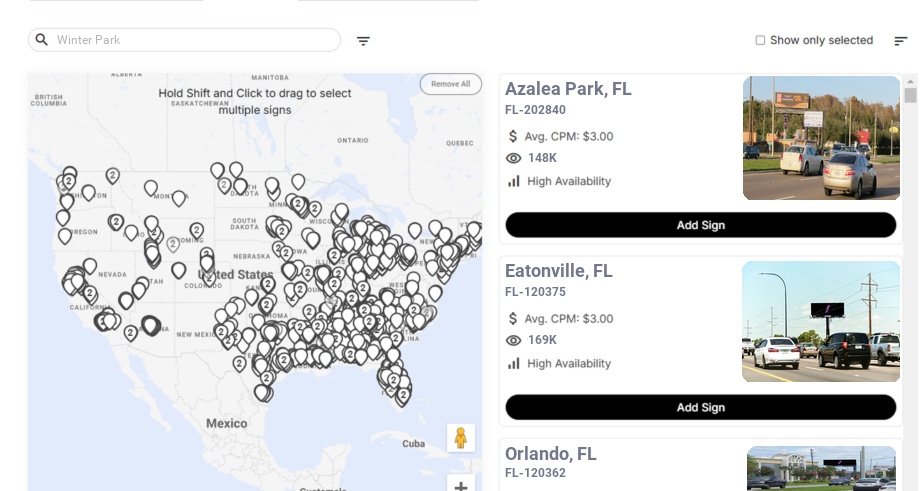



How much is a billboard in Winter Park?
Why Choose Blip for Billboard Advertising in Winter Park
Blip lets you launch Winter Park billboards from your laptop, reaching I-4 and 17-92 commuters fast—no phone calls needed.
Use flexible budgets in Winter Park to scale up for Sidewalk Art Festival, Rollins move-in, or holiday shopping without overspending.
Daypart your Winter Park ads for 7-9 a.m. and 4-7 p.m. to catch SunRail riders and weekday commuters on SR 436 and 17-92.
No contracts make it easy to test Winter Park, then shift spend to the Park Ave weekends or Longwood corridors that perform best.
Track Winter Park results in real time and adjust as tourism, campus traffic, and Orlando spillover shift through the season.
Blip's creative tools help Winter Park ads stand out with clean, upscale designs that fit Park Avenue, lakeside homes, and Rollins audiences.
Frequently Asked Questions About Billboard Advertising in Winter Park
How much does a billboard cost near Winter Park, Florida with Blip?
With Blip’s flexible, pay-per-blip pricing, you control exactly how much you spend on Winter Park billboards by setting a daily budget that can be adjusted anytime. Each blip is a 7.5–10 second ad on rotating digital billboards near Winter Park, Florida, and you only pay for the blips you receive, so your total cost over time is simply the sum of those brief ad displays. Blip makes it easy to start with any budget and see real visibility fast.
Where can I advertise with Blip near Winter Park, Florida?
There are 43 digital billboards near Winter Park serving the area from nearby Azalea Park, Orlando, and Longwood. These boards are strategically positioned within 10 miles of Winter Park along some of Central Florida’s most heavily traveled corridors. This network of Winter Park billboards and nearby placements allows us to build layered coverage across multiple drive patterns.
Who sees Winter Park, Florida billboards from Blip?
The Winter Park, Florida area combines affluent locals, college students, and a steady flow of regional and international visitors. Winter Park is also known for its upscale residential neighborhoods and boutique retail, and Rollins College in the heart of the area enrolls around 3,000 students plus several hundred faculty and staff. These audiences create a reliable mix of residents, students, commuters, and visitors.
When should I run billboards in Winter Park, Florida with Blip?
Blip’s flexible scheduling lets us buy impressions in the Winter Park area by daypart, day of week, and season. Commuter peaks are roughly 7–9 a.m. and 4–7 p.m., while weekends are ideal for dining, shopping, entertainment, events, and tourism messaging. For student-focused campaigns, orientation and welcome events, move-ins in August and January, and graduation in May are especially useful timing windows.
What roads get the most Winter Park, Florida billboard traffic?
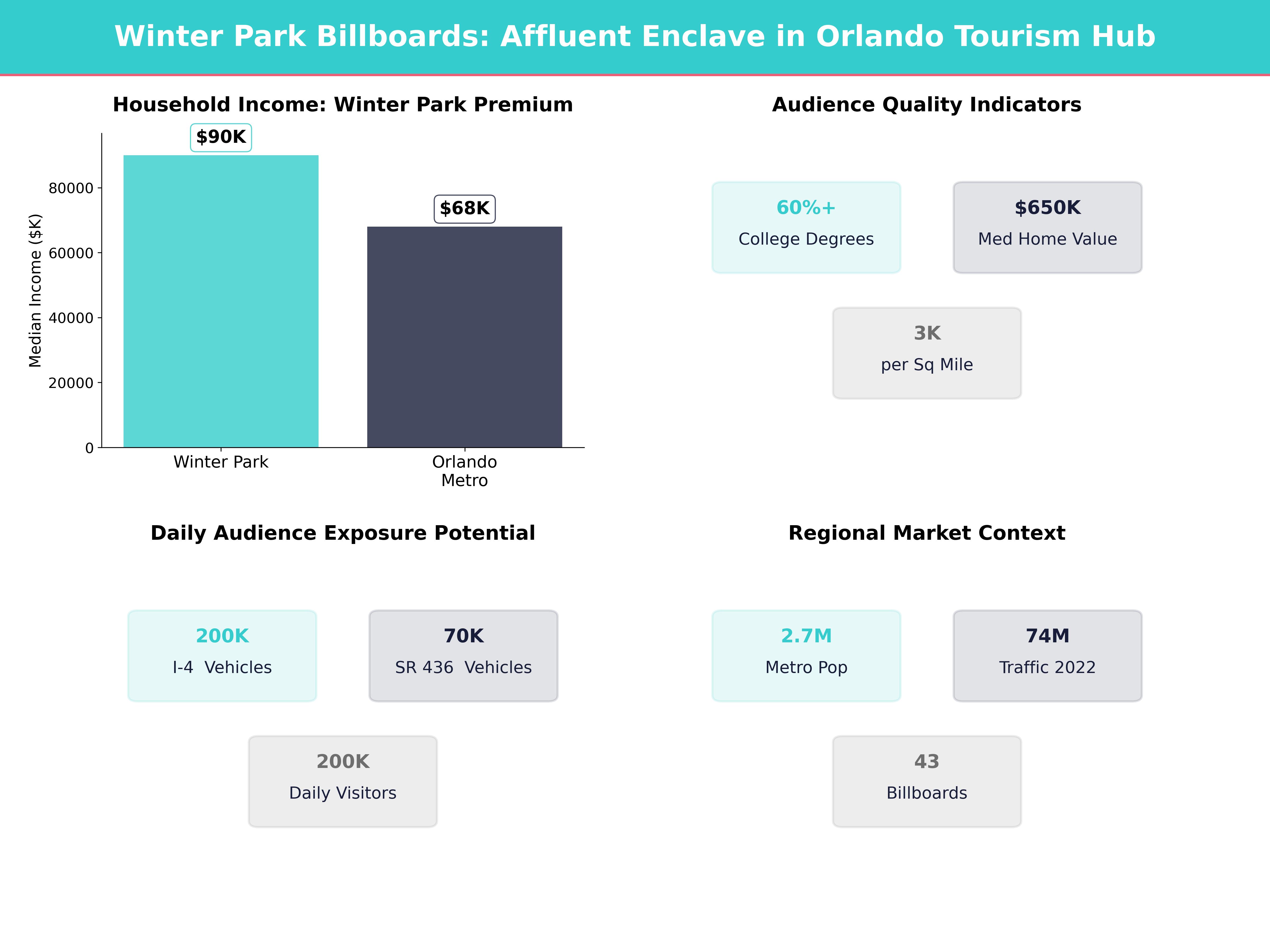
Our 43 digital billboards serving the Winter Park area are positioned along I‑4, State Road 436 / Semoran Boulevard, US 17‑92 / Orlando Avenue, and SR 434 / Longwood area corridors. Segments of I‑4 through Orlando carry around 200,000 vehicles per day, and many SR 436 segments handle roughly 60,000–80,000 vehicles per day. Typical urban volumes on US 17‑92 range from 30,000–50,000 vehicles per day in and around Winter Park and adjacent cities.
Do I need a contract to advertise with Blip in Winter Park?
No, Blip has no long-term contracts or minimum commitments. You can start, pause, or stop your campaign at any time.
How fast can I launch a billboard campaign with Blip in Winter Park?
You can have your campaign live in minutes. Create a free account, select your locations, set your budget, upload your design, and start running once approved.
Where can I advertise with Blip in Winter Park?
Blip has digital billboards in Winter Park. You can browse available locations on a map, choose the ones that fit your audience, and start advertising right away.
Still have questions? Launch a campaign in minutes — no contracts, no commitments.
Start Your CampaignWinter Park Billboard Advertising Guide
The Winter Park, Florida area combines affluent locals, college students, and a steady flow of regional and international visitors. With 43 digital billboards near Winter Park serving the area from nearby Azalea Park, Orlando, and Longwood, we can reach audiences where they actually drive, commute, shop, and play—all with flexible, data-driven scheduling for convenient billboard rental near Winter Park.
Why the Winter Park Area Is a High-Value Billboard Market
Winter Park is a compact but high-impact market. The City of Winter Park
The broader Orlando region magnifies that opportunity:
- The Orlando Economic Partnership notes that the Orlando metro has more than 2.7 million residents and has added well over 500,000 people since 2010, making it one of the fastest-growing large metros in the U.S.
- According to Visit Orlando, the area drew about 74 million visitors in 2022, up roughly 25% over 2021 and approaching its pre-pandemic record of 75+ million annual visitors. That equates to an average of more than 200,000 visitors in-market on a typical day.
- Orange County, where Winter Park is located, has grown rapidly over the past decade, adding tens of thousands of residents and thousands of new businesses, as highlighted by Orange County Government. County data show overall population growth of roughly 20% in the 2010s, with continued year-over-year gains.
When we pair Winter Park’s high-income local base with the Orlando area’s tourism and population growth, digital billboards serving the Winter Park area become a powerful way to build brand visibility both for local businesses and regional or national advertisers. For many of these brands, billboard advertising near Winter Park is a cost-effective complement to search, social, and other digital channels.
Understanding Winter Park Audiences
To make the most of our 43 digital billboards serving the Winter Park area, we need to understand who we are reaching and why they are valuable. The more precisely we match each audience with the right Winter Park billboards, the better our campaigns perform.
Affluent professionals and families
- Winter Park is known across Central Florida for its upscale residential neighborhoods and boutique retail. City economic profiles show that a large share of residents work in management, business, finance, healthcare, and professional services, with college-degree attainment rates well above 60%, far higher than state and national averages.
- Owner-occupied home values in Winter Park skew high; many neighborhoods have median home values in the $500,000–$800,000 range, with lakeside and historic homes easily exceeding $1 million. This aligns with higher discretionary spending on categories like dining, travel, home improvements, and financial services.
- Park Avenue and adjacent streets attract shoppers who are open to higher-end dining, fashion, home services, financial services, and healthcare offerings. On busy weekends and during events, the district can draw several thousand visitors per day, including residents from neighboring communities like Maitland Orlando, and downtown Orlando.
Rollins College community
- Rollins College, located in the heart of the Winter Park area, enrolls around 3,000 students plus several hundred faculty and staff. Total campus population regularly exceeds 3,500 people during the academic year.
- Typical undergraduate enrollment is split relatively evenly by gender and has a significant out-of-state component, meaning many students are discovering local businesses and services for the first time each fall.
- Students and young professionals travel between campus, downtown Winter Park, downtown Orlando, and nearby neighborhoods, creating a reliable flow of younger, trend-sensitive traffic along major corridors like US 17‑92 and Fairbanks Avenue.
- Brands targeting education, housing, entertainment, fitness, and food concepts can leverage messaging timed to semesters, move-in weeks, and graduation periods. For example, orientation and move-in weekends can bring thousands of visiting family members to the area in just a few days, making billboard advertising near Winter Park especially useful for student-focused offers.
Regional commuters and service workers
- Many Winter Park workers live elsewhere in Orange and Seminole County and commute through nearby Orlando, Azalea Park, and Longwood. Regional planning data indicate that tens of thousands of commuters travel daily between northern suburbs like Longwood, Lake Mary
- The SunRail
- Major employers in healthcare, education, and professional services in the Winter Park–Orlando corridor help sustain strong weekday travel patterns, with many workers making two or more car trips through core corridors each day.
- This commuter base is ideal for campaigns related to auto, quick-service restaurants, banks, healthcare, and recurring services (e.g., insurance, home maintenance, childcare) that benefit from continuous billboard advertising near Winter Park and its approach routes.
Visitors and day-trippers
- While Orlando’s theme parks receive global attention, Winter Park’s tourism and cultural attractions—galleries, the Winter Park Chain of Lakes, boat tours, events, and museums—pull in a large share of day-trippers and higher-spend visitors from within Central Florida and beyond.
- Signature cultural sites such as the Charles Hosmer Morse Museum of American Art and scenic boat tours collectively attract hundreds of thousands of visitors annually. During major festivals, daily visitor counts in downtown Winter Park can soar into the tens of thousands.
- These audiences often travel along key roadways near our digital billboards, making area-based targeting valuable for hotels, restaurants, attractions, and retail. Because these visitors typically stay longer and spend more per trip than theme-park-only tourists, they are particularly receptive to messages about dining, shopping, and cultural experiences displayed on billboards near Winter Park.
Key Corridors and Where Our Boards Reach Drivers
Our 43 digital billboards serving the Winter Park area are strategically positioned in nearby Azalea Park, Orlando, and Longwood—within 10 miles of Winter Park—along some of Central Florida’s most heavily traveled corridors. Many segments on these routes see daily traffic volumes from 30,000 to more than 200,000 vehicles, resulting in millions of weekly impressions potential. This network of Winter Park billboards and nearby placements allows us to build layered coverage across multiple drive patterns.
While exact placements vary, several patterns matter for campaign planning:
I‑4 (serving Orlando and regional traffic)
Running just southwest of the Winter Park area, Interstate 4 is the backbone of Central Florida travel.
- Segments of I‑4 through Orlando carry around 200,000 vehicles per day, according to traffic counts reported by the Florida Department of Transportation (FDOT). Some central segments have peak-hour volumes surpassing 10,000 vehicles per lane.
- This corridor captures commuters moving between downtown Orlando, Winter Park, Longwood, and Lake Mary, along with a heavy layer of tourists heading to and from attractions and Orlando International Airport.
- Annual average daily traffic (AADT) levels on I‑4 translate into tens of millions of vehicle trips per month across key segments, providing large-scale reach for regional and national brands.
Use I‑4–adjacent inventory for:
- Regional or multi-location brands
- Tourism, attractions, events, and sports
- High-consideration purchases (autos, real estate, healthcare, education)
State Road 436 / Semoran Boulevard (Azalea Park area)
Running east of Winter Park through Azalea Park and past Orlando Executive Airport and Orlando International airports:
- FDOT counts show many SR 436 segments handling roughly 60,000–80,000 vehicles per day, with some locations near major intersections and shopping areas exceeding 80,000.
- This route links dense residential neighborhoods, retail centers, and airport-related activity, including travelers, airport workers, and logistics traffic.
- The Orlando International Airport area handles more than 50 million passengers annually through Orlando International Airport (MCO), and a significant portion of rental cars, ride-shares, and hotel shuttles use nearby stretches of SR 436.
Use SR 436–adjacent boards for:
- Airport shuttles, hotels, and travel services
- Everyday consumer services (grocery, clinics, banks)
- Multilingual campaigns targeting diverse neighborhoods near Azalea Park
US 17‑92 / Orlando Avenue (north–south access to the Winter Park area)
This corridor runs straight through the Winter Park area and continues toward Orlando and Longwood:
- Typical urban volumes range from 30,000–50,000 vehicles per day in and around Winter Park and adjacent cities, according to FDOT’s traffic maps. In some retail-heavy segments, weekday traffic can exceed 40,000 vehicles.
- It hosts large retail centers, auto dealerships, and dining hubs that serve Winter Park shoppers and commuters from Maitland, Casselberry, and Longwood.
- Because it passes near Rollins College and central Winter Park, 17‑92 also captures student and visitor trips in addition to local residents.
Use 17‑92–oriented placements for:
- Location-based retail and dining promotions
- Automotive sales and services
- “Next right / 5 minutes ahead” directional ads
SR 434 / Longwood area corridors
Longwood, served by the City of Longwood
- Key corridors like SR 434 handle significant commuter traffic connecting residential suburbs and business districts, with many segments carrying 30,000+ vehicles per day and providing access to I‑4 and US 17‑92.
- These roads capture daily trips of families and professionals who shop, dine, and work in or near Winter Park, Altamonte Springs
- Longwood’s established neighborhoods and growing commercial corridors mean a steady mix of family households and professionals—ideal for categories like healthcare, home improvement, and education.
Use Longwood-area boards for:
- Professional services (medical, dental, legal, financial)
- Home improvement and contractors
- Education and extracurriculars (private schools, tutoring, sports)
By combining boards around I‑4, SR 436, 17‑92, and SR 434, we can blanket the main approach routes that residents, students, and visitors use to access the Winter Park area, delivering both frequency for locals and broad reach to regional travelers. This corridor strategy is at the heart of effective billboard advertising near Winter Park, ensuring that key audiences encounter your message multiple times in their regular routines.
Timing Your Blip Campaign Around Local Patterns
Blip’s flexible scheduling lets us buy impressions in the Winter Park area by daypart, day of week, and season. Winter Park’s rhythms are distinct from Orlando’s tourist core, so aligning with local behavior gives campaigns an edge and helps maximize the value of billboard rental near Winter Park.
Weekday vs. weekend patterns
- Commuter peaks: Orange County transportation data and SunRail ridership trends show familiar rush-hour patterns—roughly 7–9 a.m. and 4–7 p.m.—on major roads serving the Winter Park area. On many corridors, peak-hour volumes are 40–70% higher than mid-day baselines.
-
Weekdays:
- Strong for campaigns targeting workers (B2B services, banking, healthcare, lunch spots, after-work fitness).
- Great for “on your way home” messaging for retail and services; many commuters make shopping stops on 17‑92, SR 436, and near I‑4 interchanges.
-
Weekends:
- Park Avenue, lakes, and cultural spots draw more leisure traffic, with foot traffic in the Park Avenue district often doubling compared with typical weekdays during event weekends.
- Ideal for dining, shopping, entertainment, events, and tourism messaging.
Tourism and airport-related traffic
- Orlando International Airport consistently ranks among the busiest in the U.S., with over 50 million passengers annually departing or arriving through MCO, as highlighted by the Greater Orlando Aviation Authority. That averages to roughly 130,000–150,000 passengers per day, not counting accompanying family or ride-share drivers.
- Many of those trips feed into the east-side corridors near Azalea Park and then toward Winter Park via SR 436 and connecting roads.
- Target midday and evening windows (11 a.m.–11 p.m.) near SR 436 and Orlando-area boards to reach travelers, ride-shares, and rental cars when they are searching for dining, shopping, and last-minute accommodations.
Academic and school-year cycles
- Rollins College operates on a traditional semester schedule, with move-ins in August and January, midterms in October/March, and graduation in May. Orientation and welcome events alone can bring a few thousand visitors to Winter Park over several days.
- Local K‑12 calendars from Orange County Public Schools and Seminole County Public Schools produce predictable spikes around back-to-school shopping, sports seasons, and holidays. With tens of thousands of students in these districts within driving distance of Winter Park, family-oriented purchasing peaks several times a year.
- Friday evenings and Saturdays during school sports seasons drive additional regional traffic to fields, gyms, and nearby restaurants and retail.
Use Blip scheduling to:
- Concentrate impressions during August and early January for housing, furnishings, tech, and student-focused offers.
- Ramp up in late July and early August for back-to-school retail and services, when spending on supplies, apparel, and electronics typically jumps 20–40% compared with off-peak months.
- Promote camps, enrichment, and attractions during spring break and summer, when K‑12 and college calendars free up and families look for local activities.
Crafting Effective Creative for the Winter Park Area
Digital billboards serving the Winter Park area perform best when artwork reflects local expectations: polished, clear, and relevant to a design-conscious community. Clear, localized messaging also helps your billboard advertising near Winter Park stand out from generic regional campaigns.
Design for quick comprehension
Most drivers only have 6–8 seconds to absorb your message at typical corridor speeds (35–55 mph):
- Limit to 6–8 words of primary copy; legibility studies show that concise headlines significantly increase recall at highway speeds.
- Use a single bold visual: a product close-up, a recognizable logo, or a clear lifestyle image. Overly busy creatives reduce comprehension and can cut recall rates by 30–40%.
- Ensure high contrast: dark text on light backgrounds or vice versa, considering Florida’s bright sun and summer glare. Strong contrast can improve readability by up to 50% compared with low-contrast designs.
Appeal to Winter Park’s aesthetic
Winter Park is known for its brick streets, tree canopies, and boutique vibe:
- Lean into clean, upscale design—think minimalistic layouts and sophisticated color palettes that mirror the look of Park Avenue storefronts and lakeside homes.
- For premium brands (real estate, luxury retail, medical, financial), emphasize trust, expertise, and lifestyle benefit rather than price alone. Testimonials, years in business (e.g., “Serving Winter Park since 1995”), and local awards can improve credibility and response.
- Use subtle nods to local icons: Park Avenue, the lakes, or Rollins College—but only when it supports clear messaging. Simple geographic cues (“Steps from Park Ave”) help audiences quickly place your business.
Targeted messages for nearby boards
Because we have 43 boards serving the Winter Park area, we can tailor creative by direction and distance:
- Directional copy: “2 miles ahead on 17‑92,” “Next right on Park Avenue,” or “10 minutes from this exit” when boards are near your location. Distance-based messaging has been shown to boost store-visitation rates by 10–20% versus generic brand ads.
- Commuter-specific: “Beat I‑4 traffic—book online,” or “On your way home? Swing by Park Ave Happy Hour,” timed to 4–7 p.m. on weekdays.
- Student-focused: “Rollins discount with student ID” or “Late-night eats near campus” timed around semester peaks and evening hours.
Use dynamic and rotating creative
Digital formats allow multiple creatives within a campaign:
- Test two to three variations that change by time of day (e.g., coffee in the morning, cocktails in the evening). Advertisers who daypart creative often see higher engagement metrics—such as website visits or coupon redemptions—in the targeted windows.
- Rotate event countdowns (“Art Festival starts in 5 days”) leading up to key dates; countdown-style creative can lift urgency and response by double-digit percentages.
- Highlight different benefits or offers to see what resonates best with your site traffic or store footfall, then scale the best-performing messages.
Seasonal & Event-Based Opportunities
Winter Park has a full events calendar, plus the broader Orlando area’s year-round tourism. Aligning your Blip flights with these peaks can multiply your impact by putting your brand in front of both local residents and surging visitor traffic. During these periods, well-placed Winter Park billboards can influence both planned itineraries and spur-of-the-moment decisions.
Winter Park Sidewalk Art Festival
- One of the nation’s top outdoor art shows, the Winter Park Sidewalk Art Festival
- Many attendees travel via I‑4, 17‑92, and adjacent corridors, as well as SunRail and local streets near Park Avenue. This produces noticeable spikes in both vehicular and pedestrian traffic.
Strategies:
- Start brand or directional campaigns 2–3 weeks before the festival to capture planners and repeat visitors, building awareness as travel and hotel bookings ramp up.
- Focus creatives on “before/after the festival” dining, shopping, or accommodation, as many visitors extend their stay in Winter Park for meals and browsing.
- Highlight proximity (“Steps from Park Ave,” “2 minutes from the festival”) to capture spontaneous decisions as visitors move through the area.
Holidays and retail peaks
- Winter holidays: Winter Park’s decorations, tree lightings, and events make it a regional shopping destination, amplifying traffic around Park Avenue and area malls. Retail sales in November–December frequently represent 20–30% of annual revenue for many local shops.
- Spring break: March and April see strong leisure travel into Orlando, with hotel occupancy in the region often climbing above 80%. A portion of these visitors venture to Winter Park for a more relaxed, walkable experience.
- Summer: While hot, summer still pulls in family vacationers and local staycationers, with theme-park and resort traffic creating additional spillover into Winter Park’s dining and lakes.
Consider:
- Holiday gift campaigns for jewelry, fashion, tech, and local experiences, especially from mid-November through New Year’s.
- Seasonal services (A/C, pool service, landscaping) messaging timed to early summer, when temperatures and household service needs spike.
- Event tie-ins with content from local outlets like the Orlando Sentinel, WESH 2 News, or ClickOrlando to ride the wave of community conversations and news coverage of local festivities.
Local sports and community events
- College sports, youth leagues, and community events promoted via the City of Winter Park events calendar Winter Park Chamber of Commerce all create micro-spikes in localized traffic.
- High school football, soccer, and youth tournaments can draw hundreds or even thousands of visitors to a single facility on game days, many of whom then visit nearby restaurants and shops.
- Use short, intense campaigns (e.g., 7–10 days) around these events to boost awareness for nearby businesses or sponsors and test localized offers (“Show your game ticket and save 10%”).
Sample Strategies by Business Type
The Winter Park area’s mix of wealth, education, and tourism supports many sectors. Here are ways different advertisers can leverage Blip’s flexibility and set up efficient billboard rental near Winter Park.
Local restaurants and bars
- Target evening and weekend dayparts on boards near Orlando and Longwood that funnel diners into the Winter Park area. Dinner traffic typically peaks between 6–8 p.m., with weekend evenings often 20–40% busier than weekdays.
- Use time-sensitive offers (“Tonight only,” “Weekend brunch on Park Ave”) and simple calls to action. Clear, offer-based creatives tend to generate higher direct response than purely brand-focused messages.
- Emphasize atmosphere and unique value—Winter Park diners respond to ambiance as much as price. Imagery featuring outdoor seating, lake views, or Park Avenue streetscapes resonates well.
Healthcare and professional services
- Focus on consistent weekday presence, especially during morning and evening commute periods. For many practices, new-patient call volume peaks between 8–10 a.m. and 3–6 p.m.
- Highlight trust markers: years in practice, board certifications, outcomes, and convenient location near known landmarks (“Across from Winter Park Hospital,” “Minutes from Park Ave”).
- Rotate messages across specialties (e.g., pediatrics, orthopedics, dental) to test what drives the most new calls or online bookings. Use unique URLs or phone numbers for each specialty where possible.
Real estate and home services
- Winter Park’s housing market skews higher-value; median sale prices in and around Winter Park frequently outpace regional medians by 30–50%. Property and renovation campaigns benefit from strong visuals and prestige positioning.
- Target commuters using I‑4, 17‑92, and SR 436 who might aspire to move into the Winter Park area. Many buyers currently reside in neighboring communities and move closer to Winter Park over time.
- Highlight stats like “Homes starting in the $X00s,” “Average Winter Park sale price up X% year-over-year,” or “Serving the Winter Park area since 20XX” to emphasize both opportunity and local expertise.
Education, camps, and youth activities
- Time campaigns with school calendars: January (spring enrollments), March–May (summer camps), July–August (new school year). Many private schools and camps see the majority of inquiries—often 50% or more—during these short enrollment windows.
- Use family-friendly visuals and clear benefits (“STEM camp near Winter Park,” “After-school tutoring 5 minutes from Rollins”) along with age ranges (e.g., “Grades K–8”) to improve relevance.
- Consider dayparting to afternoon and early evening when parents are picking up kids or commuting home; these windows align with decision-making about activities and childcare.
Attractions, arts, and culture
- Promote museums, galleries, boat tours, theaters, and festivals that compete with Orlando’s big-ticket attractions. Visitors looking for non-theme-park experiences often search same-day, making timely billboard exposure valuable.
- Use billboards near Orlando and Azalea Park to intercept visitors who may be looking for more relaxed, upscale experiences away from the theme parks. Even capturing a small fraction of Orlando’s 74 million visitors can mean thousands of additional guests per season.
- Feature strong imagery of iconic Winter Park scenes—lakes, brick streets, or art—plus concise directions and “Today / This Weekend” messaging to encourage immediate visits.
Measuring, Testing, and Optimizing With Blip
Digital billboards serving the Winter Park area should be treated like any other measurable media channel. When you view billboard advertising near Winter Park through the same performance lens as search or social, it becomes easier to justify and optimize your spend.
Set clear objectives
Decide whether your priority is:
- Brand awareness in the Winter Park area
- Driving visits to a store or restaurant
- Generating calls or web leads
- Promoting a time-limited event or sale
Align your impressions and budget accordingly—short, heavy bursts for events; steady, moderate presence for brand building. For example, a two-week event campaign might concentrate 50–70% of its impressions in the final 5–7 days to maximize urgency.
Tie campaigns to trackable actions
- Use short, memorable URLs or unique landing pages for billboard traffic. Monitor direct visits and branded search volume before, during, and after campaigns.
- Include offer codes that are exclusive to outdoor campaigns (“Mention ‘WINTER PARK’ to save 10%”), and track redemption rates relative to total sales.
- Compare website traffic and conversions during active Blip flights versus baseline periods. Even a 5–10% lift in traffic or calls can be meaningful for high-value services.
Run simple A/B tests
Blip’s ability to upload multiple creatives and adjust schedules makes testing straightforward:
- Test headline A vs. headline B over the same week and time windows; keep all other elements constant. After a statistically meaningful period (often 1–2 weeks at steady impression levels), shift spend to the better-performing version.
- Test lifestyle imagery vs. product imagery to see which better drives interest or store visits.
- Test different offers (percent-off vs. dollar-off, or “free consultation” vs. “same-day appointment”). Many service providers find that “free consultation” messages generate more inquiries, while retail often performs better with clear monetary value.
Monitor results using web analytics, POS data, or call-tracking, and then shift more budget to the higher-performing creative sets and time windows.
Bringing It All Together for the Winter Park Area
The Winter Park area offers a uniquely efficient combination: a dense, affluent core; a vibrant college community; and access to one of the country’s most visited metropolitan regions. Our 43 digital billboards in nearby Azalea Park, Orlando, and Longwood give advertisers the ability to cover every major approach into the Winter Park area and reach residents, commuters, students, and visitors at the moments that matter. This mix of billboards near Winter Park makes it simple for businesses of all sizes to scale up or down based on seasonality and demand.
By combining:
- Smart geographic selection along I‑4, SR 436, 17‑92, and SR 434,
- Thoughtful timing based on commuting, school, and event cycles,
- Locally attuned creative that reflects Winter Park’s style and priorities, and
- Ongoing testing and measurement,
we can use Blip to build campaigns that not only look great on a billboard, but also deliver tangible business results throughout the Winter Park area. For advertisers seeking flexible, data-driven billboard rental near Winter Park, this approach turns local traffic patterns into consistent, measurable opportunities for growth.