Billboards near Country Club, FL
No Minimum Spend. No Long-Term Contracts. Just Results.
Trusted by Leading Brands


Billboard advertising
near Country Club has never been easier
How much is a billboard near Country Club?
Why Choose Blip for Billboard Advertising near Country Club
Blip lets Country Club brands launch fast on SR 826, I‑75, and NW 186th St with self-serve control, so you reach commuters without the usual buying hassle.
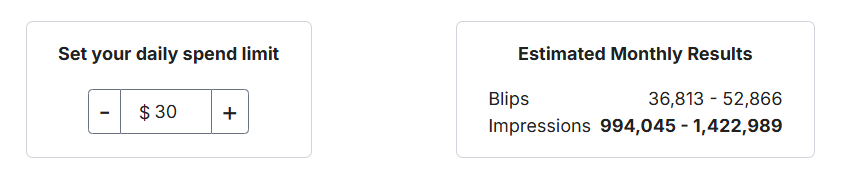
Set flexible daily budgets for Country Club and pay only for the blips you want, perfect for testing local retail and family offers in this dense commuter belt.
Daypart your Country Club ads for 7–9 a.m. and 4–7 p.m. when Miami-Dade traffic peaks, hitting drive-alone commuters at the right moment.
No contracts means Country Club advertisers can ramp up for Hard Rock Stadium game days or back-to-school season, then adjust anytime.
Track Country Club campaign results in real time and shift spend toward Hialeah, Miami Gardens, or Miramar routes that drive the best response.
Use Blip creative tools to build bilingual Country Club billboards for Spanish-first neighborhoods, with short, bold copy that reads well at highway speed.
Frequently Asked Questions About Billboard Advertising near Country Club
How much does a billboard cost near Country Club, Florida with Blip?
With Blip, you control exactly what you spend on Country Club billboards by setting a daily budget that can be adjusted anytime, so your campaign always stays within your comfort zone. Each “blip” is a brief 7.5 to 10-second ad display, and you only pay for the individual blips you receive, making digital billboards near Country Club, Florida accessible on virtually any budget. Costs vary based on when and where your ad shows and current advertiser demand, but you’ll always see your spend reflected directly in the exposure you get.
Where can I advertise with Blip near Country Club, Florida?
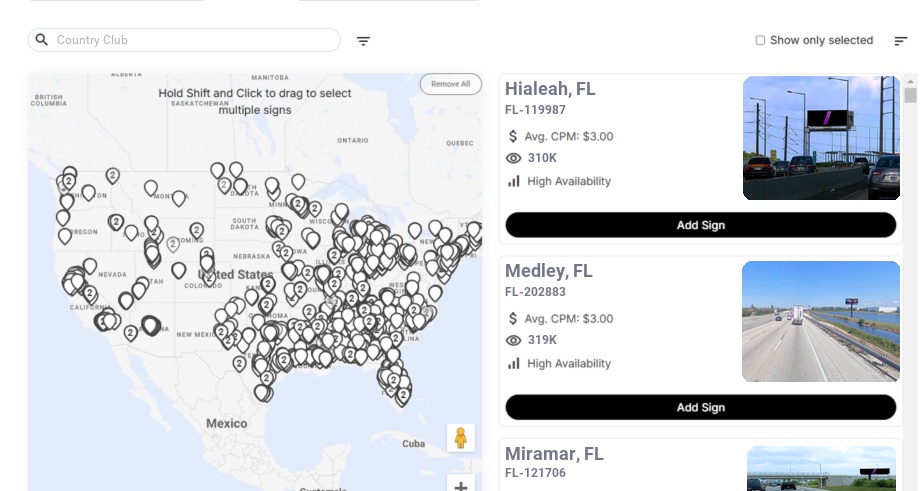
With 59 digital billboards serving the Country Club area from nearby cities like Miramar, Miami Gardens, Hialeah, North Miami, and North Miami Beach, advertisers can tap into a high-traffic, highly local audience. These nearby placements function like an integrated Country Club billboard network, delivering local coverage without paying downtown Miami rates. The boards are concentrated in nearby cities within roughly a 10-mile radius, giving you flexible options that match your exact trade area.
What kind of audience do Country Club, Florida billboards reach?
Country Club is an unincorporated community and census-designated place in northwest Miami-Dade County, surrounded by dense housing, commuter corridors, and nearby employment centers. The Country Club CDP has close to 50,000 residents packed into just a few square miles, with densities exceeding 10,000 people per square mile. The area is heavily Hispanic/Latino, and 72% of residents speak a language other than English at home, with over 63% speaking Spanish at home.
What are the best times to run billboards in Country Club, Florida with Blip?
Morning commute, midday, and evening commute are the strongest daily windows in northwest Miami-Dade. Traffic volumes between 7–9 a.m. are 40–60% higher than late-morning baselines, while 4–7 p.m. often brings the single-highest peak hour on key arterials. Using Blip’s scheduling tools, you can increase your bids during local peaks and scale back during low-value periods.
What roads and traffic patterns make Country Club, Florida a good billboard market?
The Country Club area is crisscrossed by major regional corridors and local arterials that drive predictable daily patterns. The Palmetto Expressway (SR 826) carries over 200,000 vehicles per day on some segments, and I-75 sees six-figure daily vehicle counts as well, with key segments between 100,000 and 150,000 vehicles per day. NW 186th Street, NW 183rd Street, NW 67th Avenue, NW 57th Avenue, and NW 87th Avenue also carry heavy local traffic tied to residential neighborhoods and retail nodes.
Do I need a contract to advertise with Blip near Country Club?
No, Blip has no long-term contracts or minimum commitments. You can start, pause, or stop your campaign at any time.
How fast can I launch a billboard campaign with Blip near Country Club?
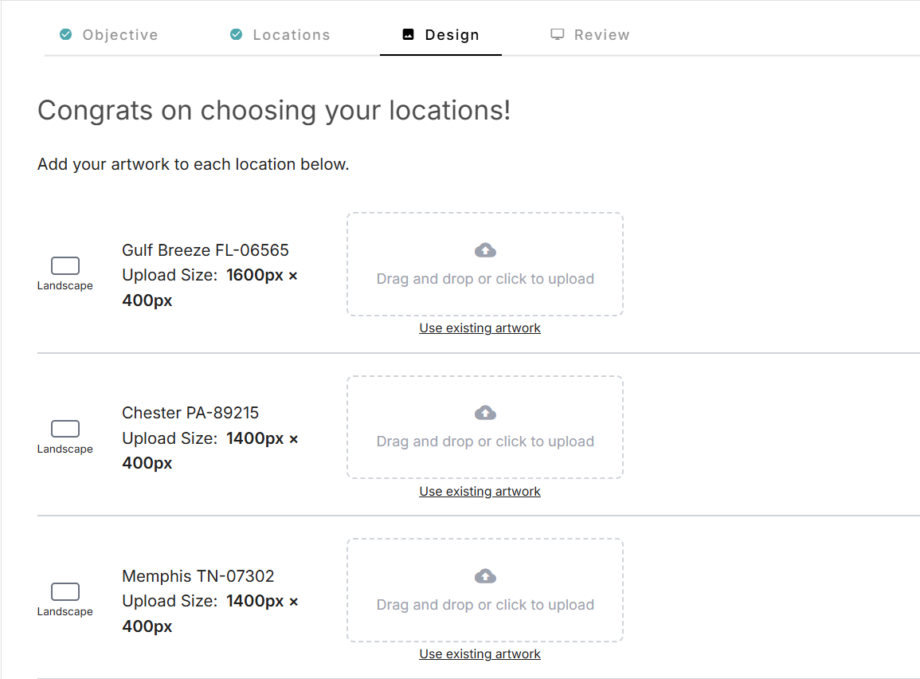
You can have your campaign live in minutes. Create a free account, select your locations, set your budget, upload your design, and start running once approved.
Where can I advertise with Blip near Country Club?
Blip has digital billboards near Country Club. You can browse available locations on a map, choose the ones that fit your audience, and start advertising right away.
Still have questions? Launch a campaign in minutes — no contracts, no commitments.
Start Your CampaignCountry Club Billboard Advertising Guide
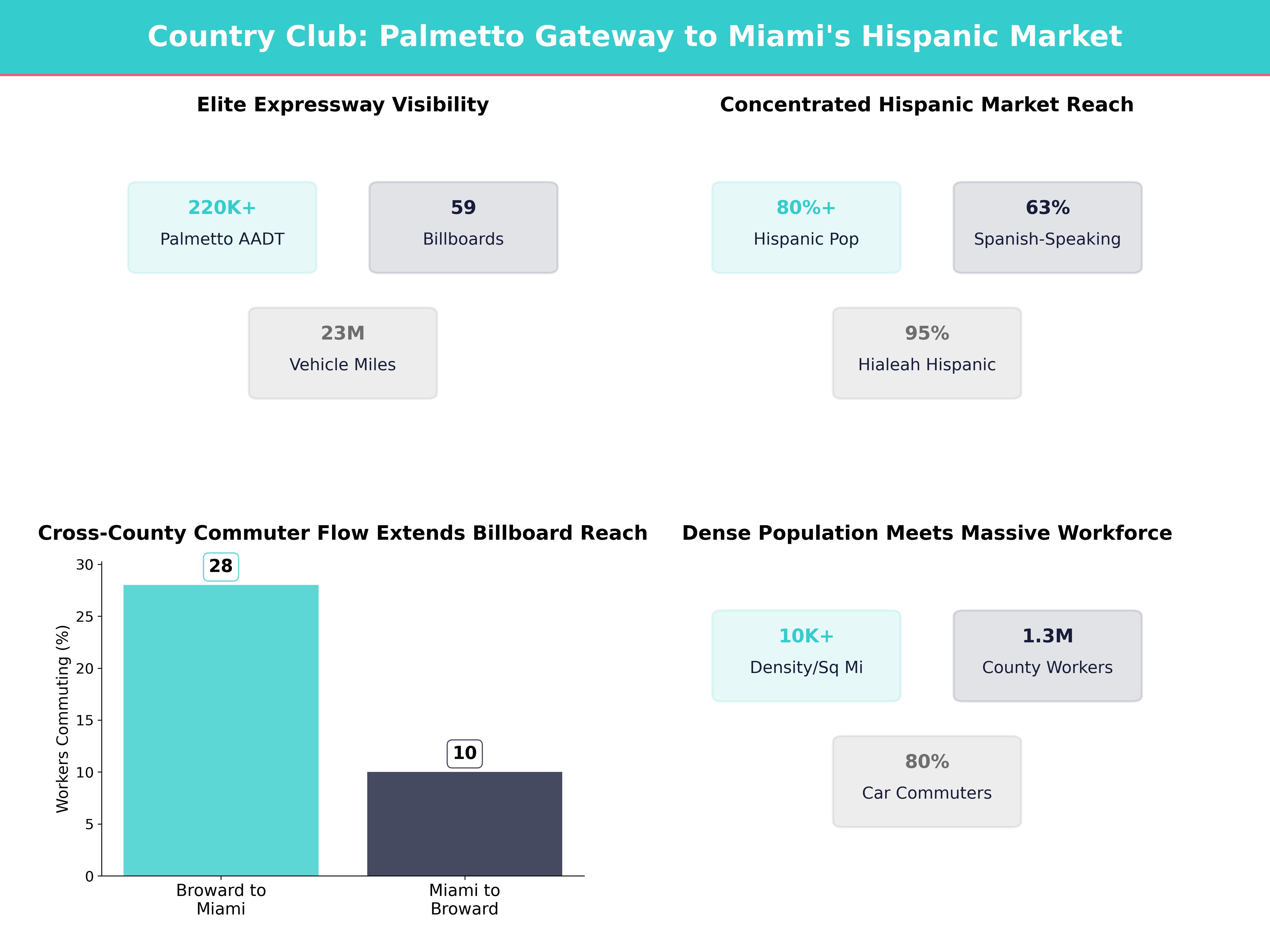
Country Club, Florida sits at the heart of northwest Miami‑Dade’s commuter belt, surrounded by dense residential neighborhoods, major retail corridors, and heavily traveled expressways. With 59 digital billboards serving the Country Club area from nearby cities like Miramar, Miami Gardens Hialeah, North Miami North Miami Beach, we can help advertisers tap into a high‑traffic, highly local audience that lives, shops, and commutes within a tight radius every day. For brands specifically looking for billboards near Country Club, these nearby placements function like an integrated Country Club billboard network, delivering local coverage without paying downtown Miami rates. Miami‑Dade County as a whole records more than 1.3 million workers and over 23 million daily vehicle miles traveled, according to the Miami‑Dade Transportation Planning Organization, giving billboard campaigns a large, measurable movement base to work with.
Understanding the Country Club Area Audience
Country Club is an unincorporated community and census‑designated place in northwest Miami‑Dade County. It is bordered by cities such as Hialeah, Hialeah Gardens Miami Lakes, and is governed at the county level by Miami‑Dade County. This combination of dense housing, commuter corridors, and nearby employment centers makes billboard advertising near Country Club an efficient way to reach residents throughout their daily routines.
Key demographic characteristics of residents in the Country Club area:
- Population density: The Country Club CDP has close to 50,000 residents packed into just a few square miles, with densities exceeding 10,000 people per square mile—making it one of the more densely populated suburban pockets in the county. Nearby Hialeah, for example, has a density above 10,000 residents per square mile as noted in city planning documents from the City of Hialeah.
- Age profile: The northwest Miami‑Dade region skews slightly younger than the national average, with a strong concentration of adults ages 25–44 and substantial numbers of school‑age children and teens. In Miami‑Dade County overall, more than 26% of residents are under 20 and about 30% are 25–44, according to Miami‑Dade County demographic profiles
- Ethnicity and language: The area is heavily Hispanic/Latino, with well over 80% of local residents identifying as Hispanic in nearby communities such as Hialeah and Hialeah Gardens, according to Miami‑Dade County 72% of residents speak a language other than English at home, and over 63% speak Spanish at home, making bilingual messaging especially powerful. Spanish and English are both widely used every day.
- Income: Household incomes near Country Club typically cluster in the mid‑range for Miami‑Dade: many neighborhoods fall in the roughly $45,000–$75,000 annual household income band. In Miami‑Dade overall, about 31% of households fall between $35,000 and $74,999, based on county community profile summaries, which is high enough to support frequent dining, retail, automotive, and service purchases, but where price sensitivity still matters.
- Family and housing patterns: Miami‑Dade data show that roughly 52% of households are family households with children under 18, and about 46% of occupied units are renter‑occupied. This mix favors advertisers in apartments, home services, children’s activities, and everyday retail serving multi‑generational households.
Implications for your billboard creative:
- Consider bilingual or Spanish‑forward messaging, especially for consumer services, retail, and healthcare.
- Emphasize family needs, convenience, and value—themes that resonate strongly with working households and large families.
- Simple, bold visuals and short phrases (7 words or fewer) in either language perform best on fast‑moving commuter routes. Industry research from the Outdoor Advertising Association of America shows that concise copy can increase ad recall by 20–30% versus more cluttered executions.
Commuting, Traffic, and Movement Patterns
The Country Club area is crisscrossed by major regional corridors and local arterials that drive predictable daily patterns and make strategically placed billboards near Country Club especially visible:
-
Expressways nearby:
- The Palmetto Expressway (SR 826) runs just east and south through Hialeah and Hialeah Gardens, carrying over 200,000 vehicles per day on some segments, per Florida Department of Transportation District Six 220,000 average annual daily traffic (AADT).
- I‑75 to the west connects northwest Miami‑Dade with Broward County and sees six‑figure daily vehicle counts as well, with key segments between 100,000 and 150,000 vehicles per day, creating strong exposure to cross‑county commuters.
-
Key surface streets:
- NW 186th Street (Miami Gardens Drive) and NW 183rd Street channel traffic between Country Club and Miami Gardens; county traffic counts often exceed 40,000 vehicles per day on these arterials, according to the Miami‑Dade TPO traffic monitoring program
- NW 67th Avenue, NW 57th Avenue, and NW 87th Avenue tie residential neighborhoods to retail nodes in Hialeah, Hialeah Gardens, and Miramar, with many segments carrying 20,000–35,000 vehicles daily.
Regionally, more than 80% of workers in Miami‑Dade commute by car, according to county transportation planning studies from the Miami‑Dade Transportation Planning Organization, and typical one‑way commute times average around 32–33 minutes. Nearly 60% of workers drive alone, and another 10–12% carpool, which means billboards on key roadways repeatedly reach the same residents every weekday.
How this informs your strategy:
- Use boards near Miami Gardens and Miramar for north–south commuters who live near Country Club but work or shop in Broward County. More than 28% of employed Broward residents and over 10% of Miami‑Dade workers cross county lines for work, according to regional planning coordination reports between Broward MPO and the Miami‑Dade TPO.
- Use boards near Hialeah, Hialeah Gardens, and Medley to capture heavy east–west commute flows, warehouse and industrial workers, and shoppers heading to established retail areas. Medley alone contains over 1,500 businesses and a daytime population that far exceeds its resident base, according to the Town of Medley, translating into strong daytime traffic volumes.
- If you are driving foot traffic to a local storefront, focus impressions on AM and PM peaks plus Saturday shopping hours on boards closest to your store’s access corridors. Retail studies cited by the Greater Miami Convention & Visitors Bureau indicate that weekend spending in Miami‑Dade can be 15–25% higher than mid‑week totals for dining and entertainment, making weekend dayparts especially valuable.
Where Our 59 Digital Billboards Serve the Country Club Area
Our 59 digital billboards serving the Country Club area are concentrated in nearby cities within roughly a 10‑mile radius, giving you flexible options for Country Club billboards that match your exact trade area:
-
South & East:
- Miami Gardens (about 3.8 miles away) – key for capturing traffic around Hard Rock Stadium and major arterials. Hard Rock Stadium, home of the Miami Dolphins and major college football and international soccer events, seats around 65,000–65,300 fans and can draw 70,000+ attendees for concerts and special events, according to event information shared by Hard Rock Stadium Miami Herald City of Miami Gardens
- Opa‑locka (4.2 miles) – reaches drivers around Opa‑locka Executive Airport and industrial zones. The airport handles more than 130,000 aircraft operations annually, according to the Miami‑Dade Aviation Department, creating steady traffic from aviation, logistics, and business travelers. See the City of Opa‑locka
- Hialeah Gardens (5.0 miles) and Hialeah (5.2 miles) – dense, highly Hispanic communities with strong local retail. Hialeah alone has over 220,000 residents and is among the largest cities in Florida by population, with more than 95% Hispanic or Latino residents according to city demographic summaries from the City of Hialeah. See the City of Hialeah and Hialeah Gardens
- Medley (6.2 miles) – industrial and logistics hub with daytime worker traffic. The Town of Medley notes that the town’s industrial base supports tens of thousands of workers moving in and out daily despite a small resident population, which can drive high daytime impression counts.
-
North & East toward the coast:
- North Miami (6.7 miles) and North Miami Beach (10 miles) – ideal for reaching residents who commute between the coast and the Country Club area; these cities together host more than 110,000 residents and connect inland neighborhoods to coastal employment and education centers like Florida International University’s Biscayne Bay Campus. Check the City of North Miami City of North Miami Beach for civic and cultural events that can spike evening and weekend traffic.
- West Park (7.4 miles) and Miramar (2.8 miles) in Broward County – capture cross‑county commuters and shoppers. Miramar alone has more than 135,000 residents and a large office and industrial base, generating significant weekday inflows, according to the City of Miramar. See the City of Miramar and City of West Park
With Blip, you can selectively target boards in these neighboring communities to saturate the daily routes most frequently used by Country Club area residents without paying to cover the entire metro. This makes billboard rental near Country Club simple to scale up or down as your needs change. Because digital billboards typically cycle 6–8 advertisers per minute (with each spot lasting 6–10 seconds), your campaign can secure thousands of impressions per day on high‑volume corridors even with modest budgets.
Timing Your Campaign: Dayparts, Seasons, and Events
Because we sell digital billboard “blips” by the impression, you can align your spend with the times your audience is most likely to notice and act.
Daily patterns to consider
Travel behavior reports from the Miami‑Dade TPO and regional traffic counts show clearly defined weekday peaks:
- Morning commute (6:30–9:30 a.m.): In many northwest Miami‑Dade corridors, traffic volumes between 7–9 a.m. are 40–60% higher than late‑morning baselines. Ideal for reminders about coffee shops, breakfast spots, school‑related services, and traffic‑driven digital actions (e.g., “Order now, pick up after work”).
- Midday (11 a.m.–2 p.m.): Typically a secondary peak as workers and residents run errands and go to lunch; restaurant and service‑sector businesses often see 20–30% of daily revenue during this window. Great for lunchtime restaurants, healthcare clinics, auto services, and same‑day appointments.
- Evening commute (4–7 p.m.): Many key arterials experience their single‑highest peak hour in this window, with volumes 50–70% above mid‑afternoon levels. Strong fit for grocery, big‑box retail, family dining, entertainment, and after‑school programs.
- Late evening (7–11 p.m.): Useful for entertainment, nightlife in nearby cities, and last‑minute digital actions like streaming services and food delivery. According to consumer behavior research cited by the Greater Miami Convention & Visitors Bureau, a significant share of dining and entertainment decisions in Miami‑Dade are made within 2 hours of the activity, making timely, location‑based reminders valuable.
Seasonal and local event considerations
- Hurricane season (June–November): The Atlantic hurricane season runs from June 1 to November 30. Home improvement, insurance, and emergency preparedness messaging can resonate. In years with significant storms, local hardware and grocery retailers often report double‑digit sales spikes in the 48–72 hours before landfall, as noted by coverage from the Miami Herald
- Back‑to‑school (August–September): The Miami‑Dade County Public Schools calendar, available via Miami‑Dade County Public Schools, drives clear spikes in demand for tutoring, uniforms, after‑school care, and healthcare. The district serves more than 330,000 students across 400+ schools, making school‑related messaging extremely scalable for Country Club‑area families.
- Holiday shopping (November–December): Statewide, Visit Florida reports that the fourth quarter regularly accounts for roughly 25–30% of annual tourism visits, pushing up mall and corridor traffic in South Florida. Retailers near Country Club can leverage this with gift, financing, and holiday‑hours messaging.
- Sports and entertainment: Events at Hard Rock Stadium in Miami Gardens create heavy traffic surges on game and concert days. NFL and major college games routinely attract 60,000+ attendees, with marquee concerts and international soccer matches often selling out the stadium, according to coverage by the Miami Herald NBC 6 South Florida. Check the stadium schedule via local outlets such as the Miami Herald NBC 6 South Florida and increase budgets on those dates to tap into tens of thousands of regional visitors.
Using Blip’s scheduling tools, you can increase your bids during local peaks and scale back during low‑value periods, allowing even modest budgets to achieve meaningful visibility. Many advertisers find that concentrating 60–70% of impressions into their best‑performing hours yields a stronger return than running evenly across the full day.
Crafting Creative That Works for the Country Club Area
To be effective on fast‑moving roads serving the Country Club area, billboard creative must be tailored both visually and culturally.
Language and cultural alignment
- Test Spanish‑only, English‑only, and bilingual creatives. For heavily Hispanic corridors such as Hialeah and Hialeah Gardens, Spanish‑first headlines with English secondary copy can perform best. In a region where more than 60% of residents speak Spanish at home, ads that mirror everyday language can significantly improve recognition and recall.
- Reflect local culture and everyday life: family gatherings, after‑church dining, youth sports, and neighborhood small‑business imagery tend to feel authentic. Highlighting local references (e.g., “near Miami Lakes,” “off Miami Gardens Drive”) can increase relevance for the large share of residents who live and work within a 5–10 mile radius.
Copy and design guidelines
- Keep headlines to 7 words or fewer and avoid more than 2 lines of text. Field studies commissioned by OOH industry groups show that drivers have roughly 3–6 seconds to process a message at highway speeds, and ad recall drops sharply when copy exceeds 10–12 words.
- Use high‑contrast color pairings (e.g., white or yellow on deep blue, black on bright yellow) to combat strong South Florida sun and frequent glare. The region sees over 250 sunny days per year, according to regional climate summaries referenced by the National Weather Service Miami‑South Florida Office, making contrast and font weight critical.
-
Make your call to action extremely clear and short:
- “Salida 4 – Hialeah Gardens”
- “LLámanos hoy: 305‑XXX‑XXXX”
- “Order at PanaderíaElSol.com”
- If you promote a physical location, include distance or direction (“2 miles east on NW 186th St”) to catch local drivers making quick decisions. Wayfinding‑style CTAs can increase visit intent by up to 20%, according to case studies shared by the Outdoor Advertising Association of America.
Because Blip allows unlimited creative rotations, we encourage testing 3–6 variations targeting different sub‑audiences (families vs. young professionals, Spanish vs. English, weekday vs. weekend offers) and then optimizing spend toward top performers. Even small sample tests—such as 1–2 weeks of higher rotation on a new creative—can reveal which message yields higher lift in web visits, calls, or store traffic.
Using Blip’s Flexibility to Target the Country Club Area Efficiently
Digital billboards serving the Country Club area let you act more like a digital marketer than a traditional out‑of‑home buyer:
-
Geo‑focused board selection:
- Focus on Miami Gardens and Miramar boards to hit north–south commuters and cross‑county travelers. These corridors see combined daily traffic in the hundreds of thousands of vehicles, based on FDOT and Broward County
- Layer in Hialeah, Hialeah Gardens, and Medley boards to concentrate on east–west flows and industrial workers. Miami‑Dade’s industrial submarket hosts over 200 million square feet of warehouse and distribution space, much of it clustered around Medley and Hialeah, according to regional economic development summaries from the Beacon Council, helping ensure strong weekday reach.
- Add North Miami and North Miami Beach when you want to reach coastal commuters who live, work, or shop around Country Club, especially if your business draws from Aventura, Sunny Isles, or other nearby coastal communities.
-
Budget control: You can start with low daily budgets and only bid on the hours and boards that align with your highest‑value customers. This is especially powerful for local small businesses looking to compete with larger brands. Many local advertisers in Miami‑Dade allocate as little as $10–$20 per day to test specific time slots and corridors before scaling successful patterns, making billboard rental near Country Club accessible even for first‑time advertisers.
-
Message rotation and testing: Use multiple creatives to test:
- Price‑driven vs. quality‑driven messaging.
- Spanish vs. English vs. bilingual.
- Store‑visit CTAs vs. website or phone CTAs.
Then watch response in your own internal metrics (web traffic, call volume, coupon redemptions) by time and day. Pairing billboard flights with Google Analytics time‑of‑day and day‑of‑week reports can help you identify 15–30% lifts in traffic that coincide with specific rotations.
Industry‑Specific Ideas for the Country Club Area
A few examples of how different advertisers can leverage billboards serving the Country Club area:
- Restaurants and bakeries: Promote breakfast and lunch specials on weekday daytime rotations, with heavier weekend evening presence for family dining. In South Florida, food and beverage spending by visitors alone surpassed $7 billion annually before the pandemic, according to the Greater Miami Convention & Visitors Bureau, and local residents add billions more—so highlighting mouth‑watering photography, price points, and an exit number or street name can capture both locals and visitors moving through the corridor.
- Healthcare and dental clinics: Highlight bilingual care, extended hours, and walk‑in availability. Miami‑Dade has more than 2.7 million residents, and local health reports from the Florida Department of Health in Miami‑Dade County
- Auto dealers and repair shops: Focus on commuter corridors with straightforward offers (“Oil change $39 – 2 miles ahead”). Vehicle registration data cited in county transportation plans indicate that Miami‑Dade has well over 1.6 million registered vehicles, reflecting a heavily car‑dependent market. Rotate creative for service vs. sales, and increase bids before and after paydays (for example, the 1st and 15th of the month), when discretionary automotive spending tends to spike.
- Education and tutoring: Align with the Miami‑Dade County Public Schools academic calendar—heavy exposure in late summer and exam seasons—emphasizing bilingual support and after‑school convenience. With more than 330,000 students and thousands of graduating seniors each year, demand for tutoring, test prep, and enrichment programs is strong, especially in family‑dense neighborhoods around Country Club, Hialeah, and Miami Gardens.
- Local retailers and services: Use boards closest to your storefront’s main access road and keep the message hyper‑local (“Serving Country Club families since 2005”). Local business surveys cited by the Miami‑Dade Chamber of Commerce and area merchant associations highlight that a large share of customers—often 60–70% for neighborhood services—live within a 3–5 mile radius, so signaling proximity and community roots is key. For many of these businesses, concentrating on a handful of billboards near Country Club is enough to build strong, repeat local awareness.
By understanding how residents move through nearby cities like Miramar, Miami Gardens, Hialeah, and North Miami each day—and by using Blip’s flexible scheduling, targeting, and creative rotation—we can turn 59 digital billboards serving the Country Club area into a precise, data‑driven engine for local growth.