Billboards in Port St. Lucie, FL
No Minimum Spend. No Long-Term Contracts. Just Results.
Trusted by Leading Brands


Billboard advertising
in Port St. Lucie has never been easier
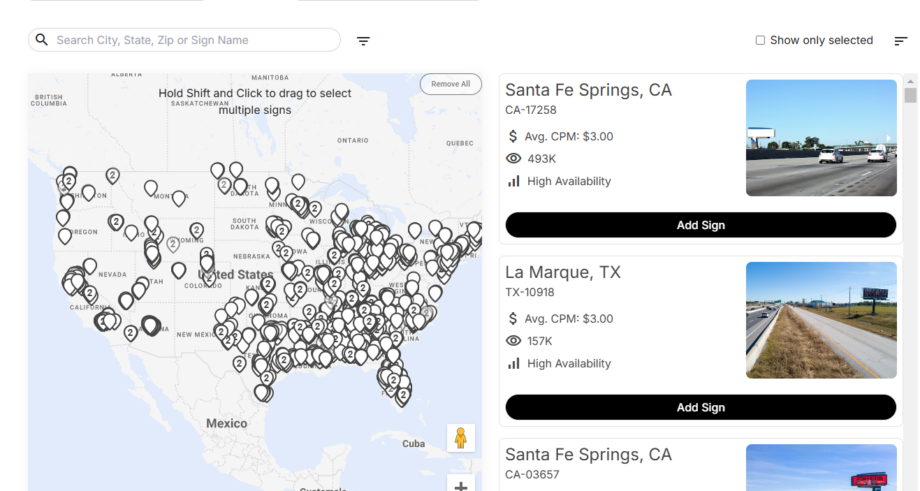



How much is a billboard in Port St. Lucie?
Why Choose Blip for Billboard Advertising in Port St. Lucie
Blip lets Port St. Lucie advertisers launch fast on I-95, US-1, and Crosstown corridors—no traditional buy process needed.
Set a flexible budget in Port St. Lucie and spend only on the blips you want, great for snowbird season or spring training traffic.
Dayparting with Blip helps Port St. Lucie brands hit morning commutes on Gatlin, Port St. Lucie Blvd, and St. Lucie West Blvd.
No contracts means Port St. Lucie businesses can test campaigns near Tradition and Clover Park, then scale what works.
Real-time analytics let Port St. Lucie advertisers track results and adjust as I-95, Turnpike, and US-1 traffic shifts.
Use Blip's creative tools to make bold Port St. Lucie billboards for families, retirees, and bilingual audiences without extra hassle.
Frequently Asked Questions About Billboard Advertising in Port St. Lucie
How much does a billboard cost in Port St. Lucie, Florida with Blip?
With Blip, you control exactly what you spend on Port St. Lucie billboards by setting a daily budget that fits your business, large or small. Each ad display, or “blip,” runs for 7.5 to 10 seconds, and you only pay for the individual blips you receive, making it easy to stay on budget while still reaching people as they move through the city. Costs for billboards in Port St. Lucie, Florida adjust based on when and where you choose to advertise and on real-time advertiser demand, so you can stretch your budget further by targeting the times and locations that work best for you.
Where can I advertise with Blip in Port St. Lucie, Florida?
Using Blip, we can prioritize boards near Port St. Lucie’s key routes and local corridors. I-95, Florida’s Turnpike, US-1, and local connectors like Port St. Lucie Blvd, Gatlin Blvd, St. Lucie West Blvd, and Crosstown Parkway all carry significant traffic. The page also highlights targeting near Tradition, St. Lucie West, IRSC, hospitals, and Clover Park access routes.
What kinds of people see Port St. Lucie, Florida billboards?
Port St. Lucie has a large, stable year-round base of more than 1 in 3 Treasure Coast residents living in the city, plus a constant influx of new homeowners and renters. The median age is about 42–44, average household size is near 2.7–2.8 people, and roughly 73–78% of housing units are owner-occupied. There is also a sizable retiree and snowbird population, especially from October through April.
When is the best time to run Blip billboards in Port St. Lucie, Florida?
Using Blip’s scheduling, campaigns can be aligned with traffic surges throughout the day. Weekday morning rush hour, midday lunch traffic, evening homebound commutes, and evenings and weekends all create different opportunities. The page also says you can increase spend during winter snowbird months, spring training, and major city events, then dial back during off-peak months while maintaining presence.
Why is Port St. Lucie, Florida a strong market for billboard advertising?
Port St. Lucie sits at the heart of Florida’s Treasure Coast, one of the fastest-growing metros in the country. The city’s population has climbed to roughly 235,000–240,000 residents as of 2023, and the broader Treasure Coast totals about 640,000–680,000 residents. Heavy corridor traffic, strong seasonal swings, and a car-dependent population make digital billboards an especially powerful tool here.
Do I need a contract to advertise with Blip in Port St. Lucie?
No, Blip has no long-term contracts or minimum commitments. You can start, pause, or stop your campaign at any time.
How fast can I launch a billboard campaign with Blip in Port St. Lucie?
You can have your campaign live in minutes. Create a free account, select your locations, set your budget, upload your design, and start running once approved.
Where can I advertise with Blip in Port St. Lucie?
Blip has digital billboards in Port St. Lucie. You can browse available locations on a map, choose the ones that fit your audience, and start advertising right away.
Still have questions? Launch a campaign in minutes — no contracts, no commitments.
Start Your CampaignPort St. Lucie Billboard Advertising Guide
Port St. Lucie sits at the heart of Florida’s Treasure Coast, one of the fastest‑growing metros in the country. That growth, combined with heavy corridor traffic and strong seasonal swings, makes digital billboards an especially powerful tool here. With Blip, we can time, target, and test campaigns around local commuting patterns, tourism peaks, snowbird season, and marquee events like spring training baseball—turning Port St. Lucie billboards into always‑on drivers of awareness and response.
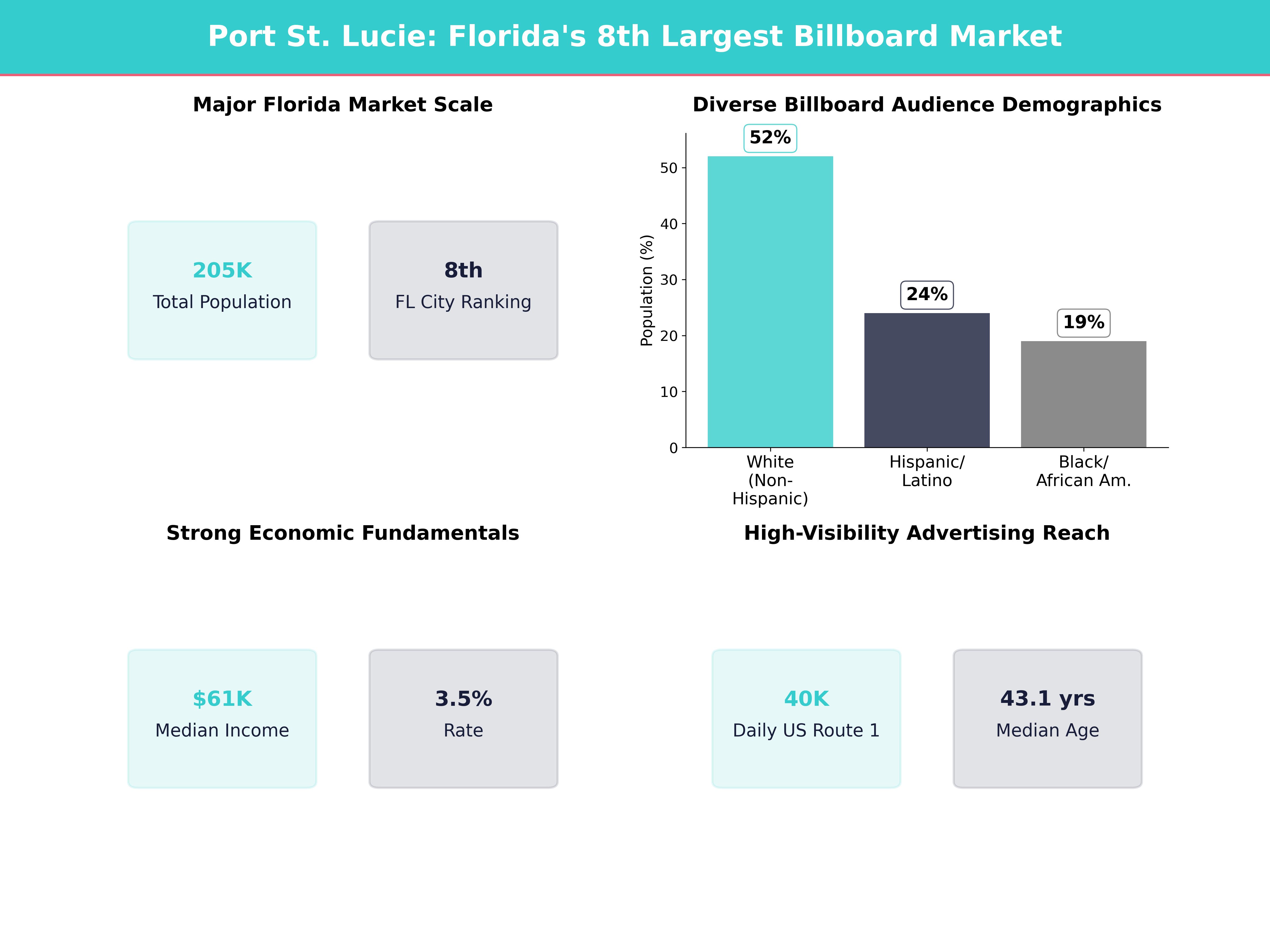
Market snapshot: Why Port St. Lucie is a high‑leverage billboard market
Port St. Lucie’s scale and growth create a broad audience for out‑of‑home advertising and support consistent demand for Port St. Lucie billboard advertising:
- The city’s population has climbed to roughly 235,000–240,000 residents as of 2023, up from about 165,000 just a decade earlier—a jump of more than 40% in ten years and more than 20% growth since 2016 alone, according to the City of Port St. Lucie.
- The wider St. Lucie County area is home to about 340,000+ people, and the broader Treasure Coast (St. Lucie, Martin, Indian River counties) totals ~640,000–680,000 residents, forming a regional market similar in size to a mid‑tier metro.
- Median household income in Port St. Lucie is around $70,000–$75,000, while St. Lucie County overall trends slightly lower in the mid‑$60,000s, signaling that city residents have relatively strong purchasing power for retail, home services, healthcare, and leisure.
- The city has consistently ranked among the top‑10 fastest‑growing large cities in the U.S. in recent years, with some years posting 3–4% annual population growth, drawing both young families and retirees. You can see growth highlights on the city’s site at City of Port St. Lucie.
- Housing growth has followed population: over the last decade, Port St. Lucie has added thousands of new single‑family homes and townhomes, with building permits often topping 2,500–3,000 units per year, especially in communities like Tradition and St. Lucie West.
For advertisers, this means:
- A large, stable year‑round base of more than 1 in 3 Treasure Coast residents living in Port St. Lucie—ideal for long‑term Port St. Lucie billboard advertising strategies that build familiarity over time.
- A constant influx of new homeowners and renters: St. Lucie County has recorded double‑digit percentage gains in occupied housing units over the past decade, translating to steady demand for local services (medical, dental, insurance, home improvement, auto care, financial).
- A strong share of middle‑income, car‑dependent households—more than 80–85% of workers commute by car, many traveling 20–35 minutes each way, which is ideal for billboard reach.
Digital billboards through Blip let us tap into these audiences dynamically, adjusting budgets and messages as the city and its traffic evolve. Instead of being locked into static billboard rental in Port St. Lucie, we can scale impressions up or down as needed.
Who we’re talking to: Local demographics and what they mean for creative
Understanding who makes up Port St. Lucie helps us design artwork and offers that resonate and ensures billboards in Port St. Lucie speak directly to real local households.
Age and household makeup
-
Median age is about 42–44, which is slightly older than the U.S. average but younger than many Florida coastal retirement markets:
- A robust base of adults in their 30s and 40s with school‑age children.
- Working‑age adults in their 20s–50s commuting to jobs along I‑95, the Florida Turnpike, and US‑1.
- A sizable retiree and “snowbird” population, particularly late 50s through 70s, especially October–April.
-
Average household size is near 2.7–2.8 people, and Port St. Lucie is predominantly owner‑occupied:
- Roughly 73–78% of housing units are owner‑occupied.
- About 22–27% are renter‑occupied, providing a steady market for apartments, insurance, and move‑related services.
-
Families with children are a major segment:
- Around 30–35% of households include children under 18.
- The school‑age population (K‑12) in St. Lucie County exceeds 40,000 students, supported by St. Lucie Public Schools.
Implications for messaging:
-
Show family‑oriented imagery (kids, parents, multigenerational households) for:
- Healthcare, dental, urgent care.
- Education, tutoring, youth sports.
- Local attractions, restaurants, entertainment.
-
Emphasize trust, stability, and convenience for older and retiree audiences:
- “Locally trusted for 20+ years”
- “Easy access near I‑95 Exit ___”
- “Same‑day appointments for seasonal residents”
-
Include clear value propositions that speak to households managing mortgages and kids:
- “Same‑day service”
- “0% interest for 12 months”
- “Free consultation this week”
- “Family plans starting at $___/month”
Language and culture
Port St. Lucie and St. Lucie County have notable Hispanic and Caribbean communities:
- Approximately 20–25% of residents identify as Hispanic or Latino, a share that has climbed several points over the past decade.
-
Many neighborhoods also include:
- Spanish speakers from Puerto Rico, Mexico, and other Latin American countries.
- Haitian Creole speakers with strong ties to local churches and community organizations.
- Brazilian/Portuguese speakers connected to small businesses and service trades.
Creative considerations:
-
For businesses that serve bilingual or multilingual customers, test:
- Short Spanish‑language or bilingual boards on US‑1, near dense residential clusters and retail centers.
- Culturally relevant imagery (extended families, neighborhood gatherings, church/community events).
- Keep translations simple and bold—digital billboards allow rotation, so we can run English and Spanish creatives alternately during the same day.
- Consider including bilingual call‑to‑action lines (“Llámanos hoy / Call us today”) to serve both English‑dominant and Spanish‑dominant drivers without overloading the design.
Traffic patterns and high‑value corridors
Port St. Lucie’s residents are heavily car‑dependent, and most local commerce happens along a few key arteries. Using Blip, we can prioritize boards near these corridors and day‑part our campaigns based on real commuting behavior, ensuring Port St. Lucie billboards are seen at the right place and time.
Local transportation planners and the St. Lucie Transportation Planning Organization
Key routes
-
I‑95 (north–south spine)
- Daily traffic around Port St. Lucie often exceeds 110,000–130,000 vehicles per day (AADT) according to regional counts from the Florida Department of Transportation District 4
- Some nearby segments in St. Lucie County approach 140,000+ vehicles per day during peak winter months when seasonal residents and tourists are in town.
-
Captures:
- Long‑distance traffic between Orlando, South Florida, and the Space Coast.
- Daily commuters traveling to/from Tradition, St. Lucie West, and neighboring cities like Fort Pierce and Jensen Beach.
- Best for: Regional brands, hospitals, colleges, auto dealers, tourism, and any advertiser drawing from beyond a single neighborhood.
-
Florida’s Turnpike
- Typically 55,000–70,000 vehicles per day in the Treasure Coast section, with traffic swelling during holiday and spring‑break travel.
- Toll road skewing slightly more toward commuters and higher‑income drivers; a meaningful share of vehicles are long‑distance travelers, business commuters, and logistics traffic.
- Best for: Professional services, financial institutions, high‑ticket home services, and automotive.
-
US‑1 / Federal Highway
- A major local commercial corridor carrying roughly 40,000–60,000 vehicles per day through St. Lucie County, with some city segments regularly surpassing 50,000 vehicles daily in season.
- Lined with big‑box retail, restaurants, car dealerships, medical offices, and service businesses—drivers here are often already in a “shopping or errands” mindset.
- Best for: Retail promos, dine‑in/takeout, gyms, salons, immediate‑response offers (“Next right,” “Across from ___”).
-
Midport and Crosstown locals (e.g., Port St. Lucie Blvd, Gatlin Blvd, St. Lucie West Blvd, Crosstown Parkway)
- These connectors can each carry 20,000–40,000 vehicles per day, tying residential subdivisions to I‑95, US‑1, schools, and major shopping areas.
- Port St. Lucie Blvd and Gatlin Blvd, in particular, see intense morning and late‑afternoon flows as residents head to work, school, and Tradition or St. Lucie West retail.
- Best for: Neighborhood‑focused campaigns—local schools, churches, medical offices, small retailers, home services.
Day‑parting strategy with Blip
Using Blip’s scheduling, we can align our message with traffic surges and get more impact from billboard rental in Port St. Lucie:
-
Weekday morning (6–9 a.m.)
- Heavy outbound flows toward I‑95 and US‑1, often peaking between 7:00–8:30 a.m.
- Promote coffee, breakfast, gas, morning radio/podcasts, gyms (“Start your day strong”), and service businesses targeting decision‑makers commuting to work.
-
Midday (11 a.m.–2 p.m.)
- Lunch traffic around retail nodes such as St. Lucie West, Tradition Square, and US‑1 plazas.
- Run lunch specials, medical appointments (“Walk‑in today”), and errands‑oriented offers (“Drop off your car on your lunch break”).
-
Evening (4–7 p.m.)
- Strong homebound commute, with congestion around school pick‑ups and retail areas.
- Focus on family‑oriented brands: restaurants, grocery stores, childcare, after‑school programs, home services, local events.
-
Evenings and weekends
- Elevated trips to parks, beaches, malls, sports venues, and faith centers, with many families and retirees on the road.
- Elevate campaigns for entertainment, events, weekend shopping, and tourism, particularly near Tradition, St. Lucie West, and US‑1.
With Blip, we can buy more impressions in the exact windows that matter most (e.g., “only during weekday rush hour” or “heavy weekends during snowbird months”), maximizing ROI.
Seasonality: Snowbirds, tourism, and local event cycles
Port St. Lucie’s audience changes shape through the year, and we can take advantage of that with flexible budgets and creatives tailored to billboards in Port St. Lucie, not just digital channels.
Snowbird and peak tourist season (roughly November–April)
-
Florida’s east coast experiences a substantial increase in seasonal residents and visitors during winter:
- Local tourism officials report that St. Lucie County hosts hundreds of thousands of overnight visitors annually, with peak visitation in the December–March window, promoted through Visit St. Lucie.
- Hotels and short‑term rentals in and around Port St. Lucie often see occupancy rates jump by 10–20 percentage points compared with slower summer months.
- Restaurant and entertainment districts in Tradition, St. Lucie West, and along US‑1 report notable revenue uplifts in winter and early spring, often accounting for a disproportionate share of annual sales.
-
The snowbird population (part‑time residents who spend several months in the area) significantly expands the market:
- Many neighborhoods see parking lots and clubhouses noticeably busier from January–March, with community events, golf leagues, and HOA activities in full swing.
Advertising implications:
-
Ramp up spend for:
- Restaurants, golf courses, fishing charters, boat rentals, eco‑tours.
- Healthcare providers targeting seasonal residents (cardiology, orthopedics, urgent care).
- Local attractions promoted by Visit St. Lucie, such as beaches, nature preserves, and waterfront activities.
-
Feature easy directions and “first‑time visitor” language:
- “Exit 121, then 2 miles east”
- “New to the area? We’re your local ___.”
- “Parking for RVs and trailers welcome”
- Consider geo‑targeting boards near hotel clusters, RV parks, and Turnpike/I‑95 exits where visitors first enter the city.
Spring training and sports
Port St. Lucie is home to the New York Mets spring training at Clover Park
- Games typically run February through March, drawing fans from across Florida and the Northeast.
- Single games can bring 6,000–7,000+ attendees, and over the full spring schedule, total attendance can reach well into the six figures.
- On game days, traffic increases noticeably on St. Lucie West Blvd and I‑95 Exit 121, with pre‑ and post‑game spikes about 60–90 minutes before and after first pitch.
Advertising implications:
- In February–March, prioritize boards on I‑95, St. Lucie West Blvd, and key access routes to Clover Park.
-
Promote:
- Restaurants, bars, and breweries (“Show your game ticket for ___% off”).
- Hotels, vacation rentals, and attractions.
- Sports medicine, chiropractors, fan gear, and local sports bars.
- Use time‑sensitive creatives on home‑game days: “Tonight after the game,” “Pre‑game lunch 1 mile ahead,” etc.
Hurricane season and weather sensitivity (June–November)
- Official Atlantic hurricane season runs June 1–November 30, and the Treasure Coast is frequently within the forecast cone of tropical systems.
-
When storms threaten, interest surges in:
- Roofing, impact windows, generators, insurance, tree services, and emergency repairs.
- Portable storage, hotel rooms inland, and boarding/pet care services.
- Even without a direct hit, heavy rain events can trigger short‑term spikes in service calls for roofing, drainage, and HVAC.
Advertising implications:
-
Prepare storm‑response creatives in advance, then activate them with Blip when severe weather is forecast:
- “Roof damage? Call us before the next storm.”
- “Hurricane‑ready impact windows – book your free estimate.”
- “Is your generator ready? Tune‑ups in 24 hours.”
- Consider shifting more budget to post‑storm weeks, when residents are making urgent repair decisions and insurance claims.
- For essential services (pharmacies, urgent care, grocery), use creatives that emphasize hours and availability: “Open after the storm,” “Power, AC, and Wi‑Fi available.”
Local anchors: Employers, institutions, and community hubs
Port St. Lucie’s residents cluster around several major employment and institutional hubs that define daily movement patterns and create natural focal points for Port St. Lucie billboard advertising.
Healthcare and biotech
-
Cleveland Clinic Tradition Hospital at Tradition is a major employer and healthcare destination. Learn more at Cleveland Clinic Tradition Hospital
- The hospital and associated medical offices support thousands of jobs across clinical, administrative, and support roles.
- The broader Cleveland Clinic network in Martin and St. Lucie counties attracts patients from across the Treasure Coast and northern Palm Beach County.
- Nearby medical offices, clinics, and labs cluster around I‑95 exits, especially Exits 118, 120, and 121, concentrating high‑value healthcare traffic in a compact corridor.
Education
- St. Lucie Public Schools, serving over 40,000 students, employ thousands of staff and operate dozens of schools and programs across the county. See district info at St. Lucie Public Schools.
-
Indian River State College (IRSC) operates campuses and centers in St. Lucie County, including the Pruitt Campus in St. Lucie West. More about IRSC at Indian River State College.
- IRSC’s enrollment across the region is in the tens of thousands, and its St. Lucie sites pull daily commuter traffic from across the Treasure Coast for classes, workforce training, and events.
Retail and lifestyle centers
- Tradition (master‑planned community and town center) is a major destination for shopping, dining, and events, hosting regular markets, festivals, and seasonal celebrations promoted via the City of Port St. Lucie events calendar
- St. Lucie West offers retail, restaurants, and entertainment near I‑95, and on game days serves as the primary gateway to Clover Park.
- US‑1 carries a long string of strip centers and big‑box retailers, including national chains and local businesses, whose combined parking capacity runs into the thousands of spaces—an indicator of overall shopper volume.
Advertising implications:
-
If we’re hiring, recruiting students, or targeting medical consumers, we can:
- Focus impressions near IRSC, Tradition, and hospital corridors during commuting and lunch hours.
- Use career‑focused or education‑focused messaging (“Now hiring nurses and techs,” “Finish your degree locally,” “Walk‑in clinic open 7 days”).
- Retailers and restaurants can lean into event‑driven surges at Tradition and St. Lucie West by rotating creatives that mention “Tonight” or “This weekend” when big gatherings are scheduled.
Crafting effective creative for Port St. Lucie
Digital billboards demand clarity and speed. In Port St. Lucie, where drivers move quickly on I‑95 but more slowly along US‑1 and local boulevards, we should optimize for both so Port St. Lucie billboards stay readable and memorable.
Design principles
- Fewer than 8–10 words of primary copy; aim for 2–3 key ideas only.
- High contrast color palettes (dark background with bright text or vice versa), especially vital in Florida sun where bright, cloudless days can exceed 230+ sunny days per year on average.
- A single dominant focal point—logo, product, or face.
- Clear call to action: “Exit 121,” “Call Today,” “Book Online,” “Text ‘PSL’ to ___.”
- Ensure font sizes and line spacing are legible at highway speeds (drivers on I‑95 often travel 65–75 mph; they may have only 3–5 seconds to register your message).
Local flavor
-
Incorporate Treasure Coast imagery:
- Beaches, riverfronts, mangroves, sailboats, golf courses, local wildlife (dolphins, manatees, sea turtles).
- Reference recognized local areas: Tradition, St. Lucie West, Crosstown, US‑1, “near Clover Park,” “minutes from the Turnpike.”
-
For community‑focused brands, highlight involvement:
- “Proud supporter of St. Lucie Public Schools”
- “Serving Port St. Lucie families since 2005”
- “Sponsor of community events listed on the City of Port St. Lucie calendar”
Weather‑aware visuals
- Bright, sunny creative works nearly year‑round; the region experiences warm temperatures most months, with summer highs regularly hitting 90°F+ and humidity adding to the perceived heat.
-
For summer and hurricane season, test:
- Storm‑ready themes for home services.
- “Beat the heat” imagery for HVAC, pools, and ice cream/food.
- Evening creatives can leverage sunset and waterfront imagery that resonates with locals who frequent nearby beaches and the St. Lucie River.
Because Blip makes swapping artwork easy, we can maintain different creatives by season, by weekday vs. weekend, and by audience (e.g., English vs. Spanish) across all billboards in Port St. Lucie where we run.
Using Blip’s tools to out‑execute traditional billboard buys
Blip’s flexibility matters more in a dynamic market like Port St. Lucie than in slower, static ones. We can:
-
Day‑part
-
Concentrate spend on:
- Rush hours for commuters (auto, finance, home services).
- Midday for seniors and stay‑at‑home parents (medical, retail, restaurants).
- Evenings/weekends for leisure and tourism (events, attractions, dining).
-
Concentrate spend on:
-
Adjust budget by season and event
-
Increase your daily max during:
- Winter snowbird months (often November–April).
- Spring training (Feb–Mar).
- Local festivals, holiday parades, and major city events featured on the City of Port St. Lucie events calendar
-
Dial back during off‑peak months while still maintaining presence, using lower daily caps and fewer dayparts rather than going dark completely.
-
-
Geo‑optimize
-
Run different creatives on:
- Boards nearest Tradition for lifestyle, new housing, and medical care.
- US‑1 for immediate, “turn now” retail offers.
- I‑95/Turnpike for regional visit‑us messages, recruitment, and high‑ticket services.
- Align messaging with known traffic generators like IRSC campuses, major shopping centers, and hospital clusters to intercept people already in a decision‑making mode.
-
Run different creatives on:
-
A/B test creative
-
Test two versions of the same concept:
- “$0 down” vs. “0% APR” offers.
- English‑only vs. bilingual.
- Phone number vs. website vs. QR‑style callouts (“Search ‘YourBrand PSL’”).
- Use web analytics, coupon codes, and call tracking to identify the top‑performing creative, then shift more impressions toward it.
- For brick‑and‑mortar businesses, monitor foot traffic during specific dayparts or weeks when campaigns are live to quantify lift.
-
Test two versions of the same concept:
This approach turns billboard rental in Port St. Lucie into a flexible, data‑informed media channel rather than a fixed cost.
Industry‑specific angles for Port St. Lucie
Different industries can lean into Port St. Lucie’s specific dynamics:
Home services and real estate
-
Strong residential growth fuels demand:
- St. Lucie County regularly records thousands of new residential construction permits per year, and Port St. Lucie has been one of Florida’s top single‑family home‑building markets.
- A significant share of homes are single‑family owner‑occupied units, ideal for roofing, HVAC, solar, and landscaping services.
-
Strategy:
- Heavy presence on local boulevards and US‑1 where homeowners run daily errands.
- Weather‑ready creatives around hurricane season (roofing, impact windows, generators).
- “New homeowner” messaging timed with peak moving seasons (spring and early summer) and aligning with new subdivision openings in Tradition and southern PSL.
Healthcare and wellness
- With Cleveland Clinic Tradition Hospital, independent practices, urgent care centers, and specialists, competition is high.
-
Strategy:
- Run trust‑building, brand‑first creatives (not just promos): “Board‑certified specialists,” “Same‑day appointments,” “Walk‑ins welcome until 8 p.m.”
- Focus on family care, urgent care, ortho, cardiology, and senior health—key needs for a population with a median age in the low‑40s and a growing retiree segment.
- Target midday and early afternoon when patients are scheduling appointments and retirees are likely on the road.
Restaurants, retail, and entertainment
-
Snowbird months and spring training are crucial revenue windows:
- Many eateries report double‑digit percentage sales increases during February–March versus slower months.
- Weekend evenings often see peak parking lot occupancy at Tradition Square, St. Lucie West, and major US‑1 centers.
-
Strategy:
- Use proximity language: “2 minutes off Exit 121,” “Across from Walmart on US‑1.”
- Tie promotions to game days and weekends (“Show your Clover Park ticket,” “Game‑day happy hour”).
- Promote happy hours, lunch specials, and live music with time‑specific day‑parting.
Education and workforce
- IRSC, private schools, trade schools, and large employers can use billboards for enrollment and hiring.
-
Strategy:
- Run campaigns around application deadlines, new program launches, or hiring blitzes.
- Target commuting routes near IRSC, Tradition, and major business parks, where thousands of daily commuters pass.
- Use strong, single‑benefit headlines: “Become an RN in PSL,” “Earn more as a certified tech,” “Now hiring with benefits from day one.”
Local regulations, community standards, and best practices
Blip boards comply with state and local sign regulations, but advertisers should still be aware of the local environment before planning Port St. Lucie billboard advertising.
- The City of Port St. Lucie publishes planning and zoning details at its Planning & Zoning Division
- St. Lucie County provides broader development and land‑use information at Planning & Development Services
For creatives:
-
Avoid messages that could be perceived as insensitive around:
- Hurricane impacts or flooding—be helpful and solution‑focused, not sensational.
- Schools and youth audiences—stay away from overtly adult content near school zones and family areas.
- Ensure medical, financial, and legal claims are accurate and properly disclaimed.
- Be mindful of brightness and motion standards for digital boards so as not to distract drivers; local and state rules set limits on dwell time and transition speed.
We also recommend staying in tune with local news and community sentiment via outlets like TCPalm, which covers Port St. Lucie and the Treasure Coast, as well as city updates from City of Port St. Lucie.
Measuring success and iterating
To get the most from digital billboards in Port St. Lucie, we should measure and refine consistently:
- Use vanity URLs, promo codes, and unique phone numbers on billboard creatives to track responses.
-
Watch for spikes in:
- Direct website visits and branded search (“Your Brand Port St. Lucie”).
- Store visits during flight periods.
- Call volume and form submissions during targeted time blocks.
- If you have multiple locations, compare sales or visit trends across Port St. Lucie versus non‑advertising markets to estimate billboard‑driven lift.
Then:
- Shift budget toward corridors and dayparts that correlate with the best performance.
- Promote successful creatives more widely and retire underperformers.
- Rotate fresh seasonal messaging so locals don’t tune out your brand, especially given that many residents will pass the same boards hundreds of times per year on their daily routes.
By leaning into Port St. Lucie’s rapid growth, strong road network, family‑heavy demographics, and distinct seasonal patterns, we can build digital billboard campaigns that are both efficient and impactful. With Blip, we’re able to show up exactly where and when it matters—from daily commutes along US‑1 and I‑95 to snowbird season, spring training crowds, and beyond—ensuring our Port St. Lucie billboards keep pace with this fast‑evolving Treasure Coast city.