Billboards near Miami Springs, FL
No Minimum Spend. No Long-Term Contracts. Just Results.
Trusted by Leading Brands


Billboard advertising
near Miami Springs has never been easier
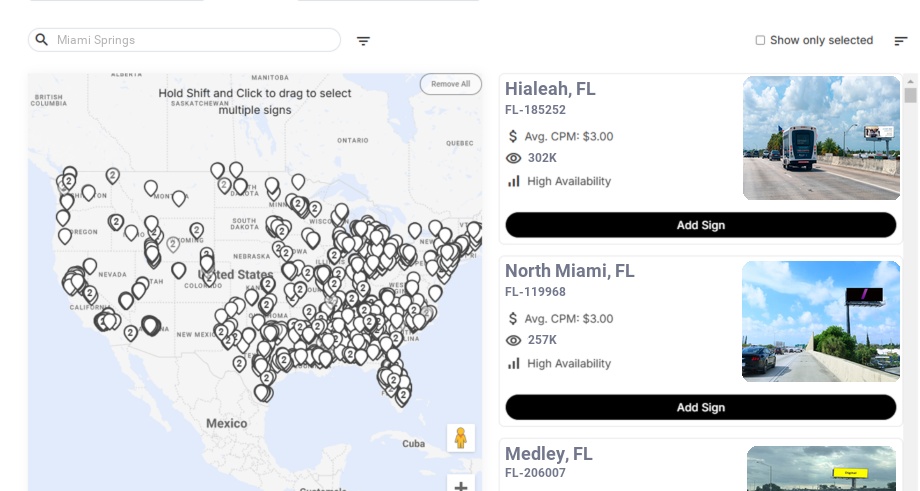



How much is a billboard near Miami Springs?
Why Choose Blip for Billboard Advertising near Miami Springs
Blip lets you launch Miami Springs billboards self-serve in minutes—perfect for reaching SR 826, SR 836, and MIA traffic fast.
Set flexible budgets on Miami Springs billboards and scale up for Dec-Apr tourism or pull back in slower months—no contracts needed.
Use dayparting on Blip to hit Miami Springs commuters at 6-9 a.m. and 4-8 p.m., when Palmetto and Dolphin traffic peaks.
Track Miami Springs billboard results in real time and shift spend toward boards near Hialeah, Medley, or Le Jeune as traffic changes.
Blip creative tools make it easy to test English and Spanish ads for Miami Springs families, airport workers, and travelers on quick highway reads.
Frequently Asked Questions About Billboard Advertising near Miami Springs
How much does a billboard cost near Miami Springs, Florida with Blip?
With Blip, advertising on Miami Springs billboards is flexible and affordable, because you only pay for each 7.5–10 second “blip” your ad appears on digital billboards near Miami Springs, Florida. You set your own daily budget, and Blip automatically keeps your campaign within that amount while adjusting to advertiser demand and the times and places you choose to run your ads. You can change your budget at any time, making it easy to scale up or pause as needed.
Where can I advertise with Blip near Miami Springs, Florida?
With 66 digital billboards within about 10 miles, we can build highly targeted campaigns that speak directly to residents, commuters, and travelers moving through this compact, high-traffic pocket of northwest Miami-Dade County. Our billboards serving the Miami Springs area are concentrated in nearby cities with heavy traffic and commercial activity, including Hialeah, Medley, Miami, Hialeah Gardens, North Miami, Opa-locka, Miami Gardens, and North Bay Village. This cluster of inventory creates unusually precise coverage for a relatively small footprint.
What makes Miami Springs, Florida a good market for Blip billboard ads?
The City of Miami Springs has 14,000–15,000 residents within just 3.0 square miles, translating to about 4,700–5,000 residents per square mile—denser than the nationwide average by more than four times. Nearby cities like Hialeah and Miami add major population and traffic volume, while Miami International Airport, Medley, and PortMiami bring in commuters, logistics traffic, and travelers. These dynamics mean we can build campaigns that feel local and community-focused, while still benefiting from large regional and tourist traffic volumes.
When should I run billboard ads near Miami Springs, Florida with Blip?
Greater Miami’s high tourist season typically runs December through April, when hotel occupancy rates often climb into the 80–90% range on many weekends. The official Atlantic hurricane season runs June 1–November 30, and late summer and early fall can bring softer tourism numbers and more variable demand. Aligning your Blip schedule with these cycles allows us to shift budgets dynamically—spending more when your customers are most active and pulling back during quieter weeks.
What roads near Miami Springs, Florida get the most traffic for billboard advertising?
Major arteries near the Miami Springs area include SR 826 (Palmetto Expressway), SR 836 (Dolphin Expressway), NW 36th Street, and Le Jeune Road (NW 42nd Avenue). Traffic counts on these roads are among the highest in the county, including SR 826 near MIA at 180,000–210,000 vehicles per day and SR 836 near MIA at 140,000–170,000 vehicles per day. The NW 36th Street / Doral–Airport corridor commonly sees 40,000–60,000 vehicles per day, with some segments higher.
Do I need a contract to advertise with Blip near Miami Springs?
No, Blip has no long-term contracts or minimum commitments. You can start, pause, or stop your campaign at any time.
How fast can I launch a billboard campaign with Blip near Miami Springs?
You can have your campaign live in minutes. Create a free account, select your locations, set your budget, upload your design, and start running once approved.
Where can I advertise with Blip near Miami Springs?
Blip has digital billboards near Miami Springs. You can browse available locations on a map, choose the ones that fit your audience, and start advertising right away.
Still have questions? Launch a campaign in minutes — no contracts, no commitments.
Start Your CampaignMiami Springs Billboard Advertising Guide
Digital billboards serving the Miami Springs area give us a rare combination: small-town community feel with big-city traffic volume from nearby Hialeah, Medley, Miami, and key highway corridors around Miami International Airport (MIA). With 66 digital billboards within about 10 miles, we can build highly targeted campaigns that speak directly to residents, commuters, and travelers moving through this compact, high-traffic pocket of northwest Miami-Dade County. For advertisers specifically searching for billboards near Miami Springs, this cluster of inventory creates unusually precise coverage for a relatively small footprint.
Understanding the Miami Springs Area Market
Miami Springs
Key facts that shape billboard strategy near Miami Springs:
-
Population & density
- The City of Miami Springs 14,000–15,000 residents within just 3.0 square miles, translating to about 4,700–5,000 residents per square mile—denser than the nationwide average by more than four times.
- Miami-Dade County overall has approximately 2.7 million residents spread across 34 municipalities and unincorporated areas, making it Florida’s most populous county and a massive potential reach just outside the Miami Springs city limits.
- Nearby cities that feed the Miami Springs trade area also have significant populations:
-
Economy & employment
- Miami-Dade’s unemployment rate in recent local labor reports has generally tracked around 2.0–3.0%, signaling a tight labor market and relatively strong consumer spending power.
- Countywide employment is anchored by sectors such as trade, transportation & utilities (≈20–22% of jobs), education & health services (≈18–20%), professional & business services (≈15–17%), and leisure & hospitality (≈10–12%), all of which are heavily represented in and around the airport, Hialeah, Medley, and central Miami.
- Miami International Airport alone supports an estimated 30,000–40,000 on-site jobs (airlines, TSA, concessions, ground handling, maintenance) and tens of thousands more off-site jobs in logistics, warehousing, and tourism-related businesses.
- The industrial zones in Medley and along the Palmetto Expressway host hundreds of warehouses and distribution centers, contributing to Miami-Dade’s status as a logistics hub that handles over 1 million containers annually through PortMiami.
-
Tourism & visitors
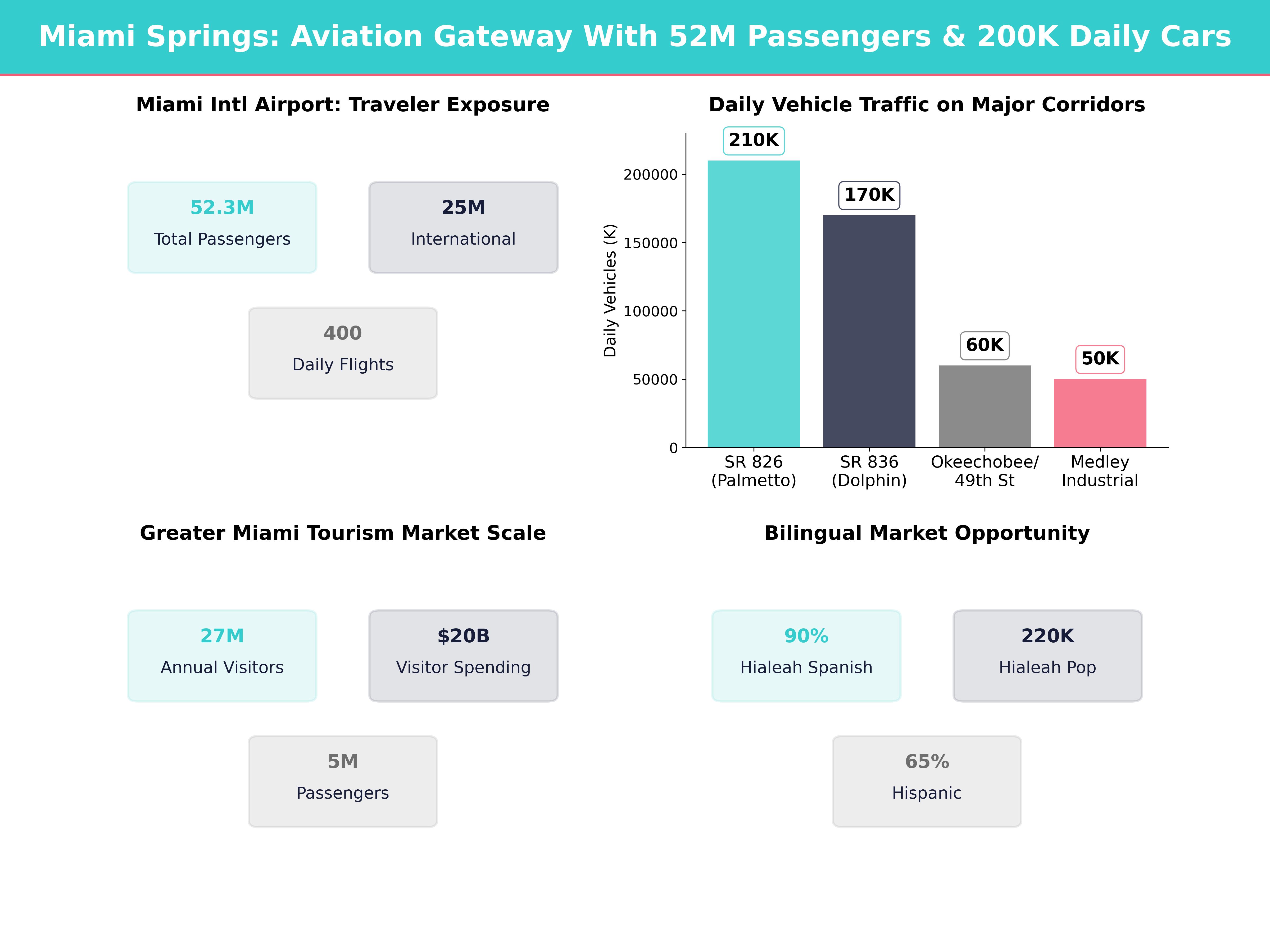
- According to the Greater Miami Convention & Visitors Bureau, Greater Miami & Miami Beach welcomed 27+ million overnight and day visitors in 2023, generating visitor expenditures of over $20 billion, supporting approximately 150,000+ tourism-related jobs in the region.
-
MIA is one of the primary gateways into South Florida, processing:
- 52.3 million passengers in 2023 (up from roughly 50.6 million in 2022), including more than 25 million international passengers.
- Over 400 daily flights to 160+ destinations.
- A large share of these visitors (including cruise passengers headed to PortMiami) transit through hotel corridors on NW 36th Street and Le Jeune Road, directly adjacent to the Miami Springs area, creating a constant flow of high-intent, spend-ready audiences that can be reached efficiently with billboard advertising near Miami Springs.
These dynamics mean we can build campaigns that feel local and community-focused, while still benefiting from large regional and tourist traffic volumes.
Where Our 66 Billboards Reach in the Miami Springs Area
Our 66 digital billboards serving the Miami Springs area are concentrated in nearby cities with heavy traffic and commercial activity, offering a range of options for billboard rental near Miami Springs that match different audience profiles:
- Hialeah (≈3.3 miles) – One of Florida’s largest cities, with over 220,000 residents, strong working-class and small-business presence, and intense local shopping traffic. Major corridors like Okeechobee Road (US‑27) and East/West 49th Street carry 40,000–60,000 vehicles per day on many segments, ideal for high-frequency impressions.
- Medley (≈3.7 miles) – An industrial and logistics hub with warehouses, distribution centers, and commercial traffic, especially trucks and contractors. Some stretches of NW South River Drive and roads connecting to SR 826 (Palmetto Expressway) see 30,000–50,000 vehicles per day, dominated by B2B and freight traffic.
- Miami (≈3.9 miles) – Urban traffic feeding into downtown, Brickell, and the airport area, capturing both commuters and visitors. The Dolphin Expressway (SR 836) near the airport typically handles 140,000–170,000 vehicles per day, while nearby arterials often exceed 30,000–40,000 vehicles per day.
- Hialeah Gardens (≈4.7 miles) – Growing residential and commercial mix with steady local driving patterns. Segments of NW 103rd Street and approaches to the Palmetto Expressway often reach 30,000+ vehicles per day.
- North Miami, Opa-locka, Miami Gardens, and North Bay Village – These surrounding cities extend reach to northern and coastal commuters who work, shop, or fly near Miami Springs. Segments of I‑95, SR 826, and US‑441 in these areas see anywhere from 80,000 to over 200,000 vehicles per day, depending on the corridor, amplifying your regional coverage.
Because digital billboards rotate “blips” (individual ad plays) throughout the day, we can:
- Select specific boards that align with your core trade area (e.g., Hialeah residents driving toward Miami Springs businesses), ensuring higher relevance and reducing waste for billboard advertising near Miami Springs.
- Emphasize airport-adjacent routes if you serve travelers, hospitality, or logistics, prioritizing segments documented by Miami-Dade County and Florida Department of Transportation District Six
- Focus on industrial corridors near Medley for B2B services (fleet repair, equipment rental, business insurance, staffing, etc.), where a high share of vehicles are commercial or work-related.
How People Move Near Miami Springs (And Why It Matters)
Placement and timing are everything. To get the most from digital billboards serving the Miami Springs area, we should lean into how residents and visitors travel:
-
Commuter flows
-
Major arteries near the Miami Springs area include SR 826 (Palmetto Expressway), SR 836 (Dolphin Expressway), NW 36th Street, and Le Jeune Road (NW 42nd Avenue). Traffic counts on these roads are among the highest in the county:
- SR 826 near MIA: often 180,000–210,000 vehicles per day.
- SR 836 near MIA: typically 140,000–170,000 vehicles per day.
- NW 36th Street / Doral–Airport corridor: commonly 40,000–60,000 vehicles per day, with some segments higher.
- Miami-Dade commuters average around 30 minutes per one-way trip, with many workers spending 10+ hours per week in traffic when you factor in congestion and return trips. That extended drive time supports repeated exposures on the same boards.
- Many Miami Springs residents work across Hialeah, Miami, Doral, and the airport area, frequently using the same routes every day—ideal for frequency-based billboard messaging designed to be seen 20–40+ times per month by regular commuters.
-
Major arteries near the Miami Springs area include SR 826 (Palmetto Expressway), SR 836 (Dolphin Expressway), NW 36th Street, and Le Jeune Road (NW 42nd Avenue). Traffic counts on these roads are among the highest in the county:
-
Airport-driven traffic
-
Miami International Airport handled over 52 million passengers in 2023, including:
- Roughly 29–30 million domestic passengers.
- Roughly 22–23 million international passengers, particularly from Latin America, the Caribbean, and Europe.
- MIA is immediately adjacent to the Miami Springs area. Travelers, airline employees, and airport contractors constantly move along NW 36th Street, Le Jeune Road, and the Palmetto/Dolphin exchanges. The Miami-Dade Transportation Planning Organization identifies these as critical high-volume corridors linking the airport to downtown Miami, the beaches, and suburban cities.
-
This creates strong opportunities for:
- Airport hotels and short-term rentals: Greater Miami offers 60,000+ hotel rooms, with thousands clustered within 5–10 minutes of MIA.
- Parking, rideshare, and shuttle services: off-airport parking operators can target passengers who make last-minute decisions as they approach the airport.
- Car rental, auto repair, and car wash businesses: MIA’s large rental car center serves multiple millions of rental transactions annually, driving recurring demand for vehicle services.
- Tourist attractions, boat tours, and entertainment targeting first-night or last-day visitors who often have 4–24 hours of “flex time” between flights and cruise departures.
-
Miami International Airport handled over 52 million passengers in 2023, including:
-
Local shopping & dining patterns
- Miami Springs’ residential character means many locals leave the neighborhood to shop in Hialeah, Miami, or Doral, then return via the same corridors. Community surveys and local business associations report that a significant share of residents do weekly shopping at major centers in Hialeah and Doral rather than inside the city itself.
-
Weekend retail peaks often occur around:
- Big-box and shopping centers in Hialeah/Hialeah Gardens (where many centers report Friday–Sunday sales 20–40% higher than weekday averages).
- Restaurants and nightlife closer to Miami, Wynwood, and Doral’s CityPlace area.
- Airport hotel dining and bar options, which pick up from both overnight guests and locals meeting business contacts near MIA.
By matching creative and schedule to these patterns, we can show the right message to the right audience precisely when they’re deciding where to spend money, and make Miami Springs billboards work harder for your budget.
Seasonality: Timing Campaigns in the Miami Springs Area
The Miami Springs area is influenced by both tourist seasons and local cultural rhythms.
Key seasonal patterns:
-
Tourism peaks
- Greater Miami’s high tourist season typically runs December through April, when hotel occupancy rates often climb into the 80–90% range on many weekends, according to the Greater Miami Convention & Visitors Bureau.
- International visitors, cruise passengers, and snowbirds flow heavily through MIA in these months. Cruise activity alone drives 5+ million cruise passengers per year through PortMiami, many of whom pass near airport-area billboards as they arrive or depart.
-
During this period, we recommend:
- Higher daily budgets or more frequent blips on boards nearest MIA and main hotel clusters, to stay visible amid increased competition.
- Creative in multiple languages, especially English and Spanish (with Spanish commonly spoken at home by 70–80% of residents in nearby Hialeah and surrounding neighborhoods), and sometimes Portuguese, depending on your target segments.
-
Hurricane season & slower tourism (June–November)
- The official Atlantic hurricane season runs June 1–November 30. Late summer and early fall can bring softer tourism numbers and more variable demand, especially in August–September.
- Hotel occupancy and average daily rates often decline during these months compared to peak winter, which typically means more local traffic relative to tourists on nearby roadways.
- This can be a cost-efficient time for local-focused campaigns (home services, medical clinics, schools, legal services) to gain share-of-voice at potentially lower relative competition, especially if some tourism-focused advertisers reduce spend.
-
Back-to-school and local events
- Miami-Dade County Public Schools (one of the largest districts in the U.S., serving 330,000+ students across 400+ schools) drives predictable cycles: August back-to-school, holiday breaks, spring sports, and exam seasons.
- Local news outlets such as the Miami Herald NBC 6 South Florida, Local 10 WPLG, and WSVN 7 News regularly cover community and school events, sports tournaments, and traffic changes that affect driving patterns and consumer behavior.
-
For family-oriented businesses, we can match billboard pushes to:
- Back‑to‑school shopping (late July–August), when many families make large purchases on clothing, electronics, and school supplies.
- Youth sports seasons (fall and spring), which increase weekend travel to parks and fields across northwest Miami-Dade.
- Holiday periods (November–December) when visiting relatives stay near the airport and hotels by the Miami Springs area, often boosting restaurant and entertainment spending by 20–30% over typical months.
Aligning your Blip schedule with these cycles allows us to shift budgets dynamically—spending more when your customers are most active and pulling back during quieter weeks, while keeping your core billboards near Miami Springs visible year-round.
Crafting High-Impact Creative for Drivers Near Miami Springs
Because traffic flows near Miami Springs are a mix of local residents, working commuters, and international visitors, our creative should be clear, fast to read, and culturally attuned.
Best practices for artwork in the Miami Springs area:
-
Use bilingual or Spanish-forward messaging when appropriate
- Estimates place Hispanic and Latino residents at well over 65% of the population in surrounding Miami-Dade neighborhoods, with Hialeah often cited as one of the most heavily Spanish-speaking cities in the country (local surveys show 90%+ of residents speaking Spanish at home).
-
Consider either:
- Simple bilingual creative (e.g., headline in English, supporting line in Spanish), or
- Separate English and Spanish creatives and rotate them using Blip’s multiple-creative tools to compare response.
- Keep Spanish copy as concise as English—aim for 7 words or fewer on most designs; legibility tests suggest that at 55–65 mph, drivers typically process no more than 3–7 key words per exposure.
-
Design for quick highway reading
- Many of our 66 screens sit along high-speed routes near the Miami Springs area where average speeds are 45–65 mph and typical viewing time is 3–6 seconds.
-
Use:
- A single bold headline (≤7 words) sized for at least 18–24 inches of letter height on full-size bulletins, which testing shows can be legible from 400–600 feet.
- A single strong image or icon (logo, product, or human face) that communicates instantly.
- Large, high-contrast color combinations (e.g., white/yellow on dark blue, or black on light yellow) that maintain strong contrast ratios in bright South Florida sun.
- Avoid small legal disclaimers or clutter; treat billboards as brand and directional media, not brochures.
-
Call-to-action tailored to context
-
For airport-area traffic:
- “5 Minutes from MIA – Exit on 36th St”
- “Park Near the Airport – Save Up to 40%”
- “Got a Layover? Food & Drinks 1 Exit Away”
-
For local resident traffic:
- “Miami Springs Area Families: Free First Consultation”
- “Hialeah & Miami Springs Area Delivery in 30 Minutes”
- “Local Dentist – Same‑Day Appointments Near You”
- Use proximity hooks: “Just 2 miles ahead,” “Next right on Le Jeune,” or “Near Miami Springs Circle,” which help shorten decision time for drivers who are already close.
-
For airport-area traffic:
-
Weather-aware messaging
-
South Florida’s frequent rain and high heat lend themselves to clever seasonal creatives:
- “Rain or Shine, We Come to You”
- “Beat the Heat: A/C Tune-Up $79”
- “Storm Season Is Here – Secure Your Roof Today”
- The Miami area averages 60+ inches of rain per year and 90°F+ daytime highs in summer months, giving weather-themed creatives real urgency and relevance.
-
South Florida’s frequent rain and high heat lend themselves to clever seasonal creatives:
We can preload multiple creative versions and rotate them to test what resonates best—without any printing costs, and quickly adapt as we learn which messages perform best on Miami Springs billboards compared to boards farther out.
Using Blip’s Flexibility to Target the Miami Springs Area Precisely
Digital billboards let us treat outdoor advertising more like digital marketing—buying exactly the times and places that matter most.
Here are ways to leverage Blip-style features for the Miami Springs area:
-
Dayparting (time-of-day targeting)
-
Morning commute (6–9 a.m.):
- Great for coffee shops, breakfast spots, childcare, and reminders (“Call before work,” “Book your appointment today”). Many expressway corridors near Miami Springs see peak hourly volumes during this window, often exceeding 8,000–10,000 vehicles per hour.
-
Midday (11 a.m.–2 p.m.):
- Capture lunch traffic from airport staff, office workers, and logistics employees in Medley. This is a sweet spot for quick-service restaurants, medical walk-ins, and auto services.
-
Evening (4–8 p.m.):
- Restaurants, gyms, tutoring, and family services as people head home through the Miami Springs area. Local surveys show that 40–50% of households make key dining and shopping decisions on the drive home, making this window particularly influential.
-
Morning commute (6–9 a.m.):
-
Day-of-week strategies
- Weekdays: Emphasize services like auto repair, medical, legal, B2B, staffing, and logistics support—categories that often see 70–80% of revenue on Monday–Friday.
- Weekends: Highlight entertainment, restaurants, churches, real estate open houses, and tourism offers. In tourist season, weekends can account for 30–40% of weekly visitor spending, especially in hospitality and attractions.
-
Board-level selection
-
Choose boards near:
- Industrial Medley for B2B, fleet, and trades where a high percentage of passing vehicles are work trucks and commercial vehicles.
- Residential Hialeah / Miami Gardens / North Miami for consumer services and retail, capturing dense neighborhoods where household incomes and family sizes vary but car ownership rates are high (most households have 1–2 vehicles).
- Corridors around MIA and Miami for tourism, travel, and hospitality, where short-stay visitors often make decisions within hours of arrival.
- Coordinate your board selection with traffic information from the Miami-Dade County Department of Transportation and Public Works FDOT District Six
-
Choose boards near:
Because you can set a daily or total campaign budget, there is no requirement to “own” a board all day. Instead, we can concentrate spending in specific high-value time windows, spreading impressions across multiple boards that surround the Miami Springs area and maximizing the impact of billboard rental near Miami Springs.
Data-Driven Optimization: Test, Learn, and Refine
To get the most from billboard campaigns near Miami Springs, we recommend treating each campaign as a test-and-learn cycle.
Consider tracking:
-
Store or business metrics
- Walk-ins or check‑ins from ZIP codes around Miami Springs, Hialeah, and Medley; for many local retailers, a 10–20% lift in visits during a billboard flight is a realistic early benchmark.
- Call volume, quote requests, or bookings during specific time windows when your ads run. For example, if you daypart 7–9 a.m. and 4–7 p.m., watch for call spikes in those same windows.
- Promo codes like “Mention MIA36 for 10% off” tied to airport-adjacent creatives, and separate codes like “SPRINGS10” for neighborhood-focused boards, to compare response and understand which billboards near Miami Springs are driving the strongest ROI.
-
Web & digital metrics
- Spikes in direct traffic or branded search when your campaign is live—many local businesses observe 5–30% increases in direct or search traffic during strong out-of-home flights.
- Landing pages tailored to billboard viewers (short URL like “yourbrand.com/mia”), then monitoring page views, form fills, and click‑to‑call rates.
- Geofenced campaigns in paid search or social around the same corridors to build a multi-channel presence. Coordinated offline+online campaigns can generate 20–50% higher response rates than single-channel tactics.
-
Creative A/B tests
-
Run two or three creative variants simultaneously:
- English vs. Spanish-first.
- Price-led (“Oil Change $39”) vs. value-led (“Fast, Honest Mechanic Near the Airport”).
- Simple icon vs. human face image.
- After 2–4 weeks, compare website visits, calls, or in-store conversions and shift more of your budget to the winner. Aim for at least 1,000–2,000 plays per creative before declaring a clear winner, depending on your category and budget.
-
Run two or three creative variants simultaneously:
Local media such as the Miami Herald Local 10 WPLG, WSVN 7 News, and NBC 6 South Florida can also provide context on economic trends and events that might affect response (e.g., new developments, traffic changes, or large events at nearby venues such as loanDepot park or major festivals downtown).
Strategy Ideas by Industry in the Miami Springs Area
Below are practical frameworks you can adapt:
Hospitality, Short-Term Rentals, and Tourism
Audience: Airport passengers, cruise travelers, and overnight visitors.
Tactics:
- Focus boards on routes to MIA and main hotel corridors (NW 36th St, Le Jeune), where daily traffic can exceed 40,000–60,000 vehicles and includes a high proportion of visitors who are especially responsive to billboard advertising near Miami Springs that highlights convenience and last-minute deals.
- Run heavier during December–April and weekends, when visitor spending per day is typically highest.
- Include quick decision drivers such as “Free Parking,” “Shuttle Every 30 Minutes,” or “No Resort Fees,” which can influence bookings within minutes of seeing the ad.
-
Examples:
- “Hotel 3 Minutes from MIA – Free Shuttle & Breakfast”
- “Cruise Tomorrow? Stay Near the Airport Tonight”
- “Late Arrival? 24/7 Check‑In – Exit on 36th St”
Auto Services and Transportation
Audience: Local residents, airport employees, rental car drivers, commercial fleets.
Tactics:
- Use boards near Medley and Hialeah for fleets and industrial businesses, where work-vehicle traffic is concentrated.
- Daypart around shift changes (early morning, late afternoon, overnight shifts for airport operations).
- Emphasize speed and proximity: many drivers within 3–5 miles are willing to detour only 5–10 minutes for auto services.
-
Examples:
- “Flat Tire Near the Miami Springs Area? Call 24/7”
- “Fleet Maintenance Specialists – Near Palmetto & 36th”
- “Airport Workers: Oil Change in 30 Minutes – Show Your ID for 10% Off”
Healthcare, Dental, and Clinics
Audience: Families and working adults in the Miami Springs, Hialeah, and Miami Gardens areas.
Tactics:
- Bilingual creative highlighting same-day appointments, walk‑ins, or extended hours, focusing on convenience for commuters and shift workers.
- Heavier presence at morning and evening commute times, and during flu season (typically October–March) when urgent care visits spike.
- Promote insurance acceptance and payment options; healthcare providers that communicate clear pricing or “Se aceptan la mayoría de seguros” often see higher response in heavily bilingual markets.
-
Examples:
- “Urgent Care Near the Miami Springs Area – Open Late”
- “Dentista Cerca de Usted – Aceptamos Nuevos Pacientes”
- “Pediatrics Near MIA – Same‑Day Appointments Available”
Home Services (HVAC, Roofing, Landscaping, Contractors)
Audience: Homeowners and property managers in nearby residential zones.
Tactics:
- Emphasize weather-related urgency: heat waves, heavy rain, and storm preparedness. Miami’s combination of high humidity and storm risk makes A/C and roofing urgent needs, not luxuries.
- Increase presence before and during hurricane season (June–November), especially when local forecasts highlight approaching storms—local news viewership and search interest in home services can jump 50–100% ahead of major weather events.
- Use geographic cues like “Serving Miami Springs, Hialeah & Doral” to signal local expertise and show that your services are supported by visible Miami Springs billboards.
-
Examples:
- “A/C Not Keeping Up? Miami Springs Area Service in 2 Hours”
- “Prep for Storm Season – Free Roof Inspection”
- “Yard Looking Rough? Landscaping Near the Airport Area – Call Today”
Education, Training, and After-School Programs
Audience: Parents commuting through nearby corridors and young adults seeking training.
Tactics:
- Schedule heavier July–September (back-to-school) and January (new-year goals), when interest in enrollment peaks.
- For workforce training and trade schools, focus on commuters along SR 826 and SR 836, where many blue- and white-collar workers travel to and from industrial and office areas.
- Use simple, aspirational headlines and proximity-based CTAs. Programs that highlight time-to-completion (e.g., “Graduate in 9 Months”) often see higher response.
-
Examples:
- “After-School Tutoring Near the Miami Springs Area – Enroll Now”
- “Learn to Trade, Not Just Work – Classes Near MIA”
- “English & GED Classes – Night Schedules for Airport Workers”
Practical Checklist for Launching a Campaign Near Miami Springs
To wrap strategy into action, here’s a concise checklist:
- Define your core audience
-
Pick your primary corridors
- MIA-adjacent routes (NW 36th St, Le Jeune), Palmetto (SR 826), Dolphin (SR 836), or north–south connectors through Hialeah and Miami that your best customers already use.
-
Set your time focus
- Commuter hours vs. weekend vs. all-day presence for high-urgency services (like emergency dental or roadside assistance).
-
Prepare 2–3 strong creatives
- At least one bilingual or Spanish-first design.
- Big fonts, minimal words (ideally ≤7), clear CTA and location cue that tie back to easily recognized Miami Springs billboards or nearby landmarks.
-
Align with local seasonality
- Tourism peaks (Dec–Apr), back-to-school (Jul–Sep), hurricane season (Jun–Nov), or holiday shopping (Nov–Dec).
-
Attach clear tracking
- Unique URLs, phone extensions, promo codes, QR codes for slower intersections, or “mention this billboard” offers.
-
Review results every 2–4 weeks
- Compare calls, web visits, and in-store activity. Use insights to shift budget to the highest-performing routes, times, and creatives, and adjust language mix (English vs. Spanish) based on response.
By understanding how residents, workers, and visitors move through the Miami Springs area and surrounding cities like Hialeah, Medley, and Miami, we can use our 66 digital billboards to build campaigns that are not only visible, but strategically aligned with real-world behavior. That’s how we turn impressions from billboard advertising near Miami Springs into measurable business results.