Billboards near Port St. John, FL
No Minimum Spend. No Long-Term Contracts. Just Results.
Trusted by Leading Brands


Billboard advertising
near Port St. John has never been easier




How much is a billboard near Port St. John?
Why Choose Blip for Billboard Advertising near Port St. John
Blip lets you self-serve Port St. John campaigns fast, reaching commuters on I-95 and US 1 without sales calls or contracts.
Use Blip-optimized ads in Port St. John to auto-pick timing and boards for North Brevard commuters, beach traffic, and Cocoa gateways.
Port St. John advertisers can flex budgets anytime on Blip, ideal for launch windows, cruise surges, and seasonal traffic on SR 528.
Daypart Port St. John billboards for 6-9 a.m. and 3-7 p.m. with Blip, matching local school, work, and shopping trips.
Track Port St. John results in real time with Blip and shift creative fast for storm prep, back-to-school, or holiday demand.
Frequently Asked Questions About Billboard Advertising near Port St. John
How much does a billboard cost in Port St. John with Blip?
Pricing starts at just $0.01 per display. Each “blip” is a 7.5-to-10-second display on a rotating digital billboard, and the cost per blip can vary based on time of day, location, and advertiser demand. You only pay when your ad actually runs, and you can set your spend, adjust it anytime, or pause whenever you want.
Where can I advertise near Port St. John with Blip?
We currently have 4 digital billboards in nearby Cocoa, all within 10.0 miles of the Port St. John area, with the closest about 6.9 miles away. That placement lets us reach households near Port St. John as they travel toward Cocoa, Rockledge, Titusville, and the broader Brevard County corridor. Nearby Cocoa boards also work well as a gateway to the Port St. John market.
What kind of people does billboard advertising in Port St. John reach?
The Port St. John area functions as a stable suburban audience with repeat trip patterns, and households commonly head south toward Cocoa and Rockledge or north toward Titusville and launch-related employment areas. The area is largely neighborhood-based, family-oriented, and built around driving, which makes billboard frequency valuable for home services, healthcare, restaurants, financial services, schools, automotive businesses, and retail brands. About 8 in 10 Brevard workers commute by car, mostly alone.
When is the best time to run billboard ads in Port St. John with Blip?
March brings spring break travel, June through August brings summer family traffic, and the cooler-weather period from roughly November through April can also be productive. For local services, back-to-school campaigns should build during late July and early August, while holiday retail and dining should typically ramp 2 to 3 weeks before Thanksgiving and stay active through December. For commuter-focused campaigns, weekday weighting around 6-9 a.m. and 3-7 p.m. often matches the most useful drive windows.
Why is billboard advertising in Port St. John a strong market for Blip?
Advertising near Port St. John works especially well because the market is residential, commuter-driven, and tied to one of Florida’s most recognizable regional economies. The broader area includes a 13,808-resident Port St. John CDP, a 606,612-resident Brevard County market, and about 7.6 million cruise passengers moving through Port Canaveral in fiscal 2024. When we add Space Coast commuting patterns, cruise travel, beach traffic, and launch-related visitation, the Port St. John area becomes a strong market for brands that want steady visibility without paying for a much larger metro footprint.
Do I need a contract to advertise with Blip near Port St. John?
No, Blip has no long-term contracts or minimum commitments. You can start, pause, or stop your campaign at any time.
How fast can I launch a billboard campaign with Blip near Port St. John?
You can have your campaign live in minutes. Create a free account, select your locations, set your budget, upload your design, and start running once approved.
Where can I advertise with Blip near Port St. John?
Blip has digital billboards near Port St. John. You can browse available locations on a map, choose the ones that fit your audience, and start advertising right away.
Still have questions? Launch a campaign in minutes — no contracts, no commitments.
Start Your CampaignPort St. John Billboard Advertising Guide
Advertising near Port St. John works especially well because the market is residential, commuter-driven, and tied to one of Florida’s most recognizable regional economies, serving a 13,808-resident Port St. John CDP and a 606,612-resident Brevard County 7.6 million cruise passengers moving through Port Canaveral in fiscal 2024. We currently have 4 digital billboards in nearby Cocoa 10.0 miles of the Port St. John area, with the closest about 6.9 miles away. That placement lets us reach households near Port St. John as they travel toward Cocoa Rockledge Titusville Brevard County
Port St. John area market overview
Population scale and household profile near Port St. John
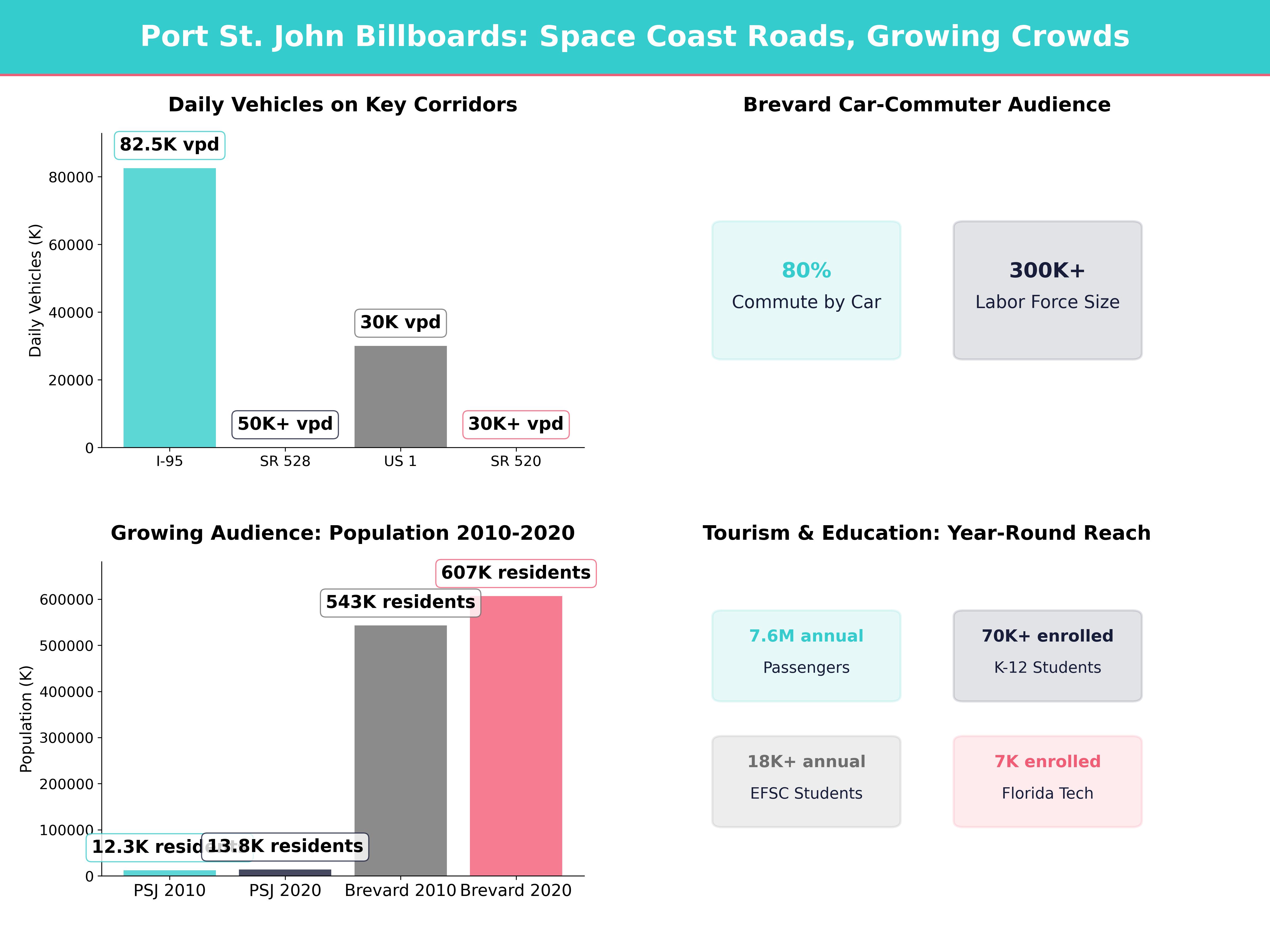
The Port St. John area is a substantial north Brevard residential market, not just a pass-through community. 2020 census counts put the Port St. John CDP at 13,808 residents, up from 12,267 in 2010, which works out to roughly 12.6% growth over the decade. That pace slightly outperformed overall Brevard County 543,376 residents in 2010 to 606,612 in 2020, or about 11.6%.
For advertisers, that matters because the Port St. John area functions as a stable suburban audience with repeat trip patterns. Households near Port St. John commonly head south toward Cocoa, Rockledge, and other central Brevard retail and service hubs, while some also travel north toward Titusville and launch-related employment areas. That gives us a dependable rhythm of daily impressions rather than a market that appears only on weekends.
The demographic feel of the Port St. John area is especially favorable for local and regional advertisers. The area is largely neighborhood-based, family-oriented, and built around driving, which makes billboard frequency valuable for home services, healthcare, restaurants, financial services, schools, automotive businesses, and retail brands that want to stay top of mind.
Economy and commuting behavior serving the Port St. John area
The broader north Brevard economy adds another layer of strength. The Economic Development Commission of Florida’s Space Coast Port Canaveral, Health First, L3Harris, Boeing, and Blue Origin
Recent FloridaCommerce 300,000. That is a meaningful scale for a county market, and it reinforces why repeated commuter exposure matters.
Just as important, the Port St. John area remains highly car-dependent. Roughly 8 in 10 Brevard workers commute by car, mostly alone, which is exactly the kind of travel behavior that makes digital out-of-home perform well. Space Coast Area Transit provides public transportation options, but the local geography still centers on private vehicles, especially for suburban neighborhoods near Port St. John. For advertisers, that means our message can meet people during the same work, school, shopping, and errand routes again and again.
Key traffic corridors serving the Port St. John area
I-95 and north Brevard commuter flow near Port St. John
I-95 is the main regional spine serving the Port St. John area. It connects north Brevard to Cocoa, Rockledge, Melbourne, Daytona Beach, and the rest of the East Coast. According to corridor planning work from the Space Coast Transportation Planning Organization FDOT, segment counts in north Brevard around exits 208, 212, and 220 typically land in the 75,000 to 90,000 vehicles per day range, depending on the exact segment and count year.
That volume is what gives nearby Cocoa billboards such strong value for the Port St. John market. Even though our boards are not inside Port St. John itself, they sit along the movement patterns that residents near Port St. John already use. If we want broad awareness across north Brevard, I-95-facing or I-95-connected inventory is the fastest way to build repetition.
I-95 is especially useful for campaigns targeting:
- Regional healthcare.
- Auto dealers and repair.
- Home services.
- Legal services.
- Retail destinations.
- Employers recruiting across the county.
Those categories benefit from the simple fact that many residents near Port St. John drive the same interstate and feeder corridors several times each week.
US 1, SR 528, and SR 520 connections for the Port St. John market
US 1 is the corridor that feels most local to the Port St. John audience. It connects the Port St. John area with Cocoa to the south and Titusville to the north, and it acts as the practical main street for many everyday trips. Segment counts through the north Cocoa-to-Titusville stretch that serves Port St. John households often run about 25,000 to 35,000 vehicles per day.
State Road 528 matters for a different reason. Near Cocoa, SR 528 regularly handles 50,000-plus vehicles per day, and it connects the Port St. John market to Orlando, airport-bound travel, and Port Canaveral. That makes it especially important for tourism, hospitality, entertainment, and any business that wants to reach both locals and visitors moving through the Space Coast gateway.
State Road 520 is also meaningful near Cocoa, where many segments commonly carry 30,000-plus vehicles daily. It helps feed retail, dining, and service traffic around Cocoa Village, Merritt Island, and the cross-county commercial core.
Closer to the residential side of the market, streets such as Fay Boulevard and Port St. John Parkway feed neighborhood trips toward US 1 and the interstate network. That means the winning billboard strategy near Port St. John is usually not about covering every street. It is about owning the few corridors that nearly everyone uses.
Audience segments we can reach near Port St. John
Commuters and working households in the Port St. John area
The first major audience is daily commuters. Because the Port St. John area is predominantly suburban and vehicle-oriented, residents near Port St. John often travel to work, shopping, appointments, and services by car. With a county labor force above 300,000 and about 8 in 10 workers commuting by car, this is a market where repeated roadside visibility can outperform more passive media.
We can use nearby Cocoa billboards to reach workers traveling toward Health First facilities, local schools, aerospace employers, retail nodes, and professional offices across north and central Brevard. For businesses such as urgent care clinics, dentists, HVAC companies, roofing companies, insurance agencies, banks, and family restaurants, this audience is often the most valuable because it combines frequency with high local intent.
Tourists, cruisers, and recreation visitors serving the Port St. John area
The second major audience is tourism and recreation traffic. The Space Coast Office of Tourism promotes 72 miles of Atlantic beaches across the Space Coast, which gives the area a strong year-round visitor identity. Port Canaveral reported about 7.6 million cruise passengers in fiscal 2024, which is an enormous regional demand driver for hotels, restaurants, attractions, transportation services, and retail.
Many of those visitors move through Cocoa and the SR 528 corridor before splitting toward the cruise terminals, beach communities, Titusville, or attractions such as the Kennedy Space Center Visitor Complex. Even when the target customer ultimately ends up north of Cocoa, the gateway traffic still supports campaigns serving the Port St. John area.
Tourism-adjacent campaigns near Port St. John often work well for: Restaurants and casual dining; Hotels and vacation lodging; Attractions and family entertainment; Car rental and transportation services; Beach, marine, and outdoor brands; Visitor-facing healthcare and urgent care.
Launch-related visitation also matters, even though it is less predictable than commuting. When launch windows cluster on weekends or holidays, north Brevard roads can see noticeable traffic surges from spectators, media, and families traveling to watch from popular viewing areas.
Students, parents, and family audiences near Port St. John
The third major audience is education- and family-connected households. Brevard Public Schools serves more than 70,000 students across the county. Eastern Florida State College serves more than 18,000 students annually, and Florida Institute of Technology enrolls roughly 7,000 students.
Those numbers matter even for advertisers focused on the Port St. John area because students and parents create dependable year-round traffic for food, tutoring, mobile carriers, healthcare, auto services, athletics, childcare, and local entertainment. Families near Port St. John also travel throughout the county for school events, shopping, recreation, and attractions such as Brevard Zoo
Seasonal and timing opportunities in the Port St. John area
Tourism and event-driven timing near Port St. John
The Port St. John market has several predictable seasonal windows. March brings spring break travel, which supports dining, attractions, beach-related businesses, and tourism services. June through August brings summer family traffic, beach trips, and cruise demand, especially for campaigns tied to food, entertainment, lodging, and convenience services.
The cooler-weather period from roughly November through April can also be productive because the Space Coast tends to see stronger visitor activity, seasonal residents, and comfortable outdoor conditions. That is a smart time for hospitality, medical services, home services, and higher-ticket retail to stay visible.
Launch schedules can create opportunity in any month of the year. Because those schedules can change quickly, it helps to use a platform that lets us swap creative fast rather than locking into one static message for months.
Retail, service, and school-calendar timing serving the Port St. John area
For local services, the school calendar is a major timing cue. Brevard Public Schools generally starts the new year in August, so back-to-school campaigns should build during late July and early August. That timing works well for family restaurants, eye care, dentistry, tutoring, kids’ activities, retail, and cell-phone plans.
For home services in the Port St. John area, we usually recommend heavier weight from April through June for HVAC, roofing, pest control, lawn care, and pool-related offers, because households start preparing for hotter weather and summer rains. Hurricane-prep messaging can also be timely from June through November, especially for roofers, storm shutters, generators, insurers, and emergency service brands.
Holiday retail and dining should typically ramp 2 to 3 weeks before Thanksgiving and stay active through December. For commuter-focused campaigns, weekday weighting around 6-9 a.m. and 3-7 p.m. often matches the most useful drive windows. For tourism and entertainment, midday, evening, and weekend schedules usually make more sense.
Billboard design tips for the Port St. John market
Creative approaches that fit the Port St. John and Space Coast audience
The Port St. John area responds best to clean, direct, regionally aware creative. The Space Coast is visually distinct, so we do not need generic urban imagery to make an ad feel polished. Colors that often fit the market well include deep blue, bright white, black, and sunset orange, because they echo coastal water, bright sky, launch flames, and high-contrast Florida light.
We also need to design for local conditions. Central Florida sunlight is intense, and summer rain can reduce readability fast. Because of that, pale text on light blue skies usually underperforms. Strong contrast is more reliable than subtle gradients. If we are targeting families near Port St. John, imagery of neighborhood life, beaches, boats, rockets, schools, or local service crews usually feels more relevant than stock photos of downtown towers.
Region-specific wording can also help. Phrases such as “Space Coast,” “North Brevard,” “Near US 1,” “Next Exit,” “Cocoa,” or “Titusville” can make an offer feel immediately local when the business truly serves that area.
Messaging tips for commuters near Port St. John
For the Port St. John market, we usually recommend very short copy. 6 to 8 words, 1 core benefit, and 1 clear call to action are often enough. Drivers on I-95, US 1, SR 528, and SR 520 are moving, so clarity matters more than cleverness.
Good local billboard messaging often does one of the following:
- It names a nearby destination.
- It highlights a practical benefit.
- It gives a simple reason to act now.
- It uses a directional cue the driver can process quickly.
For example, location-based phrases such as “Near Cocoa,” “Off 528,” “North Brevard Care,” or “Next Exit Dining” can work better than broad branding lines when the goal is response. On longer campaigns, we also like to rotate creative every 2 to 4 weeks so the message stays fresh for repeat commuters near Port St. John.
Regional strategies near Port St. John
Using nearby Cocoa as the main gateway to the Port St. John area
Because all 4 of our digital billboards serving the Port St. John area are in nearby Cocoa
For businesses based in Cocoa Rockledge
This strategy is well suited to:
- Medical and dental providers.
- Grocery-adjacent and quick-service dining.
- Auto repair and dealerships.
- Home improvement companies.
- Legal and financial services.
- Regional employers recruiting across north Brevard.
Reaching north Brevard and Titusville-oriented travel near Port St. John
Nearby Cocoa boards also work for advertisers based farther north. The Port St. John area sits between major north and south nodes, which means residents near Port St. John often move along the same trunk corridors whether they are heading toward Titusville
For Titusville
Highway interchanges, commercial districts, and service corridors near Port St. John
Interchange strategy matters near Port St. John because the market is heavily shaped by route choice. Inventory tied closely to I-95 and SR 528 is ideal when we want broad awareness among commuters, Orlando-bound travelers, cruise passengers, and regional visitors. Inventory tied more closely to US 1 and SR 520 is usually better when we want repeated local frequency for restaurants, service businesses, Cocoa Village, and practical household spending.
When we evaluate which nearby billboard locations fit a goal, we usually ask four questions:
- Are we trying to reach weekday commuters or weekend visitors?
- Do we need broad regional scale or repeated local frequency?
- Is the business south of the Port St. John area, north of it, or tied to the coast?
- Does the offer depend on immediate action or longer-term brand recall?
Those answers usually make the right location strategy obvious.
Blip tools and capabilities for the Port St. John area
Matching Blip tools to Port St. John travel patterns
The Port St. John market is a strong fit for Blip because the audience is corridor-based and timing-sensitive. If we already know we want the nearby Cocoa billboards that serve Port St. John, we can use a manual campaign and select them directly on the map. If we want the platform to help balance spend and timing automatically, we can use a Blip-optimized campaign and let the system allocate budget where it sees the best opportunity.
This is especially useful in a market where commuter periods, tourism periods, and launch-related surges do not all behave the same way. We can weight weekdays around 6-9 a.m. and 3-7 p.m. for work-trip campaigns, or we can lean into midday, evenings, and weekends for restaurants, events, and visitor-focused offers.
Flexible budgeting and creative control for the Port St. John market
Blip also fits the Port St. John area because we do not need to overcommit to test a market. Pricing starts at $0.01 per display, and each blip lasts about 7.5 to 10 seconds. That structure gives us room to test messages for commuters, families, tourists, or seasonal campaigns without waiting for a long traditional buying cycle.
For this geography, fast creative changes can be a real advantage. We can update around launch weekends, school season, storm-prep periods, holiday retail, or special offers tied to cruise traffic. Real-time analytics also help us see whether a campaign is behaving more like a commuter campaign or a tourism campaign, which makes future targeting smarter.
Getting started with billboard rental near Port St. John
How we choose the right billboard strategy serving the Port St. John area
When we get started with billboard rental near Port St. John, the first step is to define the real goal. We usually sort campaigns into three buckets: brand awareness, local foot traffic, or lead generation. Once we know which of those matters most, the location strategy becomes much easier.
If our customers live near Port St. John but usually shop or seek services farther south, the nearby Cocoa boards are often the best fit because they sit only 6.9 miles away and align with real-world travel. If our customers are commuters, we prioritize routes tied to I-95 and US 1. If our customers are tourists or cruisers, we give more weight to SR 528-connected traffic and weekend timing.
A practical evaluation checklist looks like this:
- We confirm whether the audience is local, regional, or visitor-driven.
- We check whether the strongest travel pattern is morning, evening, midday, or weekend.
- We decide whether the message needs frequency or broad reach.
- We match the board location to the route people already use, not the route we wish they used.
That last point is the one advertisers miss most often, and it is where nearby Cocoa inventory becomes so useful for the Port St. John area.
What to expect when we rent a billboard near Port St. John with Blip
Traditional billboard buying often starts with sales calls, limited inventory conversations, and fixed-term commitments that can make testing difficult. Blip simplifies that process. We can launch online, set our own budget, upload creative, adjust timing, and change direction as we learn.
For a new advertiser serving the Port St. John area, we often recommend starting with a focused 2- to 4-week test. That window is usually long enough to see whether the campaign performs better with commuters, families, or visitor traffic. From there, we can expand the schedule, change the creative, shift the timing, or add more boards if the response supports it.
The biggest advantage is control. We do not have to guess once and live with the result. We can start small, learn from actual delivery, and scale the locations and dayparts that best serve the Port St. John market.