Billboards in Vero Beach, FL
No Minimum Spend. No Long-Term Contracts. Just Results.
Trusted by Leading Brands


Billboard advertising
in Vero Beach has never been easier
How much is a billboard in Vero Beach?
Why Choose Blip for Billboard Advertising in Vero Beach
Blip lets Vero Beach brands launch fast on I-95, U.S. 1, or SR 60—no sales cycle, just self-serve control.
Match Vero Beach budgets to winter visitors, beach traffic, or school-season demand, then adjust anytime with Blip.
No contracts mean Vero Beach businesses can test billboard ads along Exit 147 and the beach routes without long commitments.
Use real-time analytics to see what works in Vero Beach, from commuter-heavy U.S. 1 to seasonal A1A traffic.
Blip's creative tools make it easy to build clear, high-contrast ads for Vero Beach's older, driving-first audience.
Frequently Asked Questions About Billboard Advertising in Vero Beach
How much does a billboard cost in Vero Beach with Blip?
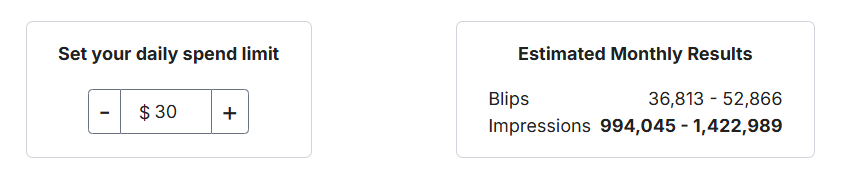
With Blip, billboard advertising in Vero Beach is surprisingly accessible because you only pay when your ad actually appears. Each “blip” is a 7.5-to-10-second display on a rotating digital billboard, and pricing starts at just $0.01 per display. You set a daily budget, and Blip’s algorithm uses it to bid for open ad slots, helping maximize your reach while keeping costs under control.
Where should I advertise with Blip in Vero Beach to reach the most drivers?
Vero Beach travel patterns are concentrated on a short list of roads, which is good news for outdoor advertisers. I-95 and the State Road 60 interchange at Exit 147 capture both regional through traffic and local trips into Vero Beach, while U.S. 1 is the everyday commercial spine. State Road 60 is the main east-west funnel from I-95 into Vero Beach and out toward the barrier island.
What kind of audience can I reach with Blip billboards in Vero Beach?
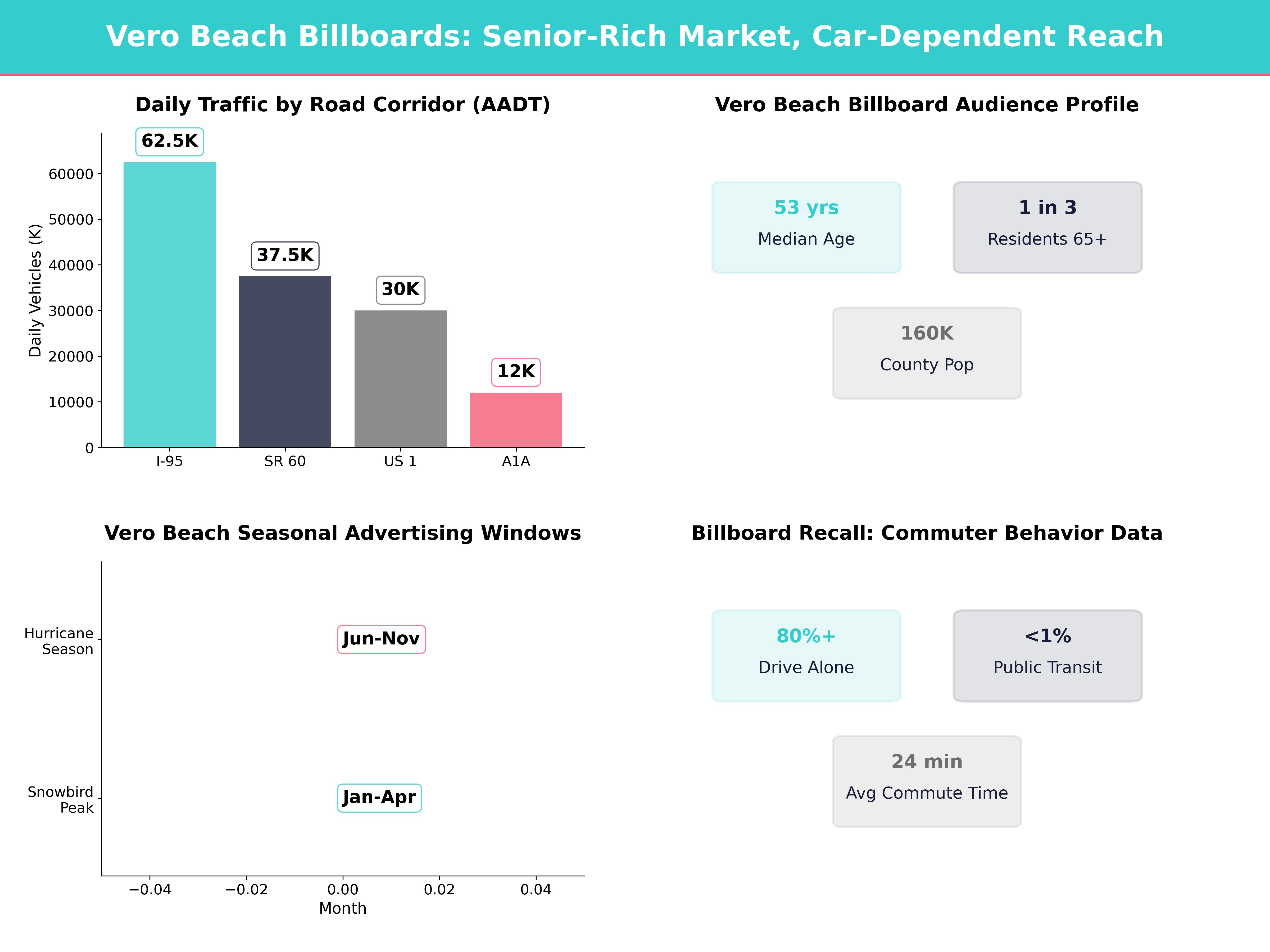
Vero Beach gives us a rare mix of local repeat traffic, affluent households, and visitor demand. Indian River County has a median age of about 53 years, and roughly 1 in 3 residents are 65 or older, which gives the market unusually strong demand for healthcare, financial services, home improvement, real estate, leisure, and premium retail. The market also includes seasonal residents and visitors, especially from January through April.
When is the best time to run billboard ads in Vero Beach?
From January through April, Vero Beach gets some of its most valuable visitor and seasonal-resident traffic. Summer brings a different opportunity set, and the Atlantic hurricane season runs from June 1 through November 30, which makes summer and early fall strong for roofing, shutters, generators, insurance, urgent care, and pest control. The school year usually starts in August and runs into late May, creating clear retail and service windows.
Why is Vero Beach a strong market for Blip billboard advertising?
Vero Beach is a driving market, with more than 80% of workers driving alone to work and fewer than 1% using public transit for commuting. The average commute is about 24 minutes, so roadside impressions matter more than dense pedestrian traffic. The local economy is also supported by major institutions like Cleveland Clinic Indian River Hospital, Indian River State College, the School District of Indian River County, and Piper Aircraft.
Do I need a contract to advertise with Blip in Vero Beach?
No, Blip has no long-term contracts or minimum commitments. You can start, pause, or stop your campaign at any time.
How fast can I launch a billboard campaign with Blip in Vero Beach?
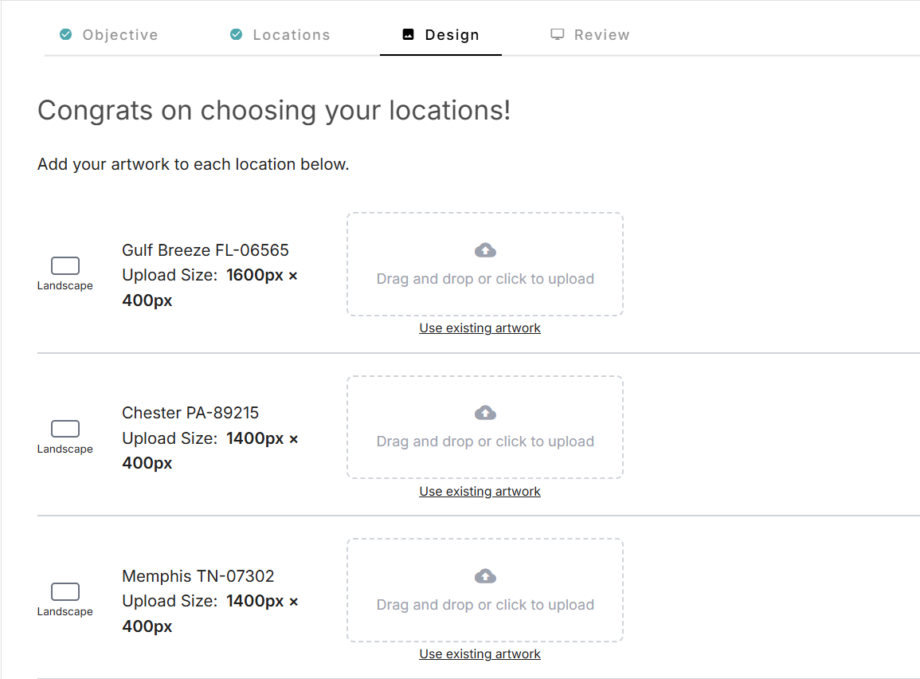
You can have your campaign live in minutes. Create a free account, select your locations, set your budget, upload your design, and start running once approved.
Where can I advertise with Blip in Vero Beach?
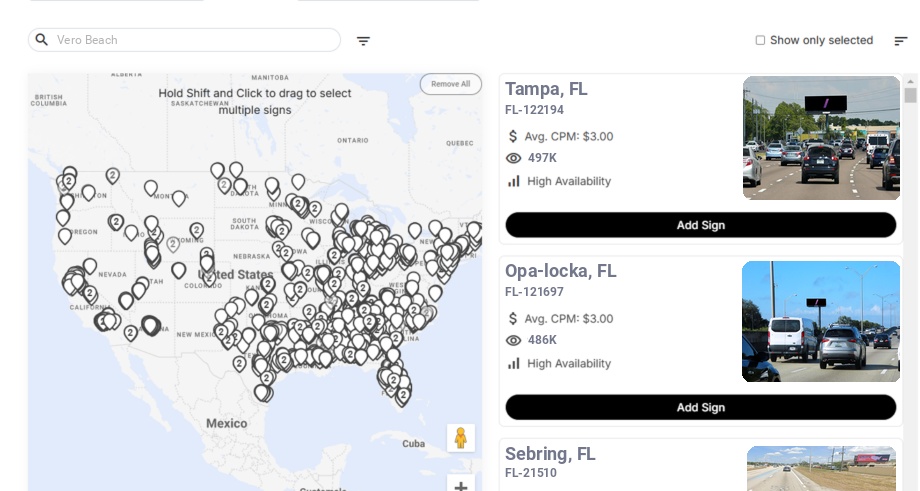
Blip has digital billboards in Vero Beach. You can browse available locations on a map, choose the ones that fit your audience, and start advertising right away.
Still have questions? Launch a campaign in minutes — no contracts, no commitments.
Start Your CampaignVero Beach Billboard Advertising Guide
Vero Beach gives us a rare mix of local repeat traffic, affluent households, and visitor demand. The City of Vero Beach had 16,354 residents in the 2020 Census, but the real advertising trade area is much larger because Indian River County had 159,788 residents and funnels daily travel through just 3 dominant roads. Most trips are made by car, especially along I-95, U.S. 1, and State Road 60, so well-placed digital billboards can build frequency fast. We also benefit from 22 miles of county beaches, a strong winter visitor season from January through April, and a year-round mix of healthcare, education, aviation, retail, and home services.
Market Overview for Vero Beach Billboards
Demographics and growth in the Vero Beach area
From 2010 to 2020, Vero Beach grew from 15,220 to 16,354 residents, which was an increase of about 7.5%. Over the same decade, Indian River County grew from 138,028 to 159,788, or roughly 15.8%. That growth matters because billboard campaigns here should be planned for the countywide market, not just the city limits. We can reach shoppers, patients, contractors, and visitors moving between Vero Beach, Sebastian 3 incorporated municipalities.
Indian River County is older than many Florida counties, with a median age of about 53 years in recent ACS profiles. Roughly 1 in 3 residents are 65 or older, which gives the market unusually strong demand for healthcare, financial services, home improvement, real estate, leisure, and premium retail. That older skew also means clarity matters. When we advertise here, simple offers and strong readability usually outperform cluttered creative.
Car dependence and mobility in Vero Beach
Vero Beach is a driving market. More than 80% of workers drive alone to work, fewer than 1% use public transit for commuting, and the average commute is about 24 minutes, even though GoLine
Economic anchors that shape demand in Vero Beach
The local economy is deeper than many outsiders expect. Major institutions include the 332-bed Cleveland Clinic Indian River Hospital Indian River State College, which serves more than 20,000 students annually across the Treasure Coast, the School District of Indian River County, which educates nearly 17,000 students, and Piper Aircraft at the Vero Beach Regional Airport. That mix gives us a healthier base than a pure tourism market. It is also one reason the Indian River County Chamber of Commerce represents such a broad range of local industries, including healthcare, construction, hospitality, marine activity, aviation, agriculture, and small business services.
Key Traffic Corridors for Vero Beach Billboards
Vero Beach travel patterns are concentrated on a short list of roads, which is good news for outdoor advertisers. When we understand how each corridor functions, we can choose placements that match the audience’s intent instead of buying reach that looks good on paper but does not fit local behavior.
I-95 and the State Road 60 interchange in Vero Beach
According to the Florida Department of Transportation and the Indian River County Metropolitan Planning Organization 55,000 to 70,000 AADT range. The State Road 60 interchange at Exit 147 is especially valuable because it captures both regional through traffic and local trips into Vero Beach. This corridor connects the broader east coast flow between Melbourne, Vero Beach, and Port St. Lucie, so it gives us reach beyond city residents.
This is usually the best corridor when we want high visibility for hotels, attractions, medical groups, auto dealers, quick-service restaurants, fuel brands, and regional retailers. Drivers here are actively making stop-or-continue decisions, which makes directional or immediate-response messaging especially effective.
U.S. 1 through central Vero Beach
U.S. 1 is Vero Beach’s everyday commercial spine. FDOT traffic counts in and around central Vero Beach typically fall in the 25,000 to 35,000 AADT range, which gives us steady repetition with local drivers rather than one-time highway impressions. This route ties together residential areas, retail strips, business districts, and service corridors, so it is excellent for advertisers that rely on consistent frequency.
We usually like U.S. 1 for healthcare providers, banks, legal services, pharmacies, furniture stores, home services, and restaurants. It is also a strong choice when we want to stay visible to year-round residents, not just seasonal visitors.
State Road 60, also known as 20th Street, in Vero Beach
State Road 60 is the main east-west funnel from I-95 into Vero Beach and out toward the barrier island. MPO and FDOT counts commonly show central segments in the 30,000 to 45,000 AADT range, with especially strong demand west of U.S. 1 and near major retail nodes. Because SR 60 carries commuters, shoppers, beach traffic, and service calls, it is one of the most versatile choices in the market.
Retail promotions, urgent care, entertainment, insurance, furniture, and event advertising all fit this corridor. We often get the best results when we use location-specific language, such as “minutes from I-95,” “east of U.S. 1,” or “on the way to the beach,” because SR 60 users are moving with a destination in mind.
A1A and the beachside approaches near Vero Beach
Traffic on State Road A1A and the bridge approaches is lighter, often around 8,000 to 16,000 AADT depending on the segment and season, but the audience is highly valuable. Beachside drivers are heading toward Disney’s Vero Beach Resort Kimpton Vero Beach Hotel & Spa, Costa d’Este Beach Resort & Spa, the Main Street Vero Beach
A1A placements are ideal for luxury retail, real estate, dining, arts, spas, boutique fitness, and premium healthcare. A smaller traffic count can still create strong business value when the audience has high intent and high spending power.
Audience Segments in Vero Beach
Commuters and everyday service buyers in Vero Beach
Because more than 4 in 5 workers drive alone, billboards are a practical way to stay top of mind for recurring needs. Commuters on U.S. 1, SR 60, and feeder roads are ideal for dentists, roofers, HVAC companies, pest control, attorneys, childcare, and grocery. In a market where the average commute is roughly 24 minutes, repeated exposure across the same route can create strong recall.
This segment also responds well to local credibility cues. A visible 772 phone number, a “same-day service” offer, or a simple “free estimate” message feels highly relevant in Vero Beach.
Seasonal residents and visitors in Vero Beach
Vero Beach’s tourism appeal is unusually broad for a smaller market, especially during the January-to-April snowbird season. Visit Indian River County promotes 22 miles of beaches, and visitors also circulate through McKee Botanical Garden 18-acre subtropical garden, the Vero Beach Museum of Art, Historic Dodgertown Environmental Learning Center, and Sebastian Inlet State Park
What makes this segment especially appealing is timing. Visitors are not spread evenly through the year, so we can increase visibility when seasonal demand is actually present.
Students, parents, and education households in Vero Beach
The education segment is larger than many advertisers assume. The School District of Indian River County serves nearly 17,000 students, and Indian River State College serves more than 20,000 students annually across its region. That gives us dependable back-to-school, tutoring, tech, quick-service dining, banking, and youth-service demand, especially in August, January, and May.
This audience is most reachable on mainland commuter routes. If our product depends on family decision-makers, we usually focus on SR 60, U.S. 1, and nearby residential-service corridors instead of beachside inventory.
Retirees and healthcare consumers in Vero Beach
With a median age around 53 and about 1 in 3 residents age 65+, Vero Beach is a strong market for healthcare and senior-focused services. The 332-bed Cleveland Clinic Indian River Hospital
We usually get the best results with this audience when we emphasize trust, convenience, accepted insurance, and short drive times. Trendy copy is less effective here than direct benefit statements.
Aviation, marine, and skilled-trades workers around Vero Beach
Piper Aircraft and the Vero Beach Regional Airport keep an aviation and skilled-labor audience in the market, while marine businesses, contractors, and home service firms serve both year-round residents and seasonal homeowners. This segment responds well to practical messages about scheduling, reliability, licensing, financing, and same-week availability.
Campaigns along I-95, SR 60, and west-side commercial areas usually outperform beachside boards for these buyers. When we sell a functional service, the everyday-drive audience is often more important than the leisure audience.
Seasonal and Timing Opportunities in Vero Beach
Winter and spring opportunities in Vero Beach
From January through April, Vero Beach gets some of its most valuable visitor and seasonal-resident traffic. Snowbirds return, arts and golf activity rises, and local spending increases across dining, healthcare, events, and home services. We can align campaigns with spring staples such as Under the Oaks March, exhibitions at the Vero Beach Museum of Art, tournaments at Historic Dodgertown Main Street Vero Beach
For many categories, this is the highest-value season of the year. Real estate, hospitality, elective healthcare, and premium dining all deserve stronger share of voice during this window.
Summer weather and storm-season timing in Vero Beach
Summer brings a different opportunity set. Local families stay active, weekend beach traffic still matters, and the Atlantic hurricane season runs from June 1 through November 30. That makes summer and early fall strong for roofing, shutters, generators, insurance, urgent care, pest control, air conditioning, indoor attractions, and rainy-day dining or retail campaigns.
We often shift creative from aspirational leisure messaging to practical problem-solving as soon as storms, heat, and humidity become part of the daily conversation. In Vero Beach, weather is not just background context. It directly changes what people buy.
School calendars and holiday windows in Vero Beach
The school year usually starts in August and runs into late May, which creates clear retail and service windows. We can push family dining, after-school programs, orthodontics, tutoring, youth sports, and college services in August and September, then pivot to gifting, entertainment, and event messaging in November and December.
Holiday campaigns also work well near Ocean Drive, downtown Vero, and the SR 60 retail corridor because shopping trips increase even when the year-round population stays relatively stable. Seasonal messaging does not need to be complicated. It just needs to reflect what local households are already doing.
Best dayparts for Vero Beach billboard campaigns
On commuter corridors, 6 a.m. to 9 a.m. and 4 p.m. to 6 p.m. generally deliver the strongest repetition. On beachside and senior-skewing routes, 10 a.m. to 4 p.m. is often just as important because retirees, visitors, and flexible-schedule residents are on the road outside the standard rush. Weekend pulses matter too, especially from Friday afternoon through Sunday evening on SR 60 and A1A.
Billboard Design Tips for the Vero Beach Market
Use upscale coastal cues without blending into the scenery
Vero Beach creative should feel polished and local. Ocean blues, sea-glass greens, sand tones, and clean white space fit the market, but we also need contrast because blue-on-blue disappears against sky and water. Coral, citrus orange, deep navy, and black text on light backgrounds usually read better on sunny Treasure Coast roads.
This is especially important on A1A, SR 60, and other bright, open corridors. If the design looks elegant but lacks contrast, it can still fail at driving speed.
Write for an older, driving-first audience in Vero Beach
In a county with a median age around 53, we should favor larger type, one clear offer, and a direct call to action. Messages such as “Same-Day Appointments,” “772 Local Team,” “Minutes from I-95 Exit 147,” or “Beachside Dining on Ocean Drive” feel more useful than abstract slogans. Trust markers also matter here. “Family Owned Since 1998,” “Board-Certified Care,” and “Free Estimates” all fit the expectations of Vero Beach buyers.
Reference landmarks that Vero Beach drivers actually use
Generic regional copy wastes a local advantage. We should name places people recognize, such as “SR 60,” “U.S. 1,” “Ocean Drive,” “Downtown Vero,” “Sebastian,” “Beachside,” or “Exit 147.” On the mainland, directional language like “west of U.S. 1” or “near the bridge” helps convert awareness into visits. On the barrier island, ads that mention brunch, oceanfront dining, boutiques, galleries, or spa services feel native to the market.
Match imagery to the buying category in Vero Beach
For healthcare and senior services, we should use calm, reassuring visuals and legible benefit statements. For restaurants, resorts, and arts venues, we can lean into sunshine, palm silhouettes, coastal dining, and weekend-escape imagery. For contractors and home services, we should show roofs, windows, docks, pools, or garages that resemble actual Indian River County homes rather than generic national stock photos.
Regional Strategies Across Greater Vero Beach
Mainland Vero Beach and the SR 60-U.S. 1 core
This is our frequency zone. Boards around central Vero Beach help us reach repeat local drivers headed to shopping centers, medical offices, schools, and daily errands. If our goal is store visits, appointments, or household services, this is usually the first cluster we test.
Beachside Vero Beach and A1A
Beachside is smaller in population but higher in intent and average spend. We should treat it as a premium audience zone for real estate, hospitality, fine dining, wellness, jewelry, spas, galleries, and professional services aimed at seasonal homeowners. Copy can be slightly more lifestyle-oriented here, especially from Thursday through Sunday and during the January-to-April visitor surge.
West Vero Beach and I-95 capture
West-side placements near I-95 are ideal when we want regional reach or stop-now behavior. They work well for hotels, attractions, chain restaurants, fuel, big-box retail, urgent care, and any business that benefits from the moment a driver decides whether to exit. If we serve customers from Melbourne, Vero Beach, and Port St. Lucie, these boards often provide the broadest reach per dollar.
Greater Indian River County, including Sebastian and Fellsmere
When we want countywide coverage, we should think beyond the Vero city core. Sebastian
South county and Oslo-area households near Vero Beach
South of central Vero, the Oslo corridor and surrounding neighborhoods are useful for family services, discount retail, grocery, schools, healthcare, and everyday dining. These consumers may not respond to luxury beach messaging, but they do respond to value, convenience, and proximity. When our offer is broad-based, pairing south-county exposure with SR 60 and U.S. 1 creates much better market saturation than staying in one zip code.
Using Blip Tools in Vero Beach
Use dayparting to match Vero Beach travel patterns
Vero Beach is not a one-schedule market. We can put more weight on 6 a.m. to 9 a.m. and 4 p.m. to 6 p.m. for commuter routes like I-95, SR 60, and U.S. 1, then shift to 10 a.m. to 4 p.m. for retiree, healthcare, and beachside campaigns. That kind of schedule control is especially valuable here because the audience changes meaningfully by corridor and season.
Scale budgets around Vero Beach events and visitor peaks
We do not need to overcommit months in advance to take advantage of Vero Beach demand. We can raise budgets for March arts and event traffic, winter visitor months, holiday shopping weeks, or a storm-prep push before late-summer weather threats. We can also pull back when a corridor is less relevant and reallocate to another part of the market.
Let analytics guide corridor mix in Vero Beach
Because Blip reports performance in real time, we can test 2 or 3 creative versions and learn quickly whether the audience responds better to a trust message, a location cue, or a seasonal offer. A healthcare advertiser might compare “Same-Day Appointments” against “772 Local Care.” A restaurant might compare “Oceanfront Brunch” against “Happy Hour on Ocean Drive.” These small tests matter in a compact market where frequency builds fast.
Refresh Vero Beach creative quickly with artwork support
Vero Beach campaigns often need quick seasonal adjustments. We may want one design for January through April, another for hurricane season, and another for back-to-school. Blip’s artwork tools and templates make that easier, which helps us keep creative aligned with what residents and visitors are actually thinking about right now.
Getting Started with Billboard Rental in Vero Beach
Start with our business goal, not just a map pin
The smartest Vero Beach rental strategy starts with one question: Do we want awareness, immediate visits, or countywide frequency? If we need broad reach, we usually begin with I-95 and SR 60. If we need repeat local exposure, we lean into U.S. 1 and central Vero. If we want affluent leisure traffic, we add A1A and beachside boards.
Evaluate each Vero Beach billboard by context
When we compare locations, we should look at four things. First, we should confirm the corridor’s typical traffic volume, such as 55,000 to 70,000 AADT on I-95 versus 8,000 to 16,000 on many beachside segments. Second, we should consider driver mindset, because a commuter on U.S. 1 behaves differently than a resort guest on A1A. Third, we should judge distance to the destination, because “next exit” messaging works better near I-95 than near downtown. Fourth, we should match the board to the audience we actually want, whether that is retirees, parents, tourists, or regional pass-through traffic.
Use Blip to simplify billboard rental in Vero Beach
Traditional billboard buying in a smaller market often means long sales cycles, fixed terms, and more inventory than we really need. With Blip, we can launch quickly, choose only the boards that fit our geography, set our own pacing, and change creative or budgets without turning the campaign into a negotiation. That flexibility is helpful in Vero Beach, where January-to-April demand looks very different from August-to-September school season or June-to-November storm-prep season.
Build from a small Vero Beach test into a local system
We usually recommend starting with 2 to 4 boards that represent different roles in the market, such as one I-95 capture board, one SR 60 commuter board, one U.S. 1 local-frequency board, and one beachside board if the product fits. After 2 to 3 weeks, we can review performance, rotate in fresh creative, and shift budget toward the best-performing corridors. That approach keeps billboard rental practical, measurable, and scalable for Vero Beach businesses of almost any size.