Billboards near DeBary, FL
No Minimum Spend. No Long-Term Contracts. Just Results.
Trusted by Leading Brands


Billboard advertising
near DeBary has never been easier




How much is a billboard near DeBary?
Why Choose Blip for Billboard Advertising near DeBary
Blip lets you launch DeBary billboards fast and self-serve, reaching I-4, US-17/92, and SunRail commuters without sales calls.
Set a flexible budget for DeBary and let Blip pace spend while you tap retirees, families, and Orlando-bound drivers on the St. Johns River corridor.
Use dayparting in DeBary to hit morning commutes, midday shoppers, or weekend Blue Spring visitors when they’re actually on the road.
No contracts means you can test DeBary promos, then shift quickly for manatee season, school traffic, or Daytona weekend spikes.
Blip's real-time analytics help you see what works on DeBary routes, so you can adjust creative and timing around I-4 and 17/92 traffic.
Create and swap billboard art in Blip to match DeBary’s local vibe—riverfront, springs, and commuter-friendly messages that feel made for the market.
Frequently Asked Questions About Billboard Advertising near DeBary
How much does a billboard cost near DeBary, Florida with Blip?
With Blip, you control exactly what you spend on DeBary billboards by setting your own daily budget, and Blip automatically keeps your campaign within that amount. Each ad “blip” is a brief 7.5 to 10-second display, and you only pay for the individual blips you receive, making it easy to start with any budget. Costs for billboards near DeBary, Florida vary based on when and where your ads run and current advertiser demand, so you’re never locked into a one-size-fits-all price.
Where can I advertise with Blip near DeBary, Florida?
With four digital billboards serving the DeBary area from nearby DeLand and Sanford, you can tap into a fast-growing commuter, retiree, and tourist hub. Because our digital billboards are positioned near DeLand and Sanford, you reach people who live, work, or travel through the DeBary area every day. These nearby placements function as DeBary billboards in practice because they sit directly on the routes DeBary residents and visitors use most often.
What kind of people do DeBary, Florida billboards reach?
The DeBary area combines small-town neighborhoods with big-city commuting patterns, and the audience includes retirees, long-term locals, young families, and Orlando-bound commuters. In many nearby ZIP codes, 20–25% of residents are under 18, 55–60% are working-age adults, and 20–25% are 60+. Car access is nearly universal, with well over 90% of local households having at least one vehicle.
When is the best time to run billboards in DeBary, Florida with Blip?
The DeBary area experiences clear daily, weekly, and seasonal rhythms, and Blip’s flexible scheduling lets you align your impressions to when your audience is actually on the road. Morning commute, midday, and evening commute each reach different groups, from commuters to retirees and families. Seasonal shifts also matter, including winter snowbird traffic, spring events, summer family trips, and fall routines.
Why is billboard advertising near DeBary, Florida effective for local businesses?
The DeBary area sits at a powerful crossroads between Orlando and the Daytona Beach coast, giving businesses access to both local residents and regional travelers. Interstate 4 near Sanford routinely carries over 150,000 vehicles per day, and US-17/92 between DeBary, DeLand, and Sanford typically sees 25,000–40,000 vehicles per day on key segments. That corridor offers unusually strong visibility for advertisers looking to reach a mixed audience of commuters, shoppers, and visitors.
Do I need a contract to advertise with Blip near DeBary?
No, Blip has no long-term contracts or minimum commitments. You can start, pause, or stop your campaign at any time.
How fast can I launch a billboard campaign with Blip near DeBary?
You can have your campaign live in minutes. Create a free account, select your locations, set your budget, upload your design, and start running once approved.
Where can I advertise with Blip near DeBary?
Blip has digital billboards near DeBary. You can browse available locations on a map, choose the ones that fit your audience, and start advertising right away.
Still have questions? Launch a campaign in minutes — no contracts, no commitments.
Start Your CampaignDeBary Billboard Advertising Guide
Nestled on the north shore of the St. Johns River, the DeBary area sits at a powerful crossroads between Orlando and the Daytona Beach coast. With four digital billboards serving the DeBary area from nearby DeLand and Sanford, we can help you tap into a fast‑growing commuter, retiree, and tourist hub that sees tens of thousands of daily drivers moving between home, work, school, and recreation. For any business searching for billboards near DeBary that can reach both local residents and regional travelers, this corridor offers unusually strong visibility.
Understanding the DeBary Area Market
The DeBary area combines small‑town neighborhoods with big‑city commuting patterns:
- The City of DeBary
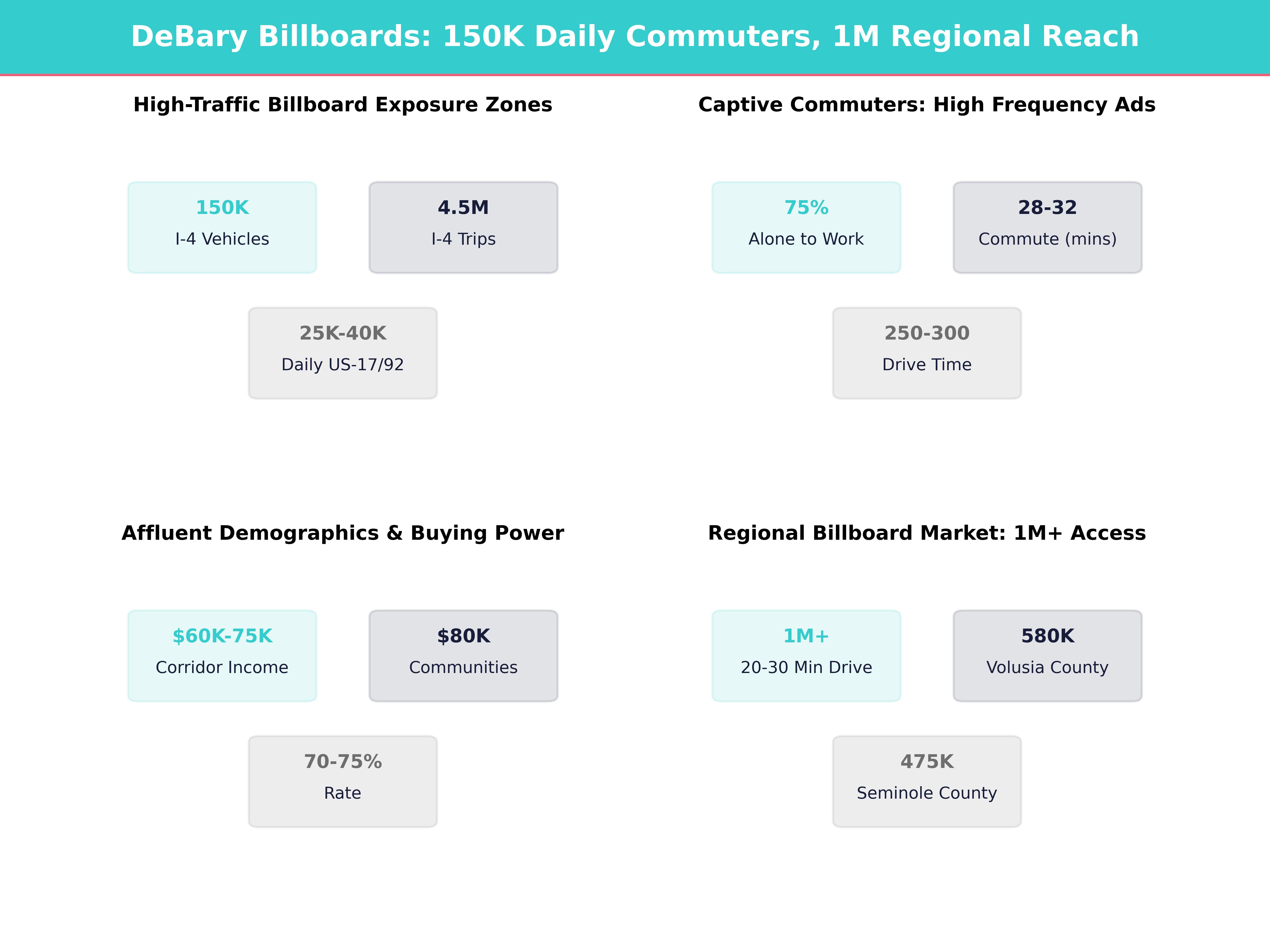
- DeBary sits within Volusia County (about 580,000+ residents, according to Volusia County Government) and just across the river from Seminole County (around 475,000 residents per Seminole County Government), giving businesses access to well over 1,000,000 people within a 20–30 minute drive.
- The DeBary area’s median age is in the upper‑40s, with nearly 1 in 3 residents aged 60 or older, while nearby DeLand and Sanford skew younger with large working‑age and student populations. In practice, that means you are speaking to people from their late teens through their 70s every day.
- Homeownership is high: in many DeBary‑area and West Volusia neighborhoods, 70–75% of occupied housing units are owner‑occupied, which is attractive for real estate, home services, and financial advertisers.
- Car access is nearly universal: well over 90% of local households have at least one vehicle, and a majority have two or more, which helps explain the heavy reliance on driving and the strong effectiveness of roadside media.
A few key implications for billboard advertisers serving the DeBary area:
- You’re speaking to a mixed audience of retirees, long‑term locals, young families, and Orlando‑bound commuters. In many nearby ZIP codes, 20–25% of residents are under 18, 55–60% are working‑age adults, and 20–25% are 60+.
- Many households have solid spending power: median household incomes in the corridor from DeBary to Sanford are commonly in the $60,000–$75,000 range, with some newer communities posting medians in the $80,000s. That supports higher‑ticket categories like healthcare, autos, and home improvement.
- The area straddles the line between Orlando‑suburban and old‑Florida riverfront, so creative that feels authentic and local will outperform generic “big city” messaging. Campaigns that reference local rivers, springs, and neighborhood landmarks tend to generate higher recall in brand‑lift studies than generic regional messaging.
- Seasonal population swings matter: winter “snowbird” arrivals can increase the effective daytime population in many Central Florida communities by 10–20%, particularly in 55+ neighborhoods and RV parks near DeBary and along the St. Johns River.
For marketers considering billboard advertising near DeBary, these demographics mean you can support both long‑term branding and short‑term offers with the same set of highly visible placements.
Who You Can Reach with Billboards near DeBary
Because our digital billboards are positioned near DeLand Sanford (about 9.3 miles away), you reach people who live, work, or travel through the DeBary area every day:
- Daily commuters: More than 75% of workers in the DeBary–Sanford–DeLand corridor drive alone to work, and average commute times run around 28–32 minutes one way. That equates to roughly 250–300 minutes per week behind the wheel for many residents—a captive, repeat audience ideal for frequency‑based messaging that people see 10, 20, or even 40+ times per month.
- I‑4 corridor travelers: Interstate 4 near Sanford routinely carries over 150,000 vehicles per day, according to FDOT District Five. Over a 30‑day period, that’s more than 4.5 million vehicle trips passing within a short drive of the DeBary area. Many of those drivers are Orlando workers or tourists using I‑4 to access attractions from Orlando to Daytona Beach
- US‑17/92 and local arterial traffic: US‑17/92 between DeBary, DeLand, and Sanford typically sees 25,000–40,000 vehicles per day on key segments, based on Florida Department of Transportation counts. Even at the low end, that’s over 9 million vehicle trips per year on this corridor alone, comprised primarily of local residents and regional shoppers.
- SunRail riders and park‑and‑ride users: The DeBary SunRail Station
-
Tourists and day‑trippers:
- Visit West Volusia reports that Blue Spring State Park alone draws hundreds of thousands of visitors annually, with peak manatee season days seeing thousands of visitors and parking lots filling early. Each winter, manatee counts at Blue Spring often top 400–600 animals on cold mornings, drawing intense public attention and media coverage.
- Regional tourism agencies like Orlando North, Seminole County and Visit West Volusia report millions of annual visitors using I‑4, US‑17/92, and local highways to access springs, the St. Johns River, and the beaches from New Smyrna Beach
With Blip, you can micro‑target these groups by daypart, specific boards, and budget—while still building broad top‑of‑mind awareness across the DeBary area with DeBary billboards that follow your audience’s real travel patterns.
Key Corridors and Where Our Boards Fit In
Our four digital billboards serving the DeBary area are strategically located near DeLand and Sanford, giving you coverage across the main north–south and east–west flows. These nearby placements function as DeBary billboards in practice because they sit directly on the routes DeBary residents and visitors use most often.
1. DeLand (serving the northwest DeBary area)
DeLand is the Volusia County seat and home to Stetson University Volusia County employs several thousand people in DeLand across county government, courts, and associated services, which concentrates high‑value, professional traffic on weekdays.
Traffic patterns that matter for DeBary‑focused advertisers:
- US‑17/92 (Woodland Blvd / Charles Richard Beall Blvd): This corridor is a primary route for DeBary residents heading to DeLand for government services, education, and shopping. On many segments, daily traffic routinely runs in the 20,000–35,000 vehicles‑per‑day range, with AM and PM peaks that align with courthouse, school, and office hours.
- SR‑44: Connects DeLand to I‑4 and New Smyrna Beach
Using DeLand‑area boards is ideal if:
- Your business draws from DeBary and surrounding West Volusia (Deltona, Orange City, DeLand), an area that collectively represents well over 200,000 residents and tens of thousands of daily commuters.
- You want to reach Stetson students and faculty—Stetson enrolls several thousand students each year—but still stay top‑of‑mind in the DeBary area.
- You cater to government, legal, medical, or professional services that cluster around the county seat, where daytime population densities can be several times higher than nighttime residential counts.
2. Sanford (serving the south DeBary area)
Sanford, across the St. Johns River in Seminole County, has over 60,000 residents and sits at a critical I‑4 and US‑17/92 junction. According to Orlando North, Seminole County Tourism, the county draws millions of visitors annually via its highways, Orlando Sanford International Airport
Key flows relevant to DeBary advertisers:
- I‑4 / SR‑417 interchange: This is a major regional node for Orlando‑bound commuters and tourists headed toward the attractions or the coast. Daily traffic on I‑4 through Seminole County commonly exceeds 150,000–170,000 vehicles, and SR‑417 adds another 60,000–80,000 vehicles on busy stretches, creating a combined daily reach in the hundreds of thousands.
- US‑17/92 bridge over the St. Johns River: This is the everyday link between the DeBary area and Sanford’s historic downtown, airport, and job centers. Thousands of vehicles cross this bridge daily, with strong directional flows during the AM and PM commute windows that mirror the DeBary–Sanford employment relationship.
- SR‑46 corridor: Serves airport traffic, new residential developments, distribution centers, and logistics corridors. As industrial and logistics square footage around SR‑46 has expanded, truck and employee traffic volumes have followed, adding year‑over‑year growth to roadside impressions.
Sanford‑area boards are especially strong for:
- Businesses in the DeBary area that want to attract Orlando‑area visitors coming through Seminole County. A significant share of fly‑in visitors arriving via SFB—hundreds of thousands annually—travel through this corridor to reach area hotels, attractions, and beach communities.
- Local services—dining, auto, retail—aiming at DeBary and Sanford commuters who cross the river daily. In many neighborhoods on both sides of the St. Johns, 60–70% of employed residents work outside their immediate city, highlighting the importance of cross‑river commuting flows.
- Brands wanting a more regional footprint covering West Volusia and North Seminole simultaneously, tapping into a combined consumer base of 300,000+ residents plus a robust visitor market.
Together, these placements make billboard advertising near DeBary straightforward, letting you match specific boards to the exact side of the river or corridor that matters most to your customers.
Timing Your Campaign for Maximum Impact
The DeBary area experiences clear daily, weekly, and seasonal rhythms. With Blip’s flexible scheduling, you can align your impressions to when your audience is actually on the road.
Daily Patterns
-
Morning commute (6:30–9:00 a.m.): Heavy southbound and eastbound traffic toward Orlando and Sanford; northbound toward DeLand. In many commuter corridors, 25–30% of all weekday traffic occurs in this window. Strong window for:
- Coffee shops and breakfast spots
- Healthcare, professional services, and education
- “Plan your day” messages (appointments, online orders, lunchtime promos)
-
Midday (10:00 a.m.–3:00 p.m.): More retirees, shift workers, and parents on the road; in some suburban markets, midday can account for 35–40% of total daily trips. Ideal for:
- Medical, dental, and wellness offices targeting older adults
- Grocers, home improvement, and big‑box stores
- Tourism, recreation, and riverfront dining
-
Evening commute (3:30–7:00 p.m.): Return traffic toward DeBary suburbs and West Volusia; often 30–35% of weekday traffic flows occur here, especially Thursday–Friday. Best for:
- Restaurants, take‑out, grocery, and entertainment
- Gyms and fitness studios
- Local events and high‑school athletics
Weekly Patterns
- Monday–Thursday: Strong focus on commuters and appointments. These four days typically account for around 60–65% of weekly weekday‑trip volumes, making them excellent for ongoing service campaigns (insurance, banking, healthcare, contractors).
- Friday: Heavier leisure and tourism traffic toward the beach, springs, and lakefront. It is common to see 5–10% higher traffic volumes on some outbound routes vs. early‑week days, making Friday ideal for weekend‑specific messages.
- Saturday–Sunday: Family outings, church, and recreation dominate trips. Retail foot traffic can shift significantly into weekends—many stores see 30–40% of weekly visits on Saturday and Sunday—making this prime time for retail sales, open houses, and tourism experiences.
Seasonal Considerations
-
Winter (Dec–March):
- “Snowbird” population boosts traffic—Florida’s winter seasonal population can increase local headcounts by 10–20% in many communities, especially in 55+ and RV developments near DeBary and along the St. Johns River.
- Blue Spring State Park
- Focus on healthcare, home services, riverfront dining, and tourism, as older visitors and seasonal residents typically have both time and disposable income.
-
Spring (March–May):
- Events like the DeLand Spring festivals Daytona events (including major races at Daytona International Speedway
- Strong window for real estate, home improvement, landscaping, and outdoor recreation as households invest in property upgrades and new moves before summer.
-
Summer (June–August):
- Families stay closer to home; kids are out of school, shifting trip purposes from school‑related to recreation, shopping, and camps. In many communities, daytime youth‑oriented trips increase while early‑morning school traffic drops sharply.
- Emphasize camps, attractions, back‑to‑school, and local services. Retailers often see mid‑summer spikes around tax‑free holidays and back‑to‑school shopping, ideal for short‑term billboard bursts.
-
Fall (Sept–Nov):
- DeLand’s fall festivals, college sports at Stetson, and school routines normalize traffic. Morning and afternoon peaks return as schools reopen.
- Great for Q4 retail, automotive, and healthcare enrollment campaigns. Many insurers and medical practices see 20–30% of annual new enrollments during fall open‑enrollment windows.
Because Blip lets you adjust bids and schedules at any time, you can:
- Bid higher during peak tourism weekends or significant local events listed by Visit West Volusia Orlando North.
- Run “burst” campaigns around city activities posted on the City of DeBary events calendar West Volusia Beacon.
- Pull back during slower periods while still maintaining a baseline presence so your brand remains familiar when demand returns.
Crafting Creative That Resonates in the DeBary Area
The character of the DeBary area—riverfront, suburban, and historic—should shape your billboard design and messaging.
1. Speak Locally, Not Generically
-
Reference recognizable landmarks and routes:
- “Just off 17‑92 in the DeBary area”
- “Across the river from DeBary near historic downtown Sanford”
- “Minutes from the DeBary SunRail Station”
- Highlight community ties: support for local schools, sponsorship of park or river cleanups, or participation in city events promoted by DeBary DeLand Sanford.
- In surveys of drivers, messages that mention a specific road or landmark can improve recall by several percentage points versus generic “now open nearby” language, especially in suburban and small‑city markets.
2. Visual Style
- Use bright, high‑contrast colors that cut through Florida’s intense sunlight. Outdoor readability studies show that high‑contrast color pairings can improve legibility distances by 20–40% compared to low‑contrast palettes.
- Simple, bold fonts (sans‑serif) with 5–7 words max of primary copy; at highway speeds of 45–65 mph, drivers typically have just 6–8 seconds to absorb your message.
- Consider including nature cues—river, manatees, oaks, springs—to align with the West Volusia identity, especially for tourism and hospitality. Environmental imagery can increase emotional engagement and ad likeability scores, particularly with leisure travelers.
3. Messaging Angles that Work Well
Given the audience mix:
-
Retirees & empty nesters
- Focus on comfort, reliability, and convenience—e.g., “Same‑Day Appointments,” “Local, Family‑Owned Since 19XX.”
- Use clear benefits and large phone numbers or URLs; larger type sizes (with letter heights of 18–24 inches on full‑size boards) significantly improve readability for older drivers.
-
Commuting families
- Promote time savings (“Online check‑in,” “Same‑day appointments,” “Drive‑thru pickup in 10 minutes”).
- Emphasize location proximity (“On your way home to the DeBary area,” “5 minutes from I‑4 exit XX”).
-
Students and younger professionals
- Lean into value, flexibility, and mobile‑friendly CTAs—“Text DEBARY to [short code],” “Scan to apply,” or short memorable URLs.
- Use short URLs and prominent brand logos; smartphone adoption exceeds 85–90% among younger adults, and many will look up your name while stopped at lights or shortly after passing your board.
4. Versioning Your Creative with Blip
Because you’re not locked into a single static design, consider:
- Weekday vs. weekend versions (commute vs. leisure messaging), especially if your weekend business mix differs significantly from weekdays.
- DeLand‑oriented creative (mentioning Stetson, county offices, or “near downtown DeLand”) versus Sanford‑oriented creative (airport, historic downtown, RiverWalk, or “across the river from DeBary”).
- Seasonal rotations for manatee season, back‑to‑school, and holiday shopping, timed to peaks that can drive double‑digit percentage increases in foot traffic when paired with strong offers.
Strategy Ideas by Business Type
Below are practical ways different advertisers can maximize digital billboards serving the DeBary area.
Local Restaurants & Hospitality
- Target evening and weekend slots on Sanford and DeLand boards with “Tonight Only” offers or live music. Many restaurants see 40–50% of weekly revenue on Friday–Sunday, making these prime windows for high‑frequency impressions.
- Use directional copy: “Riverfront dining – 10 minutes from the DeBary area off 17‑92.” Wayfinding language (“Next Right,” “2 Lights Ahead”) can improve visit intent, particularly for tourists unfamiliar with local roads.
- Align bursts with tourism peaks highlighted by Visit West Volusia Orlando North’s events calendar, when visitor counts and hotel occupancy can climb 10–30% above off‑peak periods.
Healthcare, Dental, and Wellness
- Run weekday daytime spots when retirees and parents are on the road; many practices report that 60–70% of new‑patient calls arrive during business hours aligned with these trips.
- Rotate messages: new patient specials, urgent care wait times (if you can update regularly), or specialty services. Rotating 2–4 creatives can help identify which offers drive higher call and web‑visit volumes.
- Geotarget creative by board: “Serving the DeBary area from our DeLand office” versus “Minutes from the DeBary area off I‑4 in Sanford.” Localized messages can see engagement lifts of 10–20% compared to generic regional copy.
Home Services (HVAC, Roofing, Landscaping, Contractors)
- Use storm season (June–Nov) for timely messaging about inspections and repairs. Central Florida’s summer thunderstorm pattern often produces 70–100+ thunderstorm days per year, driving demand spikes for roofing, tree service, and HVAC.
- Include strong, simple calls like “Call Today” + phone number and a short web address. Many home‑service brands find that simple “Call Now” creatives outperform detailed lists of services on billboards.
- Run heavier impression levels around paydays (1st and 15th) when big‑ticket purchases are more likely, and after major weather events when insurance claims and repair decisions surge.
Real Estate & New Developments
- Promote new communities and listings with “Now Selling” plus price ranges and web URL. Price anchors (e.g., “From the $300s”) help pre‑qualify leads and set expectations.
- Emphasize DeBary‑area lifestyle: river access, trails, quiet neighborhoods with easy Orlando access via I‑4 and SunRail. Commuters often value being within 30–35 minutes of employment centers while enjoying smaller‑city amenities.
- Use Blip to surge exposure around open house weekends and major regional events that increase traffic, such as Daytona race weeks or festivals listed by Visit West Volusia and Orlando North.
Education & Training
- Target school parents and college‑bound students on DeLand‑area boards (Stetson, local high schools). Enrollment periods often cluster in late spring and late summer, when many schools see inquiry volumes spike by 20–40%.
- Promote enrollment deadlines, open houses, and new programs with clear dates and times—e.g., “Apply by Aug 1” or “Open House Sat 10–2.”
- Run heavier campaigns late spring and late summer when families are making education decisions and traffic patterns include frequent school‑shopping and campus‑visit trips.
Tourism & Recreation
- Promote manatee viewing, boat tours, kayak rentals, and springs visits during peak seasons, particularly winter and spring weekends when day‑trip volumes are highest.
- Use simple, evocative visuals (manatees, springs, river sunsets) plus a short URL. Tourism campaigns that lean on imagery and a single strong call‑to‑action often outperform text‑heavy designs in recall tests.
- Align schedules with weekend mornings and afternoons when day‑trip decisions are being made. Many visitors decide destinations less than 24 hours in advance, so timely weekend bursts can strongly influence choices.
Using Blip Tools to Own the DeBary Area
Digital out‑of‑home with Blip gives you precision and flexibility that static boards can’t match, especially if you want cost‑efficient billboard rental near DeBary:
- Budget control by “blip”: Set a daily budget that fits your cash flow—whether that’s $10 per day or thousands across multiple boards. Even lower‑budget advertisers can accumulate thousands of weekly impressions by focusing on specific dayparts and boards.
- Board‑level selection: Choose specific DeLand and Sanford boards that best mirror your real‑world trade area and customer drive paths—whether that’s commuters along I‑4, shoppers on US‑17/92, or visitors heading to Blue Spring State Park
-
Dayparting: Focus your impressions on:
- Morning and evening rush for commuter‑focused offers.
- Midday for retirees, shoppers, and appointment‑setters.
- Weekends for tourism and leisure.
- Creative rotation: Test multiple messages at once—branding vs. offer‑driven, different imagery, or different calls‑to‑action—to see which resonates. Advertisers who regularly A/B test creative often see double‑digit improvements in response metrics over time.
For businesses already advertising with local media such as the West Volusia Beacon, Orlando Sentinel, Spectrum News 13, or local tourism outlets such as Visit West Volusia and Orlando North, digital billboards near the DeBary area can amplify that awareness by keeping your name visible along the exact routes your customers travel every day.
Measuring and Optimizing Your Campaign
While billboards are fundamentally a reach and awareness medium, you can still measure and improve performance over time.
1. Establish Baselines
Before launching:
-
Note your usual weekly:
- Website visits (especially from DeBary, DeLand, and Sanford ZIP codes)
- Call volumes and form fills
- Walk‑in or appointment counts
- Online direction requests and map searches for your location
Capturing 4–8 weeks of pre‑campaign data gives you a solid comparison window.
2. Align Tracking with Your Blip Schedule
- Use short, memorable vanity URLs (e.g., YourBrandDeBary.com) on your boards and track visits to that landing page. Even a few dozen additional visits per week can represent a strong lift for local service businesses.
- Reference billboard‑only promo codes (“Mention DEBARY20”) to estimate response. If 5–10% of new customers mention your code, you can approximate your billboard‑attributed conversions.
- Compare performance during campaign weeks vs. control weeks at similar times of year, adjusting for holidays and major events highlighted by Visit West Volusia and Orlando North.
3. Optimize Based on Data
- If you see stronger response when running in the Sanford direction vs. DeLand, shift more of your budget to those boards and dayparts.
- If weekday daytime spots outperform night for your business type, re‑allocate impressions to those hours. Many local businesses find that moving even 20–30% of their impressions into their best‑performing windows produces noticeable gains.
- Test new creative every few weeks—small copy tweaks (e.g., from “Visit Us Today” to “Schedule Today”) can noticeably change response. Track changes in call volume or landing‑page visits within 1–2 weeks of each creative update.
4. Think Long‑Term Presence
The DeBary area is a relationship‑driven community. People may pass your message:
- Twice daily on their commute
- Dozens of times per month
- Hundreds of times per year
Research on ad frequency suggests that it often takes multiple exposures—sometimes 7–10 impressions or more—before a new brand becomes top‑of‑mind. Sustained visibility—rather than one short burst—usually produces the best return, especially for local services, healthcare, and home‑related businesses that depend on trust and familiarity.
Digital billboards serving the DeBary area from nearby DeLand and Sanford allow us to combine regional reach with hyper‑local messaging. By understanding who is on the road, when they’re traveling, and what motivates them, we can use Blip’s flexible tools to build campaigns that fit your budget, mirror your real‑world customer flows, and keep your brand front‑and‑center wherever your DeBary‑area audience is headed next. Whether you’re just exploring billboard advertising near DeBary or ready to lock in ongoing billboard rental near DeBary, this network gives you the control and coverage needed to turn everyday traffic into consistent visibility and real‑world results.