Billboards near Palm Springs, FL
No Minimum Spend. No Long-Term Contracts. Just Results.
Trusted by Leading Brands


Billboard advertising
near Palm Springs has never been easier



How much is a billboard near Palm Springs?
Why Choose Blip for Billboard Advertising near Palm Springs
Blip lets Palm Springs brands launch fast on I-95, Lake Worth Rd, and Military Trail—no contracts, just the routes your customers drive.
Set flexible budgets for Palm Springs and scale up for snowbird season, SunFest, or the Boat Show when traffic spikes around West Palm Beach.
Use dayparting in Palm Springs to hit 7-9 a.m. commuters and lunch traffic on U.S. 1, Congress Ave, and Forest Hill Blvd.
Track Palm Springs campaigns in real time, then shift spend toward Lake Worth or Boynton Beach as commuter and shopper response changes.
Blip's creative tools help Palm Springs ads stay readable for bilingual, family, and retiree audiences across dense neighborhoods and busy arterials.
Frequently Asked Questions About Billboard Advertising near Palm Springs
How much does a billboard cost near Palm Springs, Florida with Blip?
With Blip, you can advertise on Palm Springs billboards serving the Palm Springs area on any budget, because you set a daily limit and only pay for the digital “blips” your ad receives. Each blip is a brief, 7.5 to 10-second display, and your total cost is simply the sum of these individual blips, based on when and where you choose to show your ad and current advertiser demand. It can be as flexible as you need it to be—start small, adjust your budget anytime, and scale up when you’re ready.
Where can I advertise with Blip near Palm Springs, Florida?
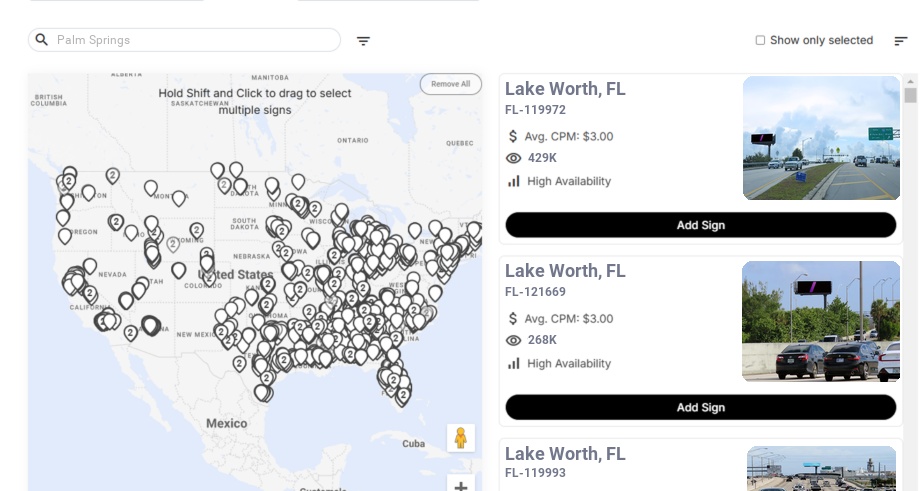
While there are no Blip billboards located inside the village itself, there are 15 digital boards within approximately 10 miles that create a strong ring of coverage around the Palm Springs area. The closest clusters are in Lake Worth, Boynton Beach, West Palm Beach, and Riviera Beach, giving you several options to reach residents and visitors on all sides. This network lets your campaign effectively surround the Palm Springs area along major commuting and shopping corridors.
Who does billboard advertising in Palm Springs, Florida reach?
Palm Springs is a compact but densely populated village in central Palm Beach County, and the broader trade area includes well over 400,000 residents within a 15–20 minute drive. Palm Beach County is majority-minority, and in several census tracts near Palm Springs and Lake Worth, 50–70% of residents identify as Hispanic or Latino. Many nearby neighborhoods also have strong residential stability, with more than 50% of households living in the same home for 5+ years.
When is the best time to run Blip billboards near Palm Springs, Florida?
More than 80–85% of area workers commute by car, truck, or van, so drive-time scheduling is especially useful in the Palm Springs area. The page recommends targeting 7:00–9:00 a.m. and 4:00–6:30 p.m. for commuters, midday for restaurant and retail offers, and evenings and weekends for entertainment, events, and family-oriented businesses. Winter months from November through April are also especially strong because seasonal residents and visitors increase traffic and demand.
What roads and traffic patterns make Palm Springs, Florida billboards effective with Blip?
The Palm Springs area is served by core corridors like I-95, Florida’s Turnpike, Lake Worth Road, Forest Hill Boulevard, Congress Avenue, Military Trail, and U.S. 1. I-95 through central Palm Beach County frequently carries 150,000–190,000 vehicles per day on certain segments, while arterials such as Lake Worth Road, Forest Hill Boulevard, Okeechobee Boulevard, and Military Trail often carry 30,000–55,000 vehicles daily. U.S. 1 also provides high-visibility, slower-speed traffic that is ideal for message absorption.
Do I need a contract to advertise with Blip near Palm Springs?
No, Blip has no long-term contracts or minimum commitments. You can start, pause, or stop your campaign at any time.
How fast can I launch a billboard campaign with Blip near Palm Springs?
You can have your campaign live in minutes. Create a free account, select your locations, set your budget, upload your design, and start running once approved.
Where can I advertise with Blip near Palm Springs?
Blip has digital billboards near Palm Springs. You can browse available locations on a map, choose the ones that fit your audience, and start advertising right away.
Still have questions? Launch a campaign in minutes — no contracts, no commitments.
Start Your CampaignPalm Springs Billboard Advertising Guide
The Palm Springs, Florida area sits in the heart of central Palm Beach County, surrounded by dense residential neighborhoods, busy commuter corridors, and year‑round tourism. With 15 digital billboards serving the Palm Springs area from nearby Lake Worth Beach, Boynton Beach West Palm Beach, and Riviera Beach
Understanding the Palm Springs Area Market
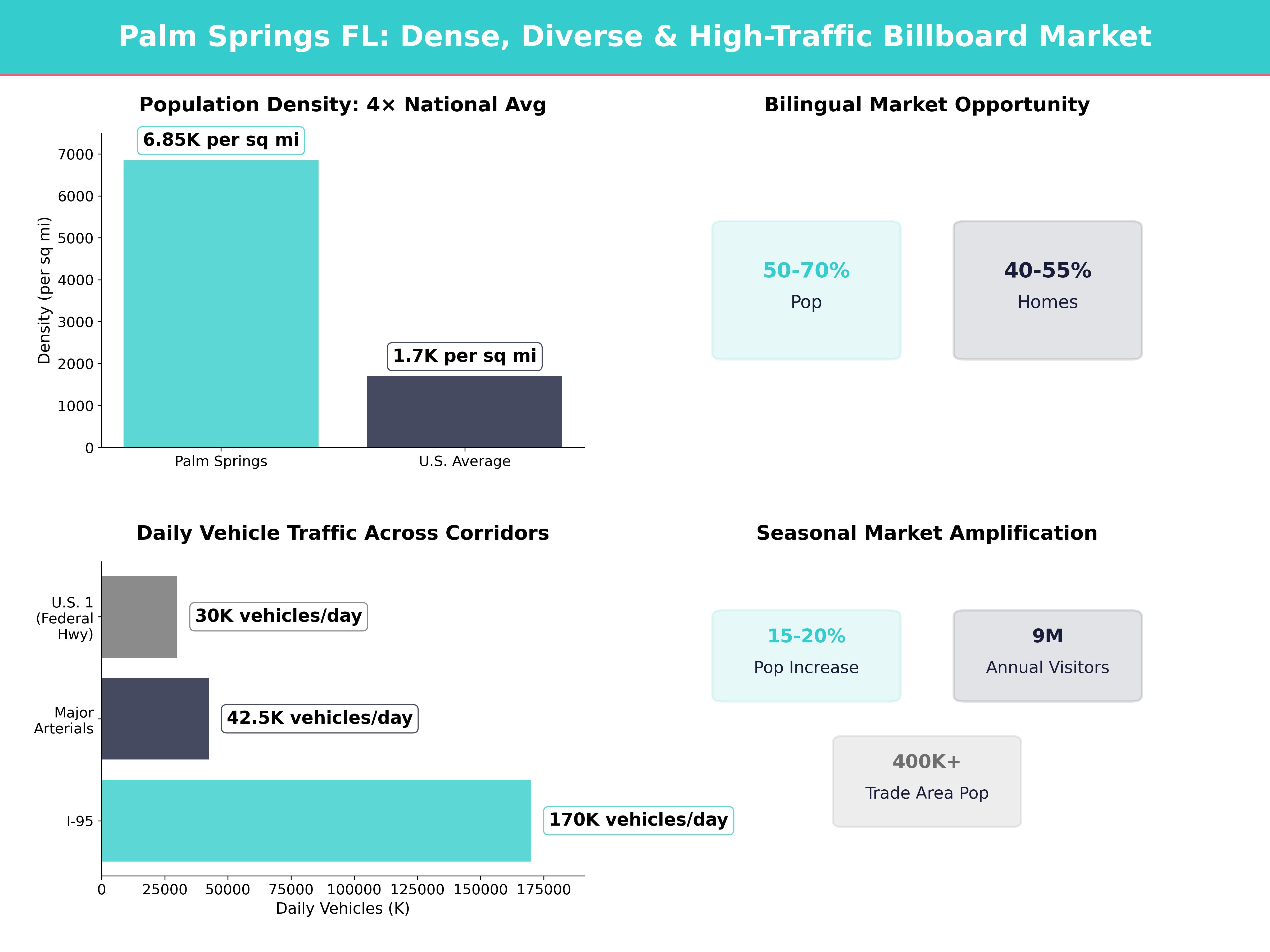
Palm Springs is a compact but densely populated village in central Palm Beach County. Recent estimates place the village’s population at roughly 27,000–28,000 residents in just over 4.0 square miles, translating into a population density of around 6,700–7,000 residents per square mile—more than 4 times the current U.S. average density (about 1,600–1,800 residents per square mile). The surrounding Lake Worth, West Palm Beach, and Boynton Beach communities raise the broader trade area to well over 400,000 residents within a 15–20 minute drive, all of whom can be reached efficiently through Palm Springs billboards positioned along major commuting routes.
Palm Beach County as a whole now has about 1.5–1.6 million residents, making it one of Florida’s three most populous counties. The Village of Palm Springs Palm Beach County both highlight strong residential stability: in many nearby neighborhoods, more than 50% of households have lived in the same home for 5+ years, which supports long‑term brand building on billboards and makes billboard advertising near Palm Springs especially effective for repeat exposure.
Key demographic and economic indicators for the Palm Springs area:
-
Population growth:
- Palm Beach County has grown by roughly 13–15% over the last decade, adding more than 170,000 residents.
- Several zip codes near Palm Springs have seen annual growth rates in the 1.0–1.5% range, driven by in‑migration from other Florida counties and from Northeastern and Midwestern states.
-
Age mix:
- The county’s median age is in the 44–46 range, but areas around Palm Springs skew younger, with many neighborhoods showing a median age in the mid‑30s to low‑40s.
- Roughly 55–60% of nearby residents are in the working‑age bracket (18–64), with about 20–23% age under 18 and 18–22% age 65+. This supports multi‑generational messaging (families, professionals, and retirees).
-
Households and families:
- Average household size in nearby tracts often sits around 2.7–3.0 persons per household, above the national average of about 2.5, indicating larger family units.
- In many neighborhoods bordering Palm Springs, 55–65% of households are families, and 25–30% include children under 18.
-
Income:
- Median household income in the Palm Springs trade area typically falls in the $55,000–$70,000 range, with some nearby communities in central West Palm Beach below $50,000 and parts of western Boynton Beach and Wellington $80,000–$90,000.
- Around 20–25% of households in central Palm Beach County earn $100,000+, while roughly one‑third earn under $50,000, supporting both value‑oriented and premium positioning.
-
Diversity:
- Palm Beach County is majority‑minority; countywide, fewer than 50% of residents identify as non‑Hispanic White.
- In several census tracts near Palm Springs and Lake Worth, 50–70% of residents identify as Hispanic or Latino, and 40–55% of households speak a language other than English at home (predominantly Spanish).
- In some nearby schools in the School District of Palm Beach County, Spanish speakers make up 50% or more of enrollment, reinforcing the value of bilingual messaging.
Local government and community resources like the Village of Palm Springs Palm Beach County, and the county’s official tourism arm, Discover The Palm Beaches
Where Our Billboards Reach Near Palm Springs
While there are no Blip billboards located inside the village itself, our 15 digital boards within approximately 10 miles create a strong ring of coverage around the Palm Springs area, giving you several options for billboards near Palm Springs that reach residents and visitors on all sides:
- Lake Worth, Florida (about 1.9 miles from Palm Springs)
Lake Worth and Lake Worth Beach provide immediate coverage to Palm Springs commuters and shoppers moving along Lake Worth Road, 6th Avenue South, and Dixie Highway. This is the closest cluster to the village and connects to key nodes such as Downtown Lake Worth Beach and nearby public beaches, which attract thousands of daily visitors in peak season. For hyperlocal visibility, these faces function as de facto Palm Springs billboards for drivers heading in and out of the village. - Boynton Beach, Florida (about 5.1 miles from Palm Springs)
Boynton Beach 80,000–85,000 residents, with regional shopping centers that can draw 20,000–30,000 shopper visits on busy weekends. Strategically placed boards here are ideal for billboard advertising near Palm Springs that aims to influence purchase decisions close to point of sale. - West Palm Beach, Florida (about 5.2 miles from Palm Springs)
As the county seat and largest city in the county, West Palm Beach has roughly 120,000–115,000+ residents and a daytime population that swells significantly due to commuters. The nearby City of West Palm Beach hosts numerous government offices, courthouses, and major hospitals, drawing tens of thousands of workers and visitors each weekday. Our boards here help you reach residents from the Palm Springs area heading to jobs, courts, hospitals, and entertainment, making West Palm Beach a core component of any billboard rental near Palm Springs focused on professionals and daytime workers. - Riviera Beach, Florida (about 9.4 miles from Palm Springs)
Riviera Beach Port of Palm Beach more than 2.5 million tons of cargo annually and supports thousands of jobs, contributing a steady flow of commercial and employee traffic near our boards.
This network means you can run a campaign that effectively “surrounds” the Palm Springs area—catching people as they commute, shop, and travel along core corridors like I‑95, Florida’s Turnpike, Lake Worth Road, Forest Hill Boulevard, Congress Avenue, Military Trail, and U.S. 1. Many of these roads are highlighted in regional transportation planning from agencies such as Palm Beach TPA and the local transit provider Palm Tran, underscoring their importance for daily mobility and visibility when you are investing in Palm Springs billboards and related placements.
Traffic Patterns and Commuting Behavior
For out‑of‑home advertising, vehicle and commuter behavior matters as much as population data. In the Palm Springs area and broader central Palm Beach County:
-
Commuting dominance:
- More than 80–85% of area workers commute by car, truck, or van.
- Only about 2–3% typically use public transportation, and 2–4% walk or bike, which means the overwhelming majority of workers are in vehicles that can see roadside media.
-
Average commute:
- Typical one‑way commute times in Palm Beach County hover around 25–27 minutes, roughly in line with or slightly above the national average (about 26 minutes).
- A significant share of residents—often 30–35%—commute 30 minutes or more, generating repeated daily exposures as they drive the same routes.
-
Where people work:
- Many Palm Springs area residents travel to job centers in West Palm Beach, Lake Worth, Boynton Beach, and along the I‑95 and Florida’s Turnpike corridors.
- Employment hubs include healthcare (major hospitals and clinics), government, retail, logistics, and hospitality/tourism, all heavily concentrated along our billboard corridors.
-
Traffic volume:
- I‑95 through central Palm Beach County frequently carries 150,000–190,000 vehicles per day on certain segments, according to regional traffic counts reported by agencies like FDOT District Four
- Arterials such as Lake Worth Road, Forest Hill Boulevard, Okeechobee Boulevard, and Military Trail often carry 30,000–55,000 vehicles per day, depending on the segment.
- U.S. 1 (Federal Highway) provides additional high‑visibility, slower‑speed traffic, with many sections handling 25,000–35,000 vehicles daily, ideal for message absorption at lower speeds and frequent signalized intersections.
By using Blip’s dayparting tools, you can align your impressions with these peak flows. For example:
- Target 7:00–9:00 a.m. and 4:00–6:30 p.m. to reach daily commuters from the Palm Springs area going to and from West Palm Beach or Boynton Beach. In many traffic reports from outlets like WPTV and the Palm Beach Post
- Emphasize midday (11:00 a.m.–2:00 p.m.) for restaurant, quick‑service, and retail offers when workers and retirees are running errands or grabbing lunch; local mobility surveys often show lunchtime trips accounting for 15–20% of weekday vehicle movements.
- Use evening and weekend scheduling for entertainment, events, fitness, and family‑oriented businesses, when shopping centers and coastal areas can see attendance jumps of 20–40% compared with weekdays.
Local traffic and incident reporting from outlets like WPTV and the Palm Beach Post
Seasonality: Snowbirds, Tourism, and Local Events
The Palm Springs area participates fully in the seasonal rhythms of South Florida:
-
Snowbird season:
- From roughly November through April, Palm Beach County’s population swells as seasonal residents and visitors arrive from the Northeast, Midwest, and Canada.
- Local government and tourism officials often estimate an effective population increase of 15–20% in peak winter months in coastal and central areas, translating into hundreds of thousands of additional people using I‑95, U.S. 1, and major arterials each week.
-
Tourism:
- According to Discover The Palm Beaches millions of visitors per year, with recent figures surpassing 9 million annual visitors and generating billions of dollars in direct visitor spending (over $5–6 billion in many recent years).
- Hotel occupancy in peak winter months often climbs into the 70–80% range, compared with 50–65% in slower months, particularly in West Palm Beach, Lake Worth Beach, and coastal Boynton Beach.
- Many of these visitors travel the same arteries that pass near the Palm Springs area—particularly I‑95, U.S. 1, and routes to beaches and downtown West Palm Beach—ensuring your billboards are seen by both locals and tourists.
-
Air and cruise arrivals:
- Palm Beach International Airport in West Palm Beach typically handles 6–7 million passengers per year, with winter months representing the highest volumes.
- Cruise and day‑trip passengers through Port of Palm Beach
-
Events:
- Major events like the Palm Beach International Boat Show tens of thousands of attendees over several days), SunFest 50,000–100,000+ attendees), and spring training baseball in nearby West Palm Beach and Jupiter
- Regional fairs and festivals—such as the South Florida Fair at the South Florida Fairgrounds, cultural festivals in Lake Worth Beach, and seasonal events in Boynton Beach West Palm Beach, and Riviera Beach 10,000–20,000+ visitors.
How to adapt your billboard strategy:
-
Winter focus:
- Promote tourism‑oriented businesses (dining, attractions, charter services, luxury retail, healthcare specialists) more heavily from December–March, when visitor counts and seasonal occupancy are highest.
- Use clear, brand‑building creative aimed at affluent visitors and seasonal homeowners; in some coastal tracts, 30–40% of housing units are seasonal or vacant part‑year, meaning billboard impressions help build awareness quickly for those unfamiliar with local streets and landmarks.
-
Off‑season (May–October):
- Shift to loyalty and frequency marketing aimed at year‑round Palm Springs area residents. These months often see more stable traffic from locals as visitor numbers dip by 15–25% from winter peaks.
- Highlight value offers, local services (auto repair, dentists, schools, contractors), and hurricane‑season services (roofing, insurance, impact windows). The official Atlantic hurricane season (June 1–November 30) regularly sees 10–20 named storms in the Atlantic basin, keeping demand high for preparedness services in Palm Beach County.
-
Event‑timed campaigns:
- Launch short, high‑intensity bursts during weeks when big events are scheduled, using Blip’s flexible budgeting and scheduling to ramp up spend for 5–10 days instead of maintaining the same level year‑round.
- For example, during SunFest or the Boat Show, focus on West Palm Beach boards; during the South Florida Fair, highlight routes leading to the fairgrounds; and when Lake Worth Beach hosts major street festivals, prioritize Lake Worth/Lake Worth Beach placements.
Checking calendars from Discover The Palm Beaches Lake Worth Beach, Boynton Beach West Palm Beach, and Riviera Beach
Crafting Creative for a Diverse, Fast‑Moving Audience
To succeed on digital billboards serving the Palm Springs area, your artwork needs to communicate quickly, clearly, and in a culturally aware way. Whether you are exploring billboard rental near Palm Springs for the first time or expanding an existing campaign, keep these best practices in mind.
1. Language and cultural nuance
Given that many neighborhoods near the Palm Springs area have high Hispanic populations and widespread Spanish usage at home:
- In nearby tracts where 50–70% of residents identify as Hispanic or Latino, consider bilingual creative (English/Spanish) for broad consumer brands and essential services.
- In majority‑Hispanic trade areas (e.g., segments of Lake Worth and West Palm Beach), test Spanish‑first creative with a simple English tagline or web address. In some nearby public schools, Spanish‑speaking students exceed 50% of enrollment, supporting Spanish‑led campaigns.
- Avoid clutter; two‑language creative still needs to stay under 7 words of core message, especially given average billboard viewing times of 4–8 seconds at typical travel speeds.
2. Readability and speed
On major roads like I‑95 and Military Trail, vehicles often travel 40–65 mph:
- Use large fonts (at least 18–24 inches equivalent in your design specs for primary text) and high‑contrast color palettes (dark text on light background or vice versa).
- Limit each creative to one main idea: a brand line, a promo, or a call‑to‑action—not all three. Studies of out‑of‑home effectiveness often show response rates climbing when copy is held to 6–10 words total.
- Keep calls‑to‑action simple: “Exit Lake Worth Rd,” “Search ‘Palm Springs HVAC’,” or a short vanity URL. Short, memorable URLs can increase direct‑type visits by 20–40% compared with long, complex addresses.
3. Visual themes that resonate locally
Leverage imagery and references that feel recognizably “Palm Beach County,” but still inclusive of the Palm Springs area:
- Coastal and outdoor imagery: beaches, palms, Intracoastal Waterway, boating, and golf—tourism research for Palm Beach County consistently shows beach and outdoor recreation as top trip motivators.
- Suburban family life: parks, youth sports, and schools that speak directly to year‑round residents served by the School District of Palm Beach County.
- Health and wellness: fitness, medical services, and active‑senior imagery, reflecting a market where nearly 1 in 5 residents is 65+ and healthcare is one of the top employment sectors.
Avoid overly “luxury Palm Beach only” imagery if your core customers live and work in the Palm Springs and Lake Worth neighborhoods; focus on aspirational yet approachable visuals that appeal to middle‑income and working‑class households as well as higher‑income visitors.
Smart Targeting with Blip’s Tools
Digital boards serving the Palm Springs area allow you to buy exposure in flexible “blips” instead of fixed‑term, fixed‑cost contracts. We can use this flexibility to engineer smarter campaigns and make billboard advertising near Palm Springs more efficient.
1. Geographically focused placement
- Choose boards in Lake Worth for maximum proximity to the Palm Springs area for neighborhood‑based services, local retail, churches, and schools. Many Palm Springs residents travel Lake Worth Road daily to reach shopping centers and I‑95.
- Add West Palm Beach boards to reach Palm Springs area residents commuting to downtown offices, government buildings, and hospitals clustered around DowntownWPB
- Use Boynton Beach placements to capture shoppers and commuters heading to major malls, home centers, and restaurants, especially along I‑95 and Congress Avenue, where daily traffic routinely exceeds 30,000–40,000 vehicles on surface segments.
- Layer Riviera Beach for campaigns targeting industrial, marine, and port‑related workers or for brands looking for expanded northern county reach, including those traveling to Port of Palm Beach
2. Time‑of‑day customization
With Blip, you can:
- Run drive‑time only campaigns (e.g., 6–10 a.m. and 3–7 p.m.) to maximize impressions per dollar for commuting‑oriented businesses, mirroring the busiest traffic windows identified in local congestion reports.
- Focus on evenings and weekends for entertainment, nightlife, and family activities—ideal for restaurants, cinemas, attractions, and events promoted by Discover The Palm Beaches
- Emphasize weekday daytime if you are targeting retirees or at‑home parents in the Palm Springs area; in Palm Beach County, adults 65+ and adults outside the labor force can represent 30–35% of the daytime population in many neighborhoods.
3. Budget agility
Because you set your maximum bid and daily budget:
-
Start with smaller daily budgets (for example, $10–$30 per day per board cluster) to test which boards and time slots generate the best lift in web traffic, calls, or store visits.
- Increase bids during competitive periods (e.g., tax season for accountants, hurricane season for contractors, back‑to‑school shopping periods) and scale back during slower times.
- Run short, intense campaigns (3–10 days) for sales events or grand openings, then revert to a lower‑level brand‑awareness schedule that maintains presence at a reduced cost. This approach lets you fine‑tune billboard rental near Palm Springs to match seasonal demand and cash flow.
Industry Examples and Local Use Cases
Here are ways businesses can profitably use billboards serving the Palm Springs area:
-
Home services (HVAC, roofing, plumbing, impact windows):
- Run hurricane‑season promotions from June–November, concentrating on Lake Worth and Boynton Beach boards where single‑family homes and townhomes make up a large share of housing.
- Use simple messages like “Free Roof Inspection – Call Today” with a local phone number and short URL. After major storms, service calls can spike by 50–100%, and visibility during these periods is critical.
-
Healthcare and dental practices:
- Target boards near primary commuter routes into West Palm Beach and Boynton Beach—areas with large medical centers, clinics, and specialty practices. Healthcare accounts for tens of thousands of jobs countywide, and many workers and patients travel from the Palm Springs area.
- Use trust‑building messaging: “New Patients Welcome – Same‑Day Appointments – [PracticeName].” Adding urgency (“Same‑Day” or “Walk‑Ins Welcome”) can increase response rates by 20–30% in many local campaigns.
-
Auto dealers and repair shops:
- Focus on high‑traffic arterials and I‑95 boards, promoting clear offers like “$29 Oil Change” or “0% APR – This Weekend Only.”
- Time heavier blipping to Friday–Sunday, when dealership visits and test drives typically increase; many dealers see 30–40% of their weekly traffic on weekends.
-
Restaurants and QSR:
- Use dayparting to run lunch messages 10:30 a.m.–2 p.m. and dinner messages 4–9 p.m. Feature mouth‑watering food imagery and easy directions: “Just off Lake Worth Rd.”
- In neighborhoods with strong Hispanic presence, test Spanish or bilingual offers; bilingual campaigns in similar markets often see click‑through or response gains of 10–25% compared with English‑only.
-
Education and training:
- Community colleges, trade schools, and language academies such as Palm Beach State College and local campuses of Keiser University can reach adult learners in the Palm Springs area by focusing on drive‑time campaigns during enrollment periods.
- Use simple CTAs like “Enroll by Aug 15 – Evening Classes Available.” Enrollment campaigns timed 4–6 weeks before term starts typically capture the largest share of last‑minute decision‑makers.
Measuring and Optimizing Campaign Performance
To make the most of billboards serving the Palm Springs area, tie your creative and scheduling decisions to specific success metrics:
-
Website and search lift:
- Track branded search volume and direct URL visits during your campaign. Tools like Google Trends and your own analytics can show week‑over‑week changes in branded searches.
- Add a short, unique URL (e.g., “/palm”) or promo code so you can attribute responses; advertisers often see 10–30% of total site sessions during a campaign period tied to direct or branded traffic influenced by out‑of‑home.
-
Call tracking:
- Use a call‑tracking number exclusively on your billboard creative to measure inbound calls generated from the campaign. In service industries (HVAC, legal, medical, auto), call volumes can increase 15–40% during well‑timed flights.
-
In‑store responses:
- Train staff to ask, “How did you hear about us?” and log “billboard” responses. Even a small, consistent uptick—say, 5–10 additional transactions per week—can justify sustained spend for many local businesses, especially with higher‑ticket services.
-
Creative testing:
-
Use Blip’s ability to rotate multiple creatives to A/B test messages:
- Creative A: Brand‑heavy, no offer
- Creative B: Strong offer (e.g., “$50 Off First Visit”)
- Run each version for at least 2–4 weeks at similar spend levels, then compare which version drives more calls, form fills, or store visits. Many advertisers find that strong‑offer creatives can outperform brand‑only messages by 20–50% in immediate response, while brand‑only creatives better support long‑term recognition.
-
Use Blip’s ability to rotate multiple creatives to A/B test messages:
By regularly reviewing these metrics—ideally weekly or monthly—you can refine which boards, times of day, and creative approaches work best in the Palm Springs area and shift your budget toward the highest‑performing combinations.
With dense neighborhoods, strong commuter flows, a diverse population, and robust seasonal tourism, the Palm Springs, Florida area is well‑suited to digital billboard advertising. By strategically using the 15 digital billboards serving the Palm Springs area and Blip’s flexible tools, we can build campaigns that reach local residents, workers, and visitors at the right times, in the right places, with messages that truly resonate. For any business considering billboards near Palm Springs or broader billboard advertising near Palm Springs, this approach offers a scalable, data‑driven way to stay visible in one of central Palm Beach County’s most active markets.