Billboards near Wright, FL
No Minimum Spend. No Long-Term Contracts. Just Results.
Trusted by Leading Brands


Billboard advertising
near Wright has never been easier



How much is a billboard near Wright?
Why Choose Blip for Billboard Advertising near Wright
Blip lets you launch Wright ads fast on U.S. 98 and Beal Parkway, reaching commuters, base traffic, and beach-bound drivers without agency delays.
Set a Wright daily budget that fits your goals, then scale up for summer beach traffic and holiday spikes on the Emerald Coast.
Use dayparting in Wright to hit Eglin and Hurlburt commuters at 6:30–8:30 a.m. and 3:30–5:30 p.m. when corridors peak.
No contracts mean Wright businesses can test PCS, Tricare, or tourism offers, then pause or pivot as demand shifts by season.
Track your Wright campaign in real time and swap creatives quickly for U.S. 98, Fort Walton Beach, and Mary Esther traffic patterns.
Blip's creative tools help Wright ads stay bold and simple for fast-moving drivers near Gulf Coast beaches, schools, and retail hubs.
Frequently Asked Questions About Billboard Advertising near Wright
How much does a billboard cost near Wright, Florida with Blip?
With Blip, you control exactly what you spend on Wright billboards by setting a daily budget that works for you, whether you’re a local business or promoting a one-time event in the Wright area. Each “blip” is a 7.5–10 second ad on digital billboards near Wright, Florida, and you only pay for the blips you receive. The cost per blip changes based on when and where your ad runs and current advertiser demand, so you can choose the times that best fit your goals and budget.
Where can I advertise with Blip near Wright, Florida?
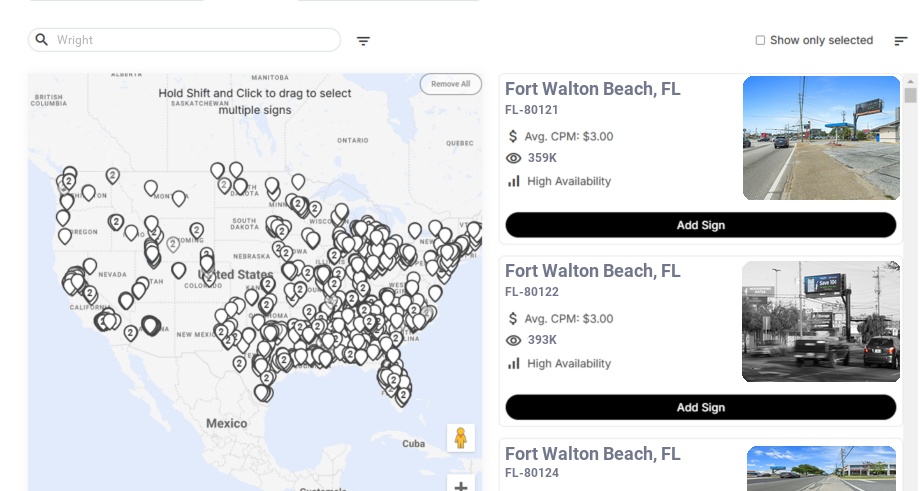
Choose from 10 digital billboards near Wright, Florida, set your own budget, control your schedule, and watch your message pop up in real time. Our 10 digital billboards near Wright are strategically located along high-traffic arteries in Fort Walton Beach and Mary Esther that residents regularly use. With boards in Fort Walton Beach and Mary Esther, we can also concentrate impressions on east-west traffic near the beach and retail corridors or focus more on north-south commuter routes connecting neighborhoods in the Wright area to workplaces and bases.
What kind of traffic do Blip billboards near Wright, Florida reach?
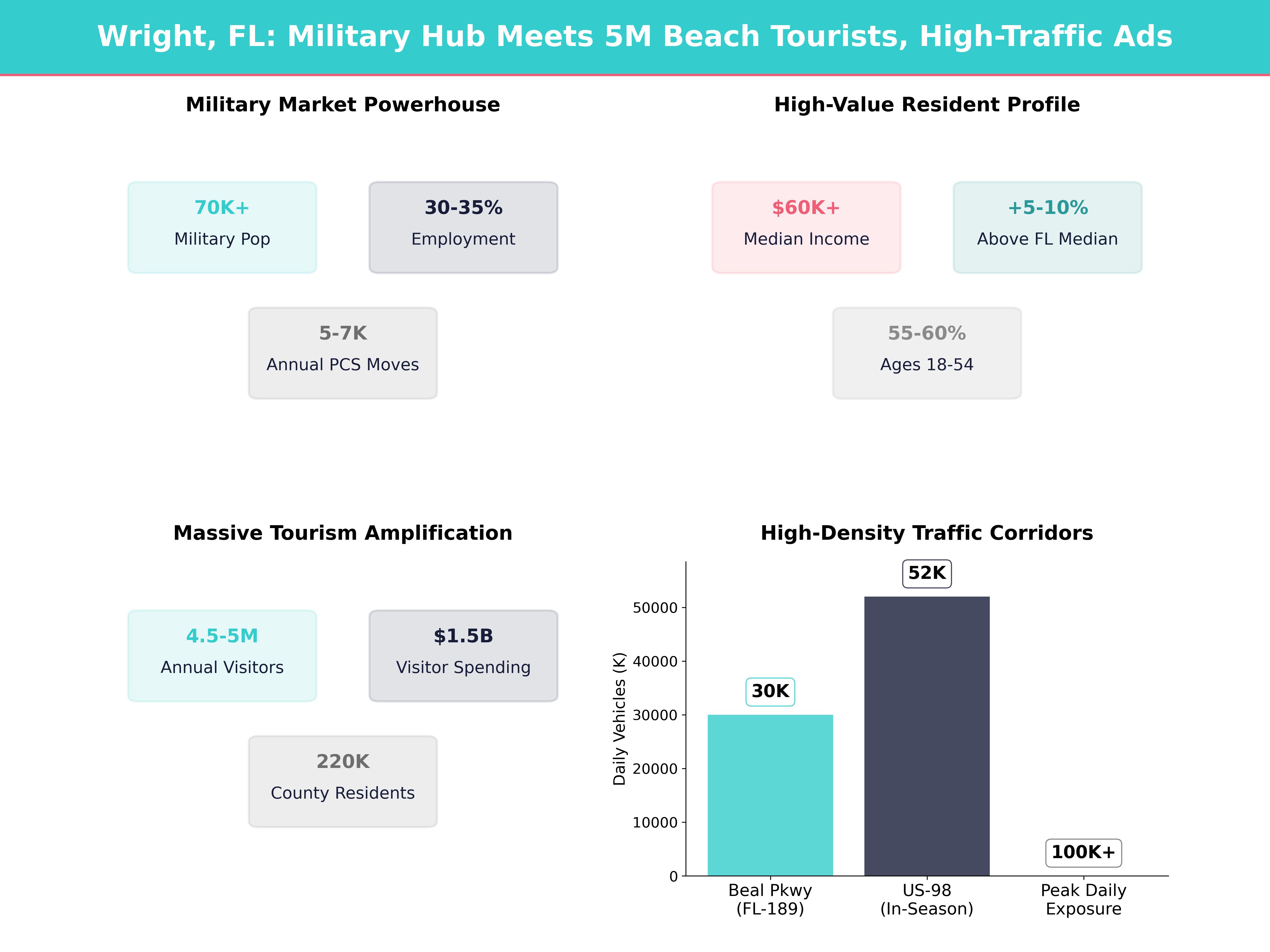
U.S. 98 near Fort Walton Beach and Mary Esther regularly sees 45,000–60,000 vehicles per day in-season, combining commuter, local shopper, and beach-bound tourist traffic. Beal Parkway (FL-189) carries an estimated 25,000–35,000 vehicles per day between Wright, Fort Walton Beach, and Mary Esther. Base access routes into Eglin AFB and Hurlburt Field also experience pronounced morning and afternoon peaks.
Why advertise in Wright, Florida with Blip?
Wright, Florida sits in the heart of Florida’s Emerald Coast, making it a compact but high-impact market for digital billboard advertising. With roughly 23,000 residents in the Wright area and more than 220,000 residents across Okaloosa County, plus an estimated 4.5–5.0 million annual visitors to nearby Gulf Coast beaches, advertisers can consistently reach both local households and a powerful stream of travelers, commuters, and military personnel. The area is also shaped by a strong military presence and steady tourism.
When should I run Blip ads near Wright, Florida?
Target morning commute windows (6:30–9:00 a.m.) to reach base commuters, hospitality workers, and school drop-offs. Hit lunch and early evening (11:00 a.m.–2:00 p.m. and 4:00–7:00 p.m.) to influence retail, dining, and service decisions during periods when many corridors see traffic volumes at or near peak levels. Use late-night and weekend scheduling for bars, entertainment, emergency services, and tourism-focused campaigns when visitors and service-industry workers are most active.
Do I need a contract to advertise with Blip near Wright?
No, Blip has no long-term contracts or minimum commitments. You can start, pause, or stop your campaign at any time.
How fast can I launch a billboard campaign with Blip near Wright?
You can have your campaign live in minutes. Create a free account, select your locations, set your budget, upload your design, and start running once approved.
Where can I advertise with Blip near Wright?
Blip has digital billboards near Wright. You can browse available locations on a map, choose the ones that fit your audience, and start advertising right away.
Still have questions? Launch a campaign in minutes — no contracts, no commitments.
Start Your CampaignWright Billboard Advertising Guide
Wright, Florida sits in the heart of Florida’s Emerald Coast Fort Walton Beach and Mary Esther, making it a compact but high-impact market for digital billboard advertising. With roughly 23,000 residents in the Wright area and more than 220,000 residents across Okaloosa County, plus an estimated 4.5–5.0 million annual visitors to nearby Gulf Coast beaches, advertisers can use our 10 nearby digital billboards near Wright to consistently reach both local households and a powerful stream of travelers, commuters, and military personnel. In this guide, we highlight how we can leverage these Wright-area billboards to help you connect your brand with residents, tourists, and military audiences throughout the Emerald Coast.
Understanding the Wright Area Market
The Wright area is an unincorporated community that functions as a suburban and commercial hub just north of Fort Walton Beach. It is closely tied to:
- Fort Walton Beach (0.9 miles away), home to about 22,000–23,000 residents and a historic downtown and beach corridor. The city has a median age in the mid-30s and a housing occupancy rate above 85%, supporting steady, year-round local traffic. The city provides detailed community information and development updates on the official City of Fort Walton Beach site.
- Mary Esther (8.1 miles away), a smaller but densely traveled community along U.S. 98 with convenient access to retail and the waterfront. With fewer than 5,000 residents but daily traffic volumes on U.S. 98 exceeding 40,000 vehicles, it punches far above its population weight for roadside visibility. See city info at the City of Mary Esther.
- Okaloosa County, which has grown to over 220,000 residents and continues to see steady population gains of roughly 1–2% per year. Countywide employment regularly tops 95,000 jobs, with unemployment rates often running 1–2 percentage points below the national average. It is governed from nearby Crestview; local policy, permitting, and economic data are available from Okaloosa County.
Several key factors shape advertising reach near Wright:
-
Military presence:
- Eglin Air Force Base Hurlburt Field
- Regional studies attribute more than 30–35% of total employment and billions of dollars in annual economic impact to defense-related activity in Okaloosa County.
- Between active-duty personnel, dependents, retirees, and civilian workers, the local military-connected population is commonly estimated at 70,000+ people within a short drive of Wright.
-
Tourism:
- Okaloosa County’s tourism body, the Emerald Coast Convention & Visitors Bureau
- Local “bed tax” collections in Okaloosa County have grown steadily, with double-digit percentage increases in some recent years, reflecting strong demand for short-term rentals and hotels.
- This visitor flow directly passes near our Fort Walton Beach and Mary Esther boards along U.S. 98 and connecting corridors.
-
Commuter corridors:
- Routes such as Beal Parkway (FL-189), Eglin Parkway (FL-85), and U.S. 98 (Miracle Strip Parkway) channel tens of thousands of daily trips between Wright, Fort Walton Beach, Mary Esther, Destin, and the bases.
- Many local workers spend 20–35 minutes commuting each way, often using the same main corridors daily—ideal conditions for frequency-based billboard campaigns.
With 10 digital Wright billboards serving the area from Fort Walton Beach and Mary Esther, we can help you tap a combined resident–tourist audience that is several times larger than the Wright population alone, reaching a realistic daily exposure pool of well over 100,000 unique drivers and passengers during peak months.
Key Demographics and Audiences Near Wright
The Wright area and surrounding communities present a diverse, economically active audience:
-
Population density:
- Wright’s roughly 23,000 residents occupy less than 13 square miles, giving a density around 1,700–1,800 residents per square mile.
- Fort Walton Beach’s population density is significantly higher, roughly 2,300–2,500 residents per square mile, and some central neighborhoods exceed 3,000 residents per square mile. These densities make roadside advertising especially efficient because a large share of households regularly travel the same limited set of major corridors.
-
Age profile:
- Okaloosa County’s median age sits in the mid- to upper-30s, slightly younger than Florida’s statewide median (which is in the low 40s), due in large part to the military presence.
- In many nearby census tracts, more than 55–60% of residents are in the prime working ages of 18–54.
- Children under 18 typically make up about 20–23% of the local population, supporting strong demand for family services, schools, and youth activities.
-
Household income:
- Okaloosa County’s median household income is in the mid–$60,000s to upper–$60,000s range, running roughly 5–10% above the Florida statewide median.
- Dual-income military and contractor households are common; in several areas near Wright, more than 35–40% of households report incomes above $75,000, and 15–20% exceed $100,000.
- This translates into robust spending on vehicles, home improvement, dining, fitness, healthcare, financial services, and recreation.
-
Education & skills:
- The defense and aerospace sectors create a concentration of technically skilled workers; some nearby tracts show bachelor’s degree attainment in the 30–35% range and associate degrees or technical certifications in another 25–30%.
- This audience responds well to clear, rational value propositions (e.g., “Save 20% this week,” “0% APR for 12 months,” or “GI Bill–friendly programs”) alongside lifestyle imagery.
-
Military market:
- Eglin AFB alone spans over 700 square miles and supports more than 20,000 military personnel and dependents, while Hurlburt Field contributes another 8,000+ active-duty members and families.
- The broader region hosts thousands of annual PCS (Permanent Change of Station) moves, with some years seeing 5,000–7,000 inbound or outbound military-related relocations.
- Offers geared to PCS moves, VA loans, auto sales, insurance, medical and dental offices, and childcare tend to perform especially well near the bases.
What this means for billboard advertising near Wright:
- Lean into family-oriented and value-driven messages (childcare, dentists, auto repair, quick service restaurants) that appeal to mid-income families and dual-earner households.
- Use creative that speaks to military life where appropriate (flexible hours, military discounts, Tricare acceptance, VA/DoD experience).
- Highlight time savings and convenience—this is a drive-heavy market where many households own 2–3 vehicles and are often moving between work, home, schools, and the beach.
Traffic Patterns and Where Our Boards Fit
Our 10 digital billboards near Wright are strategically located along high-traffic arteries in Fort Walton Beach and Mary Esther that residents regularly use. Traffic estimates from the Florida Department of Transportation (FDOT) and local counts typically show:
-
Beal Parkway (FL-189)
- Carries an estimated 25,000–35,000 vehicles per day between Wright, Fort Walton Beach, and Mary Esther.
- Some segments north of U.S. 98 approach or exceed 30,000 Average Annual Daily Traffic (AADT), with heavier weekday peaks.
-
U.S. 98 (Miracle Strip Parkway) near Fort Walton Beach and Mary Esther
- Regularly sees 45,000–60,000 vehicles per day in-season, combining commuter, local shopper, and beach-bound tourist traffic. Certain stretches near major intersections can climb into the 60,000+ vehicle range during summer.
- Weekend volumes can spike 10–20% above weekday norms during major holidays and special events.
-
Base access routes into Eglin AFB and Hurlburt Field
- Experience pronounced morning peaks roughly between 6:30–8:30 a.m. and afternoon peaks around 3:30–5:30 p.m.
- Training cycles, exercises, and deployments can create additional surges, often increasing traffic by 5–10% on key gate approaches on specific days.
Because Blip sells individual ad plays (“blips”) instead of fixed periods, we can help you concentrate impressions during the times when your core customers are most likely to be on the road:
- Target morning commute windows (6:30–9:00 a.m.) to reach base commuters, hospitality workers, and school drop-offs.
- Hit lunch and early evening (11:00 a.m.–2:00 p.m. and 4:00–7:00 p.m.) to influence retail, dining, and service decisions during periods when many corridors see traffic volumes at or near peak levels.
- Use late-night and weekend scheduling for bars, entertainment, emergency services, and tourism-focused campaigns when visitors and service-industry workers are most active.
Seasonality: Tourists, Snowbirds, and Local Rhythms
The Emerald Coast has distinct traffic and spending cycles that should shape your digital billboard strategy:
-
Spring and summer tourism (March–August):
- Peak beach season brings the bulk of the area’s 4.5–5.0 million annual visitors to Fort Walton Beach, Destin, and Okaloosa Island.
- Hotels and short-term rentals in the Fort Walton Beach area often report occupancy rates above 75–80% on average during June and July, and 90%+ on key holiday weekends like Memorial Day and July 4.
- Visitor spending on dining, attractions, and retail can run 30–40% higher in summer months than in the winter off-season.
- Expect higher traffic throughout the day on U.S. 98 and routes near the water; tourists are exploring, shopping, and dining at varied hours, not just traditional commute times.
- Use this window for tourism-driven offers: attractions, restaurants, water sports, surf shops, family entertainment, and retail.
-
Shoulder seasons (September–October, March):
- Families with younger children and retirees (“snowbirds”) extend the season while road congestion is slightly lower—often 10–20% below peak summer volumes but still above winter baselines.
- These visitors frequently stay longer, with average stays of 5–7 nights versus 3–4 nights for peak-season weekenders, and may spend more per trip on services and home-related purchases.
- Focus on extended-stay packages, healthcare, home services, and big-ticket retail such as furniture, appliances, and vehicles.
-
Winter and off-peak (November–February):
- Visitor numbers dip, but mild Gulf Coast weather still draws regional travelers, especially around Thanksgiving, Christmas, and New Year’s.
- In many locations, tourism volumes fall 30–50% from summer peaks, but local residents and military families dominate the roads—ideal for brand-building and loyalty campaigns.
- Promote holiday sales, tax services, education and training enrollment, and home improvement projects that locals plan for cooler months.
Using Blip, we can increase your bids and frequency during high-value seasonal windows, then scale back to a “maintenance” presence in slower periods to keep your brand visible in the Wright area without overspending.
Creative Strategy for the Wright Area
To capture attention near Wright on fast-moving corridors like U.S. 98 and Beal Parkway, artwork must work in 2–3 seconds at highway speeds. National out-of-home studies consistently show that simple, high-contrast creatives are remembered at rates 20–30 percentage points higher than cluttered designs.
Based on traffic conditions and audience behavior:
- Prioritize ultra-clear messaging
- Limit copy to 6–8 words—boards with fewer than 7 words typically see significantly better recall in driver surveys.
-
Make one primary call to action, like:
- “Military Discount – Auto Repair Next Right”
- “PCS Moving? Storage 5 Minutes Ahead”
- “Tonight: Live Music in Downtown Fort Walton Beach”
- Use bold local references
-
Mention nearby landmarks or directions:
- “Near Eglin Parkway”
- “Across from Santa Rosa Mall”
- “2 Miles Past Beal Pkwy”
- Local references build trust and help transient drivers orient themselves quickly; in tourism surveys, 40–50% of visitors report relying on roadside signs for “what to do next” decisions.
- Design for sun, rain, and coastal glare
The Gulf Coast sun can be intense, and sudden storms are common:
- High-contrast color combinations (dark backgrounds with bright text) maintain legibility in glare; contrast ratios of at least 4.5:1 improve readability by 20–25% according to visibility tests.
- Avoid thin fonts; use thick, sans-serif typefaces that remain readable at 40–55 mph.
- Keep logos large and simple; aim for logos to occupy at least 25–30% of the visual height so they are recognizable at a glance.
- Consider that summer afternoon thunderstorms can reduce visibility; bolder, higher-brightness creatives maintain effectiveness in low-light and rainy conditions.
- Appeal to mixed resident–tourist audiences
Because boards serving the Wright area reach both:
-
For tourists:
- Emphasize easy decisions: “Free Parking,” “Kids Eat Free,” “Beach Gear Here,” or “Tickets This Exit.”
- Include simple URLs or memorable names rather than detailed directions; short URLs or names under 15 characters are easier to recall.
-
For residents:
- Stress long-term benefits and loyalty: “Family Dentist Accepting Tricare,” “Local Credit Union – Low Auto Rates,” or “Trusted Vet Near Beal Pkwy.”
- Loyalty-oriented offers (e.g., “First Month Free,” “Locals Save 15%”) can improve repeat business and word-of-mouth among locals who see your message daily.
- Leverage multiple creatives
Digital boards allow easy rotation. We recommend at least 3–5 creative variations per campaign:
- One for brand awareness (“Who We Are”).
- One for a specific offer or promotion.
- One for directions or location focus.
- Optional: Military-specific creative (“Proud to Serve Eglin & Hurlburt Families”).
- Optional: Seasonal creative (“Summer Specials on U.S. 98,” “Back-to-School Sale”).
This rotation keeps your message fresh for daily commuters while allowing A/B testing of offers and imagery. Industry data shows campaigns that rotate 3+ creatives can deliver 10–20% higher engagement and response rates than static single-creative efforts.
Using Blip’s Flexibility Near Wright
Our digital boards serving the Wright area give you precise control over when, where, and how often your ads show, making them ideal for cost-efficient billboard rental near Wright.
- Budget control
- Set a daily budget as low as a few dollars and adjust anytime; some local advertisers start with test budgets of $10–$20 per day and then scale based on performance.
-
Increase bids on:
- Payday and end-of-month periods, when discretionary spending on retail, dining, and auto services typically rises 10–15%.
- Holiday weekends (Memorial Day, July 4th, Labor Day) when visitor volumes and traffic counts on U.S. 98 can spike 20–40%.
- Decrease bids during historically slower days if your business sees predictable patterns (e.g., Mondays for nightlife, mid-week for certain attractions).
- Dayparting
Align your blips with specific customer behaviors:
- Morning (6–9 a.m.): Coffee shops, breakfast spots, daycare, fitness, military-oriented services, and quick-service car care.
- Midday (11 a.m.–2 p.m.): Lunch specials, medical clinics, car washes, quick errands, and attractions encouraging same-day visits.
- Afternoon/evening (3–7 p.m.): Restaurants, retail, after-school programs, family entertainment, and healthcare appointments.
- Late night (after 9 p.m.): Bars, music venues, late-night food, emergency services, and tourism sectors catering to night-time activity.
- Location selection
With boards in Fort Walton Beach and Mary Esther, we can:
- Concentrate impressions on east–west traffic near the beach and retail corridors for tourism and shopping campaigns—ideal for businesses in or near popular areas like Okaloosa Island and Destin–Fort Walton Beach.
- Focus more on north–south commuter routes connecting neighborhoods in the Wright area to workplaces and bases for local services and employment campaigns.
- Layer locations so that a driver might see your message 2–3 times along a single trip, which research shows can increase message recall by 30–40%.
Local Insights and Content Ideas
Tapping into local culture and media can make your billboard campaigns near the Wright area feel more relevant.
-
Monitor local news from outlets like the Northwest Florida Daily News and TV stations such as WEAR ABC 3 and WJHG NewsChannel 7 to reference:
- Community events
- Festivals
- High school sports milestones
- Base-related news and recognitions
-
Coordinate your campaigns around promoted events on:
- The Fort Walton Beach city calendar
- The Destin–Fort Walton Beach events page
- Regional community listings from the Greater Fort Walton Beach Chamber of Commerce
Examples of locally relevant campaigns:
- Event-driven: “Tonight: Live Music – 2 Blocks from the Landing” aligned with Fort Walton Beach Landing Park
- Back-to-school: Campaigns timed to the Okaloosa County School District calendar for tutoring centers, clothing retailers, and pediatric practices, especially in late July and early August when local parents increase school-related spending.
- Military appreciation: Promotions during Air Force anniversaries, local air shows, or base open houses, which can attract tens of thousands of visitors and generate sizable surges in nearby traffic.
Vertical-Specific Strategy Near Wright
Different industries can use the Wright-area boards in distinct, high-return ways and get more from billboard advertising near Wright:
- Restaurants & Food Service
- Use lunch and dinner dayparts on boards closer to commercial clusters and U.S. 98. Many full-service restaurants see 60–70% of their daily revenue concentrated between 11 a.m.–2 p.m. and 5–8 p.m.
- Promote time-sensitive offers: “Lunch Combo Under $10 – Exit Now,” “Happy Hour 4–6 p.m.,” or “Kids Eat Free on Tuesdays.”
- Rotate creatives featuring local seafood, beach views, or family dining to appeal to visitors and residents. Tourism surveys frequently show that 25–30% of visitors will try a restaurant they saw advertised on a roadside sign during their stay.
- Auto Dealers & Services
- The car is central to daily life in the Wright area; vehicle ownership rates are high, and many households have 2–3 vehicles.
-
Highlight:
- Low payment offers (“Payments Under $350/Month”).
- Quick-service oil changes (“10-Min Oil Change – Walk-Ins Welcome”).
- Tire and brake specials before major holidays or hurricane season (June–November), when road trips and storm prep increase demand.
- Geotarget boards along commuter paths linking neighborhoods north of Wright to U.S. 98 and the bases to intercept drivers who pass your dealership service area multiple times each week.
- Real Estate, Apartments & Storage
- With frequent PCS moves and tourism-driven investing, there is constant housing churn. Some nearby zip codes see annual turnover rates of 15–20% of households.
-
Run campaigns tied to:
- “Now Leasing Near Eglin.”
- “Military Move-In Specials – Pets Welcome.”
- “Climate-Controlled Storage – First Month $1.”
- Consider timing heavier rotations in late spring and late summer, when many military and family moves occur and local property management firms report higher inquiry volumes.
- Healthcare & Wellness
-
Dental, urgent care, and primary care practices can focus on:
- “Walk-Ins Welcome Near Beal Pkwy.”
- “Tricare Accepted – New Patients.”
- “Open 7 Days – Urgent Care on 98.”
- Gyms and fitness centers can hit early morning and evening commutes with simple calls to action: “24/7 Gym 5 Min Ahead” or “No Contract – Join Today.”
- In many markets, 30–40% of new healthcare patients say location or convenience was their top deciding factor, making proximity-focused billboard messages especially effective.
- Attractions & Tourism Businesses
- Water sports, boat tours, mini-golf, museums, and family fun centers benefit most during peak visitor months, when day-trip and impulse activities are highest.
- Show bold visuals and a clear benefit: “Dolphin Cruises Today – Tickets Ahead on 98,” “Parasailing – Free Parking,” or “Rainy Day? Indoor Fun This Exit.”
- Visitor studies often show that 40–50% of attraction tickets are purchased within 24 hours of the activity, so real-time billboard messaging can strongly influence decisions.
Measuring and Optimizing Campaigns
To get the most from your Wright-area billboard campaigns, connect them with trackable elements:
- Use unique URLs or landing pages displayed on your creatives for this market only (e.g.,
yourbrand.com/wright), and monitor traffic spikes during key dayparts. - Add promo codes like “WRIGHT20” for discounts and track redemptions; even a 5–10% redemption rate among new customers can signal strong billboard performance.
- Ask customers, “How did you hear about us?” and train staff to log “billboard” as a distinct source in your POS or CRM system.
-
Compare performance across:
- Different dayparts (morning vs. evening).
- Weekdays vs. weekends.
- Seasonal periods (summer vs. winter).
Because Blip allows rapid creative swaps and budget adjustments, we can iteratively refine your campaign—shifting budget to the times, messages, and boards that drive the strongest response in the Wright area, and pausing underperforming variations within days rather than months.
Bringing It All Together
The Wright area sits at a unique intersection of military life, family neighborhoods, and Gulf Coast tourism. With 10 digital billboards serving the Wright area from Fort Walton Beach and Mary Esther, we can help you:
- Reach a dense local population of more than 220,000 residents and millions of annual visitors.
- Tailor campaigns by time of day, season, and corridor to match real-world traffic flows that can exceed 50,000–60,000 vehicles per day on key segments.
- Test multiple creatives quickly and prioritize the best performers using trackable offers and URLs.
- Align your message with local events, base activity, school calendars, and tourism cycles for maximum relevance.
By combining data-driven scheduling with locally attuned creative, digital billboards near Wright become a powerful, flexible tool for growing awareness, driving immediate visits, and building long-term loyalty in one of Florida’s most dynamic coastal markets. Whether you are just exploring billboard advertising near Wright for the first time or looking to scale existing campaigns, Wright billboards offer a high-impact way to stay visible to both residents and visitors every day.