Billboards near Callaway, FL
No Minimum Spend. No Long-Term Contracts. Just Results.
Trusted by Leading Brands


Billboard advertising
near Callaway has never been easier



How much is a billboard near Callaway?
Why Choose Blip for Billboard Advertising near Callaway
Blip lets you launch Callaway, Florida billboards yourself and target US-98 commuters near Tyndall AFB in minutes.
With flexible budgets, Callaway, Florida advertisers can test peak spring break and summer tourist traffic without long-term commitments.
Daypart your Blip ads in Callaway, Florida for 6-9 a.m. base commuters and 4-8 p.m. beach return traffic.
No contracts mean Callaway, Florida businesses can shift fast for hurricane season, rebuild demand, or local event spikes.
Track real-time results on Callaway, Florida boards and tweak creative for military families, contractors, and Gulf Coast visitors.
Frequently Asked Questions About Billboard Advertising near Callaway
How much does a billboard cost near Callaway, Florida with Blip?
With Blip, you control exactly how much you spend on Callaway billboards by setting a daily budget that can start small and be adjusted anytime. Each 7.5 to 10-second “blip” is a brief ad on rotating digital billboards near Callaway, Florida, and you only pay for the blips you receive. This pay-per-blip model means your total cost over time is simply the sum of each individual ad display, tailored to when and where you choose to show your message.
Where can I advertise with Blip near Callaway, Florida?
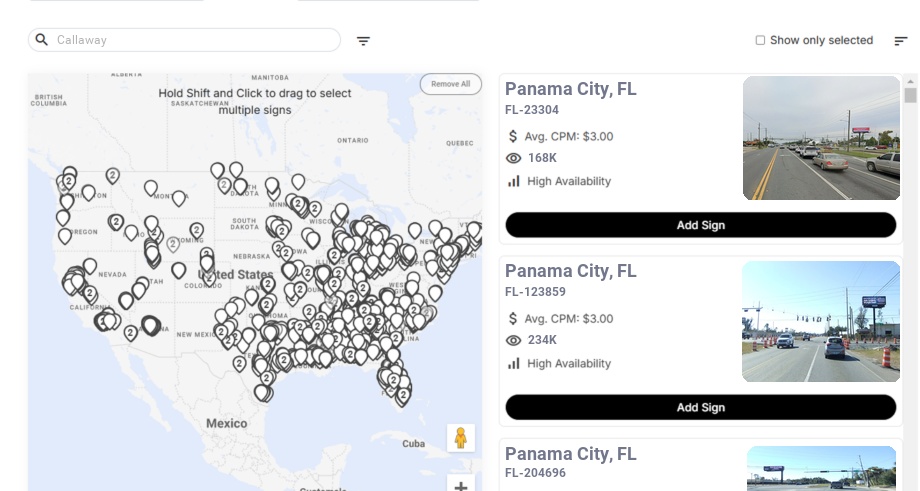
There are 11 digital billboards serving the Callaway area from nearby Pretty Bayou and Panama City. These placements sit along the same core commuter and shopping routes that Callaway residents and workers use daily. For many advertisers, these locations function as de facto Callaway billboards because they sit directly on the primary approach corridors into and out of the city.
What kind of audience can Blip reach around Callaway, Florida?
Callaway is part of the Panama City urban area in Bay County, a region that blends suburban neighborhoods, military installations, industrial employers, and tourism. This mix makes Callaway billboards and other out-of-home media especially effective at reaching a broad, high-intent audience. Campaigns near Callaway can simultaneously speak to year-round local households, a large military community, construction and trade workers, and a heavy influx of seasonal visitors.
When is the best time to run billboards in Callaway, Florida with Blip?
The Gulf Coast has pronounced seasonal rhythms, and Spring Break, summer, and weekend travel can drive major traffic increases near Callaway. Weekday morning commute hours, lunchtime, and evening periods are also important because they capture military, construction, healthcare, and shopping traffic. With Blip, you can designate specific hours and days for your ads to run near Callaway so your spending is concentrated when your audience is most likely on the road.
Why do digital billboards near Callaway, Florida work well for local traffic?
US-98 is the primary east-west artery connecting the Callaway area to Panama City, Panama City Beach, and Tyndall AFB, and FDOT traffic counts on similar segments often show 25,000–45,000 vehicles per day. A single well-positioned board on a 40,000-AADT segment can easily deliver 60,000–70,000 daily impressions at full coverage. Because boards in Pretty Bayou and Panama City sit on these routes, they can reach commuters, visitors, and shoppers moving through the Callaway area.
Do I need a contract to advertise with Blip near Callaway?
No, Blip has no long-term contracts or minimum commitments. You can start, pause, or stop your campaign at any time.
How fast can I launch a billboard campaign with Blip near Callaway?
You can have your campaign live in minutes. Create a free account, select your locations, set your budget, upload your design, and start running once approved.
Where can I advertise with Blip near Callaway?
Blip has digital billboards near Callaway. You can browse available locations on a map, choose the ones that fit your audience, and start advertising right away.
Still have questions? Launch a campaign in minutes — no contracts, no commitments.
Start Your CampaignCallaway Billboard Advertising Guide
The Callaway, Florida area sits at the crossroads of Gulf Coast tourism, military activity, and year‑round local traffic. With 11 digital billboards serving the Callaway area from nearby Pretty Bayou and Panama City, advertisers can reach residents, workers, and visitors moving between Panama City, Tyndall Air Force Base
Understanding the Callaway Area Market
Callaway is part of the Panama City urban area in Bay County, a region that blends suburban neighborhoods, military installations, industrial employers, and tourism. This mix makes Callaway billboards and other out‑of‑home media especially effective at reaching a broad, high‑intent audience.
Key market facts:
-
Population base
- Callaway’s population is roughly 14,000–15,000 residents, based on the 2020 count of 14,287 and modest post‑rebuilding growth as documented by Bay County and regional planning sources.
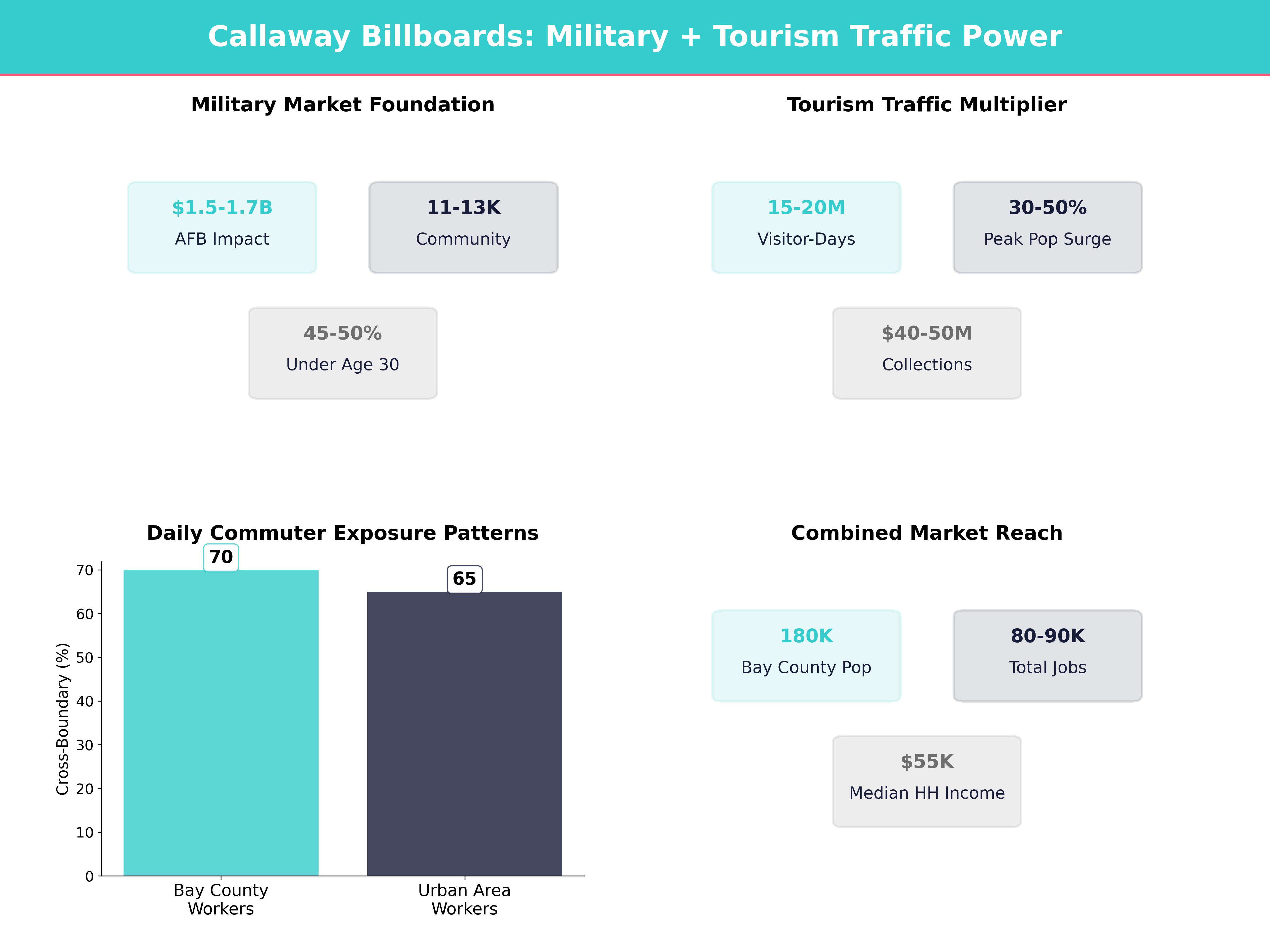
- Bay County’s total population has climbed to roughly 180,000 residents (up from 168,852 in 2010), an increase of about 6–7% over the decade as the area recovered from Hurricane Michael and expanded housing and jobs.
- The broader Panama City–Lynn Haven–Callaway urbanized area functions as one commuting and shopping region; well over 70% of Bay County workers are employed outside their home municipality, according to regional labor analyses. This means billboards in Pretty Bayou and Panama City efficiently reach people who live, work, or shop near Callaway.
-
Military and federal presence
- Tyndall Air Force Base 11,000–13,000 active‑duty personnel, Guard/Reserve, civilian employees, and dependents in a typical year, according to base and local economic‑impact summaries from Tyndall AFB.
- Pre‑Hurricane Michael, Tyndall’s annual economic impact was frequently estimated in the $1.5–$1.7 billion range; ongoing “Base of the Future” reconstruction has brought in thousands of additional contract workers and hundreds of millions of dollars in construction activity along the US‑98 corridor.
- Military families skew younger: nationally, about 45–50% of active‑duty members are under age 30, and over 50% are married, creating strong demand for housing, autos, healthcare, childcare, and dining in the Callaway–Panama City area.
-
Tourism and seasonal visitors
- Nearby Panama City Beach tourism consistently logs 15–20 million visitor‑days per year, with bed‑tax collections in Bay County surpassing $40–50 million annually in recent years. Local tourism officials have noted double‑digit percentage growth in key years after the pandemic, with some seasons exceeding 10–15% year‑over‑year gains in tax receipts.
- At peak periods (spring break and midsummer), daily visitor counts along the Gulf Coast can swell the effective daytime population of Bay County by 30–50%, driving heavy traffic on US‑98 and feeder routes.
- Many of these visitors travel through or near the Callaway area en route to accommodations, marinas, or offshore fishing charters, particularly those approaching from the east along US‑98 or from inland Georgia/Alabama markets, making billboard advertising near Callaway a strong way to intercept these travelers.
-
Local economy highlights
- Bay County supports roughly 80,000–90,000 jobs, with major employment sectors including defense, healthcare, construction, retail, hospitality, and logistics. Defense and federal activities (Tyndall AFB and Naval Support Activity Panama City thousands of direct jobs and a large share of household income.
- Construction has been one of the fastest‑growing sectors since Hurricane Michael, with local building permit activity in some years more than doubling pre‑storm levels. This has translated into increased commercial and contractor vehicle traffic, especially weekdays between 6 a.m. and 5 p.m.
- Median household income for Bay County has risen into the mid‑$50,000s to low‑$60,000s, while pockets of higher‑income households around coastal and suburban neighborhoods support premium retail and service spending.
For advertisers, this means that campaigns near Callaway can simultaneously speak to year‑round local households, a large military community, construction and trade workers, and a heavy influx of seasonal visitors that can add tens of thousands of extra drivers to area roads on peak days. Carefully chosen billboards near Callaway can tie all of these audiences together in a single, efficient out‑of‑home plan.
Traffic Patterns and Why Nearby Billboards Work for Callaway
Digital billboards in Pretty Bayou (about 8.3 miles from Callaway) and Panama City (about 10 miles from Callaway) sit along the same core commuter and shopping routes that Callaway residents and workers use daily. For many advertisers, these placements function as de facto Callaway billboards because they sit directly on the primary approach corridors into and out of the city.
Key transportation and traffic insights:
-
US‑98 (Tyndall Parkway / Panama City corridor)
- US‑98 is the primary east‑west artery connecting the Callaway area to Panama City, Panama City Beach, and Tyndall AFB. It is designated by the Florida Department of Transportation (FDOT) as a Strategic Intermodal System corridor, reflecting its regional importance.
- FDOT traffic counts on similar segments of US‑98 through the Panama City urban area often show Average Annual Daily Traffic (AADT) of 25,000–45,000 vehicles per day, with some urban stretches exceeding 50,000 vehicles per day during peak tourism months.
- If each vehicle carries an average of 1.5–1.7 occupants, a single well‑positioned board on a 40,000‑AADT segment can easily deliver 60,000–70,000 daily impressions at full coverage, before factoring in Blip’s share of rotation.
-
Residential–retail linkage
- Commuting data for Bay County show that a majority of residents travel outside their immediate city for work, with roughly 60–70% of workers in the Panama City–Lynn Haven–Callaway area crossing city boundaries daily.
- Callaway residents commonly drive toward Panama City for employment, hospital systems, and major retail. Key destinations include shopping areas around Panama City Mall and 23rd Street corridors, which sit within the circulation footprint of nearby digital billboards.
- This pattern means that boards located just 8–10 miles from Callaway along US‑98 and adjacent arterials can reach a very high percentage of local households multiple times per week, especially when scheduled during commute peaks.
-
Tourist flow
- Visitors arriving from the east via US‑98, from I‑10 via US‑231, or from the north via US‑331/US‑231 are funneled onto the same corridors that lead past our boards toward Panama City Beach and attractions promoted by Visit Panama City Beach.
- During spring break and summer weekends, FDOT has documented 20–30% higher traffic volumes on key approaches to the beaches compared to off‑season weekdays, significantly boosting impressions for tourism‑oriented creatives.
- This makes the Callaway area ideal for campaigns targeting drive‑in tourists: vacation rentals, charter fishing, restaurants, attractions, and retail that benefit when visitors are still deciding where to eat, shop, and play.
Because Blip lets us choose specific boards and time windows, we can prioritize locations and hours that match these patterns—rush‑hour commuters on US‑98, evening shopping runs, and weekend tourist surges—so you’re paying for impressions when traffic is naturally heaviest. For advertisers exploring billboard rental near Callaway, this flexible control over where and when your message appears is key to maximizing return.
Key Audience Segments in the Callaway Area
When planning creative and scheduling, it helps to think about a few distinct segments you can reach near Callaway:
-
Military Households and Contractors
- Between Tyndall AFB and Naval Support Activity Panama City, the broader area supports well over 10,000 uniformed and civilian defense employees, plus thousands of spouses and children. Tyndall alone has historically contributed an economic impact of more than $1.5 billion annually.
- The age profile skews young: nationally, around 45–50% of active‑duty members are under 30, and more than 40% have children, driving consistent spending on family services.
- The base’s ongoing reconstruction has also attracted a rotating workforce of hundreds to thousands of contractors at any given time, many commuting daily through the Callaway–US‑98 corridor.
- High demand categories: auto dealers and repair, insurance, quick‑service restaurants, fitness, childcare, healthcare, and home furnishings. Military families typically move every 3–4 years, creating recurring demand for move‑in specials and home setup services.
- Messaging ideas: “Military discounts,” “Move‑in specials,” “On your way to Tyndall?” callouts, and clear directions from US‑98. Mentioning base proximity (e.g., “5 minutes from the Tyndall gate”) can increase relevance.
-
Local Suburban Families and Workers
- The Callaway area includes established neighborhoods and new subdivisions with household incomes around the Bay County median (roughly the mid‑$50,000s to low‑$60,000s per year).
- Roughly 60–65% of households in the broader region are owner‑occupied, supporting steady demand for home services such as HVAC, roofing, and landscaping.
- Bay District Schools 25,000–30,000 students across the county, meaning a high concentration of families with school‑age children traveling daily along bus and commute routes; see Bay District Schools for school locations and calendars.
- Key interests: schools, youth sports, healthcare, local dining, family entertainment, financial services, and home services.
- Messaging ideas: community‑oriented language, “locally owned,” “serving the Callaway area,” and promotions tied to school calendars (back‑to‑school, sports seasons, graduations) and holidays.
-
Tourists and Seasonal Visitors
- Spring and summer bring surges of tourists—especially March through August—with some spring break weeks adding tens of thousands of extra visitors per day to the Panama City Beach area. Local tourism reports note hotel occupancy rates in peak season frequently exceeding 80–90%.
- Average party size for leisure travel to the area often falls between 3–4 people per party, and visitor spending can exceed $150–200 per person per day on lodging, food, entertainment, and retail, according to regional tourism benchmarks.
- High spend categories: lodging, dining, experiences, and impulse retail (souvenirs, surf shops, convenience stores, attractions).
- Messaging ideas: beach‑oriented imagery, “Tonight only,” “Next right,” “5 miles ahead,” and time‑sensitive offers. Pair with flexible Blip scheduling to intensify impressions on weekends and peak months, when road volumes may be 20–30% higher than the annual average.
-
Trades and Industrial Workforce
- Ongoing reconstruction, infrastructure work, and industrial activity around the port and defense installations create a large daily flow of contractors and tradespeople using pickup trucks, work vans, and commercial vehicles.
- Employment in construction and related trades has grown by 20–30% in some post‑Hurricane Michael years, according to local economic‑development updates from Bay County and Port Panama City
- High relevance for: equipment rental, building supplies, fuel stations, quick meals, banking, and safety services. These workers are often on the road during early‑morning and mid‑day time blocks.
- Messaging ideas: early‑morning scheduling for coffee and breakfast offers, clear directions to supply yards, contractor credit programs, and “fleet‑friendly” signage (diesel availability, large‑vehicle access).
By tailoring creatives and dayparts to these segments, campaigns serving the Callaway area can achieve strong relevance and frequency on a modest budget, even with competitive tourist‑season traffic levels. This is where well‑planned billboard advertising near Callaway can outperform more fragmented media buys.
Seasonal and Temporal Strategy Near Callaway
The Gulf Coast has pronounced seasonal rhythms. Using Blip’s ability to adjust bids, budgets, and schedules by day and hour, we can align your campaign with these patterns.
Seasonality to factor in:
-
Spring Break & Early Spring (March–April)
- Panama City Beach is one of Florida’s better‑known spring break destinations, with March hotel occupancy and traffic counts often 20–40% higher than winter averages. Local law‑enforcement and tourism agencies regularly prepare for tens of thousands of additional visitors during peak weeks.
- Good window for restaurants, attractions, nightlife, retail, and seasonal employment recruiting (hospitality, lifeguards, service staff).
- Strategy: Increase bids and impressions on weekends and evenings, especially Thursdays–Sundays, when visitor arrivals and on‑road activity are highest.
-
Summer High Season (May–August)
- Sustained high tourism plus local families with kids out of school. Summer accounts for a significant share—often 40–50%—of annual tourist tax revenues in coastal Panhandle counties.
- Great for family activities, camps, pediatric and urgent care services, and tourist‑facing businesses.
- Strategy: Maintain presence daily, with heavier coverage from mid‑afternoon through late evening (roughly 2–9 p.m.) when families dine out, shop, and attend activities after beach time.
-
Hurricane and Rebuild Period (Late Summer–Fall)
- The Atlantic hurricane season runs June 1–November 30, with climatological peaks in August–October. Demand for home services, insurance, contractors, and emergency preparedness typically rises when storm activity increases in the Gulf.
- After significant storms, the region has historically seen spikes in construction employment, insurance claims, and spending on home repair and temporary housing.
- Strategy: Prepare flexible creatives you can rotate in quickly during or after severe weather advisories—roofing, tree service, generators, storage, and cleanup. Coordinate messaging with updates from Bay County Emergency Services and the City of Callaway.
-
Off‑Season (November–February)
- Fewer tourists, more local‑only traffic. Holiday shopping and tax‑season planning begin, and snowbird visitors contribute a smaller but stable boost.
- Retail sales often spike 20–30% above monthly averages in November–December for many categories, while auto and financial services see increased activity around year‑end and early tax‑refund periods (January–March).
- Strategy: Shift messaging to locals—holiday sales, end‑of‑year medical benefits, tax prep, and auto service. Lower bids can often still secure strong share of voice because competition softens outside major holidays.
Day‑of‑week and time‑of‑day:
-
Weekday Morning Commute (6–9 a.m.)
- Captures military, construction, healthcare, and office commuters heading toward Panama City and Tyndall. Traffic volumes can reach 70–90% of daily peaks during this window on major corridors.
- Strong for coffee/breakfast, radio and streaming promotions, auto and insurance, contractor needs, and quick‑service promotions.
-
Lunchtime (11 a.m.–1 p.m.)
- Ideal for restaurants, quick service, and errands like banking or medical clinics; many service and retail workers take staggered lunches throughout this period.
- Boards near retail centers and medical clusters can influence same‑day decisions.
-
Evening (4–8 p.m.)
- Captures commuters returning to the Callaway area, family dining, shopping, and entertainment. In tourism months, beach‑to‑hotel traffic is also heavy during this window.
- Strong for promotions that benefit from “where should we go tonight?” decisions.
-
Weekends
- More discretionary travel—beaches, shopping, events, church, and family activities. Traffic to coastal areas and entertainment venues can be significantly higher on Saturdays and Sundays than midweek, especially in March–August.
- Crucial for tourism‑oriented advertisers, churches, event promoters, and large retail centers.
With Blip, we can designate specific hours and days for your ads to run near Callaway, so your spending is concentrated exactly when your audience is most likely on the road. This level of control is particularly valuable if you’re testing billboard rental near Callaway for the first time and want to start with your highest‑value time blocks.
Geographic Strategy: Positioning Your Message Around Callaway
While the billboards themselves are in Pretty Bayou and Panama City, they sit on the routes that Callaway residents and visitors rely on. We recommend building a “corridor strategy” rather than thinking in strict city limits.
Consider these geographic tactics:
-
East–West Commuter Flow
- Target boards that align with US‑98 and key feeders where Callaway‑area commuters funnel toward Panama City’s employment centers and retail hubs. According to FDOT counts, these routes can see tens of thousands of vehicles daily, offering efficient reach with the right rotations.
- Use directional copy like “Ahead on 98,” “Just past the bridge,” or “10 minutes from here in the Callaway area” to make distance clear and reduce uncertainty about location.
-
Retail and Service Destinations
- Many Callaway‑area households shop at big‑box stores, auto dealers, and medical clusters in Panama City, including corridors near 23rd Street and major shopping centers.
- Place messages on boards that precede major intersections and retail corridors to influence store choice on the same trip. National retail studies show 30–40% of shoppers are willing to change destinations when prompted by a timely roadside offer.
- Consider pairing directions (“Next 2 lights, turn left”) with value propositions (“Free estimates,” “Same‑day service”) to drive immediate response.
-
Beach‑Bound and Tourist Routes
- For campaigns targeting visitors, choose boards closer to connectors that lead to Panama City Beach and coastal areas promoted by Bay County tourism and government information.
- Beach traffic is heavily directional: mornings and late afternoons often see strong flows toward and away from the shoreline. Positioning creatives that say “on your way to the beach” or “before you hit the surf” makes your offer part of the day’s plan.
- Include quick exit information (“Exit in 2 miles,” “Turn at [Road Name]”) to capture last‑minute decisions from drivers unfamiliar with local roads.
-
Local Brand Presence
- Even if your physical location is inside the Callaway area, advertising near Pretty Bayou and Panama City helps you tap into the full Bay County market and reinforce your brand as a regional player.
- A consistent presence across multiple boards and corridors can drive frequency; marketing research on out‑of‑home (OOH) often points to 10–20 exposures per month as a strong threshold for brand recall among regular commuters.
Because impressions and pricing can vary by board, we can start with a cluster of locations, then focus budget on the boards performing best for your objectives, using traffic data and response metrics as a guide. This corridor‑based approach effectively transforms nearby placements into a network of Callaway billboards that follow your audience throughout their daily journeys.
Creative Best Practices for the Callaway Area
Traffic speeds along US‑98 and parallel arterials mean your message must be clear and legible in under 3–5 seconds. Consider these design and messaging tips tailored to the local environment:
-
Bold, High‑Contrast Design for Bright Coastal Light
- The Florida sun and frequent glare require strong contrast. Studies of digital OOH readability show that high‑contrast combinations can improve legibility distance by 20–30% compared to low‑contrast designs.
- Use dark text on light backgrounds or vice versa; avoid mid‑tone color combinations that wash out. Coastal blues and greens work well if paired with white or very dark lettering.
- Ensure essential elements (headline, logo, key directional cue) occupy a large visual area—aim for text heights that are at least 18–24 inches in physical size on the board for highway speeds.
-
Keep It to 7 Words or Fewer
- OOH best practices recommend 7 words or fewer for primary copy to ensure quick comprehension at 45–60 mph.
- Aim for one core message: a benefit, offer, or call to action.
- Example for a restaurant: “Fresh Gulf Seafood – 5 Miles Ahead” plus your logo and exit number. Supporting details (phone numbers, long URLs) are typically skipped by drivers at speed.
-
Local and Military‑Friendly Messaging
- Phrases like “Serving the Callaway area,” “Local since [year],” or “Military welcome – ask about discounts” resonate with both residents and Tyndall AFB personnel. National surveys indicate that 60–70% of military families actively look for military discounts and prefer businesses that acknowledge their service.
- Use local landmarks when helpful: “Near Tyndall Parkway,” “Minutes from the bridge,” “By [well‑known intersection].” This increases trust and navigational confidence, especially for new arrivals.
-
Directional & Proximity Cues
-
Because boards serving the Callaway area sit in nearby cities, be explicit about:
- Approximate drive time (“10 minutes from here”)
- Travel direction (“East toward Callaway area”)
- Major roads (“Off US‑98 at [Street Name]”)
- Research on wayfinding‑oriented OOH suggests that including distance or exit info can improve visit follow‑through by 10–20%, particularly among tourists.
-
Because boards serving the Callaway area sit in nearby cities, be explicit about:
-
Use Rotating Creative Strategically
-
With digital, we can run multiple creatives rotating on the same board:
- One aimed at military commuters.
- One aimed at tourists (only during peak months/times).
- One evergreen, brand‑focused design.
- Testing even 2–3 headline variations and tracking response (web visits, calls, coupon redemptions) can reveal performance differences of 20–50% between top and bottom creatives.
- Use seasonal swaps: for example, hurricane‑preparedness messages in August–October, holiday shopping in November–December, and tax‑refund offers in late winter.
-
With digital, we can run multiple creatives rotating on the same board:
-
Urgency and Time Sensitivity
- For events, flash sales, or limited‑time offers, use time‑bound language: “Today Only,” “This Weekend,” “Spring Break Special.” Time‑limited offers can increase response rates by 15–30% compared to evergreen offers in many retail categories.
- Since Blip allows schedule changes quickly, you can update creatives to match current promotions, weather (e.g., “Rainy Day Indoor Fun”), or community events highlighted by outlets such as the Panama City News Herald or local stations like WJHG and WMBB
Using Data and Testing to Optimize Your Campaign
To get the most from digital billboards serving the Callaway area, we recommend a test‑and‑learn approach:
-
Define a Primary KPI
-
Examples:
- Increase branded search volume by 15–25% in the Callaway area over a 6‑week period.
- Drive an additional 10–20 calls per week to a tracked phone line.
- Redeem 50+ in‑store coupon codes tied to a specific billboard message in the first month.
- Use unique URLs (e.g., “/98”), promo codes, or tracked phone numbers to attribute responses. Many advertisers find that 20–30% of customers mention “I saw your sign” when staff are trained to ask.
-
Examples:
-
Start with a 4–6 Week Test
- Run your campaign across multiple boards serving the Callaway area for at least one full month to capture weekday/weekend and pay‑cycle variability; 4–6 weeks is a common minimum to see trend‑level changes in web traffic and store visits.
- Allocate more impressions to peak times for your audience (e.g., 7–9 a.m. and 4–7 p.m. for commuters; weekends and evenings for leisure), and monitor whether higher‑priced peak hours produce proportionally better results.
-
Monitor Local Signals
- Track activity around significant local news, events, or weather alerts via outlets like the Panama City News Herald, WJHG, or WMBB
- Check event calendars from Visit Panama City Beach or city channels such as the City of Callaway and City of Panama City for festivals, parades, sports tournaments, or holiday events that may boost traffic by 10–30% on certain days or weekends.
- If a big local event, festival, or storm is in the headlines, consider swapping in relevant creatives (event sponsorship messages, repair services, emergency info) within 24–48 hours to align with heightened local attention.
-
Iterate Creative and Scheduling
-
After the first few weeks, identify patterns:
- Do you see more web traffic when running morning vs. evening?
- Are military‑focused messages producing more conversions than general ones?
- Does weekend‑heavy scheduling correlate with higher in‑store traffic compared to weekday‑heavy schedules?
- Many advertisers find that focusing on the top 20–30% of best‑performing dayparts and creatives can improve overall campaign ROI by 25–50%.
- Use these insights to shift budget to best‑performing dayparts, boards, and creative variations while pausing underperforming slots.
-
After the first few weeks, identify patterns:
Local Context, Regulations, and Community Alignment
Operating near Callaway means considering both municipal and county context:
-
Local Government and Planning
- The City of Callaway and Bay County provide information on growth, zoning, and major infrastructure projects. Road‑widening, bridge work, or new commercial developments can shift traffic patterns substantially; for example, temporary detours can relocate thousands of vehicles per day for weeks or months.
- Reviewing transportation and development updates at least quarterly helps ensure your board selection and directional messaging remain accurate and relevant.
-
Community Values
- The Callaway area is a blend of long‑time locals, new arrivals, and military families with strong community ties. Surveys of similar Gulf Coast communities indicate that 60–70% of residents value businesses that support local schools, youth sports, churches, and veterans’ organizations.
- Consider highlighting support for local schools, veterans’ organizations, and disaster‑relief efforts—especially during hurricane season and rebuilding initiatives. Partnering with local charities or events and featuring them briefly on your creatives can build goodwill and distinctiveness.
-
Weather and Durability of Messaging
- Gulf Coast weather can be intense: high UV, heavy rain, and occasional storms. Where static vinyl can fade or be damaged, digital billboards allow creatives to remain visually consistent and be updated quickly.
- You can rotate in storm‑preparedness messages, emergency services, or post‑storm recovery offers with little lead time, closely coordinating messaging with guidance from Bay County Emergency Services and local news outlets.
- Weather‑triggered campaigns—such as promoting indoor attractions on rainy days or HVAC services during heat waves—can align with real‑time needs and often see higher engagement rates compared to static, season‑agnostic messaging.
By aligning your message with local priorities and staying informed via official sites and local news, your brand can build long‑term credibility in the Callaway area while making the most of every impression. Whether you are a local business or a regional brand, treating these placements as strategic billboards near Callaway helps anchor your presence in the community.
Putting It All Together for the Callaway Area
To summarize an effective digital billboard strategy serving the Callaway area:
- Treat the Callaway–Panama City corridor as one integrated market, using our 11 boards in Pretty Bayou and Panama City to intercept daily commuters, military personnel, and tourists who collectively generate tens of thousands of vehicle trips per day along US‑98 and nearby routes. In practice, this network operates like a connected set of Callaway billboards covering all major approach roads.
- Use data about local traffic volumes, seasonality, and audience segments to choose your dayparts, boards, and creative angles—focusing on the 4–6 weeks and the 20–30% of hours that matter most for your objectives.
- Craft simple, high‑contrast, locally relevant messages that can be absorbed in a few seconds at highway speeds, with clear directional cues and, when appropriate, military‑friendly offers.
- Leverage Blip’s flexibility to test multiple creatives, adjust schedules around tourism peaks and local events, and refine based on performance metrics such as web traffic, call volume, and coupon redemptions.
With a focused, data‑driven strategy, digital billboards serving the Callaway area can become a powerful, cost‑efficient pillar of your marketing mix—reinforcing your brand every day along the Gulf Coast routes your customers travel most and giving you full control over your billboard advertising near Callaway.