Billboards in Estero, FL
No Minimum Spend. No Long-Term Contracts. Just Results.
Trusted by Leading Brands


Billboard advertising
in Estero has never been easier
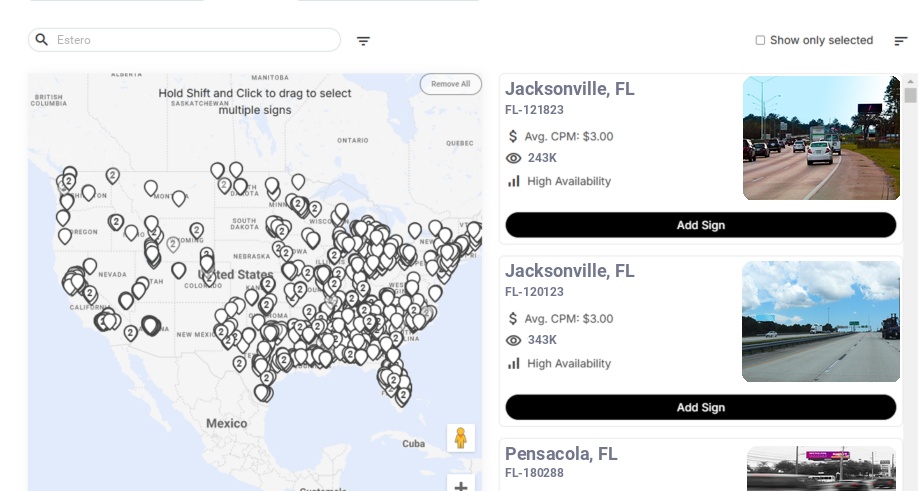



How much is a billboard in Estero?
Why Choose Blip for Billboard Advertising in Estero
Blip lets you self-serve Estero billboards fast, reaching I-75, U.S. 41, and Corkscrew Road commuters without the paperwork.
Set any daily budget in Estero and Blip only pays when ads play, so you can scale around winter snowbird traffic or summer locals.
Use Blip-optimized campaigns in Estero to auto-pick timing and placements near FGCU, Coconut Point, and Miromar Outlets.
Daypart your Estero ads for morning I-75 rush, midday shoppers, or Hertz Arena evenings, then pause anytime with no contracts.
Track Estero performance in real time and shift spend toward the routes driving more visits from airport, retail, and commuter traffic.
Blip's creative tools help tailor Estero billboards with clear, local messaging for FGCU students, retirees, and seasonal visitors.
Frequently Asked Questions About Billboard Advertising in Estero
How much does a billboard cost in Estero with Blip?
With Blip, the cost of billboard advertising in Estero is refreshingly flexible. You set a daily budget, and Blip’s algorithm uses it to bid for open ad slots on rotating digital billboards, so you only pay when your ad actually displays. Each “blip” is a 7.5-to-10-second ad, and pricing starts at just $0.01 per display.
Where can I advertise with Blip in Estero, Florida?
Estero’s travel patterns are concentrated on a few high-value roads, including Interstate 75, U.S. 41, Corkscrew Road, and Alico Road. I-75 is the dominant regional spine through south Lee County, while U.S. 41 serves west Estero and the coastal side of south Lee County. Corkscrew Road and Alico Road are especially useful for shopping, campus, employment, and airport-related traffic.
What makes Estero a strong billboard market for Blip?
Estero is a compact but high-impact billboard market because it sits at one of Southwest Florida’s busiest crossroads. The Village of Estero counted 36,939 residents in the 2020 Census, and it sits inside Lee County, which counted 760,822 residents. That means ads can speak to both a local community and a much larger regional trade area.
When is the best time to run billboard ads in Estero?
Winter season in Estero is prime time, especially in January, February, and March when seasonal population is at its highest. Spring training and spring break also widen the regional audience, and the spring-training window typically runs for about 6 weeks from mid-February through late March. Summer favors local families and practical services, while hurricane season creates opportunities for storm-prep and recovery messaging.
What kinds of audiences can Blip reach in Estero, Florida?
Estero blends affluent households, students, workers, and visitors, so it is not a one-audience town. Florida Gulf Coast University alone enrolls more than 15,000 students, and retail and entertainment anchors like Coconut Point and Miromar Outlets expand the effective audience. The market also includes commuters, retirees, snowbirds, and eventgoers tied to Hertz Arena and Southwest Florida International Airport.
Do I need a contract to advertise with Blip in Estero?
No, Blip has no long-term contracts or minimum commitments. You can start, pause, or stop your campaign at any time.
How fast can I launch a billboard campaign with Blip in Estero?
You can have your campaign live in minutes. Create a free account, select your locations, set your budget, upload your design, and start running once approved.
Where can I advertise with Blip in Estero?
Blip has digital billboards in Estero. You can browse available locations on a map, choose the ones that fit your audience, and start advertising right away.
Still have questions? Launch a campaign in minutes — no contracts, no commitments.
Start Your CampaignEstero Billboard Advertising Guide
Estero Village of Estero 36,939 residents in the 2020 Census, and it sits inside Lee County, which counted 760,822 residents, so our ads can speak to both a local community and a much larger regional trade area.
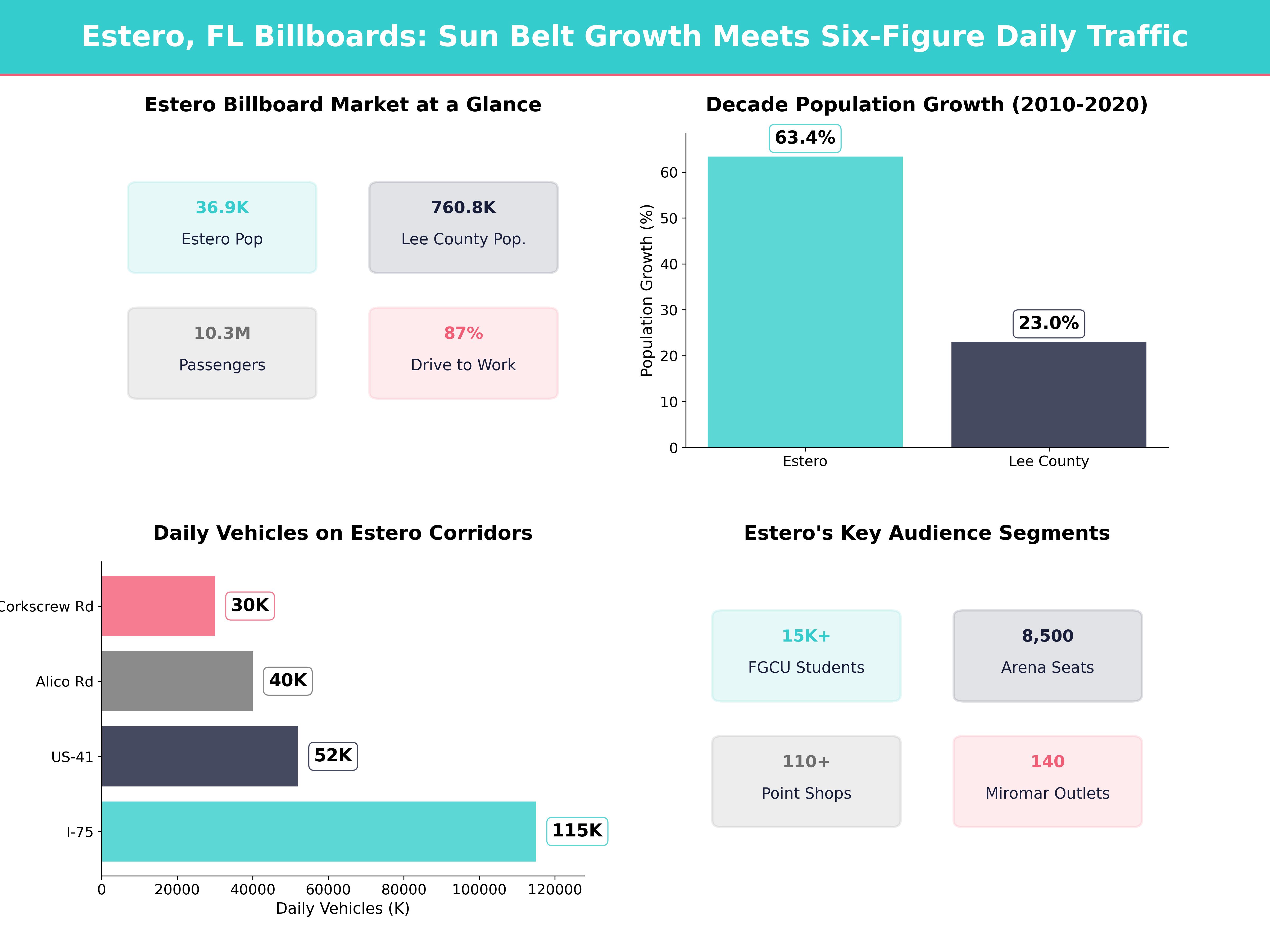
Travel in this part of Florida is overwhelmingly car-oriented, with I-75, U.S. 41, and major east-west connectors moving commuters, shoppers, students, and visitors every day. With roughly 86% to 88% of Lee County workers commuting by car, truck, or van, Estero becomes a smart place to build awareness fast.
When we add in destination drivers like Florida Gulf Coast University, Coconut Point Miromar Outlets, Hertz Arena, and Southwest Florida International Airport more than 10 million passengers annually, including roughly 10.3 million in 2023), Estero becomes a smart place to build awareness fast.
Estero Market Overview
Estero’s growth story creates a larger ad market than many advertisers expect
Estero is still a relatively young municipality, because the village incorporated in 2014. The area’s population rose from 22,612 in 2010 to 36,939 in 2020, which means Estero added 14,327 residents in one decade, or about 63.4% growth.
That pace matters for billboard advertisers because growth brings new rooftops, new shopping habits, new healthcare demand, and a steady stream of people learning the market. The broader county story is just as important. Lee County grew from 618,754 residents in 2010 to 760,822 in 2020, which was an increase of 142,068 people, or about 23.0%.
That means a billboard in Estero is not limited to village residents. It can also reach drivers moving between Fort Myers Bonita Springs
Estero blends affluent households, students, workers, and visitors
One of Estero’s strengths is that it is not a one-audience town. We can reach retiree-heavy communities, working households, students linked to Florida Gulf Coast University, and destination shoppers coming from across Southwest Florida.
FGCU alone enrolls more than 15,000 students, which gives the market a younger and more active consumer layer than many Florida retirement-oriented communities. Retail and entertainment anchors also expand the effective audience.
Coconut Point more than 110 shops and restaurants, and Miromar Outlets markets itself around 140 designer and brand-name stores. Hertz Arena seats roughly 8,500 for major events, concerts, and family shows.
Those numbers mean Estero supports both everyday local advertising and regional destination advertising. Car dependence keeps billboard advertising especially relevant in Estero.
Car dependence keeps billboard advertising especially relevant in Estero
Estero is built for driving. Local commuting profiles in Lee County typically place the share of workers using a car, truck, or van at roughly 87% (mid-to-high 80% range), which is exactly the kind of mobility pattern that favors out-of-home advertising.
Even residents who work remotely still drive to shopping centers, medical appointments, restaurants, entertainment venues, and the airport corridor. For us as advertisers, that translates into repeated daily exposure.
A well-placed digital billboard in Estero can reach the same commuter several times each week. It can also catch seasonal visitors and weekend shoppers who may not consume the same local media.
That mix of repetition and turnover is one of Estero’s biggest strengths.
Key Traffic Corridors for Digital Billboards in Estero
Estero’s travel patterns are concentrated on a few high-value roads. When we understand which corridors carry regional traffic and which corridors deliver local intent, we can place campaigns much more strategically.
Interstate 75 in Estero
Florida Department of Transportation data and Lee County MPO planning materials consistently show I-75 as the dominant regional spine through south Lee County. In recent years, segments of I-75 through the Estero area have generally fallen in the 100,000 to 130,000 AADT range, which puts the corridor firmly in six-figure daily traffic territory.
This is the corridor to use when we want broad reach. It is especially effective for:
- Regional healthcare brands, because patients travel between south Lee County and larger medical hubs.
- Universities, trade schools, and employers, because the highway connects labor and student flows from multiple communities.
- Retail, attractions, and event venues, because shoppers and concertgoers use I-75 to reach Estero’s major destinations.
- Legal, insurance, and financial services, because these categories benefit from repeated commuter frequency.
The most important Estero exits are Exit 123 for Corkscrew Road and Exit 121 for Alico Road. When we run campaigns near those interchanges, we can align creative with specific trip purposes, such as shopping, campus access, dining, or airport travel.
U.S. 41, also known as Tamiami Trail, in Estero
U.S. 41 is the street-level commercial backbone for west Estero and the coastal side of south Lee County. FDOT counts along the Estero-Bonita corridor commonly land in the 45,000 to 60,000 AADT band, which is lower than I-75 but often stronger for local relevance and repeat neighborhood visibility.
This route is ideal when we want to reach:
- Local diners and shoppers heading toward Coconut Point
- Homeowners and retirees making frequent trips for errands and appointments.
- Service-based businesses, including healthcare, dentistry, home services, fitness, and banking.
- Restaurants and entertainment venues that depend on same-day decision-making.
If I-75 gives us regional scale, U.S. 41 gives us local frequency and intent.
Corkscrew Road in Estero
Corkscrew Road is one of the most valuable east-west connectors in the village. Recent traffic maps often show volumes of 30,000 vehicles per day or more near the I-75 interchange and the high-activity area around Miromar Outlets, Florida Gulf Coast University, and Hertz Arena.
This corridor works well for advertisers that need an active, mixed audience. We can use Corkscrew Road for:
- Apartments, builders, and home services, because residential growth east of I-75 continues to shape travel demand.
- Quick-service restaurants and casual dining, because drivers are often making immediate stop decisions.
- Family entertainment and youth programs, because the route carries parents, students, and event traffic.
- Retail centers and outlet promotions, because it captures people already in shopping mode.
Alico Road and the north Estero gateway
Alico Road connects Estero to employment centers, industrial areas, campus traffic, and the airport approach. Near I-75 and the FGCU area, FDOT counts often exceed 40,000 vehicles per day, making Alico one of the most useful roads for high-intent business and travel campaigns.
We should especially consider Alico-focused placements for:
- Airport parking, hotels, and travel services tied to Southwest Florida International Airport
- Business-to-business recruiting and logistics messaging, because the corridor serves major employment activity.
- Healthcare and urgent care campaigns, because time-sensitive needs convert well on commuter roads.
- Student-oriented services, because the FGCU area sits directly in this travel shed.
Estero Audience Segments
Estero commuters and daily drivers
The most obvious audience in Estero is the daily driver. Because commuting and errand travel are so automobile-heavy, billboards can reach residents multiple times per week on the same routes.
That matters for categories that benefit from familiarity, such as healthcare, insurance, legal services, real estate, and home improvement. This audience is especially strong on I-75, U.S. 41, Corkscrew Road, and Alico Road.
When we want reach, we should lean into the highway network. When we want conversion-oriented local reminders, we should lean into the arterial network.
Estero students, faculty, and campus-linked households
Florida Gulf Coast University adds a very different consumer layer to Estero. With more than 15,000 students, plus faculty, staff, and visiting families, FGCU creates demand for apartments, food, entertainment, healthcare, apparel, tutoring, mobile services, and entry-level recruiting.
This audience responds best to clear value, direct calls to action, and location-specific messaging. Ads that mention proximity to campus, late hours, student pricing, or fast access from Corkscrew Road or Alico Road tend to make more sense here than broad luxury messaging.
Estero shoppers and dining audiences
Estero punches above its population in retail gravity. Coconut Point 110-plus shops and restaurants, and Miromar Outlets brings 140 outlet and brand stores.
Nearby Gulf Coast Town Center adds still more regional retail pull just north of Estero. That gives us strong billboard opportunities for:
- Retail promotions, especially when we use limited-time offers.
- Restaurant launches and seasonal menus, especially around weekends and evenings.
- Entertainment, salons, med spas, and wellness brands, because these categories benefit from destination traffic.
- Automotive, home décor, and service retailers, because shoppers are already in purchase mode.
Estero eventgoers and visitors
Hertz Arena gives Estero a reliable event audience. With seating of about 8,500, the venue attracts hockey fans, concert attendees, family-show audiences, and tournament visitors.
We can also reach travelers tied to Lee County Port Authority Southwest Florida International Airport more than 10 million passengers annually in recent years. Visitors also move through local leisure assets.
Koreshan State Park 200 acres, and nearby resorts such as Hyatt Regency Coconut Point Resort and Spa
It is also a visitor decision market.
Estero retirees, snowbirds, and homeowner-heavy communities
South Lee County has a large mature-adult and seasonal-resident base, and Estero is one of the clearest examples of that pattern. This is an especially valuable audience for healthcare, financial planning, legal services, home remodeling, pest control, landscaping, senior living, and premium dining.
The key is tone. This audience often responds better to trust, convenience, reputation, and location than to hype.
In Estero, credibility is usually a stronger billboard strategy than noise.
Estero Seasonal and Timing Opportunities
Winter season in Estero is prime time
January, February, and March are peak months for South Florida seasonal population. That is when snowbirds, vacationers, and second-home residents create heavier demand for dining, healthcare, entertainment, retail, and home services.
If we want the broadest high-income adult reach in Estero, winter is usually the strongest window. This is also the best time for advertisers in categories such as elective healthcare, real estate, golf and leisure, financial services, and premium retail.
We should expect higher demand around the strongest boards during this period, because more brands are trying to reach the same affluent seasonal traffic.
Spring training and spring break widen the regional audience
Nearby Fort Myers 2 Major League Baseball spring-training clubs, the Boston Red Sox JetBlue Park, and the Minnesota Twins at Lee Health Sports Complex. The spring-training window typically runs for about 6 weeks, from mid-February through late March, and it adds a large recreational audience to the area.
That period is excellent for bars, restaurants, attractions, apparel, rideshare alternatives, urgent care, and tourist-facing retail. Because Estero sits between Fort Myers and Bonita Springs, we can often capture this audience while it is in motion.
Summer in Estero favors local families and practical services
Summer brings heat, rain, and a more local pattern. That does not mean the market disappears; it means the mix changes.
Families, year-round residents, workers, and regional weekend travelers become more important than seasonal visitors. We can use summer to emphasize indoor entertainment, family dining, camps, back-to-school promotions, HVAC, roofing, auto service, and storm-readiness offers.
This is also a good time to test lower-cost share-of-voice strategies while some winter advertisers are out of market.
Hurricane season requires flexible messaging
Florida hurricane season runs from June 1 through November 30. In Estero, that creates real opportunities for storm-prep, insurance, restoration, generators, pharmacies, hardware, and emergency-response services.
It also means we should be ready to swap creative quickly when the weather changes. This is where flexible digital billboard scheduling becomes especially useful.
We can increase spend before a storm, pause when messaging becomes inappropriate, and relaunch with recovery-oriented creative when the community shifts from preparation to cleanup and rebuilding.
Back-to-school and holiday retail matter in Estero
August is important because The School District of Lee County
Holiday campaigns near Coconut Point, Miromar Outlets, and the I-75 interchanges can be especially effective for gift retail, dining, events, and service reminders.
Estero Billboard Design Tips
Use visuals that feel like Southwest Florida, but keep them disciplined
Estero creative should reflect place without becoming generic beach wallpaper. Clean blues, greens, whites, and warm sunset accents usually feel natural here, especially when they support categories like healthcare, hospitality, dining, and home services.
However, we should keep layouts disciplined because I-75 traffic moves quickly and drivers need fast recognition. In other words, tropical imagery works best when it is paired with a strong brand name, a short promise, and a simple directional or action cue.
Use local place names that drivers instantly recognize
Estero drivers respond to familiar landmarks and route language. “Corkscrew,” “Coconut Point,” “Miromar,” “FGCU,” “U.S. 41,” and “Next Exit” are more useful than vague regional copy.
If our location is near Exit 123 or Exit 121, we should say so. If we are 2 miles away, we should say that too.
This is especially important for restaurants, retail, urgent care, event promotions, and service businesses that depend on immediate route-based decisions.
Match the message to the audience on each side of Estero
West Estero and U.S. 41 often call for polished, trust-oriented creative that feels appropriate for affluent neighborhoods and lifestyle retail. The FGCU and Corkscrew area can support more energetic, value-oriented, event-oriented, or youth-oriented messaging.
Airport and employment corridors can support practical creative that emphasizes speed, convenience, and logistics. We should not force the same artwork everywhere.
In Estero, one campaign often performs better with 2 or 3 tailored versions than with one generic design.
Lead with one idea, not five
Estero billboards work best when we choose one job per board. On I-75, that may be simple brand awareness.
On U.S. 41, that may be a direct prompt to visit today. Near Hertz Arena, that may be an event tie-in.
Near FGCU, that may be a price point or student offer. When we stay focused, the local context does more of the selling for us.
Regional Strategies Around Estero
West Estero and the U.S. 41, Coconut Point, and resort corridor
This part of the market is ideal for affluent consumer categories. We can prioritize healthcare specialists, fine dining, med spas, real estate, home services, financial advisors, and premium retail.
The goal here is usually not raw volume alone. It is quality of audience and repetition among high-value households and active shoppers.
Central Estero around Corkscrew Road, Miromar Outlets, FGCU, and Hertz Arena
This is the highest-mix zone in Estero. Students, commuters, event audiences, and outlet shoppers all intersect here.
We should use this area for restaurants, entertainment, retail, recruiting, apartments, fitness, mobile services, and event-driven campaigns. If we want one submarket that captures Estero’s variety, this is often the best starting point.
North Estero toward Alico Road, Fort Myers, and the airport corridor
This area serves employment traffic, airport-linked travel, and campus flow. It is especially strong for hotels, airport parking, travel services, B2B recruiting, healthcare, and logistics-oriented brands.
If our offering solves a practical need while people are in motion, north Estero deserves attention.
South Estero toward Bonita Springs and Naples
Traffic moving south picks up a more upscale coastal and commuter character as it approaches Bonita Springs Naples
This area can be valuable when we want to extend Estero messaging into a wealthier southbound flow.
Using Blip Tools in Estero
We can daypart around Estero’s real traffic behavior
Estero is not a market where every hour performs the same. Morning and late-afternoon commuter windows matter on I-75 and Alico Road.
Midday can matter near retail and healthcare destinations. Evenings and weekends matter around Coconut Point, Miromar, and Hertz Arena.
With Blip, we can match spend to those patterns instead of buying every hour the same way.
We can test Estero submarkets without committing to one big guess
A smart Estero campaign often starts by comparing corridors. We can test I-75 for reach, U.S. 41 for neighborhood frequency, and Corkscrew Road for mixed shopper and student demand.
We can also test winter creative against summer creative, or homeowner messaging against student messaging, and let performance data guide the next move.
We can localize creative quickly
Because Estero has several distinct audiences, artwork flexibility matters. We can run one version that highlights “Next Exit” convenience, another that references FGCU, and another that leans into seasonal residents near Coconut Point.
That helps us stay relevant without rebuilding an entire campaign from scratch.
We can use analytics to scale what actually works in Estero
The biggest advantage in a market like Estero is not just launching fast. It is learning fast.
If one corridor is giving us stronger frequency, better time-of-day efficiency, or more meaningful response signals, we can shift budget there. If a retail-heavy board spikes on weekends, we can lean harder into weekend scheduling.
That kind of refinement is especially valuable in a market with both local and seasonal traffic swings.
Getting Started with Billboard Rental in Estero
We should begin with one clear Estero objective
Before we select any board, we should decide whether we want broad awareness, immediate visits, event turnout, recruiting, or repeated local visibility. Estero can support all of those goals, but the best locations are different for each one.
I-75 is usually better for reach. U.S. 41 is usually better for local frequency.
Corkscrew and Alico are often better for targeted activity near shopping, campus, and employment centers.
We should evaluate boards by trip purpose, not just by ZIP code
In Estero, a billboard’s value depends heavily on why people are on that road. A driver on I-75 may be commuting between cities.
A driver on U.S. 41 may be heading to lunch, shopping, or a medical appointment. A driver on Corkscrew may be combining errands, campus activity, and entertainment.
When we choose locations based on those trip purposes, our messaging becomes much more effective.
We should plan for repetition and a realistic test window
Billboard advertising works best when people see us more than once. In Estero, a 2- to 4-week test is often long enough to evaluate corridor fit, timing, and creative performance without overcommitting.
We should also consider rotating 2 or 3 ad variations so we can learn which message resonates with retirees, students, shoppers, or commuters.
We should expect a simpler rental process with Blip than with traditional buying
Traditional billboard buying often forces us into longer negotiations, larger commitments, and less flexible flighting. Blip makes Estero easier to approach because we can launch, adjust, and pause based on what the local market is doing.
That matters in a place where winter demand, event calendars, weather, and tourism can all shift quickly.
We should define success before we launch
The final step is deciding what success looks like in Estero. For some campaigns, success means broad reach on I-75.
For others, it means stronger local frequency near Coconut Point, FGCU, or the airport corridor. When we connect the right goal, the right route, the right season, and the right creative, Estero becomes one of the most efficient billboard markets in Southwest Florida.