Billboards in Miami Beach, FL
No Minimum Spend. No Long-Term Contracts. Just Results.
Trusted by Leading Brands


Billboard advertising
in Miami Beach has never been easier
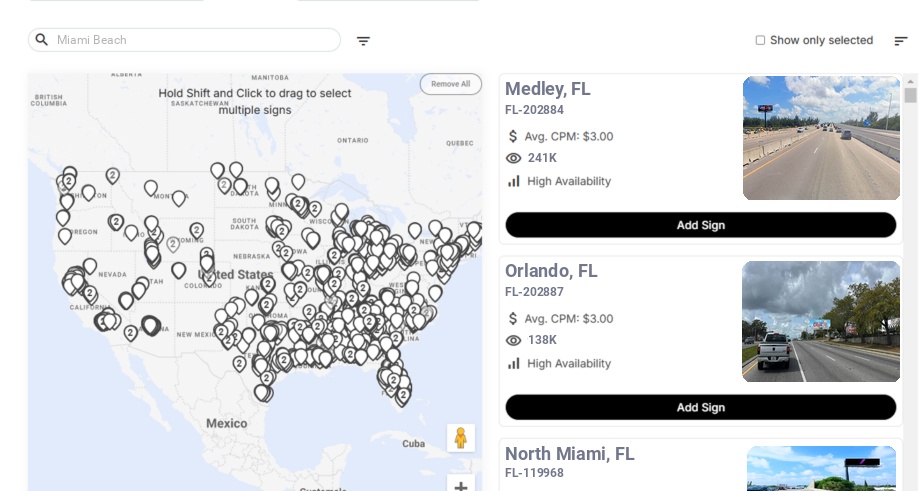



How much is a billboard in Miami Beach?
Why Choose Blip for Billboard Advertising in Miami Beach
Blip lets Miami Beach brands launch fast on Collins, MacArthur, and Julia Tuttle—catching tourists, commuters, and cruise arrivals in one self-serve campaign.
Use Miami Beach dayparting to hit brunch, beach, and nightlife windows on Collins Avenue and Ocean Drive, then shift spend when the crowd shifts.
No contracts means Miami Beach advertisers can test Spring Break, Art Basel, or SOBEWFF bursts, then pause when demand cools.
Track Miami Beach campaigns in real time and move budget from 79th Street commuters to late-night Washington Avenue traffic as results come in.
Blip creative tools help Miami Beach ads stand out with bold, bilingual visuals for a city where Spanish is widely spoken and attention spans are short.
Frequently Asked Questions About Billboard Advertising in Miami Beach
How much does a billboard cost in Miami Beach, Florida with Blip?
With Blip, you can advertise on Miami Beach billboards on any budget by setting a daily amount that works for you; Blip then automatically keeps your campaign within that limit while you pay only for each brief 7.5–10 second “blip” your ad receives. The price of each blip varies based on when and where your ad appears, plus real-time advertiser demand, so you stay in control and can adjust your budget whenever you like. Your total cost is just the sum of the individual blips you choose to run on billboards in Miami Beach, Florida, making premium exposure surprisingly accessible.
Where can I advertise with Blip in Miami Beach, Florida?
Causeway boards are ideal for awareness and directional calls-to-action, especially as inbound volumes to the island can spike 20–40% on weekends and event days. On-island boards work well for last-minute influence—where to eat tonight, which club to try after dinner, or which boutique to visit before heading to the beach—reaching visitors several times per day as they move between hotel, beach, and nightlife. For businesses off the main strip, we can use arrows, distance, and landmarks like near Lincoln Road or near Española Way for clarity.
Who sees Miami Beach billboards with Blip?
Miami Beach has a uniquely layered audience made up of residents, commuters, and tourists, each with different motivations and schedules. The city has a permanent population just over 80,000 residents, but Greater Miami and Miami Beach typically record 16–18 million overnight visitors annually and roughly 8–10 million day visitors. Thousands of people also commute into Miami Beach daily via the MacArthur, Julia Tuttle, Venetian, and 79th Street Causeways.
When is the best time to run Miami Beach billboards with Blip?
Miami Beach doesn’t have the same “quiet” seasonality as many beach towns; it has multiple high-intensity peaks with different audience profiles. Winter high season runs from December through March, while Art Basel and Miami Art Week hit in late November and early December, and Spring Break & festival season runs from March through April. Summer is softer on hotel occupancy, but it can still be a strong time for promotions and extended-stay offers.
What kind of creative works best for Miami Beach billboards with Blip?
Miami Beach is a visually saturated environment; creative must cut through neon, LED signage, and iconic architecture in seconds. Use high contrast, lean into local imagery like Art Deco silhouettes, palm trees, lifeguard stands, sunsets, and ocean views, and keep the message hierarchy simple because drivers and pedestrians often have only 3–7 seconds to process a billboard. In Miami-Dade County and especially in Miami Beach, Spanish is widely spoken, so bilingual headlines or alternating English/Spanish creatives can significantly improve resonance and recall.
Do I need a contract to advertise with Blip in Miami Beach?
No, Blip has no long-term contracts or minimum commitments. You can start, pause, or stop your campaign at any time.
How fast can I launch a billboard campaign with Blip in Miami Beach?
You can have your campaign live in minutes. Create a free account, select your locations, set your budget, upload your design, and start running once approved.
Where can I advertise with Blip in Miami Beach?
Blip has digital billboards in Miami Beach. You can browse available locations on a map, choose the ones that fit your audience, and start advertising right away.
Still have questions? Launch a campaign in minutes — no contracts, no commitments.
Start Your CampaignMiami Beach Billboard Advertising Guide
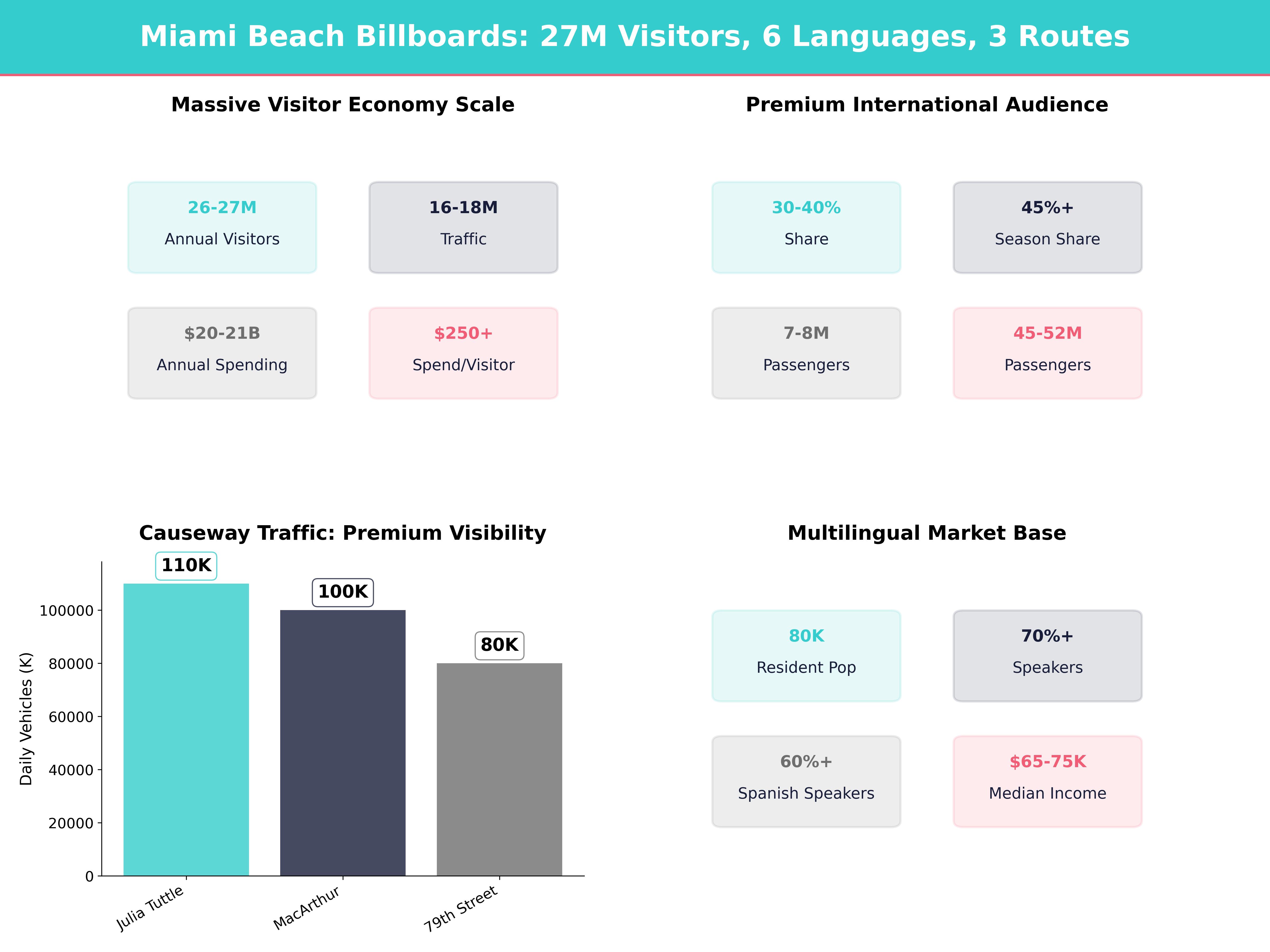
Miami Beach is one of the most visually driven, visitor-heavy cities in the United States, which makes it an ideal place to run high-impact digital billboard campaigns. With a resident population of around 80,000 people but millions of annual visitors, we are speaking to a constantly refreshing audience that is here to spend, explore, and share what they see. Recent tourism reports from the Greater Miami Convention & Visitors Bureau show that Greater Miami and Miami Beach welcome roughly 26–27 million total visitors per year, with 16–18 million overnight visitors and the balance as day trippers, generating more than $20–21 billion annually in direct visitor spending across lodging, dining, retail, and entertainment. By pairing that reality with Blip’s flexibility—short flights, precise dayparting, and the ability to adjust creative quickly—we can build highly efficient, locally tuned strategies using Miami Beach billboards that work for both small and large advertisers.
Understanding the Miami Beach Audience
Miami Beach has a uniquely layered audience made up of residents, commuters, and tourists, each with different motivations and schedules. That mix is what makes Miami Beach billboard advertising especially effective when campaigns are tailored to each group.
-
Residents: The City of Miami Beach reports a permanent population just over 80,000 residents across South Beach, Mid-Beach, and North Beach. Local demographic snapshots show:
- Median age in the low 40s, with a mix of young service-industry workers and older “snowbird” homeowners.
- Median household income in the $65,000–$75,000 range—above the Florida state median—with significant spread between luxury condominium owners and hospitality workers.
- Approximately 60–65% of housing units are renter-occupied, underscoring a large base of year-round and seasonal renters.
- Employment is concentrated in accommodation, food services, retail, and arts/entertainment, reflecting the city’s tourism-driven economy. Many are service-industry workers, hospitality professionals, and small-business owners. This creates a resident audience that is both lifestyle-focused and highly responsive to convenience, dining, and local services messaging.
-
Tourists: According to the Greater Miami Convention & Visitors Bureau, Greater Miami and Miami Beach typically record:
- 16–18 million overnight visitors annually.
- Roughly 8–10 million day visitors.
- Annual hotel occupancy in the 70–75% range across the market, with Miami Beach oceanfront properties often exceeding 80% during peak months.
-
Visitor spending regularly exceeding $20 billion per year, including:
- Around 35–40% on lodging.
- About 25–30% on food and beverage.
- Roughly 15–20% on shopping and retail. The average overnight visitor often spends $250–300+ per person, per day, which strongly supports high-impact advertising for experiences, dining, and retail and justifies investing in prominent billboards in Miami Beach.
-
International mix: Greater Miami is one of the most international metros in the country, and Miami Beach’s tourist base reflects that. City and tourism bureau data show that:
- More than 70% of Miami Beach residents speak a language other than English at home, with Spanish dominant.
- International visitors typically account for 30–40% of total visitors in a given year, with particularly strong volumes from Latin America (Brazil, Argentina, Colombia, Mexico), Europe (UK, Germany, France, Spain, Italy), and Canada.
- In some peak periods, international visitors represent 45%+ of total overnight stays. This strongly supports bilingual (English/Spanish) or even trilingual campaigns, particularly for hospitality, retail, and attractions.
-
Commuters: Thousands of people commute into Miami Beach daily via the MacArthur, Julia Tuttle, Venetian, and 79th Street Causeways, working in hotels, restaurants, nightlife venues, and retail. Traffic count programs from Miami-Dade transportation agencies and the Miami-Dade Transportation Planning Organization show:
- MacArthur Causeway segments typically carry around 90,000–110,000 vehicles per day.
- Julia Tuttle Causeway segments often register 100,000–120,000 vehicles per day.
- 79th Street Causeway commonly sees 70,000–90,000 vehicles per day.
- Even the smaller Venetian Causeway handles a steady flow of local traffic throughout the day. This flow drives significant repeated impressions for commuter-focused messaging and makes commuter corridors prime locations for Miami Beach billboard advertising.
Implication for creatives: Our campaigns should assume we are talking to:
- People who live and work here and see the same boards repeatedly, sometimes 5+ times per week on their regular commute.
- Visitors who are here for 3–5 days on average, looking for “what to do tonight” and “where to spend now.”
That mix rewards simple, instantly legible creative that makes it easy to decide and act within hours—not weeks.
Key Corridors and Movement Patterns
Miami Beach traffic flows are highly directional and time-sensitive, and Blip’s scheduling tools let us take advantage of that. Understanding where billboards in Miami Beach sit relative to these corridors helps us decide which units to prioritize for each objective.
Main access routes:
- MacArthur Causeway (I‑395 / SR 836 extension): Connects Downtown Miami/PortMiami to South Beach. It is one of the primary connectors to PortMiami, which handles around 7–8 million cruise passengers per year, often cited as the “Cruise Capital of the World.” A meaningful share of those passengers arrive one or more nights early or stay after their cruise in Miami Beach hotels, creating a high-value, short-stay audience. MacArthur also funnels traffic from downtown events, Bayside Marketplace, and the Kaseya Center (home of the Miami Heat) into South Beach.
- Julia Tuttle Causeway (I‑195): Primary link between Mid-Beach/North Beach and the I‑95 corridor. With 100,000+ daily vehicles in some segments, it is heavily used by daily commuters and visitors staying at mid- and north-beach hotels, as well as residents accessing mainland employment centers in Downtown, Brickell, and the Miami Design District.
- Venetian Causeway: Smaller but key for locals, boutique hotel guests, and higher-income residents along the Venetian Islands. Traffic volumes are lower than the major causeways, but average household incomes on the Venetian Islands are well above the county average, making it attractive for upscale brands.
- 79th Street Causeway (SR 934): Connects North Beach to North Miami and the mainland, with significant local commuter and retail traffic. Volumes often in the 70,000–90,000 vehicles-per-day range make it important for campaigns targeting North Beach residents and workers, as well as value-oriented hotels and retail centers.
On-island arteries:
- Collins Avenue (A1A): The tourism spine of Miami Beach—lined with hotels, restaurants, bars, and retail. Weekday and weekend traffic patterns are strong throughout the year; during peak events and holidays, north–south travel times can slow to 10–15 mph in segments, effectively increasing dwell time on digital boards. The Miami Beach Visitor and Convention Authority regularly highlights Collins Avenue hotels and attractions as key drivers of visitor stays.
- Washington Avenue: Dense nightlife and service-industry corridor; more locals and workers, plus nightlife visitors. Washington’s blend of residential buildings, bars, and small shops creates multiple daily touchpoints with the same audience.
- Alton Road: Heavily used by residents for daily errands; more practical, local-business-friendly environment. Traffic counts along Alton regularly exceed 30,000–40,000 vehicles per day in busier segments, driven by supermarkets, pharmacies, and neighborhood services.
- Ocean Drive: Heavy pedestrian presence and slow-moving traffic in South Beach’s Art Deco district, with foot traffic surging on weekends and during special events. During major festivals, portions of Ocean Drive may become pedestrian-only, which makes large-format visuals even more impactful to walking visitors. Nearby Lincoln Road and Española Way
Implications:
- Causeway boards are ideal for awareness and directional calls-to-action (“Tonight Only,” “Exit in 2 Miles,” “Turn Left on Collins”), especially as inbound volumes to the island can spike 20–40% on weekends and event days.
- On-island boards work well for last-minute influence—where to eat tonight, which club to try after dinner, or which boutique to visit before heading to the beach—reaching visitors several times per day as they move between hotel, beach, and nightlife.
- For businesses off the main strip, we can use arrows, distance (“0.4 miles ahead”), and landmarks (near Lincoln Road, near Española Way) for clarity, capitalizing on the fact that over half of visitors report walking or using short rideshare trips within the beach area. This is where carefully placed billboards in Miami Beach can bridge the gap between digital discovery and in-person visits.
Seasonality and Event-Driven Strategy
Miami Beach doesn’t have the same “quiet” seasonality as many beach towns; it has multiple high-intensity peaks with different audience profiles. Hotel metrics reported through local tourism and hospitality sources and summarized by outlets like the Miami Herald show large swings in occupancy and average daily rate (ADR) across the year, which advertisers can mirror in their media spend. We can use Blip’s campaign controls to scale up around these moments and time billboard rental in Miami Beach to when demand and spend are highest.
High Seasons
According to MiamiandBeaches.com and local hospitality reporting:
-
Winter high season (December–March):
- Driven by snowbirds, holiday travel, and international visitors escaping winter.
- Many Miami Beach hotels report occupancy levels in the 80–90% range during key winter weeks.
- ADR can be 30–60% higher than low season; luxury properties along Collins and Ocean Drive often see nightly rates exceeding $400–$500 during New Year’s, major holidays, and top convention dates.
- Audience: older, higher-spend tourists, families, and international leisure travelers. These visitors often have above-average household incomes and longer stays, with a significant portion staying 5+ nights.
- Creative focus: upscale dining, luxury retail, wellness and spa, premium experiences, fine arts, and attractions.
-
Spring Break & festival season (March–April):
- Younger demographic; heavy nightlife, music, and entertainment demand.
- In strong years, local reports cite hundreds of thousands of Spring Break-related visitors over the full period, concentrating particularly on weekends.
- Miami Beach has implemented stricter controls on public safety in recent years, including curfews and increased police presence in certain zones, but the period still brings substantial visitor volumes and high late-night activity.
- Creative focus: nightlife, bars, clubs, late-night food, rideshares, event promotions, and youth-oriented brands. Short, high-frequency bursts over a 2–4 week window can capture much of the available demand.
-
Art Basel and Miami Art Week (late November–early December):
- Art Basel Miami Beach tens of thousands of attendees—often estimated in the 70,000–80,000 range across VIPs, collectors, and general visitors.
- The Miami Beach Convention Center becomes the epicenter; the facility spans over 1.4 million square feet, including 500,000+ square feet of exhibit space and hosts hundreds of thousands of attendees annually across its event calendar.
- Satellite fairs and events across Miami Beach and the mainland generate a citywide spike in luxury spending; local coverage regularly notes record sales for galleries, private events, and fine dining venues during this week.
- Creative focus: luxury brands, galleries, design, high-end dining, private events, and premium services (chauffeurs, private aviation, yacht charters).
Shoulder and Low Seasons
-
Summer (June–September):
- Hotter, more humid; more domestic families, Caribbean and Latin American vacationers, and value-seeking travelers.
- Average hotel occupancy can soften into the 60–70% range with ADR often 20–30% lower than peak winter months, making it a strong time for promotions and extended-stay offers.
- Families are more price-sensitive but still spend strongly on activities: local tourism data frequently shows attraction and dining spend remaining robust even as room rates decline.
- Creative focus: promotions, family activities, attraction passes, retail sales, indoor entertainment, and locals’ discounts.
-
Hurricane season (June–November):
- Weather variability can affect day-to-day visitor activity; in weeks with active storm threats, cancellations and shorter stays can temporarily reduce occupancy.
- Blip’s ability to pause, resume, or shift budgets quickly lets us respond to weather: for example, pushing indoor attractions during heavy rain days, reinforcing takeout and delivery for restaurants, and scaling back outdoor/event-focused messages when a storm is approaching.
- When conditions are clear, hurricane season can actually generate opportunistic demand from value-focused travelers who take advantage of lower rates and smaller crowds.
Using Blip, we can pre-build templates for peak, shoulder, and low seasons, then rotate creatives and budgets accordingly instead of starting from scratch each time, mirroring the same seasonality hotels and attractions use in their yield management. This approach ensures billboard rental in Miami Beach remains profitable across the full calendar year.
Dayparting: Matching Messages to Daily Routines
Miami Beach behaves differently by time of day. Visitor behavior research summarized by tourism agencies and covered by local outlets such as WLRN and NBC 6 South Florida consistently shows that dining, nightlife, and shopping decisions are heavily clustered by time of day. Blip’s granular scheduling lets us reflect that:
Morning (6 a.m.–10 a.m.)
- Audience: hotel guests heading to breakfast or tours, workers commuting in via causeways, fitness and beachgoers. In resort areas, a large share of visitors—often 40–50%—report being out of their rooms by mid-morning.
-
Strategy:
- On causeways: promote breakfast cafes, coffee shops, tours with morning departures, coworking, and professional services.
- On Collins/Alton: “Open Now” breakfast and brunch spots; fitness studios; wellness offers (yoga, spas, gym day passes).
- Use concise, benefit-led copy, as average vehicle speeds are higher than mid-day and dwell times slightly shorter.
Midday (10 a.m.–4 p.m.)
- Audience: beachgoers, shoppers, families, conference attendees. Surveys of Miami-area visitors show that midday is prime time for shopping and attractions, with many visitors allocating 2–4 hours in this window to off-beach activities.
-
Strategy:
- Retail, beach clubs, lunch specials, museums, boat tours, and spa services.
- Promote sun-safe and weather-reactive messaging (e.g., “Too Hot? Cool Off at Our Indoor Exhibit”) that we can manually toggle or rotate as forecasts change.
- Encourage immediate decisions: “Walk In Today,” “Tours Leaving Every Hour,” or “No Reservation Needed.”
Evening (4 p.m.–9 p.m.)
- Audience: pre-dinner and pre-nightlife crowd; commuters heading home. Dining surveys across Greater Miami indicate that more than half of visitors dine out for dinner most nights of their stay, and many choose restaurants same-day.
-
Strategy:
- Strong calls-to-action for dinner reservations, happy hours, shows, and events “Tonight.”
- Directional creatives helping visitors pick a neighborhood (South of Fifth, Lincoln Road, Sunset Harbour).
- Align spend with inbound flows: southbound and eastbound causeway traffic as visitors head to dinner, and major north–south hotel corridors on Collins.
Late Night (9 p.m.–3 a.m.)
- Audience: nightlife, hospitality workers, rideshare drivers, club and bar patrons. Miami Beach is a late-night city; local nightlife districts often see peak walk-up volumes between 11 p.m. and 2 a.m. on weekends.
-
Strategy:
- Nightclubs, bars, late-night food, rideshare or designated-driver services, after-parties.
- Bold, high-contrast, neon-style visuals work particularly well in the Miami Beach night environment.
- Consider rotating creative by weekday vs. weekend, with heavier emphasis Thursday–Sunday, when nightlife and club visitation spikes.
We can split our budget so that higher-value dayparts (like early evening for restaurants) get more frequent blips, while lower-value hours get coverage only when needed. For example, a restaurant might allocate 50–60% of spend to 4–9 p.m., 25–30% to midday, and the balance to morning and late night. This kind of dayparting is one of the main advantages of digital Miami Beach billboards over static placements.
Creative Considerations for Miami Beach
Miami Beach is a visually saturated environment; our creative must cut through neon, LED signage, and iconic architecture in seconds.
1. Visual style
- Use high contrast: bold colors against dark or light backgrounds—neon blues, hot pinks, turquoise, and golds work well with the local aesthetic and photograph well for social media, which can extend your impressions beyond the billboard itself.
- Lean into local imagery: Art Deco silhouettes, palm trees, lifeguard stands, sunsets, and ocean views. These resonate immediately with visitors and match the imagery promoted by the Miami Beach Visitor and Convention Authority.
- For luxury positioning (common around Art Basel and high season), simplify: minimalistic layouts, lots of negative space, and a single powerful image. Luxury buyers, who often spend 2–3 times the average visitor on dining and retail, respond well to clean, exclusive visuals.
2. Language and multicultural appeal
- In Miami-Dade County and especially in Miami Beach, Spanish is widely spoken; local profiles indicate that 60%+ of residents speak Spanish at home, and a large share of visitors from Latin America are Spanish-dominant.
-
For visitor-facing campaigns, bilingual headlines or alternating English/Spanish creatives can significantly improve resonance and recall with both locals and tourists:
- E.g., “Dinner Tonight on Ocean Drive” followed by “Cena Esta Noche en Ocean Drive.”
- Consider Portuguese or French support if you target high-volume international segments, especially Brazilian or European travelers during key holidays; Brazil alone typically ranks among the top 3–5 international source markets for Greater Miami.
3. Message hierarchy
Because drivers and pedestrians often have 3–7 seconds to process a billboard:
- Limit to 6–8 words for primary message.
- Keep URLs short (preferably brandname.com or a custom short domain).
- Try one main call-to-action per creative (“Book Now,” “Turn Left,” “Tonight 9 PM”).
- Use large type and avoid thin fonts; remember that at typical viewing distances of 300–600 feet, overly detailed text will be lost.
We can rotate variants rapidly with Blip to A/B test which message structure gets better response (e.g., promo-focused vs. brand-focused, English-only vs. bilingual).
4. Use of urgency and time-bound offers
Miami Beach’s visitors typically stay 3–5 days, and many decisions are same-day:
- Use phrases like “Tonight Only,” “This Weekend,” “Happy Hour 4–7 PM,” or “Show This Ad for 10% Off Today.”
- Change offers by weekday vs. weekend with Blip’s scheduling, so we don’t show weekend-only deals on Mondays.
- Consider aligning urgency with major events: during Miami Beach Pride, South Beach Wine & Food Festival
Targeting Locals vs. Visitors
We should consciously design campaigns either for locals, visitors, or a hybrid, then pick boards and schedules accordingly. Smart placement and scheduling across Miami Beach billboards allows one campaign to serve multiple audience segments without wasted spend.
Visitor-focused campaigns:
-
Prioritize:
- Causeway and airport-adjacent routes (noting that Miami International Airport is on the mainland but feeds many visitors into Miami Beach). MIA typically handles 45–52 million passengers per year, and a substantial portion of leisure passengers stay in Miami Beach.
- Collins Avenue, Ocean Drive, and Lincoln Road vicinity, where visitor foot traffic is dense and daily.
-
Messaging themes:
- Experiences (“Boat Tours Today,” “VIP Table Tonight,” “Art Gallery Open Late”).
- Convenience (“Steps from the Beach,” “2 Blocks from Ocean Drive”).
- Packages or passes (“3 Attractions, 1 Ticket,” “Family Fun Pass – Save 20%”). Visitors commonly look for bundle value; tourism bureau research often shows that multi-attraction passes increase total spend per party while simplifying decision-making.
Local-focused campaigns:
-
Prioritize:
- Traffic heavy with residents and workers: Alton Road, North Beach corridors, Julia Tuttle and 79th Street Causeways, and neighborhood-oriented streets identified in City of Miami Beach transportation plans.
- Morning and late-night commuter windows, when workers and business owners travel to and from shifts.
-
Messaging themes:
- Service businesses (insurance, real estate, healthcare, auto, legal).
- Employment and hiring (“Now Hiring – Walk In Interviews”). Hospitality employers often need to reach a workforce where job turnover can exceed 30–40% annually, so ongoing recruiting messages can be effective.
- Local loyalty programs and weekday offers (“Locals’ Tuesday 20% Off,” “Free Delivery in Miami Beach”).
We can also create hybrid campaigns where certain creatives run only during commuter hours (local message) and others run mid-day/weekends (visitor message), all on the same boards, allowing one location to work double-duty and maximizing the value of your billboard rental in Miami Beach.
Leveraging Major Events and the Convention Calendar
The Miami Beach Convention Center 10,000+ attendees per show. The renovated facility offers:
- Over 1.4 million square feet of total space.
- Approximately 500,000–600,000 square feet of exhibit space.
- Four ballrooms and nearly 60 meeting rooms, which can host concurrent events.
Major events include Art Basel, large industry-specific expos, tech and healthcare conferences, and spillover from the Discover Boating Miami International Boat Show hundreds of thousands.
For brands targeting B2B or specific professional groups, we can:
- Focus spend on dates around large conventions published on the convention center’s calendar.
- Use language referencing the event location (“Steps from the Convention Center,” “Show Your Badge for 15% Off”).
- Run directional creative leading from convention areas to your location, leveraging the fact that many delegates stay at nearby hotels within a 10–15 minute walk.
Other major events that move tourism and local activity include:
- Art Basel Miami Beach / Miami Art Week (late November–early December).
- Miami Beach Pride (typically April), which draws tens of thousands of attendees to parades, concerts, and related events.
- South Beach Wine & Food Festival (SOBEWFF, typically February) hosted largely on the beach and around Collins Avenue, featuring 90+ events and celebrity chefs and attracting tens of thousands of food and wine enthusiasts.
- Holiday weekends (New Year’s Eve, Memorial Day, Labor Day, Fourth of July), when occupancy and ADR can spike well above monthly averages.
- Cultural events and festivals promoted by the City of Miami Beach Tourism & Culture Department, which often include free concerts, film festivals, and public art activations.
We can build event-specific creatives that turn on only for those windows, then revert to evergreen messaging afterward—all within the same Blip campaign, aligning with the spikes in foot traffic and spending that local tourism and news outlets regularly document. For brands that rely on conventions and festivals, this type of Miami Beach billboard advertising provides a flexible, high-visibility complement to digital and on-site promotions.
Budgeting and Frequency in a High-Volume Market
Miami Beach’s advertising environment is competitive, but digital billboards let us buy intelligently even on modest budgets.
Frequency vs. reach
- Causeway boards can deliver tens of thousands of daily impressions per face, with some high-traffic faces effectively reaching 100,000+ vehicle trips per day. When targeting commuters, higher frequency (same drivers seeing your ad multiple times per week) leads to better recall; outdoor advertising studies commonly show that 5–7 exposures over a short window materially boost brand awareness.
- On tourist-heavy corridors, reach (hitting more unique visitors) can matter more, as many individuals will only see your boards during their short stay. A visitor may walk or drive past your board 2–3 times over a long weekend; you want to make sure you’re live during those critical windows.
We can:
- Concentrate budget on a small set of boards for local, repeat exposure, aiming for high weekly impression counts among the same viewers.
- Spread budget across multiple boards and dayparts for visitor campaigns aiming at broader reach, especially during peak tourism weeks.
Dynamic budget allocation
-
Increase bids and budgets for:
- Weekends, when hotel occupancy and restaurant covers typically rise 15–30% versus midweek.
- Major events and conventions, which can bring 10,000–80,000+ incremental visitors to the area.
- High season months (December–March; Art Basel week; Spring Break).
-
Decrease or pause during:
- Severe weather events or active hurricane threats.
- Low-traffic weekdays outside your business hours.
- Off-peak months if your business is highly seasonal.
Blip’s flexibility lets us experiment: for instance, run a two-week heavier test on Julia Tuttle morning inbound, then shift to MacArthur afternoon outbound and compare in-store or online response. Over time, these tests help identify which corridors produce the highest return per dollar in terms of bookings, sales, or leads. By continuously reallocating spend, marketers can treat billboard rental in Miami Beach with the same performance mindset they bring to search and social campaigns.
Measuring Impact and Optimizing
Even though billboards are an offline medium, we can create clear measurement paths.
1. Trackable calls-to-action
- Use unique promo codes specifically for billboard audiences (“MBEACH10,” “SOBEACH20”) and track redemption counts; even a modest redemption rate (e.g., 1–3% of exposed customers) can represent substantial incremental revenue in high-ticket categories like dining and tours.
- Use short URLs or QR codes pointing to campaign-specific landing pages, and watch direct traffic and conversions during your flight.
- For local services, ask customers “How did you hear about us?” and track billboard as a distinct source in your CRM or POS.
2. Time-based attribution
- Align your busiest walk-in, booking, or web-traffic periods with your Blip schedule. If you notice that sales or bookings increase 10–20% during the weeks when your boards are active versus similar non-advertising weeks, that’s a strong directional signal—even before more advanced modeling.
- Compare performance on days or dayparts with and without billboard activity while keeping other marketing channels steady to isolate the billboard effect.
3. Creative rotation testing
-
Run two or three creative variants:
- English-only vs. bilingual.
- Offer-led (“20% Off Tonight”) vs. brand-led (“Miami Beach’s Top-Rated Sushi”).
- Image-heavy vs. text-heavy.
- Rotate them evenly over a set period, then compare performance indicators (store traffic, online conversions, or promo code use). With Blip, swapping or pausing underperforming creatives is quick and low-friction; reallocating even 20–30% of impressions toward better-performing creative can materially improve campaign ROI.
Regulatory and Community Context
The City of Miami Beach has a strong stance on aesthetics and signage, especially in historic and residential areas. Digital billboards available through Blip will already comply with local regulations, but we should still be respectful of:
- Sensitivity around neighborhood character, particularly in historic Art Deco districts overseen by local preservation programs.
- Community concerns during high-impact times like Spring Break (public safety messaging often increases; many residents and local officials focus heavily on quality-of-life issues and have implemented crowd-control measures).
- Noise and light concerns in residential corridors; even legal signage that appears too aggressive or off-tone can draw negative press or community pushback in local outlets like the Miami Herald or Local 10 News.
Brands that demonstrate awareness of local values—safety, sustainability, cultural pride—can build goodwill. Consider occasional creatives that:
- Promote community involvement (“Proud Sponsor of Miami Beach Pride,” “Supporting Local Artists This Art Week”).
- Highlight environmental responsibility (beach cleanups, plastic reduction, reusable products). Environmental stewardship is a recurring theme in city communications and in the work of organizations highlighted by the Miami Beach Chamber of Commerce.
- Feature partnerships with local nonprofits, schools, or cultural institutions, linking your brand to the long-term wellbeing of the destination.
Linking to or collaborating with entities such as the Miami Beach Chamber of Commerce, neighborhood associations, or local cultural organizations can further strengthen local credibility and may open cross-promotion opportunities around major events. For advertisers, aligning Miami Beach billboard advertising with community priorities can improve both brand perception and long-term campaign performance.
Putting It All Together
To maximize digital billboard campaigns in Miami Beach with Blip, we recommend:
- Define audience first: locals, visitors, specific event attendees, or a mix. Use available data—such as annual visitor volumes of 26–27 million, average stays of 3–5 nights, and causeway traffic counts over 80,000–100,000 vehicles per day—to decide where your best prospects are and which Miami Beach billboards can reach them most efficiently.
- Map movement: choose causeways for inbound awareness, on-island arteries for immediate action. Align eastbound vs. westbound and north–south patterns with when your audience is most likely to purchase.
- Time your campaign: align with high seasons, major events, and dayparts that match your customers’ behavior, increasing spend when hotel occupancy, ADR, and visitor spend are all peaking.
- Craft bold, bilingual-aware creative: minimal words, strong visuals, clear calls-to-action, and, where appropriate, Spanish support to connect with a market where 60%+ of residents—and a large portion of visitors—are comfortable in Spanish.
- Use Blip’s flexibility: adjust schedules and bids based on occupancy, weather, events, and performance data, shifting flights in near real time around storms, last-minute conventions, or unexpected surges in demand.
- Measure and iterate: implement trackable offers, watch performance around live dates, and refine creatives and placements accordingly. Even simple tracking (promo codes, landing pages, time-based comparisons) can reveal which boards, dayparts, and messages drive the highest return.
Miami Beach is a city where people come to experience more—more culture, more nightlife, more dining, more style. With carefully planned, data-informed digital billboard campaigns and strategic billboard rental in Miami Beach, we can meet them at every step of their journey and turn that desire into measurable results.