Billboards near Coral Terrace, FL
No Minimum Spend. No Long-Term Contracts. Just Results.
Trusted by Leading Brands


Billboard advertising
near Coral Terrace has never been easier




How much is a billboard near Coral Terrace?
Why Choose Blip for Billboard Advertising near Coral Terrace
Blip lets Coral Terrace brands launch fast on SR 836, SR 826, and SW 8th Street traffic without long-term contracts.
Use flexible budgets in Coral Terrace to reach commuters heading to Coral Gables, Downtown Miami, Doral, and the airport corridor.
Daypart your Coral Terrace ads for the 7–9 a.m. and 4–7 p.m. rush, when repeat commuter exposure is highest.
Track Coral Terrace campaign results in real time and shift spend toward the local routes and time blocks that perform best.
Blip’s creative tools make it easy to test Spanish-first, bilingual, or family-focused ads for Coral Terrace’s Hispanic audience.
Frequently Asked Questions About Billboard Advertising near Coral Terrace
How much does a billboard cost near Coral Terrace, Florida with Blip?
With Blip, you can advertise on digital Coral Terrace billboards on almost any budget, because you only pay per “blip”—a 7.5 to 10-second ad display on rotating digital billboards serving the Coral Terrace area. You choose your daily budget during campaign setup, and Blip automatically keeps your campaign within that limit, so you stay in control and can adjust your spend anytime. The price of each blip on billboards near Coral Terrace, Florida depends on when and where your ad runs and on advertiser demand, so you only pay for the exposure you receive.
Where can I advertise with Blip near Coral Terrace, Florida?
We do not place billboards directly inside Coral Terrace, but our 45 digital faces near Miami, Medley, Hialeah, and Hialeah Gardens are positioned along the major commuter arteries that residents use daily. This placement ensures that when advertisers request billboards near Coral Terrace, their messages are still integrated into the most important everyday routes for local drivers. Billboards serving the Coral Terrace area reach not only local residents but also daily commuters connecting between Coral Gables, FIU, the Miami International Airport district, Hialeah, and central Miami.
What kind of audience do Coral Terrace, Florida billboards reach?
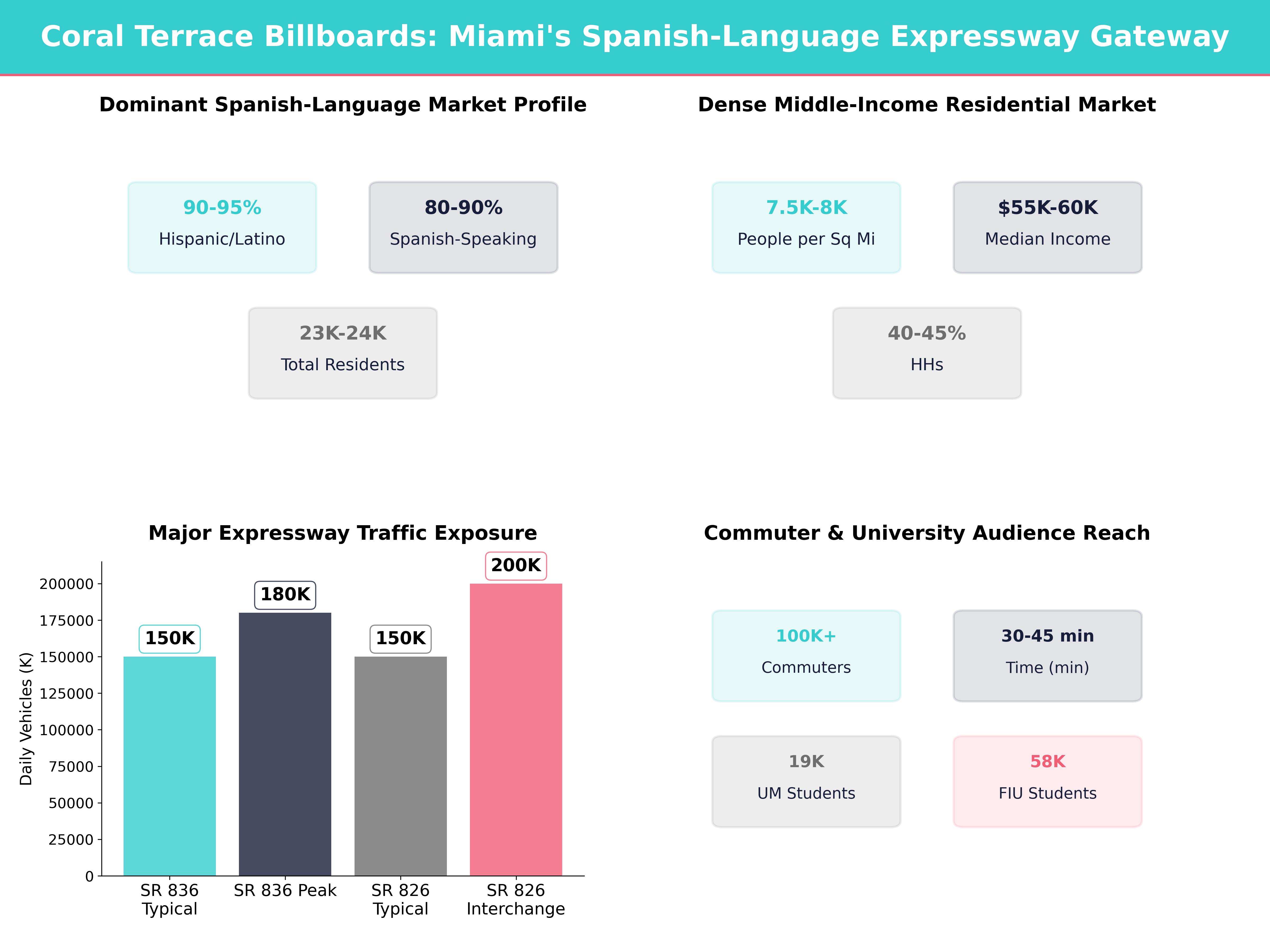
The Coral Terrace area is overwhelmingly Hispanic and Spanish-speaking. Around 90–95% of residents identify as Hispanic or Latino, and roughly 80–90% of households primarily speak Spanish at home. For broad consumer campaigns, we recommend Spanish-first or bilingual creative, especially on boards serving SW 8th Street and local arterials.
When is the best time to run Coral Terrace, Florida billboards with Blip?
For Coral Terrace area advertisers, late summer and early fall are stronger for local-only focus, when tourism dips and roads skew more toward residents. November–April is ideal for a local + tourist focus, when both residents and tourists crowd the roads passing near Coral Terrace. With Blip’s scheduling tools, we can push more impressions during these high-value windows without being locked into a static, year-long buy.
What roads and traffic patterns make Coral Terrace, Florida billboards effective?
Coral Terrace sits at the heart of west Miami-Dade’s daily commute grid, wedged between Coral Gables, Westchester, and central Miami. Key nearby corridors include Dolphin Expressway (SR 836), Palmetto Expressway (SR 826), and US-41 / SW 8th Street (Tamiami Trail), which all carry heavy traffic. On a typical weekday, regional traffic models show hundreds of thousands of vehicle trips moving through this central-west corridor of Miami-Dade, creating repeated exposures for campaigns that follow commuter flows.
Do I need a contract to advertise with Blip near Coral Terrace?
No, Blip has no long-term contracts or minimum commitments. You can start, pause, or stop your campaign at any time.
How fast can I launch a billboard campaign with Blip near Coral Terrace?
You can have your campaign live in minutes. Create a free account, select your locations, set your budget, upload your design, and start running once approved.
Where can I advertise with Blip near Coral Terrace?
Blip has digital billboards near Coral Terrace. You can browse available locations on a map, choose the ones that fit your audience, and start advertising right away.
Still have questions? Launch a campaign in minutes — no contracts, no commitments.
Start Your CampaignCoral Terrace Billboard Advertising Guide
Understanding the Coral Terrace Area Market
Coral Terrace is an unincorporated community in Miami‑Dade County, just west of Coral Gables and about 7 miles west of Downtown Miami. It’s compact but extremely dense, which is ideal for billboard frequency and makes Coral Terrace billboards especially effective for sustained local visibility:
- Population: roughly 23,000–24,000 residents within just over 3 square miles (density of about 7,500–8,000 people per square mile), making it denser than many nearby suburban areas of Miami‑Dade.
- Age profile: median age in the early‑40s, with around 60–65% of residents in core working ages (18–64), and a notable share of children under 18 (about 18–22%), supporting family-oriented products and services.
-
Household income: typical household incomes in the Coral Terrace area fall in the $55,000–$60,000 range, with a broad middle-income band:
- Roughly 40–45% of households between $35,000 and $75,000.
- An additional 20–25% above $75,000, including dual‑income professional households commuting into Coral Gables, Downtown Miami, and Doral.
The Coral Terrace area is largely residential but is surrounded by key commercial and institutional anchors:
- Downtown Coral Gables and Miracle Mile shopping and dining (about 3 miles east) – promoted by the City of Coral Gables and the Coral Gables Chamber of Commerce
- Major medical facilities like Doctors Hospital Nicklaus Children’s Hospital
- University of Miami in Coral Gables, with over 19,000 students plus thousands of faculty and staff, according to UM. UM home football games and major events routinely draw crowds in the 30,000–60,000 range to the broader area.
- Florida International University’s Modesto A. Maidique Campus west of the area, with roughly 58,000 students system‑wide per FIU, plus over 9,000 faculty and staff.
-
Nearby employment hubs:
- The Miami International Airport district, where Miami International Airport reports over 36 million total passengers in 2023 and tens of thousands of on‑site jobs.
- Doral and airport‑area logistics/warehouse clusters, supported by Miami‑Dade County as one of the region’s largest employment zones.
- Industrial and distribution centers in Hialeah, Hialeah Gardens, and Medley, highlighted in planning documents from the Miami‑Dade Transportation Planning Organization.
Billboards serving the Coral Terrace area reach not only local residents but also daily commuters connecting between Coral Gables, FIU, the Miami International Airport district, Hialeah, and central Miami. On a typical weekday, regional traffic models show hundreds of thousands of vehicle trips moving through this central-west corridor of Miami‑Dade, creating repeated exposures for campaigns that follow commuter flows and rely on sustained billboard advertising near Coral Terrace.
A Bilingual, Hispanic‑Dominant Audience
The Coral Terrace area is overwhelmingly Hispanic and Spanish‑speaking:
- Around 90–95% of residents identify as Hispanic or Latino, among the highest concentrations in Miami‑Dade.
- Roughly 80–90% of households primarily speak Spanish at home, with high English proficiency among younger adults and professionals.
- In the broader Miami‑Dade region, more than 70% of residents speak a language other than English at home, and Spanish is the dominant language in daily commerce, media, and neighborhood life.
This has direct implications for creative strategy on Coral Terrace billboards and nearby boards:
-
Language mix
- For broad consumer campaigns (retail, QSR, CPG, telecom), we recommend Spanish‑first or bilingual creative, especially on boards serving SW 8th Street and local arterials.
- For more specialized professional or B2B services, English‑dominant or bilingual works well, especially when targeting commuters working in Downtown Miami, Coral Gables, Doral, or the Airport district.
-
Cultural references
Draw on familiar local touchpoints: Miami sports (Heat, Dolphins, Marlins, Inter Miami), family‑centric imagery, and neighborhood‑oriented messages (e.g., “para tu familia en el área de Coral Terrace”). Local sports venues and events highlighted by the Greater Miami Convention & Visitors Bureau regularly attract crowds in the tens of thousands, amplifying brand visibility when tied to game days. -
Copy length
Spanish phrases can run longer; keep text extremely tight (ideally 7 words or fewer) and prioritize one clear call‑to‑action. Field tests across digital OOH campaigns in South Florida consistently show that messages with 7 words or fewer and one focal visual element can achieve recall rates 20–30% higher than cluttered designs.
Blip’s flexibility allows us to A/B test language quickly—e.g., run a Spanish‑only creative, a bilingual creative, and an English‑leaning version in rotation to see which earns more engagement (as measured by web traffic, call volume, or promo code use when your blips run).
Where Traffic Flows Around the Coral Terrace Area
We do not place billboards directly inside Coral Terrace, but our 45 digital faces near Miami, Medley, Hialeah, and Hialeah Gardens are positioned along the major commuter arteries that residents use daily. This placement ensures that when advertisers request billboards near Coral Terrace, their messages are still integrated into the most important everyday routes for local drivers.
Key nearby corridors that shape viewing patterns include:
- Dolphin Expressway (SR 836) – just north of Coral Terrace, this is one of Miami‑Dade’s most heavily traveled east‑west corridors, linking the Airport area to Downtown and the western suburbs. According to the Miami‑Dade Expressway Authority, annual average daily traffic on segments of SR 836 often exceeds 150,000 vehicles per day, with some stretches approaching 180,000 vehicles per day.
- Palmetto Expressway (SR 826) – running north‑south west of Coral Terrace, connecting to Hialeah, Hialeah Gardens, and Medley. FDOT District Six data frequently shows 150,000+ vehicles per day on busy segments of SR 826 ( FDOT District Six 200,000+ vehicles per day when combined with ramps and connectors.
- US‑41 / SW 8th Street (Tamiami Trail) – forming the southern edge of the Coral Terrace area, with heavy local and commuter traffic plus strong retail and restaurant presence. Local counts on commercial stretches of SW 8th Street in west Miami‑Dade commonly exceed 40,000–50,000 vehicles per day.
- Arterials through nearby Miami, Hialeah, and Medley that feed industrial zones, distribution centers, and airport‑related employment hubs, including corridors highlighted in the Miami‑Dade TPO traffic and freight plans.
Commuting patterns in the broader Miami metro mean long drive times: average commute times around 30–33 minutes are common across Miami‑Dade, with many workers in the central-west corridor spending 45 minutes or more in daily one‑way travel. This translates into significant billboard exposure and high weekly frequency.
Many Coral Terrace area residents travel toward:
- Downtown Miami and Brickell – the City of Miami estimates over 100,000 daytime workers in the urban core.
- Coral Gables business district – thousands of office, retail, and hospitality jobs clustered around Miracle Mile and Ponce de Leon Boulevard.
- Doral and airport area logistics hubs – supported by Miami International Airport and airport‑area business parks.
- Hialeah industrial and retail centers – anchored by major retailers, manufacturers, and logistics companies promoted by the City of Hialeah.
By targeting digital billboards near Miami, Hialeah, Hialeah Gardens, and Medley with Blip, we can repeatedly intersect the same drivers from the Coral Terrace area multiple times per week. For campaigns that run daily on key commuter corridors, it’s realistic to achieve 10–20 impressions per week per regular commuter, building strong local brand familiarity through sustained billboard advertising near Coral Terrace.
Seasonality: When to Push Harder
Tourism greatly amplifies road traffic throughout Miami‑Dade County. The Greater Miami Convention & Visitors Bureau has reported 25–27 million overnight visitors annually in recent years, plus millions of additional day visitors arriving via cruises at PortMiami or regional drive‑markets.
These visitors jam highways, particularly from:
- December–April: peak “snowbird” and winter tourism season, when hotel occupancy frequently runs in the 75–85% range across Greater Miami.
- March–May: spring break, Ultra Music Festival, Miami Open, and other major events, each drawing tens of thousands of attendees over event weekends.
- November–December: Art Basel Miami Beach and holiday shopping, with some retail centers reporting double‑digit percentage increases in foot traffic versus off‑season months.
For Coral Terrace area advertisers, this translates into:
-
Local‑only focus:
- Stronger in late summer and early fall (August–October), when tourism dips and roads skew more toward residents.
- Ideal for back‑to‑school campaigns, healthcare, local restaurants, and service providers. Miami‑Dade Public Schools, via Miami‑Dade County Public Schools, enrolls over 330,000 students, and back‑to‑school shopping and healthcare checkups surge in July–September.
-
Local + tourist focus:
- November–April, when both residents and tourists crowd the roads passing near Coral Terrace.
- Great for hospitality, attractions, dining, retail, and transportation services. Miami‑Dade’s hotel, food service, and entertainment sectors collectively employ well over 150,000 workers, many of whom commute through the expressway network near Coral Terrace.
With Blip’s scheduling tools, we can push more impressions during these high‑value windows without being locked into a static, year‑long buy—concentrating budget during weeks where road volumes and visitor spending are at their peaks.
Dayparting: Matching Messages to Daily Life
Life patterns around the Coral Terrace area are heavily commuter‑driven and family‑oriented. Miami‑Dade’s typical workday traffic peaks:
- Morning commute: roughly 7:00–9:30 a.m.
- Midday / errands: 11:00 a.m.–2:00 p.m.
- Evening commute: 4:00–7:00 p.m.
- Late night / nightlife (downtown, Wynwood, Brickell draws): 9:00 p.m.–1:00 a.m. on Thursdays–Saturdays.
On major expressways, volumes during peak hours can be 30–40% higher than mid‑day baselines, according to FDOT District Six
-
Morning drive
- Best for coffee shops, breakfast spots, auto services, healthcare reminders (“Schedule your checkup today”), and education (schools, colleges).
- Use quick clarity: “Café cubano 5 min ahead – Exit now.”
- Many parents in the area drop children at schools within the Miami‑Dade County Public Schools system between 7:00–9:00 a.m., creating repetitive, route‑based exposures.
-
Midday
- Reach stay‑at‑home parents, service workers, shift workers, and retirees running errands near the Coral Terrace area.
- Ideal for lunch specials, retail sales, grocery and pharmacy messaging, and same‑day services (e.g., walk‑in clinics, auto repair).
- In retail‑heavy corridors like SW 8th Street, midday traffic often represents 25–30% of daily volume, supporting steady visibility.
-
Evening drive
- Great for restaurants, grocery chains, streaming services, gyms, and after‑work activities.
- Family‑oriented creative plays well: “Cena lista en 15 minutos – Ordena en línea.”
- Many service businesses in Miami‑Dade report 30–40% of daily revenues occurring after 5 p.m., making this a prime window for time‑sensitive offers.
-
Late night / weekend nightlife
- Bars, clubs, rideshare services, and quick‑serve restaurants can target nightlife traffic moving between Coral Terrace, Coral Gables, Brickell, Midtown, and the Airport area.
- Entertainment districts promoted by the City of Miami and tourism agencies draw strong late‑night volumes Thursday–Saturday.
By isolating and testing time blocks, we can learn when cost per result (e.g., per website visit or coupon redemption) is lowest and reallocate your Blip budget accordingly. In many Miami‑area campaigns, advertisers find that focusing on 2–3 high‑impact dayparts can reduce cost per acquisition by 20–40% vs. running 24/7.
Creative Strategies That Work Near Coral Terrace
Digital billboards serving the Coral Terrace area must cut through both literal and visual heat: Miami sun, bright skies, and color‑dense surroundings.
Key design practices for this market:
-
High contrast and bold color
- Use dark backgrounds with bright text or vice versa.
- Avoid thin fonts and low‑contrast pastels; sunlight and fast speeds will wash them out. On expressways where average speeds can reach 45–60 mph, drivers typically glance at a board for 6–8 seconds, so legibility is critical.
-
Bilingual hierarchies
- If using two languages, pick a dominant one. For example, Spanish main line, smaller English tagline.
-
Example:
- Big: “Seguro de auto desde $29/mes”
- Small: “Auto insurance you can afford.”
-
One idea per creative
- Given 6–8 seconds of viewing, focus on one clear message: a price, a benefit, or a location cue.
- Use geocues like “a 5 minutos del área de Coral Terrace” or “cerca de Coral Gables.” Campaign tests in the Miami market consistently show higher recall when a specific distance or exit is mentioned.
-
Directional and proximity cues
- Many Coral Terrace area decisions are hyperlocal—people decide where to eat, fix their cars, or shop while driving along SW 8th St or heading to the expressway.
- Use arrows, “next exit,” or “just off SW 8th St” style cues to catch drivers in the moment.
-
Mobile‑friendly calls-to-action
- Mobile internet usage in the Miami metro area is very high, with smartphone penetration comfortably above 85–90% among adults. Short URLs, QR codes (on slower‑speed locations), and simple prompts like “Busca: ‘Dentista Coral Terrace’” work well.
We also encourage advertisers to adapt creatives for weather: afternoon rainstorms are common in summer, with Miami‑area rainfall peaking from June through September. For example, rotate in “Lluvia hoy – revisa tus llantas” for tire shops or “Pide delivery ahora antes de la tormenta” for restaurants.
Using Blip’s Flexibility to Own the Coral Terrace Area
Blip’s platform lets us buy digital billboard space by the “blip”—a single play of your ad—rather than long‑term, all‑or‑nothing contracts. That’s especially powerful in a compact residential area like Coral Terrace, where we want frequency among the same local drivers and need cost‑efficient billboard rental near Coral Terrace that can scale up or down quickly.
Ways to take advantage:
-
Hyper-local coverage without overpaying
- Focus your budget on faces near Miami, Medley, Hialeah, and Hialeah Gardens that align with the Coral Terrace area’s outbound and inbound routes.
- You don’t have to purchase every board; we can test a subset and expand once results are proven. In practice, many advertisers see strong results with 5–10 well‑chosen faces before scaling up.
- Align with local corridors and business parks outlined by communities such as Hialeah Gardens Town of Medley.
-
Dynamic scheduling
- Increase blips during back‑to‑school weeks, hurricane‑season promotions (e.g., home improvement or insurance), or around UM/FIU home games and local events reported by outlets like the Miami Herald Local 10 News.
- Hurricane season (June–November) regularly drives spikes in demand for insurance, home improvement, generators, and grocery stock‑ups across Miami‑Dade.
-
Creative rotation based on performance
- Run multiple versions—different offers, languages, or images—and track which time blocks correspond to more web traffic or store visits.
- Pause underperforming creatives and re‑allocate spend to winners in near real time. Advertisers that actively optimize creative can often lift response rates by 30–50% over the course of a campaign.
-
Budget control for small businesses
- Local businesses serving the Coral Terrace area can start with modest daily budgets that would be impossible for traditional static billboards.
- Grow spend slowly as you see lifts in calls, walk‑ins, or online leads. Many neighborhood businesses in Miami‑Dade prove ROI starting with a few dollars per hour in select dayparts, then scale.
Campaign Ideas by Industry for the Coral Terrace Area
Because of its demographics and traffic patterns, the Coral Terrace area is particularly strong for certain sectors, and they can all benefit from well‑planned billboard advertising near Coral Terrace:
Restaurants & Food Service
- High density of families and extended households means frequent dining out and delivery. In many Miami‑Dade neighborhoods with similar demographics, over half of households report ordering takeout or delivery at least once per week.
- Use dinner‑time and weekend dayparts; highlight convenience and family value.
- Rotate creatives: weekday lunch deals, weekend brunch near Coral Gables, late‑night delivery after UM or FIU events. Tie messaging to popular corridors promoted by the City of Coral Gables and City of Miami.
Healthcare & Dental
- Promote clinics, urgent care, pediatricians, and dentists within a short drive. Miami‑Dade’s large insured and uninsured populations alike rely heavily on neighborhood medical offices and urgent care centers for routine care.
-
Use trust‑building imagery (families, local doctors) and bilingual reassurance:
- “Dentista de confianza para el área de Coral Terrace – Llama hoy.”
- Align bursts of impressions around back‑to‑school and open enrollment periods, when many families seek checkups and insurance changes. Health system utilization data across South Florida consistently shows appointment volumes spike 15–25% in these windows.
Auto Dealers & Auto Services
- Miami‑Dade has high vehicle ownership and heavy use; countywide, there are well over 1 million registered vehicles, and most Coral Terrace area residents rely on cars daily due to limited rail transit coverage in the west‑central corridor.
- Target expressway‑adjacent boards with offers like oil changes, tire deals, or used car promotions.
- Use strong price points and distance indicators: “3 minutos al norte de aquí.” Expressway‑visible auto campaigns that include a clear price plus a distance cue often see 20–30% higher response than generic branding.
Education & Training
- Private schools, tutoring centers, vocational programs, and language schools can reach parents and adults commuting near Coral Terrace.
- Use back‑to‑school timing and exam seasons; pair dayparting with school commute hours (7–9 a.m., 2–5 p.m.).
- With Miami‑Dade County Public Schools serving over 330,000 students, plus tens of thousands of college students at UM and FIU, there is a large and recurring market for tutoring, test prep, and continuing education.
Real Estate & Home Services
- Many homes in the Coral Terrace area are older properties, ideal for renovation services, roofing, impact windows, and AC upgrades—especially given South Florida’s extended hot season, with average highs above 85°F for much of the year.
- Promote real estate teams, mortgage brokers, roofing, AC services, and solar during peak heat and storm seasons.
- Use clear service area callouts: “Sirviendo el área de Coral Terrace y alrededores.” In local service categories, geographically explicit messaging can boost lead quality and reduce out‑of‑area calls.
Integrating Billboards With Digital & Local Media
Billboards serving the Coral Terrace area perform best when they reinforce your other channels:
-
Coordinate with local news and sports
- When a story runs on WSVN 7News or a big game is on, sync themed creatives (e.g., “Celebrate the win tonight with 2x1 wings”). Local TV outlets and sports coverage in Miami routinely reach hundreds of thousands of viewers on key nights, and billboards can capture those same viewers on the road.
-
Match online targeting
- Use geofenced social and search ads around Coral Terrace, Coral Gables, and Westchester.
- Mirror the slogan, colors, and offers from your billboard creative to boost cross‑channel recognition. Multi‑channel campaigns that include both digital OOH and social/search often see 10–30% higher conversion rates compared with single‑channel efforts.
-
Track with simple mechanisms
- Use promo codes like “TERRACE10” or dedicated phone numbers / URLs to attribute responses to your billboard flights.
- Watch for traffic spikes in Google Analytics during the hours and days your Blip schedule is most active. Many advertisers in Miami‑Dade observe detectable traffic lifts (often 5–20% during heavy flights) within the first 2–4 weeks of a well‑targeted digital billboard campaign.
Regulatory & Local Context
Coral Terrace is in unincorporated Miami‑Dade, so outdoor advertising is governed at the county level. For broader development and zoning context, we follow resources from Miami‑Dade County and align with FDOT standards along state roads, including guidelines from FDOT District Six
Because Coral Terrace is surrounded by multiple municipalities—Miami, Coral Gables, Hialeah, Hialeah Gardens, Medley, and West Miami—each with its own land‑use priorities, we stay informed via local government and planning resources (such as the City of Hialeah, Hialeah Gardens Town of Medley) to ensure that the digital faces we access are fully permitted and properly sited.
With Blip, we work only with digital billboards that are already fully permitted and compliant. That lets you focus entirely on strategy—who to reach in the Coral Terrace area, when to reach them, and what to say—while we handle the technical side of delivery and the logistics of billboard rental near Coral Terrace.
By understanding the Coral Terrace area’s dense, bilingual residential base; its reliance on SR 836, SR 826, and SW 8th Street; and its proximity to major employment, education, and tourism hubs, we can design digital billboard campaigns that put your brand in front of the right drivers at the right moments. With Blip’s flexible buying, precise scheduling, and easy creative rotation, advertisers of any size can build a strong, measurable presence near Coral Terrace, Florida, using a network of Coral Terrace billboards and nearby boards that match real-world travel patterns.