Billboards in North Miami Beach, FL
No Minimum Spend. No Long-Term Contracts. Just Results.
Trusted by Leading Brands


Billboard advertising
in North Miami Beach has never been easier
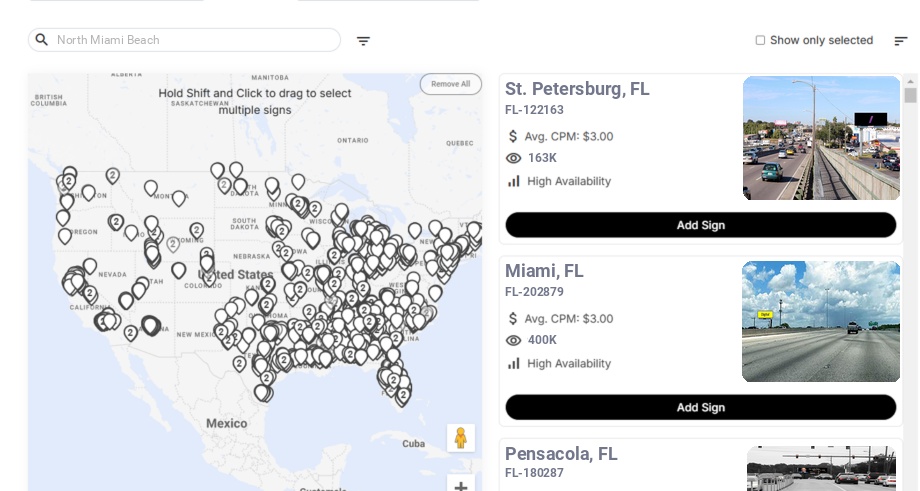



How much is a billboard in North Miami Beach?
Why Choose Blip for Billboard Advertising in North Miami Beach
Blip lets North Miami Beach advertisers launch fast on I-95, 163rd, or US-1 to catch commuters, beach traffic, and shoppers without the usual barriers.
Set flexible budgets in North Miami Beach and scale up during winter tourism, spring break, or holiday mall rushes as results come in.
Daypart your North Miami Beach blips for 7-10 a.m. commuters, midday errands, or weekend beach runs to match real traffic patterns.
No contracts means North Miami Beach brands can test bilingual creative for Haitian, Spanish, and English audiences, then pivot instantly.
Track North Miami Beach performance in real time and optimize by corridor, from Aventura Mall traffic to Oleta River Park and Sunny Isles-bound drivers.
Blip's creative tools make it easy to build bold North Miami Beach ads that stand out in sun, rain, and heavy congestion.
Frequently Asked Questions About Billboard Advertising in North Miami Beach
How much does a billboard cost in North Miami Beach, Florida with Blip?
With Blip, you control exactly what you spend on North Miami Beach billboards by setting your own daily budget, and the platform automatically keeps your campaign within that amount. Each “blip” is a 7.5–10 second ad on rotating digital billboards in North Miami Beach, Florida, and you only pay for the blips you receive. Pricing for each blip varies based on when and where your ad runs and current advertiser demand, so you can start small and scale up as you see results.
Where should I place a Blip billboard in North Miami Beach, Florida?
Choose boards along I-95 for broad reach and brand awareness, especially if you serve customers across Miami-Dade and Broward. Focus on NE 163rd / SR 826 and US-1 when driving store visits, restaurant traffic, healthcare visits, and short-trip conversions, where many viewers are within a 2–5 mile radius of your location. For hyperlocal businesses, prioritize secondary roads that line up with your primary trade area and school catchment zones.
When is the best time to run Blip billboards in North Miami Beach, Florida?
Greater Miami’s driving patterns are relatively consistent year-round, but daily and seasonal nuances matter. Morning peak is about 7:00–9:30 a.m., midday is about 11:00 a.m.–2:00 p.m., and evening peak is about 3:30–7:30 p.m. Weekend daytime often sees sustained high volumes from about 10:00 a.m.–7:00 p.m., and winter, spring break, and holiday periods bring especially strong traffic.
Who do North Miami Beach, Florida billboards with Blip reach?
North Miami Beach is one of South Florida’s most diverse communities, with large Haitian, Caribbean, and Hispanic populations alongside long-time Anglo and Jewish communities. In many recent estimates, 60–65% of residents are foreign-born, and more than 70% speak a language other than English at home, including Spanish and Haitian Creole. The area also intercepts both north-south and east-west travel, so billboards can capture local and regional traffic in a single campaign.
What makes North Miami Beach, Florida a good market for Blip billboard advertising?
North Miami Beach sits at the crossroads of tourism, retail, and dense suburban neighborhoods in northeast Miami-Dade County. With heavy year-round traffic, high consumer spending, and a rich mix of cultural communities, it’s an ideal place to run flexible, data-informed digital billboard campaigns with Blip. The city’s position just west of the Intracoastal and a few miles south of the Broward line means it naturally intercepts both north-south and east-west travel.
Do I need a contract to advertise with Blip in North Miami Beach?
No, Blip has no long-term contracts or minimum commitments. You can start, pause, or stop your campaign at any time.
How fast can I launch a billboard campaign with Blip in North Miami Beach?
You can have your campaign live in minutes. Create a free account, select your locations, set your budget, upload your design, and start running once approved.
Where can I advertise with Blip in North Miami Beach?
Blip has digital billboards in North Miami Beach. You can browse available locations on a map, choose the ones that fit your audience, and start advertising right away.
Still have questions? Launch a campaign in minutes — no contracts, no commitments.
Start Your CampaignNorth Miami Beach Billboard Advertising Guide
North Miami Beach sits at the crossroads of tourism, retail, and dense suburban neighborhoods in northeast Miami-Dade County. With heavy year-round traffic, high consumer spending, and a rich mix of cultural communities, it’s an ideal place to run flexible, data-informed digital billboard campaigns with Blip. Below, we walk through how to think about audiences, timing, messaging, and locations so you can turn local traffic patterns into real business outcomes with North Miami Beach billboard advertising tailored to this unique market.
Understanding the North Miami Beach Market
North Miami Beach (NMB) is a compact city with outsized reach. Within roughly 5 square miles, it connects major economic and residential zones across northeast Miami-Dade, making North Miami Beach billboards especially efficient for reaching multiple audience segments at once:
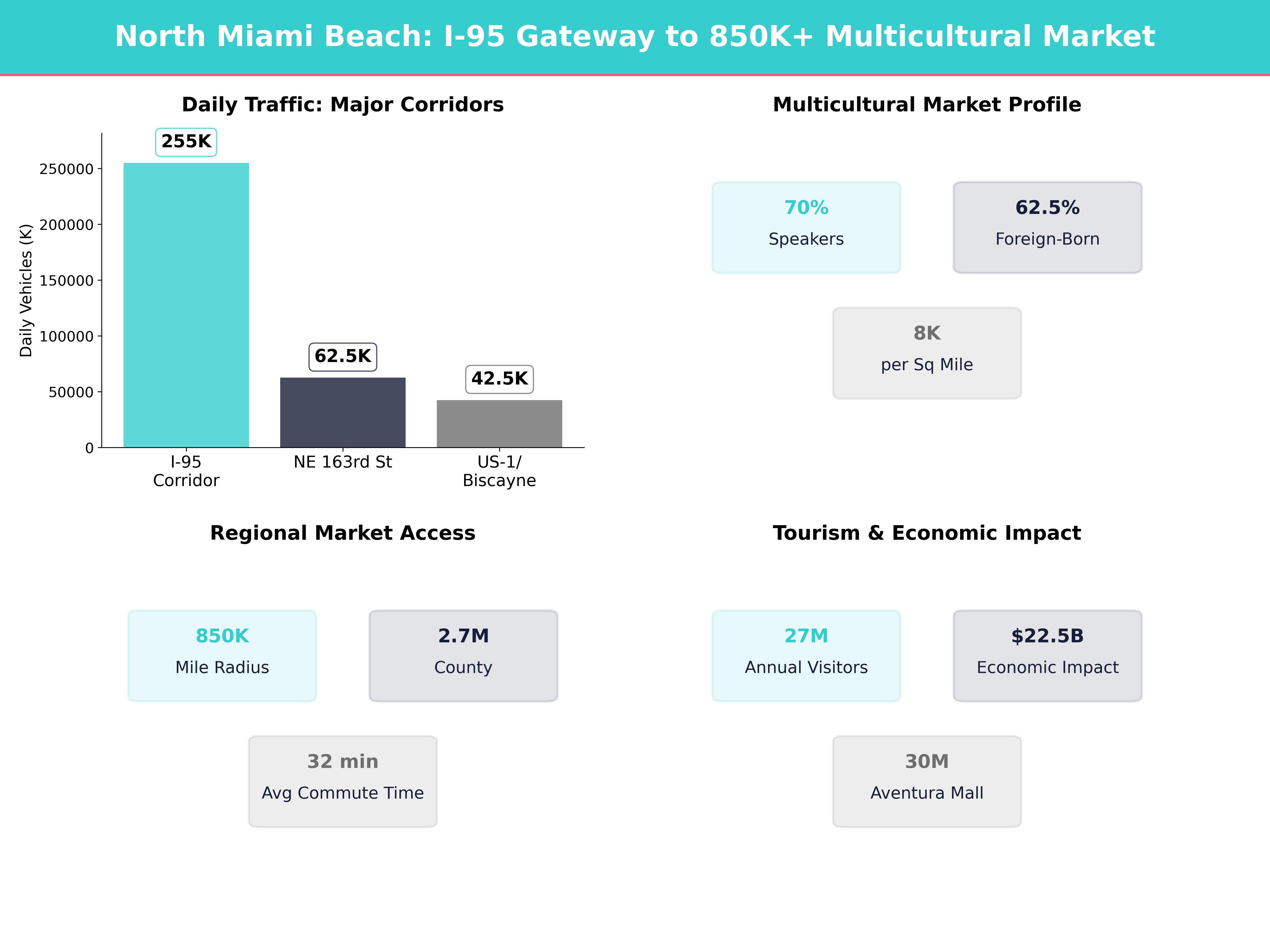
- Population: Recent estimates put NMB at around 43,000–45,000 residents, with population density above 8,000 people per square mile, one of the denser suburban cities in the county. Within a 10–12 mile drive radius—taking in North Miami Aventura Miami Gardens Hallandale Beach Miami proper—you tap into well over 800,000–900,000 residents.
- Age profile: Median age is about 39–40 years, with roughly 55–60% of residents in the 25–64 working-age bracket, a sweet spot for income, commuting, and discretionary spending.
- Cultural makeup: NMB is one of South Florida’s most diverse communities, with large Haitian, Caribbean, and Hispanic populations alongside long-time Anglo and Jewish communities. In many recent estimates, 60–65% of residents are foreign-born, and more than 70% speak a language other than English at home, including Spanish and Haitian Creole.
NMB is embedded in the broader Miami-Dade economy of roughly 2.7 million residents and more than 1.3 million jobs, according to county data from Miami-Dade County. The city’s position just west of the Intracoastal and a few miles south of the Broward line means it naturally intercepts both north–south and east–west travel, which is why billboards in North Miami Beach can capture both local and regional traffic in a single campaign.
Regionally, Greater Miami attracted roughly 26–28 million visitors annually (overnight and day-trip combined) in the most recent reporting years, according to the Greater Miami Convention & Visitors Bureau. Total visitor economic impact has exceeded $20–25 billion per year in recent reports, with hotel occupancy often in the 70–80% range across peak seasons. Many of these visitors funnel through or around NMB en route to:
- Beaches: Sunny Isles Beach Haulover Park Bal Harbour, promoted by local destinations such as the City of Sunny Isles Beach Bal Harbour Village.
- Shopping & entertainment: Aventura Mall (often cited at 30 million+ visitors annually by mall estimates; see Aventura Mall), Skylake, Intracoastal Mall area, and multiple neighborhood centers.
- Outdoor & eco-tourism: Oleta River State Park—Florida’s largest urban park, drawing an estimated 400,000–500,000 visitors yearly—and the Intracoastal Waterway, highlighted on regional resources like Miami and Beaches.
For advertisers, this means a single NMB-focused digital billboard strategy can simultaneously reach:
- Local households and repeat customers who see your message dozens of times per month along their regular commute.
- Regional commuters from Broward County 31–33 minutes, according to county transportation summaries.
- High-spend tourists drawn to malls, resorts, and beaches—where overnight visitors in Greater Miami routinely spend $180–$250+ per party per day on food, shopping, and entertainment.
When planned well, North Miami Beach billboard advertising lets you speak to all three groups with one coordinated presence.
Key Corridors and Traffic Patterns
To succeed in North Miami Beach, we should anchor campaigns to the roads that concentrate daily life. Traffic counts (“Annual Average Daily Traffic” or AADT) vary by exact segment, but typical ranges in and around NMB—based on regional planning data from agencies such as the Miami-Dade Transportation Planning Organization and Miami-Dade County—are:
-
I-95:
- One of the busiest interstates in the country; segments near NMB commonly carry 230,000–280,000 vehicles per day, with some stretches in northeast Miami-Dade approaching 300,000.
- Core north–south spine for commuters between Miami, North Miami, NMB, Aventura, Miami Gardens, and Broward County.
- Even modest 1–2% capture of daily I-95 traffic can translate into thousands of impressions per hour.
-
NE 163rd Street / SR 826 (the Causeway):
- Often 55,000–70,000 vehicles per day through NMB, with higher peaks on weekends and holidays heading to the beaches.
- Connects I-95 to Sunny Isles Beach and Collins Avenue, capturing beach traffic, tourists, and local shoppers.
- Because travel speeds can drop to 15–25 mph in heavy congestion, dwell time for viewing messages is higher than on pure freeway segments, which is valuable for digital billboards in North Miami Beach that rely on quick message recognition.
-
US-1 / Biscayne Boulevard:
- Typically 35,000–50,000 vehicles per day in NMB corridors.
- Dense with retail, dining, services, auto, financial, and health-care locations.
- Ideal for reaching “errand” and “shopping” mindset drivers—people who are already within 5–10 minutes of making a purchase decision.
-
NE 6th Avenue and other arterials:
- Local north–south routes feeding neighborhoods, parks, and schools.
- While volumes are lower (often 10,000–25,000 vehicles per day), these roads deliver high local relevance and repeated frequency for neighborhood-focused campaigns.
Local agencies such as the City of North Miami Beach and Miami-Dade County routinely highlight congestion relief and corridor improvements—such as signal timing upgrades, bus rapid transit, and safety projects on 163rd Street and Biscayne Boulevard—which underscores how trafficked these roads are and how often residents encounter roadside media and North Miami Beach billboards during their weekly routines.
How to use this with Blip:
- Choose boards along I-95 for broad reach and brand awareness, especially if you serve customers across Miami-Dade and Broward.
- Focus on NE 163rd / SR 826 and US-1 when driving store visits, restaurant traffic, healthcare visits, and short-trip conversions, where many viewers are within a 2–5 mile radius of your location.
- For hyperlocal businesses (schools, clinics, neighborhood retail, faith communities), prioritize secondary roads that line up with your primary trade area and school catchment zones.
When People Are on the Road: Timing Your Blips
Greater Miami’s driving patterns are relatively consistent year-round, but daily and seasonal nuances matter. Regional mobility reports from Miami-Dade County and the Miami-Dade Transportation Planning Organization show:
Weekday patterns
- Morning peak: ~7:00–9:30 a.m.
Commuters heading toward downtown Miami, offices in Aventura and Miami Gardens, hospitality jobs on the beach, and Miami-Dade’s many industrial zones. In some corridors, 30–35% of daily traffic occurs before noon. - Midday: ~11:00 a.m.–2:00 p.m.
Errands, lunch traffic, older residents, parents, and service workers with midday breaks. Retail and dining corridors like Biscayne Boulevard and 163rd often see steady, not spiky, flows in this window. - Evening peak: ~3:30–7:30 p.m.
Workers returning home, school pickups, after-work shopping and dining. Traffic on 163rd and Biscayne Boulevard can remain heavy well into the evening, with some segments seeing peak-hour speeds under 20 mph. - Late evening: ~8:00–11:00 p.m.
Restaurant, entertainment, and nightlife traffic, especially on weekends and near the beach or Aventura Mall. In a late-night metro like Miami, 10–15% of daily traffic in some corridors can still occur after 8 p.m.
Weekend patterns
-
Saturday daytime often sees sustained high volumes from about 10:00 a.m.–7:00 p.m., with heavy traffic toward:
- Beaches via 163rd / SR 826 and the William Lehman Causeway.
- Shopping and dining in Aventura, Skylake, and nearby plazas.
- Sunday mornings to early afternoon mix worship-related travel (NMB has numerous churches, synagogues, and temples), brunch, and family outings. For many congregations, 60–80% of weekly attendance occurs on Sunday, which translates into predictable spikes near religious corridors.
Seasonal trends
-
Winter (Dec–March):
- High “snowbird” presence and tourism, with county hotel data frequently showing 75–85% occupancy on peak weeks and average daily room rates well over $250 in prime Miami Beach and coastal areas.
- Passenger traffic at Miami International Airport typically peaks in this period, often topping 4–5 million passengers per month.
- Expect more out-of-state plates, higher discretionary spending, and strong conditions for branding and tourist-focused offers (dining, attractions, health & wellness, retail, real estate).
-
Spring break & holiday periods:
- March–April and late December see traffic spikes toward beaches and malls, with some beach corridors reporting double typical weekend volumes.
- Teen and young adult audiences surge, making this ideal for entertainment, quick-serve restaurants, fashion, and events.
-
Summer (June–Aug):
- Slight dip in some tourist segments but more local family activity, youth programs, and back-to-school shopping.
- The Miami-Dade Public Schools calendar drives predictable waves around camp signups (spring/early summer) and back-to-school (late July–August).
- Afternoon thunderstorms are common; bright, high-contrast creative is crucial to cut through rain and dark skies.
-
Hurricane season (June–Nov):
- The Atlantic hurricane season shapes local media attention. When storms are in the forecast, interest in insurance, generators, shutters, roofing, and emergency supplies spikes sharply—local news outlets like the Miami Herald WSVN 7 News routinely report sellouts for key items.
- Weather-related messaging and emergency-prep offerings can perform well when timed around advisories.
How to use this with Blip:
-
Daypart your buys:
- B2B and professional services: Heavier in 7–10 a.m. and 4–7 p.m. on weekdays when decision-makers and commuters are in motion.
- Restaurants and QSR: Focus your blips around 11 a.m.–2 p.m. and 5–9 p.m.; these windows often capture 60–70% of daily dining traffic.
- Family and faith-based services: Stronger weekend and early evening focus, particularly Friday–Sunday.
-
Shift budgets seasonally:
- Increase budget during winter and major holiday periods when audience volume, hotel occupancy, and per-visitor spending rise.
- Use summer for brand-building tests and creative experiments at often lower competition and slightly lower CPMs.
Well-timed North Miami Beach billboard advertising allows you to show the right message in the right corridor exactly when your best prospects are most likely to be driving.
Audience Insights: Who You’re Talking To
NMB’s diversity makes message relevance essential. Approximate local characteristics, drawing on city profiles from the City of North Miami Beach and broader county data:
-
Language & culture
- A large share of residents are of Haitian or broader Caribbean origin, and Haitian Creole is widely spoken; in some nearby ZIP codes, Haitian Creole speakers account for 15–25% of households.
- Significant Hispanic/Latino population (Cuban, Dominican, Venezuelan, Colombian, and others), with Hispanic residents making up 50%+ of some surrounding communities.
- English, Spanish, and Haitian Creole are all prominent in day-to-day life, which means language choice in creative can significantly affect recall.
-
Income & spending
- Household incomes span from working class to affluent, especially when factoring nearby Aventura and coastal condos in Sunny Isles Beach and Bal Harbour. Median household income in NMB is in the $45,000–$55,000 range, but many adjacent coastal areas report medians above $80,000–100,000, creating a blended trade area with varied price sensitivity.
-
Miami-Dade consumer expenditure data consistently show high spending on:
- Housing and home improvement (often 30–35% of total expenditures).
- Food away from home (restaurants, fast casual, delivery), frequently 5–7% of household budgets.
- Apparel and personal care in fashion-forward markets like Aventura and Sunny Isles.
- Auto purchase and maintenance, important in a county where over 85% of commuters use cars.
-
Education & institutions
- Proximity to Florida International University – Biscayne Bay Campus, Miami Dade College North Campus, and multiple high schools and K–8 centers such as those listed by Miami-Dade County Public Schools.
- Strong base of students, educators, and health-care workers commuting daily along I-95, Biscayne Boulevard, and 163rd Street. Combined enrollment at nearby higher-ed campuses runs into the tens of thousands.
-
Commuters & cross-county flow
- Many drivers on I-95 and 163rd are commuting between Broward County (Hollywood, Hallandale Beach, Pembroke Park) and Miami. Miami-Dade labor stats indicate that 25–30% of workers in some border communities cross county lines for work.
- This makes NMB boards ideal for businesses that serve regional rather than just hyperlocal audiences: health systems, banks, auto dealers, and larger retailers.
How to use this with Blip:
-
Consider bilingual or trilingual creative where appropriate:
- English + Spanish for broad reach in retail, QSR, banking, and health.
- English + Haitian Creole when specifically targeting Haitian communities (clinics, legal services, community events, churches).
- Campaigns that speak the viewer’s primary language can see 10–20% higher response rates in similar multicultural markets.
- Aim for instant clarity: Short headlines (6–8 words), large fonts, and simple call-to-actions (“Exit 163rd”, “Order at [brand].com”, “Open 7 Days”).
- Reference familiar local landmarks: “Across from Aventura Mall,” “Just off 163rd,” “Near Oleta River State Park,” or “5 minutes from I-95” to reduce friction and increase visit intent.
When you know who you are speaking to and in which languages, it becomes much easier to design billboards in North Miami Beach that resonate with daily life in the city.
Crafting High-Impact Creative for North Miami Beach
The visual environment in NMB is busy: palm trees, retail signage, dense traffic, and often bright sun. To stand out:
Design principles
-
Big, bold, and simple:
- 6–8 words max for your headline; studies of roadside readability show comprehension drops sharply beyond 8–10 words.
- One key image or icon that can be understood in under half a second.
- High-contrast color palettes (e.g., dark navy on bright yellow, white on black, bold magenta on deep blue).
-
Weather-aware design:
- Digital boards must stay legible under intense sun (UV index often 9–11 on summer days) and through heavy rain.
- Avoid thin fonts and low-contrast color combinations that disappear in glare or storms.
-
Motion and sequencing:
- With Blip’s rotation-based displays, assume 1–2 seconds of attention as a vehicle approaches and passes.
-
Use sequential creatives on the same board to tell a micro-story:
- Frame 1: “Stuck in traffic?”
- Frame 2: “We deliver in 30 minutes – [Brand].com”
Local hooks that work well
-
Tourist and beach mindset:
- Use visuals of beaches, shopping bags, nightlife (within local regulations enforced by cities such as North Miami Beach and Sunny Isles Beach
- Clear “Next Exit” or “10 Minutes Ahead” messages for visitors unfamiliar with the area; directional cues can boost response by 10–15% versus generic branding.
-
Community pride:
- Reference local events, neighborhoods, high schools, or holidays listed on civic calendars like citynmb.com.
- Promote sponsorships and partnerships with local organizations and show them on your billboard: “Proud Sponsor of NMB Little League” or “Supporting Local Schools”.
-
Urgency and scarcity:
- “This weekend only,” “Today only,” or “Limited spots” can work extremely well on high-frequency commuter routes like I-95, where the same driver might see your message 10–20 times per week.
Cultural and language considerations
-
If you use Spanish or Haitian Creole:
- Keep translations short and idiomatic; avoid literal, awkward phrasing.
- Avoid stuffing multiple languages into a single cramped frame. Instead, run separate language versions in rotation with Blip and allocate 20–40% of impressions to each language depending on your target mix.
- When targeting tourists, default to English, with universal visuals and simple CTAs. Many international visitors to Miami report at least basic English proficiency, and simple messages with strong visuals travel best across languages.
Effective creative tailored to the city’s conditions turns basic billboard rental in North Miami Beach into a powerful storytelling channel for your brand.
Using Blip’s Flexibility: Geo, Dayparting, and Testing
North Miami Beach lends itself perfectly to Blip-style, flexible buying because travelers, locals, and tourists all share the roads but at different times and in different places.
Geo-targeting strategy
-
I-95 boards:
- Use for wider-market brands: auto dealerships, health networks, major retailers, banks, colleges, and regional events.
- Great for campaigns aimed at both Miami-Dade’s 2.7M residents and Broward’s nearly 2M residents who travel this corridor.
-
NE 163rd / Causeway boards:
- Target tourists and locals heading to Sunny Isles Beach and Aventura Mall.
- Promote restaurants, attractions, beachwear, spas, and in-mall retailers, especially when mall foot traffic peaks around weekends and holidays.
-
US-1 boards:
- Best for local businesses: auto service, gyms, grocery stores, local clinics and dentists, small retailers, and professional offices.
We can adjust location mixes over time:
- Heavy on beach and mall corridors during peak tourism (winter, spring break, holiday shopping season), when coastal hotel occupancy and mall traffic are highest.
- Heavier on neighborhood corridors and I-95 during back-to-school, tax season (Jan–April), and hurricane prep season (late summer/early fall).
This flexible approach to billboard rental in North Miami Beach lets you steadily refine which boards deliver the best return for each season and campaign.
Dayparting and budget control
With Blip, we can schedule blips only during hours that match your audience:
- Morning rush for coffee shops, quick breakfast, transit apps, radio stations, and business services. Many radio stations such as WPLG’s partners on Local10.com and NBC 6 South Florida highlight strong morning audience numbers that align well with I-95 placements.
- Afternoons for after-school programs, tutoring, kids’ activities, healthcare and dental visits, and senior services.
- Evenings and weekends for restaurants, entertainment, nightlife, and retail, when discretionary spending is highest.
This is particularly powerful in a 24/7 market like Miami where off-peak impressions (late night) can still be valuable for certain verticals (e.g., bars, streaming services, nightlife, urgent care) but might be less efficient for others (e.g., banks, schools).
A/B testing creative
Use NMB’s steady high traffic volume to quickly learn what works:
-
Run two or three creative variations simultaneously:
- Different headlines (“Save 20% Today” vs. “Buy 1 Get 1 Free”).
- Different offers (percent discount vs. dollar amount vs. “free gift”).
- Different language mixes (English-only vs. bilingual).
-
After 1–2 weeks with consistent flighting—long enough to reach the same commuter multiple times—compare:
- Web traffic (direct and branded search).
- Promo code usage and in-store redemptions.
- Call or form-fill volume.
- Shift more budget to the best-performing creative and retire underperformers. In similar markets, advertisers who regularly test and optimize can see 20–40% improvements in campaign response over static, untested creative.
Blip’s tools make it easier to treat North Miami Beach billboard advertising as an always-improving channel instead of a one-time media buy.
Vertical-Specific Strategies in North Miami Beach
Different industries can lean into NMB’s unique dynamics in specific ways:
Retail & e-commerce
-
Pair digital billboards near Aventura Mall, US-1, and 163rd Street with short, clear offers:
- “Today Only – 20% Off Swimwear – Exit 163rd”
- “Free Parking – 5 Minutes Ahead – Biscayne Blvd”
-
Use billboards as top-of-funnel awareness and direct to:
- A vanity URL.
- QR codes (large, simple, high-contrast) if traffic speeds and visibility allow; in lower-speed corridors (under 35 mph), QR engagement can be meaningful.
- In a region where retail sales per capita are above national averages and malls like Aventura Mall report tens of millions of annual visits, even a small conversion rate on impressions yields strong revenue potential.
Restaurants, bars, and nightlife
- Target beach-bound and mall-bound traffic on weekends and evenings, when restaurant revenues can be 30–40% higher than weekday lunch periods.
-
Use real-time offers aligned with day-of-week:
- “Taco Tuesday – 2 for $5 – 5 Min Ahead”
- “Happy Hour 4–7 – Sunny Isles Exit”
- “Brunch This Sunday – Free Mimosa with Entrée”
-
Leverage NMB’s diversity with cuisine-specific messages:
- Haitian, Caribbean, Latin, kosher, and fusion concepts can all draw audiences regionally; many diners will travel 15–20 minutes for unique or highly rated spots.
- Highlight convenience (free parking, valet, takeout, delivery) to capture busy commuters.
Real estate and home services
- North Miami Beach and surrounding areas see steady condo, single-family, and rental activity, including coastal luxury product in nearby Sunny Isles and Bal Harbour and more affordable housing inland.
-
Use boards on I-95 and Biscayne Boulevard to:
- Promote new developments and open houses.
- Highlight special financing (“Rates as Low as X%”) or incentives (“3 Months Free Parking”).
- Boost brand visibility for brokerages and property managers operating across multiple ZIP codes.
- For contractors, roofers, and hurricane-prep services, dial up visibility before and during hurricane season and after major storms. Local news outlets such as the Miami Herald WSVN 7 News often report large spikes in demand for roofing and repair services after significant weather events.
Healthcare, legal, and professional services
-
Target commuters and families with:
- Short, trust-building messages (“24/7 ER,” “Same-Day Appointments,” “Walk-Ins Welcome,” “No Fee Unless We Win”).
- Certifications or years-in-business (“Serving NMB Since 1995”) to build credibility quickly.
- Consider language-specific creatives for legal, immigration, and healthcare services when focusing on Haitian Creole or Spanish-speaking audiences; in similar markets, language-matched ads have shown significantly higher call and appointment rates.
- Use proximity cues: “On Biscayne, Just South of 163rd” or “Next to Aventura Hospital.”
Education and training
-
Use timing around:
- Back-to-school (July–September) when families are choosing schools and supplies.
- Summer program signups (March–June).
- College enrollment peaks (late spring and late fall).
-
Boards near I-95 and US-1 are ideal for:
- Charter schools and private schools targeting broader catchment areas.
- Vocational programs, trade schools, and English-language training.
- Colleges and universities like Miami Dade College North Campus.
- Highlight clear benefits and deadlines: “Apply by Aug 1,” “Scholarships Available,” “Job-Ready in 12 Months.”
For each of these verticals, a thoughtful mix of locations, messaging, and timing will determine which North Miami Beach billboards deliver the strongest performance.
Integrating with Local Media and Community Activity
To maximize ROI, we should not treat digital billboards in isolation. Instead, sync them with local news cycles and events.
Leverage local news and events
-
Monitor outlets like the Miami Herald, WSVN 7 News, Local 10 (WPLG), and NBC 6 South Florida for:
- Major events (festivals, parades, sporting events, concerts).
- Traffic changes and construction on I-95, 163rd, and Biscayne Boulevard.
- Local policy changes that affect your industry (short-term rentals, zoning, health regulations).
-
Align campaigns with:
- City of North Miami Beach initiatives and events listed at citynmb.com, such as cultural festivals, parks & recreation events, and public safety campaigns.
- County-level happenings promoted by Miami-Dade County, including transit expansions, tax-free holidays, and emergency preparedness events.
Community trust and reputation
-
Use billboards to:
- Celebrate sponsorship of youth sports, school events, or local nonprofits—“Proud Sponsor of NMB Chargers,” “Supporting Local Schools & Teachers.”
- Show support during community challenges (e.g., weather emergencies, recovery efforts) with simple, empathetic messages.
- In a tight-knit and diverse community like NMB, demonstrating local commitment can significantly enhance response rates; brands recognized as “local supporters” often see higher repeat business and referral rates than anonymous national brands.
Coordinating your billboard rental in North Miami Beach with these local touchpoints helps your message feel like part of the community conversation rather than just another ad.
Measuring Success in a High-Flow Market
Because traffic volumes in and around NMB are high, it’s critical to define clear success metrics for your digital billboard campaigns.
Trackable metrics
-
Website analytics:
- Watch for direct traffic spikes (people typing your URL) during campaign windows. In similar markets, businesses often see 10–30% increases in direct or branded traffic while boards are live.
- Look for increases in branded search (your brand name) in Google Analytics or similar tools, especially during your heaviest Blip hours.
-
Promo codes & vanity URLs:
- Use simple, billboard-only codes (“NMB20,” “163RD10”) or URLs (“brand.com/NMB”) to measure conversions.
- Track redemption rates by daypart and board location if you run multiple codes.
-
Call and form volume:
- Track call volume and form submissions by day and hour and compare to your Blip schedule. Even a 5–10% uplift in calls or forms during flight windows can be meaningful in high-value categories (legal, healthcare, real estate).
-
In-store questions:
- Train staff to ask, “How did you hear about us?” and explicitly track “billboard” responses in your POS or CRM. Over several weeks, you should start to see patterns emerge.
Benchmarks and expectations
-
For awareness campaigns, look for:
- Increases in direct or branded search traffic of 10–30% during active flight periods.
- Higher social media engagement when you mirror billboard creative on platforms like Instagram and Facebook.
- For promotion-based campaigns, even a 1–3% redemption rate on billboard-only offers can be very strong given the massive reach of corridors like I-95 and 163rd.
- Use multiple short flights (for example, 2–3 weeks each) across different time windows and creatives rather than one long, unchanging campaign. Advertisers who regularly adjust creative and timing often achieve lower effective cost per response than those who “set and forget” for months.
By understanding how residents, commuters, and tourists move through North Miami Beach—where they drive, when they travel, what languages they speak, and what they’re here to do—we can build digital billboard campaigns that feel timely, local, and compelling. Leveraging Blip’s flexibility in location, timing, and creative testing, advertisers can turn NMB’s dense, diverse traffic into measurable business results all year long and make North Miami Beach billboard advertising a reliable driver of growth for their brands.