Billboards in Gainesville, FL
No Minimum Spend. No Long-Term Contracts. Just Results.
Trusted by Leading Brands


Billboard advertising
in Gainesville has never been easier



How much is a billboard in Gainesville?
Why Choose Blip for Billboard Advertising in Gainesville
Choose Blip in Gainesville to launch fast on I-75, Archer Road, or Newberry Road with self-serve control and no contracts.
Set flexible daily budgets in Gainesville and reach UF students, healthcare workers, and families when your ad matters most.
Use Blip dayparting in Gainesville to hit game days, campus rush, and commuter peaks on University Avenue and I-75.
Track Gainesville blips in real time, then shift spend toward the routes and audiences driving the best response.
Blip's creative tools make it easy to tailor Gainesville ads for move-ins, UF events, and local retail trips without slowing launch.
Frequently Asked Questions About Billboard Advertising in Gainesville
How much does a billboard cost in Gainesville with Blip?
Each “blip” is a 7.5-to-10-second display on a rotating digital billboard, with pricing that can start at just $0.01 per display. Costs vary by time of day, location, and advertiser demand, but Blip works to stretch your budget for the best possible reach. Because your total cost is simply the sum of your individual blips, billboard advertising in Gainesville stays flexible, transparent, and accessible for businesses of almost any size.
Where can I advertise with Blip in Gainesville to reach the most traffic?
I-75 through the Gainesville area commonly carries more than 90,000 vehicles per day, and the busiest local segments can approach or exceed 100,000 daily vehicles. The most important interchange zones are Exit 384 at Archer Road and Exit 387 at Newberry Road. This corridor is the market’s best choice when we want broad reach, regional visibility, and strong frequency.
What Gainesville areas are best for Blip ads if I want to reach shoppers and restaurants?
Archer Road between I-75 and SW 34th Street generally falls in the 40,000 to 50,000 AADT range, and it ties together interstate traffic, apartment traffic, healthcare visits, and destination retail. Butler Enterprises includes more than 1.5 million square feet of retail, and Celebration Pointe adds dining, entertainment, and mixed-use traffic nearby. We usually favor this corridor for retailers, restaurants, elective healthcare, fitness, student housing, entertainment venues, and any business that wants to convert drivers who are already close to a purchase.
When is the best time to run billboard ads in Gainesville with Blip?
The strongest student-targeting windows usually arrive in August and January, when leases turn over, classes begin, and parents return to town. We often recommend increasing visibility during the 2 to 4 weeks before those starts. Fall football weekends, spring graduation, and March events like the NHRA Gatornationals also create major short-term demand spikes.
What kind of audience can Blip reach in Gainesville, Florida?
Gainesville’s strength is not just traffic volume; its real advantage is audience variety. More than 60,000 UF students create an enormous year-round audience, and UF Health, UF Research, HCA Florida North Florida Hospital, and the Innovation District support a steady base of clinicians, researchers, administrators, entrepreneurs, and support staff. Families and suburban households across Alachua County are also a major audience, especially along Newberry Road, Archer Road, and I-75 access points.
Do I need a contract to advertise with Blip in Gainesville?
No, Blip has no long-term contracts or minimum commitments. You can start, pause, or stop your campaign at any time.
How fast can I launch a billboard campaign with Blip in Gainesville?
You can have your campaign live in minutes. Create a free account, select your locations, set your budget, upload your design, and start running once approved.
Where can I advertise with Blip in Gainesville?
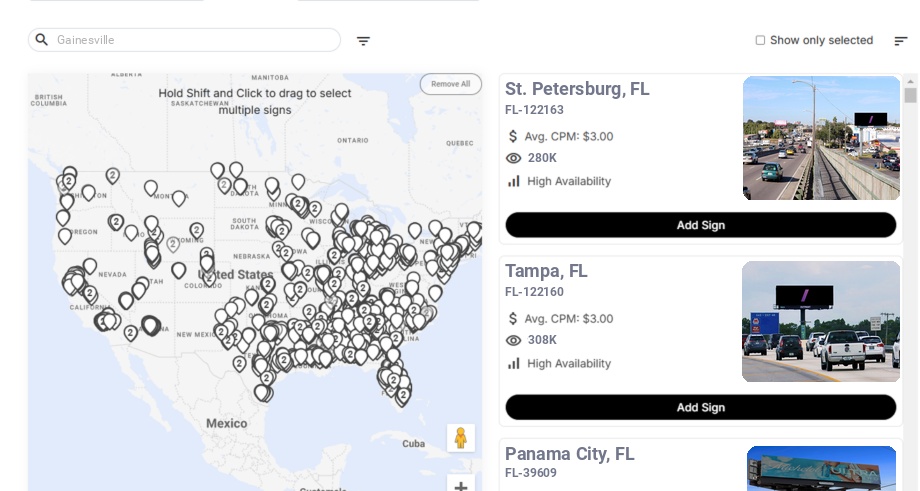
Blip has digital billboards in Gainesville. You can browse available locations on a map, choose the ones that fit your audience, and start advertising right away.
Still have questions? Launch a campaign in minutes — no contracts, no commitments.
Start Your CampaignGainesville Billboard Advertising Guide
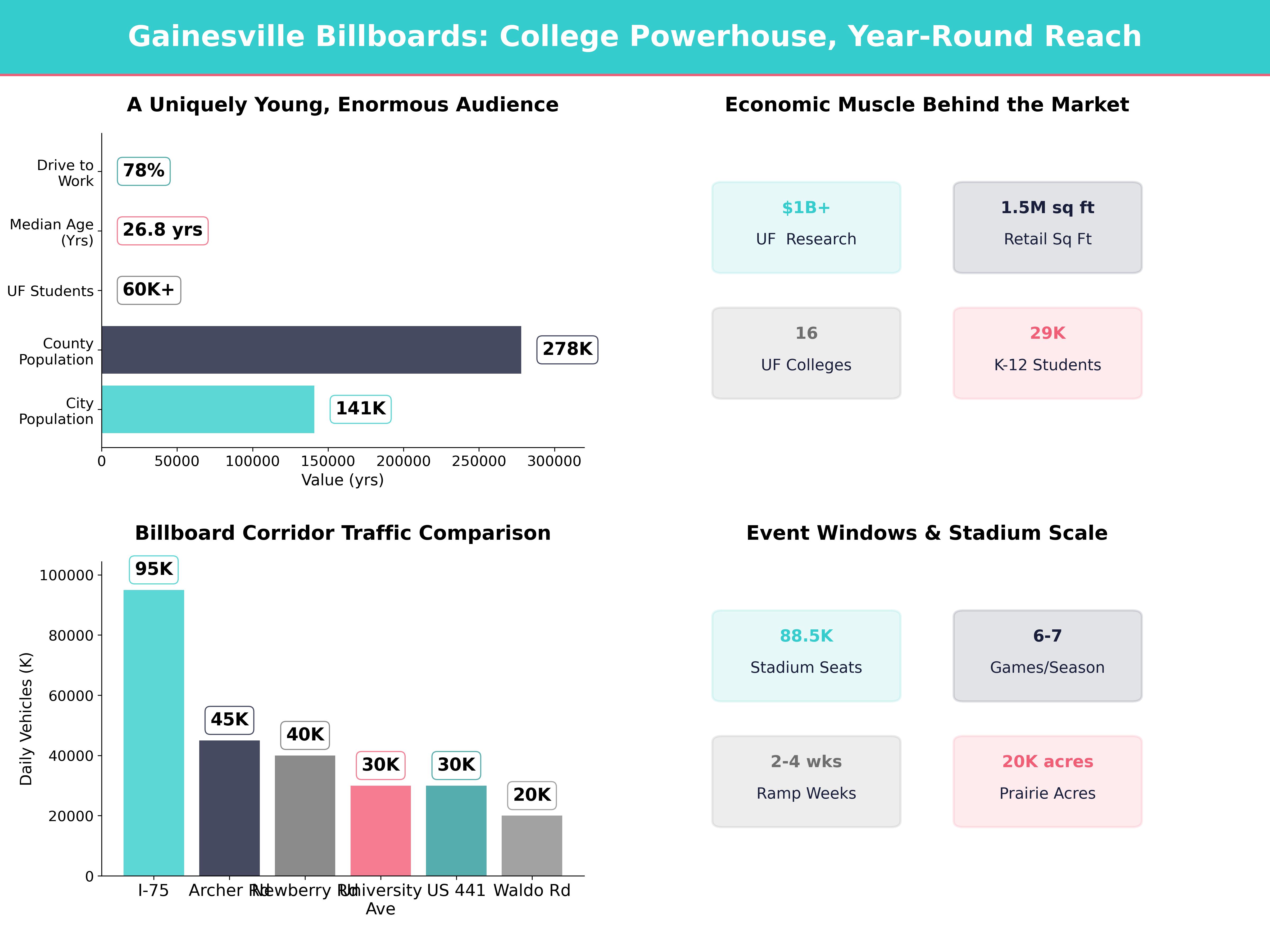
Gainesville gives us one of Florida’s most versatile billboard markets because it combines a 141,085-resident city, a 278,468-resident county, and a university population of more than 60,000 students that keeps local travel active all year. Most daily trips still happen by car, with roughly 78% of workers commuting by car, van, or truck, and those trips concentrate on a relatively small set of highways and arterials that are easy for us to target with precision. At the same time, University of Florida events, regional healthcare traffic to UF Health, and leisure visits promoted by Visit Gainesville, Alachua County bring in fresh audiences beyond local residents. That mix lets us use Gainesville billboards for both broad awareness and highly local conversion.
Gainesville Market Overview
Gainesville is often described as a college town, but for advertisers it functions more like a regional service hub with a powerful education engine attached. We can reach students, faculty, healthcare workers, families, suburban households, and pass-through interstate traffic in the same market.
Gainesville’s population base and growth support steady demand
The City of Gainesville had 141,085 residents in 2020, and Alachua County had 278,468 residents. From 2010 to 2020, Gainesville grew by 13.5%, and Alachua County grew by 12.6%. That is meaningful growth for a North Central Florida market, and it helps explain why west-side retail, housing, healthcare, and service traffic remain so active.
Growth also extends beyond the city core. Communities such as Newberry 7,342 residents in the 2020 Census), Alachua (10,574), and High Springs 6,215) feed regular commuter and shopping trips back into Gainesville. Population estimates from the UF Bureau of Economic and Business Research have continued to show Alachua County as a growing market, which supports long-term billboard relevance.
Education, research, and healthcare anchor the Gainesville economy
University of Florida enrolls more than 60,000 students and includes 16 colleges. UF Research now exceeds $1 billion in annual research activity, which gives Gainesville a deeper economic base than many similarly sized cities. Santa Fe College
Healthcare also matters in a major way. UF Health and HCA Florida North Florida Hospital draw patients, employees, vendors, and family visitors from across North Central Florida. The result is a market where demand for healthcare, retail, dining, housing, recruiting, financial services, and home services stays visible even when the university calendar changes.
Gainesville commuting still favors out-of-home visibility
Gainesville has a stronger transit, walking, and biking culture than many Florida metros, but road travel still dominates. Data USA shows that roughly 78% of workers commute by car, van, or truck, and the city’s median age is about 26.8. That youthful profile is unusual, but the road reliance is still highly favorable for billboard advertisers.
Gainesville Regional Transit System Butler Enterprises Celebration Pointe
Key Traffic Corridors for Gainesville Billboards
Gainesville travel patterns are shaped by a few dominant roads, which is excellent news for out-of-home planning. When we understand where traffic concentrates, we can choose boards that match both the audience and the buying mindset.
I-75 through Gainesville
According to traffic count data from the Florida Department of Transportation, I-75 through the Gainesville area commonly carries more than 90,000 vehicles per day, and the busiest local segments can approach or exceed 100,000 daily vehicles. The most important interchange zones are Exit 384 at Archer Road and Exit 387 at Newberry Road.
This corridor is the market’s best choice when we want broad reach, regional visibility, and strong frequency. We should prioritize I-75 when the goal is to reach:
- Hotels, attractions, and restaurants, because interstate travelers are often making immediate stop decisions.
- Healthcare providers and urgent care brands, because regional patients and family members frequently arrive by car from outside Gainesville.
- Statewide service brands, colleges, and major retailers, because I-75 captures both local and pass-through traffic at scale.
Archer Road and the retail spine around Exit 384
FDOT counts on Archer Road between I-75 and SW 34th Street generally fall in the 40,000 to 50,000 AADT range. That makes Archer Road one of Gainesville’s highest-intent consumer corridors, not just one of its busiest roads.
Archer Road works especially well because it ties together interstate traffic, apartment traffic, healthcare visits, and destination retail. Butler Enterprises 1.5 million square feet of retail, and Celebration Pointe
Newberry Road and the west Gainesville family corridor
Newberry Road near I-75 and The Oaks Mall often runs around 35,000 to 45,000 vehicles per day. While this road still carries student traffic, it leans more household-oriented than Archer Road in many stretches.
We can use Newberry Road to reach west Gainesville families, commuters from Newberry
University Avenue and the core urban grid
University Avenue around campus and downtown commonly falls in the 25,000 to 35,000 AADT range, depending on the segment. Even when its traffic volume trails I-75, its audience density and contextual relevance can be outstanding.
This corridor links University of Florida, downtown Gainesville, the UF Innovation District
U.S. 441, Waldo Road, and east-side approaches
Major urban segments of U.S. 441 in Gainesville often run roughly 25,000 to 35,000 vehicles per day, while Waldo Road and nearby east-side connectors frequently range from 15,000 to 25,000 vehicles per day. These roads do not match I-75 for raw scale, but they can deliver very strong local relevance.
We often like these corridors for staffing companies, trade schools, industrial suppliers, logistics firms, bilingual service providers, and employers recruiting local workers. When our campaign needs repeated exposure to working households rather than broad tourism traffic, these east-side routes can be surprisingly efficient.
Audience Segments We Can Reach in Gainesville
Gainesville’s strength is not just traffic volume. Its real advantage is audience variety. We can reach very different groups within a compact geography, and each group responds to different messaging and timing.
Students and campus-connected households in Gainesville
More than 60,000 UF students create an enormous year-round audience, especially when we include parents, faculty, staff, alumni visitors, and graduate researchers. Santa Fe College
This audience is highly responsive to convenience, pricing, and timing. We can target it effectively with offers related to apartments, move-ins, food, storage, internet, rides, events, banking, and healthcare. Campaigns near campus usually perform best when they feel immediate and specific rather than overly polished or corporate.
Healthcare, research, and professional workers in Gainesville
UF Health, UF Research, HCA Florida North Florida Hospital, and the Innovation District
For advertisers, this audience is valuable because it tends to travel on predictable weekday schedules and often has strong needs around professional services, childcare, recruiting, continuing education, insurance, and specialty healthcare. We should think of this group as a frequency-driven audience rather than a one-time event crowd.
Families and suburban households across Alachua County
Alachua County Public Schools serves about 29,000 students, and family-oriented growth continues west and northwest of Gainesville. That creates repeated trips for school, youth activities, grocery, healthcare, and home maintenance.
This segment is especially important along Newberry Road, Archer Road, and I-75 access points. Pediatric care, orthodontics, HVAC, plumbing, flooring, banking, grocery, furniture, and family entertainment all align well with these household travel patterns. If we want durable repetition with local decision-makers, Gainesville’s suburban traffic can be more valuable than its student visibility.
Visitors, sports fans, and cultural travelers in Gainesville
Florida Gators football fills 88,548-seat Ben Hill Griffin Stadium, and the team typically hosts 6 or 7 home games each season. That alone creates several major visitor spikes every fall. Beyond sports, Visit Gainesville, Alachua County promotes meetings, nature travel, and cultural attractions that keep nonresident traffic in the market.
Gainesville also benefits from attractions such as the Florida Museum of Natural History, the Harn Museum of Art, the Cade Museum for Creativity & Invention 20,000 acres protected at Paynes Prairie Preserve State Park
Seasonal and Timing Opportunities in Gainesville
Gainesville rewards advertisers who plan around the calendar. The market’s audience composition changes noticeably with the school year, football schedule, spring events, and summer travel patterns.
August and January are Gainesville’s cleanest reset moments
The strongest student-targeting windows usually arrive in August and January, when leases turn over, classes begin, and parents return to town. We often recommend increasing visibility during the 2 to 4 weeks before those starts.
These windows are ideal for apartments, storage, internet providers, furniture, quick-service restaurants, banks, and local service brands. Messaging that mentions move-ins, deadlines, or location cues such as “near campus” or “off Archer Road” usually feels much more relevant than a generic branding message.
Fall football drives short, intense demand bursts
Florida Gators home football weekends can transform traffic, lodging demand, and consumer spending across Gainesville. We usually see the biggest opportunities for restaurants, bars, tailgating retailers, hotels, urgent care, rideshare services, and local attractions.
These are not always the best moments for long explanations. They are ideal moments for concise offers, directional copy, and high-frequency bursts. If we want to own a game weekend, it often makes sense to concentrate spend for a few days rather than spread it lightly across several weeks.
Spring brings graduation, racing, and family visits
Spring is another strong seasonal window because it layers together commencement, family travel, and special events. The NHRA Gatornationals at Gainesville Raceway typically arrive in March, bringing a different kind of visitor audience into the market.
This season can work especially well for hotels, attractions, moving companies, storage brands, and restaurants. It is also a strong time for healthcare, apartments, and financial services because families often make longer-range decisions while they are in town for graduation and campus visits.
Summer in Gainesville stays active in different ways
Summer is quieter around the student core, but it is far from empty. Orientation, healthcare travel, regional road trips, and outdoor recreation all continue through the warmer months. Visitors still head to museums, trails, and the more than 20,000-acre Paynes Prairie Preserve State Park UF and Santa Fe College
Summer can be a smart time for home services, healthcare, moving, and family attractions because the market is less dominated by campus clutter. We can often get cleaner message recall when the city is slightly less crowded.
Gainesville Billboard Design Tips That Feel Local
Creative that performs in Gainesville usually reflects the market’s pace, culture, and audience mix. We do not need to overcomplicate it, but we do need to make it feel like it belongs here.
Gainesville creative should feel local in a hurry
On most Gainesville boards, especially along I-75, we should aim for 6 to 8 words of primary copy. Interstate drivers need to understand the ad in about 3 seconds or less, so the strongest creative usually leads with one offer, one brand cue, and one directional instruction.
Exit numbers work particularly well in Gainesville because so much retail behavior is organized around Exit 384 and Exit 387. If we can say how far away we are, which road to use, or what immediate problem we solve, we usually make the board more actionable.
Gainesville responds to sports energy, nature cues, and practical value
Orange-and-blue palettes can tap into local sports energy, but we should avoid protected University of Florida trademarks unless we have permission. For family, tourism, and healthcare campaigns, greens, aquas, and canopy-inspired colors often fit Gainesville’s identity better because the city is strongly associated with trees, springs, and outdoor recreation.
Local visual cues can help too. Live oaks, stadium weekends, lab imagery, downtown activity, or west-side retail references can make a board feel native to Gainesville. Generic stock imagery is less persuasive in a place where local identity is unusually strong.
We should match the message to the corridor
Archer Road creative can be promotional because drivers are often already close to Butler Plaza Celebration Pointe
When we align the message with the road, performance usually improves. The same ad that works near a shopping district may be too detailed for interstate traffic, and the same brand-only ad that works on I-75 may feel too vague near campus.
Convenience language often outperforms abstract slogans in Gainesville
Because Gainesville blends students, young professionals, researchers, and families, convenience often beats aspiration. Messages like “same-day care,” “free parking,” “2 miles ahead,” “game-day specials,” or “move in now” tend to land better than broad taglines.
We should also design for Florida conditions. Bright daylight, summer rain, and visually busy roadways all reward high contrast, bold typography, and uncluttered layouts.
Regional Strategies Across Gainesville and Alachua County
Not every part of the market should be approached the same way. Gainesville works best when we treat it as a set of distinct sub-areas with different traffic behaviors and buying mindsets.
The Gainesville I-75 retail belt
The corridor around Exits 384 and 387 is the market’s highest-intent consumer zone. We should emphasize restaurants, entertainment, lodging, urgent care, retail, and destination businesses here because drivers are already moving toward major purchase areas.
This is also a smart place for conquesting. If competitors are clustered near Butler Enterprises Celebration Pointe The Oaks Mall, we can intercept shoppers before they arrive.
Gainesville’s urban core, campus, and Innovation District
Boards near University of Florida, downtown Gainesville, and the Innovation District
We should think of this zone as a repetition market. The same people often pass through it multiple times each week, so consistency and local resonance matter as much as raw impressions.
West Gainesville, Jonesville, and Newberry
The west and northwest arc is the clearest family-market strategy in the area. Newberry
This is where home services, orthodontics, childcare, private education, financial services, and grocery-related campaigns often make sense. If our product depends on family decision-makers rather than student spontaneity, this submarket often deserves its own creative and schedule.
North county and the Alachua employment cluster
Alachua functions as an important employment node for manufacturing, biotech, and logistics, and it captures movement between Gainesville and Lake City
We should also remember that this strategy extends our reach beyond Gainesville’s city limits without leaving the county trade area. For some advertisers, that is a valuable middle ground between a strictly local buy and a much more expensive regional plan.
High Springs and outdoor-travel corridors
High Springs
We usually treat them as complementary placements. They work best when they reinforce a broader Gainesville campaign rather than trying to carry the whole buy on their own.
Using Blip Tools for Gainesville Campaigns
Gainesville is exactly the kind of market where flexibility matters. Traffic patterns are predictable, but audience priorities shift quickly with semesters, sports, and local events, so we benefit when we can adapt without friction.
We can daypart Gainesville around real local behavior
Morning and late-afternoon windows usually make the most sense for commuter-heavy boards on I-75 and west-side arterials. Midday can work surprisingly well on Archer Road because shopping, dining, and appointment traffic stay active there. Evening periods matter more near campus, downtown, and entertainment zones.
Using dayparting this way helps us keep budget focused on the hours when local intent is strongest. Gainesville does not need a one-size-fits-all schedule.
We can test different messages for different Gainesville audiences
This market is compact enough for us to test quickly. We can run student-focused creative near campus, family-focused offers on Newberry Road, and broad brand messaging on I-75, then compare how each version performs.
That kind of testing is especially useful in Gainesville because the audience mix changes so much by corridor. A recruiting message, a restaurant offer, and an apartment lease-up creative can all succeed here, but they should not all look the same or run in the same places.
We can scale up fast for Gainesville spikes
Game weekends, move-in periods, graduation, and March motorsports events all create short windows of elevated demand. Gainesville makes us money when we react to those spikes quickly, not when we lock ourselves into one static plan.
Blip lets us lean into those high-opportunity windows, then return to a lower always-on level once the surge passes. That approach is especially helpful in a university market where timing can change performance dramatically.
We can localize artwork without slowing down launch
If we need different versions for I-75, Archer Road, and campus-adjacent boards, Blip’s artwork tools make that easier. We can localize distance markers, event language, neighborhood references, or student offers without rebuilding an entire campaign from scratch.
For Gainesville, that matters. A market with this many seasonal shifts rewards creative updates that happen quickly and stay relevant.
Getting Started with Billboard Rental in Gainesville
Renting a billboard in Gainesville is much easier when we start with a clear objective and match it to the right roads. We do not need to overbuy the market to get traction, but we do need to choose locations intentionally.
We should begin with one clear Gainesville goal
Before we select any board, we should decide whether the campaign is meant to build awareness, drive store visits, recruit employees, support an event, or generate leads. That single choice shapes everything else.
If we want maximum awareness, I-75 is usually the right starting point. If we want same-day retail visits, Archer Road and Newberry Road often make more sense. If we want students or downtown professionals, University Avenue and nearby urban routes are usually stronger.
We should evaluate Gainesville boards like locals
We recommend using five practical filters when comparing Gainesville billboard locations: traffic volume, travel speed, distance from our destination, direction of approach, and audience fit. A higher-volume board is not always the better board if it is too far from the action we want.
In Gainesville, a placement 1 to 3 miles from a store, clinic, or apartment community can outperform a more distant location because the message is immediately usable. We should also pay attention to landmarks, shopping centers, hospital routes, and campus gateways, because they reveal why people are on that road.
We can use a simple board-selection framework
- For regional awareness, we should start with I-75 placements near Exits 384 and 387.
- For retail and dining conversion, we should focus on Archer Road near Butler Enterprises Celebration Pointe
- For family-oriented services, we should look closely at Newberry Road and west-side approaches.
- For student response, we should prioritize University Avenue, downtown, and campus-adjacent routes.
- For recruiting and workforce campaigns, we should consider east-side corridors, U.S. 441, and north-county placements near Alachua.
Blip simplifies Gainesville billboard rental compared with legacy buying
Traditional billboard buying can involve long commitments, larger entry costs, and slower revisions. In a market like Gainesville, that can be limiting because the best opportunities often come in short bursts tied to classes, games, and seasonal traffic.
With Blip, we can start with a small test, compare boards on a map, watch results, and refine our mix as we learn. That flexibility is particularly valuable in Gainesville because one month may call for student-focused creative, and the next may call for football, family, or healthcare messaging.
A practical Gainesville launch plan
We usually recommend a staged approach that stays manageable and measurable:
- We start with 3 to 5 boards aligned to one main audience.
- We run the campaign for 2 to 4 weeks to establish a baseline.
- We review performance by location, timing, and message.
- We shift budget toward the boards and dayparts that show the strongest response.
- We refresh creative before the next local wave, such as move-in, football season, or graduation.
That process keeps Gainesville billboard rental approachable, data-driven, and adaptable. When we combine Gainesville’s concentrated traffic corridors with Blip’s self-serve control, we can launch quickly, learn quickly, and build a smarter local out-of-home strategy.