Billboards near Sunset, FL
No Minimum Spend. No Long-Term Contracts. Just Results.
Trusted by Leading Brands


Billboard advertising
near Sunset has never been easier



How much is a billboard near Sunset?
Why Choose Blip for Billboard Advertising near Sunset
Blip lets you launch Sunset, Florida billboards fast on Sunset Drive, SR 874, and US-1—perfect for commuter reach without sales calls.
Set a flexible budget for Sunset, Florida and adjust anytime to match rush hours, school traffic, or weekend retail peaks near Dadeland.
No contracts means Sunset, Florida brands can test bilingual creative for Miami-Dade's Hispanic audience and scale what works.
Daypart your Sunset, Florida ads to hit 7-9 a.m. and 4-7 p.m. commuters on SR 874 and SR 878 when traffic is heaviest.
Blip's real-time analytics help Sunset, Florida advertisers track response and shift spend as traffic moves between Coral Gables, Kendall, and South Miami.
Use Blip's creative tools to swap quick, bold ads for Sunset, Florida's high-income, bilingual audience and keep messages fresh in Miami sun.
Frequently Asked Questions About Billboard Advertising near Sunset
How much does a billboard cost near Sunset, Florida with Blip?
With Blip, you control exactly what you spend on Sunset billboards by setting a daily budget that can be adjusted anytime, so your campaign always stays within your comfort zone. Each ad plays as a quick 7.5 to 10-second “blip” on digital billboards near Sunset, Florida, and you only pay for the individual blips you receive. This pay-per-blip model means the cost depends on when and where you choose to show your message and on advertiser demand in the Sunset area.
Where can I advertise with Blip near Sunset, Florida?
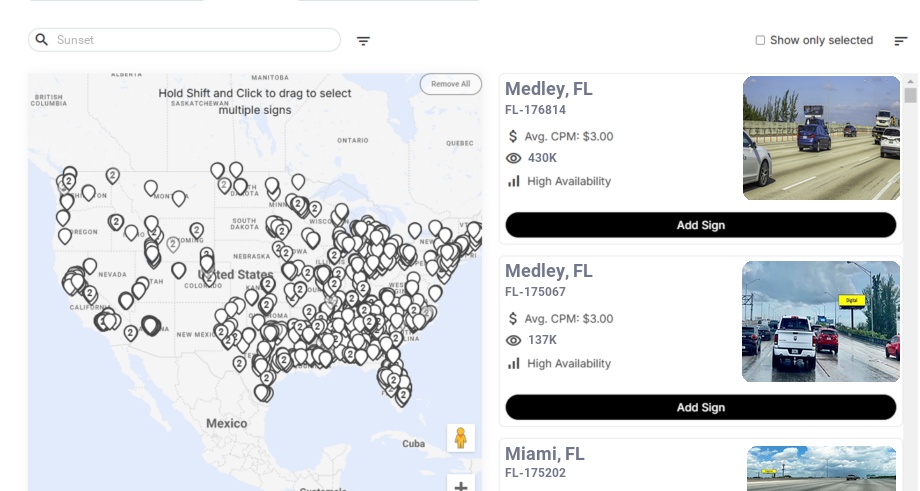
There are 26 digital billboards serving the Sunset area from nearby Miami locations within about 10 miles. These boards help advertisers tap into a dense, mobile audience that lives, works, shops, and commutes through this suburban-urban mix every day. Because the boards are in Miami locations near Sunset, they can intersect both neighborhood trips and regional flows to Downtown Miami, Coral Gables, Dadeland, and Miami International Airport.
What kind of audience will see Sunset, Florida billboards?
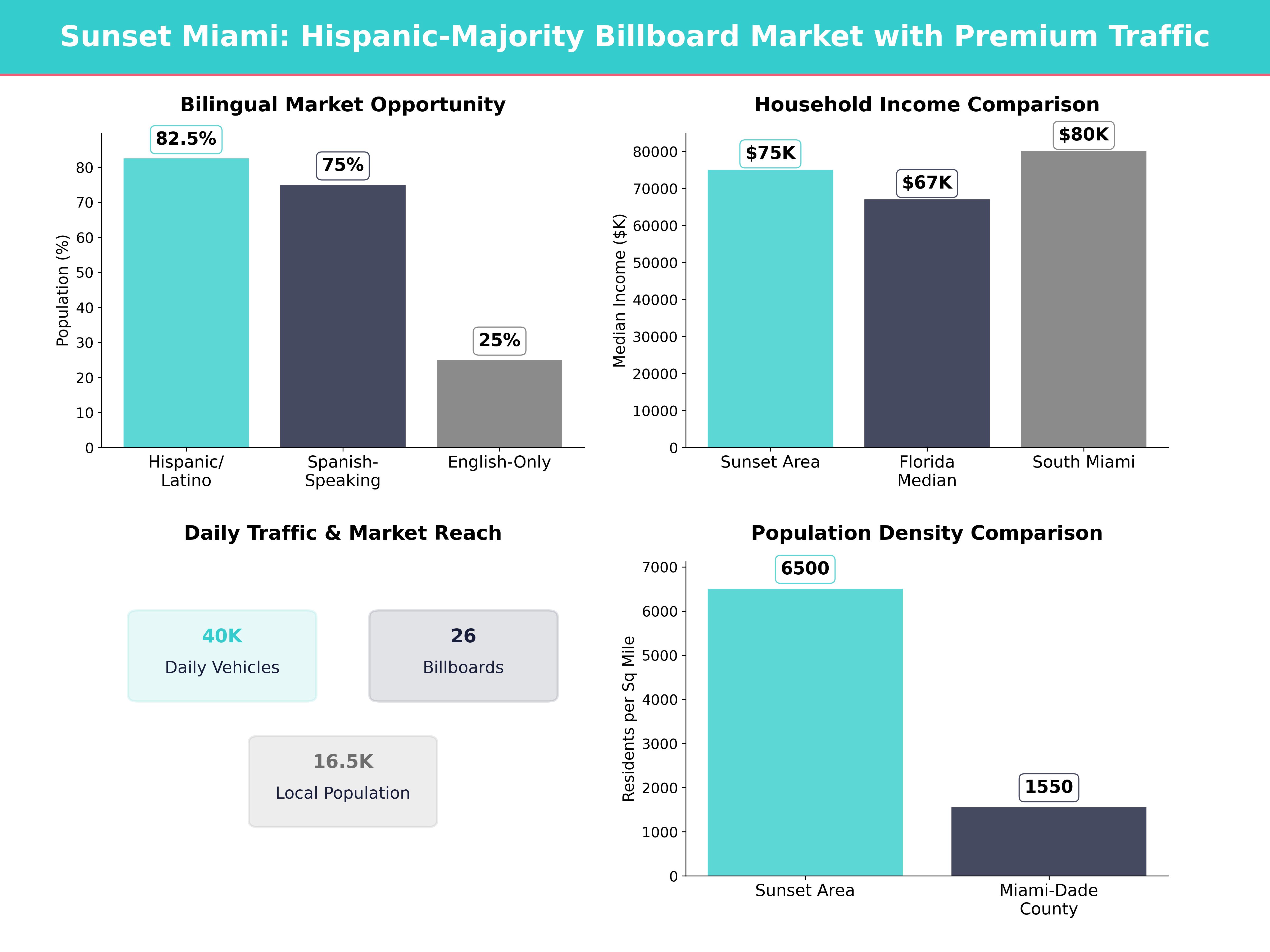
The Sunset area sits at the heart of southwest Miami-Dade, surrounded by high-income neighborhoods, busy commuter corridors, and heavily traveled retail destinations. The Sunset area is a suburban community of roughly 16,000–17,000 residents, with a population density of about 6,000–7,000 residents per square mile. It is also part of a broader, heavily Hispanic, bilingual Miami-Dade market where Hispanic or Latino residents make up roughly 80–85% of the Sunset area.
When is the best time to run billboards near Sunset, Florida with Blip?
Rush hours are intense around the Sunset area, with morning peak traffic roughly from 7:00–9:30 a.m. and evening peak traffic roughly from 4:00–7:00 p.m. For restaurants, retail, family entertainment, and personal services, the page recommends pushing more budget into 11 a.m.–2 p.m. and 5–9 p.m. Friday, plus 10 a.m.–9 p.m. Saturday–Sunday. By adjusting your bids and schedules in Blip, you can lean into the time windows where your target audience in the Sunset area is most likely to see your message.
How should I design a billboard for Sunset, Florida to get noticed?
Because digital billboards near the Sunset area reach drivers at 40–65 mph on expressways and busy arterials, artwork must be instantly digestible and culturally tuned. The page recommends keeping text to 7 words or fewer and using bold, high-contrast colors because Miami’s bright sun and frequent rain can wash out subtle designs. It also suggests localizing visuals with South Florida imagery and using smart bilingual strategy when serving the Sunset area.
Do I need a contract to advertise with Blip near Sunset?
No, Blip has no long-term contracts or minimum commitments. You can start, pause, or stop your campaign at any time.
How fast can I launch a billboard campaign with Blip near Sunset?
You can have your campaign live in minutes. Create a free account, select your locations, set your budget, upload your design, and start running once approved.
Where can I advertise with Blip near Sunset?
Blip has digital billboards near Sunset. You can browse available locations on a map, choose the ones that fit your audience, and start advertising right away.
Still have questions? Launch a campaign in minutes — no contracts, no commitments.
Start Your CampaignSunset Billboard Advertising Guide
The Sunset, Florida area sits at the heart of southwest Miami-Dade, surrounded by high-income neighborhoods, busy commuter corridors, and some of the most heavily traveled retail destinations in the county. With 26 digital billboards serving the Sunset area from nearby Miami locations within about 10 miles, we can help advertisers tap into a dense, mobile audience that lives, works, shops, and commutes through this suburban-urban mix every day. For brands specifically looking for billboards near Sunset or broader Sunset billboards coverage, this cluster of locations offers a flexible way to dominate the nearby corridors. Across Miami‑Dade, typical digital billboards on major arterials and expressways routinely deliver hundreds of thousands of weekly impressions per face, based on traffic volumes reported by agencies such as the Florida Department of Transportation District Six and local planning organizations.
Understanding the Sunset Area Market
The Sunset area is a suburban community of roughly 16,000–17,000 residents in southwest Miami-Dade County. It lies just west of South Miami and Coral Gables and north of Kendall, with major corridors like Sunset Drive (SW 72nd Street), the Don Shula Expressway (SR 874), the Snapper Creek Expressway (SR 878), and US‑1/Dixie Highway funneling traffic around it, making this an ideal zone for billboard advertising near Sunset that reaches both local residents and regional commuters.
Key market characteristics:
- Population density: The Sunset area packs about 6,000–7,000 residents per square mile, compared with a U.S. average of roughly 90–100 residents per square mile and a Miami‑Dade County average of around 1,500–1,600 residents per square mile, according to county planning summaries from Miami‑Dade County. This density translates into strong local exposure when we target boards in nearby Miami that serve the Sunset area.
- County scale: Miami‑Dade County as a whole has roughly 2.7 million residents, according to county data from Miami‑Dade County, making it Florida’s most populous county and part of a larger 6‑million‑plus South Florida metro. Sunset is tightly integrated into that broader commuting and shopping ecosystem.
- Household income: Median household income in the Sunset area is estimated in the $70,000–80,000 range, above the Florida median (around $67,000). Nearby communities skew higher: Pinecrest and Coral Gables often report median household incomes above $110,000–$120,000, and South Miami typically falls in the $70,000–90,000 band. This makes the Sunset catchment area a prime zone for mid‑ to high‑ticket consumer offers—automotive, home improvement, healthcare, financial services, and private education.
- Homeownership: Owner-occupancy is high, around 60–70% in and around Sunset, versus roughly 56–60% for Miami‑Dade County overall. Higher homeownership correlates with longer tenure; in many southwest Miami zip codes, a substantial share of owners (often 35–45%) have lived in their homes for 10 years or more, supporting campaigns that depend on long-term purchasing power.
Because our 26 boards are placed in Miami locations near Sunset, we can intersect both neighborhood-level trips and regional flows to Downtown Miami, Coral Gables, Dadeland, Miami International Airport, and other employment and retail hubs. This concentrated network of Sunset billboards gives you multiple ways to reach the same high-value audience as they move through different parts of their daily routine.
Demographics and Cultural Insights for Better Targeting
The Sunset area is part of the broader, heavily Hispanic, bilingual Miami‑Dade market. Countywide, roughly 69–70% of residents identify as Hispanic or Latino, and in many southwest Miami communities that share characteristics with Sunset, that share climbs into the 80–90% range. To connect effectively, campaigns should reflect that cultural and linguistic reality.
Approximate demographic profile for the Sunset area:
-
Ethnicity:
- Hispanic or Latino: roughly 80–85%
- Non-Hispanic White: about 10–15%
- Black, Asian, and other groups: the balance (5–10% combined)
- Foreign-born residents: Around 45–55% of residents in similar southwest Miami‑Dade communities are foreign-born, predominantly from Cuba, Central America, South America, and the Caribbean. For Miami‑Dade County as a whole, foreign-born residents account for roughly 53–55% of the population, making it one of the most international counties in the U.S.
-
Language:
- Spanish spoken at home: about 70–80% of households in the Sunset-adjacent area
- English-only households: about 20–30%
- Countywide, approximately 72–75% of residents age 5+ speak a language other than English at home, with Spanish dominating.
What this implies for your billboards serving the Sunset area:
-
Bilingual creative wins. In heavily Hispanic corridors of Miami‑Dade, bilingual or Spanish-led creative consistently outperforms English-only campaigns in recall and response among Hispanic audiences in third‑party OOH studies. Consider:
- Fully bilingual concepts (headline in Spanish, subhead or CTA in English) or vice versa.
- Simple Spanish CTAs like “Llama hoy,” “Visítanos,” or “Agenda tu cita,” which can be understood in 1–2 seconds of viewing.
-
Localized tone. Use visuals and language that feel “Miami”:
- Color palettes inspired by local teams like the Miami Heat, Dolphins, and Hurricanes, or Miami-style tropical palettes—teals, corals, and bright neons—which stand out particularly well in OOH environments in South Florida’s bright light.
- Imagery of multigenerational families, outdoor lifestyles, and Latin American food/entertainment cues that mirror the reality that more than 30% of Miami‑Dade households include three or more generations.
- Trust and credibility. Many residents rely on local news from outlets like the Miami Herald, WPLG Local 10, WSVN 7 News, and NBC 6 South Florida. These outlets routinely reach hundreds of thousands of viewers and readers weekly across TV, digital, and print. Referencing local landmarks or neighborhoods in your copy (“serving Kendall and the Sunset area,” “near Dadeland Mall,” “minutes from Coral Gables”) can significantly boost trust and recall, especially when used on highly visible billboard advertising near Sunset that people see every day on their commutes.
Daily Traffic Patterns: When Your Message Matters Most
Traffic around the Sunset area is shaped by a mix of commuters, school traffic, and retail trips to nearby hubs like Dadeland Mall and the University of Miami corridor.
Key patterns based on regional travel data and local road realities:
-
Rush hours are intense:
- Morning peak: roughly 7:00–9:30 a.m., when many major Miami‑Dade corridors operate at 80–100% of capacity.
- Evening peak: roughly 4:00–7:00 p.m., often with slower average speeds on US‑1 and the Don Shula Expressway segments.
-
Heavily traveled highway connectors:
- Don Shula Expressway (SR 874) and Snapper Creek Expressway (SR 878) carry commuters from Kendall and the southwest suburbs toward central Miami. FDOT traffic counts in the broader southwest Miami system show key expressway segments carrying 80,000–120,000 vehicles per day.
- US‑1/Dixie Highway near Dadeland Mall sees daily traffic counts often exceeding 80,000–100,000 vehicles on key segments, according to regional figures cited by the Miami-Dade Transportation Planning Organization.
-
Local arterials:
- Sunset Drive (SW 72nd Street) is a key east‑west spine tying the Sunset area to South Miami, Coral Gables, and Dadeland. Segments closer to Dadeland and US‑1 can see 35,000–45,000 vehicles per day.
- Nearby retail-heavy corridors like North Kendall Drive (SW 88th Street) and Bird Road (SW 40th Street) attract consistent mid‑day and weekend traffic; in many segments, daily traffic reaches 40,000–60,000 vehicles.
How to use Blip’s tools with these patterns:
-
Daypart by commute: Concentrate impressions during 7–10 a.m. and 4–7 p.m. for:
- Financial services
- Healthcare & clinics
- Higher education and tutoring
- B2B or professional services
These categories tend to see higher conversion during commuting hours, when professionals and parents are most reachable.
-
Midday & weekend strategy: For restaurants, retail, family entertainment, and personal services, push more budget into:
- 11 a.m.–2 p.m. (lunch and errands) when many Miami‑Dade workers take mid‑day breaks, and Dadeland-area restaurants experience significant lunchtime peaks.
- 5–9 p.m. Friday and 10 a.m.–9 p.m. Saturday–Sunday, when regional malls like Dadeland and Kendall-area power centers attract weekend foot traffic measured in the tens of thousands of visitors per day.
By adjusting your bids and schedules in Blip, you can lean into exactly the time windows where your target audience in the Sunset area is most likely to see your message, aligning your impressions with the highest-traffic 30–40 hours per week on nearby roads. This kind of precise scheduling is especially valuable when you’re using billboards near Sunset to support time-sensitive offers or events.
Seasonal Opportunities in the Sunset Area and Greater Miami
Miami‑Dade’s climate and tourism cycles create unique seasonal dynamics you can leverage on digital billboards near the Sunset area.
- Tourism scale: The Greater Miami & Miami Beach area welcomed about 26–27 million visitors annually pre‑pandemic, with recent recovery years again surpassing 24–25 million visitors, according to the Greater Miami Convention & Visitors Bureau. Visitor spending has been measured in the $17–20 billion per year range, with a sizable portion flowing through the southern metro (Dadeland, Kendall, Coral Gables, South Miami) for shopping, dining, and lodging.
-
Peak visitor periods:
- December–April: peak winter tourism, when hotel occupancy in beach and urban cores frequently climbs above 80–85% on many weekends.
- March: spring break and event season, with spikes in airport passenger traffic at Miami International Airport, which handles more than 50 million passengers annually in recent years.
- Late November–early January: holiday travel and shopping season, when regional malls like Dadeland see some of their highest sales weeks of the year.
-
School calendar effects:
- Miami‑Dade County Public Schools—one of the largest U.S. districts with over 330,000 students and 350+ schools—affect family routines from August–June. School start and end times drive added morning/afternoon traffic on key Sunset-area routes, especially around major high schools and elementary schools in the Kendall/South Miami zone.
- When school is in session, local arterial traffic can spike by 10–20% during drop‑off and pick‑up windows around 7–9 a.m. and 2–4 p.m.
Seasonal strategy ideas:
- Winter & spring: Promote travel, attractions, healthcare checkups, tax services, and real estate when many seasonal residents and visitors are in town. Tax preparation demand peaks between late January and mid‑April, and many healthcare providers see increased preventive-care bookings in Q1.
- Back-to-school (July–September): Focus on tutoring, private schools, kids’ activities, technology, and apparel. Retailers in South Florida typically see back‑to‑school spend rivaling the holiday season for categories like clothing, shoes, and electronics.
- Hurricane season (June–November): Home improvement, insurance, generators, roofing, and emergency-prep services can run time-sensitive campaigns tied to storm awareness. Miami‑Dade’s high single-family homeownership rates around Sunset and Kendall (often 60–70% of occupied units) means strong demand for roofing, shutters, and backup power.
- Holiday retail (November–December): Use countdown messages (“3 days left,” “This weekend only”) and frequent creative swaps via Blip to drive urgency to stores near Dadeland and Kendall. Nationally, as much as 20–25% of annual retail revenue can occur in this period for some categories, and South Florida’s tourism inflow amplifies local demand.
Where Our Billboards Are and How They Serve the Sunset Area
All 26 digital billboards serving the Sunset area are located in Miami within roughly 10 miles. That proximity allows us to reach both residents and through‑traffic that directly impacts businesses in and around the Sunset area. Within that 10‑mile radius live several hundred thousand residents across Kendall, West Kendall, South Miami, Coral Gables, Pinecrest, and adjacent neighborhoods, along with major office, healthcare, and retail employment centers. For advertisers comparing different options for billboard rental near Sunset, this cluster of signs delivers a powerful combination of neighborhood coverage and regional reach without having to manage multiple vendors.
Typical placement advantages you can expect from Miami boards serving the Sunset area:
-
Proximity to major retail:
- Dadeland Mall, one of Miami’s largest malls, with more than 185 stores and restaurants and annual foot traffic in the millions of visitors.
- Kendall Drive shopping centers such as The Palms at Town & Country and other regional centers along SW 88th Street.
- Big-box clusters along US‑1/Dixie Highway and Bird Road that include national retailers, auto dealers, and home-improvement stores.
-
Coverage of commuter flows:
- Daily trips between Kendall, West Kendall, and central Miami; many commuters in these corridors travel 10–20 miles each way, passing multiple billboard locations.
- Routes to employment centers in Coral Gables, Downtown Miami, and the Miami International Airport zone, which together host hundreds of thousands of jobs across finance, healthcare, higher education, and tourism.
-
Access to key institutions:
- University of Miami area (Coral Gables), serving more than 17,000 students plus thousands of faculty and staff.
- Major hospitals and medical clusters near South Miami and Kendall, including facilities in systems like Baptist Health South Florida and Nicklaus Children’s Hospital, which draw patients and visitors from across the region.
- Government and civic centers for Miami‑Dade County, including county buildings, courts, and municipal facilities in Coral Gables, South Miami, and Pinecrest that generate steady daytime traffic.
In Blip, you can select specific boards near these hubs, adjusting bids higher on the signs that most closely align with your customer base while still maintaining broad coverage serving the Sunset area. For example, you might bid more aggressively on expressway boards reaching 80,000+ daily vehicles, while maintaining a baseline presence on secondary arterials that deliver consistent neighborhood reach. This makes it simple to build a layered strategy that includes large-format expressway Sunset billboards for reach plus more localized placements near Sunset Drive for frequency.
Creative Best Practices for the Sunset Area
Because digital billboards near the Sunset area reach drivers at 40–65 mph on expressways and busy arterials, artwork must be instantly digestible and culturally tuned. OOH research indicates that drivers typically have 5–8 seconds to absorb a roadside message, and recall drops sharply as the number of words and visual elements increases.
Guidelines that work especially well in this market:
-
Keep text to 7 words or fewer.
Drivers typically have 5–8 seconds of viewing time. Aim for:- One clear headline
- One strong CTA
- Brand or logo
Campaigns that stay under 7 words often show significantly higher recall scores than more text-heavy designs.
-
Use bold, high‑contrast colors.
Miami’s bright sun and frequent rain can wash out subtle designs. Opt for:- High-contrast combos (white on navy, yellow on black, magenta on dark teal)
- Avoid thin serifs and low-contrast backgrounds, which can reduce legibility at 300–600 feet.
-
Localize your visuals.
- Use imagery that feels like South Florida: palms, outdoor lifestyle, water, Latin food and culture, and architecture similar to Coral Gables, Pinecrest, and Dadeland.
- For healthcare or professional services targeting the Sunset area, show approachable, diverse professionals and families that mirror Miami‑Dade’s majority Hispanic and multicultural population.
-
Smart bilingual strategy.
- Consider one full-Spanish version and one English version and rotate them—e.g., 50/50 split or weighted by corridor demographics (more Spanish where Hispanic concentration exceeds 80%).
- Use short, powerful Spanish phrases: “Sin contrato,” “Abierto hoy,” “Financiamiento disponible.”
- Make sure phone numbers and URLs are easy to read at a glance—short domains of 10–15 characters or fewer tend to perform better in OOH.
-
Clear, simple contact paths.
- Use short URLs or memorable vanity URLs.
- Consider trackable phone numbers or text codes (e.g., “Texto SUNSET al 55555”).
- “Exit 20 – Dadeland” or “Near Sunset Drive & 87th Ave” style location hints help people connect the ad to where they’re headed, especially on expressways where exit decisions are made in 2–4 seconds.
Because creative can be swapped effortlessly on digital, test multiple versions (color schemes, Spanish vs. English emphasis, different offers) across the 26 boards serving the Sunset area, then lean into the designs driving the most response. Many advertisers see improved performance after 2–3 optimization cycles of creative testing, especially when they specifically compare how different messages perform on billboards near Sunset versus more distant boards in other parts of Miami.
Using Blip’s Flexibility to Match Budgets and Goals
Blip allows advertisers to buy individual “blips” (ad plays) instead of fixed multi‑week contracts, which is ideal for the dynamic, event‑driven Miami market near the Sunset area.
Ways to tailor your approach:
-
Start small, then scale:
Begin with a modest daily budget spread across several boards near Sunset-area routes. Even $10–$20 per day can generate meaningful frequency on select boards. When you see positive responses (site visits, calls, store traffic), gradually increase your maximum bids on the best-performing signs and time slots. -
Own key moments:
For important dates—grand openings, sales events, sports seasons—temporarily raise bids during high-traffic hours along routes your customers take (e.g., Saturday afternoons around Dadeland, weekday rush hours toward Coral Gables and Downtown). Concentrating spend into 3–5 key days can create noticeable “ownership” of a corridor. -
Hyperlocal reach:
Focus your campaign on boards closest to your physical storefront or service area—often within 1–3 miles—then add a second ring of boards on major highways to capture broader awareness from commuters and visitors. This is an efficient way to use billboard rental near Sunset to support both brand-building and direct-response goals. -
Event alignment:
Leverage major local events that draw traffic through the Sunset area and surrounding corridors:- University of Miami football and basketball seasons, which bring thousands of fans to the Coral Gables area for home games.
- County fairs or festivals listed on Miami‑Dade County’s events calendars, many of which attract tens of thousands of attendees over a weekend.
- Major concerts or events that impact traffic toward Downtown or Coral Gables—using time‑limited creative (“Tonight,” “This Weekend”) to capitalize on increased corridor traffic.
Industry-Specific Tactics for the Sunset Area
Different sectors can benefit from a tailored approach to billboards serving the Sunset area:
Local Retail & Restaurants
- Promote lunch and dinner specials during 11 a.m.–2 p.m. and 4–9 p.m. on weekdays, plus midday weekends. These windows align with typical restaurant peak hours in Miami‑Dade, when many locations generate 60–70% of their daily traffic.
- Use simple promos: “Kids eat free,” “Happy hour 4–7,” “Tonight only.” Short, offer-driven copy tends to lift response by double‑digit percentages in OOH studies compared with purely brand-focused messaging.
- Call out proximity: “5 minutes from Dadeland” or “Off Sunset Drive near 87th Ave” to connect with drivers who travel those routes multiple times per week and are already familiar with seeing Sunset billboards along their daily paths.
Healthcare & Wellness
- The Sunset area and nearby communities have many families and older residents with strong insurance coverage. In several southwest Miami zip codes, more than 85–90% of residents under 65 have some form of health coverage.
-
Promote:
- Urgent care and walk‑in clinics (ideal for rush-hour and evening slots)
- Dental and orthodontics (high-value, repeat-visit services)
- Specialty practices and imaging centers located along US‑1, Kendall Drive, or near South Miami Hospital and other Baptist Health facilities
- Align with open enrollment periods (typically November–January) and flu season (October–February), and use reassuring, trust-building language and visuals that emphasize bilingual staff or “Se habla español,” given the 70–80% Spanish-at-home share.
Real Estate & Home Services
- With high homeownership rates and stable neighborhoods, real estate and home-service campaigns can perform well. Many nearby submarkets see median home values above $400,000–$600,000, especially in Coral Gables, Pinecrest, and parts of Kendall.
-
Showcase:
- Mortgage opportunities and rate-based offers; even small rate changes (e.g., 0.25–0.50 percentage points) can shift buyer urgency.
- Renovation and roofing; in hurricane-prone South Florida, roofing, impact windows, and shutters are recurring needs.
- Solar, HVAC, landscaping, security systems—categories that tap into high property values and year‑round outdoor living.
- Time messaging around hurricane season (prep & repair) and peak moving seasons (spring and summer, when many leases expire and families prefer to move between school years).
Education & Youth Activities
-
Many families in the Sunset area look for:
- Private schools and academies
- After-school programs and tutoring
- Sports leagues, dance, and arts programs
Miami‑Dade’s large K‑12 population (over 330,000 public school students plus tens of thousands in private schools) creates strong demand for supplementary education and activities.
- Run heavier rotations in August–September and January (new semester) and target morning & mid‑afternoon traffic on school routes. Aligning messaging with report card periods and standardized testing windows can also boost relevance.
Measuring and Optimizing Campaign Performance
To get the most value from billboards serving the Sunset area, connect your campaign to measurable outcomes:
- Use custom URLs and promo codes:
For example, “/sunset” landing pages or “SUNSET20” codes to isolate billboard-driven responses. Short, memorable URLs typically see higher direct-type traffic than long or complex ones. - Monitor local traffic data and news:
Stay plugged into Miami‑Dade County’s transportation updates and local outlets like Miami Herald or Local 10 for roadwork and events that may shift traffic flows. Major construction projects or lane closures can move thousands of daily vehicles from one corridor to another, changing which boards deliver the most impressions. -
Iterate creative often:
Because digital boards allow quick swaps, plan multiple creative waves:- Wave 1: Brand awareness
- Wave 2: Highlight offers and benefits
- Wave 3: Urgency (deadlines, limited-time deals)
Many advertisers find that rotating new creative every 4–8 weeks keeps recall high and combats message fatigue. Track lift in calls, walk‑ins, and website activity during each wave and refine your mix of boards, dayparts, and creatives accordingly.
By aligning your messaging, timing, and board selection with the unique demographic, cultural, and traffic realities of the Sunset area and greater Miami, digital billboards through Blip can become a powerful, flexible pillar of your local marketing strategy. With 26 strategically placed boards serving the Sunset area, the ability to start at virtually any budget, and access to corridors carrying tens of thousands to over 100,000 vehicles per day, we can help you put your brand in front of thousands of potential customers every day as they move through one of South Florida’s most vibrant corridors. Whether you’re seeking broad billboard advertising near Sunset for regional awareness or highly focused billboard rental near Sunset to drive customers to a specific location, this market offers the scale and precision to support your goals.