Billboards near Fountainebleau, FL
No Minimum Spend. No Long-Term Contracts. Just Results.
Trusted by Leading Brands


Billboard advertising
near Fountainebleau has never been easier



How much is a billboard near Fountainebleau?
Why Choose Blip for Billboard Advertising near Fountainebleau
Blip lets you launch Fountainebleau billboards fast, reaching SR 836 and SR 826 commuters without a long setup.
Set a flexible budget for Fountainebleau and keep it within reach of local shoppers, FIU traffic, and airport travelers.
Daypart your Fountainebleau ads for rush hour, mall midday, or weekend family drives near Dolphin Mall.
No contracts on Blip means you can test Fountainebleau creative for Spanish-first commuters and adjust anytime.
Track real-time results in Fountainebleau and shift spend as traffic surges on west Miami-Dade expressways.
Use Blip's creative tools to build bold bilingual ads for Fountainebleau's Hispanic audience and bright Florida roads.
Frequently Asked Questions About Billboard Advertising near Fountainebleau
How much does a billboard cost near Fountainebleau, Florida with Blip?
With Blip, you control exactly what you spend on Fountainebleau billboards by setting your own daily budget, and our platform automatically keeps your campaign within that amount. Each 7.5–10 second ad, or “blip,” is priced individually based on when and where it runs, plus real-time advertiser demand, so you only pay for the exposure you receive. This pay-per-blip model makes billboards near Fountainebleau, Florida accessible whether you want to start small or scale up.
Where can I advertise with Blip near Fountainebleau, Florida?
Our 50 digital billboards near Fountainebleau, Florida give you flexible, budget-friendly exposure in the Fountainebleau area, complete with real-time control and cheekily eye-catching creative. The billboards serve the area from nearby Miami, Medley, Hialeah Gardens, and Hialeah. By strategically using locations near major corridors, advertisers can build frequency among Fountainebleau-area residents and visitors.
What kind of audience do Fountainebleau, Florida billboards reach?
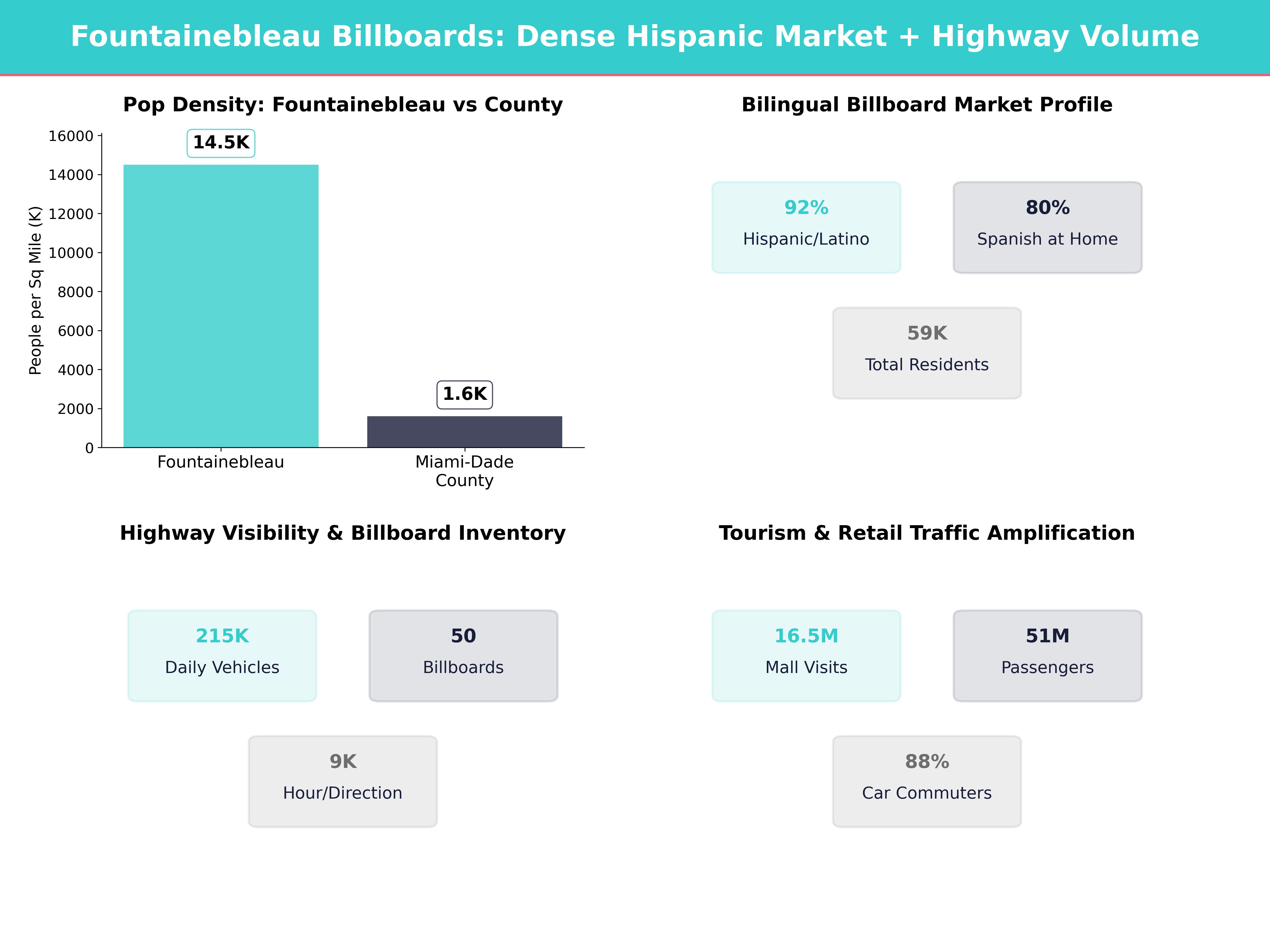
Fountainebleau is a compact but densely populated community, with roughly 59,000 residents within just about 4 square miles. Around 90–94% of residents identify as Hispanic or Latino, and over 80% speak Spanish at home. Campaigns that include Spanish typically reach a clear majority of residents, and bilingual or Spanish-first creatives can address more than 4 out of 5 households directly in their primary language.
When is the best time to run billboard ads in Fountainebleau, Florida with Blip?
With Blip-style digital buying, you can control when your ads appear on boards serving the Fountainebleau area. Morning commute hours from 6:30–9:30 a.m. and evening peaks from 4:00–7:30 p.m. are strong for reaching commuters, while 10:00 a.m.–3:00 p.m. works well for mall, student, and lunch traffic. The Fountainebleau area also skews highly local during evenings and weekends, making those times effective for restaurants, family entertainment, and community-oriented offers.
Why do Spanish and bilingual billboards work so well in Fountainebleau, Florida?
Local demographic data indicate that around 90–94% of residents identify as Hispanic or Latino, and over 80% speak Spanish at home. In Miami-Dade overall, about 73–75% of residents speak a language other than English at home, so Fountainebleau skews even more Spanish-first than the county average. Campaigns that include Spanish typically reach a clear majority of residents, making Fountainebleau billboards especially effective for culturally tailored messaging.
Do I need a contract to advertise with Blip near Fountainebleau?
No, Blip has no long-term contracts or minimum commitments. You can start, pause, or stop your campaign at any time.
How fast can I launch a billboard campaign with Blip near Fountainebleau?
You can have your campaign live in minutes. Create a free account, select your locations, set your budget, upload your design, and start running once approved.
Where can I advertise with Blip near Fountainebleau?
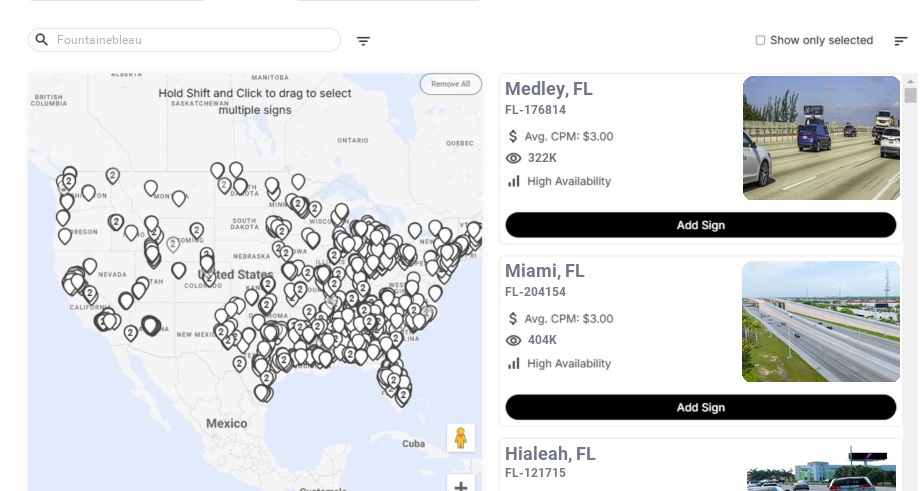
Blip has digital billboards near Fountainebleau. You can browse available locations on a map, choose the ones that fit your audience, and start advertising right away.
Still have questions? Launch a campaign in minutes — no contracts, no commitments.
Start Your CampaignFountainebleau Billboard Advertising Guide
The Fountainebleau, Florida area sits at the heart of west Miami-Dade, surrounded by major expressways, regional shopping destinations, and dense residential neighborhoods. With 50 digital billboards serving the Fountainebleau area from nearby Miami, Medley, Hialeah Gardens, and Hialeah, we can help you tap into one of South Florida’s most active, bilingual consumer markets—on your schedule and budget, using flexible billboard advertising near Fountainebleau that fits your goals.
Understanding the Fountainebleau Area Market
Fountainebleau is a compact but densely populated community. The Fountainebleau census-designated place has roughly 59,000 residents within just about 4 square miles, yielding a density of around 14,000–15,000 people per square mile—higher than many parts of central Miami and more than triple the overall Miami-Dade County density (about 1,500–1,600 people per square mile across roughly 2.7 million residents).
Key characteristics that matter for billboard messaging near Fountainebleau:
-
Heavily Hispanic and bilingual:
Local demographic data indicate that around 90–94% of residents identify as Hispanic or Latino, and over 80% speak Spanish at home. In Miami-Dade overall, about 73–75% of residents speak a language other than English at home, so Fountainebleau skews even more Spanish-first than the county average. Campaigns that include Spanish typically reach a clear majority of residents, and bilingual or Spanish-first creatives can address more than 4 out of 5 households directly in their primary language, making Fountainebleau billboards especially effective for culturally tailored messaging. -
Working and commuting community:
Many residents work in logistics, retail, hospitality, healthcare, education, and professional services. Miami-Dade’s unemployment rate has generally ranged between 1.7% and 3.0% in recent years, reflecting a busy labor market and heavy daily movement. Average one-way commute times in the west Miami-Dade area often fall in the 30–35 minute range, with many workers making daily trips along the Dolphin Expressway (SR 836), the Palmetto Expressway (SR 826), and surface arteries connecting to Miami, Doral, Medley, and Hialeah. That translates into hundreds of viewing opportunities per commuter per month when campaigns on billboards near Fountainebleau are timed to peak traffic. -
Retail and education anchors nearby:
The area is minutes from Florida International University’s Modesto A. Maidique Campus, Dolphin Mall Miami International Airport, each drawing substantial monthly traffic:- FIU reports more than 56,000 students systemwide and thousands of faculty and staff; the Modesto A. Maidique Campus alone brings tens of thousands of people into the west Miami-Dade area on a typical weekday.
- Dolphin Mall has been reported as one of Miami-Dade’s highest-traffic shopping centers, with estimates of 15–18 million visitors per year (over 1.2–1.5 million monthly on average), including a strong share of international tourists.
- Miami International Mall serves a primarily local and regional audience, with foot traffic commonly estimated in the several-hundred-thousand-visitors-per-month range during peak seasons.
- Miami International Airport recorded more than 50–52 million passengers in recent years, averaging over 4 million passengers per month, and a large share of those travelers pass through or near the Fountainebleau corridor via SR 836 and local arterials.
For advertisers, this mix creates an audience that is:
- Local and neighborhood-focused during evenings and weekends
- Highly mobile along expressways and arterial roads during commute times
- Comfortable engaging with Spanish, English, or both within the same message
Our 50 digital billboards near Fountainebleau allow you to reach these residents where they already travel—near their jobs, shopping centers, schools, and entertainment hubs—while keeping your billboard rental near Fountainebleau targeted and efficient.
Where Our Billboards Reach Near Fountainebleau
While our boards are located in nearby cities, they are positioned to serve everyday traffic patterns in the Fountainebleau area and function as high-impact Fountainebleau billboards for local and commuter traffic:
- Miami (about 5.4 miles from Fountainebleau):
Boards along key corridors leading toward Downtown Miami, Brickell, and the airport capture commuters and travelers moving between Fountainebleau and central employment centers. The City of Miami itself houses roughly 440,000–450,000 residents, with weekday daytime populations surging by tens of thousands more due to inbound commuters. Learn more about the city at miamigov.com. - Medley (about 5.7 miles away):
Medley is a major industrial and logistics hub, with heavy truck and workforce traffic. More than 80% of the town’s land area is dedicated to industrial and commercial use, and thousands of workers enter Medley’s warehouses and distribution centers each weekday. Our inventory near Medley reaches Fountainebleau-area residents employed in warehouses, distribution, and manufacturing. The town’s site at townofmedley.com highlights its industrial role in the region. - Hialeah Gardens (about 6.9 miles away):
Located just north of the Palmetto Expressway, Hialeah Gardens - Hialeah (about 7.0 miles away):
One of Florida’s largest cities, Hialeah has a population of over 220,000, with more than 94% of residents identifying as Hispanic or Latino and over 90% speaking a language other than English at home. Our boards near Hialeah add reach into a demographically similar market with strong cross-traffic to the Fountainebleau area for work, shopping, and services.
Daily traffic counts on major expressways in west Miami-Dade often exceed 180,000–250,000 vehicles per day on segments of SR 826 and SR 836, according to state and county transportation data. For example, recent counts on heavily used portions of SR 836 near the airport have been reported in the 190,000–210,000 vehicles-per-day range, while key segments of SR 826 see roughly 220,000–240,000 vehicles per day. By strategically using locations near these corridors, advertisers can build frequency among Fountainebleau-area residents and visitors, generating millions of monthly impressions, without needing boards directly inside Fountainebleau itself. This makes billboard advertising near Fountainebleau accessible to brands of all sizes, from local retailers to regional service providers.
Audience Insights: Who You’ll Reach
Based on regional data from Miami-Dade County and local economic patterns, here is how we can think about the audience you’ll reach in the Fountainebleau area with billboards near Fountainebleau:
-
Age and life stage
- Strong representation of adults 25–54, a core buying demographic that typically accounts for more than 45–50% of the local population.
- Significant number of young families, with roughly one-third of households including children under 18 in much of west Miami-Dade.
- Nearby FIU brings over 56,000 students (undergraduate and graduate) plus thousands of faculty and staff to the area; on a busy weekday, tens of thousands of trips are generated to and from the Modesto A. Maidique Campus, expanding the daytime audience well beyond Fountainebleau’s 59,000 residents.
-
Household and income
- Average household sizes often exceed 3 people (Miami-Dade’s average is about 2.9–3.0, while several west-county neighborhoods, including Fountainebleau, trend closer to 3.0–3.3). Multi-generational living is common, with many homes including grandparents, parents, and children under one roof.
- Household incomes range from working-class to solidly middle-income. In nearby ZIP codes, median household incomes often fall in the $45,000–$65,000 range, while Miami-Dade’s overall median sits around the low-to-mid $60,000s. Many households prioritize value, convenience, and family-focused services when making purchasing decisions.
-
Language and culture
- Predominantly Spanish-speaking, with many bilingual households. In some west Miami-Dade tracts, more than 85–90% of residents speak Spanish at home.
- Strong cultural ties to Cuba, Venezuela, Colombia, Nicaragua, the Dominican Republic, and other Latin American countries, which influence food, holidays, and media preferences.
- Media consumption often includes local Spanish-language TV and radio, as well as outlets like the Miami Herald Local 10 News, El Nuevo Herald Telemundo 51 Univision 23 Miami. These stations collectively reach hundreds of thousands of viewers in the Miami-Fort Lauderdale TV market on a weekly basis.
This context suggests that billboard creative near Fountainebleau should be:
- Clear and legible in both Spanish and English (or primarily Spanish depending on your brand)
- Family- and community-oriented in tone
- Value-focused for essentials (groceries, services, healthcare, transportation) and experience-focused for entertainment (restaurants, nightlife, shopping, travel)
Timing Your Campaign: When to Show Your Ads
With Blip-style digital buying, you can control when your ads appear on boards serving the Fountainebleau area. To make that count, align your schedule with how the area moves and how you plan your billboard rental near Fountainebleau.
In Miami-Dade, congestion indexes consistently rank the county among the most traffic-congested metros in the U.S., and it’s common for peak-period speeds on SR 836 and SR 826 to fall 30–40% below free-flow speeds. That creates longer exposure windows for your creatives during key commute periods.
Weekday commute windows
-
Morning (6:30–9:30 a.m.)
This window aligns with typical office, school, and logistics shift start times. Traffic volumes on SR 836 and SR 826 can reach 8,000–10,000 vehicles per hour per direction at peak. Focus on commuters heading toward Miami, Doral, Medley, and the airport. Great for:- Quick-service restaurants and coffee shops (“Desayuno listo en 5 minutos”)
- Auto dealers and service centers
- Business services and professional practices
-
Evening (4:00–7:30 p.m.)
Evening peaks are often slightly longer than morning peaks, with similar or higher volumes as workers stagger their departures. Capture residents returning to the Fountainebleau area on SR 836, SR 826, and cross streets. Ideal for:- Grocery, retail, and big-box stores highlighting evening deals
- Gyms, fitness, and wellness promotions
- Home services (AC repair, plumbing, internet, insurance)
Midday and student traffic
-
FIU, Dolphin Mall, and Miami International Mall generate strong midday and early afternoon flows. Retail analytics and university traffic studies for similar campuses suggest thousands of vehicle trips per hour in surrounding corridors at lunchtime and between classes:
-
10:00 a.m.–3:00 p.m. is prime for:
- Mall retailers, fashion, electronics, and entertainment
- Quick lunches and cafes
- Student-focused offers, test-prep, trade schools, and tutoring
-
10:00 a.m.–3:00 p.m. is prime for:
Evenings and weekends
The Fountainebleau area skews highly local during non-work hours:
-
Evenings (7:30–11:00 p.m.) & weekends
Weekend traffic patterns in west Miami-Dade often shift from commuter-heavy expressway use to more local trips for shopping, dining, and family activities. Optimize for:- Restaurants, bars, lounges, and nightlife close to the Fountainebleau area
- Family entertainment (movies, escape rooms, attractions, kids’ activities)
- Faith-based events, community programs, and local festivals
Leveraging flexible scheduling, you can concentrate your budget on these high-impact windows instead of paying for low-relevance times of day, maximizing the return on your billboard advertising near Fountainebleau.
Seasonality in the Fountainebleau Area
Greater Miami is a year-round market, but seasonal patterns can dramatically change who is on the road and what they are thinking about. According to the Greater Miami Convention & Visitors Bureau, the region welcomes more than 26 million visitors annually, including over 17–18 million overnight visitors and millions more day-trippers and cruise passengers. Visitor spending has been estimated in the tens of billions of dollars per year, and a large share of these travelers pass near or through west Miami-Dade on their way to the airport, beaches, or shopping.
Consider these seasonal strategies for Fountainebleau billboards:
-
Winter (December–March): High tourism + holiday shopping
- Snowbirds and international visitors surge, especially from Latin America and Europe. In some years, winter occupancy rates across Miami-Dade hotels exceed 80–85%, compared with lower shoulder-season occupancy in late summer.
- Retail sales in November–December can spike 20–30% above average monthly levels for many categories.
-
Emphasize:
- Tourism, attractions, hotels, and vacation rentals
- Luxury retail, jewelry, high-end dining
- Tax services starting in January
-
Spring (March–May): Events and graduation
- Spring break and major events (such as music festivals and sports events in the Greater Miami area) can push hotel and short-term rental demand up significantly on select weeks.
- FIU’s graduation periods bring thousands of graduates and their families to the area over several days, with local spending spikes on restaurants, photography, florists, and event venues.
-
Focus on:
- Event promotions and nightlife
- Graduation gifts, photography, and party venues
- Housing and job opportunities for new grads
-
Summer (June–August): Local families and students
- Fewer international tourists compared with winter, more local families on the road as schools close for summer. Miami-Dade County Public Schools serve more than 320,000 students; when school is out, daytime trips shift toward camps, childcare, and recreation.
- Back-to-school spending is one of the largest retail events of the year; national data often show families spending several hundred dollars per child on supplies, clothing, and electronics, and Fountainebleau households mirror that behavior.
-
Ideal for:
- Summer camps, tutoring, and back-to-school promotions
- Local attractions, theme parks, and weekend getaways
- Home improvement and moving services
-
Hurricane season messaging (June–November)
- Hurricane season spans six months, and Miami-Dade residents are highly attuned to preparedness messaging. Surveys regularly show that more than 60–70% of South Florida homeowners and renters consider storm readiness a priority purchase category during this period.
-
Effective for:
- Insurance, home protection, impact windows, generators
- Public service messages in coordination with Miami-Dade County and local emergency management updates
Crafting Effective Creative for a Bilingual, Urban Audience
To stand out near Fountainebleau, billboard artwork must be built for fast reading and cultural relevance. Industry research for out-of-home (OOH) advertising shows that drivers typically have 5–8 seconds to absorb a message at highway speeds, and recall rates drop quickly when creatives are cluttered or text-heavy.
Language strategy
-
For most local businesses, we recommend:
- Spanish-first or bilingual messaging.
- Keep each message to 6–8 words per language max; OOH best practices suggest that limiting total word count to about 10–12 words can significantly improve recall.
-
Example structures:
- Headline in Spanish + call-to-action in English
- Major offer in Spanish with a short English tagline (“Now Open,” “Free Delivery,” “Exit 27”)
Visual and copy tips
- Bold, simple visuals:
High-contrast colors (white or yellow on dark backgrounds, or vice versa) work well under bright South Florida sun, which often exceeds UV indexes of 9–11 on clear days. High contrast improves legibility at 400–600 feet. - Large, legible fonts:
Avoid script or overly thin fonts; think big, blocky, and easy to read from moving vehicles. Many OOH guidelines recommend a minimum letter height of 12–18 inches for primary headlines on highway billboards, which equates to clean, sans-serif styles and limited text. - Clear calls-to-action:
Use short URLs, simple QR codes, or easily remembered phone numbers. In dense communities like Fountainebleau, where more than 80% of residents are local repeat travelers, they will remember a simple “On 87th Ave & Flagler” much better than a complex web address. -
Cultural resonance:
Reference familiar local elements:- Foods (cafecito, croquetas, arepas)
- Neighborhoods and landmarks (Dolphin Mall, FIU, Airport West)
- Holidays widely celebrated in the Hispanic community (Three Kings Day, Mother’s Day, Independence days for key Latin American countries)
Aligning creative to local culture can lift brand favorability and ad recall, with some studies indicating double-digit percentage gains when audiences see themselves reflected in the message.
Using Multiple Locations Strategically
With 50 digital billboards serving the Fountainebleau area, you can design campaigns that mirror the real-world paths your customers take. In a county where more than 85–90% of workers commute by car, motorcycle, or carpool, coverage across multiple corridors can dramatically scale reach.
Common strategies we see work well:
-
Commuter funnel
- Use boards near Hialeah and Hialeah Gardens to introduce your brand to northbound/southbound commuters.
- Reinforce the message on boards closer to Miami and Medley as they approach your store or service area.
-
Example:
- North of the Palmetto: “¿Listo para un auto nuevo?”
- Near Fountainebleau-area exits: “Entrega hoy en 836 & 87 Ave”
-
Retail radius
- If your physical location is near the Fountainebleau area, select boards on all primary approach routes: SR 836, SR 826, and major surface roads such as West Flagler Street, SW 8th Street (Calle Ocho), and NW/SW 87th Avenue.
-
Vary the message based on distance:
- 5–7 miles out: brand + offer (“50% Off Lunch Specials”)
- 1–3 miles out: clear directional cue (“2 Exits Ahead – NW 87 Ave”)
-
Daypart rotation
-
Run different creatives at different times:
- Morning: work-related or coffee/breakfast imagery
- Midday: shopping and lunch
- Evening: family dinners, nightlife, and home services
-
Run different creatives at different times:
Because digital billboards can rotate multiple ads, you can test and refine messages by time of day, day of week, or location without committing to a single static creative for months. Advertisers commonly rotate 2–4 creatives per campaign and track response via web traffic, call volume, or in-store redemptions; even small creative changes can yield noticeable lifts in metrics like click-through to branded search or coupon scans. This flexibility is one of the biggest advantages of digital billboard rental near Fountainebleau compared with traditional static placements.
Industries Poised to Win Near Fountainebleau
Several categories are especially well-suited to digital billboard campaigns in the Fountainebleau area, given its high density, Hispanic-majority population, and strong retail and logistics base:
-
Restaurants and food service
- Cafeterias, bakeries, Latin restaurants, fast-casual chains, food trucks, and delivery services.
- Miami-Dade households spend thousands of dollars per year on food at home and away from home, and dining accounts for a significant share of discretionary spending.
- Use appetizing imagery and short headlines (“Café Cubano en 5 Minutos – Salida Próxima”).
-
Healthcare
- Clinics, dental offices, urgent care, and specialists.
- In heavily Hispanic communities, bilingual staff and culturally aware care can be key differentiators; survey data in similar markets show that more than 60% of Spanish-dominant adults prefer healthcare providers who speak Spanish.
- Emphasize bilingual staff, walk-in availability, and insurance acceptance.
-
Auto sales and services
- Nearby Medley and Hialeah host numerous auto dealers and mechanics, contributing to the county’s hundreds of thousands of registered vehicles.
- Promote financing options, same-day approvals, and service specials, especially along high-traffic segments of SR 826 and SR 836 where drivers are already thinking about their vehicles.
-
Education and training
- FIU programs, trade schools, language schools, tutoring centers.
- With more than 56,000 college students nearby and over 300,000 K–12 students across Miami-Dade County Public Schools, education-oriented offers can reach parents and students year-round.
- Target students and parents during school-year commutes and back-to-school periods.
-
Financial and insurance services
- Banks, credit unions, remittance services, tax preparers, and insurers.
- Miami-Dade’s large immigrant population sends billions of dollars in remittances abroad annually, making money transfer and banking services especially relevant.
- Highlight trust, community roots, and easy access for Spanish-speaking customers.
-
Real estate and housing
- Apartment communities, condos, and real estate agents.
- In recent years, Miami-Dade has seen strong housing demand and rising rents and home prices, driving constant movement within the rental and ownership markets.
- Promote pre-leasing, move-in specials, or new developments in nearby neighborhoods.
Integrating with Local Media and Community
Boards serving the Fountainebleau area work best when they’re part of a broader local presence. Out-of-home advertising often boosts the effectiveness of digital and social campaigns by 20–40% in cross-channel studies, especially when messages are coordinated.
- Align your messages with stories and trends covered by outlets like the Miami Herald Local 10, WSVN 7 News, El Nuevo Herald Telemundo 51 Univision 23 Miami. These organizations frequently report on traffic, local events, and consumer issues that your campaigns can reference.
- Coordinate creative with local events and updates from Miami-Dade County or nearby cities such as Miami, Hialeah, Hialeah Gardens Medley. You can also draw on regional tourism storytelling from the Greater Miami Convention & Visitors Bureau and county resources like Discover Miami-Dade
- Use billboards to amplify social media campaigns by featuring hashtags, simple handles, or QR codes that lead to localized landing pages. National research on QR usage shows that more than 40–50% of smartphone users have scanned a QR code in the past year, and adoption is particularly strong among adults 18–44—a key demographic in the Fountainebleau area.
By marrying hyper-local creative with flexible scheduling and precise location selection across our 50 digital billboards serving the Fountainebleau area, we can help you connect with one of South Florida’s most dynamic, bilingual markets in a way that is measurable, adaptable, and deeply rooted in how this community lives and moves every day. Whether you need short-term billboard advertising near Fountainebleau for a promotion or ongoing billboard rental near Fountainebleau to build your brand, the infrastructure is in place to support your campaign.