Billboards in Temple Terrace, FL
No Minimum Spend. No Long-Term Contracts. Just Results.
Trusted by Leading Brands


Billboard advertising
in Temple Terrace has never been easier
How much is a billboard in Temple Terrace?
Why Choose Blip for Billboard Advertising in Temple Terrace
Blip lets you launch Temple Terrace ads fast for I-75, I-4, and Fowler Ave commuters—no traditional buy-in needed.
Set flexible budgets in Temple Terrace and scale up for USF move-in, Busch Gardens weekends, or quieter weeks.
Use dayparting on Temple Terrace billboards to hit USF morning rush and Busch Gardens afternoon traffic when they're on the road.
No contracts with Blip means Temple Terrace advertisers can test Fowler, Fletcher, and 56th St, then shift spend as traffic changes.
Track Temple Terrace campaigns in real time and optimize for weekday students, healthcare workers, and tourist peaks near Busch Gardens.
Blip's creative tools help Temple Terrace ads stay bold and simple for fast-moving drivers on I-75 and neighborhood arterials.
Frequently Asked Questions About Billboard Advertising in Temple Terrace
How much does a billboard cost in Temple Terrace, Florida with Blip?
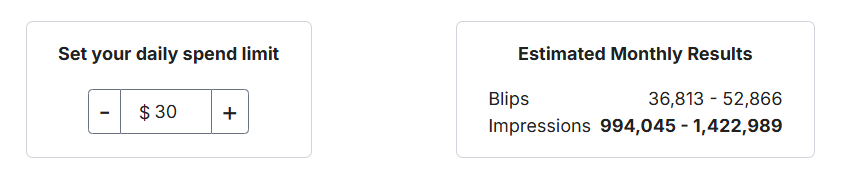
With Blip, you’re in control of your budget from the start—you set a daily amount that works for you, and Blip automatically keeps your Temple Terrace billboards campaign within that limit. Each “blip” is a brief 7.5 to 10-second ad display you only pay for when it actually runs, so you can start small, test different times and locations, and adjust your spend whenever you like. Costs vary based on when and where your ad appears and on advertiser demand, but you never risk overspending.
Where can I advertise with Blip in Temple Terrace, Florida?
Temple Terrace doesn’t sit directly on an interstate, but it is framed by major routes that concentrate daily traffic and make billboard rental in Temple Terrace useful for both local and regional campaigns. I-75 runs just to the east, I-4 lies to the south, and Fowler Avenue, Fletcher Avenue, and 56th Street form key corridors bordering and running through the area. These roads connect to USF, Busch Gardens, residential neighborhoods, and regional commuter traffic.
Who sees Temple Terrace, Florida billboards near USF and Busch Gardens?
Temple Terrace gives us a rare opportunity to reach families, students, commuters, and visiting tourists from a very compact geographic footprint. More than 50,000 students are enrolled across USF’s campuses, and Busch Gardens Tampa Bay and Adventure Island draw millions of visitors annually to the area. The page also notes that major medical and research centers in the Uptown district attract tens of thousands of employees, patients, and visitors each day.
When should I run Temple Terrace, Florida billboards with Blip for the best results?
The most effective billboard messaging in Temple Terrace will often be about timing and context, because USF traffic is heaviest on Monday–Thursday when class schedules are densest. For commuter capture, rush-hour dayparts of 6:30–9:00 a.m. and 4:00–7:00 p.m. are recommended, while tourist-related businesses can benefit from weekends and afternoons during peak seasons. Blip also lets you shift spend to match weekday rush hours, midday, or weekends depending on your audience.
Do I need a contract to advertise with Blip in Temple Terrace?
No, Blip has no long-term contracts or minimum commitments. You can start, pause, or stop your campaign at any time.
How fast can I launch a billboard campaign with Blip in Temple Terrace?
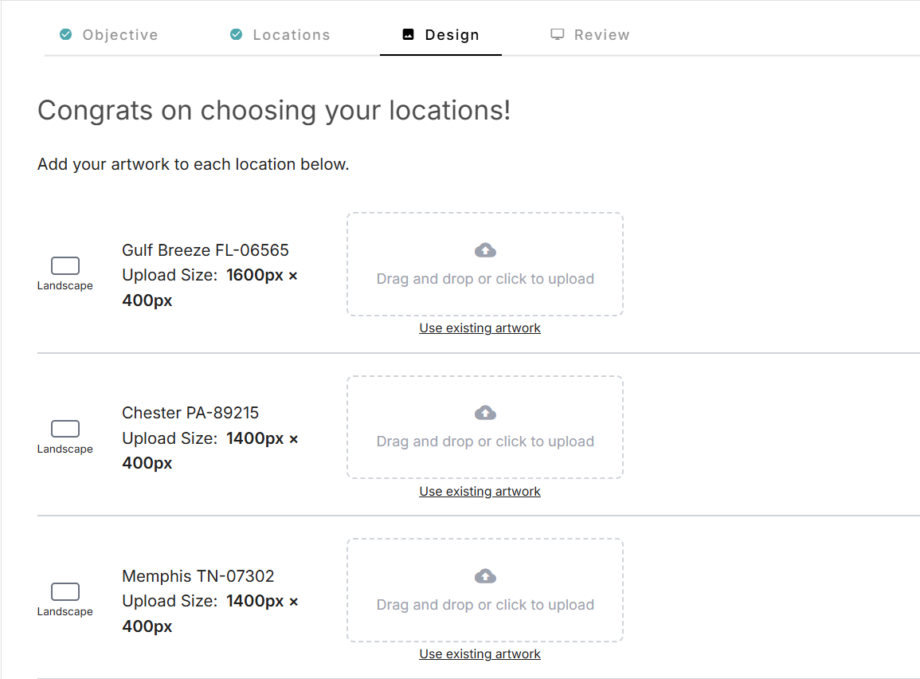
You can have your campaign live in minutes. Create a free account, select your locations, set your budget, upload your design, and start running once approved.
Where can I advertise with Blip in Temple Terrace?
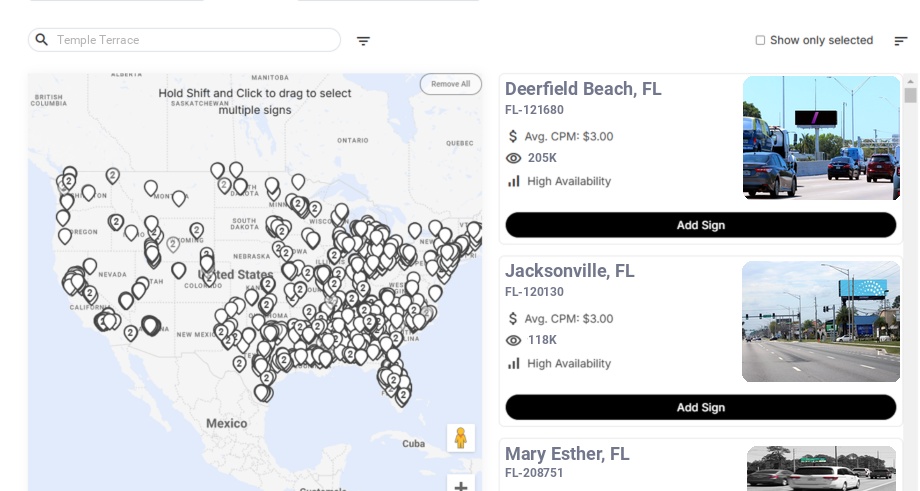
Blip has digital billboards in Temple Terrace. You can browse available locations on a map, choose the ones that fit your audience, and start advertising right away.
Still have questions? Launch a campaign in minutes — no contracts, no commitments.
Start Your CampaignTemple Terrace Billboard Advertising Guide
Temple Terrace, Florida, sits at the intersection of neighborhood living, higher education, and regional tourism. Nested just northeast of Tampa and adjacent to the University of South Florida (USF), it gives us a rare opportunity: we can reach families, students, commuters, and visiting tourists from a very compact geographic footprint. With digital billboards through Blip, we can tap into these overlapping audiences with tailored messages, precise timing, and hyper-local relevance, making Temple Terrace billboards a smart piece of a wider Tampa-area marketing strategy.
Understanding the Temple Terrace Market
Temple Terrace is a small city with outsized influence inside the Tampa–St. Petersburg–Clearwater metro area, which makes billboards in Temple Terrace especially efficient for advertisers trying to cover multiple audience segments from a single cluster of boards.
- Temple Terrace itself has roughly 27,000–28,000 residents, according to recent figures shared by the City of Temple Terrace 27,000 residents living within roughly 7.3 square miles, giving it a relatively high density of nearly 3,700 residents per square mile—ideal for concentrated out-of-home reach.
- It is part of Hillsborough County, which has grown to more than 1.5 million residents, per county government data from Hillsborough County. County estimates show the population increasing by roughly 20–25% since the mid‑2000s, adding well over 250,000 new residents in less than two decades.
- The broader Tampa Bay metro region now exceeds 3.3 million people, making it one of the fastest-growing large metros in the Southeast, a trend reflected in regional planning resources from the Hillsborough County Metropolitan Planning Organization. Regional projections from Plan Hillsborough indicate the county could add another 400,000+ residents by 2045, continuing to increase traffic and advertiser reach and reinforcing the long-term value of Temple Terrace billboard advertising.
Temple Terrace’s unique edge is its immediate proximity to institutional and entertainment hubs:
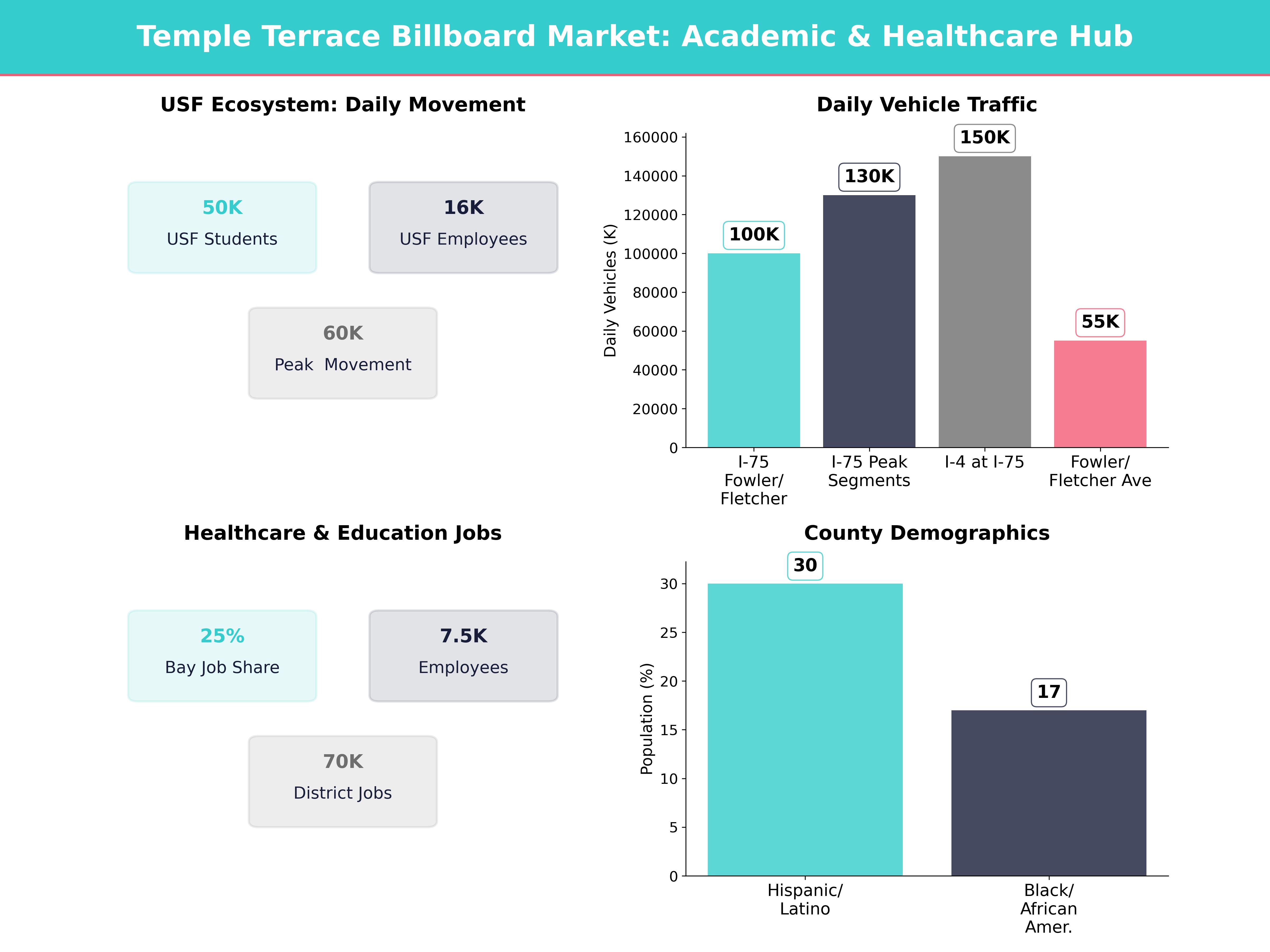
- University of South Florida (USF): More than 50,000 students enrolled across USF’s campuses, with roughly 37,000+ at the Tampa campus alone, per USF. USF also employs more than 16,000 faculty and staff, which means 50,000–60,000 people are regularly moving to and from campus on peak days.
- Busch Gardens Tampa Bay and Adventure Island: These draw millions of visitors annually to the area, supported by tourism data from Visit Tampa Bay. Visit Tampa Bay has reported 26–27 million annual visitors to the Tampa Bay region in recent years, with Busch Gardens consistently ranking among the area’s top paid attractions and generating well over 1 million visits per year.
- Major medical and research centers in the “Uptown” district: the James A. Haley Veterans’ Hospital H. Lee Moffitt Cancer Center & Research Institute USF Health complex collectively attract tens of thousands of employees, patients, and visitors each day. For example, public reports have noted that Moffitt alone employs more than 7,500 people, and the James A. Haley VA hospital serves tens of thousands of veterans annually, creating consistent weekday traffic on nearby arterials that Temple Terrace billboards can tap into.
What this means for us as advertisers:
- We’re not just advertising to 27,000 residents—we’re tapping into the daily flow of commuters, students, healthcare workers, and tourists passing through the corridor. Between USF, Uptown medical employers, and the tourism sector, it’s realistic to reach 100,000+ unique individuals over the course of a typical week with well-placed boards.
- Creative that speaks to education, healthcare, entertainment, and family life will resonate strongly—these sectors together account for a large share of local jobs, with education and health services representing roughly 1 in 4 jobs in the Tampa Bay area according to regional economic summaries from Hillsborough County.
- The most effective billboard messaging in Temple Terrace will often be about timing (when these groups are on the road) and context (why they’re in the area). For instance, Busch Gardens attendance can spike 30–40% on peak weekends and holidays, while USF traffic is heaviest on Monday–Thursday when class schedules are densest.
Key Traffic Patterns and High-Value Corridors
Temple Terrace doesn’t sit directly on an interstate, but it is framed by major routes that concentrate daily traffic and make billboard rental in Temple Terrace useful for both local and regional campaigns:
- I-75 runs just to the east, moving north–south traffic for the Tampa region. Segments near Fowler Avenue and Fletcher Avenue regularly carry 100,000+ vehicles per day, according to regional transportation reports from Plan Hillsborough and traffic count data published by the Florida Department of Transportation. In some adjacent segments, annual average daily traffic (AADT) approaches 130,000 vehicles.
- I-4 lies to the south, connecting Tampa to Orlando and the I-75 corridor. Portions near the I-75 interchange see 130,000–150,000 vehicles per day, reflecting strong regional and tourist traffic on one of Florida’s highest-volume corridors.
- Fowler Avenue (SR 582) and Fletcher Avenue (CR 579) form key east–west arteries bordering Temple Terrace and connecting to USF and I-75. Various FDOT and county counts show many sections of these roads carrying 40,000–55,000 vehicles per day, with volumes surging during USF class hours and Busch Gardens operating hours.
- 56th Street (SR 583) is a major north–south spine through Temple Terrace, funnelling traffic to residential areas, USF, and Busch Gardens. Sections of 56th Street commonly see 25,000–35,000 vehicles per day, according to data shared by Hillsborough County and the City of Temple Terrace
For digital billboard campaigns through Blip, here’s how we can use these traffic patterns:
-
Commuter capture on I-75 and I-4
- Focus on rush-hour dayparts: 6:30–9:00 a.m. and 4:00–7:00 p.m. on weekdays, when traffic volumes can run 20–40% higher than midday baselines on major commuter corridors.
- This is ideal for service businesses, healthcare providers, auto dealers, financial institutions, and employers recruiting talent—commuting workers in the Tampa Bay region often spend 25–30 minutes per one-way trip, giving multiple billboard exposure opportunities across a week.
-
Local lifestyle reach on Fowler, Fletcher, and 56th
- These corridors catch residents and students doing daily errands, grocery runs, and commutes to campus and medical jobs. Retail and service businesses along these routes benefit from the tens of thousands of daily passersby, including USF students, who represent a concentrated consumer base with billions in annual spending power regionally.
- Great for restaurants, gyms, retail, entertainment venues, and local event promotions.
-
Tourist targeting near Busch Gardens and Uptown
- Weekends, holidays, and spring/summer months see spikes in visitor traffic. Visit Tampa Bay has reported that peak tourism months can see visitor volumes 20–30% higher than off-peak periods.
- This is perfect for hotels, attractions, nightlife, and family activities that benefit from impulse decisions and same‑day visitation.
Because Blip lets us select precise boards and time slots, we can structure a campaign that spends more aggressively during weekday rush hours on commuter routes, and then shifts spend to midday and weekends around tourist and entertainment corridors. For example, a campaign might allocate 60–70% of impressions to weekday rush hours during hiring season for a healthcare employer, then flip to weekend-heavy impressions during spring break for a restaurant near Busch Gardens. This kind of flexible Temple Terrace billboard advertising ensures your budget follows real-world traffic flows.
Audience Insights: Who We’re Talking To
Temple Terrace and the surrounding area host a remarkably diverse audience:
- Younger median age: Temple Terrace’s median age trails the national average, largely due to the presence of USF. With more than 37,000 Tampa-campus students and thousands more living or spending time in nearby neighborhoods like Temple Terrace and New Tampa, the area has a high concentration of 18–34-year-olds, a demographic that tends to be heavy users of quick-service restaurants, delivery apps, entertainment, and rental housing.
- Diverse population: Hillsborough County’s population is roughly 30% Hispanic or Latino and over 17% Black or African American, with significant international communities, per county demographic summaries on Hillsborough County. Temple Terrace reflects much of this diversity—local schools in the area often report student bodies with 50%+ minority enrollment, and multilingual signage is common in nearby neighborhoods and retail centers.
- Education and healthcare workforce: USF, Moffitt Cancer Center, and area hospitals employ tens of thousands of high-skill workers, many of whom commute along the Temple Terrace corridors daily. The Uptown area—including institutions highlighted by Uptown Tampa 70,000+ jobs in and around the district.
- Families and long-term residents: Temple Terrace is known for established neighborhoods, a strong parks system, and community events promoted through the City of Temple Terrace 20 parks and recreational facilities, and community events such as the annual Fourth of July parade and seasonal festivals can draw hundreds to thousands of attendees, offering timing cues for local advertisers.
Implications for billboard creative:
- Youthful, bold visuals play well with students and young professionals—high contrast, simple icons, and social-media-friendly calls to action (“Scan & Save 20% Today”). National out-of-home studies referenced by groups like the Outdoor Advertising Association of Florida note that concise, image-forward creatives can boost recall by up to 40% versus text-heavy designs.
- Bilingual or Spanish-language messaging can significantly increase impact for many consumer-facing campaigns, especially for food, entertainment, and local retail. In neighborhoods where Spanish is commonly spoken at home, bilingual ads can expand effective reach by 15–25% compared to English-only creative.
- Professional, trustworthy tones (for healthcare, finance, B2B, education) should reflect the large white-collar, university, and medical audience—think clean design, clear logos, and concise benefit statements. Healthcare consumers consistently rank trust and clarity as top decision drivers in surveys cited by local health systems such as Tampa General Hospital and BayCare.
- Family-oriented themes work well for retail, childcare, education, and services—photos of families, kids, and local landmarks (such as Temple Terrace’s riverfront or nearby attractions) create emotional resonance and can lift ad likability by 10–20 percentage points in brand studies.
Seasonal & Weekly Timing Strategies
Temple Terrace’s audience mix changes across the year and even across the week. When we plan digital billboard campaigns through Blip, strategic dayparting and calendar planning can dramatically improve ROI and make billboard rental in Temple Terrace work harder for your budget.
Academic Calendar & Student Traffic
USF operates on a fall/spring semester schedule, with heavy campus activity:
- Fall semester: late August through early December.
- Spring semester: early January through early May.
- Summer sessions are more modest but still significant, with thousands of students remaining on or near campus.
When classes are in session:
- Morning traffic spikes between 7:30–10:00 a.m. as students and staff head to campus.
- Afternoon and early evening traffic picks up 3:00–7:00 p.m. with class and work departures.
- On peak days, USF parking and transit updates shared by the university indicate that major access roads can experience 15–30% higher volume compared with non-class days, especially around the start of each term.
Best strategy:
- For student-focused offers (food delivery, apartments, nightlife, tutoring, textbook buyback, events), we can increase our Blip budget and impressions at semester start (August–September, January), midterms, and finals periods, when demand for services and stress relief is highest. Businesses near campus often report double-digit percentage sales bumps during the first 2–3 weeks of each term.
- Run heavier frequency Monday–Thursday, when campus activity is strongest; taper on weekends unless promoting nightlife or special events. USF’s class schedule density is typically highest midweek, so allocating 60–80% of student-facing impressions to those days aligns with actual traffic.
Tourism & Snowbird Season
Tampa Bay’s tourism is highly seasonal:
- Peak visitor season typically runs February–April, overlapping with spring break and snowbird influx. Visit Tampa Bay has noted that hotel occupancy and visitor counts during this period can run 15–25% higher than annual averages.
- Summer months (June–August) also see strong visitor volume due to family vacations and theme-park traffic, according to trends reported by Visit Tampa Bay. Attractions like Busch Gardens and Adventure Island often extend operating hours in summer, contributing to heavier afternoon and evening traffic.
In Temple Terrace, this means:
- Increased out-of-town traffic near Busch Gardens, Adventure Island, and major hotels along Fowler and Busch. During spring break weeks, it’s common for local news outlets such as the Tampa Bay Times and ABC Action News to report noticeable increases in traffic and attraction attendance.
- More interstate traffic on I-4 and I-75 as visitors arrive from Orlando, the I-95 corridor, and other parts of Florida. FDOT data show that weekend AADT on some tourist-heavy segments can climb 10–20% above weekday baselines during peak seasons.
Best strategy:
- For tourism-related businesses (hotels, restaurants, attractions, transport), we can heavily daypart weekends and afternoons during February–April and June–August. Consider allocating 50–70% of impressions in these months to Friday–Sunday and noon–8 p.m. windows.
- Include location-based cues (“5 Minutes Ahead on Fowler Ave” or “Exit Now for Temple Terrace Dining”) to help non-locals navigate. Wayfinding language has been shown in local tourism campaigns to increase click-through and visitation metrics by 10–30% compared with brand-only messaging.
Weekday vs. Weekend Behavior
- Weekdays: More commuter and campus traffic; workers and students passing through on routine schedules. In the Tampa Bay area, about 75–80% of workers commute by car, so weekday traffic is reliable and predictable.
- Weekends: Traffic becomes more about shopping, entertainment, parks, religious services, and family activities. Retail centers across Hillsborough County commonly report that 30–40% of weekly sales occur between Friday afternoon and Sunday, particularly for discretionary categories.
Using Blip’s tools, we can:
- Focus weekday morning and afternoon budgets on professional services, B2B, healthcare, and education—segments that rely heavily on Monday–Friday decision cycles.
- Reallocate weekend budgets to restaurants, entertainment venues, local events, and retail sales, where weekend decision-making and walk-in volume is highest.
Creative Best Practices for Temple Terrace Billboards
Digital billboard viewers often have 3–6 seconds to absorb a message. In a mixed-traffic environment like Temple Terrace—interstate-adjacent speeds plus city arterials—we should design creative with that in mind so Temple Terrace billboards remain clear and legible in real driving conditions.
Keep It Simple and Bold
- Aim for 7–10 words or fewer in total. Industry research shows that ads within this word range can improve recall by up to 30% over longer messages.
- Use 1 main image, 1 core message, and 1 clear call to action.
- Choose high-contrast color combinations (dark text on light background or vice versa) that stand out against Florida’s often bright, sunny skies—on clear days, light levels can exceed 10,000 lux, which can wash out low-contrast designs.
Example for a Temple Terrace restaurant on Fowler Avenue:
“Hungry? Exit Fowler
Local Eats 3 Minutes Ahead
[Restaurant Name]”
Lean Into Local Landmarks & Identity
Temple Terrace residents respond well to local cues, and visitors appreciate simple wayfinding:
- Reference the Hillsborough River, Temple Terrace Golf & Country Club, USF, or Busch Gardens in copy. Mentioning a recognizable local anchor can make directions feel instantly familiar to both residents and visitors.
- Use directional hints: “Near USF,” “Next to Busch Gardens,” “Just off 56th Street.” Studies of wayfinding language indicate that adding distance or turns (“2 Miles Ahead,” “Next Right”) can increase navigation-related engagement by 10–20%.
- Consider casual nods to local news and culture from trusted outlets like the Tampa Bay Times or ABC Action News when relevant (for example, piggybacking on local sports success). Coverage of major events—like Tampa Bay Lightning or Tampa Bay Buccaneers playoff runs—often boosts city pride and can be tied into limited-time promotions.
Design for Diverse Audiences
Given the multicultural composition of Hillsborough County:
- Use inclusive imagery that reflects racial and cultural diversity. Brands that visibly reflect local diversity in their creative often see higher favorability ratings in community surveys.
- For campaigns with strong Hispanic appeal, consider dual-language creative (e.g., headline in English, sub-line in Spanish) if it stays within the 7–10-word guideline. Bilingual out-of-home campaigns in Florida markets have been reported in local case studies to lift response among Hispanic consumers by 20% or more.
- Test alternate creatives for different boards or dayparts (e.g., English-heavy messaging on I-75 commuter boards, more bilingual messaging on local Temple Terrace corridors). With Blip’s per-play pricing, you can run A/B tests with as little as a few hundred impressions per variant to see early directional results.
Using Blip’s Flexibility to Test and Optimize
Blip’s model—paying per “blip” (play of your ad) rather than renting a board for weeks or months—lets us treat Temple Terrace like a living laboratory and makes modern Temple Terrace billboard advertising far more agile than traditional static rentals.
Start Narrow, Prove, Then Expand
-
Pick 2–4 boards in or around Temple Terrace that match your audience:
- Commuter-heavy near I-75.
- Student-heavy near USF/Fowler.
- Family/tourist-heavy near Busch Gardens.
Choosing 2–4 boards keeps your initial test focused while still giving you thousands of weekly impressions across different audience profiles.
- Run 1–2 creatives per audience segment for 7–14 days. A two-week cycle captures both weekday and weekend behaviors while minimizing external noise.
-
Track response using:
- Promo codes unique to billboard campaigns.
- Special URLs or QR codes. (Recent mobile behavior studies show that QR code scans can increase when codes are used on high-visibility out-of-home, especially among 18–34-year-olds.)
- Directional attribution (spikes in store visits from zip codes near boards). Tools from POS providers and website analytics platforms can often show zip-code clusters before and after campaigns.
Once we see which combinations of location + time + creative perform best, we can:
- Increase budgets on top-performing boards and times—shifting 20–50% more impressions into proven corridors.
- Expand to similar boards in adjacent parts of Tampa, such as New Tampa, North Tampa, or Ybor City Visit Tampa Bay.
- Swap out underperforming creative without the sunk cost of long-term static placements. With digital creative, design updates can be implemented in hours or days, not weeks.
Dayparting to Match Behavior
Because Blip allows us to choose specific hours of the day:
- Morning & evening rush (6–9 a.m. / 4–7 p.m.)
Best for commuting professionals, parents, and students. In the Tampa region, over half of drivers travel during these peak windows at least four days per week, according to regional planning insights from Plan Hillsborough. - Midday (11 a.m.–2 p.m.)
Perfect for lunch spots, retail, and healthcare walk-ins. Quick-service restaurants often report that 25–35% of daily revenue is generated during this window. - Evening & late night (7–11 p.m.)
Best for entertainment, streaming services, nightlife, and restaurants. For some bars, theaters, and venues, 50% or more of daily sales may occur after 7 p.m.
In Temple Terrace, a campaign might:
- Run healthcare or urgent care ads 7 a.m.–7 p.m. near medical corridors. Urgent-care providers often see visit peaks between 8–11 a.m. and 4–7 p.m., aligning with workday bookends.
- Run food and delivery ads heavily between 11 a.m.–2 p.m. and 5–9 p.m. on Fowler and 56th, matching lunch and dinner spikes.
- Run student-focused nightlife or event ads after 7 p.m. near USF, when many students are heading out for social activities, intramural sports, or entertainment.
Industry-Specific Strategies for Temple Terrace
Different types of advertisers can leverage Temple Terrace’s geography in distinct ways when planning billboard rental in Temple Terrace or nearby corridors.
Local Restaurants & Retail
- Target lunch and dinner hours along Fowler Avenue, Fletcher Avenue, and 56th Street. With tens of thousands of daily vehicles on these roads, even a modest 1–2% capture rate can translate into dozens of incremental daily visits.
- Use distance-based messaging: “1 Mile Ahead on 56th,” “Turn Right on Fowler.” Simple navigation cues can help convert passing traffic into same‑day customers, particularly visitors unfamiliar with the area.
- Promote limited-time offers synced with high-traffic days (USF football games, Busch Gardens events, or festivals promoted via the City of Temple Terrace Raymond James Stadium, highlighted by outlets like WFLA News Channel 8
Education & Student Housing
With USF so close:
- Run move-in, lease-up, and back-to-school campaigns in July–September and December–January. Many student housing communities aim to pre-lease 90–100% of units before the start of fall semester; visibility in Temple Terrace corridors can help fill remaining inventory.
- Emphasize benefits relevant to students: “Walk to Campus,” “All-Inclusive Rent,” “Fast Wi-Fi,” “Study Lounges.” Surveys of student renters frequently show location, price, and Wi‑Fi quality among the top decision factors.
- Daypart to morning and evening when students are commuting to and from campus. Ads appearing during these windows can achieve multiple weekly exposures per student, which is key for high-consideration decisions like housing.
Healthcare & Wellness
Temple Terrace and the Uptown district have a dense healthcare ecosystem:
- Advertise walk-in clinics, dental offices, specialists, and urgent care targeting employees and patients commuting on I-75, Fowler, and Fletcher. Healthcare is one of the largest employment sectors in Hillsborough County, accounting for tens of thousands of jobs.
- Use trust-building messages: “Same-Day Appointments,” “Most Insurance Accepted,” and clear phone or web calls-to-action. Locally, health systems have reported that simple benefit-led messaging can increase appointment inquiries by 10–25% versus generic branding campaigns.
- Consider multilingual creative to reflect the diverse patient base, especially for primary care, pediatric care, and dental offices that serve multi-generational households.
Tourism, Attractions, and Hospitality
- Run campaigns during spring break and summer pointing tourists to your business from Busch Gardens, Adventure Island, and interstate exits. During peak weeks, local media like ABC Action News often highlight heavier traffic and attraction lines—an indicator that your potential audience is surging.
- Use strong wayfinding in your creative: “Exit Fowler, 2 Miles West,” “5 Minutes from Busch Gardens.” Clear distance cues help time‑pressed travelers make quick decisions.
- Coordinate with regional tourism calendars and data from Visit Tampa Bay to time campaigns with major events and conventions. Large conventions at the Tampa Convention Center and major sports tournaments can inject tens of thousands of additional visitors into the region on specific dates.
Connecting Your Billboard Strategy with Digital & Local Media
Billboards in Temple Terrace can amplify everything else you’re doing.
- Pair your billboard messaging with geotargeted social ads aimed at zip codes around your selected boards. Geofenced campaigns that mirror billboard creative can lift ad recall and action intent by 20–40%, based on case studies frequently cited in regional marketing circles and by organizations like the Tampa Bay Chamber
- Reference your billboard in local media advertising with outlets like the Tampa Bay Times or WFLA News Channel 8 3 or more channels (billboard, social, and local news ads) significantly boosts trust and perceived legitimacy.
- Use consistent slogans, colors, and offers across billboards, search ads, and social campaigns to build repetition and recall. Marketing research often cites that consumers may need 5–7 impressions before taking action; combining Temple Terrace billboards with digital channels helps you reach that threshold faster.
Putting It All Together
Temple Terrace is a compact but strategically powerful market:
- We’re tapping into local residents, 50,000+ USF students, thousands of healthcare professionals, and millions of annual visitors moving through a tight web of arterials and interstates.
- With Blip, we can align specific boards, hours, and creatives to each distinct audience and objective—commuters on I‑75, students near USF, families along 56th Street, and tourists around Busch Gardens.
- By combining local knowledge (roads, seasons, demographics) with flexible digital billboard tools, we can build campaigns that are not only visible, but also relevant, timely, and measurable.
When we approach Temple Terrace with this level of intentionality—choosing the right corridors, timing, and creative for each audience segment—we turn every blip into an opportunity to move people from simply noticing us to actually taking action, and we make the most of every dollar invested in Temple Terrace billboard advertising and billboard rental in Temple Terrace.